AI TRiSM
What is AI TRiSM?
The rapid integration of artificial intelligence (AI) into enterprise operations has transformed how organizations operate, compete, and deliver value. According to McKinsey's 2024 Global AI Survey, 78% of organizations have adopted AI in at least one business function, representing a 55% increase from 2023. Yet this widespread adoption brings unprecedented challenges around trust, security, and governance that traditional cybersecurity frameworks were never designed to address.
AI TRiSM is an acronym that represents a framework for how organizations should identify and mitigate these risks. AI TRiSM means Artificial Intelligence Trust, Risk, and Security Management, representing a comprehensive set of policies, tools, and processes that organizations implement to manage AI-related risks. First conceptualized by Gartner, this framework has become essential for enterprises seeking to harness AI's potential while maintaining security, compliance, and operational integrity.
Without proper AI TRiSM implementation, organizations expose themselves to financial, reputational, and security vulnerabilities that can undermine their entire AI investment strategy.
Components of an AI TRiSM framework
The AI TRiSM framework, as commonly attributed to Gartner's research on AI trust and risk, encompasses several fundamental pillars that work together to create comprehensive AI governance. Understanding these components helps organizations build robust defenses against the unique challenges AI systems present.
Explainability and model monitoring
Organizations must maintain visibility into how their AI models make decisions and track their performance over time. This pillar involves implementing tools that provide clear insights into model logic, establishing baseline performance metrics, and creating alert systems for anomalous outputs. These tools include demographic parity metrics, distributed impact measurements, and statistical tests such as the Kolmogorov-Smirnov test or the Population Stability Index (PSI). Without explainability, organizations cannot identify when models drift from expected behavior or produce biased results.
AI model operations
Effective model operations ensure consistent deployment, versioning, and life cycle management across all AI implementations. They include establishing model registries with Git-based version control, implementing A/B testing frameworks for gradual rollouts, and maintaining feature stores that ensure training-serving consistency. Model operations also require maintaining comprehensive documentation and creating rollback procedures when models fail to perform as expected.
Application security

AI systems introduce novel security considerations that extend beyond traditional application protection. Organizations must implement input validation layers that detect adversarial examples using techniques such as defensive distillation and gradient masking. Model extraction defenses should include rate limiting or prediction APIs, output perturbation to prevent model inversion attacks, and watermarking techniques that embed traceable signatures within model parameters.
Data privacy and protection
AI systems require comprehensive data lineage tracking that documents the origins, transformations, and consumption patterns of data throughout the model's life cycle. Organizations must implement robust data governance policies and ensure compliance with regulations such as the General Data Protection Regulation (GDPR) and the California Consumer Privacy Act (CCPA). They must also establish clear protocols for data usage, retention, and deletion within the context of AI.
Benefits of AI TRiSM implementation
Organizations implementing AI TRiSM frameworks realize significant operational and strategic advantages beyond risk mitigation, including:
- Team confidence: Properly implemented AI TRiSM technology provides teams with the confidence to innovate and experiment with AI tools, knowing that appropriate safeguards are in place to protect against potential failures or misuse. This psychological safety accelerates AI adoption and enables organizations to explore more ambitious use cases that might otherwise seem too risky.
- Reliable business decisions: Business decisions powered by AI become more reliable when organizations implement model monitoring and validation processes. Proper frameworks protect against misuse or corrupted data, ensuring any data is trustworthy and reliable.
- Protection against threats: AI TRiSM safeguards against emerging threats that are specific to AI systems. These include prompt injection attacks, model poisoning attempts, and adversarial inputs designed to manipulate the behavior of AI systems.
- Commitment to responsible AI usage: Implementing AI TRiSM demonstrates organizational commitment to responsible AI usage, which is critical for regulatory compliance and maintaining customer trust. As AI regulations increase globally, organizations with established AI TRiSM frameworks find themselves better positioned to adapt to new requirements without disrupting operations.
Challenges and risks of unmanaged AI use
The absence of proper AI governance exposes organizations to multifaceted risks, including:
- Data privacy and intellectual property concerns: Employees might inadvertently share confidential information with public AI models, or proprietary algorithms could be leaked through improperly secured APIs.
- Output reliability: Without proper validation and monitoring, AI models can produce hallucinations or degrade in accuracy over time. These failures often go undetected until they cause significant operational disruptions or reputational damage.
- New attack vectors: AI systems introduce new avenues for adversaries to exploit. Model poisoning attacks corrupt training data to create backdoors, while prompt injection techniques manipulate large language models into revealing sensitive information or performing unauthorized actions. Traditional security tools lack the capability to detect or prevent these AI-specific threats.
- Inherent bias: Unmanaged AI systems can perpetuate or amplify discriminatory patterns present in training data, leading to unfair treatment of customers or employees and potential regulatory violations.
Tips for implementing AI TRiSM
Successful AI TRiSM implementation requires systematic approaches that address technical and organizational dimensions of AI governance.
Establish AI governance and explainability
Organizations should form cross-functional teams with IT, security, legal, and business stakeholders to oversee AI usage across the enterprise. These teams maintain comprehensive inventories of all AI models in production, including their purposes, data sources, and risk profiles. When selecting AI tools, prioritize solutions that offer built-in explainability features, allowing teams to understand and audit model decisions.
Secure AI DevOps
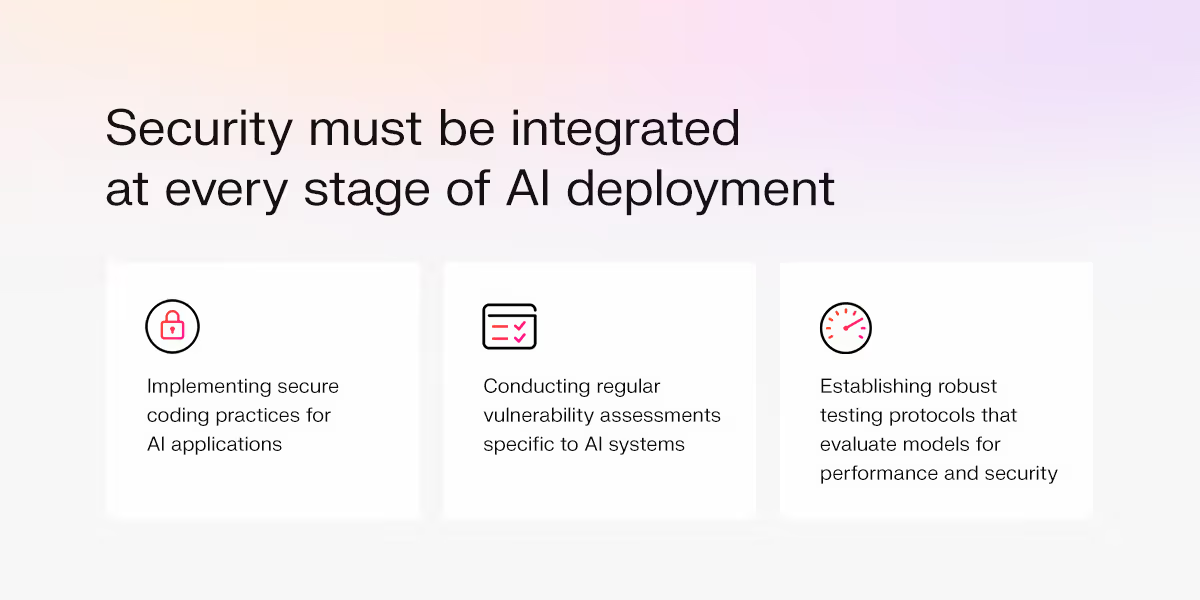
Security must be integrated at every stage of AI deployment, including:
- Implementing secure coding practices for AI applications
- Conducting regular vulnerability assessments specific to AI systems
- Establishing robust testing protocols that evaluate models for performance and security
Organizations should implement protection mechanisms against model tampering, including integrity checks and secure model storage.
Safeguard data flowing to and from AI systems
Robust data protection policies must govern all information processed by AI systems. Organizations must establish clear protocols that define authorized uses of AI tools, implement data classification systems to prevent sensitive information from reaching inappropriate models, and deploy anonymization techniques that protect privacy while maintaining the utility of the models. An example of AI TRiSM in action would be an organization implementing automated data loss prevention tools that scan and block attempts to upload confidential documents to public AI services.
Monitor continuously
Effective AI TRiSM requires constant vigilance through comprehensive monitoring systems. Organizations need visibility into all AI-related network traffic to identify unauthorized tool usage or data exfiltration attempts. Real-time anomaly detection systems can identify unusual AI model behavior that might indicate compromise or degradation. These monitoring capabilities must extend across cloud, on-premises, and hybrid environments where AI workloads operate.
Learn more about the intersections of AI and security with Darktrace
AI TRiSM is the essential framework organizations need to transform AI from a potential liability into a strategic advantage. Organizations that establish robust AI TRiSM frameworks today will be better positioned to capitalize on AI innovations tomorrow.
The convergence of AI and cybersecurity creates both unprecedented opportunities and complex challenges for organizations. Darktrace explores these dynamics through comprehensive resources that help security teams navigate the landscape. For ongoing insights into AI security trends and best practices, explore our blog or white papers to discover how behavioral AI enhances security for your entire organization.