API Security
What is API security?
Application Programming Interface (API) security encompasses the technical controls, governance frameworks, and operational practices required to protect application programming interfaces from exploitation, data exfiltration, and service disruption. For enterprise security teams managing hundreds of API endpoints across hybrid cloud environments, the challenge goes beyond authentication and encryption.
Modern API security demands comprehensive visibility into API behavior patterns, automated threat detection capabilities, and dynamic response mechanisms that adapt to evolving attack methods. As adversaries increasingly target APIs as primary attack vectors, organizations must implement defense strategies that address both the technical vulnerabilities in API architectures and the business logic flaws that threat actors exploit to bypass conventional security controls.
Why is API security critical in today’s threat landscape?
The transformation of enterprise architectures toward microservices, containerization, and serverless computing has increased API surface areas. Security teams now contend with API sprawl across multiple cloud providers, legacy on-premises systems, and edge computing environments. This distributed landscape creates numerous entry points for adversaries who recognize APIs as high-value targets offering direct access to sensitive data and critical business functions.
Recent 2024 breaches demonstrate the sophistication of modern API attacks:
- Microsoft: In January 2024, Microsoft experienced the Midnight Blizzard attack, in which Russian state-sponsored actors exploited OAuth applications to access corporate email accounts.
- Trello: An attack in January 2024 exposed 15 million user records through an unsecured API endpoint that allowed unauthenticated data scraping at scale.
- Dell: In May 2024, Dell suffered a breach that affected 49 million customers when threat actors exploited partner portal APIs lacking proper access controls.
- Authy: Authy exposed 33 million phone numbers via an unauthenticated API endpoint used to verify numbers in July 2024.
These incidents revealed common attack patterns targeting API-specific vulnerabilities. Adversaries exploit broken object-level authorization (BOLA) to access resources beyond their privileges, abuse excessive data exposure in API resources, and execute administrative functions. The programmatic nature of API interactions enables adversaries to automate attacks at scale, rapidly identifying and exploiting vulnerabilities across thousands of endpoints.
API security requirements are addressed in regulatory frameworks, including the General Data Protection Regulation (GDPR) and the California Consumer Privacy Act (CCPA), and industry-specific standards like the Payment Card Industry Data Security Standard (PCI DSS). Organizations face significant penalties for API-related data breaches, with GDPR fines reaching up to 4% of global annual revenue.
Beyond regulatory compliance issues, API breaches damage brand reputation, erode customer trust, and can result in competitive disadvantage when proprietary data or intellectual property is exposed.
What are the challenges with API security?
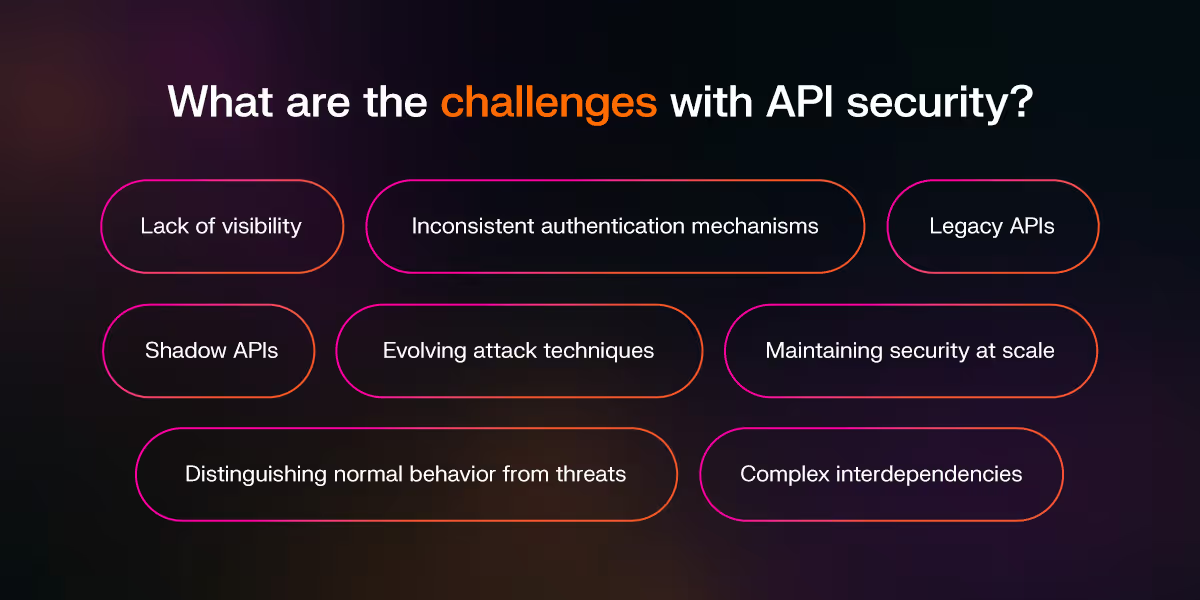
Enterprise API environments present unique security challenges that traditional application security approaches fail to address adequately, including:
- Lack of visibility: Security teams struggle to maintain comprehensive inventories of all API endpoints, including internal microservices communications, GraphQL schemas, and webhook URLs that automated discovery tools frequently miss. Without complete visibility, organizations cannot assess their true attack surface or identify which APIs process sensitive data.
- Inconsistent authentication mechanisms: Different API versions and implementations often use varying authentication methods ranging from basic API keys to OAuth 2.0, creating security gaps where weaker authentication on legacy endpoints undermines stronger controls elsewhere. This inconsistency complicates policy enforcement and increases the risk of authentication bypass attacks.
- Legacy APIs: Older APIs built on modern security frameworks continue to support critical business functions, but they cannot be updated without breaking critical integrations. These endpoints often lack encryption, use outdated authentication methods, and contain unpatched vulnerabilities that adversaries exploit.
- Shadow APIs: Development teams deploying through Continuous Integration and Continuous Delivery (CI/CD) pipelines create undocumented APIs that bypass security review processes, operating without proper authentication, rate limiting, or monitoring controls. These unknown endpoints are critical visibility gaps that adversaries discover through reconnaissance while remaining invisible to security teams.
- Evolving attack techniques: Adversaries develop new methods to exploit business logic flaws, chain multiple API calls to bypass controls, and abuse legitimate functionality for malicious purposes. Traditional signature-based defenses fail to detect these novel attack patterns that target organization-specific implementations.
- Maintaining security at scale: Each new endpoint increases the attack surface, while the rapid pace of API development through DevOps practices outpaces security teams' ability to assess and protect new implementations. Organizations deploying dozens of API updates daily struggle to maintain consistent security controls across their entire API portfolio.
- Distinguishing normal behavior from threats: The legitimate use of automated API consumers, including mobile applications, partner integrations, and service-to-service communications, generates high-volume traffic patterns that make it difficult to identify malicious activity.
- Complex interdependencies: APIs rarely operate in isolation, creating cascading security implications where vulnerabilities in one endpoint can compromise entire service chains. These interconnected relationships between internal APIs, third-party services, and partner integrations mean that security teams must consider systematic vulnerabilities across the entire API ecosystem.
API security best practices
Implementing comprehensive API security requires a layered defense that addresses vulnerabilities across the entire API life cycle. The following API security checklist can help you protect against known attack patterns and emerging threats:
1. Know your APIs
Deploy automated discovery tools that continuously scan network traffic, container registries, and service meshes to identify all API endpoints, including shadow and zombie APIs. Security teams should integrate discovery platforms with Configuration Management Databases (CMDBs) to track ownership, data classifications, and dependencies, ensuring no endpoint operates without proper security controls and monitoring.
2. Implement consistent authentication and least-privilege access
Enforce mutual Transport Layer Security (TLS) for service-to-service communication while deploying OAuth 2.0 with Proof Key for Code Exchange (PKCE) for external consumers. Every API request requires verification regardless of origin, with role-based and attribute-based access controls limiting permissions to the minimum necessary privileges. Token expiration and rotation policies prevent credential abuse while maintaining seamless legitimate access.
3. Deploy comprehensive input validation and output filtering
Validate all incoming data against strict schemas at the gateway level, rejecting malformed requests before backend processing. Implement parameterized queries to prevent injection attacks while encoding output data for consumption contexts. Response filtering should exclude sensitive fields based on caller privileges, preventing inadvertent data exposure through API responses.
4. Enforce adaptive rate limiting and abuse prevention
Configure distributed rate limiting using token bucket algorithms that adjust thresholds based on authentication status, historical patterns, and current system load. GraphQL endpoints require query complexity analysis to prevent resource exhaustion through nested queries. Geographic restrictions and behavioral analysis identify automated attacks while maintaining availability for legitimate high-volume consumers.
5. Centralize security through gateway enforcement
API gateways provide consistent policy application across all endpoints, enabling protocol translation, traffic shaping, and threat detection at the edge. Deploy web application firewall rules tuned for API traffic patterns, blocking malicious requests before they reach backend services while maintaining detailed audit logs for forensic analysis.
6. Encrypt data with field-level protection
Beyond TLS 1.3 enforcement, implement field-level encryption for sensitive data within payloads, maintaining confidentiality even if transport encryption is compromised. Hardware security modules manage encryption keys following API security best practices for rotation and access control, ensuring cryptographic integrity across the API ecosystem.
7. Enable behavioral monitoring and anomaly detection
Machine learning models baseline normal API usage patterns, identifying deviations that indicate potential attacks or compromised credentials. Correlation engines link activities across multiple endpoints to detect attack chains, providing security teams with prioritized alerts and automated investigation capabilities through advanced analytics platforms.
8. Conduct continuous security validation
Integrate API security testing into CI/CD pipelines using Dynamic Application Security Testing (DAST) tools that validate authentication, authorization, and business logic controls. Following a comprehensive API security checklist ensures consistent evaluation across all endpoints, while regular penetration testing identifies vulnerabilities that automated scanning might miss.
Learn more with Darktrace
API security requires continuous adaptation to address emerging threats and evolving architectures. Security teams must implement solutions that provide comprehensive visibility, automated threat detection, and dynamic response capabilities across complex API ecosystems.
Darktrace is a leader in cybersecurity, delivering a proactive, AI-powered approach to cyber resilience and providing preemptive visibility into security posture, real-time detection, and autonomous response to both known and unknown threats. For comprehensive insights into how AI transforms cybersecurity and broader defensive strategies, explore our State of AI Cybersecurity report.