Cloud-Native Security
What is cloud-native security
Cloud-native security builds security into the fabric of a cloud-native application's life cycle. It's not a single tool, but a strategic shift from traditional, perimeter-based security to a model designed for dynamic, distributed systems. This strategic shift is fundamentally aligned with zero trust architecture, which assumes no implicit trust and requires continuous verification for all users, devices, and applications, regardless of their location. Taking this comprehensive approach helps integrate security throughout the development life cycle, protecting technologies such as microservices, containers, and serverless architectures.
Key pillars of cloud-native security
Cloud-native security is a comprehensive approach to securing infrastructure and applications. It encompasses several distinct layers:
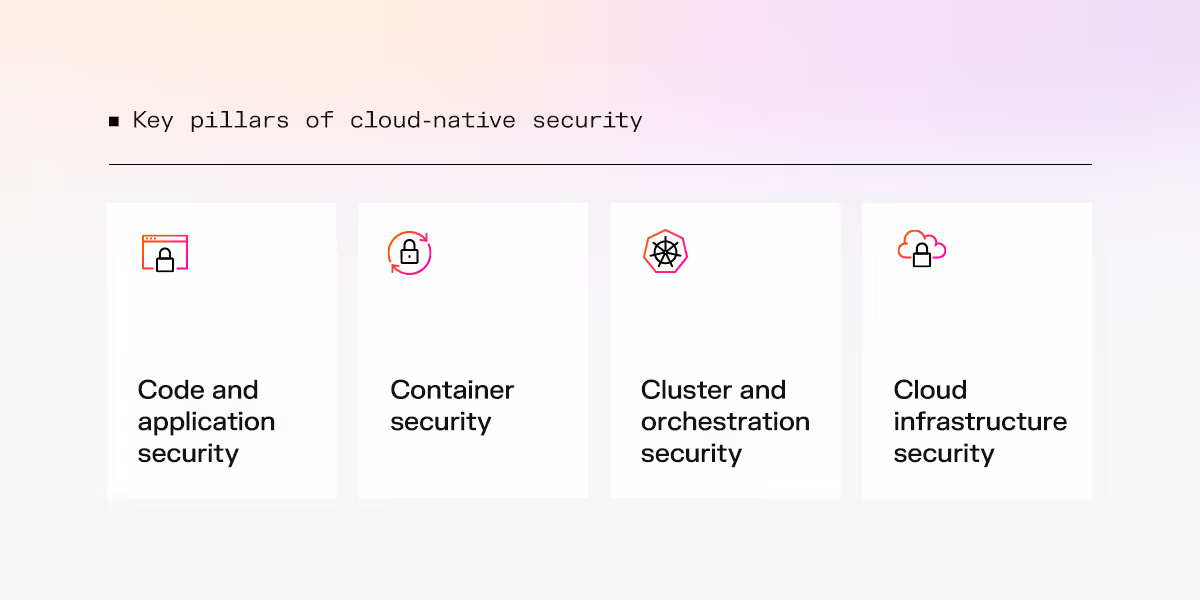
Code and application security
Cloud-native application security safeguards the entire software supply chain, from development to deployment. It involves rigorously scanning application code for vulnerabilities such as SQL injection or cross-site scripting, which prevents proprietary code from becoming a weak point.
Managing third-party dependencies is vital. Open-source libraries and components require thorough vetting and regular updates to minimize significant security risks. A robust application security strategy should implement the following actions to prevent malicious code or known vulnerabilities from reaching production:
- Secure coding practices
- Regularly updated inventory of all software components
- Regular security testing, such as Static Application Security Testing (SAST) and Dynamic Application Security Testing (DAST)
Container security
Container security addresses the unique challenges of protecting containerized applications throughout their life cycle. This proactive approach focuses on scanning container images for known vulnerabilities before they are deployed to production environments. Doing so helps identify and remediate issues in base images and application layers early, preventing minor complications from becoming serious security breaches.
Beyond image scanning, it's vital to secure the container runtime environment. The following container security strategies help prevent exploits that could compromise the host or other containers:
- Implement strong isolation between containers
- Enforce least privilege principles
- Monitor container activity for suspicious behavior
- Harden container hosts
- Ensure images are built from trusted sources
Cluster and orchestration security
Cluster and orchestration security focuses on securing the container orchestration platform's control plane and worker nodes. Kubernetes is a prime example. Proper configuration of the Kubernetes API server, etcd, and worker nodes is crucial for preventing unauthorized access and privilege escalation. The following elements protect container orchestration platforms such as Kubernetes:
- Network segmentation policies: These policies isolate workloads and restrict communication paths between different applications or namespaces, which limits the blast radius of a potential breach.
- Robust role-based access control (RBAC): Implementing a robust RBAC helps ensure users and service accounts have only the minimum necessary permissions to perform their tasks.
- Regular audits and security best practices: Adhering to security best practices and performing regular audits of cluster configurations helps maintain the integrity and availability of orchestrated environments.
Cloud infrastructure security
Cloud infrastructure security protects foundational cloud services, such as Infrastructure as a Service (IaaS) and Platform as a Service (PaaS), on which cloud-native applications run. It involves securing virtual machines, networks, storage, and identity and access management (IAM) within a chosen cloud provider.
The primary aspect of cloud infrastructure security is identifying and remediating misconfigurations, which are a leading cause of data breaches in cloud environments. Cloud security posture management (CSPM) tools continuously scan cloud resources for compliance with security policies and best practices, such as open S3 buckets or overly permissive security groups. Shared responsibility model considerations are paramount. The cloud provider secures the cloud while the user manages security within the cloud, necessitating careful attention to all configurations and access policies.
Where traditional security models fall short
Legacy tools alone are inadequate for dynamic and ephemeral cloud environments for the following reasons:
- The vanishing perimeter: Legacy tools rely on a clear network boundary, but distributed cloud applications lack a single traffic “chokepoint.” This reality renders perimeter-based monitoring mostly ineffective, making it impossible for traditional systems to establish a clear defensive line.
- Ephemeral workloads: Traditional scanning tools are designed for long-lived assets and cannot keep up with cloud workloads. This leaves these short-lived instances invisible and vulnerable. Security requires more than slow, scheduled scans that often miss rapidly changing components.
- The DevOps pace: Rapid, continuous changes introduced by CI/CD pipelines occur too frequently for manual security reviews or slow, traditional vulnerability assessments to keep pace. This faster pace creates a constant security gap as new code deploys before the system can thoroughly inspect it.
- Unmanageable complexity: The volume of assets, security alerts, and configurations a cloud environment generates rapidly overwhelms human-scale analysis. This overload makes it impossible for legacy tools to provide meaningful insights or effective threat detection. Enterprises tend to drown in data when they lack the automation to make sense of it.
Why cloud-native security is a business essential
Cloud-native security is more than a technical requirement — it's a fundamental business essential that delivers significant strategic value. By integrating security into every stage of the cloud-native development life cycle, organizations can enable secure innovation and accelerate time-to-market. Doing so transforms security from a perceived roadblock into a powerful business enabler.

A robust cloud-native security strategy allows businesses to manage an increasingly distributed and ever-changing attack surface, which minimizes risk and maximizes agility. The proactive approach facilitates continuous resilience and hardening. It shifts away from a reactive, incident-response-centric posture toward one that anticipates and prevents threats from the ground up. Cloud-native security helps businesses protect brand reputation, customer trust, and financial stability while leveraging rapidly advancing technology with higher confidence.
The rise of the cloud-native security platform (CNSP)
The evolving landscape of cloud-native environments has necessitated the rise of the cloud-native security platform (CNSP), which is also known as a cloud-native application protection platform. A CNSP represents a unified, code-to-code solution. It consolidates traditionally disparate security capabilities, such as CSPM and cloud workload protection platforms, into a single, integrated offering.
CNSP is a comprehensive approach that contrasts the traditional, fragmented model involving disconnected point solutions. With CNSP, security teams can overcome challenges such as critical visibility gaps, operational inefficiencies, and high-volume security alerts.
Artificial intelligence powers modern CNSPs, enhancing the ability to handle a cloud-native infrastructure's unprecedented speed, scale, and inherent complexity. An AI-powered platform continuously learns and establishes an environment's regular patterns to do the following:
- Identify anomalies that indicate potential attacks
- Detect novel threats within the environment
- Equip security teams with high-fidelity, actionable insights
- Enable autonomous response
- Enhance resilience
- Reduce human intervention
Explore cloud-native security with Darktrace
Cloud-native security is an indispensable strategy for modern enterprises, protecting dynamic and ephemeral cloud environments across code, containers, clusters, and infrastructure. A CNSP provides a unified solution that addresses the inherent complexity and speed of cloud operations. AI-powered CNSPs understand an environment's unique patterns, prioritize critical risks, and enable autonomous responses.
Darktrace's multi-layered AI learns your unique business to provide a CNSP that identifies and stops novel threats in real time. Darktrace / CLOUD offers unified cloud detection and response that significantly reduces security complexity. Download the solution brief to learn more about cloud-native security, or explore the blog for additional information.