
Blog
/
Proactive Security
/
March 31, 2026

AI-powered security for a rapidly growing grocery enterprise

By combining AI-driven detection and autonomous response, this leading grocery holding group has built a security model that delivers continuous protection, accelerates growth, and empowers a small, highly efficient team to safeguard a complex retail ecosystem.
Inside the SOC
Darktrace cyber analysts are world-class experts in threat intelligence, threat hunting and incident response, and provide 24/7 SOC support to thousands of Darktrace customers around the globe. Inside the SOC is exclusively authored by these experts, providing analysis of cyber incidents and threat trends, based on real-world experience in the field.
Written by
The Darktrace Community
Default blog imageDefault blog imageDefault blog imageDefault blog imageDefault blog imageDefault blog image
31
Mar 2026

Protecting a complex, fast-growing retail organization

For this multi-banner grocery holding organization, cybersecurity is considered an essential business enabler, protecting operations, growth, and customer trust. The organization’s lean IT team manages a highly distributed environment spanning corporate offices, 100+ stores, distribution centers and  thousands of endpoints, users, and third-party connections.

Mergers and acquisitions fueled rapid growth, but they also introduced escalating complexity that constrained visibility into users, endpoints, and security risks inherited across acquired environments.

Closing critical visibility gaps with limited resources

Enterprise-wide visibility is a top priority for the organization, says the  Vice President of Information Technology. “We needed insights beyond the perimeter into how users and devices were behaving across the organization.”

A security breach that occurred before the current IT leadership joined the company reinforced the urgency and elevated cybersecurity to an executive-level priority with a focus on protecting customer trust. The goal was to build a multi-layered security model that could deliver autonomous, enterprise-wide protection without adding headcount.

Managing cyber risk in M&A

Mergers and acquisitions are central to the grocery holding company’s growth strategy. But each transaction introduces new cyber risk, including inherited network architectures, inconsistent tooling, excessive privileges, and remnants of prior security incidents that were never fully remediated.

“Our M&A targets range from small chains with a single IT person and limited cyber tools to large chains with more developed IT teams, toolsets and instrumentation,” explains the VP of IT. “We needed a fast, repeatable, and reliable way to assess cyber risk before transactions closed.”

AI-driven security built for scale, speed, and resilience

Rather than layering additional point tools onto an already complex environment, the retailer adopted the Darktrace ActiveAI Security Platform™ in 2020 as part of a broader modernization effort to improve resilience, close visibility gaps, and establish a security foundation that could scale with growth.

“Darktrace’s AI-driven approach provided the ideal solution to these challenges,” shares the VP of IT. “It has empowered our organization to maintain a robust security strategy, ensuring the protection of our network and the smooth operation of our business.”

Enterprise-wide visibility into traffic  

By monitoring both north-south and east-west traffic and applying Self-Learning AI, Darktrace develops a dynamic understanding of how users and devices normally behave across locations, roles, and systems.

“Modeling normal behavior across the environment enables us to quickly spot behavior that doesn’t fit. Even subtle changes that could signal a threat but appear legitimate at first glance,” explains the VP of IT.

Real-time threat containment, 24/7

Adopting autonomous response has created operational breathing room for the security team, says the company’s Cybersecurity  Engineer.

“Early on, we enabled full Darktrace autonomous mode and we continue to do so today,” shares the IT Security Architect. “Allowing the technology to act first gives us the time we need to investigate incidents during business hours without putting the business at risk.”

Unified, actionable view of security ecosystem

The grocery retailer integrated Darktrace with its existing security ecosystem of firewalls, vulnerability management tools, and endpoint detection and response, and the VP of IT described the adoption process as “exceptionally smooth.”

The team can correlate enterprise-wide security data for a unified and actionable picture of all activity and risk. Using this “single pane of glass” approach, the retailer trains Level 1 and Level 2 operations staff to assist with investigations and user follow-ups, effectively extending the reach of the security function without expanding headcount.

From reactive defense to security at scale

With Darktrace delivering continuous visibility, autonomous containment, and integrated security workflows, the organization has strengthened its cybersecurity posture while improving operational efficiency. The result is a security model that not only reduces risk, but also supports growth, resilience, and informed decision-making at the business level.

Faster detection, faster resolution

With autonomous detection and response, the retailer can immediately contain risk while analysts investigate and validate activity. With this approach, the company can maintain continuous protection even outside business hours and reduce the chance of lateral spread across systems or locations.

Enterprise-grade protection with a lean team

From cloud environments to clients to SaaS collaboration tools, Darktrace provides holistic autonomous AI defense, processing petabytes of the organization’s network traffic and investigating millions of individual events that could be indicative of a wider incident.

Today, Darktrace autonomously conducts the majority of all investigations on behalf of the IT team, escalating only a tiny fraction for analyst review. The impact has been profound, freeing analysts from endless alerts and hours of triage so they can focus on more valuable, proactive, and gratifying work.

“From an operational perspective, Darktrace gives us time back,” says the Cybersecurity Engineer. More importantly, says the VP of IT, “it gives us peace of mind that we’re protected even if we’re not actively monitoring every alert.”

A strategic input for M&A decision-making

One of the most strategic outcomes has been the role of cybersecurity on M&A. 90 days prior to closing a transaction, the security team uses Darktrace alongside other tools to perform a cyber risk assessment of the potential acquisition. “Our approach with Darktrace has consistently identified gaps and exposed risks,” says the VP of IT, including:

  • Remnants of previous incidents that were never fully remediated
  • Network configurations with direct internet exposure
  • Excessive administrative privileges in Active Directory or on critical hosts

While security findings may not alter deal timelines, the VP of IT says they can have enormous business implications. “With early visibility into these risks, we can reduce exposure to inherited cyber threats, strengthen our position during negotiations, and establish clear remediation requirements.”

A security strategy built to evolve with the business

As the holding group expands its cloud footprint, it will extend Darktrace protections into Azure, applying the same AI-driven visibility and autonomous response to cloud workloads. The VP of IT says Darktrace's evolving capabilities will be instrumental in addressing the organization’s future cybersecurity needs and ability to adapt to the dynamic nature of cloud security.

“With Darktrace’s AI-driven approach, we have moved beyond reactive defense, establishing a resilient security foundation for confident expansion and modernization.”

Inside the SOC
Darktrace cyber analysts are world-class experts in threat intelligence, threat hunting and incident response, and provide 24/7 SOC support to thousands of Darktrace customers around the globe. Inside the SOC is exclusively authored by these experts, providing analysis of cyber incidents and threat trends, based on real-world experience in the field.
Written by
The Darktrace Community

More in this series

No items found.

Blog

/

/

May 11, 2026

The Next Step After Mythos: Defending in a World Where Compromise is Expected

mythos cybersecurityDefault blog imageDefault blog image

Is Anthropic’s Mythos a turning point for cybersecurity?

Anthropic’s recent announcements around their Mythos model, alongside the launch of Project Glasswing, have generated significant interest across the cybersecurity industry.

The closed-source nature of the Mythos model has understandably attracted a degree of skepticism around some of the claims being made. Additionally, Project Glasswing was initially positioned as a way for software vendors to accelerate the proactive discovery of vulnerabilities in their own code; however, much of the attention has focused on the potential for AI to identify exploitable vulnerabilities for those with malicious intent.

Putting questions around the veracity of those claims to one side – which, for what it’s worth, do appear to be at least partially endorsed by independent bodies such as the UK’s AI Security Institute – this should not be viewed as a critical turning point for the industry. Rather, it reflects the natural direction of travel.

How Mythos affects cybersecurity teams  

At Darktrace, extolling the virtues of AI within cybersecurity is understandably close to our hearts. However, taking a step back from the hype, we’d like to consider what developments like this mean for security teams.

Whether it’s Mythos or another model yet to be released, it’s worth remembering that there is no fundamental difference between an AI discovered vulnerability and one discovered by a human. The change is in the pace of discovery and, some may argue, the lower the barrier to entry.

In the hands of a software developer, this is unquestionably positive. Faster discovery enables earlier remediation and more proactive security. But in the hands of an attacker, the same capability will likely lead to a greater number of exploitable vulnerabilities being used in the wild and, critically, vulnerabilities that are not yet known to either the vendor or the end user.

That said, attackers have always been able to find exploitable vulnerabilities and use them undetected for extended periods of time. The use of AI does not fundamentally change this reality, but it does make the process faster and, unfortunately, more likely to occur at scale.

While tools such as Darktrace / Attack Surface Management and / Proactive Exposure Management  can help security teams prioritize where to patch, the emergence of AI-driven vulnerability discovery reinforces an important point: patching alone is not a sufficient control against modern cyber-attacks.

Rethinking defense for a world where compromise is expected

Rather than assuming vulnerabilities can simply be patched away, defenders are better served by working from the assumption that their software is already vulnerable - and always will be -and build their security strategy accordingly.

Under that assumption, defenders should expect initial access, particularly across internet exposed assets, to become easier for attackers. What matters then is how quickly that foothold is detected, contained, and prevented from expanding.

For defenders, this places renewed emphasis on a few core capabilities:

  • Secure-by-design architectures and blast radius reduction, particularly around identity, MFA, segmentation, and Zero Trust principles
  • Early, scalable detection and containment, favoring behavioral and context-driven signals over signatures alone
  • Operational resilience, with the expectation of more frequent early-stage incidents that must be managed without burning out teams

How Darktrace helps organizations proactively defend against cyber threats

At Darktrace, we support security teams across all three of these critical capabilities through a multi-layered AI approach. Our Self-Learning AI learns what’s normal for your organization, enabling real-time threat detection, behavioral prediction, incident investigation and autonomous response. - all while empowering your security team with visibility and control.

To learn more about Darktrace’s application of AI to cybersecurity download our White Paper here.  

Reducing blast radius through visibility and control

Secure-by-design principles depend on understanding how users, devices, and systems behave. By learning the normal patterns of identity and network activity, Darktrace helps teams identify when access is being misused or when activity begins to move beyond expected boundaries. This makes it possible to detect and contain lateral movement early, limiting how far an attacker can progress even after initial access.

Detecting and containing threats at the earliest stage  

As AI accelerates vulnerability discovery, defenders need to identify exploitation before it is formally recognized. Darktrace’s behavioral understanding approach enables detection of subtle deviations from normal activity, including those linked to previously unknown vulnerabilities.

A key example of this is our research on identifying cyber threats before public CVE disclosures, demonstrating that assessing activity against what is normal for a specific environment, rather than relying on predefined indicators of compromise, enables detection of intrusions exploiting previously unknown vulnerabilities days or even weeks before details become publicly available.

Additionally, our Autonomous Response capability provides fast, targeted containment focused on the most concerning events, while allowing normal business operations to continue. This has consistently shown that even when attackers use techniques never seen before, Darktrace’s Autonomous Response can contain threats before they have a chance to escalate.

Scaling response without increasing operational burden

As early-stage incidents become more frequent, the ability to investigate and respond efficiently becomes critical. Darktrace’s Cyber AI Analyst’s AI-driven investigation capabilities automatically correlate activity across the environment, prioritizing the most significant threats and reducing the need for manual triage. This allows security teams to respond faster and more consistently, without increasing workload or burnout.

What effective defense looks like in an AI-accelerated landscape

Developments like Mythos highlight a reality that has been building for some time: the window between exposure and exploitation is shrinking, and in many cases, it may disappear entirely. In that environment, relying on patching alone becomes increasingly reactive, leaving little room to respond once access has been established.

The more durable approach is to assume that compromise will occur and focus on controlling what happens next. That means identifying early signs of misuse, containing threats before they spread, and maintaining visibility across the environment so that isolated signals can be understood in context.

AI plays a role on both sides of this equation. While it enables attackers to move faster, it also gives defenders the ability to detect subtle changes in behavior, prioritize what matters, and respond in real time. The advantage will not come from adopting AI in isolation, but from applying it in a way that reduces the gap between detection and action.

AI may be accelerating parts of the attack lifecycle, but the fundamentals of defense, detection, and containment still apply. If anything, they matter more than ever – and AI is just as powerful a tool for defenders as it is for attackers.

To learn more about Darktrace and Mythos read more on our blog: Mythos vs Ethos: Defending in an Era of AI‑Accelerated Vulnerability Discovery

[related-resource]

Continue reading
About the author
Toby Lewis
Head of Threat Analysis

Blog

/

Network

/

May 6, 2026

When Trust Becomes the Attack Surface: Supply-Chain Attacks in an Era of Automation and Implicit Trust

Software supply chain attacksDefault blog imageDefault blog image

Software supply-chain attacks in 2026

Software supply-chain attacks now represent the primary threat shaping the 2026 security landscape. Rather than relying on exploits at the perimeter, attackers are targeting the connective tissue of modern engineering environments: package managers, CI/CD automation, developer systems, and even the security tools organizations inherently trust.

These incidents are not isolated cases of poisoned code. They reflect a structural shift toward abusing trusted automation and identity at ecosystem scale, where compromise propagates through systems designed for speed, not scrutiny. Ephemeral build runners, regardless of provider, represent high‑trust, low‑visibility execution zones.

The Axios compromise and the cascading Trivy campaign illustrate how quickly this abuse can move once attacker activity enters build and delivery workflows. This blog provides an overview of the latest supply chain and security tool incidents with Darktrace telemetry and defensive actions to improve organizations defensive cyber posture.

1. Why the Axios Compromise Scaled

On 31 March 2026, attackers hijacked the npm account of Axios’s lead maintainer, publishing malicious versions 1.14.1 and 0.30.4 that silently pulled in a malicious dependency, plain‑crypto‑[email protected]. Axios is a popular HTTP client for node.js and  processes 100 million weekly downloads and appears in around 80% of cloud and application environments, making this a high‑leverage breach [1].

The attack chain was simple yet effective:

  • A compromised maintainer account enabled legitimate‑looking malicious releases.
  • The poisoned dependency executed Remote Access Trojans (RATs) across Linux, macOS and Windows systems.
  • The malware beaconed to a remote command-and-control (C2) server every 60 seconds in a loop, awaiting further instructions.
  • The installer self‑cleaned by deleting malicious artifacts.

All of this matters because a single maintainer compromise was enough to project attacker access into thousands of trusted production environments without exploiting a single vulnerability.

A view from Darktrace

Multiple cases linked with the Axios compromise were identified across Darktrace’s customer base in March 2026, across both Darktrace / NETWORK and Darktrace / CLOUD deployments.

In one Darktrace / CLOUD deployment, an Azure Cloud Asset was observed establishing new external HTTP connectivity to the IP 142.11.206[.]73 on port 8000. Darktrace deemed this activity as highly anomalous for the device based on several factors, including the rarity of the endpoint across the network and the unusual combination of protocol and port for this asset. As a result, the triggering the "Anomalous Connection / Application Protocol on Uncommon Port" model was triggered in Darktrace / CLOUD. Detection was driven by environmental context rather than a known indicator at the time. Subsequent reporting later classified the destination as malicious in relation to the Axios supply‑chain compromise, reinforcing the gap that often exists between initial attacker activity and the availability of actionable intelligence. [5]

Additionally, shortly before this C2 connection, the device was observed communicating with various endpoints associated with the NPM package manager, further reinforcing the association with this attack.

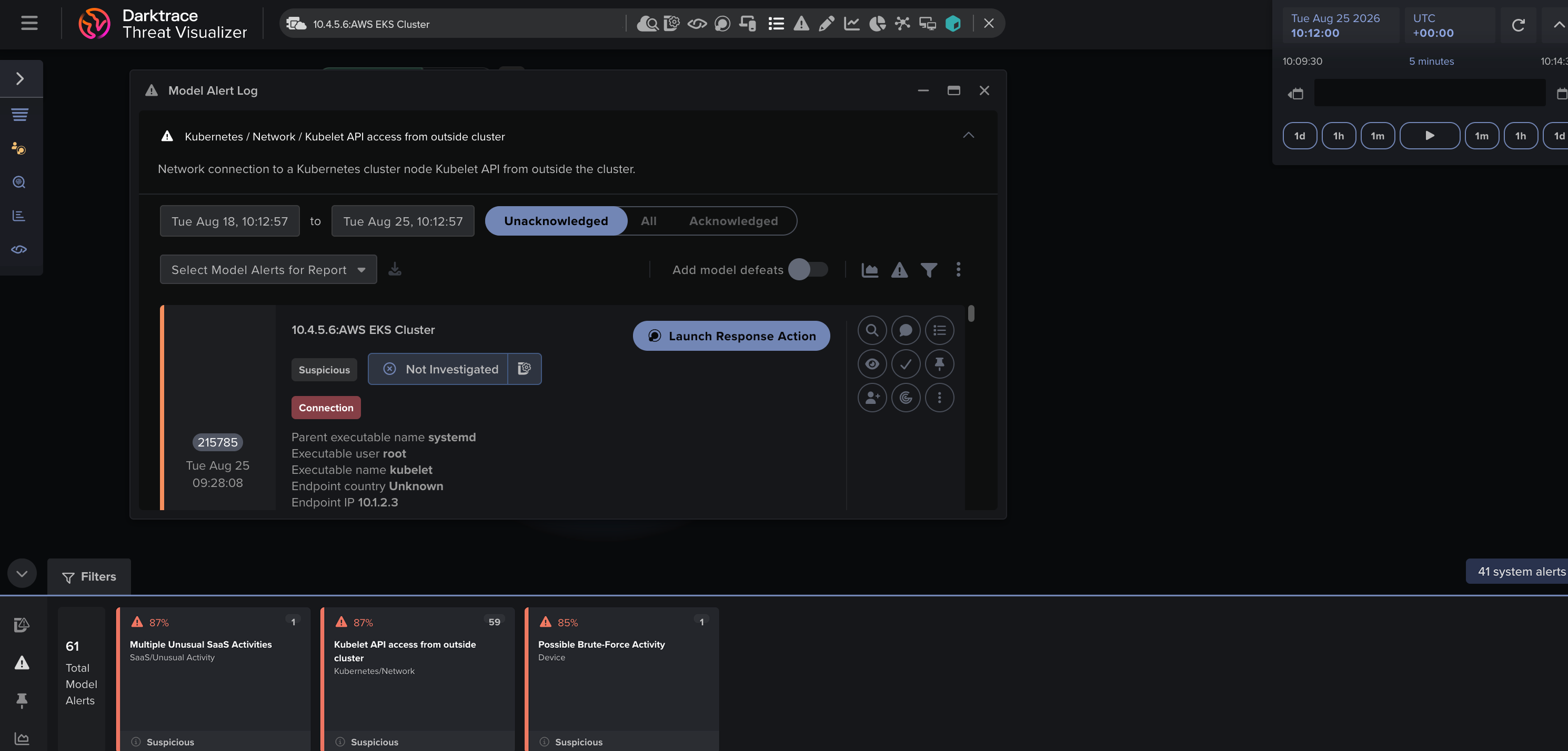
Darktrace’s detection of the unusual external connection to 142.11[.]206[.]73 via port 8000.  
Figure 1: Darktrace’s detection of the unusual external connection to 142.11[.]206[.]73 via port 8000.  

Within Axios cases observed within Darktrace / NETWORK customer environments, activity generally focused on the use of newly observed cURL user agents in outbound connections to the C2 URL sfrclak[.]com/6202033, alongside the download of malicious files.

In other cases, Darktrace / NETWORK customers with Microsoft Defender for Endpoint integration received alerts flagging newly observed system executables and process launches associated with C2 communication.

A Security Integration Alert from Microsoft Defender for Endpoint associated with the Axios supply chain attack.
Figure 2: A Security Integration Alert from Microsoft Defender for Endpoint associated with the Axios supply chain attack.

2. Why Trivy bypassed security tooling trust

Between late February and March 22, 2026, the threat group TeamPCP leveraged credentials from a previous incident to insert malicious artifacts across Trivy’s distribution ecosystem, including its CI automation, release binaries, Visual Studio Code extensions, and Docker container images [2].

While public reporting has emphasized GitHub Actions, Darktrace telemetry highlights attacker execution within CI/CD runner environments, including ephemeral build runners. These execution contexts are typically granted broad trust and limited visibility, allowing malicious activity within build automation to blend into expected operational workflows, regardless of provider.

This was a coordinated multi‑phase attack:

  • 75 of 76  of trivy-action tags and all setup‑trivy tags were force‑pushed to deliver a malicious payload.
  • A malicious binary (v0.69.4) was distributed across all major distribution channels.
  • Developer machines were compromised, receiving a persistent backdoor and a self-propagating worm.
  • Secrets were exfiltrated at scale, including SSH keys, Kuberenetes tokens, database passwords, and cloud credentials across Amazon Web Service (AWS), Azure, and Google Cloud Platform (GCP).

Within Darktrace’s customer base, an AWS EC2 instance monitored by Darktrace / CLOUD  appeared to have been impacted by the Trivy attack. On March 19, the device was seen connecting to the attacker-controlled C2 server scan[.]aquasecurtiy[.]org (45.148.10[.]212), triggering the model 'Anomalous Server Activity / Outgoing from Server’ in Darktrace / CLOUD.

Despite this limited historical context, Darktrace assessed this activity as suspicious due to the rarity of the destination endpoint across the wider deployment. This resulted in the triggering of a model alert and the generation of a Cyber AI Analyst incident to further analyze and correlate the attack activity.

TeamPCP’s continued abused of GitHub Actions against security and IT tooling has also been observed more recently in Darktrace’s customer base. On April 22, an AWS asset was seen connecting to the C2 endpoint audit.checkmarx[.]cx (94.154.172[.]43). The timing of this activity suggests a potential link to a malicious Bitwarden package distributed by the threat actor, which was only available for a short timeframe on April 22. [4][3]

Figure 3: A model alert flagging unusual external connectivity from the AWS asset, as seen in Darktrace / CLOUD .

While the Trivy activity originated within build automation, the underlying failure mode mirrors later intrusions observed via management tooling. In both cases, attackers leveraged platforms designed for scale and trust to execute actions that blended into normal operational noise until downstream effects became visible.

Quest KACE: Legacy Risk, Real Impact

The Quest KACE System Management Appliance (SMA) incident reinforces that software risk is not confined to development pipelines alone. High‑trust infrastructure and management platforms are increasingly leveraged by adversaries when left unpatched or exposed to the internet.

Throughout March 2026, attackers exploited CVE 2025-32975 to authentication on outdated, internet-facing KACE appliances, gaining administrative control and pushing remote payloads into enterprise environments. Organizations still running pre-patch versions effectively handed adversaries a turnkey foothold, reaffirming a simple strategic truth: legacy management systems are now part of the supply-chain threat surface, and treating them as “low-risk utilities” is no longer defensible [3].

Within the Darktrace customer base, a potential case was identified in mid-March involving an internet-facing server that exhibited the use of a new user agent alongside unusual file downloads and unexpected external connectivity. Darktrace identified the device downloading file downloads from "216.126.225[.]156/x", "216.126.225[.]156/ct.py" and "216.126.225[.]156/n", using the user agents, "curl/8.5.0" & "Python-urllib/3.9".

The timeframe and IoCs observed point towards likely exploitation of CVE‑2025‑32975. As with earlier incidents, the activity became visible through deviations in expected system behavior rather than through advance knowledge of exploitation or attacker infrastructure. The delay between observed exploitation and its addition to the Known Exploited Vulnerabilities (KEV) catalogue underscores a recurring failure: retrospective validation cannot keep pace with adversaries operating at automation speed.

The strategic pattern: Ecosystem‑scale adversaries

The Axios and Trivy compromises are not anomalies; they are signals of a structural shift in the threat landscape. In this post-trust era, the compromise of a single maintainer, repository token, or CI/CD tag can produce large-scale blast radiuses with downstream victims numbering in the thousands. Attackers are no longer just exploiting vulnerabilities; they are exploiting infrastructure privileges, developer trust relationships, and automated build systems that the industry has generally under secured.

Supply‑chain compromise should now be treated as an assumed breach scenario, not a specialized threat class, particularly across build, integration, and management infrastructure. Organizations must operate under the assumption that compromise will occur within trusted software and automation layers, not solely at the network edge or user endpoint. Defenders should therefore expect compromise to emerge from trusted automation layers before it is labelled, validated, or widely understood.

The future of supply‑chain defense lies in continuous behavioral visibility, autonomous detection across developer and build environments, and real‑time anomaly identification.

As AI increasingly shapes software development and security operations, defenders must assume adversaries will also operate with AI in the loop. The defensive edge will come not from predicting specific compromises, but from continuously interrogating behavior across environments humans can no longer feasibly monitor at scale.

Credit to Nathaniel Jones (VP, Security & AI Strategy, FCISCO), Emma Foulger (Global Threat Research Operations Lead), Justin Torres (Senior Cyber Analyst), Tara Gould (Malware Research Lead)

Edited by Ryan Traill (Content Manager)

Appendices

References:

1)         https://www.infosecurity-magazine.com/news/hackers-hijack-axios-npm-package/

2)         https://thehackernews.com/2026/03/trivy-hack-spreads-infostealer-via.html

3)         https://thehackernews.com/2026/03/hackers-exploit-cve-2025-32975-cvss-100.html

4)         https://www.endorlabs.com/learn/shai-hulud-the-third-coming----inside-the-bitwarden-cli-2026-4-0-supply-chain-attack

5)         https://socket.dev/blog/axios-npm-package-compromised?trk=public_post_comment-text

IoCs

- 142.11.206[.]73 – IP Address – Axios supply chain C2

- sfrclak[.]com – Hostname – Axios supply chain C2

- hxxp://sfrclak[.]com:8000/6202033 - URI – Axios supply chain payload

- 45.148.10[.]212 – IP Address – Trivy supply chain C2

- scan.aquasecurtiy[.]org – Hostname - Trivy supply chain C2

- 94.154.172[.]43 – IP Address - Checkmarx/Bitwarden supply chain C2

- audit.checkmarx[.]cx – Hostname - Checkmarx/Bitwarder supply chain C2

- 216.126.225[.]156 – IP Address – Quest KACE exploitation C2

- 216.126.225[.]156/32 - URI – Possible Quest KACE exploitation payload

- 216.126.225[.]156/ct.py - URI - Possible Quest KACE exploitation payload

- 216.126.225[.]156/n - URI - Possible Quest KACE exploitation payload

- 216.126.225[.]156/x - URI - Possible Quest KACE exploitation payload

- e1ec76a0e1f48901566d53828c34b5dc – MD5 - Possible Quest KACE exploitation payload

- d3beab2e2252a13d5689e9911c2b2b2fc3a41086 – SHA1 - Possible Quest KACE exploitation payload

- ab6677fcbbb1ff4a22cc3e7355e1c36768ba30bbf5cce36f4ec7ae99f850e6c5 – SHA256 - Possible Quest KACE exploitation payload

- 83b7a106a5e810a1781e62b278909396 – MD5 - Possible Quest KACE exploitation payload

- deb4b5841eea43cb8c5777ee33ee09bf294a670d – SHA1 - Possible Quest KACE exploitation payload

- b1b2f1e36dcaa36bc587fda1ddc3cbb8e04c3df5f1e3f1341c9d2ec0b0b0ffaf – SHA256 - Possible Quest KACE exploitation payload

Darktrace Model Detections

Anomalous Connection / Application Protocol on Uncommon Port

Anomalous Server Activity / Outgoing from Server

Anomalous Connection / New User Agent to IP Without Hostname

Anomalous File / EXE from Rare External Location

Anomalous File / Script from Rare External Location

Anomalous Server Activity / New User Agent from Internet Facing System

Anomalous Server Activity / Rare External from Server

Antigena / Network / External Threat / Antigena Suspicious File Block

Antigena / Network / External Threat / Antigena Suspicious File Pattern of Life Block

Device / New User Agent

Device / Internet Facing Device with High Priority Alert

Anomalous File / New User Agent Followed By Numeric File Download

Continue reading
About the author
Nathaniel Jones
VP, Security & AI Strategy, Field CISO
Your data. Our AI.
Elevate your network security with Darktrace AI