
Blog
/
OT
/
September 30, 2025

Redefining OT security with dedicated OT workflows & NEXT-gen visibility for industrial teams

The latest release of Darktrace / OT brings powerful new innovations to security teams defending industrial infrastructure. With a dedicated OT dashboard, segmentation-aware risk modeling, and expanded visibility into edge assets and automation protocols, Darktrace / OT empowers engineers and defenders with the context and control they need to protect today’s converged environments, from IT to the industrial edge.
Inside the SOC
Darktrace cyber analysts are world-class experts in threat intelligence, threat hunting and incident response, and provide 24/7 SOC support to thousands of Darktrace customers around the globe. Inside the SOC is exclusively authored by these experts, providing analysis of cyber incidents and threat trends, based on real-world experience in the field.
Written by
Pallavi Singh
Product Marketing Manager, OT Security & Compliance
Default blog imageDefault blog imageDefault blog imageDefault blog imageDefault blog imageDefault blog image
30
Sep 2025

The challenge of convergence without clarity

Convergence is no longer a roadmap idea, it is the daily reality for industrial security teams. As Information Technology (IT) and Operational Technology (OT) environments merge, the line between a cyber incident and an operational disruption grows increasingly hard to define. A misconfigured firewall rule can lead to downtime. A protocol misuse might look like a glitch. And when a pump stalls but nothing appears in the Security Operations Center (SOC) dashboard, teams are left asking: is this operational or is this a threat?

The lack of shared context slows down response, creates friction between SOC analysts and plant engineers, and leaves organizations vulnerable at exactly the points where IT and OT converge. Defenders need more than alerts, they need clarity that both sides can trust.

The breakthrough with Darktrace / OT

This latest Darktrace / OT release was built to deliver exactly that. It introduces shared context between Security, IT, and OT operations, helping reduce friction and close the security gaps at the intersection of these domains.

With a dedicated dashboard built for operations teams, extended visibility into endpoints for new forms of detection and CVE collection, expanded protocol coverage, and smarter risk modeling aligned to segmentation policies, teams can now operate from a shared source of truth. These enhancements are not just incremental upgrades, they are foundational improvements designed to bring clarity, efficiency, and trust to converged environments.

A dashboard built for OT engineers

The new Operational Overview provides OT engineers with a workspace designed for them, not for SOC analysts. It brings asset management, risk insights and operational alerts into one place. Engineers can now see activity like firmware changes, controller reprograms or the sudden appearance of a new workstation on the network, providing a tailored view for critical insights and productivity gains without navigating IT-centric workflows. Each device view is now enriched with cross-linked intelligence, make, model, firmware version and the roles inferred by Self-Learning AI, making it easier to understand how each asset behaves, what function it serves, and where it fits within the broader industrial process. By suppressing IT-centric noise, the dashboard highlights only the anomalies that matter to operations, accelerating triage, enabling smoother IT/OT collaboration, and reducing time to root cause without jumping between tools.

This is usability with purpose, a view that matches OT workflows and accelerates response.
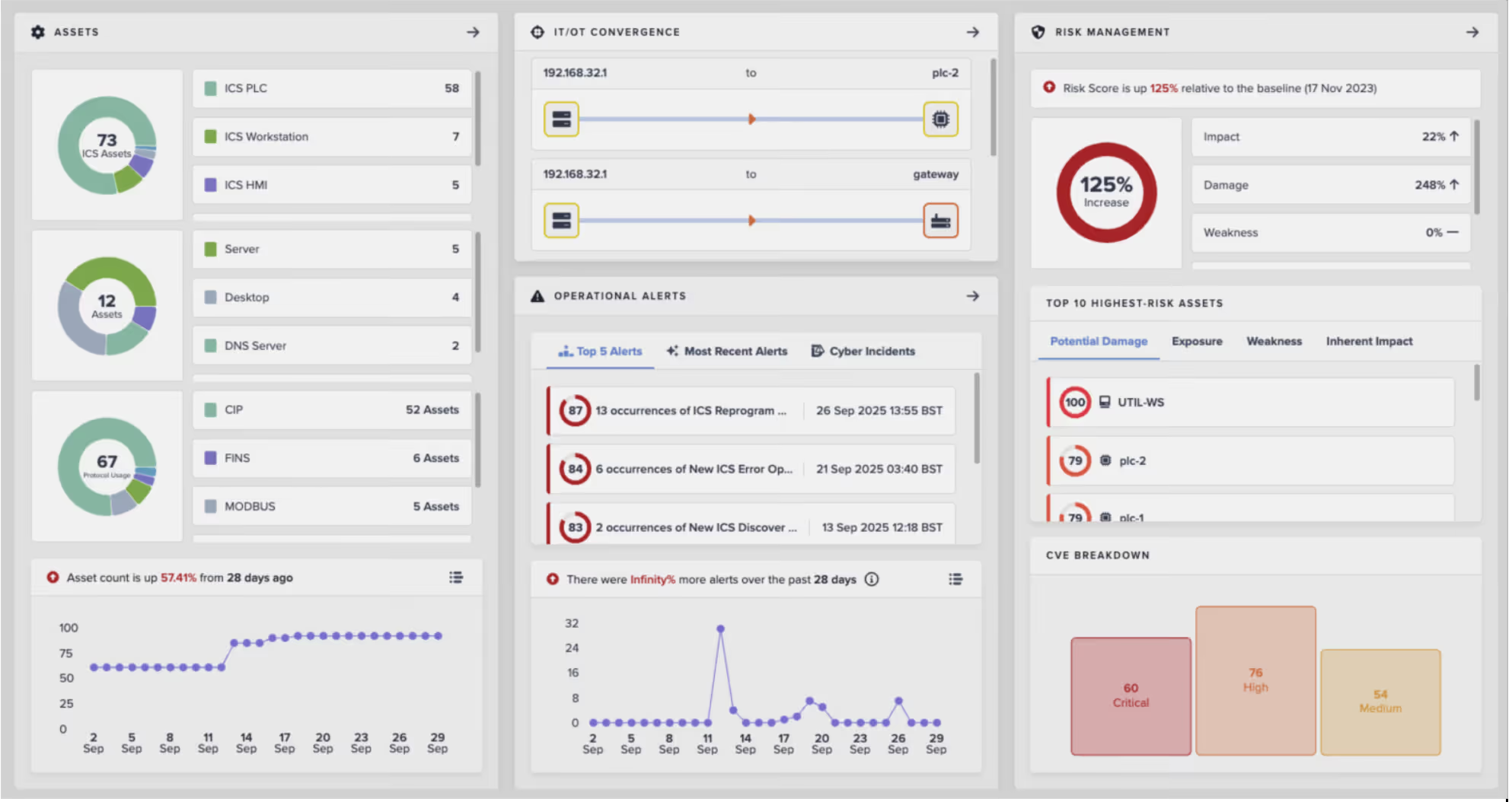
Figure 1: The Operational Overview provides an intuitive dashboard summarizing all OT Assets, Alerts, and Risk.

Full-spectrum coverage across endpoints, sensors and protocols

The release also extends visibility into areas that have traditionally been blind spots. Engineering workstations, Human-Machine Interfaces (HMIs), contractor laptops and field devices are often the entry points for attackers, yet the hardest to monitor.

Darktrace introduces Network Endpoint eXtended Telemetry (NEXT) for OT, a lightweight collector built for segmented and resource-constrained environments. NEXT for OT uses Endpoint sensors to capture localized network, and now process-level telemetry, placing it in context alongside other network and asset data to:

  1. Identify vulnerabilities and OS data, which is leveraged by OT Risk Management for risk scoring and patching prioritization, removing the need for third-party CVE collection.
  1. Surface novel threats using Self-Learning AI that standalone Endpoint Detection and Response (EDR) would miss.
  1. Extend Cyber AI Analyst investigations through to the endpoint root cause.

NEXT is part of our existing cSensor endpoint agent, can be deployed standalone or alongside existing EDR tools, and allows capabilities to be enabled or disabled depending on factors such as security or OT team objectives and resource utilization.
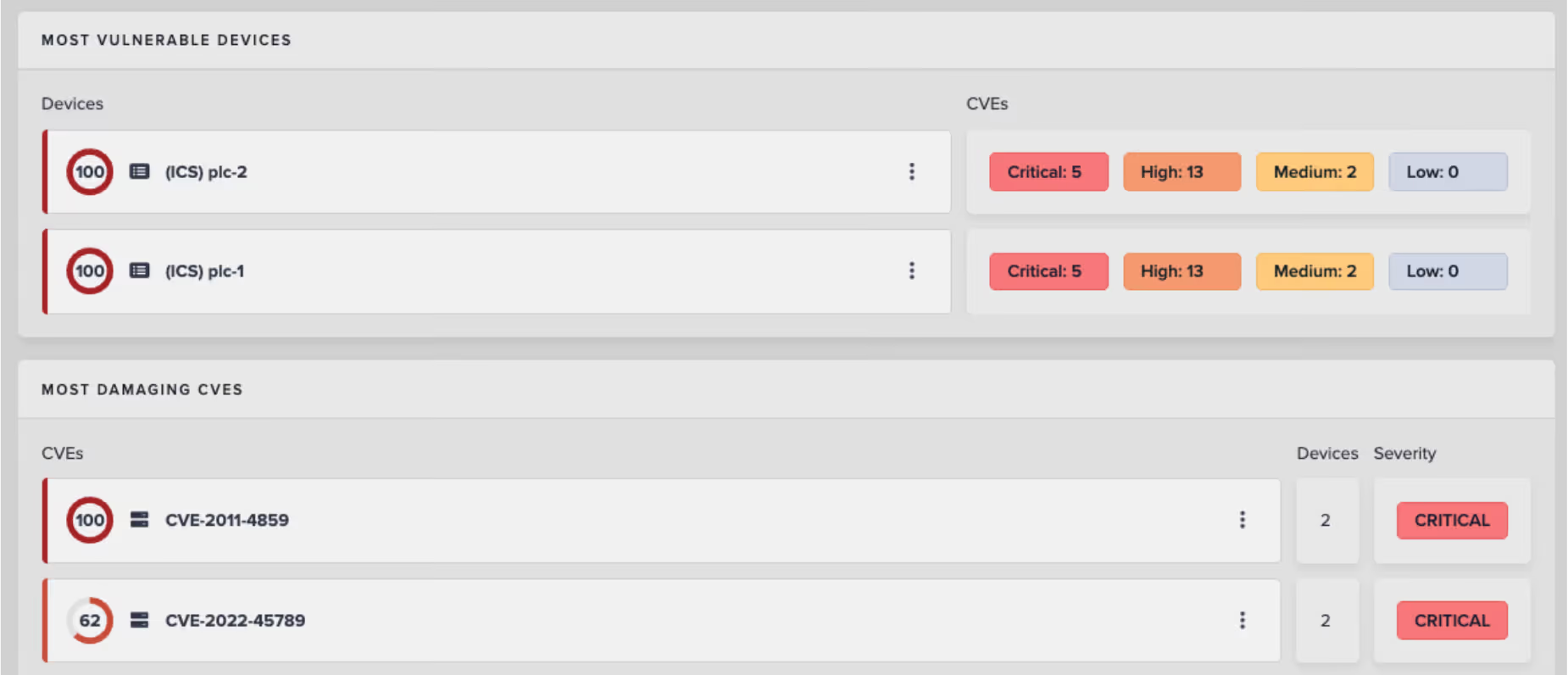
Figure 2: Darktrace / OT delivers CVE patch priority insights by combining threat intelligence with extended network and endpoint telemetry

The family of Darktrace Endpoint sensors also receive a boost in deployment flexibility, with on-prem server-based setups, as well as a Windows driver tailored for zero-trust and high-security environments.

Protocol coverage has been extended where it matters most. Darktrace now performs protocol analysis of a wider range of GE and Mitsubishi protocols, giving operators real-time visibility into commands and state changes on Programmable Logic Controllers (PLCs), robots and controllers. Backed by Self-Learning AI, this inspection does more than parse traffic, it understands what normal looks like and flags deviations that signal risk.

Integrated risk and governance workflows

Security data is only valuable when it drives action. Darktrace / OT delivers risk insights that go beyond patching, helping teams take meaningful steps even when remediation isn't possible. Risk is assessed not just by CVE presence, but by how network segmentation, firewall policies, and attack path logic neutralize or contain real-world exposure. This approach empowers defenders to deprioritize low-impact vulnerabilities and focus effort where risk truly exists. Building on the foundation introduced in release 6.3, such as KEV enrichment, endpoint OS data, and exploit mapping, this release introduces new integrations that bring Darktrace / OT intelligence directly into governance workflows.

Fortinet FortiGate firewall ingestion feeds segmentation rules into attack path modeling, revealing real exposure when policies fail and closing feeds into patching prioritization based on a policy to CVE exposure assessment.

  • ServiceNow Configuration Management Database (CMDB) sync ensures asset intelligence stays current across governance platforms, eliminating manual inventory work.

Risk modeling has also been made more operationally relevant. Scores are now contextualized by exploitability, asset criticality, firewall policy, and segmentation posture. Patch recommendations are modeled in terms of safety, uptime and compliance rather than just Common Vulnerability Scoring System (CVSS) numbers. And importantly, risk is prioritized across the Purdue Model, giving defenders visibility into whether vulnerabilities remain isolated to IT or extend into OT-critical layers.
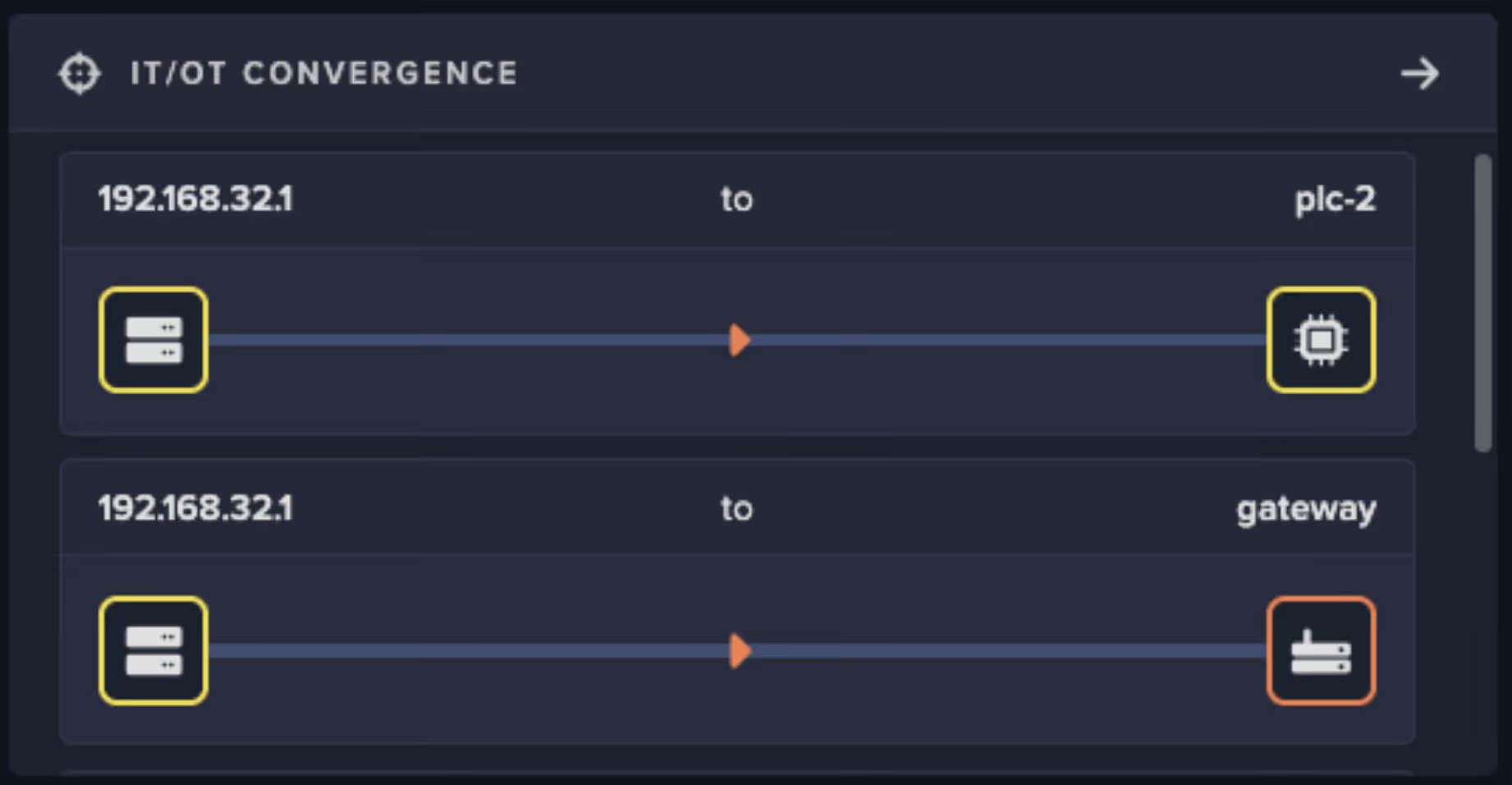
Figure 3: Attack Path Modeling based on NetFlow and network topology reveals high risk points of IT/OT convergence.

The real-world impact for defenders

In today’s environments, attackers move fluidly between IT and OT. Without unified visibility and shared context, incidents cascade faster than teams can respond.

With this release, Darktrace / OT changes that reality. The Operational Overview gives Engineers a dashboard they can use daily, tailored to their workflows. SOC analysts can seamlessly investigate telemetry across endpoints, sensors and protocols that were once blind spots. Operators gain transparency into PLCs and controllers. Governance teams benefit from automated integrations with platforms like Fortinet and ServiceNow. And all stakeholders work from risk models that reflect what truly matters: safety, uptime and compliance.

This release is not about creating more alerts. It is about providing more clarity. By unifying context across IT and OT, Darktrace / OT enables defenders to see more, understand more and act faster.

Because in environments where safety and uptime are non-negotiable, clarity is what matters most.

Join us for our live event where we will discuss these product innovations in greater detail
Inside the SOC
Darktrace cyber analysts are world-class experts in threat intelligence, threat hunting and incident response, and provide 24/7 SOC support to thousands of Darktrace customers around the globe. Inside the SOC is exclusively authored by these experts, providing analysis of cyber incidents and threat trends, based on real-world experience in the field.
Written by
Pallavi Singh
Product Marketing Manager, OT Security & Compliance

More in this series

No items found.

Blog

/

/

December 2, 2025

Protecting the Experience: How a global hospitality brand stays resilient with Darktrace

Default blog imageDefault blog image

For the Global Chief Technology Officer (CTO) of a leading experiential leisure provider, security is mission critical to protecting a business built on reputation, digital innovation, and guest experience. The company operates large-scale immersive venues across the UK and US, blending activity-driven hospitality with premium dining and vibrant spaces designed for hundreds of guests. With a lean, centrally managed IT team responsible for securing locations worldwide, the challenge is balancing robust cybersecurity with operational efficiency and customer experience.

Brand buzz attracts attention – and attacks

Mid-sized, fast-growing hospitality organizations face a unique risk profile. When systems go down in a venue, the impact is immediate: hundreds of disrupted guest experiences, lost revenue during peak hours, and potential long-term reputation damage. Each time the organization opened a new venue, the surge of marketing buzz attracted attention in local markets and waves of sophisticated cyberattacks, including:

Phishing campaigns leveraging brand momentum to lure employees into clicking on malicious links.

AI-enhanced impersonation using advanced techniques to create AI-generated video calls and deep-researched, contextualized emails  

Fake domains targeting leadership with AI-generated messages that contained insider context gleaned from public information.

“Our endpoint security and antivirus tools were powerless against these sophisticated AI-powered campaigns. We didn’t want to manage incidents anymore. We wanted to prevent them from ever happening.”  - Global CTO

Proactive, preventative security with Darktrace AI

The company’s cybersecurity vision was clear: “Proactive, preventative – that was our mandate,” said the CTO. With a lean and busy IT group, the business evaluated several security solutions using deep-dive workshops. Darktrace proved the best fit for supporting the organization’s proactive mindset, offering:

  • Autonomy without added headcount: Darktrace provided powerful AI-driven detection and autonomous response functions with minimal manual oversight required.
  • Modular adoption: The company could start with core email and network protection and expand into cloud and endpoint coverage, aligning spend with growth.
  • Partnership and responsiveness: “We wanted people we trust, respect, and know will show up when we need them. Darktrace did just that,” said the CTO.
  • Affordability at scale: Darktrace offered reasonable upfront costs plus predictable, sustainable economics as the company and IT infrastructure expanded.  

“The combination of AI capabilities, a scalable model, and a strong engagement team tipped the balance in Darktrace’s favor, and we have not been disappointed,” said the CTO.

Phased deployment builds trust

To minimize disruption to critical hospitality systems like global Point of Sales (POS) terminals and Audio-Visual (AV) infrastructure, deployment was phased:

  1. Observation and human-led response: Initially, Darktrace was deployed in detection-only mode. Alerts were manually reviewed.
  2. Incremental autonomous response: Darktrace Autonomous Response was enabled on select models, taking action on low-risk scenarios. Higher-risk subnets and devices remained under human control.
  3. Full autonomous coverage: With tuning and reinforcement, autonomous response was expanded across domains, trusted to take decisive action in real time. Analysts retained the ability to review and contextualize incidents.

“Darktrace managed the rollout through detailed, professional, and responsive project management – ensuring a smooth, successful adoption and creating a standardized cybersecurity playbook for future venue launches,” said the CTO.  

AI delivers the outcomes that matter  

Measurable efficiency replaces endless alerts

Darktrace autonomous response significantly decreased false alerts and noise. “If it’s quiet, we’re confident there isn’t a problem,” said the CTO. Within six months, Darktrace conducted 3,599 total investigations, detected and contained 320 incidents indicative of an attack, resolved 91% of those events autonomously, and escalated only 9% to human analysts. The efficiency gains were enormous, saving analysts 740 hours on investigations within a single month.  

Precision AI turns inbox chaos into calm

Darktrace Self-Learning AI modeled sender/recipient norms, content/linguistic baselines, and communication patterns unique to the organization’s launch cadence, resulting in:

  • Automated holds and neutralizations of anomalous executive-style messages
  • Rapid detection of novel templates and tone shifts that deviated from the organization’s lived email graph, even when indicators were not yet on any feed
  • Downstream reduction in help-desk escalations tied to suspicious email

Full visibility fuels real-time response

Darktrace gives IT direct visibility without extra licensing, and it surfaces ground truth across every venue, including:

  • Device geolocation and placement drift: Darktrace exposed devices and users operating outside approved zones, prompting new segmentation and access-control policies.
  • Guest Wi-Fi realities: Darktrace AI uncovered high-risk activity on guest networks, like crypto-mining and dark-web traffic, driving stricter VLAN separation and access hygiene.
  • Lateral-movement containment: Autonomous response fenced suspicious activity in real time, buying time for human investigation while keeping POS and AV systems unaffected.

Smarter endpoints for a smarter network

Endpoints once relied on static agents effective only against known signatures. Darktrace’s behavioral models now detect subtle anomalies at the endpoint process level that EDRs often miss, such as misuse of legitimate applications (commonly used in living-off-the-land attacks), unapproved application usage and policy violations. This increases the accuracy and fidelity of network-based investigations by adding endpoint process context alongside existing EDR alerts.

Autonomous response for continuous compliance

Across PCI, GDPR, and cross-border privacy obligations, Darktrace’s native evidencing is helping the team demonstrate control rather than merely assert it:

  • Asset and flow awareness: Knowing “what is where” and “who talks to what” underpins PCI scoping and data-flow diagrams.
  • Layered safeguards: Showing autonomous prevention, network segmentation, and rapid containment supports risk registers and control attestations.
  • Audit-ready artifacts: Investigations and autonomous actions produce artifacts that “tick the box” without additional tooling.  

Defining the next era of resilience with AI

With rapid global expansion underway, the company is using its cybersecurity playbook to streamline and secure future venue launches. In the near term, IT is focused on strengthening prevention, using Darktrace insights to guide new policy updates and infrastructure changes like imposing stricter guest-network posture and refining venue device baselines.

For tech leaders charting their path to proactive cyber defense, the CTO stresses success won’t come from sidestepping AI, but from turning it into a core capability.

“AI isn’t optional – it’s operational. The real risk to your business is trying to out-scale automated adversaries with human speed alone. When applied to the right use case, AI becomes a catalyst for efficiency, resilience, and business growth.” - Global CTO
Continue reading
About the author
The Darktrace Community

Blog

/

Email

/

December 2, 2025

From Amazon to Louis Vuitton: How Darktrace Detects Black Friday Phishing Attacks

Default blog imageDefault blog image

Why Black Friday Drives a Surge in Phishing Attacks

In recent years, Black Friday has shifted from a single day of online retail sales and discounts to an extended ‘Black Friday Week’, often preceded by weeks of online hype. During this period, consumers are inundated with promotional emails and marketing campaigns as legitimate retailers compete for attention.

Unsurprisingly, this surge in legitimate communications creates an ideal environment for threat actors to launch targeted phishing campaigns designed to mimic legitimate retail emails. These campaigns often employ social engineering techniques that exploit urgency, exclusivity, and consumer trust in well-known brands, tactics designed to entice recipients into opening emails and clicking on malicious links.

Additionally, given the seasonal nature of Black Friday and the ever-changing habits of consumers, attackers adopt new tactics and register fresh domains each year, rather than reusing domains previously flagged as spam or phishing endpoints. While this may pose a challenge for traditional email security tools, it presents no such difficulty for Darktrace / EMAIL and its anomaly-based approach.

In the days and weeks leading up to ‘Black Friday’, Darktrace observed a spike in sophisticated phishing campaigns targeting consumers, demonstrating how attackers combine phycological manipulation with technical evasion to bypass basic security checks during this high-traffic period. This blog showcases several notable examples of highly convincing phishing emails detected and contained by Darktrace / EMAIL in mid to late November 2025.

Darktrace’s Black Friday Detections

Brand Impersonation: Deal Watchdogs’ Amazon Deals

The impersonation major online retailers has become a common tactic in retail-focused attacks, none more so than Amazon, which ranked as the fourth most impersonated brand in 2024, only behind Microsoft, Apple, Google, and Facebook [1]. Darktrace’s own research found Amazon to be the most mimicked brand, making up 80% of phishing attacks in its analysis of global consumer brands.

When faced with an email that appears to come from a trusted sender like Amazon, recipients are far more likely to engage, increasing the success rate of these phishing campaigns.

In one case observed on November 16, Darktrace detected an email with the subject line “NOW LIVE: Amazon’s Best Early Black Friday Deals on Gadgets Under $60”. The email was sent to a customer by the sender ‘Deal Watchdogs’, in what appeared to be an attempt to masquerade as a legitimate discount-finding platform. No evidence indicated that the company was legitimate. In fact, the threat actor made no attempt to create a convincing name, and the domain appeared to be generated by a domain generation algorithm (DGA), as shown in Figure 2.

Although the email was sent by ‘Deal Watchdogs’, it attempted to impersonate Amazon by featuring realistic branding, including the Amazon logo and a shade of orange similar to that used by them for the ‘CLICK HERE’ button and headline text.

Figure 1: The contents of the email observed by Darktrace, featuring authentic-looking Amazon branding.

Darktrace identified that the email, marked as urgent by the sender, contained a suspicious link to a Google storage endpoint (storage.googleapis[.]com), which had been hidden by the text “CLICK HERE”. If clicked, the link could have led to a credential harvester or served as a delivery vector for a malicious payload hosted on the Google storage platform.

Fortunately, Darktrace immediately identified the suspicious nature of this email and held it before delivery, preventing recipients from ever receiving or interacting with the malicious content.

Figure 2: Darktrace / EMAIL’s detection of the malicious phishing email sent to a customer.

Around the same time, Darktrace detected a similar email attempting to spoof Amazon on another customer’s network with the subject line “Our 10 Favorite Deals on Amazon That Started Today”, also sent by ‘Deal Watchdogs,’ suggesting a broader campaign.

Analysis revealed that this email originated from the domain petplatz[.]com, a fake marketing domain previously linked to spam activity according to open-source intelligence (OSINT) [2].

Brand Impersonation: Louis Vuitton

A few days later, on November 20, Darktrace / EMAIL detected a phishing email attempting to impersonate the luxury fashion brand Louis Vuitton. At first glance, the email, sent under the name ‘Louis Vuitton’ and titled “[Black Friday 2025] Discover Your New Favorite Louis Vuitton Bag – Elegance Starts Here”, appeared to be a legitimate Black Friday promotion. However, Darktrace’s analysis uncovered several red flags indicating a elaborate brand impersonation attempt.

The email was not sent by Louis Vuitton but by rskkqxyu@bookaaatop[.]ru, a Russia-based domain never before observed on the customer’s network. Darktrace flagged this as suspicious, noting that .ru domains were highly unusual for this recipient’s environment, further reinforcing the likelihood of malicious intent. Subsequent analysis revealed that the domain had only recently registered and was flagged as malicious by multiple OSINT sources [3].

Figure 3: Darktrace / EMAIL’s detection of the malicious email attempting to spoofLouis Vuitton, originating from a suspicious Russia-based domain.

Darktrace further noted that the email contained a highly suspicious link hidden behind the text “View Collection” and “Unsubscribe,” ensuring that any interaction, whether visiting the supposed ‘handbag store’ or attempting to opt out of marketing emails, would direct recipients to the same endpoint. The link resolved to xn--80aaae9btead2a[.]xn--p1ai (топааабоок[.]рф), a domain confirmed as malicious by multiple OSINT sources [4]. At the time of analysis, the domain was inaccessible, likely due to takedown efforts or the short-lived nature of the campaign.

Darktrace / EMAIL blocked this email before it reached customer inboxes, preventing recipients from interacting with the malicious content and averting any disruption.

Figure 4: The suspicious domain linked in the Louis Vuitton phishing email, now defunct.

Too good to be true?

Aside from spoofing well-known brands, threat actors frequently lure consumers with “too good to be true” luxury offers, a trend Darktrace observed in multiple cases throughout November.

In one instance, Darktrace identified an email with the subject line “[Black Friday 2025] Luxury Watches Starting at $250.” Emails contained a malicious phishing link, hidden behind text like “Rolex Starting from $250”, “Shop Now”, and “Unsubscribe”.

Figure 5: Example of a phishing email detected by Darktrace, containing malicious links concealed behind seemingly innocuous text.

Similarly to the Louis Vuitton email campaign described above, this malicious link led to a .ru domain (hxxps://x.wwwtopsalebooks[.]ru/.../d65fg4er[.]html), which had been flagged as malicious by multiple sources [5].

Figure 6: Darktrace / EMAIL’s detection of a malicious email promoting a fake luxury watch store, which was successfully held from recipient inboxes.

If accessed, this domain would redirect users to luxy-rox[.]com, a recently created domain (15 days old at the time of writing) that has also been flagged as malicious by OSINT sources [6]. When visited, the redirect domain displayed a convincing storefront advertising high-end watches at heavily discounted prices.

Figure 7: The fake storefront presented upon visiting the redirectdomain, luxy-rox[.]com.

Although the true intent of this domain could not be confirmed, it was likely a scam site or a credential-harvesting operation, as users were required to create an account to complete a purchase. As of the time or writing, the domain in no longer accessible .

This email illustrates a layered evasion tactic: attackers employed multiple domains, rapid domain registration, and concealed redirects to bypass detection. By leveraging luxury branding and urgency-driven discounts, the campaign sought to exploit seasonal shopping behaviors and entice victims into clicking.

Staying Protected During Seasonal Retail Scams

The investigation into these Black Friday-themed phishing emails highlights a clear trend: attackers are exploiting seasonal shopping events with highly convincing campaigns. Common tactics observed include brand impersonation (Amazon, Louis Vuitton, luxury watch brands), urgency-driven subject lines, and hidden malicious links often hosted on newly registered domains or cloud services.

These campaigns frequently use redirect chains, short-lived infrastructure, and psychological hooks like exclusivity and luxury appeal to bypass user scepticism and security filters. Organizations should remain vigilant during retail-heavy periods, reinforcing user awareness training, link inspection practices, and anomaly-based detection to mitigate these evolving threats.

Credit to Ryan Traill (Analyst Content Lead) and Owen Finn (Cyber Analyst)

Appendices

References

1.        https://keepnetlabs.com/blog/top-5-most-spoofed-brands-in-2024

2.        https://www.virustotal.com/gui/domain/petplatz.com

3.        https://www.virustotal.com/gui/domain/bookaaatop.ru

4.        https://www.virustotal.com/gui/domain/xn--80aaae9btead2a.xn--p1ai

5.        https://www.virustotal.com/gui/url/e2b868a74531cd779d8f4a0e1e610ec7f4efae7c29d8b8ab32c7a6740d770897?nocache=1

6.        https://www.virustotal.com/gui/domain/luxy-rox.com

Indicators of Compromise (IoCs)

IoC – Type – Description + Confidence

petplatz[.]com – Hostname – Spam domain

bookaaatop[.]ru – Hostname – Malicious Domain

xn--80aaae9btead2a[.]xn--p1ai (топааабоок[.]рф) – Hostname - Malicious Domain

hxxps://x.wwwtopsalebooks[.]ru/.../d65fg4er[.]html) – URL – Malicious Domain

luxy-rox[.]com – Hostname -  Malicious Domain

MITRE ATT&CK Mapping  

Tactic – Technique – Sub-Technique  

Initial Access - Phishing – (T1566)  

Continue reading
About the author
Ryan Traill
Analyst Content Lead
Your data. Our AI.
Elevate your network security with Darktrace AI