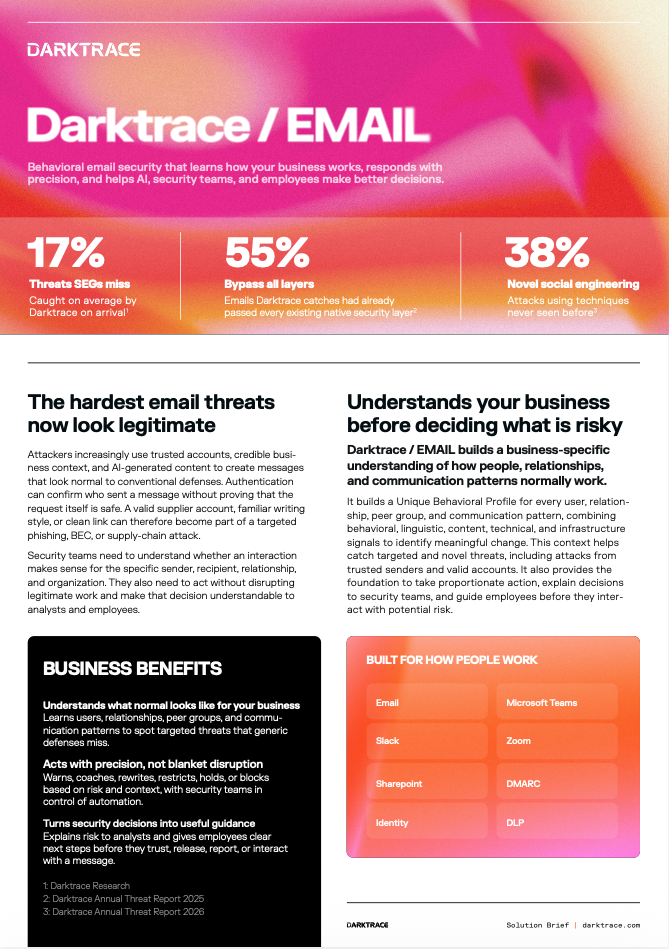
Signs of AI usage increased year-over-year,with novel social engineering techniques rising from 32% to 38% and large‑text,long‑form messages increasing from 27% to 33%. These patterns reflect a shifttoward more personalized, credible‑looking lures designed to evade traditionalfilters.
How AI is Changing the Phishing Landscape
How AI is Changing the Phishing Landscape: A Guide for Modern Security Teams
Discover how AI is reshaping phishing attacks, increasing scale and sophistication, and how security teams can use AI-driven detection and response to identify, disrupt, and reduce evolving phishing threats.

Takes 10 seconds
Descargar ahora
100+
recursos descargados este mes

Qué contiene este recurso

This is some text inside of a div block.
Signs of AI usage increased year-over-year,with novel social engineering techniques rising from 32% to 38% and large‑text,long‑form messages increasing from 27% to 33%. These patterns reflect a shifttoward more personalized, credible‑looking lures designed to evade traditionalfilters.
This is some text inside of a div block.
LLMs can do the legwork of gathering data about intended targets, so they can craft more personalized and convincing emails that mimic the style of trusted senders and domains, and know things only those entities should know.
This is some text inside of a div block.
Phishing-as-a-Service (PhaaS) kits lower barriers to entry by equipping novice attackers with everything they need – ready-to-use emails that impersonate known brands and fake hosted sites used to capture credentials.
White Paper
How AI is Changing the Phishing Landscape
The rise of AI-driven phishing attacks
82% of security professionals worldwide are concerned about the use of generative AI to craft convincing phishing emails. This white paper explores the ways in which AI is changing the phishing landscape, why the security gap keeps widening, and how defensive AI can be used to identify advanced email attacks that evade traditional defenses. As phishing campaigns become more personalized and scalable, organizations increasingly rely on AI phishing detection to recognize suspicious behavior and stop attacks before they reach users’ inboxes.
Modern cyber attackers are increasingly using generative AI and large language models to create highly convincing social engineering campaigns. These AI-generated phishing emails can mimic trusted senders, replicate internal communication styles, and remove the spelling mistakes that historically exposed phishing attempts. This shift has accelerated the rise of sophisticated AI phishing attacks, enabling threat actors to launch targeted campaigns faster and at a much larger scale.
Traditional email security tools often rely on static rules, signatures, and known indicators of compromise. However, these approaches struggle to detect new or evolving threats. AI phishing detection technologies take a different approach by analyzing behavioral patterns across users, devices, and communication channels. By understanding what normal email activity looks like within an organization, AI systems can quickly identify anomalies that indicate potential phishing attempts, business email compromise, or account takeover.
This white paper explores how modern phishing campaigns are evolving and how organizations can use defensive AI to strengthen email security. Download the report to learn how security teams can detect AI-generated phishing emails, respond to emerging AI phishing attacks, and build stronger defenses against advanced social engineering threats.
Explore los recursos relacionados
Descubre cómo otros van un paso por delante con Darktrace
10,000
Darktrace customers


Sus datos. Nuestra IA.
Mejore la seguridad de su red con Darktrace AI