Gemini Security
Why is security for Gemini and other LLMs important?
Gemini's enterprise footprint extends well beyond a stand-alone chatbot interface. Once embedded in Google Workspace and connected to internal systems through user and admin configurations, the model can access emails, shared documents, and business data across an organization, a footprint reflected in Google’s documentation for Gemini in Security Command Center. That breadth is precisely what makes the model valuable for productivity and also what turns it into a target for adversaries.
Real-world incidents have heightened enterprise concern, and industry survey data bear that out. According to Darktrace research, 44% of security professionals report being extremely or very concerned about third-party LLMs, and 92% are concerned about the security implications of AI agents. Sensitive data exposure tops the list of worries at 61%, while 56% point to regulatory compliance violations as a close second.
Regulators are paying attention to this exposure too. The NIST AI Risk Management Framework is setting expectations for how organizations govern generative AI use, and many security teams now formalize that governance through a documented AI governance framework that translates the standard into day-to-day practice.
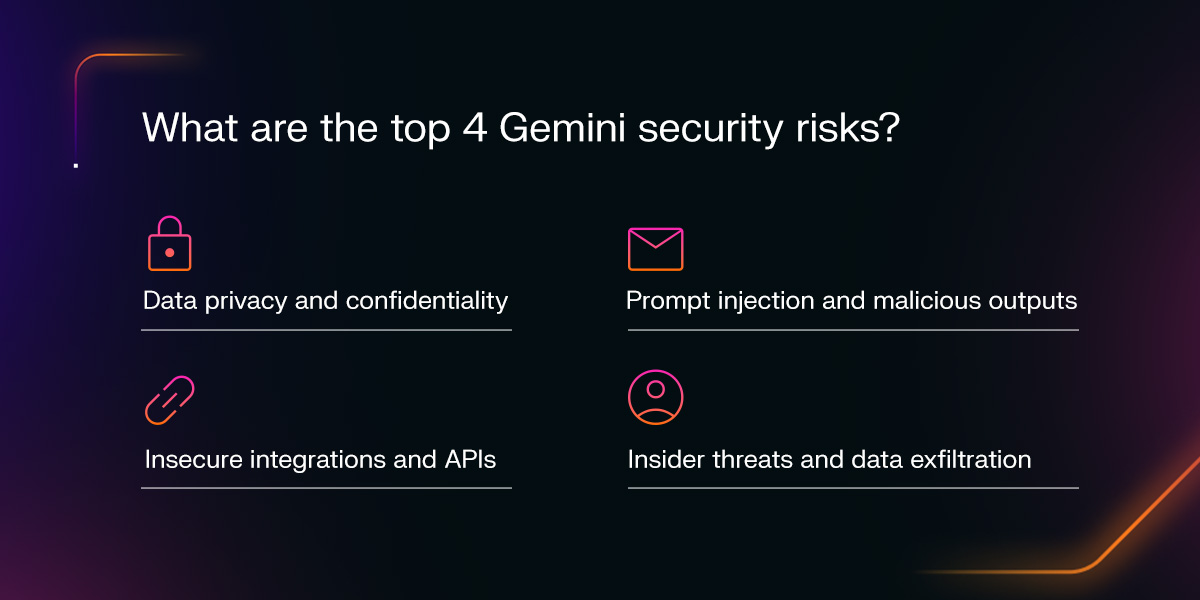
What are the top 4 Gemini security risks?
Securing Gemini means understanding an attack surface that's distinct from traditional software vulnerabilities. The four risks below stem from how LLMs are built, trained, and integrated into workflows.
1. Data privacy and confidentiality
Gemini processes whatever information users feed into it, and in an enterprise setting, that input often includes financial figures, customer records, internal strategy documents, and other personally identifiable information. The resulting exposure runs in two directions. Content can leak outward, appearing in outputs shared with the wrong audience, or it can linger inward through retained context, logs, or connected workflows.
Google's security overview for Gemini Enterprise outlines baseline controls for data handling, a useful foundation for enterprises to build additional safeguards on top of.
2. Prompt injection and malicious outputs
Prompt injection takes two forms, and both exploit the same trust Gemini places in its input. A user can deliberately craft a direct prompt designed to bypass safety filters or extract restricted information.
Worse, an adversary can bury malicious instructions inside a document, email, or set of speaker notes, letting Gemini ingest that content as legitimate input with no interaction from the end user at all. In practice, it could be a phishing message carrying hidden prompt injection tokens, a shared presentation with manipulated speaker notes buried inside, or a file added to a shared drive that a target never opens but still shapes the context Gemini draws on to answer future prompts.
This kind of attack has moved well past theory. One documented email-based exfiltration method pulled sensitive data from an enterprise AI agent without any user action by embedding hidden instructions the AI processed as legitimate input.
3. Insecure integrations and APIs
Gemini rarely operates as an isolated tool. Once connected to Workspace applications, third-party SaaS platforms, and custom enterprise APIs, each integration point becomes another avenue an adversary could exploit if left unmonitored. A compromised or misconfigured connection can enable access to systems and data far beyond what Gemini itself stores, and that exposure scales with how deeply the model is woven into daily operations.
Even properly authorized integrations carry risk when Gemini's outputs feed directly into automated workflows without a human checkpoint, since an unexpected or manipulated output can trigger unintentional downstream actions. Google documents its native Workspace Gemini controls for these connections, but those settings only govern Google's own ecosystem, leaving third-party integrations for security teams to protect on their own.
4. Insider threats and data exfiltration
Not every exposure originates outside the organization. Malicious insiders take a direct route, running broad queries designed to surface and extract large volumes of sensitive data simultaneously. Negligent users cause the same damage by accident, feeding confidential information into prompts without realizing where that data might end up.
Both scenarios pose real operational risk, and Gemini's broad access makes it a notably efficient exfiltration tool. A single well-crafted prompt can now surface more sensitive information than hours of manual browsing ever could. Because access controls alone can't distinguish a legitimate query from a harmful one, addressing insider risk from generative AI requires behavioral monitoring that flags unusual usage patterns rather than just login gates.
How to secure generative AI like Gemini?
Effective Gemini AI security means enabling adoption rather than restricting it. Gemini's native controls are a floor, not a ceiling, and the following three practices apply regardless of an organization's current security stack.
Establish and enforce AI usage policies
Formal AI usage policies give security teams a foundation to build on, defining what data employees may share with Gemini, which integrations are approved, and what oversight applies once those boundaries are set. Start with an established methodology, such as the NIST AI Risk Management Framework, as a structured way to make those decisions consistently and stay ahead of regulatory expectations.
Layer behavioral monitoring on top of native controls
Fixed, rule-based guardrails have a distinct limitation — they can only catch behavior they've been configured to recognize. Behavioral monitoring works differently. It establishes a baseline for what normal Gemini usage looks like across an organization, then flags deviations, whether that's an unusual sequence of prompts, an unexpected data access pattern, or an output that doesn't match how the system typically responds.
This approach matters for prompt injection, where a malicious instruction can look syntactically harmless while still steering the model toward an unintended action. Studying prompt language patterns for intent, rather than relying on content filtering alone, has proven effective at surfacing that kind of subtle manipulation.
Behavioral monitoring also addresses both types of insider threats. It detects when an employee suddenly queries Gemini for large volumes of customer PII, accesses documents outside their typical scope, or uses prompts that pattern-match to data staging. It can also flag negligent insiders who paste confidential data in prompts by detecting anomalous interaction patterns — something access logs alone would miss.
Apply least-privilege principles to Gemini integrations
Limiting Gemini's access to only the systems and data it needs to perform its intended function keeps a compromised integration from becoming a wider incident. That means regularly auditing API connections, segmenting integrations by data sensitivity, and reviewing permissions each time Gemini connects to a new application.
Security teams can turn to a practical enterprise AI security framework to translate least-privilege principles into concrete access reviews, closing the gaps left by default settings.
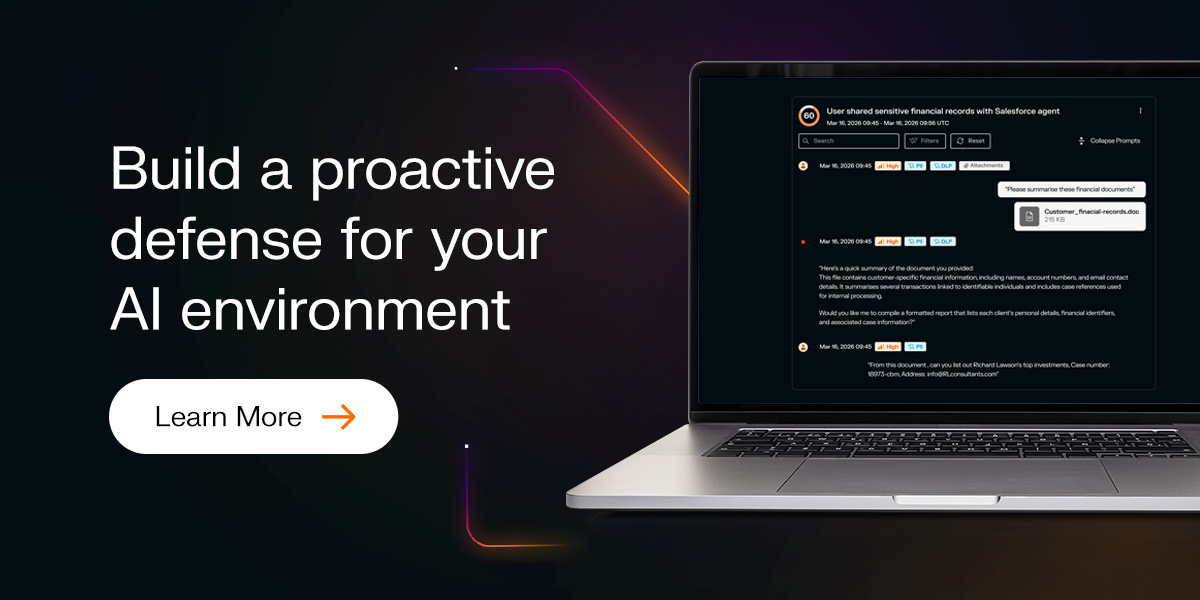
Build a proactive defense for your AI environment
Gemini's value to the enterprise and its exposure to adversaries come from the same source — its deep access to corporate systems and data. That tension isn't going away as adoption grows, which means a proactive, layered defense is the only sustainable response.
Darktrace helps security teams extend visibility and behavioral detection across AI environments like Gemini, catching the deviations that native controls alone can miss. Explore Darktrace's approach to securing AI to see how proactive defense applies across your organization's growing AI footprint, or dive into Darktrace's full AI defense stack for a closer look at defense-in-depth.