

Blog
/
Cloud
/
April 9, 2026

Bringing Together SOC and IR teams with Automated Threat Investigations for the Hybrid World

Incident response often breaks down after detection due to fragmented tools and limited visibility. Darktrace unifies detection and investigation across cloud and on-premises environments, enabling automated evidence capture and faster, clearer response.
Inside the SOC
Darktrace cyber analysts are world-class experts in threat intelligence, threat hunting and incident response, and provide 24/7 SOC support to thousands of Darktrace customers around the globe. Inside the SOC is exclusively authored by these experts, providing analysis of cyber incidents and threat trends, based on real-world experience in the field.
Written by
Paul Bottomley
Director of Product Management | Darktrace
Default blog image
09
Apr 2026

The investigation gap: Why incident response is slow, fragmented and reactive

Modern investigations often fall apart the moment analysts move beyond an initial alert. Whether detections originate in cloud or on-prem environments, SOC and Incident Response (IR) teams are frequently hindered by fragmented tools and data sources, closed ecosystems, and slow, manual evidence collection just to access the forensic context they need. SOC analysts receive alerts without the depth required to confidently confirm or dismiss a threat, while IR teams struggle with inconsistent visibility across cloud, on‑premises, and contained endpoints, creating delays, blind spots, and incomplete attack timelines.

This gap between SOC and Digital Forensics and Incident Response (DFIR) slows response and forces teams into reactive and inefficient investigation patterns. Security teams struggle to collect high‑fidelity forensic data during active incidents, particularly from cloud workloads, on‑prem systems, and XDR‑contained endpoints where traditional tools cannot operate without deploying new agents or disrupting containment. The result is a fragmented response process where investigations slow down, context gets lost, and critical attacker activity can slip through the cracks.

What’s new at Darktrace

Helping teams move from detection to root cause faster, more efficiently, and with greater confidence

The latest update to Darktrace / Forensic Acquisition & Investigation eliminates the traditional handoff between the SOC and IR teams, enabling analysts to seamlessly pivot from alert into forensic investigation. It also brings on-demand and automated data capture through Darktrace / ENDPOINT as well as third-party detection platforms, where investigators can safely collect critical forensic data from network contained endpoints, preserving containment while accelerating investigation and response.  

Together, this solidifies / Forensic Acquisition & Investigation as an investigation-first platform beyond the cloud, fit for any organization that has adopted a multi-technology infrastructure. In practice, when these various detection sources and host‑level forensics are combined, investigations move from limited insight to complete understanding quickly, giving security teams the clarity and deep context required to drive confident remediation and response based on the exact tactics, techniques and procedures employed.

Integrated forensic context inside every incident workflow

SOC analysts now have seamless access to forensic evidence at the exact moment they need it. There is a new dedicated Forensics tab inside Cyber AI Analyst™ incidents, allowing users to move instantly from detection to rich forensic context in a single click, without the need to export data or get other teams involved.

For investigations that previously required multiple tools, credentials, or intervention by a dedicated team, this change represents a shift toward truly embedded incident‑driven forensics – accelerating both decision‑making and response quality at the point of detection.
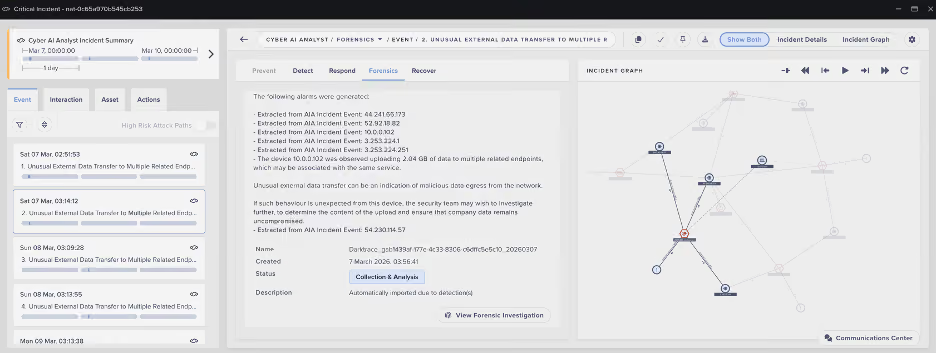
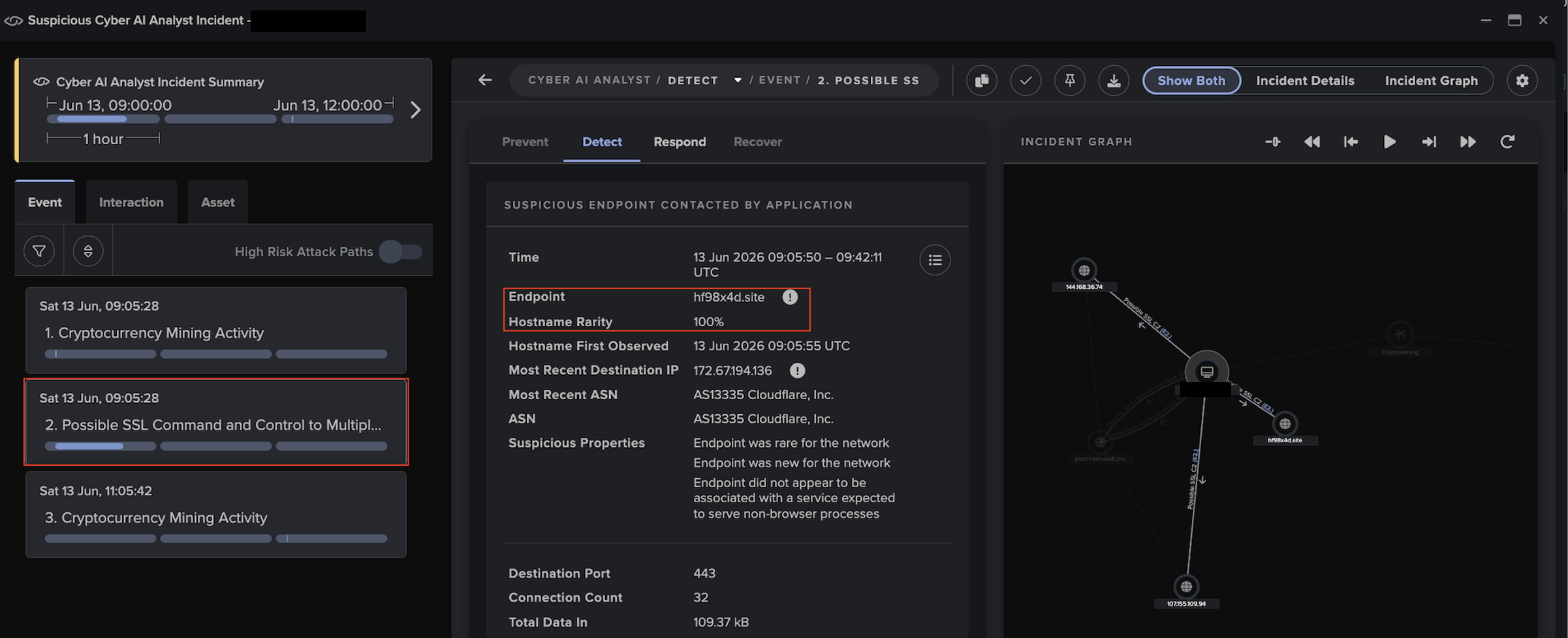
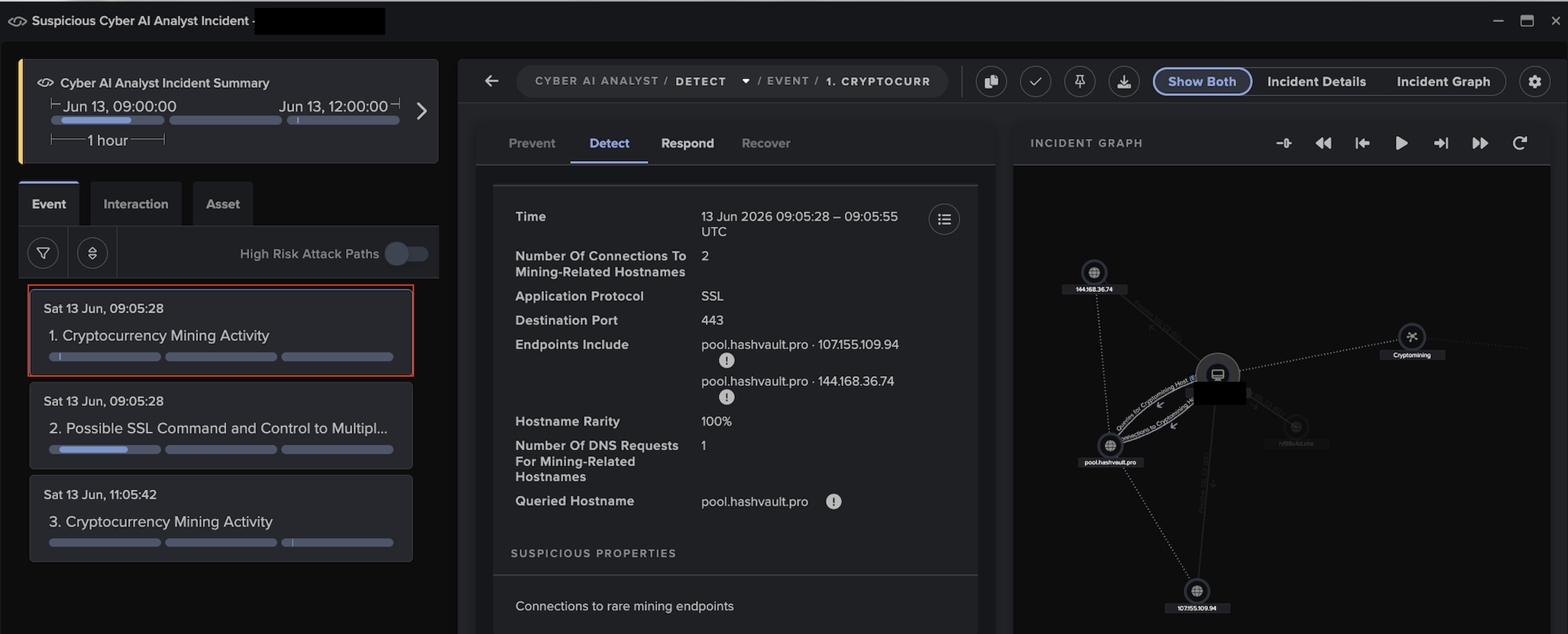
Figure 1: The forensic investigation associated with the Cyber AI Analyst™ incident appears in a dedicated ‘Forensics’ tab, with the ability to pivot into the / Forensic Acquisition & Investigation UI for full context and deep analysis workflows.

Reliable automated and manual hybrid evidence capture across any environment

Across cloud, on‑premises, and hybrid environments, analysts can now automate or request on‑demand forensic evidence collection the moment a threat is detected via Darktrace / ENDPOINT. This allows investigators to quickly capture high-fidelity forensic data from endpoints already under protection, accelerating investigations without additional tooling or disrupting systems. Especially in larger environments where the ability to scale is critical, automated data capture across hybrid environments significantly reduces response time and enables consistent, repeatable investigations.

Unlike EDR‑only solutions, which capture only a narrow slice of activity, these workflows provide high‑quality, cross‑environment forensic depth, even on third‑party XDR‑contained devices that many vendor ecosystems cannot reach.

The result is a single, unified process for capturing the forensic context analysts need no matter where the threat originates, even in third-party vendor protected areas.
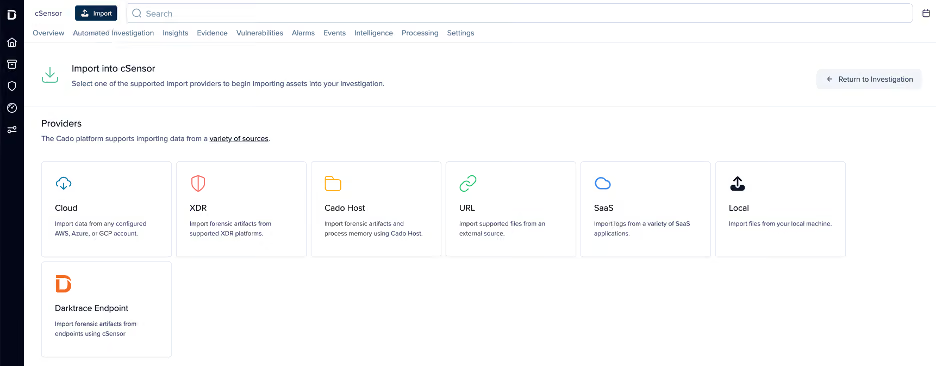
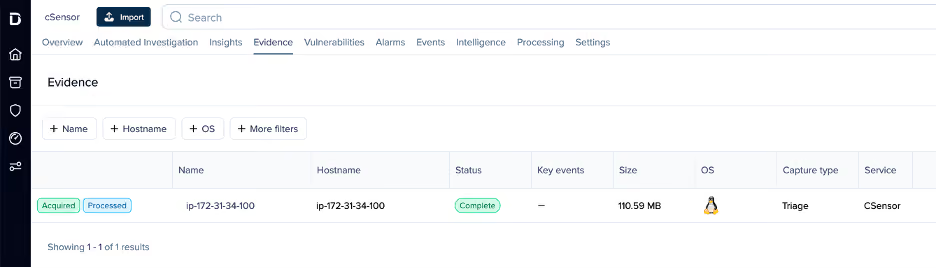
Figure 2: The ability to acquire, process, and investigate devices with the Darktrace / ENDPOINT agent installed using the ‘Darktrace Endpoint’ import provider
Figure 3: A Linux device that has the Darktrace / ENDPOINT agent installed has been acquired and processed by / Forensic Acquisition & Investigation

Investigation‑first design flexible for hybrid organizations

Luckily, taking advantage of automated forensic data capture of non-cloud assets won’t be subject to those who purely use Darktrace / ENDPOINT. This functionality is also available where CrowdStrike, Microsoft Defender for Endpoint, or SentinelOne agents are deployed.  In the case of CrowdStrike, Darktrace / Forensic Acquisition & Investigation can also perform a triage capture of a device that has been contained using CrowdStrike’s network containment capability. What’s critical here is the fact that investigators can safely acquire additional forensic evidence without breaking or altering containment. That massively improves investigation and response time without adding more risk factors.
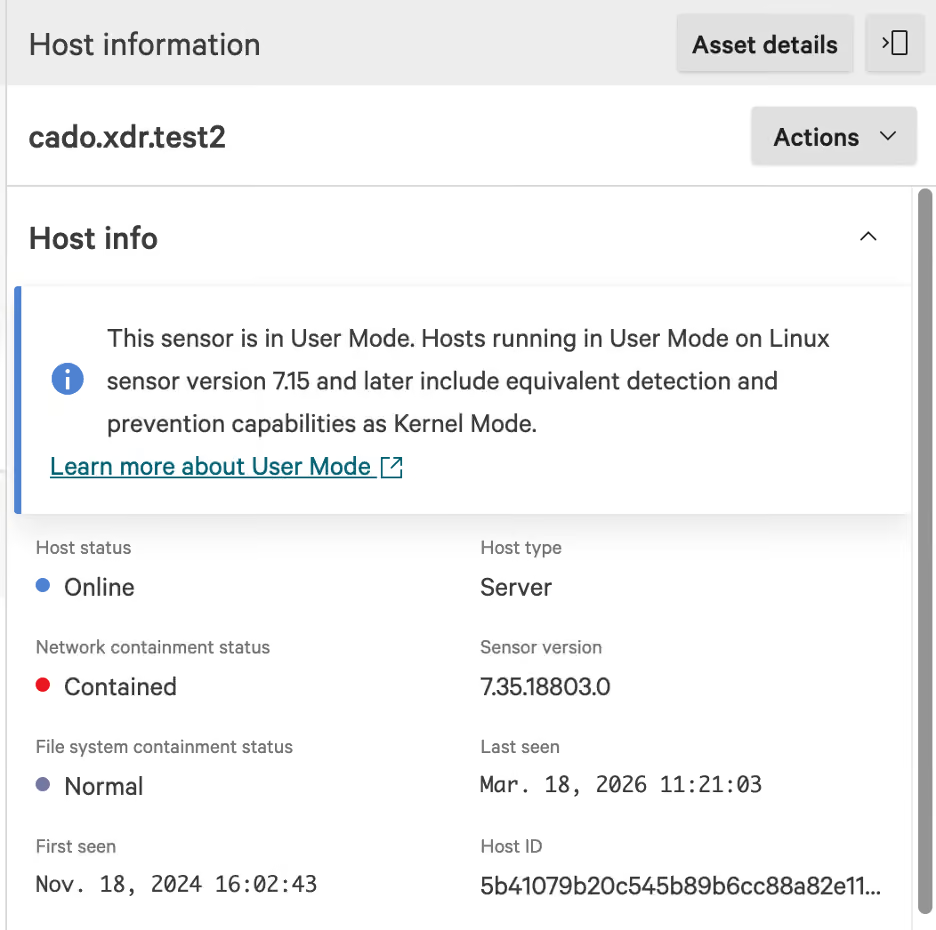
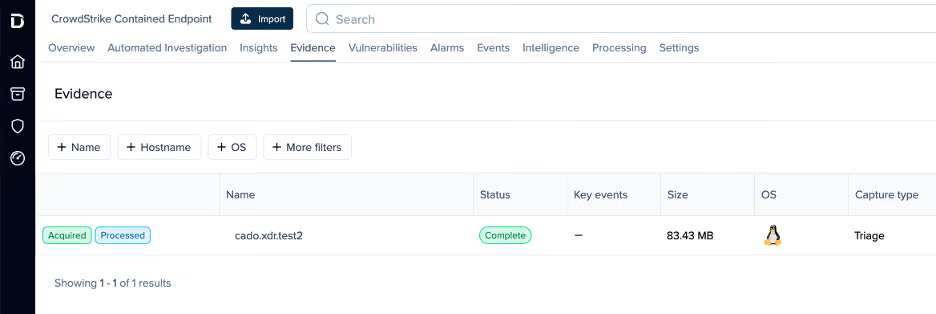
Figure 4: ‘cado.xdr.test2’ has been contained using CrowdStrike’s network containment capability
Figure 5: Successful triage capture of contained endpoint ‘cado.xdr.test2’ using / Forensic Acquisition & Investigation

The benefits of extending forensics to on‑premises and endpoint environments

Despite Darktrace / Forensic Acquisition & Investigation originating as a cloud‑first solution, the challenges of incident response are not limited to the cloud. Many investigations span on‑premises servers, unmanaged endpoints, legacy systems, or devices locked inside third‑party ecosystems.  

By extending automated investigation capabilities into on‑premises environments and endpoints, Darktrace delivers several critical benefits:

  • Unified investigations across hybrid infrastructure and a heterogeneous security stack
  • Consistent forensic depth regardless of asset type
  • Faster and more accurate root-cause analysis
  • Stronger incident response readiness

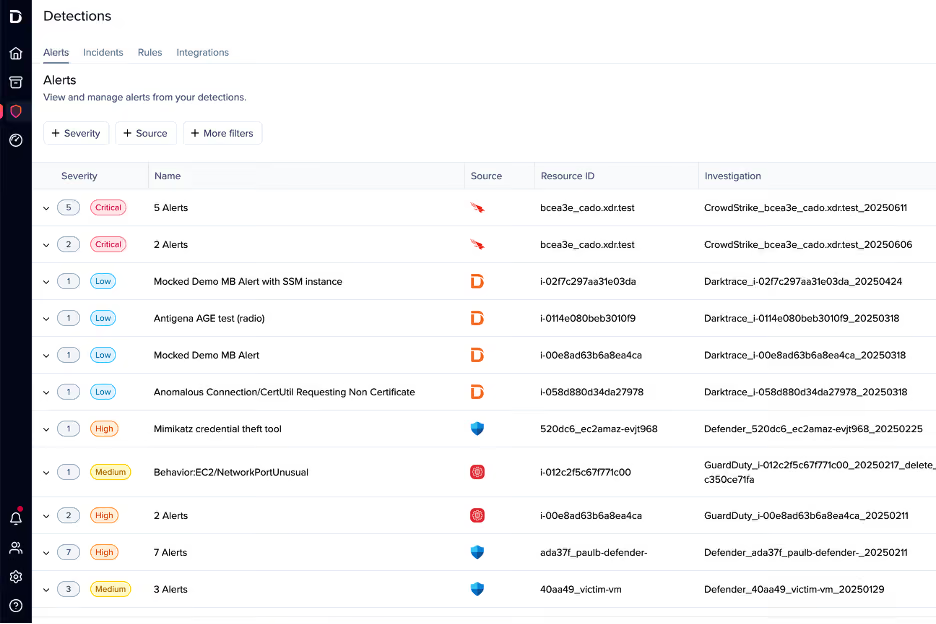
Figure 6: Unified alerts from cloud and on-prem environments, grouped into incident-centric investigations with forensic depth

Simplifying deep investigations across hybrid environments

These enhancements move Darktrace / Forensic Acquisition & Investigation closer to a vision out of reach for most security teams: seamless, integrated, high‑fidelity forensics across cloud, on‑prem, and endpoint environments where other solutions usually stop at detection. Automated forensics as a whole is fueling faster outcomes with complete clarity throughout the end-to-end investigation process, which now takes teams from alert to understanding in minutes compared to days or even weeks. All without added agents, disruptions, or specialized teams. The result is an incident response lifecycle that finally matches the reality of modern infrastructure.

Ready to see Darktrace / Forensic Acquisition & Investigation in your environment? Request a demo.

Hear from industry-leading experts on the latest developments in AI cybersecurity at Darktrace LIVE. Coming to a city near you.

[related-resource]

Get the solution brief

Discover how Darktrace / Forensic Acquisition & Investigation enables faster and deeper investigations in the cloud.

Inside the SOC
Darktrace cyber analysts are world-class experts in threat intelligence, threat hunting and incident response, and provide 24/7 SOC support to thousands of Darktrace customers around the globe. Inside the SOC is exclusively authored by these experts, providing analysis of cyber incidents and threat trends, based on real-world experience in the field.
Written by
Paul Bottomley
Director of Product Management | Darktrace

More in this series

No items found.

Blog

/

Proactive Security

/

June 3, 2026

Stopping Stealth Attacks with Precision: How Núclea Prevented a Breach Without Disruption

Default blog imageDefault blog image

Núclea is a Brazilian data and technology company that supports the country’s financial system by delivering digital services exclusively to banks and financial institutions. Operating in an environment where trust, availability, and data integrity are critical, the company faces a threat landscape that has evolved rapidly—particularly with the rise of AI-driven cyberattacks.

Brazil has experienced a wave of successful cyber incidents targeting financial institutions, many of them enabled by insiders or compromised credentials. The result was a noticeable shift in attacker strategy: instead of focusing on end customers, threat actors began targeting the institutions and platforms that underpin the financial ecosystem itself.

“Attacks became far more directed and contextual,” explains Guilherme, who leads incident response within Núclea’s security platform engineering team. “They weren’t noisy or obviously malicious—they were precise, patient, and designed to blend into normal operations.”

That precision was on full display in January 2026, when Núclea faced one of the most convincing phishing attacks the team had seen.

A real attack, built on trust and context

The attack began with a seemingly routine email.

It was sent from a real Brazilian government institution, using legitimate infrastructure and valid credentials that were later confirmed to have been compromised. Núclea had an established, ongoing relationship with this organization, and the email’s language, tone, and subject matter aligned perfectly with the type of communication the recipient team handled every day.

Attached to the email was a PDF document containing content that looked entirely legitimate.

The problem? A single URL embedded inside that PDF.

“The message itself was correct. The sender was real. The context was familiar. Even the document content made sense,” Guilherme explains. “There was just one small element that didn’t belong.”

That small detail was enough to initiate a full attack chain.

What the attackers were trying to do

If clicked, the URL would have downloaded a malicious payload designed to:

  • Collect information about the user and device
  • Identify where the system was located within the financial ecosystem
  • Install remote access tools to maintain control
  • Deploy an infostealer to extract sensitive data
  • Execute anti-forensic scripts to erase traces of the intrusion

In other words, it was a carefully engineered operation designed for persistence and stealth, not immediate disruption.

The attack also employed urgency—a classic social engineering technique. When the link didn’t open as expected, employees requested assistance from the security team, insisting the document was important and needed to be accessed quickly.

This is precisely the kind of scenario where traditional security tools struggle: almost everything about the interaction is legitimate.

Where Darktrace made the difference

Instead of blocking the entire message or relying on known indicators of compromise, Darktrace focused on behavioral context.

Darktrace recognized:

  • That the sending organization was normally trusted
  • That the communication pattern matched historical behavior
  • That the PDF content itself was not suspicious

But it also identified that the URL embedded within the document deviated from established behavioral patterns.

Rather than disrupting business operations, Darktrace took precise action: it rewrote the URL, preventing the malicious download while leaving the rest of the email untouched.

“When we analyzed it afterward, it became clear how dangerous the attack would have been,” says Guilherme. “But it never progressed—because Darktrace acted at exactly the right point.”

Subsequent forensic analysis confirmed the payload’s malicious intent. The attack never succeeded.

Precision over disruption

For Núclea, this incident reinforced a critical lesson: modern attacks don’t always look malicious—they hide within normal activity.

“What stands out to me is the precision,” Guilherme says. “Darktrace doesn’t rely on big, obvious signals. It’s effective in situations that fall outside the standard patterns we all know.”

Building resilience in a high trust ecosystem

For Núclea, cybersecurity is not just a defensive measure—it’s a business enabler.

Availability failures or successful breaches in the financial ecosystem can have immediate, large-scale consequences, from financial loss to reputational damage. Preventing those outcomes protects not just Núclea, but its partners and customers as well.

“Cyber resilience means keeping the business running—even under attack,” Guilherme explains. “And that requires people, processes, and technology working together.”

As AI continues to accelerate both attacks and defenses, the role of security is evolving. Precision, behavioral understanding, and intelligent automation are no longer optional—they’re essential.

“The easy days were yesterday,” Guilherme says. “The challenges ahead are bigger. We need to be prepared—internally and with partners that help us build resilience.”

Continue reading
About the author
Mariana Pereira
VP, Field CISO

Blog

/

Proactive Security

/

June 1, 2026

Defend What You Trust: Stories from the Front Lines of Modern Cyber Defense

Default blog imageDefault blog image

Modern attacks don’t always announce themselves, follow obvious patterns, or rely on known malware. Often, they move quietly inside trusted systems, authenticated sessions, and everyday behavior.

They don’t break in. They blend in.

That’s why an AI-powered defense is essential. It turns invisible signals into actionable insights at a scale neither analysts nor traditional tools can achieve alone.

Confidence is creating risk

One of the most dangerous assumptions in cybersecurity today is that strong controls equal strong protection.

Multi-factor authentication (MFA), for example, is widely viewed as a foundational safeguard. But as the CISO for a professional sports organization explains, that confidence can be misplaced. “A lot of organizations assume that once you have MFA, those accounts are safe. That’s not true.”

In one instance, his team identified a sophisticated attack where a threat actor bypassed MFA entirely, not by breaking it, but by going around it. A user’s authenticated session was hijacked and re-used, allowing the attacker to impersonate them without triggering traditional controls.

“Darktrace picked up that a session had been re-injected by the hacker, and we were able to block it right away,” he explains.

Attackers anticipate what we miss

Even well-trained users can become entry points.

“An email bypassed our existing security tools,” shares the VP of IT at a U.S.-based risk management services provider.  “The user missed one signal and entered their credentials into a malicious site. That’s what the bad guys count on.”

The organization responded quickly, but not before damage was done. Crucially, this occurred while Darktrace was in “watch mode,” before autonomous response was fully enabled. “Darktrace would have seen that and shut it down immediately,” he notes.

Mistakes and oversights like misconfigurations, forgotten machines, and missed patches can create serious vulnerabilities.

The CIO of a utility services organization shares an instance when Darktrace detected a breach to a client’s network via their ZTNA VPN due to misconfigured MFA. “Darktrace alerted us and autonomously blocked the scanning, preventing what could have been a ransomware-type incident.”  

The most dangerous threats are already inside

The Head of Security at a global business services provider knows firsthand how blind spots can persist inside environments. His team uncovered evidence of dormant ransomware artifacts sitting unnoticed within a company’s environment ¬¬– long before modern detection was in place.

“During a routine file transfer, Darktrace flagged the suspicious activity, identified the ransomware, and immediately quarantined the server,” he recalls.  While the attack was never executed, the implication was significant: the risk existed long before it was finally detected.

Cyber threats are also successful because they take advantage of normal human behavior, exploiting moments of cognitive overload, urgency, and trust.

The Executive Director of IT and Business Applications at a pharmaceutical lab describes the time Darktrace flagged an employee logging into Microsoft 365 from Singapore, despite him being physically located in the U.S. Darktrace immediately cut off his access and within minutes revealed that the employee’s son was using a VPN to play a video game.

While the threat was benign, it demonstrated the strength of AI to use contextual information to detect threats other tools miss. The information also saved security analysts hours of investigation and minimized downtime for the employee. “That level of precision and speed isn’t just convenient, it’s game changing.”

“Unusual” behavior is the new red flag

Detecting modern threats requires an understanding of what “normal” looks like and recognizing when something subtly deviates.

One security leader  at an AI technology enterprise described a scenario in which an employee connected to a proxy service in China. The service itself was legitimate, and although traditional tools didn’t flag it, the behavior was unusual for that user specifically.

“That’s what Darktrace picked up on. The activity turned out to be benign, but without visibility into behavioral deviations, it could just as easily have been something more serious.”

AI shifts defense from reaction to anticipation

These stories point to a fundamental shift by cyber attackers, both tactically and strategically. Because traditional security tools were built to detect what’s already known, modern attacks are often:

  • Credential-based, not malware-based
  • Behavioral, not signature-based
  • Subtle, not overt

They may operate within the boundaries of what appears normal, exploiting what organizations trust, not what they block:

  • Trusted sessions
  • Legitimate services
  • Human error

This is where AI is changing the equation. Rather than relying on predefined rules or known threat signatures, AI can:

  • Establish a baseline of normal behavior
  • Detect subtle anomalies in real time
  • Act autonomously to contain potential threats

Resilience, not perfection, is the new security standard

As these frontline experiences show, the organizations that lead are those that move beyond reactive defense and embrace AI as a core part of their strategy.

It eliminates the blind spots and uncertainty, says the CISO of a professional sports organization. “If you lack visibility, you’re not managing risk, you’re assuming it. AI gives you the actionable insights needed to turn uncertainty into control.”

And it provides the speed and agility that are vital when seconds matter, says the Executive Director of IT and Business Applications. “When Darktrace alerted us at 3:00 am to a ransomware attack, it had already quarantined the affected systems, blocked the attacker’s access, and provided us with the critical details and time needed to investigate. That action likely saved us hundreds of thousands, if not millions, of dollars.”

The modern SOC has become a cornerstone of enterprise resilience, responsible for protecting data and operational continuity while enabling digital growth and innovation. For today’s security professional, that means success is no longer measured by what they keep out, but by what they protect: revenue, reputation, and trust.

Continue reading
About the author
Your data. Our AI.
Elevate your network security with Darktrace AI