Blog
/
AI
/
May 27, 2026

How to Evaluate AI Vendors: 5 Key categories for AI Adoption

Buying AI cybersecurity tools requires more than evaluating features and marketing claims. This blog explores the challenges security teams face when assessing AI vendors, outlines five critical categories for AI evaluation, and explains how governance, transparency, model selection, and validation impact trust, adoption, and long-term security outcomes.
Inside the SOC
Darktrace cyber analysts are world-class experts in threat intelligence, threat hunting and incident response, and provide 24/7 SOC support to thousands of Darktrace customers around the globe. Inside the SOC is exclusively authored by these experts, providing analysis of cyber incidents and threat trends, based on real-world experience in the field.
Written by
Jamie Bali
Technical Author (AI) Developer
Default blog image
27
May 2026

Understanding the AI buyers’ market

AI adoption has become a central topic of discussion in boardrooms, drawing growing interest from business leaders. Ultimately, organizations hope that an investment in AI technology will have tremendous returns. However, the process of buying an AI solution is not as straight forward as it appears on the surface.  

While business leaders may be eager to improve productivity across their operations, practitioners responsible for evaluating and selecting AI solutions may not always have the visibility or technical understanding needed to make the right decisions for their business. What is typically marketed as a holistic solution to their most critical problems is usually followed by uncertainty when AI tools are finally operationalized in real environments.

This guide is intended to support security leaders who are under growing pressure to adopt AI tools while navigating complex terminology, vendor claims, and increasingly crowded buying cycles. Ultimately, the goal is to help organizations evaluate and adopt AI in a safe, effective, and well-governed way. To support this, we’ve structured the evaluation framework across five key categories:

  1. Governance, safety, and data controls
  1. Data gathering and training
  1. Model and technique choice
  1. Performance and accuracy validation    
  1. Interpretability, adjustability, and transparency    

What buying AI looks like in cybersecurity

While investing in AI can bring immense benefits to your security team, first-time buyers of AI cybersecurity solutions may not know where to start. They will have to determine the type of tool they want, know the options available, and evaluate vendors. Research and understanding are critical to ensure purchases are worth the investment.  

With acceleration in AI adoption, accompanied by the recent boom in agentic AI and autonomous agents, CISOs must look “beneath the hood" of these tools to understand how they work, how they are governed, and to ensure the system is secure and compliant with internal policies.

Challenges in the AI buyers’ marketplace  

The AI security software market is buzzing with hype and flashy promises, which, understandably, needs to be addressed with due diligence. Potential buyers, especially in the cybersecurity space, are hesitant when it comes to allowing AI autonomous capabilities across their workflows, and a lack of vendor transparency can exacerbate those feelings.  

Reinforcing this sentiment, research from this year's Darktrace’s State of AI Cybersecurity report shows where confidence and hesitancy emerge amongst potential buyers. On the one hand, security professionals agree that they have good visibility into the logic and reasoning processes their AI solutions use. However, they lack the explainability and trust to allow AI to take independent remedial action.

  • 89% say they have good visibility into the reasoning behind the outputs generated by AI solutions
  • 92% say they need to understand how a defensive AI tool makes decisions before they can trust it
  • Only 14% say they allow AI to act independently, performing autonomous actions without human approval
  • 74% say they are limiting the autonomy of AI taking action in their SOC until explainability improves

Given the desire for trust and explainability we are seeing from buyers, it's important for them to be equipped with the right questions to ask vendors during an assessment or POV of AI tools in order to demystify marketing hype from real operational outcomes.

Below is a list of categories in which buyers can assess AI vendors or AI Service Providers (AISPs) to help reach safe adoption and maximize their ROI.  

5 categories of AI vendor assessment

Darktrace groups these AI-related questions into 5 categories: governance, data and training, model and technique choice, performance validation, and interpretability and adjustability. By asking questions regarding each of these 5 categories, buyers can gain a deeper understanding of how an AISP’s systems work and whether they suit their business requirements.

Governance, safety, and data controls

Governance of AI systems is critical for all AISPs. Whether their platform is based around a single model, or is a more complex, composite AI solution, strong governance is essential to ensure the system is safe, robust, and reliable.

A simple question you could ask is:

What AI governance policies and frameworks do you follow, and/or certifications do you currently maintain?

For more questions you can ask vendors, download the full guide here.

Darktrace is certified to the ISO/IEC 42001 standard, the world’s first AI Management System (AIMS) standard. ISO/IEC 42001 addresses the unique ethical and technical challenges AI poses by setting out a structured way to manage risks such as transparency, accuracy, and misuse. This includes a commitment to ethical AI development, and effective management and monitoring of AI systems both prior to and continually after release.

Data gathering and training

Accurate, meaningful, and unbiased data gathering is the first important step in producing any AI system. An AI model trained using inaccurate, unbalanced, or poor-quality training data will fail to perform optimally.

To alleviate concerns regarding training data quality, a question you could ask is:

What steps do you take to prevent bias in your AI models and training data?

For more questions, download the full guide here.

AISPs should be able to provide information about the steps taken, workflows followed, and auditing performed to reduce AI bias where appropriate. While it’s sometimes impossible to fully remove bias from an AI model, appropriate actions should be taken to mitigate or reduce bias where relevant.

Model and technique choice

Different AI techniques are optimal for different tasks. For example, research from Gartner suggests that relying on a single “one-size-fits-all" model can lead to data gaps, especially in highly specialized domains.

To achieve more accurate and robust AI solutions, AI leaders should move beyond using just one model or technique, embrace composite AI practices, and adopt a holistic AI system perspective.

A straightforward question you could ask is simply:

What type(s) of AI model(s) do you utilize in your solution?

For more questions, download the full guide here.

While specific detailed information about custom systems used by AISPs is likely proprietary, buyers should expect vendors to be able to provide an overview of the broad techniques used. This will allow you as a buyer to determine if the type of model is appropriate for your use case.

Performance and accuracy validation  

Testing and evaluation of performance is essential for all AI systems. Performance analysis should be performed both before release and continually after release to identify potential data or model drift.  

A question you could ask to understand an AISPs testing workflow is:

How do you audit, test, evaluate, verify, and validate your AI model outputs?

For more questions, download the full guide here.

Testing workflows will likely vary depending on the type of model – measurements relevant to one system may not always be relevant to others. Assessment of systems should also extend beyond these standard accuracy and robustness tests, and should also feature physical performance, such as latency and resource consumption.  

Interpretability, adjustability, and transparency  

AI systems are typically a black box, simply providing an output without an explanation of how that output was attained. Interpretability and transparency are critical to ensure that both SOC teams and end-users trust the outputs of a system to be accurate and meaningful.

A question you could ask is:

How do you promote a trust relationship between human analysts and AI outputs?

For more questions, download the full guide here.

In the context of cybersecurity, trust and interpretability are even more essential. This is particularly relevant for generative AI-based systems (including most AI Agents), where the risk of hallucination can reduce trust in responses.

Cybersecurity systems often need to perform autonomous actions to block incoming threats – an email filtering system may hold potentially dangerous emails; a firewall may block malicious inbound connections. If SOC teams can’t trust these systems to perform accurately, these systems may be limited or disabled, critically reducing their defensive power.

Darktrace as an AI-native cybersecurity vendor

Darktrace has been building and applying AI in cybersecurity for over a decade, developing its capabilities alongside an increasingly complex and fast‑moving threat landscape. This experience has resulted in a mature, multi-layered approach to AI, which continuously learns the normal patterns of each organization to understand behavior, interpret context, and identify meaningful deviations — without relying on predefined rules or known attack signatures. Over time, this has enabled a proven behavioral understanding that helps uncover subtle signals of risk that may otherwise be missed.

With the backing of our ISO/IEC 42001 certification, stakeholders, customers, and partners can be confident that Darktrace is responsibly, ethically, and safely developing its AI systems, and managing the use of AI in day-to-day operations in a compliant and secure manner.  

Explore the principles behind Darktrace’s responsible AI approach, informed by collaboration with global experts in academia and governments, detailing how accountability, explainability, and continuous validation are built into its cybersecurity technology.

How Darktrace secures AI systems

Darktrace now brings these capabilities to monitor and respond to risk generated from AI systems across organizations with Darktrace / SECURE AI. This solution analyzes how prompts, agents, and systems are used within the context of each organization, bringing every AI interaction into a single view. This unique approach helps teams understand intent, assess risk, protect sensitive data, and enforce policy across both human and AI agent activity.

Stay up to date

Sign up for the Secure AI Readiness Program here: This gives you exclusive access to the latest news on the latest AI threats, updates on emerging approaches shaping AI security, and insights into the latest innovations, including Darktrace’s ongoing work in this area.

Ready to talk with a Darktrace expert on securing AI? Register here to receive practical guidance on the AI risks that matter most to your business, paired with clarity on where to focus first across governance, visibility, risk reduction, and long-term readiness.  

Further Reading on AI in cybersecurity

When deciding to invest in an AI solution, it’s important to understand what this means for you and your organization. The questions presented here are only a starting point in understanding an AI solution and whether it is appropriate for your use case.  

Gain deeper knowledge on applications of AI in cybersecurity and Darktrace’s multi-layered AI in the AI Arsenal White Paper.

[related-resource]

Explore the CISO’s Guide to Buying AI

Learn how to understand an AI Service Provider’s solution and determine if it’s right choice for your organization

Inside the SOC
Darktrace cyber analysts are world-class experts in threat intelligence, threat hunting and incident response, and provide 24/7 SOC support to thousands of Darktrace customers around the globe. Inside the SOC is exclusively authored by these experts, providing analysis of cyber incidents and threat trends, based on real-world experience in the field.
Written by
Jamie Bali
Technical Author (AI) Developer

More in this series

No items found.

Blog

/

AI

/

July 13, 2026

Security After Signatures: Operating in a World of Pre‑CVE Disclosure Exploitation, Collapsed Trust Boundaries, and Autonomous Systems

Default blog imageDefault blog image

Three shifts have reshaped what it means to defend an enterprise securely.  

First, exploitation often begins before defenders have a Common Vulnerabilities and Exposures (CVE) identifier, a security advisory, or an entry in the Cybersecurity and Infrastructure Security Agency's (CISA) Known Exploited Vulnerabilities (KEV) catalog.

Secondly, the trust boundary has moved beyond the network edge into identities, tokens, APIs, and Software-as-a-Service (SaaS) workflows.  

Third, an increasing share of business activity is executed through automation, integrations, and AI agent-like systems that can act faster than teams can verify intent.  

If your security model still relies on detecting known bad artefacts, triaging isolated alerts, and waiting for confirmation before acting, you are already behind the threat.  

This is not a failure of security teams; it’s a failure of the operating model to keep pace with how the environment has changed.

A SOC built around alerts and signatures assumes that malicious activity will eventually surface as an event. In real incidents, however, the decisive evidence is rarely a single event. Instead, it is a chain of individually explainable actions that only appears malicious once you connect the dots across identity, non-human identity, cloud, email, SaaS, operational technology (OT), and network telemetry.

The defenders succeeding today observe behaviors, link them into sequences, understand what those sequences mean, and contain impact before the full story unfolds. That is the operating model the current threat environment demands.  

Exploitation before disclosure

The first shift is the straightforward: the time to exploit has dropped to nearly zero.  

In one example, Darktrace observed a sequence of subtle but strategically significant anomalies within a customer environment that later aligned with exploitation of CVE‑2025‑0994 in Trimble Cityworks by likely Chinese-nexus threat actors. Behavioral indicators were visible at least 18 days before public disclosure, with related anomalies emerging 40 to 50 days earlier during the intrusion window.  

This case illustrates a familiar pattern: clusters of weak‑signal anomalies combing to form an actionable picture of intrusion long before a CVE is published. Such activity reflects long‑horizon, option‑preserving operator models often associated with mature state‑linked activity.  

Figure 1: Darktrace’s detection of malicious exploitation of CVE 2025-0994, later tied to Chinese-nexus threat actors targeting critical national infrastructure (CNI) in the US, weeks before public disclosure.

Throughout 2025 and 2026, Darktrace has continued to observe the value of anomaly-based detections across a range of incidents.

CVE CVE Public Disclosure Date Darktrace Detection Date Days Between Detection of Exploitation and CVE Public Disclosure
CVE 2025 0994
(Trimble City Works)
2025-02-06 2025-01-19 18 Days
CVE 2025-24183
(Apache)
2025-03-10 2025-02-18 20 days
CVE 2025-10035
(Fortra GoAnywhere)
2025-09-18 2025-09-11 7 days

Identity is the real control plane

The second shift is that identity has replaced perimeter as the primary control plane. As Darktrace’s Annual Threat Report 2026 illustrated, identity remains the main challenge in defending against modern intrusions. A clear example is the Adversary-in-the-Middle (AiTM) case published by Darktrace in December 2025. A phishing email led to the compromise of an Office 365 account. Session hijacking bypassed multi-factor authentication (MFA), and the compromised account was used for follow-on phishing and persistence activities including the creation of malicious email rules.  

Every step in that sequence mattered. A successful login alone does not prove legitimacy. An inbox rule, on its own, may not appear catastrophic. Mail activity, viewed in isolation, may seem operationally normal. But the behavioral chain tells a different story: credential theft, token abuse, persistence, and onward compromise through a trusted identity.  

This is why the question is no longer “Did the user authenticate successfully”. The more important question is, “Does this identity action make sense right now, in this context, given what came before it?” The AiTM case shows how identity can be compromised. In practice, however, attacks rarely remained confined to identity alone.  

In another Darktrace case, a compromised SaaS account triggered activity across the email, SaaS, and network layers, including inbox rule changes, phishing propagation, and connections to suspicious infrastructure. Viewed in isolation, none of these events were decisive. Together, however,  they formed a behavioral sequence that revealed the intrusion, with the full attack story automatically correlated and surfaced to defenders by Darktrace’s Cyber AI Analyst.  

Figure 2: Cyber AI Analyst correlated and appended additional events to the incident, including other users who connected to the suspicious redirect link after outbound phishing emails were sent.

AI accelerates the threat  

The third shift is the one many teams still underestimate: trusted tooling, integrations, and AI agent-like systems can create actions that appear legitimate but are strategically dangerous.  

The shift becomes clearer when examining how governments are now framing AI risk. In 2026, guidance published by CISA, UK’s National Cyber Security Centre (NCSC) and Five Eyes partners warned that agentic systems expand attack surfaces, accumulate privilege, and can behave in ways that are difficult to predict or explain [1]. The advice is simple: assume unexpected behavior and design controls around it.  

The real risk is not AI usage. It is unknown autonomy: systems with credentials, data access, and action paths that can execute workflow steps without sufficient behavioral validation, traceability, or human oversight. Darktrace’s Model Context Protocol (MCP) risk analysis provides a useful framework for understanding this challenge. Over-privileged agents, content injection, and tool abuse become high-consequence risks when connected systems can dynamically retrieve data, execute actions, and communicate externally.  

Whether security teams like it or not, AI is already in the enterprise. It will help drive innovation, but it will also be abused, whether accidentally or maliciously. In each of the cases below, AI either scaled the attacker, built the tooling, or existed within the environment as something to exploit or misuse.

1. AI as an Attack Multiplier

In one campaign targeting Mexican government entities, a single operator used commercial AI platforms to generate exploits, automate reconnaissance, and process large volumes of data, compressing work that would traditionally have required an entire team into a single workflow [2].  

Darktrace is also observing this trend further down the stack. In one case, Darktrace identified AI-generated malware exploiting React2Shell, where an attacker used a Large Language Model (LLM) to produce working exploit code and deploy it at scale.  

[darktrace.com], [darktrace.com]

2. AI as an Attack Surface

Attempted AI exploitation is now appearing within customer environments. In one case involving an automation technology manufacturer, a compromised LLM proxy was seemingly used as a stepping stone to access additional AI services. When that attempt failed, the attacker pivoted to cryptomining.

What is clear is that the AI layer has already become an asset worth probing, exploiting, and pivoting through. It is also clear that defenders benefit from rapidly understanding how these activities connect. In this case, Cyber AI Analyst automatically pieced together the intrusion, while Darktrace’s Managed Threat Detection service alerted to the customer, enabling the activity to be contained before it could progress further.

Figure 3: Cyber AI Analyst's investigation into a compromised LLM proxy that was abused for cryptomining activity.

AI as a trusted but dangerous actor

This does not require a cinematic vision of “rogue AI.” The Salesloft incident provides a more grounded example, where AI and automation operate with legitimate access but served malicious intent. In that case, attackers abused compromised OAuth tokens associated with the Drift AI chat agent to export significant volumes of data from Salesforce environments.  

The activity resembled legitimate API usage and relied on trusted SaaS integrations rather than malware or other obvious signs of intrusion. That is precisely the challenge. Traditional security controls are good at detecting forced entry, but far less effective when a trusted application integration behaves in a way that is technically permitted yet operationally harmful.  

In these scenarios, the security challenge shifts from validating access to validating behavior.

This is what that looks like in practice: AI-linked identities executing legitimate actions that require behavioral validation rather than access validation.

Figure 4: Darktrace / SECURE AI highlights anomalous activity across AI identities, surfacing critical behavior that requires validation and containment.

Early observations from Darktrace / SECURE AI deployments reinforce this reality. Across Darktrace's observed fleet, AI service connections per deployment increased 13% during the first half of 2026, reaching over 16 million connections overall. The typical organisation now interacts with seven different AI providers, evidence that AI is no longer operating at the edges of the enterprise. It is increasingly woven into day-to-day business activity.

The most common risks are not compromised models or advanced AI attacks. Instead, they stem from employees and business functions exposing sensitive information through entirely legitimate-looking interactions. Darktrace has observed repeated submission of personally identifiable information (PII), tax information, identification documents, and medical data into LLM prompts, alongside widespread use of unsanctioned (shadow) AI services and growing AI activity from mobile devices.  

For defenders, the challenge is increasingly one of context: understanding when legitimate business use crosses into material risk, while preserving privacy and user trust.

Conclusion

Across all three shifts, the pattern is the same: behavior precedes understanding. Security teams are not losing because adversaries have become invisible. An increasingly outdated security model assumes that malicious activity will reveal itself cleanly and early. It no longer does.  

In 2026 and beyond, defenders win by understanding behavioral sequences, continuously validating trust, and acting before certainty becomes hindsight. That is security after signatures. That is security in the AI era.

Credit to: Daniel Levy, Threat Hunting Data Scientist

Edited by: Ryan Traill, Content Manager

References

[1] https://www.cyber.gov.au/business-government/secure-design/artificial-intelligence/careful-adoption-of-agentic-ai-services  

[2]https://www.latimes.com/business/story/2026-02-26/hacker-used-anthropics-claude-ai-to-steal-mexican-government-data

Continue reading
About the author
Nathaniel Jones
VP, Security & AI Strategy, Field CISO

Blog

/

AI

/

July 9, 2026

When AI Infrastructure Becomes Part of the Attack Surface

ai infrastructure cybersecurityDefault blog imageDefault blog image

AI Infrastructure and the Evolving Attack Surface

As organizations deploy generative AI into production environments, a new layer of infrastructure has emerged inside enterprise cloud environments: AI gateways.

What is an AI gateway?

AI gateways are systems that sit between users, applications, and foundation models, often holding privileged cloud permissions and managing access to AI services at scale.

Because of that role, AI gateways are becoming an increasingly important part of the enterprise attack surface. A compromise may provide attackers with access not only to compute resources, but also to cloud identities, model services, sensitive prompts, and other connected systems.

This blog examines how Darktrace investigated a compromised AI gateway connected to Amazon Bedrock services that was subsequently observed communicating with cryptomining infrastructure. Based on its configuration and associated Identity and Access Management (IAM) role, the instance appeared to function as a gateway to Amazon Bedrock-hosted AI services. Following suspected compromise activity, the host was observed communicating repeatedly with known cryptomining infrastructure before subsequently being shut down. Darktrace detected and escalated the activity through its Enhanced Monitoring and Managed Threat Detection services.

While the ultimate impact in this case appeared to be unauthorized cryptomining, the incident is notable because of where it occurred. The compromised asset sat at the intersection of cloud infrastructure, identity, and AI services. Recent research has highlighted how AI gateways such as LiteLLM can become attractive targets due to their ability to centralize credentials, model access, and cloud permissions. Although Darktrace found no evidence linking this activity directly to publicly disclosed LiteLLM vulnerabilities, the incident demonstrates why organizations should treat AI infrastructure as part of their critical attack surface rather than as a standalone application tier [1].

Why cryptomining remains a common cloud post-compromise activity

Cryptomining can be a lucrative post-compromise activity in cloud environments. After gaining access to a cloud asset, attackers may deploy mining software to abuse the victim’s compute resources for financial gain. This type of activity is likely to be opportunistic, targeting exposed services, weak credentials, leaked access keys, vulnerable applications, or misconfigured cloud workloads.

A typical cloud cryptomining intrusion may involve:

  • Identifying exposed or vulnerable cloud infrastructure
  • Gaining access through exposed services, credentials, or application weaknesses
  • Downloading and executing mining software
  • Establishing repeated outbound connectivity to mining pool infrastructure
  • Continuing to consume compute resources until the activity is detected and disrupted

The notable element in this case is not the cryptomining alone, but where it occurred: on cloud infrastructure supporting AI-related activity. This shows how assets used to enable AI services can still be exposed to familiar cloud compromise risks.

Investigating a compromised AI gateway connected to Amazon Bedrock

On June 12, 2026, Darktrace observed activity consistent with active cryptomining from an Amazon Web Service (AWS) EC2 instance named LiteLLM-Proxy. The instance appeared to support LiteLLM activity and was associated with an instance profile that had access to Amazon Bedrock resources.

AI gateways are designed to centralize access to large language models, often handling authentication, routing, logging, and policy enforcement for AI applications. From a security perspective, they also aggregate cloud permissions, model access, and application workflows into a single control point. As a result, compromise of an AI gateway can have implications beyond the affected host itself.

While the exact initial access vector could not be confirmed, the activity appears to follow a sequence often seen in compromises of internet-facing systems: brute-forced access, payload delivery, and repeated outbound connectivity to mining pool infrastructure.

Stage 1: Internet-exposed SSH enabled initial access

Prior to the observed cryptomining activity, the LiteLLM-Proxy EC2 instance appeared to be externally exposed over SSH, with port 22 open to 0.0.0.0/0.

Figure 1: Darktrace’s misconfiguration alert EC2 instance allowing all inbound traffic to SSH port 22.

Prior to the cryptomining activity, Darktrace observed a large volume of inbound connection attempts to the instance over port 22 from external IP addresses, predominantly from 145.241.123[.]102, suggesting brute-force activity [2]. Many of these connections were short-lived, lasting only a few seconds, indicating scanning or failed login attempts.

Figure 2: Darktrace’s detection of unusual incoming connection attempts to the device over port 22.

The available telemetry did not confirm whether any inbound SSH connection resulted in successful authentication, preventing this activity from being confirmed as the initial access vector. However, the combination of public SSH exposure, inbound connections from external IP addresses, and subsequent miner activity suggests that SSH was a plausible access path.

Stage 2: XMRig malware downloaded to the AI gateway

Before the first observed connection to the mining pool, the EC2 instance downloaded 3.42 MB of data over an HTTP connection on port 80 to the external endpoint, 185.62.1[.]8, which appears to host a ZIP file containing XMRig crypto-mining malware [3][4]. As host-level logs were not available, Darktrace could not confirm how the miner was executed or whether the earlier SSH activity directly enabled payload delivery. However, the timing of the download, followed shortly by repeated mining pool connectivity, supported the assessment that the instance had been compromised and was being used for unauthorized compute activity.

Stage 3 – Compromised AI gateway communicates with cryptomining infrastructure

Just a few minutes later, Darktrace observed the LiteLLM-Proxy EC2 instance connecting to the hostname pool.hasvault[.]pro over HTTPs on port 443. Following the initial connection, repeated outbound connectivity to the same hostname was observed. This pattern is consistent with active cryptomining pool communication, where a compromised host communicates with mining infrastructure to receive work and submit results.

This activity triggered the Enhanced Monitoring model “Compromise / High Priority Crypto Currency Mining”, which was escalated to the customer by Darktrace’s SOC. The activity was also summarized by Darktrace’s Cyber AI Analyst, which grouped the relevant events into a single investigation narrative, helping to identify the repeated mining pool connectivity from the affected cloud asset.

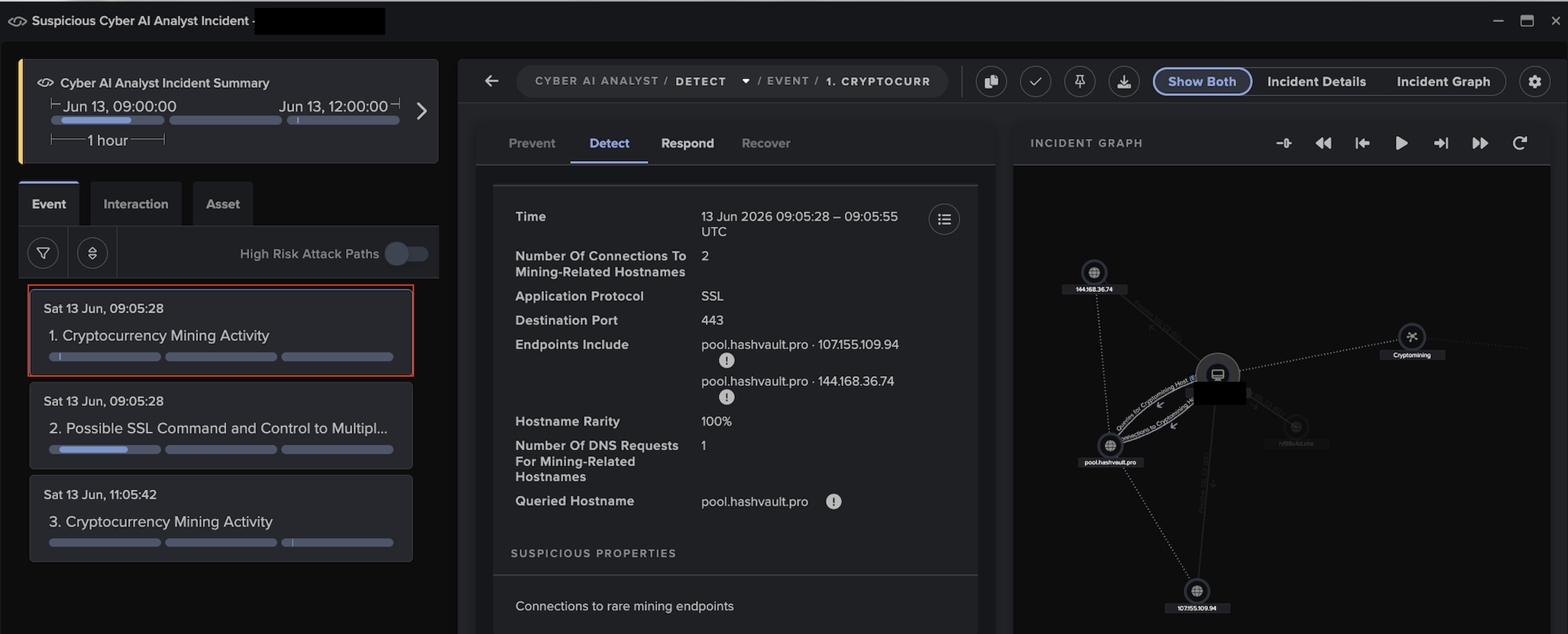
Figure 3: Cyber AI Analyst’s investigation of the cryptocurrency mining activity.

The use of HTTPS over port 443 is notable because, when viewed in isolation, this traffic may not appear inherently suspicious. In this case, however, the destination, volume of connections, and lack of similar activity provided the behavioral context needed to identify the communication as suspicious.

Stage 4: Managed Threat Detection identifies active resource abuse

The cryptomining activity was received by Darktrace’s Managed Threat Detection service and reviewed by Darktrace’s SOC. Following review, the activity was escalated to the customer. This escalation provided the customer with timely notification of active resource abuse in the AWS environment.

Stage 5: Suspicious IAM activity suggests possible cloud credential misuse

Separately, on June 13, Darktrace observed suspicious activity originating from an additional IAM user.

Figure 4: Darktrace’s Advanced Search highlighting suspicious activity performed by a second IAM user.

First, the user was observed attempting the “GetSendQuota” event, an action that had not performed by the account within at least the previous three months. Additionally, the source IP address of this command appeared to be 14.176.1[.]47, geolocated in Vietnam, whereas activity for this user had mostly been seen from Amazon IP addresses. Furthermore, the AWS CLI was also observed being used for this activity, which was also unusual for the user. This was detected by the model “IaaS / Unusual Activity / Unusual AWS CLI Activity”.

Figure 5: Darktrace’s detection of the “GetSendQuota” event.

Further suspicious activity was observed from the IAM user using the long-term access key. Notably, failed “InvokeModel” and “ListFoundationModels” commands were detected, suggesting attempted interaction with Amazon Bedrock services, including model enumeration or invocation. While this may suggest relation to the LiteLLM compromise observed the previous day, there is insufficient evidence to conclusively link the two events.

The attempted “CreateUser” command was also notable because the requested username appeared low-meaning, which may indicate an attempt to establish persistence by creating a new account. This activity triggered the model “IaaS / Admin / New AWS User Account Creation”.

Figure 6: Darktrace’s detection of the “CreateUser” event.

Even without a confirmed link between the two incidents, the IAM activity remains significant. It demonstrates the importance of incorporating workload both telemetry and control-plane telemetry into cloud compromise investigations. While the EC2 cryptomining activity indicated compute resource abuse, the IAM activity suggested potential credential compromise or misuse involving long-term access keys, along with attempted cloud service abuse.

Key lessons for securing AI infrastructure

This incident was notable not because of the cryptomining activity itself, but because of where it occurred. The compromised system appeared to function as an AI gateway with access to Amazon Bedrock services, placing it at the intersection of cloud infrastructure, identity, and AI operations. As organizations deploy AI capabilities into production environments, these platforms are becoming part of the same attack surface that adversaries already target through exposed services, credential theft, and cloud misconfigurations.

While the exact intrusion path could not be confirmed, and no definitive link was established between the compromised workload and the suspicious IAM activity observed during the investigation, both events reinforce a broader reality: AI infrastructure must be secured as part of the wider cloud environment rather than treated as a separate technology stack.

In this case, the most obvious sign of compromise was communication with cryptomining infrastructure. The more important lesson is that Darktrace’s behavioral analysis revealed risk surrounding a privileged AI-enabled asset before the full scope of the incident was understood. As AI gateways increasingly concentrate cloud permissions, model access, and application workflows, defenders will need to focus less on individual alerts and more on understanding how behaviors connect across workloads, identities, and services.

Credit to Angel Arribas Lopez (Associate Principal Cyber Analyst), Nathaniel Jones (Field CISO/VP Threat Research), Emma Foulger (Global Threat Ops),  and Mark Turner (Security Researcher)

Edited by Ryan Traill (Content Manager)

Appendices

Darktrace Model Detections

·       Compromise / High Priority Crypto Currency Mining

·       Compromise / Monero Mining

·       Device / Internet Facing Device with High Priority Alert

·       IaaS / Unusual Activity / Unusual AWS CLI Activity

·       IaaS / Admin / New AWS User Account Creation

MITRE ATT&CK Mapping

Initial Access – External Remote Services – T1133

Initial Access – Valid Accounts – T1078

Execution – Command and Scripting Interpreter – T1059

Persistence – Create Account – T1136

Discovery – Cloud Service Discovery – T1526

Impact – Resource Hijacking – T1496

References

[1] https://docs.litellm.ai/blog/security-update-march-2026

[2] https://www.abuseipdb.com/check/145.241.123.102

[3] https://urlscan.io/search/#185.62.1.8

[4] https://www.virustotal.com/gui/file/85de36ff66fae9f4b059cbedf6d36e017ebc26c828f99f911a96e78636f21200/community

Continue reading
About the author
Angel Arribas Lopez
Associate Principal Cyber Analyst
Your data. Our AI.
Elevate your network security with Darktrace AI