
Findings in this blog are taken from Darktrace’s annual State of AI Cybersecurity Report 2026.
AI is a contributing member of nearly every modern cybersecurity team. As we discussed earlier in this blog series, rapid AI adoption is expanding the attack surface in ways that security professionals have never before experienced while also empowering attackers to operate at unprecedented speed and scale. It’s only logical that defenders are harnessing the power of AI to fight back.
After all, AI can help cybersecurity teams spot the subtle signs of novel threats before humans can, investigate events more quickly and thoroughly, and automate response. But although AI has been widely adopted, this technology is also frequently misunderstood, and occasionally viewed with suspicion.
For CISOs, the cybersecurity marketplace can be noisy. Making sense of competing vendors’ claims to distinguish the solutions that truly deliver on AI’s full potential from those that do not isn’t always easy. Without a nuanced understanding of the different types of AI used across the cybersecurity stack, it is difficult to make informed decisions about which vendors to work with or how to gain the most value from their solutions. Many security leaders are turning to Managed Security Service Providers (MSSPs) for guidance and support.
The right kinds of AI in the right places?
Back in 2024, when we first conducted this annual survey, more than a quarter of respondents were only vaguely familiar with generative AI or hadn’t heard of it at all. Today, GenAI plays a role in 77% of security stacks. This percentage marks a rapid increase in both awareness and adoption over a relatively short period of time.
According to security professionals, different types of AI are widely integrated into cybersecurity tooling:
- 67% report that their organization’s security stack uses supervised machine learning
- 67% report that theirs uses agentic AI
- 58% report that theirs uses natural language processing (NLP)
- 35% report that theirs uses unsupervised machine learning
But their responses suggest that organizations aren’t always using the most valuable types of AI for the most relevant use cases.
Despite all the recent attention AI has gotten, supervised machine learning isn’t new. Cybersecurity vendors have been experimenting with models trained on hand-labeled datasets for over a decade. These systems are fed large numbers of examples of malicious activity – for instance, strains of ransomware – and use these examples to generalize common indicators of maliciousness – such as the TTPs of multiple known ransomware strains – so that the models can identify similar attacks in the future. This approach is more effective than signature-based detection, since it isn’t tied to an individual byte sequence or file hash. However, supervised machine learning models can miss patterns or features outside the training data set. When adversarial behavior shifts, these systems can’t easily pivot.
Unsupervised machine learning, by contrast, can identify key patterns and trends in unlabeled data without human input. This enables it to classify information independently and detect anomalies without needing to be taught about past threats. Unsupervised learning can continuously learn about an environment and adapt in real time.
One key distinction between supervised and unsupervised machine learning is that supervised learning algorithms require periodic updating and re-training, whereas unsupervised machine learning trains itself while it works.
The question of trust
Even as AI moves into the mainstream, security professionals are eyeing it with a mix of enthusiasm and caution. Although 89% say they have good visibility into the reasoning behind AI-generated outputs, 74% are limiting AI’s ability to take autonomous action in their SOC until explainability improves. 86% do not allow AI to take even small remediation actions without human oversight.
This model, commonly known as “human in the loop,” is currently the norm across the industry. It seems like a best-of-both-worlds approach that allows teams to experience the benefits of AI-accelerated response without relinquishing control – or needing to trust an AI system.
Keeping humans somewhat in the loop is essential for getting the best out of AI. Analysts will always need to review alerts, make judgement calls, and set guardrails for AI's behavior. Their input helps AI models better understand what “normal” looks like, improving their accuracy over time.
However, relying on human confirmation has real costs – it delays response, increases the cognitive burden analysts must bear, and creates potential coverage gaps when security teams are overwhelmed or unavailable. The traditional model, in which humans monitor and act on every alert, is no longer workable at scale.
If organizations depend too heavily on in-the-loop humans, they risk recreating the very problem AI is meant to solve: backlogs of alerts waiting for analyst review. Removing the human from the loop can buy back valuable time, which analysts can then invest in building a proactive security posture. They can also focus more closely on the most critical incidents, where human attention is truly needed.
Allowing AI to operate autonomously requires trust in its decision-making. This trust can be built gradually over time, with autonomous operations expanding as trust grows. But it also requires knowledge and understanding of AI — what it is, how it works, and how best to deploy it at enterprise scale.
Looking for help in all the right places
To gain access to these capabilities in a way that’s efficient and scalable, growing numbers of security leaders are looking for outsourced support. In fact, 85% of security professionals prefer to obtain new SOC capabilities in the form of a managed service.
This makes sense: Managed Security Service Providers (MSSPs) can deliver deep, continuously available expertise without the cost and complexity of building an in-house team. Outsourcing also allows organizations to scale security coverage up or down as needs change, stay current with evolving threats and regulatory requirements, and leverage AI-native detection and response without needing to manage the AI tools themselves.
Preferences for MSSP-delivered security operations are particularly strong in the education, energy (87%), and healthcare sectors. This makes sense: all are high-value targets for threat actors, and all tend to have limited cybersecurity budgets, so the need for a partner who can deliver affordable access to expertise at scale is strong. Retailers also voiced a strong preference for MSSP-delivered services. These companies are tasked with managing large volumes of consumer personal and financial data, and with transforming an industry traditionally thought of as a late adopter to a vanguard of cyber defense. Technology companies, too, have a marked preference for SOC capabilities delivered by MSSPs. This may simply be because they understand the complexity of the threat landscape – and the advantages of specialized expertise — so well.
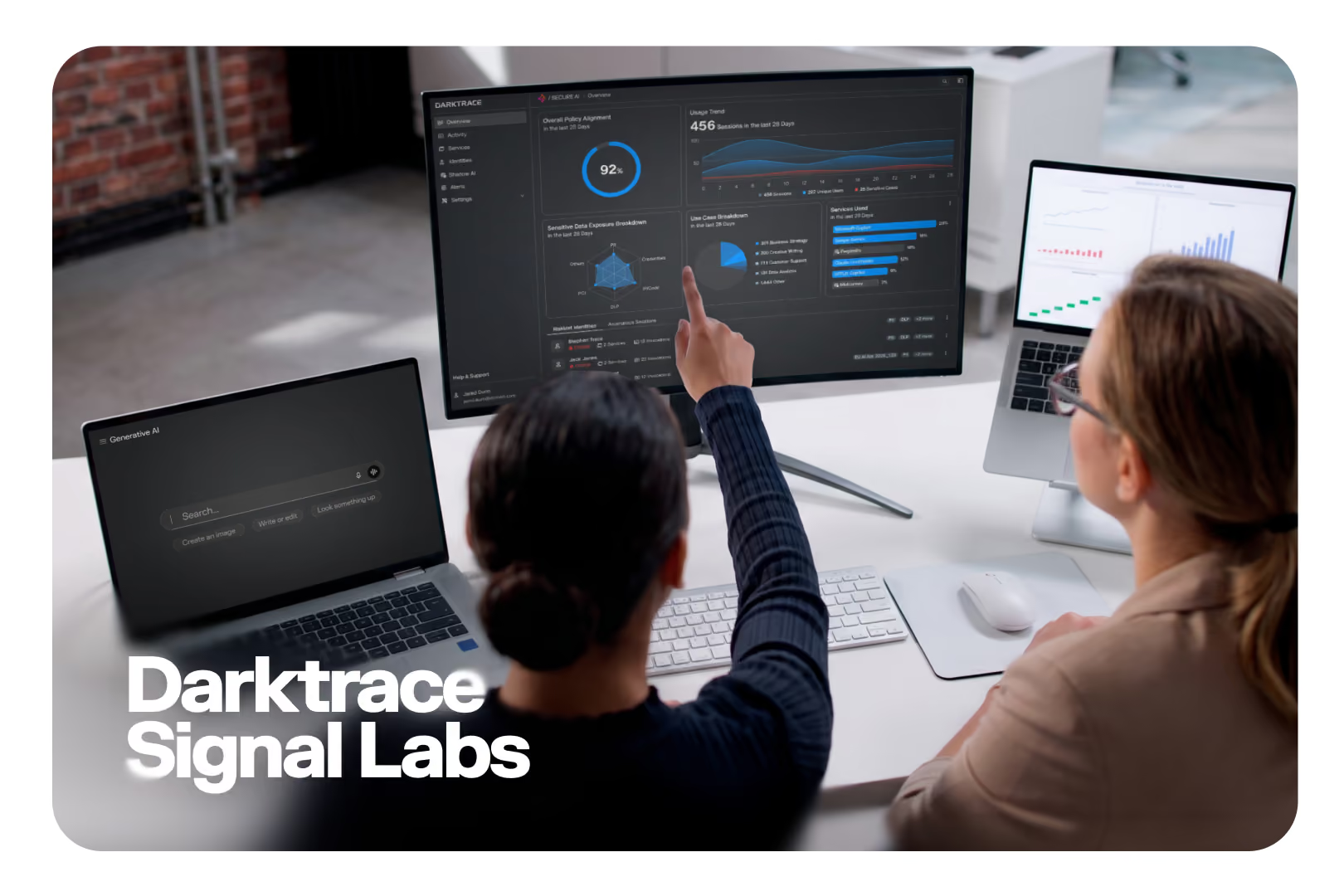
In order to help as many organizations as possible – from major enterprises to small and midmarket companies – benefit from enterprise-grade, AI-native security, Darktrace is making it easier for MSSPs to deliver its technology. The ActiveAI Security Portal introduces an alert dashboard designed to increase the speed and efficiency of alert triage, while a new AI-powered managed email security solution is giving MSSPs an edge in the never-ending fight against advanced phishing attacks – helping partners as well as organizations succeed on the frontlines of cyber defense.
Explore the full State of AI Cybersecurity 2026 report for deeper insights into how security leaders are responding to AI-driven risks.
Learn more about securing AI in your enterprise.
[related-resource]
Get the State of AI Cybersecurity 2026 Report
Explore how the rapid adoption of AI is reshaping cyber risk worldwide in our annual landmark survey on AI in the cybersecurity industry.