


Blog
/
Network
/
October 20, 2026

Why Kubernetes Security Needs A Behavioral Approach

As Kubernetes adoption accelerates, especially for AI workloads, Darktrace extends behavioral security across runtime activity, delivering visibility, detection, response, forensics, and risk context to identify and contain threats.
Inside the SOC
Darktrace cyber analysts are world-class experts in threat intelligence, threat hunting and incident response, and provide 24/7 SOC support to thousands of Darktrace customers around the globe. Inside the SOC is exclusively authored by these experts, providing analysis of cyber incidents and threat trends, based on real-world experience in the field.
Written by
Elise Longhurst
Senior Product Executive
Written by
Mikey Anderson
Senior Product Marketing Manager
Man at computerDefault blog image
20
Oct 2026

Kubernetes has become a foundational technology for modern cloud-native infrastructure. It can orchestrate everything from customer-facing applications to data pipelines and, increasingly, AI workloads. This is due to the highly scalable nature of Kubernetes, making it cost efficient and reliable.

Gartner projects that by 2028, 95% of new AI deployments will run on Kubernetes, up from less than 30% today1. However, the same qualities that make Kubernetes powerful also make it uniquely challenging to secure, leaving many organizations with limited visibility into their clusters. This lack of visibility increases risk - it’s difficult to secure what you can’t see.

However, this risk is often looked at as purely a posture management challenge. While Cloud Security Posture Management (CSPM) solutions can tell you how a cluster should be configured, they don’t tell you what it is doing in real time. This requires runtime behavioral monitoring of clusters to detect active threats.

Yet existing approaches to securing Kubernetes by most Cloud Detection and Response (CDR) and Network Detection and Response (NDR) vendors often have limited coverage or require a third-party integration to forward traffic and metadata. This means that capabilities can be limited and detections can lack the context of the wider environment, which slows down triage, investigation and response.

Why Kubernetes is hard to secure

Traditional security tooling was built for persistent, long-term infrastructure such as servers and virtual machines with fixed identities that last months or years. Some elements of Kubernetes environments can have a much shorter lifespan, breaking many assumptions those tools rely on:

  1. Increased complexity
    1. Kubernetes environments can be complex in comparison to traditional infrastructure, with many different elements to consider such as nodes, clusters, containers, pods and the workloads themselves.
  2. Ephemeral by design
    1. Kubernetes pods can spin up and terminate in seconds. A container that was compromised may no longer exist by the time a deeper investigation is required, leaving no artifact to analyze. This poses a unique challenge for security operations.
  3. Weaker workload boundaries
    1. Kubernetes containers use lightweight, shared-kernel isolation rather than separate virtual machines, improving efficiency but reducing separation between workloads and the host. As a result, a compromised container may have a greater potential impact on the node and neighboring workloads than a compromised virtual machine (VM).2
    2. Recent vulnerabilities have shown that threat actors can escape a container and gain access to the underlying host.3, 4
  4. Everything is API-driven
    1. Dozens or hundreds of microservices communicate over internal APIs, and the Kubernetes control plane itself is an API. This creates a large and dynamic attack surface, making it difficult to distinguish legitimate activity from malicious behavior.
    2. Without identity-aware runtime visibility, threat actors can move laterally between pods and exploit misconfigured role-based access controls (RBAC) with little chance of detection.

Rising to the challenge of securing Kubernetes

With the release of Darktrace 7.2, Darktrace / HYBRID NETWORK can extend behavioral security into Kubernetes, delivering visibility, detection and response capabilities across runtime activity. Darktrace addresses the challenges of securing Kubernetes environments in several ways.

Behavioral detection, not static rules

Many Kubernetes runtime tools rely on predefined rules and signatures - a fixed list of “bad” behaviors to match against. That approach struggles with novel attacks and generates noise at scale. Darktrace takes a different approach: our Adaptive AI builds a Unique Behavioral Profile for each organization from the ground up, learning the normal behavior of every workload, node and identity in your cluster. It then uses this understanding to detect meaningful deviations from expected behavior, which serves as the basis for surfacing suspicious and malicious activity.  

A pod reaching out to an unfamiliar destination, an unexpected executable launching inside a workload, or an identity performing an action it has never performed, all surface as anomalies without anyone having to write a rule in advance.
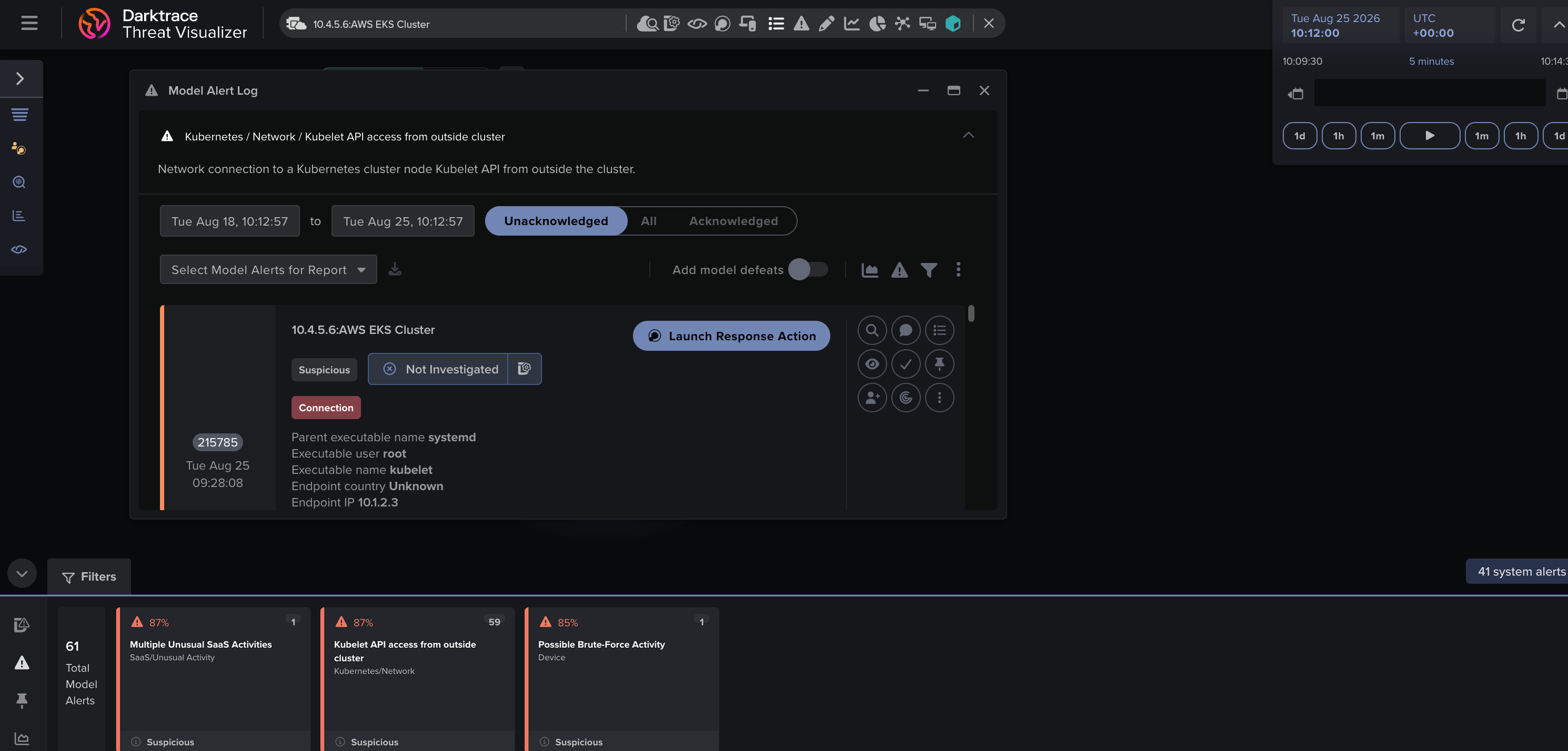
Darktrace surfaces unexpected Kubernetes activity that does not align with an organization’s Unique Behavioral Profile

‍

Visibility across the network, the process, and the control plane

Darktrace monitors Kubernetes at three levels that together provide comprehensive runtime visibility:

  1. Network-layer
    1. Traffic between pods, across nodes and out to the internet. This helps to detect lateral movement and unusual connectivity, whether internal or external.
  2. Process-layer
    1. What is executing inside your containers. If a process reads a sensitive credential file or spawns an unexpected shell inside a production pod, Darktrace can identify that activity and use it as context for further detections.
  3. Control plane
    1. Activity against the Kubernetes API itself: someone executes a command in a running pod, RBAC changes, or unusual administrative actions. Many high-impact security events involve the control plane, an area that is often less visible to solutions that only analyze or scan network-layer telemetry.

Misconfiguration and vulnerability awareness

Runtime detection is strongest when combined with posture and exposure management. Darktrace surfaces risky pod configurations, such as privileged containers, host networking, and over-permissive service accounts as workloads are deployed, and links CVEs from images to the workloads running them. Security teams can go beyond simply knowing that a vulnerability exists and see exactly where it is in the cluster. When combined with behavior-based detections, this provides invaluable context that can help prioritize incidents and proactively identify areas that need further attention. For example, anomalous workload behavior on its own might not be very interesting to a security team at first, but if that same workload is known to host sensitive data, is known to have critical vulnerabilities associated with it, or is publicly accessible, then this narrative becomes much more suspicious and demanding of their attention.
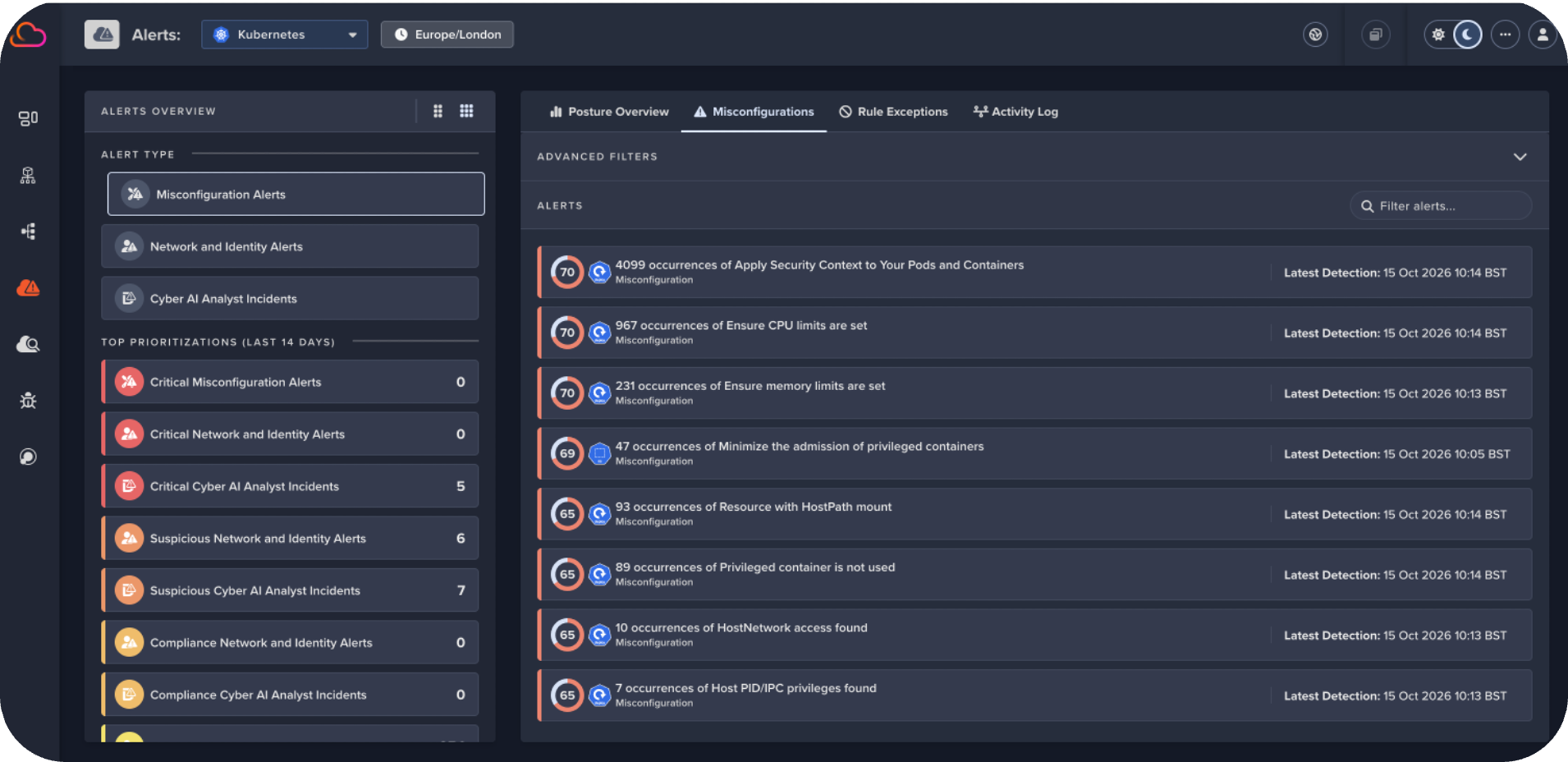
Darktrace highlights Kubernetes misconfigurations such as privileged containers, host networking, and missing security controls, helping teams prioritize runtime alerts with valuable exposure and risk context

‍

Response, tailored to Kubernetes

Detection is most effective when paired with response. Darktrace can take precise actions on Kubernetes workloads, including blocking a malicious connection at the pod level, helping to safely contain threats while security teams investigate. Response actions can be taken fully autonomously or via a human-in-the-loop process, which is completely configurable depending on the desired level of autonomy and scope. Darktrace is expanding the number of Kubernetes-native response actions to give customers even more flexibility when containing threats.

Forensics that survive the workload

Because containers are so short-lived, evidence disappears fast and this can make it very difficult to answer questions related to the initial detections. Darktrace solves this with Forensic Acquisition & Investigation capabilities that extend to Kubernetes containers, allowing investigations to be triggered manually by an analyst, or automatically from an alert, preserving evidence before the workload is gone.

For incident responders, this addresses a key challenge in container security: being able to answer “what actually happened?” after an ephemeral workload has vanished.

One platform, not another silo

Kubernetes doesn't exist in isolation, and neither should its security. Darktrace correlates cluster activity with the surrounding cloud environment, including AWS, Azure and GCP identities, network activity and cloud assets, allowing analysts to pivot between a Kubernetes workload and its wider context. A single anomalous action can be traced from the control plane to the pod, and from the pod to the cloud identity behind it, all within a single investigation workflow. This can also include alerts from other areas of hybrid infrastructure or third-party sources where relevant, adding more context to investigations and speeding up workflows for human analysts.

Built to deploy easily

Operational complexity can be a barrier to security adoption. Darktrace / HYBRID NETWORK for Kubernetes installs with a single command, and for teams that manage their infrastructure as code, it supports raw manifests so the deployment can live in a Git repository and be managed through existing GitOps workflows. The same deployment approach works across Kubernetes environments in AWS, Azure, Google Cloud, and on-premises infrastructure. Early adopters of Darktrace’s Kubernetes capabilities have highlighted the simplicity of deployment and time to value.
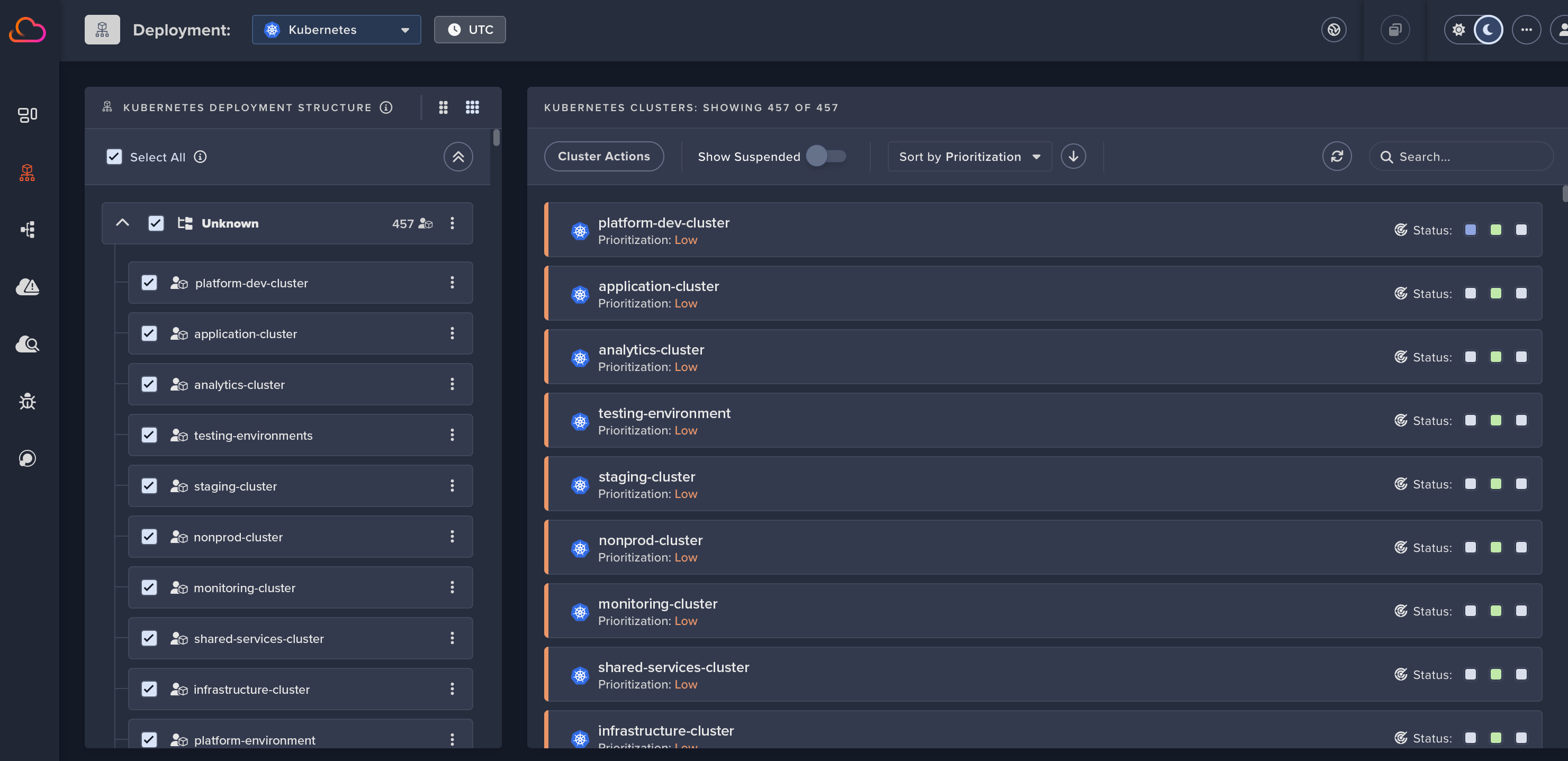
Darktrace can deploy across your Kubernetes environment and wider hybrid infrastructure, while also providing visibility into Kubernetes deployment structure and status

Next steps

Kubernetes environments are dynamic, ephemeral and API-driven in ways that challenge traditional security tooling. With Kubernetes usage increasing due to widespread AI adoption, it is essential to secure Kubernetes environments as part of securing what AI can do. Darktrace / HYBRID NETWORK addresses these challenges by learning normal behavior in Kubernetes environments across network, process and control-plane layers, identifying meaningful threats and enabling targeted response. Combined with the context of wider hybrid infrastructure and forensic investigation capabilities, Darktrace provides visibility into both emerging threats and active incidents.

To see how Darktrace can help secure your Kubernetes environment and your wider hybrid infrastructure, get in touch to arrange your free trial. Existing customers can contact their Darktrace Account Team for more information about deployment options and licensing.

‍

Sources

[1] Gartner, Container Management research, 2025: "By 2028, 95% of new AI deployments will use Kubernetes, up from less than 30% today."  https://www.gartner.com/en/documents/7913109. (quote reproduced under Gartner reprint at https://www.kubermatic.com/magic-quadrant-and-critical-capabilities-for-container-management/)

[2] Palo Alto Networks (Unit 42) – Container Breakouts: Escape Techniques in Cloud Environments. https://unit42.paloaltonetworks.com/container-escape-techniques/

[3] runC container-escape vulnerabilities (CVE-2025-31133, CVE-2025-52565, CVE-2025-52881), disclosed by a SUSE researcher on November 5, 2025. https://www.securityweek.com/runc-vulnerabilities-can-be-exploited-to-escape-containers/

[4] NVIDIAScape (CVE-2025-23266), CVSS 9.0. https://nvidia.custhelp.com/app/answers/detail/a_id/5659

[related-resource]

‍

Contain cross-domain attacks 10x faster with Adaptive AI

Discover how Darktrace delivers unified visibility, behavioral detection, and autonomous containment across on-premises, cloud, OT, and identities.
Inside the SOC
Darktrace cyber analysts are world-class experts in threat intelligence, threat hunting and incident response, and provide 24/7 SOC support to thousands of Darktrace customers around the globe. Inside the SOC is exclusively authored by these experts, providing analysis of cyber incidents and threat trends, based on real-world experience in the field.
Written by
Elise Longhurst
Senior Product Executive
Written by
Mikey Anderson
Senior Product Marketing Manager

More in this series

No items found.

Blog

/

AI

/

November 19, 2026

Microsoft Perception, Agentic Insiders and the Role of Behavioral Security

Default blog imageDefault blog image

This week at Ignite, Microsoft announced that Microsoft Perception is generally available. It is a significant milestone for the industry, and one we welcome as a Microsoft partner. Microsoft is putting an architectural bet at the center of its security strategy: AI has changed the speed of cyber, and defense must change with it.

At Darktrace, we’ve long held the same view, so it’s encouraging to see a partner of Microsoft’s scale articulate it so clearly and bring it to market.

Security gets a team of agents

Perception is Microsoft’s agentic security system. It orchestrates red, blue, and green team agents through playbooks in a closed loop: red agents simulate attacks, blue agents detect, triage and investigate, and green agents fix and remediate. Rather than adding another assistant to the SOC, it creates coordinated teams of agents that share context. Security teams set the guardrails and approve high-impact actions.

Microsoft frames this as a three-layer cyber stack: signals, sensors and actuators; a context layer; and agents, harness and models on top. Together with partner sources, the foundation produces more than 165 trillion signals per day.  

The announcement also makes a second point that matters just as much. Microsoft is treating AI agents themselves as a new insider-risk category. In its words, “Agents are the new insiders.” They work at machine speed, around the clock, with broad access to data, apps, tools and other agents, and like any insider they can make mistakes, be manipulated or be compromised. New capabilities such as Dynamic Agent Risk (now in preview) and dynamic Conditional Access controls are designed to assess and contain that risk as it changes.

Four truths about security in the agentic era

The announcement is built on four ideas, and together they describe the new reality security teams are defending:

  1. Static security can’t keep up. Microsoft validates what many security practitioners have observed; the window between a vulnerability’s discovery and its exploitation is collapsing from months to minutes. Manual triage can’t answer that pace. Autonomous detection and response is now a requirement, not simply a “nice to have”.
  2. Agents must be treated as insiders. The question for security teams is no longer only “who is this user?” but “what is this agent actually doing?” Identity tells you who an agent is. Policy tells you what it is allowed to do. Neither tells you whether its behavior is normal.
  3. Security is moving from signatures to behavior and context. Dynamic Agent Risk looks across identity, data, endpoint, cloud and network signals and asks whether an agent’s actions are drifting from the intent of its task. That is behavioral thinking, and it is philosophically close to the Adaptive AI approach Darktrace has pioneered.
  4. Machine-speed attacks demand machine-speed response. Humans set the objectives and guardrails. Autonomous systems do the work inside them, both detecting and acting. Microsoft’s design has agents investigate, recommend and, within approved boundaries, act, with security teams setting the limits. At this pace, the gap between knowing something is wrong and doing something about it has to close to seconds.

The opportunity: where control plane meets behavioral context

Perception is an extraordinary control plane for agentic security. The question for security leaders is how to make it even more effective in the environments they actually run.

Real enterprises are heterogeneous. They run AWS and Google Cloud alongside Azure, and OT, IoT and third-party identity alongside Entra. Increasingly they also run AI agents and MCP-connected systems that no single vendor’s telemetry fully covers. Microsoft’s architecture recognizes this, with more than 500 connectors into the wider ecosystem.

That is where Darktrace’s role is distinct. The challenge isn’t signal volume, where Microsoft’s scale is unmatched. It’s deeply understanding what is normal for a specific organization, across every system, identity and agent in it. Together, we deliver two complementary layers:

  • Microsoft brings global intelligence and orchestration. It tells you what is known, what it means and what to do about it.
  • Darktrace brings organization-specific behavioral context. It tells you what is unusual here, right now, across the organizations AI, people and infrastructure, even if it has never been seen before.

The difference shows up in the numbers. A large enterprise generates billions of signals. Darktrace turns them into thousands of incidents, narrows those to hundreds of AI-led investigations, and surfaces as few as 20 that merit a human’s attention. For an agentic SOC, that kind of evaluated, prioritized input makes agents faster, not busier.

As enterprises deploy more agents, the hard problem becomes behavior that is technically permitted but unusual, manipulated or inconsistent with the agent’s purpose. Consider an agent that normally reads Salesforce records during US business hours and suddenly starts enumerating SharePoint and opening unusual outbound connections. Each step may use valid access and approved tools, so identity and policy checks can all pass. Spotting it requires knowing the behavior is abnormal for this agent, in this environment, right now.

That is why one principle in Microsoft’s AI Transparency Initiative matters so much: organizations should be able to see what their AI accesses and does, and independently verify those actions.  

  • Identity and permissions answer “should this agent be allowed to do this?”
  • Behavioral defense answers “even though it is allowed, is what it’s doing normal?”

Deterministic controls around non-deterministic AI are the right foundation, and continuously learned baselines are how organizations can verify those controls are working. ‍

What to look for in an agentic SOC architecture

As organizations adopt platforms like Perception, we’d encourage them to look for three capabilities:

  1. Behavioral context in the control plane. Agents work best with high-confidence signals rather than thousands of raw alerts: here is the behavior that materially deviates from this organization’s learned normal.
  2. ‍Behavioral reasoning on demand. During an investigation, agents should be able to ask what changed around a given identity, device or agent in the last 24 hours, and get a clear answer. ‍
  3. Autonomous, coordinated response across the stack. Response should be as fast as the threat without being reckless: acting immediately when confidence is high, constraining or reversing actions when it isn’t, and keeping a human in the loop when it matters. Within policy and human-approval guardrails, it should target the abnormal behavior rather than the whole business process and span identity, endpoint and the wider environment.

These are the areas where we’re focused, and where we look forward to working with Microsoft and the broader ecosystem.

Response is where speed is won or lost

In the AI era, detection and investigation only matter if action follows quickly. Perception brings agentic orchestration to that problem, with security teams setting the guardrails and approving high-impact steps. Autonomous response from Darktrace takes a complementary approach: it responds on behavioral deviation, in a way that is proportionate and targeted. It can interrupt activity that is abnormal for that specific device, identity or agent while leaving normal business activity running.

The two approaches fit together naturally. Behavioral signals can tell an orchestration layer that something has changed and how confident the system is. Orchestrated playbooks can then coordinate wider containment across identity, endpoint and cloud, within the policies customers define.

The bigger picture

The industry’s architecture is converging on identity, policy, telemetry, behavior, autonomous reasoning and machine-speed response. Microsoft is building formidable pieces of that picture, especially identity, policy, telemetry and orchestration.

Behavior is the layer Darktrace is built to provide: an independent intelligence that continuously learns how humans, machines and AI agents normally act, detects the moment reality departs from intent, and can respond to that deviation in a targeted, proportionate way that keeps normal business running. When attacks move at machine speed, understanding what is abnormal and acting on it quickly have to go together.

Perception brings together what Microsoft knows and orchestrates the response across its stack. Darktrace helps organizations understand what is normal for them and act on what isn’t. Customers building their agentic security strategy will need both.

Congratulations to our partners at Microsoft on this milestone. We look forward to helping customers secure the agentic era together.

Learn more about Darktrace Behavioral Defense.

Continue reading
About the author
Kellie Regan
Director, Product Marketing - Cloud Security

Blog

/

AI

/

November 19, 2026

Agentic attacks in the wild: Inside three ARTEX investigations

Default blog imageDefault blog image

Key insights

·       Darktrace observed activity in several customer environments involving infrastructure and behaviors associated with reported ARTEX-enabled campaigns, including activity linked to China-nexus espionage and financially motivated attacks.

·       In the higher-confidence cases, known infrastructure appeared alongside beaconing, unusual TLS, reconnaissance, tunneling, script retrieval, SMB activity and external data transfer. One Azure case had no observed network command and control at all, only key listing and application identity activity.

·       ARTEX is now used by actors with different objectives. Identifying the framework can help locate relevant activity, while the behavior around the affected system provides the stronger evidence for understanding compromise and attribution.

‍

Introduction

Attackers have moved beyond using AI for phishing and are running agentic frameworks; open-source tools like ARTEX, CAIRN, PentAGI and Hexstrike that let AI agents scan, exploit and move through an environment with little human input [1]. ARTEX has moved quickly from an offensive security project into live intrusion activity. Since at least August 2026, the framework has been associated with espionage, financially motivated attacks and opportunistic campaigns across government, financial services, technology, defense, telecommunications and other sectors. The FBI has documented ARTEX activity spanning reconnaissance, exploitation, credential abuse, lateral movement, collection, command and control, and exfiltration [2].

Darktrace has observed activity in customer environments that overlaps with infrastructure, tooling and behaviors reported in several of these campaigns. The cases below highlight how those intrusions appeared on the network, including the activity visible before an analyst can determine which actor or framework may be responsible.

ARTEX as part of the attacker workflow

ARTEX is an open-source, multi-agent offensive security platform that converts high-level objectives into actions carried out by specialized agents [2]. Operators have used it to automate activity across the attack lifecycle, including scanning, exploitation, credential activity and post-compromise operations. Some reported intrusions moved from initial targeting to privileged access in under three hours [2].

The framework is now associated with actors pursuing different objectives and using different post-exploitation tooling. The original public repository was removed in October 2026, but archived copies and localized versions remain available. For defenders, ARTEX is more useful as context for an investigation than as an attribution shortcut.

Darktrace observations show the same point at network level. Infrastructure linked to reported ARTEX campaigns appeared alongside beaconing, tunneling, unusual TLS, reconnaissance, file retrieval and lateral activity.

Case 1: Espionage-linked activity

Darktrace observed activity associated with BLOODALCHEMY command-and-control (C2) infrastructure in two customer environments. In one environment, five devices communicated with nginxmysql[.]com and 45.153.126[.]223 between October 23 and November 2. Both indicators had previously been linked to China-nexus espionage activity involving ARTEX [4].

The connections were accompanied by suspicious beaconing, repeated successful connections and unusual self-signed TLS. One system began making suspicious TLS connections to nginxmysql[.]com on October 23. Beaconing followed on October 24, and SMB scanning appeared later in the sequence. Other affected systems subsequently communicated with previously unseen external endpoints.

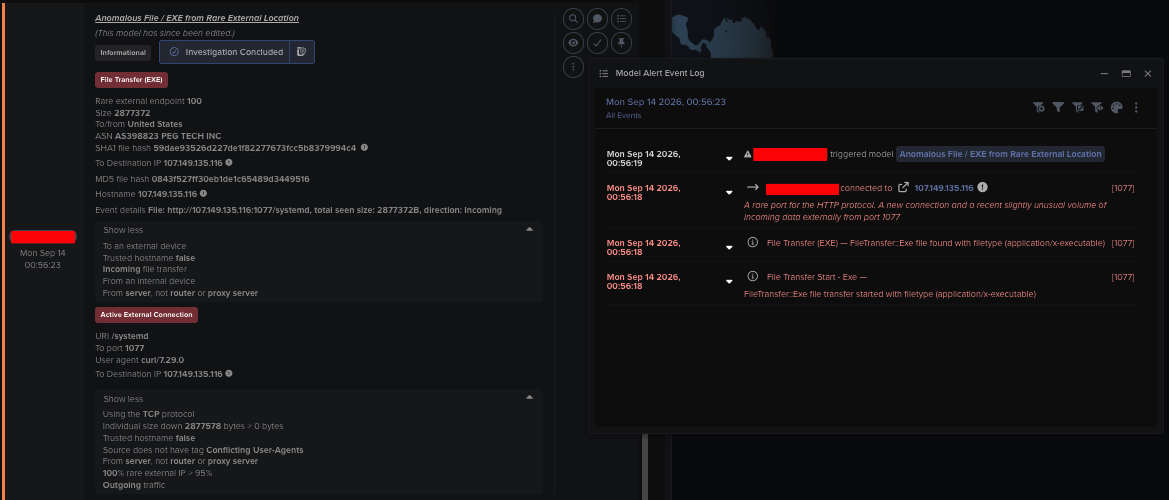
Prior to the observed C2, Darktrace detected curl requests retrieving executable and script content including /systemd, /wazuh, linux_amd64, u.sh and q.sh. Related telemetry included DRSGetNCChanges activity consistent with DCSync, LDAP enumeration, DNS zone transfers, network scanning, certificate downloads and SMB writes involving start.bat.

Figure 1: Autonomous Response model alert in due to the identification of multiple underlying lateral movement related activities, including spikes in SMB and RPC operations on an affected Ivanti network device during an Artex-supported Vapor Panda intrusion.
Figure 2: Autonomous Response action summary console listing all recommended actions for an affected Ivanti network device following the detection of several underlying anomalous behaviors during the Artex-supported Vapor Panda intrusion.

BLOODALCHEMY has been reported in more than one China-nexus cluster [5]. SoftEther infrastructure observed in one environment provided another point of correlation with reported VAPOR PANDA tradecraft. The moderate-confidence assessment tying this to a Chinese nexus threat actor is based on infrastructure, victim context, tradecraft behavior that followed the initial connection, and public reporting.

Case 2: Financial-sector activity

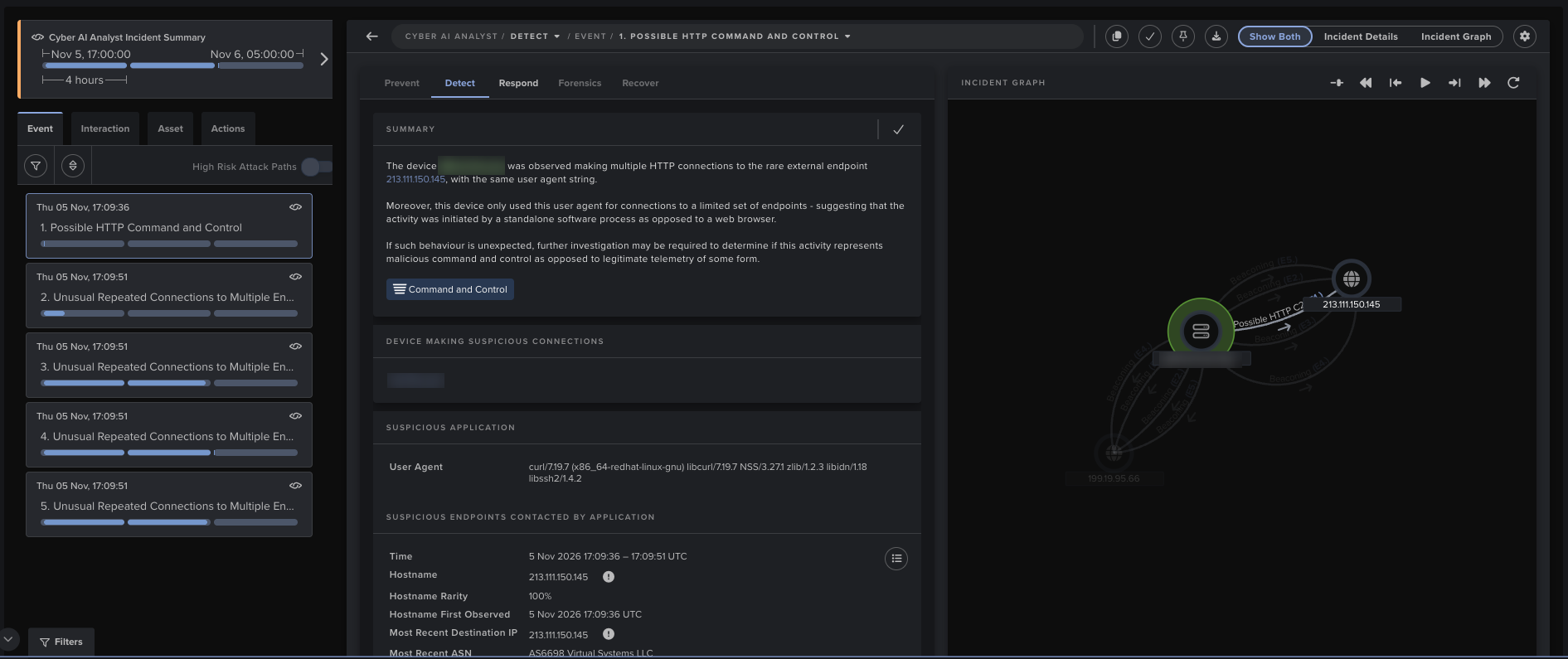
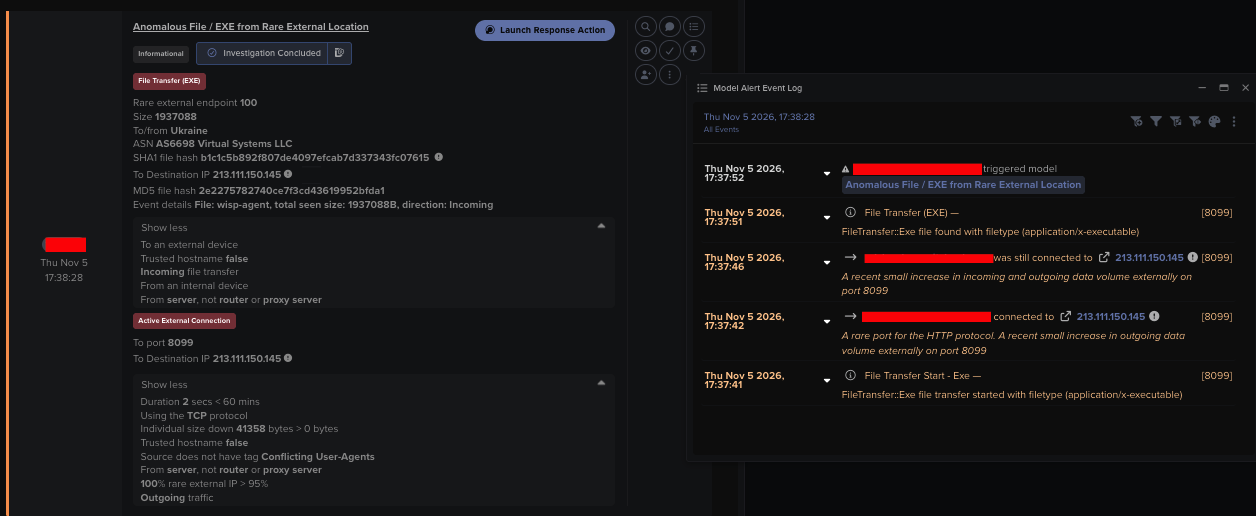
In early November, Darktrace observed activity in two financial-sector environments that overlap with reported ARTEX infrastructure. On November 5, a server connected to 213.111.150[.]145:8099 and downloaded wisp-agent, associated with WISP C2 activity.

In a second environment, a device attempted connections to 85.11.167[.]52 on November 1 and 2. The connections occurred alongside beaconing to new and rare destinations, anomalous TLS, possible tunneling and unusual package downloads.

The device also communicated with temp[.]sh, ssh.localhost[.]run, localhost[.]run, termbin[.]com, pastebin[.]com and GitHub-hosted release infrastructure. The sequence showed potential tooling retrieval, C2, tunneling and use of external services capable of staging or moving data.

Case 3: Credential collection in Azure

On October 20, Darktrace observed a sweep of credential collection in a customer’s Azure environment that is consistent with ARTEX use. The intrusion began with connections to the virtual network from 43.98.196[.]73 (Alibaba Cloud). Open-source scanning data associates the address with ARTEX.

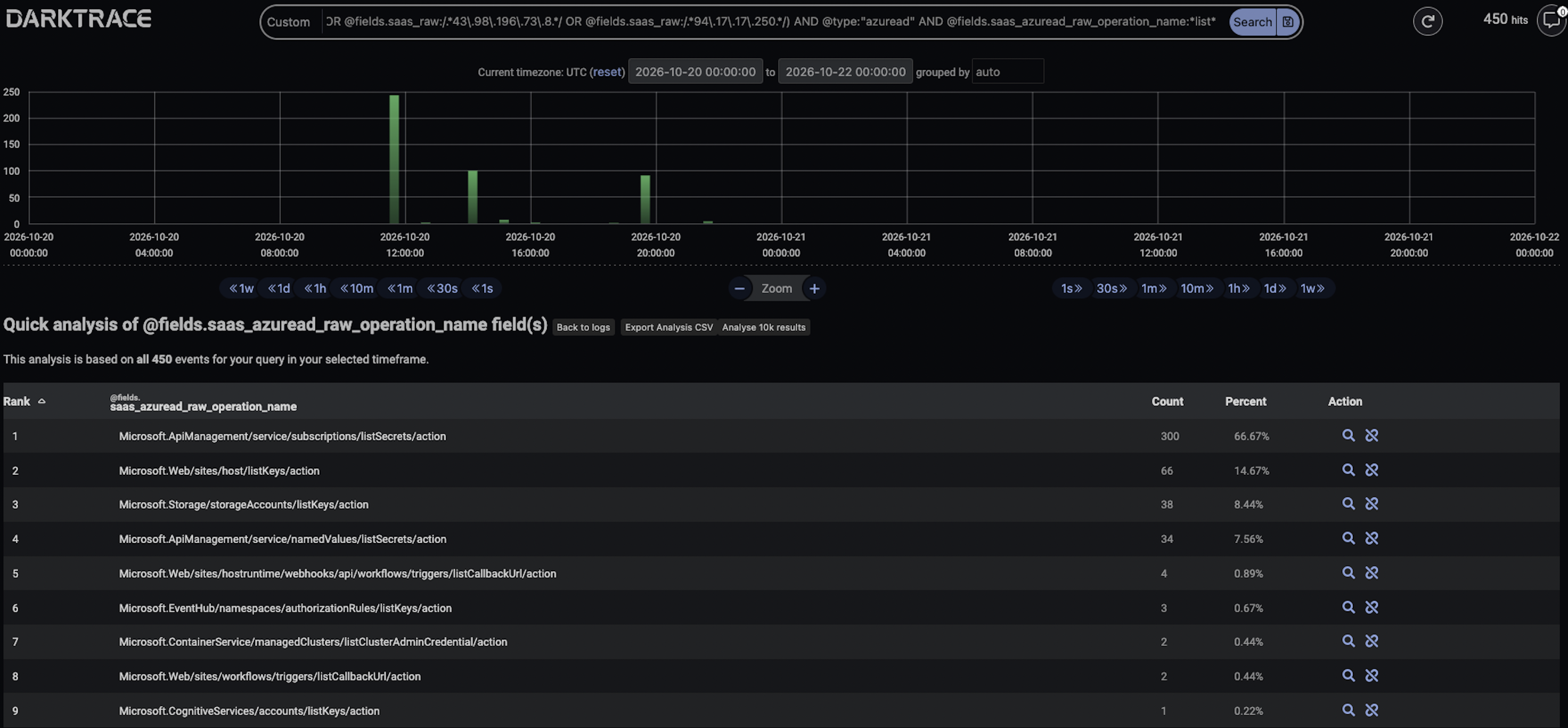
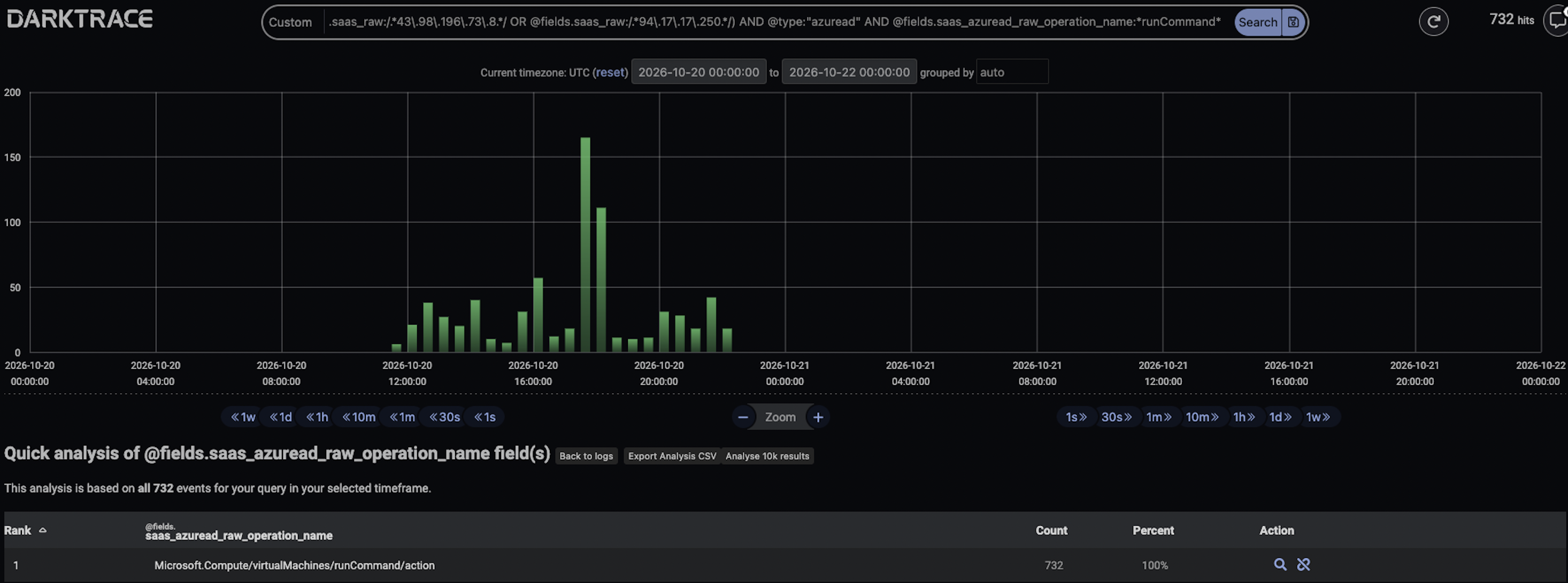
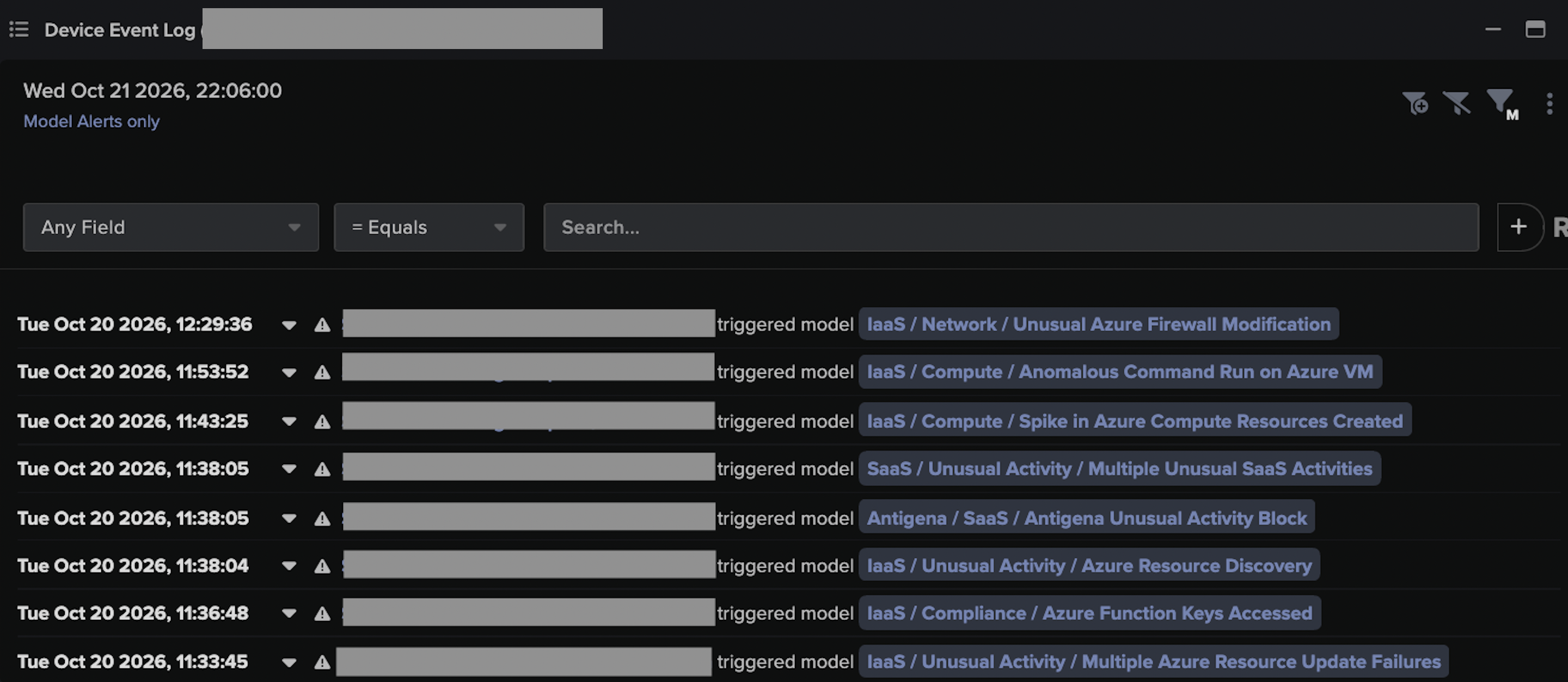
A compromised user identity made requests to the Azure Resource Manager API, though how it was compromised is unknown. The requests listed keys and secrets across API Management, web and function apps, Cognitive Services, Event Hubs, storage accounts and a managed Kubernetes cluster. With those credentials the attacker compromised multiple application identities. The attacker then used the application identities and the user identity to retrieve more credentials, change firewall and security rules and run scripts on virtual machines. Microsoft Defender alerts showed attempted execution of scripts related to Mimikatz and Impacket.

In a cloud environment, such privileged and enumerative operations are potentially indistinguishable from legitimate administrative actions. Consequently, the sequence and context of such operations signified more than any specific API call. There was no C2 traffic to match, and listing keys and using application identities are also what administrators and automation do. A compromised user, credential retrieval across several Azure services, new application identities, more credential collection and changes to security controls only made sense together, and by then access was spreading through the cloud environment.

Figure 3: Darktrace Advanced Search showing Azure AD operation names associated with the activity.
Figure 4: Darktrace Advanced Search showing the Azure Resource Manager action used to execute scripts.
Figure 5: Darktrace Device Event log window showing the triggered models related to the suspicious Azure activity.
Figure 6: Autonomous Response model alert for affected Azure account during Artex intrusion due to the  unusual source IP for the noted activity and the unexpected privileged operations in the Azure environment.
Figure 7: Autonomous Response action summary console for hijacked cloud Azure Identity following the detection of anomalous SaaS/IaaS actions including key/secret requests and Firewall configuration changes.

‍

Shared tooling weakens attribution signals

The three cases looked different on the network: BLOODALCHEMY infrastructure and espionage-consistent tradecraft, WISP infrastructure in financial-sector systems, and Azure identity and control-plane activity with no C2 at all.

Shared tooling has complicated attribution for years, and ARTEX adds to it because the framework carries out more of the attack, so reconnaissance, exploitation attempts and some post-compromise activity can look the same whoever set the objective. Attribution still needs infrastructure, malware, victimology, timing and the sequence of behavior inside the environment, and an ARTEX link is one input to that. Moreover, the behavior and the agent will still be shaped by the biases, preferences, and tradecraft of its operators.

At its core, ARTEX’s planner and worker agents identify and record facts, while exploring intents. However, the way the Large Language Model (LLM) chooses its next steps toward an objective is shaped fundamentally by the skills and tools available in its context. This includes its starting context, as well as various possible Model Context Protocol (MCP) plugins and user-injected context (e.g. user input mid-operation). Operators still have preferred tradecraft, and this preference shapes the pathways the harness will provide to the LLM in context prompts. Even on the same platform, customization based on operator preferences and goals will remain a key facet of campaign and actor identification.

Detection and response

Across the Darktrace cases, the stronger signals came from behavior after the connection: beaconing, abnormal TLS, reconnaissance, unusual authentication, tunneling, script retrieval, SMB activity and outbound transfer. Automated activity also produced compressed bursts of requests, sequential enumeration and repeated attempts with small changes.

With agentic tools reaching privileged access in under three hours, analysts may have only a short window to connect scanning or authentication activity to credential changes, new administrative access, tooling retrieval or lateral movement. Keeping network, identity and cloud telemetry together shows what happened before and after the first match, and whether a connection was noise or an intrusion moving toward privileged access.

In some of these cases, Darktrace's Autonomous Response took or recommended action against the activity, including blocking internal connectivity over specified ports, inhibiting outbound connections with likely C2 endpoints, and/or disabling SaaS/IaaS user accounts. While many of these recommended actions required human confirmation due to deployment configuration preferences, had these actions been applied autonomously at the time of alert, the scope of activity would have been limited, thereby giving analysts time to investigate and respond.

ARTEX won’t be the last of these frameworks. The next ones will come with new capabilities and defaults, but an intrusion still must interact with the target environment, and that shows up in how systems, identities and applications behave even after the indicator has aged out. The harder intrusions to catch will have no infrastructure to match, just ordinary API calls and legitimate identities. Detecting those depends on knowing what normal looks like for each identity and device. Containing abnormal activity at machine speed can stop an intrusion progressing while analysts establish impact and its extent. Autonomous Response does not replace that human analysis, but rather augments defender teams' capabilities by extending the window for investigation.

‍

Credit to Nathaniel Jones (SVP, Global Threat Intelligence), Eugene Chua (Principal Analyst), Sam Lister (Senior Security Researcher), Adam Potter (Associate Principal Cyber Analyst), Daniel Levy (Threat Hunting Data Scientist)

Edited by Ryan Traill (Content Manager)

Appendices

Darktrace model detections

·       Anomalous Connection / Multiple HTTP POSTs to Rare Hostname

·       Anomalous Connection / Rare External SSL Self-Signed

·       Anomalous Connection / Suspicious Self-Signed SSL

·       Compromise / Large Number of Suspicious Successful Connections

·       Compromise / Suspicious Beaconing Behaviour

·       Compromise / Agent Beacon to New Endpoint

·       Compromise / Beacon to Young Endpoint

·       Compromise / SSL Beaconing to Rare Destination

·       Compromise / Suspicious TLS Beaconing To Rare External

·       Compromise / Possible Tunnelling to Bin Services

·       Device / Anomalous Github Download

·       Device / Anomalous Package Download

·       Device / Initial Attack Chain Activity

Indicators of compromise (IoCs)

nginxmysql[.]com

45.153.126[.]223

213.111.150[.]145

wisp-agent

85.11.167[.]52

43.98.196[.]73

192.121.47[.]20

www[.]ddduuuppp[.]com

89.46.234[.]50

sqlserver-sqlite[.]com

199.19.95[.]66

graphics-hook-filter64.dll

graphics-hook_config.bin

References

1.      Google. GTIG AI Threat Tracker - https://cloud.google.com/blog/topics/threat-intelligence/agentic-threat-activity-crosses-a-significant-threshold

2.      Federal Bureau of Investigation, Threat Overview of ARTEX Autonomous Penetration Testing Framework, FLASH-20261113-001, 13 November 2026: https://www.ic3.gov/CSA/2026/261113.pdf

3.      Microsoft Security Blog, Storm-0940 Uses ARTEX Agentic AI in ConnectWise Supply Chain Compromise: https://www.microsoft.com/en-us/security/blog/2026/10/21/storm-0940-uses-artex-agentic-ai-connectwise-supply-chain-compromise/

4.      CrowdStrike, VAPOR PANDA Uses ARTEX to Scale Global Campaign: https://www.crowdstrike.com/en-us/blog/vapor-panda-uses-artex-to-scale-global-campaign/

5.      Bitdefender, SilkParasite: Tracking a China-Nexus APT Across Central Asia: https://www.bitdefender.com/en-us/blog/businessinsights/silkparasite-tracking-china-nexus-apt-across-central-asia

‍

‍

Continue reading
About the author
Nathaniel Jones
SVP, Global Threat Intelligence
Your data. Our AI.
Elevate your network security with Darktrace AI