AI Usage Policies
Why AI usage policies and the cyber risk landscape
Artificial intelligence has become embedded in enterprise operations, with tools like ChatGPT, GitHub Copilot, and Microsoft 365 Copilot now part of daily workflows. According to Microsoft and LinkedIn's 2024 Work Trend Index, 75% of global knowledge workers use AI at work, often without formal oversight.
This widespread, uncontrolled adoption creates a security paradox. AI accelerates innovation and automates complex tasks, yet it simultaneously opens attack surfaces that adversaries are already exploiting. Organizations need governance frameworks that preserve AI's benefits while mitigating its risks. An AI usage policy establishes how employees interact with artificial intelligence tools within an organization, balancing innovation with security.
This guide provides a technical breakdown of AI usage policies, covering their core components, the risks they mitigate, and the role of AI in enforcing compliance.
Why is an AI policy crucial for enterprise security?
An AI usage policy is a formal, enforceable document that establishes acceptable use standards for all AI technologies within an organization. Its purpose is to mitigate risk while preserving innovation. Without clear governance, employees default to convenience over security, uploading sensitive data to public models or integrating untested AI-generated code into production environments. The consequences range from immediate data breaches to long-term intellectual property erosion.
Organizations operating without an AI tool usage policy face several critical vulnerabilities:
- Data exfiltration and IP loss: Employees inadvertently feed sensitive data, proprietary algorithms, or strategic documents into public AI models like ChatGPT or Claude. These inputs may be retained by AI providers for model training or accessed through vulnerabilities, creating permanent exposure of confidential information.
- Security vulnerabilities: Developers using AI-generated code without proper validation introduce critical flaws or malware into applications. Studies show that AI-generated code often contains exploitable security weaknesses, including SQL injection vulnerabilities and improper input validation.
- Compliance and legal risks: AI-generated content exists in legal ambiguity around data residency, ownership, and regulatory adherence, with 56% of security leaders concerned with regulatory compliance violations.
- Emerging threat techniques: Adversaries exploit AI tool usage through techniques like prompt injection, where crafted inputs bypass security filters to extract sensitive information or manipulate outputs. Data poisoning attacks corrupt an AI's training data to compromise its decisions, potentially affecting security tools that rely on AI models.
Threat actors are already weaponizing AI capabilities. Organizations need policy frameworks that match the sophistication of these emerging threats.
Core components of an effective AI usage policy
Security leaders building governance frameworks can use an AI usage policy template as a starting point, ensuring coverage of scope, data handling, acceptable use, security vetting, and enforcement mechanisms. An effective policy addresses the full life cycle of AI tool adoption.
Scope and applicability
The policy must explicitly define its reach across the organization, including all employees, contractors, and third-party vendors with system access.
The technology scope should encompass the following:
- Public generative AI platforms such as ChatGPT, Claude, Gemini, and similar consumer-facing tools
- Integrated SaaS AI features, including Salesforce Einstein and Google Workspace AI
- Any proprietary or custom-built AI models and applications
Ambiguity in coverage creates enforcement gaps where employees claim exemptions based on job function or tool type.
Data classification and handling
Organizations must mandate strict adherence to existing data classification schemes. Specifically, prohibit the input of specific data types into non-approved AI systems, including:
- Personally identifiable information: Names, addresses, Social Security numbers, and other data tied to individual identities
- Protected health information: Medical records and health data subject to HIPAA
- Financial records: Payment data, account information, and sensitive financial planning documents
- Source code and intellectual property: Proprietary algorithms, trade secrets, and development assets
- Strategic business intelligence: Mergers and Acquisitions (M&A) plans, customer databases, and confidential business strategies
The policy should require employees to verify data classification before any AI interaction.
Acceptable and prohibited uses
Clear AI usage policy examples prevent misinterpretation and provide actionable guidance by delineating what activities are permitted and which cross security boundaries.
Acceptable use options include:
- Summarizing public information
- Brainstorming marketing content
- Sandboxed code generation
- Anonymized data analysis
Potential prohibited activities include:
- Accessing AI tools through personal subscriptions for corporate work
- Submitting any internal document to public AI platforms, regardless of perceived sensitivity
- Using AI to generate content that infringes on existing intellectual property or licensing agreements
- Moving AI-generated code to production without security team validation
Security, vetting, and IP
All AI tools must undergo security evaluation before deployment. The vetting process should evaluate:
- How the tool processes, stores, and transmits user inputs
- Whether user data contributes to model training or remains isolated
- Compatibility with existing identity and access management (IAM) systems
- Vendor certifications, incident response capabilities, and compliance with relevant frameworks
Additionally, address intellectual property ownership, clarifying who owns AI-generated content and acknowledging the legal risks of using AI models trained on copyrighted material without proper licensing.
Enforcement
An effective policy defines consequences for noncompliance, linking violations to existing disciplinary protocols and data security incident response procedures. Enforcement tiers might range from mandatory retraining for minor infractions to termination for deliberate policy circumvention that results in data exposure.
The policy should also establish monitoring mechanisms and reporting channels for suspected violations.
AI usage policy implementation
A policy document alone is insufficient. Organizations face a fundamental challenge with thousands of web-based AI tools entering the environment daily. Legacy security tools struggle to distinguish between an employee sending proprietary R&D data to an AI chatbot and one asking for email writing assistance. Policy implementation requires operational integration across people, process, and technology.
Cross-functional development
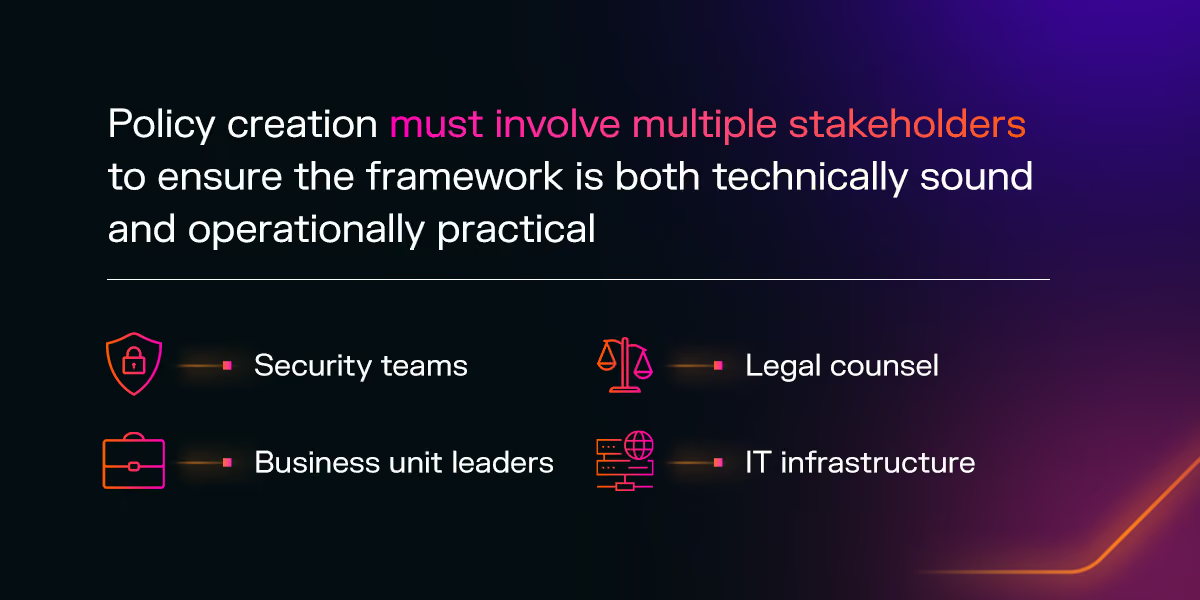
Policy creation must involve multiple stakeholders to ensure the framework is both technically sound and operationally practical:
- Security teams: Identify threat vectors and technical vulnerabilities that the policy must address
- Legal counsel: Ensure compliance with data protection regulations and intellectual property law
- Business unit leaders: Prevent policy friction that drives shadow AI adoption and circumvention
- IT infrastructure: Assess integration requirements and technical enforcement capabilities
This collaborative approach produces policies that employees can actually follow.
Continuous employee training
The threat landscape evolves as AI capabilities advance. Policy rollout requires mandatory training that explains the security implications behind each restriction.
Training should include real-world incident examples and decision trees for common AI use scenarios. Employees who understand why uploading customer data to ChatGPT creates risk are more likely to comply than those who view the policy as arbitrary bureaucracy.
Technical controls
Administrative controls require technical enforcement mechanisms that align with secure AI deployment guidance. These include:
- Network monitoring: Track data flows to known AI service endpoints and identify unauthorized AI tool access
- Data loss prevention: Scan outbound traffic for sensitive information moving to external AI platforms
- Identity and access management: Restrict which AI services employees can authenticate against using corporate credentials
These technical controls create friction at the point of policy violation rather than relying solely on user judgment.
Using AI to enforce AI policy
Policies define intent and specify acceptable behavior, but security teams need visibility into whether those rules hold up in practice. AI tools are accessed through browsers, personal accounts, and integrated SaaS features, making enforcement difficult to track with traditional controls. This creates a gap between policy intent and actual usage patterns.
Rather than attempting direct policy enforcement, security teams need to understand how AI is being used across the organization. By analyzing behavioral patterns, data movement, and user context, teams can identify when activity deviates from expected norms and investigate potential risk.
An AI security platform provides this visibility into uncontrolled AI usage, detecting anomalous data transfers to AI endpoints or unusual interaction patterns that suggest policy violations. This approach transforms AI policy from a static document into a continuously validated governance framework.
Learn more about responsible AI adoption
A robust AI usage policy is foundational to secure AI adoption, but policy alone isn't enough. Effective governance requires real-time visibility into how AI tools are actually being used across your organization and the ability to detect when activity strays from acceptable norms.
Darktrace / SECURE AI provides enterprises with AI-powered security that understands normal behavior patterns and identifies anomalous activity across AI interactions, giving security teams the visibility needed to validate policy compliance in practice.
Explore "Towards Responsible AI in Cybersecurity" to learn more about how organizations are balancing innovation with security.