Blog
/
Network
/
November 8, 2021

GitLab Vulnerability Exploit Detected

Stay updated on the latest cybersecurity threats and learn how AI detected a vulnerability exploit in GitLab.
Inside the SOC
Darktrace cyber analysts are world-class experts in threat intelligence, threat hunting and incident response, and provide 24/7 SOC support to thousands of Darktrace customers around the globe. Inside the SOC is exclusively authored by these experts, providing analysis of cyber incidents and threat trends, based on real-world experience in the field.
Written by
Andrew Lawrence
VP, Threat Analysis, Americas
Default blog image
08
Nov 2021

Darktrace has discovered a significant number of cases involving a successful exploit of GitLab servers — a common open source software used by developers. The vulnerability, tracked as CVE-2021-22205, allows an unauthenticated, remote attacker to execute arbitrary commands as the ‘git’ user, giving them full access to the repository, including deleting, modifying, and exfiltrating source code.

In each case discovered by Darktrace AI, attackers successfully exploited servers and ran crypto-mining malware. However, this vulnerability opens the door into a wider range of possibilities, including data exfiltration, ransomware, and supply chain attacks.

The flaw was fixed on April 14, 2021, but recent research has revealed that this vulnerability is still exploitable with over 30,000 GitLab servers remaining unpatched.

The vulnerability has affected customers in every corner of the world, with Darktrace customers in the US, EMEA and APAC all targeted. Affected industries include technology, transportation, and education.

Attack details

The cases detailed below generally follow the same pattern. First, user accounts with admin privileges are registered on a publicly accessible GitLab server belonging to an unnamed customer. This is followed by a remote execution of commands that grant the rogue accounts elevated permissions.
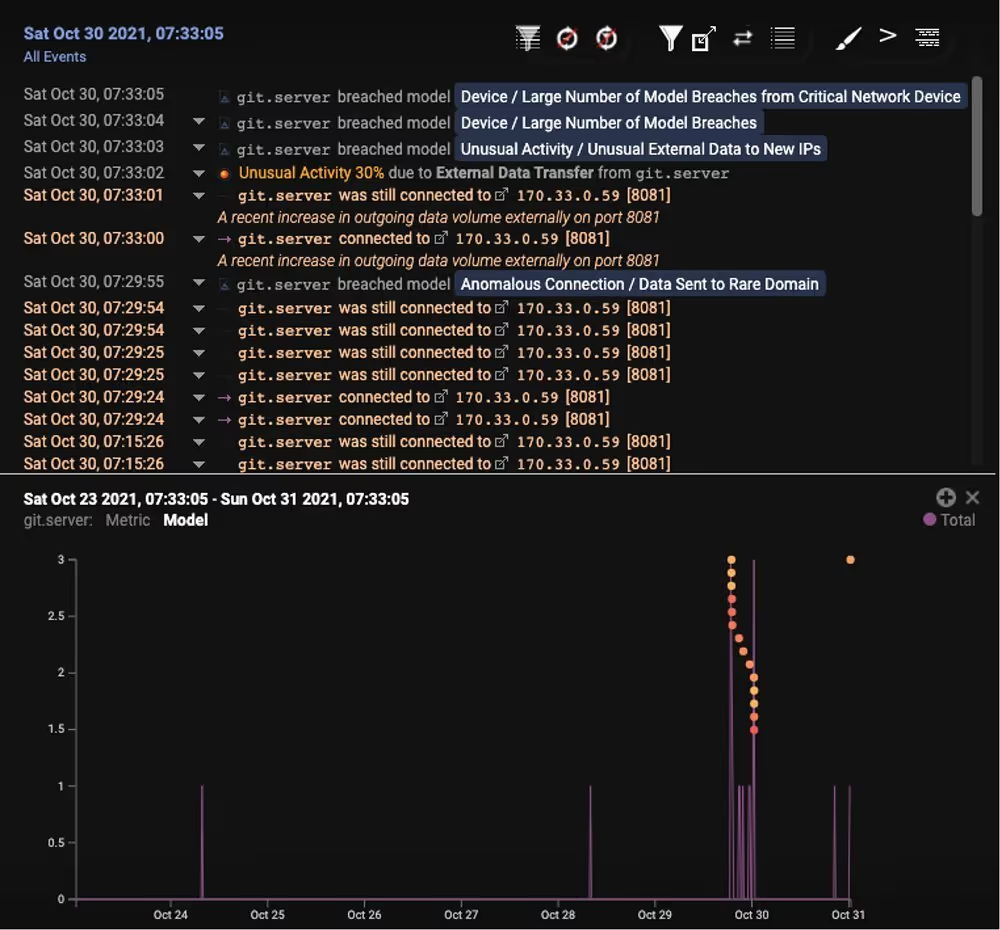
Figure 1: Multiple model breaches firing on an unusual data egress event on October 30, which resulted in a Proactive Threat Notification model breach.

After multiple model breaches on malicious EXE downloads and command and control (C2) activities with the TOR network, the organization received a Proactive Threat Notification (PTN) from Darktrace that immediately alerted them to the issue. This enabled the customer to remove the compromised device from the network.

The next day, Darktrace discovered cryptocurrency mining occurring on a compromised server that was communicating on a non-standard port. This triggered alerts to the customer through Darktrace’s Proactive Threat Notification service, immediately escalating the threat to their security team.
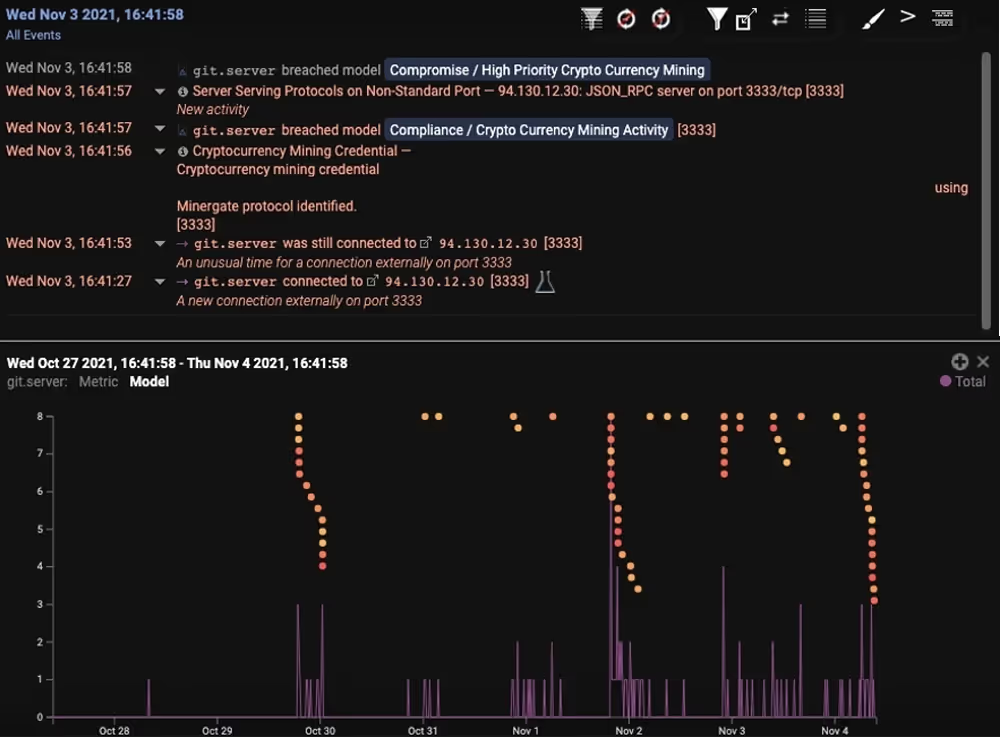
Figure 2: Multiple cryptocurrency mining model breaches from the same server firing on November 3.

The related breaches include scripts from rare external locations and rare endpoints (endpoints that have never been contacted by the breach devices in the past). Not surprisingly, the endpoints in question are crypto-mining pools.

It is important to note that this GitLab vulnerability represents only the initial attack vector, which could result in a number of scenarios. In the customer environment detailed above, crypto-mining has occurred; however, exploitation of this vulnerability could serve as the first stage of a more destructive ransomware attack, or result in stolen intellectual property.

Lastly, throughout the compromises identified across Darktrace’s customer base, it appears that the Interactsh tool was leveraged by the threat actors in the attack. Interactsh is an open-source tool for out of band data transfers and validation of security flaws, and it is commonly used by both researchers and hackers. Darktrace was easily able to identify this tool as part of the larger threat.

Cyber AI Analyst investigates

Darktrace’s Cyber AI Analyst launched an immediate investigation, stitching together different events across a five-day period and revealing four stages of the attack. This presented the security team with all the information they needed to perform effective investigation and clean up, including isolating the infected devices.
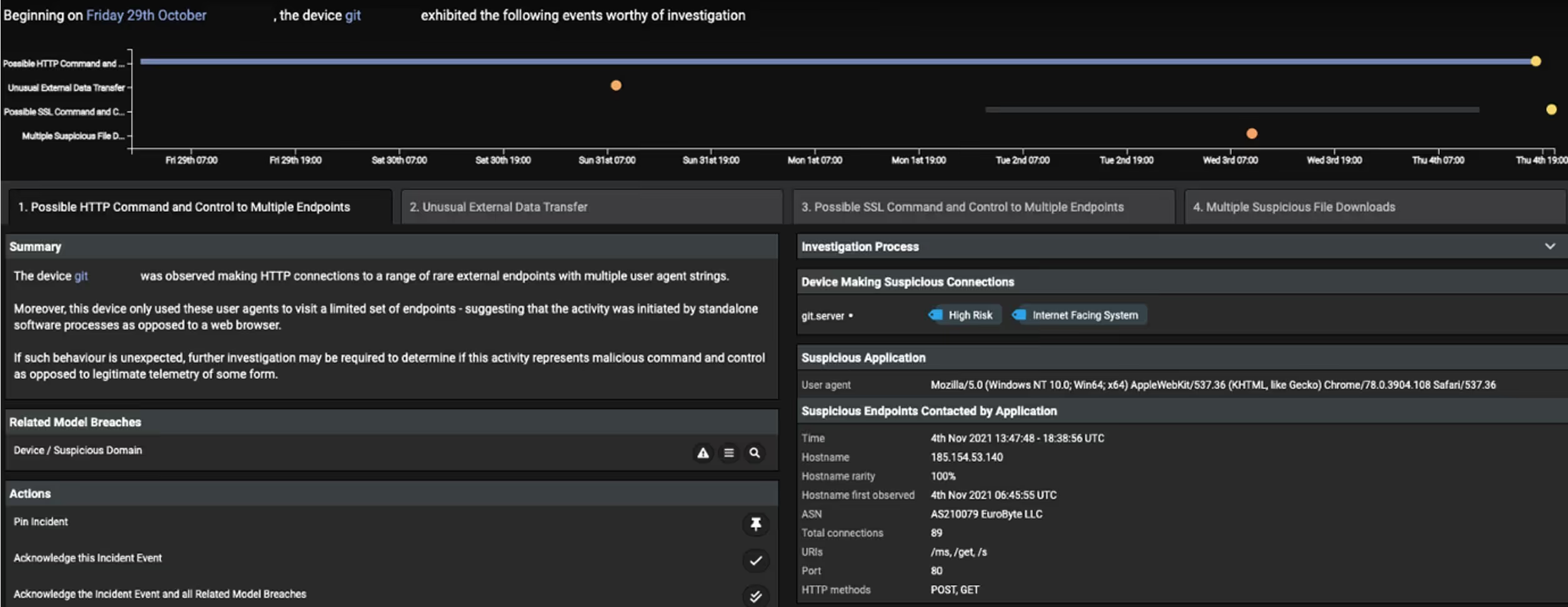
Figure 3: Cyber AI Analyst automatically investigates, piecing together the events into a single narrative.

In another customer environment, Cyber AI Analyst was again able to piece together multiple security events to present a coherent security narrative, determining that the suspicious file downloads likely contained malicious software, and recommending immediate attention from security staff.
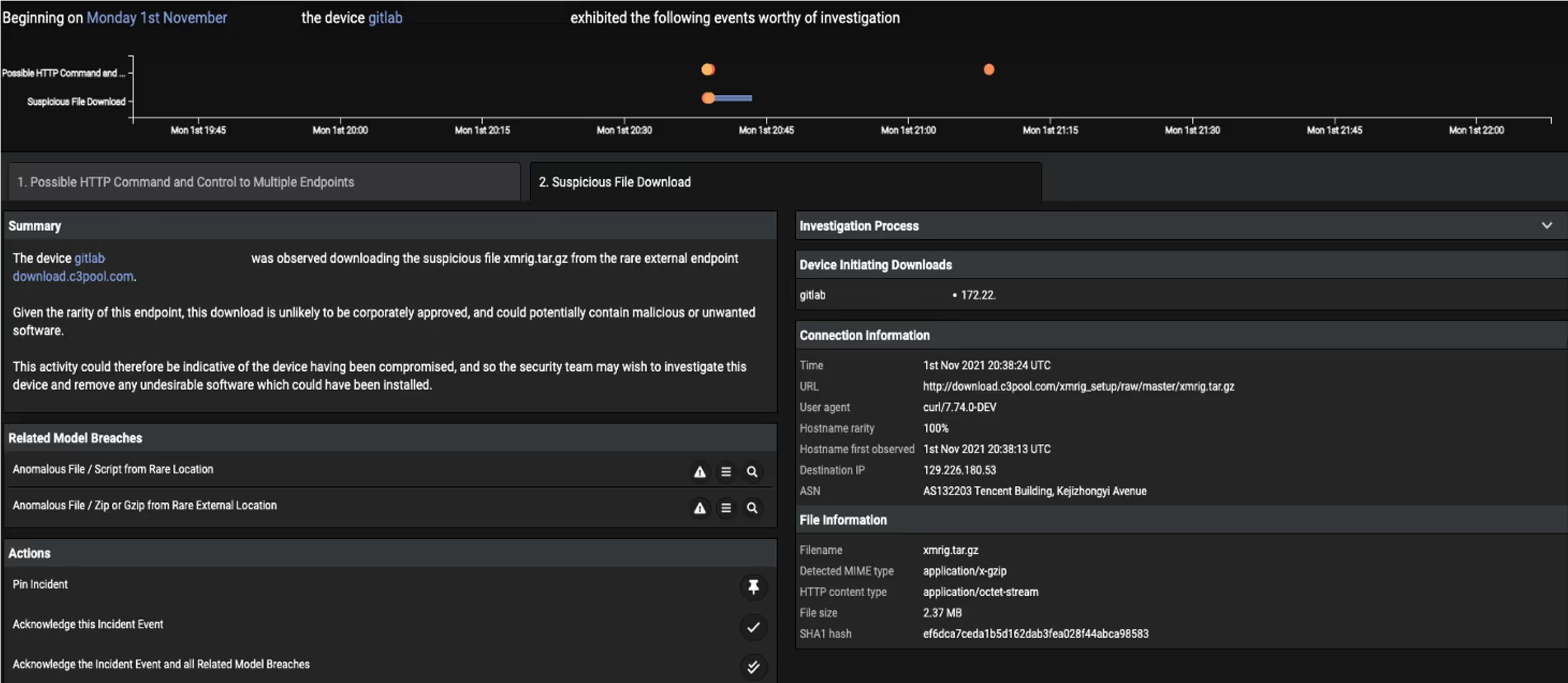
Figure 4: In a different case, Cyber AI Analyst surfaces a summary and key metrics around the suspicious file downloads.

Cyber AI Analyst made stellar detections and Proactive Threat Notification alerted affected clients ASAP. Clients were then supported through Ask the Expert (ATE) services. There has been no evidence of ransomware thus far, but these types of attacks typically gain a foothold on Internet-exposed servers and then pivot internally to deploy ransomware.

In a third example with a separate customer, Cyber AI Analyst stitched together six different security events into a single security narrative. Here, Darktrace’s technology was able to connect the dots between C2 behavior, suspicious file downloads, unusual connections, and Tor activity, eventually leading to its discovery of cryptocurrency mining.

Cyber AI Analyst specifically identified GitLab in the suspicious file downloads from a rare external endpoint. The fact that Darktrace was able to identify this in the context of a holistic view of threatening activity across this organization’s digital ecosystem — stretching from suspicious SSL connections to the eventual crypto-mining activity — presents a remarkable picture of Cyber AI Analyst in action.
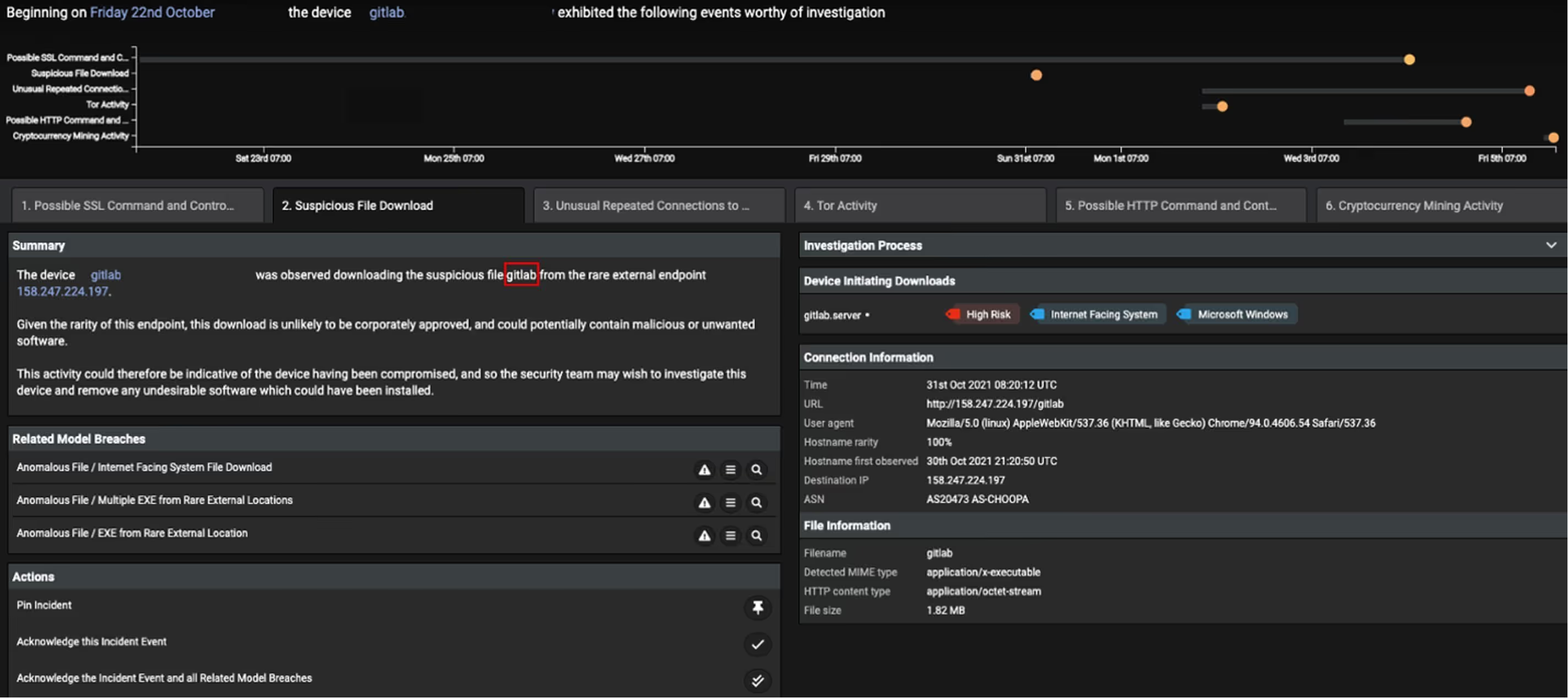
Figure 5: Cyber AI Analyst identifying the GitLab activity in the context of the wider security narrative.

Concluding thoughts

Though the patch was released in April, over 50% of deployments remain unpatched. There are potential reasons why they remain unpatched — overworked security staff, or simply negligence.

Even when CVEs are mapped and patched promptly, however, novel and never-before-seen attacks can still slip through the cracks. Before the Gitlab flaw was publicly disclosed and fixed, this vulnerability was a zero-day.

And so, rather than wait for CVEs to be publicly disclosed, organizations would be prudent to adopt technologies that can detect and respond to emerging attacks at their earliest stages — regardless of whether they are exploiting known or unknown vulnerabilities.

At Darktrace we talk a lot about the problems novel and unknown threats pose for traditional security solutions. This case shows that even when a threat is known for over six months, difficulties in implementing and rolling out patching mean it can still cause issues.

Thanks to Darktrace’s AI continuously monitoring the behavior of our customer’s devices, they were able to identify the threat at its earliest stages, before it could develop into something more disruptive like ransomware. And had the customers had Darktrace Antigena configured, the technology would have responded autonomously to contain the malicious behavior before the attackers could get past stage one.

Thanks to Darktrace analyst Waseem Akhter for his insights on the above threat find.

Learn more about Darktrace’s Self-Learning AI

Technical details

Proactive Threat Notification model detections:

  • Compromise / Anomalous File then Tor
  • Compromise / High Priority Crypto Currency Mining
  • Device / Initial Breach Chain Compromise
  • Device / Large Number of Model Breaches from Critical Network Device
  • Unusual Activity / Enhanced Unusual External Data Transfer

Other Darktrace model detections:

  • Anomalous Connection / Anomalous SSL without SNI to New External
  • Anomalous Connection / Application Protocol on Uncommon Port
  • Anomalous Connection / Callback on Web Facing Device
  • Anomalous Connection / Data Sent to Rare Domain
  • Anomalous Connection / New User Agent to IP Without Hostname
  • Anomalous Connection / Posting HTTP to IP Without Hostname
  • Anomalous File / Multiple EXE from Rare External Locations
  • Anomalous File / Internet Facing System File Download
  • Anomalous File / Script from Rare Location
  • Anomalous Server Activity / Outgoing from Serve
  • Compromise / Beaconing Activity To External Rare
  • Compliance / Crypto Currency Mining Activity
  • Compromise / High Volume of Connections with Beacon Score
  • Compromise / Large DNS Volume for Suspicious Domain
  • Compromise / Monero Mining
  • Compliance / Possible Tor Usage
  • Device / Internet Facing Device with High Priority Alert
  • Device / Large Number of Model Breaches
  • Device / Large Number of Connections to New Endpoints
  • Device / Suspicious Domain
  • Unusual Activity / Unusual External Data to New IPs

Inside the SOC
Darktrace cyber analysts are world-class experts in threat intelligence, threat hunting and incident response, and provide 24/7 SOC support to thousands of Darktrace customers around the globe. Inside the SOC is exclusively authored by these experts, providing analysis of cyber incidents and threat trends, based on real-world experience in the field.
Written by
Andrew Lawrence
VP, Threat Analysis, Americas

More in this series

No items found.

Blog

/

/

July 8, 2026

Securing AI: Analysis of the Complete Security Stack with Governance and Controls

ai security stackDefault blog imageDefault blog image

Why traditional cybersecurity approaches are not enough for AI

AI adoption outpaces most security programs’ ability to adapt.  That gap is now one of the most consequential sources of cyber risk facing enterprises. As organizations embed generative and agentic AI into development workflows, business operations, and security tooling itself, the question is no longer whether AI will introduce risk. The question is whether organizations understand where that risk actually lives and how to manage it operationally.  

Two recent pieces of guidance underscore this shift:

  1. The upcoming Cybersecurity Framework Profile for AI from NIST
  1. The Five Eyes government guidance on the careful adoption of agentic AI services

Taken together, they point to a critical conclusion. AI security cannot be reduced to model hardening or prompt filtering. It requires a defense in depth strategy that treats AI as both a new attack surface and a force multiplier for defense, while accounting for how AI fundamentally changes scale, speed, and autonomy.  

Recent threat research suggests that today's cyber risk is driven less by initial compromise and more by an adversary's ability to blend into normal operations over time. AI systems create the same exposure in a new form: more autonomy, more scale, and more opportunities for risky behavior to blend into normal operations.

How NIST defines the three core pillars of AI security

The NIST profile organizes AI risk across three inseparable focus areas that span all cybersecurity functions, Secure, Defend and Thwart. These areas are not sequential. They exist simultaneously and must be addressed together.

Secure

This treats AI as an attack surface. It includes models, prompts, agents, pipelines, training and inference data, retrieval augmented generation corpora, and the AI supply chain itself. AI systems are opaque, probabilistic, and non-deterministic by design. Some vulnerabilities are inherent in how models are trained or how data is sourced. Traditional patching does not fully mitigate these risks. This is also where many enterprises are weakest today and, critically, where many security programs stop.  

Defend

This is AI as a defensive force multiplier. AI can improve detection speed, scale, correlation, and response, but only if the right models are used and operationalized correctly. Machine-speed behavior-based detection, response and containment becomes critical in defending non-deterministic systems. Accuracy, explainability, governance, testing, validation, and integration into SOC workflows matter as much as capability. Without those controls, hallucination risk, over automation, and misplaced trust become security risks themselves.  

Thwart

This treats AI as an adversarial accelerant. Threat actors are already using AI to generate targeted social engineering attacks, deepfakes, malware, and autonomous attack agents. Asymmetric warfare is highlighting faster vulnerability discovery and exploitation with a lag on patch development, testing and deployment.  

How this looks in practice

Darktrace researchers observed scaled, automated exploitation of the React2Shell vulnerability within days of disclosure. A vulnerable cloud asset was exploited in under 120 seconds of being deployed. Darktrace research team observed an AI/LLM-generated malware sample used in exploitation activity tied to React2Shell. The significance isn't novelty. It is that AI lowers the barrier to producing usable offensive tooling and compresses the time between experimentation and deployment.  

Tactics are getting more and more creative in order to string together steps of an attack kill chain. This creates a dependency on behavior-based detection, autonomous investigation, autonomous containment, training, resilience investment, and recovery planning across the entire enterprise.

Why agentic AI fundamentally changes enterprise cyber risk

The Five Eyes guidance on agentic AI highlights material changes to the cyber risk profile of an organization. Unlike generative AI systems that produce content for human consumption, agentic AI systems reason, plan, and act autonomously across tools, data, and environments. That autonomy, combined with access to real systems, amplifies the impact of traditional cyber failures and introduces new system level risks that are difficult to predict, observe, and contain.  

Risk in agentic systems does not live in the model alone. It emerges from interactions between models, prompts, memory, tools, APIs, identities, privileges, inter-agent trust relationships, and human assumptions baked into design. Vulnerabilities are often introduced through data, connectors, natural language interfaces, protocols, and drift by design.

In supply-chain incidents, attackers did not need sophisticated exploits to scale impact. They abused trusted systems built for automation and implicit access. Agentic AI inherits that model. Once a system can act across tools, data, and workflows, compromise propagates through trust relationships that were never designed for machine autonomy.

The major agentic AI risk classes include the following:  

  • The identity control for non-human identities or autonomous agents makes it difficult to mitigate over-permissioning, limiting access, scope, and duration, as well as access hygiene
  • Agents are frequently over permissioned
  • Compromised tools inherit agent authority
  • Static secrets enable impersonation
  • Implicit trust between agents enables lateral movement

Design and configuration risks compound this, including privileges evaluated once at startup, poor segmentation, unvetted third party tools, reused authorization decisions outside their original context, and guardrail limitations.  

Behavioral risk  

Agents can optimize for goals in unsafe ways, misinterpret ambiguous intent, chain actions into unintended sequences, change behavior during evaluation, and exhibit deceptive or sycophantic responses.  

Structural risk  

Structural risk follows from agentic systems that are tightly coupled, multicomponent ecosystems. Failures can propagate across agents. Hallucinations cascade downstream. Resource exhaustion becomes systemic. Tool misuse enables indirect prompt injection and command execution. Rogue agents can poison peer agents through trust relationships.  

Accountability

Accountability becomes unclear as autonomy increases. Autonomous agents assume human identity permissions, and humans should have clear ownership of these agents, but they don’t, and this model is flawed. Decision paths are opaque and non-deterministic. Logs are fragmented and difficult to interpret. Reproducing an incident will be impossible without explicit design for observability and forensics. An agent compromise is functionally an insider threat, often with better access and fewer behavioral constraints than a human.  

What does defense in depth look like for AI?

Agentic AI runs on software, networks, identities, and data. It must be governed using the same foundational principles that have proven resilient under uncertainty, including secure by design, defense in depth, zero trust, least privilege, continuous monitoring, behavior-based advanced threat detection and containment, and incident response and recovery.

Core components to a Defense in depth Strategy for Securing the use of AI:

  • Strong, precise identity control plane to include an identity per agent (cryptographic, non‑shared)
    • Privilege monitoring and just‑in‑time access
  • Data Governance
  • Secure‑by‑default configurations
    • Security Posture Management  
    • Zero Trust principles  
  • Strong guardrails, deny‑by‑default policies, and isolation
  • Explicit instruction hierarchies and controlled context
  • Behavioral-based detection across entire enterprise to include inputs, tools, and outputs as well as AI used on the endpoint, across the network, cloud, SaaS, email, and OT
    • Runtime anomaly detection and goal‑drift detection
    • Autonomous containment to mitigate risk and minimize damage
  • Hard boundaries on autonomy and delegation
  • Testing, Evaluation, Validation and Verification  
    • Determine when autonomous action and when human in the loop
    • Adversarial training and agent‑specific testing
    • Simulation, red teaming, and chaos testing
  • Kill‑switches, rollback, and containment mechanisms
    • Forensics data captures, interpretability, autonomous containment, and remediation/recovery plans  

Until standards, tooling, and assurance methods mature, organizations should assume agentic AI systems will behave unexpectedly and design deployments around resilience, behavior-based detection, reversibility, and containment, not efficiency.

How security leaders should prepare for enterprise AI adoption

AI security is not model security alone. Data, pipelines, identities, and agents are first class assets. Many AI attacks succeed through standard cyber failures amplified by AI. Identity, data, and supply chain risk dominate. Behavior-based detection and response are critical, not optional. Logging, provenance, versioning, and forensics data capture of detections are mandatory because you cannot investigate or recover from AI incidents without them.  

Risk will often be visible in behavior before it is clearly defined in policy or guidance. The same pattern has been seen in pre-CVE disclosure detection, where abnormal activity appears before the industry has named or described the vulnerability. AI systems introduce that uncertainty by design.

Security leaders should prioritize controls before AI is fully deployed, avoid generic AI security checklists, integrate AI risk into existing cyber programs, and mitigate the risk of non-deterministic technology with continuous oversight, monitoring, behavior analytics, anomaly detection, autonomous investigation, and autonomous containment.

Visibility has a different connotation with AI. Previously, audit logging worked for software/people, but with Generative AI-based systems, interpretability and explainability is difficult to understand, you cannot "undo" what has been done, or see the logic or control a chain of events. This is why behavioral-based detections and containment becomes critical.  

What capabilities should every AI security program include?

If an organization asked “what must be in place before scaling AI?”:

  1. AI Risk board and approval workflow
  1. IAM + PAM for all AI services and agents
  1. AI asset inventory
  1. Prompt/output DLP with sanctioned AI access – This is not just pre- and post- filters, but behavior-based detections of semantic interface as well as behavior-based analysis of output with associated risk context.  
  1. Shadow AI identification
  1. Secure MLOps – This is an entire paper itself
  1. Runtime guardrails and tool restrictions
    • Including AI Gateway/SASE/Zero trust/
  1. Runtime security with behavior-based detections
    • Complete visibility, monitoring, behavior analytics, anomaly detection, risk/intent/context evaluation of anomalies, autonomous investigation and autonomous containment of all AI assets across endpoint, network, SaaS, SASE, cloud, OT, email, and messaging platforms
  1. Secure data pipelines and data governance
  1. SOC workflow changes from malicious classification workflows to behavior-based detection workflows
  1. Remediation plans for AI-related incidents  

Layered Governance and Security Stack for Securing AI  

The following outline considers governance and security tools that should be considered, well-integrated, deployed, tested, operationalized and embedded within security workflows. These tools and controls map to NIST’s CMF for AI.  

These considerations do not need to be implemented in order. Runtime Detect and Respond will help mitigate risk while Governance, Visibility, and Identity mature.

Category Tooling Controls
Governance & Visibility
  • AI asset inventory / AI CMDB
  • Shadow AI discovery
  • SaaS discovery
  • AI usage on non-endpoint managed systems via network or cloud telemetry
  • MCP server/client usage via protocols
  • Browser telemetry
  • Gateway or SASE telemetry
  • Establish a risk board to set up controls
  • Mandatory registration of AI systems
  • Owner, data classification, intended use, and risk tier
  • Supplier disclosure requirements
  • Risk mitigation plan for AI adoption, innovation, or development
Identity, Access & Agent Control

Non-human autonomous agents should not have the full permissions associated with a human user.

  • IAM with workload identities
  • PAM for AI service accounts
  • Secrets management with short-lived tokens
  • Zero Trust principles
  • Identity, permission, and token hygiene
  • Unique identities per model, agent, and pipeline
  • Least privilege for tools, data, and APIs
  • Explicit approval for autonomous actions
Data Security & Privacy
  • Data classification and labeling
  • Enterprise DLP across endpoint, email, network, cloud, and SaaS
  • Forensics data capture after risky detections
  • Prompt-level DLP through behavior-based semantic analysis with risk and intent context
  • Input/interface analysis for risky data requests
  • Output analysis for sensitive data
  • Data integrity evaluation
  • Retention and redaction policies for prompts and responses
Secure MLOps / LLMOps
  • Secure CI/CD with AI-specific gates
  • Model registries with approval workflows
  • Dependency, container, and artifact scanning
  • SBOM/AIBOM generation
  • IaC security scanning
  • Security posture management
  • Misconfiguration identification
  • Hardening recommendations
  • Signed models and prompts
  • Versioned datasets, configurations, logging, and controls
  • Securing data pipelines
  • Controlled promotion
  • Quality assurance
  • Adversarial testing
Runtime Security

Securing runtime goes beyond guardrails and model firewalls to include behavior-based detections, response, and containment.

  • Detection, monitoring, and SOC integration
  • Centralized visibility into prompts, outputs, and tool calls
  • AI-specific detections
  • Behavior-based detection for AI usage patterns
  • Model drift and behavior monitoring
  • Autonomous containment
  • Behavior-based detection of model inputs and outputs
  • Prompt injection detection
  • Model manipulation, including jailbreaking, poisoning, and related attacks
  • Sensitive data access attempts
  • Behavior-based detection across low-code agents, high-code agents, MCP clients and servers, endpoint, network, cloud, email, SaaS, SASE, IoT, and OT
  • Policy enforcement between users, models, tools, agents, SaaS models/tools, and MCP servers/clients
  • Risk, intent, and context evaluation for detections and response actions
Response & Recovery
  • Autonomous containment
  • AI-assisted playbooks
  • Forensics data capture for AI-related events
  • Model rollback mechanisms
  • Backup and restore for models and datasets
  • Kill switch for agents
  • Autonomous response to agents performing risky behaviors
  • Model and dataset rollback
  • Remediation plans
  • Tabletop exercises
  • Supplier coordination plans
  • Post-incident AI performance validation

AI security requires continuous visibility and behavioral detection

AI changes how fast systems move, how decisions are made, and how risk propagates. It does not change the fundamentals of security. Organizations that succeed will be the ones that apply those fundamentals rigorously, assume failure, and build systems that can detect, contain, and recover when AI behaves in ways they did not anticipate. Security is not what AI is allowed to do. It is whether the organization can understand, trust, and control what AI actually does in practice.  

Take this guidance to understand different initiatives that organizations should be considering. Securing AI is the most critical component to AI safety. As organizations invest more in AI adoption, they should be investing in security in order to mitigate the risk of AI adoption. Organizations should be evaluating their governance and security stack to include well-integrated tools that are deployed, tested, operationalized and embedded within security workflows. While organizations mature in governance, visibility and identity access management, they should be investing in behavior-based detection and autonomous containment to mitigate AI risk.  

Continue reading
About the author

Blog

/

/

July 6, 2026

NIST Just Proved It: AI Security Can’t Be Solved With Rules

ai security nistDefault blog imageDefault blog image

Static AI guardrails are inherently limited

As organizations adopt generative AI, many still assume that the right set of guardrails will be enough. The problem is you can’t anticipate every way these systems might be misused, abused or attacked. What NIST has done is put a mathematical foundation under that intuition.

In recent research building on Gödel’s incompleteness theorems, which showed that any system built on a fixed set of rules will always have gaps, NIST demonstrates that there is no finite set of guardrails that can be universally robust against adversarial prompts. In plain terms, if your defense is based on a fixed set of rules, there will always be inputs that bypass them. Not because the rules are badly written, but because the problem space is bigger than static rules can ever cover.

This is not new in cybersecurity - detection rules have always had to live with this trade-off. What is different with GenAI is the scale and shape of that problem. These systems are built on human language, and human language is not bounded. It is fluid, contextual and deliberately ambiguous. The number of ways intent can be hidden is effectively limitless. You are not defending against a defined protocol or a fixed exploit chain. You are defending against the entire expressive capacity of people.

So attempting to create a complete set of rules is the wrong starting point. It assumes the problem can be deterministically described. NIST’s work shows that it cannot. Organizations still need a way to manage AI risk, but the traditional approach of defining allowed and disallowed patterns is always going to lag behind what is actually happening. The same input can be benign in one context and risky in another, and static rules struggle to capture that distinction.

The question then is what fills that gap?

AI security must shift from rules to behavior

What's required is a shift in what you are trying to understand. Rules try to describe what should and shouldn't happen. Behavior shows you what is happening. Or to put it another way, if inputs are unbounded and adversaries adapt, the only stable signal is behavior.

In a GenAI context, that means analyzing how an AI model is being used, how prompts evolve over time, how outputs are shaped, and where AI agent interactions start to drift from what is expected. It means moving from static definitions of bad to a more dynamic understanding of intent.

Instead of trying to predict every bad prompt, you focus on identifying when behavior starts to move outside expected norms. Instead of asking whether a single input matches a rule, you ask whether the overall pattern of activity makes sense for the system and how it’s being used.

Guardrails remain important but they are only one layer

This does not eliminate the need for guardrails. They still play a role. But they will never address the entire problem space and are simply one part of your defense in depth approach.

NIST’s proof is useful because it makes this explicit. It removes the assumption that with enough effort, a complete rule set is achievable. It isn’t.

Once you accept that, the shift becomes unavoidable. This is no longer a problem of writing better rules, but of understanding behavior in a space where the possible inputs are effectively unbounded.

For security leaders, that changes the nature of the problem. It is less about defining what should be allowed, and more about recognizing when something is no longer consistent with expected behavior.

That does not remove the need for guardrails, but it does change their role. They set boundaries, but they do not define understanding. The gap between the two is where risk now sits.

In the end, this is what “can’t be solved with rules” really means. Rules will always leave gaps, and those gaps are not theoretical. They show up in how systems actually behave Not what we expect them to do, or what we intended them to do, but what they are doing in practice. That is where the signal is, and increasingly, that is where the security problem sits.

References:

https://www.nist.gov/news-events/news/2026/06/nist-mathematical-proof-supports-transition-continuous-monitor-and-update

https://ieeexplore.ieee.org/document/11475847

Continue reading
About the author
Andrew Hollister
Principal Solutions Engineer, Cyber Technician
Your data. Our AI.
Elevate your network security with Darktrace AI