Blog
/
Identity
/
June 9, 2021

Multi-Account Hijack Detection with AI

Discover the analysis of a sophisticated SaaS-based attack using Microsoft 365 accounts. Learn how attackers launch & maintain their offensive strategies.
Inside the SOC
Darktrace cyber analysts are world-class experts in threat intelligence, threat hunting and incident response, and provide 24/7 SOC support to thousands of Darktrace customers around the globe. Inside the SOC is exclusively authored by these experts, providing analysis of cyber incidents and threat trends, based on real-world experience in the field.
Written by
Max Heinemeyer
Global Field CISO
Default blog imageDefault blog imageDefault blog imageDefault blog imageDefault blog imageDefault blog image
09
Jun 2021

The widespread and rapid adoption of Software-as-a-Service (SaaS) has opened up a breadth of security risks for IT teams. Unlike commercial off-the-shelf (COTS) software, SaaS security tends to be managed by third-party vendors rather than the end customer. Security teams therefore struggle with reduced visibility and control over these environments, and cyber-criminals have been quick to take advantage, launching a wave of cloud-based attacks, from Vendor Email Compromise to internal account hijacks.

Attackers often gain access to multiple accounts on the same domain, enabling them to attack from multiple angles, for example sending of hundreds of emails from one account, while maintaining persistence with another. This gives the hacker an opportunity to try multiple attack vectors, using tools native to the SaaS environment as well as external payloads.

While preventative controls such as Multi-Factor Authentication (MFA) provide an extra layer of protection, there are many techniques available to circumvent zero-trust approaches. Remote and flexible working is set to continue to varying degrees across many different regions and industries, so companies must now commit to securing their cloud architecture and developing proactive cyber security measures.

In this blog, we will analyze a persistent cyber-attack which targeted a real estate company in Europe and leveraged several compromised Microsoft 365 accounts. These SaaS takeovers are quickly becoming the new norm, but they are still misunderstood and poorly documented in the wider industry. Cyber AI detected every stage of this intrusion in real time, without the use of signatures or static rules.

A and B: Hijacking Microsoft 365 accounts

The organization had around 5,000 devices in its environment, with 1,000 active SaaS accounts. The timeline below shows how the threat actor leveraged the SaaS accounts of five different users to carry out the operation, as well as exploiting several other accounts on the final day.
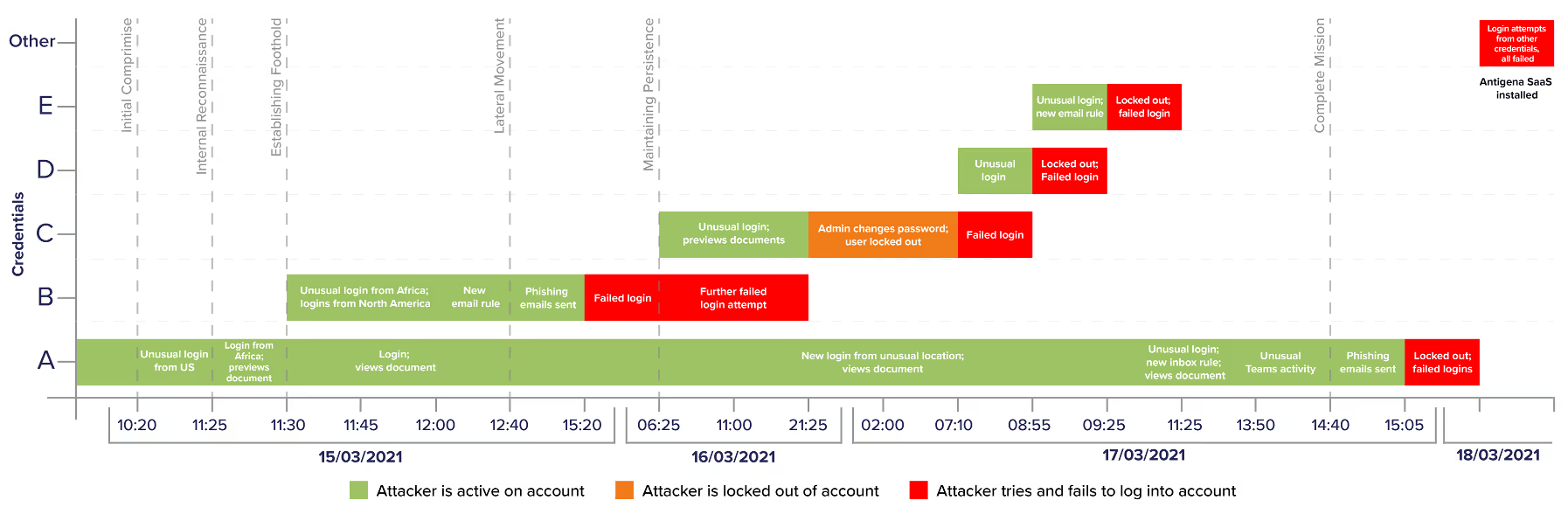
Figure 1: Diagram of the infection chain, which occurred over three days. On the fourth day, the attacker tried again but was unsuccessful.

The actor initially compromised at least two SaaS credentials – which we’ll refer to here simply as ‘account A’ and ‘account B’ – and logged in from several unusual geographical locations, presumably using a VPN. Darktrace detected this as unusual login events for the SaaS accounts.

In account A, the attacker was observed previewing files likely to contain customer information, but did not perform any other follow-up activity. In account B, they set a new inbox rule three hours after the initial compromise, resulting in a high-severity alert.

At around this time, the threat actor sent a number of phishing emails from account B: emails that appeared to be sharing a harmless and legitimate-looking folder on OneDrive. The link probably led to a fake Microsoft login page, similar to the below, which could have recorded the victims’ credentials and sent them directly back to the attacker.
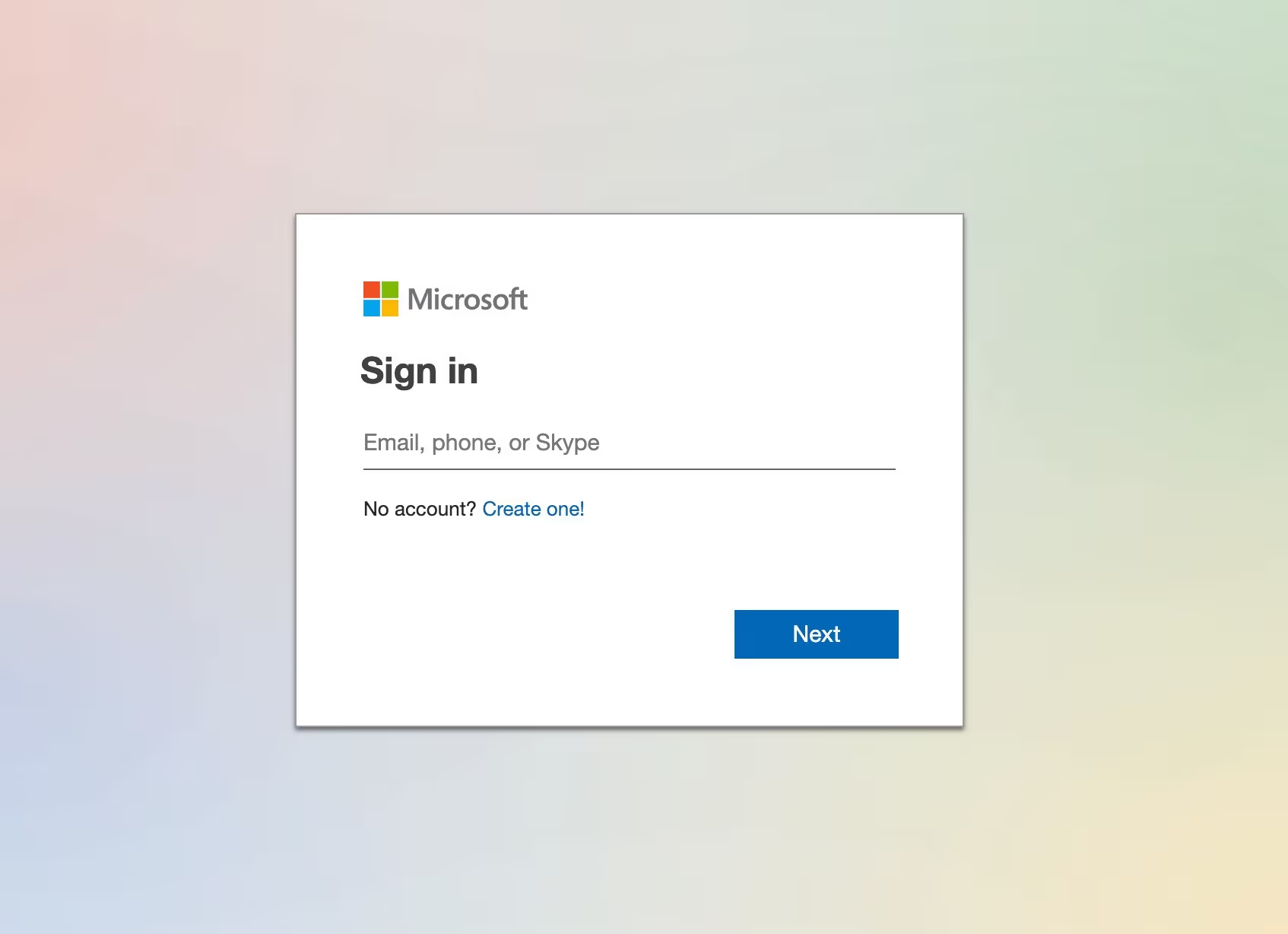
Figure 2: A seemingly legitimate Microsoft login page.

The phishing attempt was detected by Antigena Email, Darktrace’s email security technology. Antigena was in passive mode at the time, and so was not configured to take action on these threatening emails. But taking into account the highly anomalous sender surge coupled with the unusual login locations, it would have autonomously intercepted all the emails, reducing the impact of the attack.

The attacker was subsequently locked out of account B. After this, they tried (and failed) to use a legacy user agent to bypass any MFA which may have been enforced on the account. Darktrace detected this as a suspicious login and blocked the attempt.

Accounts C, D and E: The threat develops

The next day, the actor logged into a new account (account C) from the same autonomous system number (ASN), indicating that the account had been infected by the OneDrive phishing emails. In other words, the attacker had leveraged account B to compromise new users in the organization and ensure multiple points of intrusion.

Darktrace detected each stage of this, piecing together the different events into one meaningful security narrative.
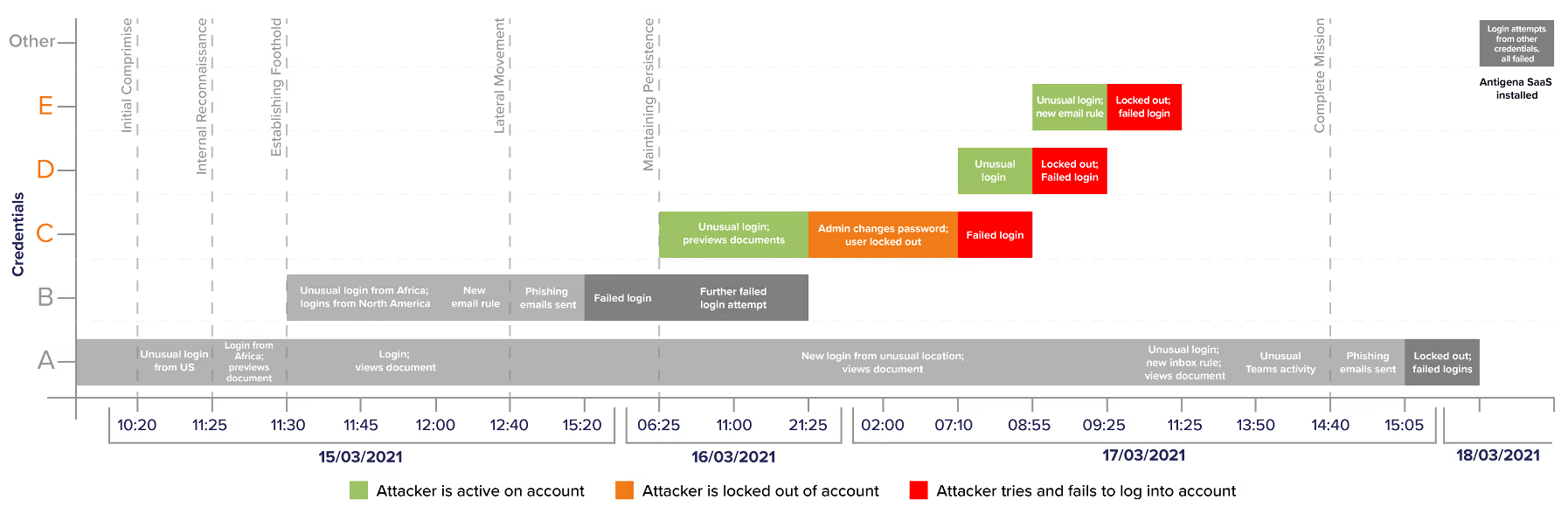
Figure 3: Anomalous activity from accounts C, D, and E.

Account C was then used to preview a file likely containing contact information.

After being locked out of account C when trying to log in the next day, the hacker worked their way through two more accounts (account D and account E), which they had hijacked in the previous phishing attempts. They were locked out each time after generating alerts due to the unusual logins and new inbox rules created around the same time.

A to Z: End of the line

Running out of options, the attacker decided to go back to account A and set a new inbox rule, using it to send new phishing emails with a link to a non-Microsoft cloud storage domain (Tresorit). Again, Darktrace recognized this as highly unusual behavior, and the hacker was promptly locked out of the account.

During this burst of activity, Darktrace also observed a Microsoft Teams session from one of the suspicious ASNs. This was likely a social engineering attempt and another possible attack vector. Microsoft Teams could have been leveraged to share a malicious link over instant message, extract sensitive information, or send spam internally and externally on the chat function.

The threat actor could have then used this to pivot across various applications and accounts, assuming that the company had a siloed security approach – with different tools for cloud, SaaS, email, and endpoint – and so could not pick up on the malicious cross-platform movement.

On the following day, the attacker attempted logins on multiple accounts again, but with no success. Cyber AI had pinpointed all the anomalous activity – no matter where it originated – and alerted the security team immediately.

SaaS attack under the microscope

Multi-account compromises can be incredibly persistent and are difficult for traditional security tools to identify. The hacker used several tactics to circumvent the customer’s existing email security products:

  1. The initial use of two compromised credentials – account A and account B – allowed the hacker to stay under the radar and not raise too much suspicion on a single account. Account A was kept quiet until other avenues had been exhausted.
  2. Activity was generated from multiple ASNs in at least three different geographical locations, probably utilizing a VPN: one in Africa where much of the activity originated, and two in North America, including some widely used ASNs which were highly unusual for the customer.
  3. The attacker entirely used Microsoft services until the final emails, choosing to ‘live off the land’ rather than sending links that may have been caught by gateways.
  4. The attacker logged into Microsoft Teams in their final movements – a fairly benign-looking event which could have been used to compromise more accounts and move laterally, and would have gone undetected.

Darktrace identified every stage of the attack – including spotting the anomalous ASNs – and launched an automatic, in-depth investigation with Cyber AI Analyst. The organization was thus able to take action before the damage was done.
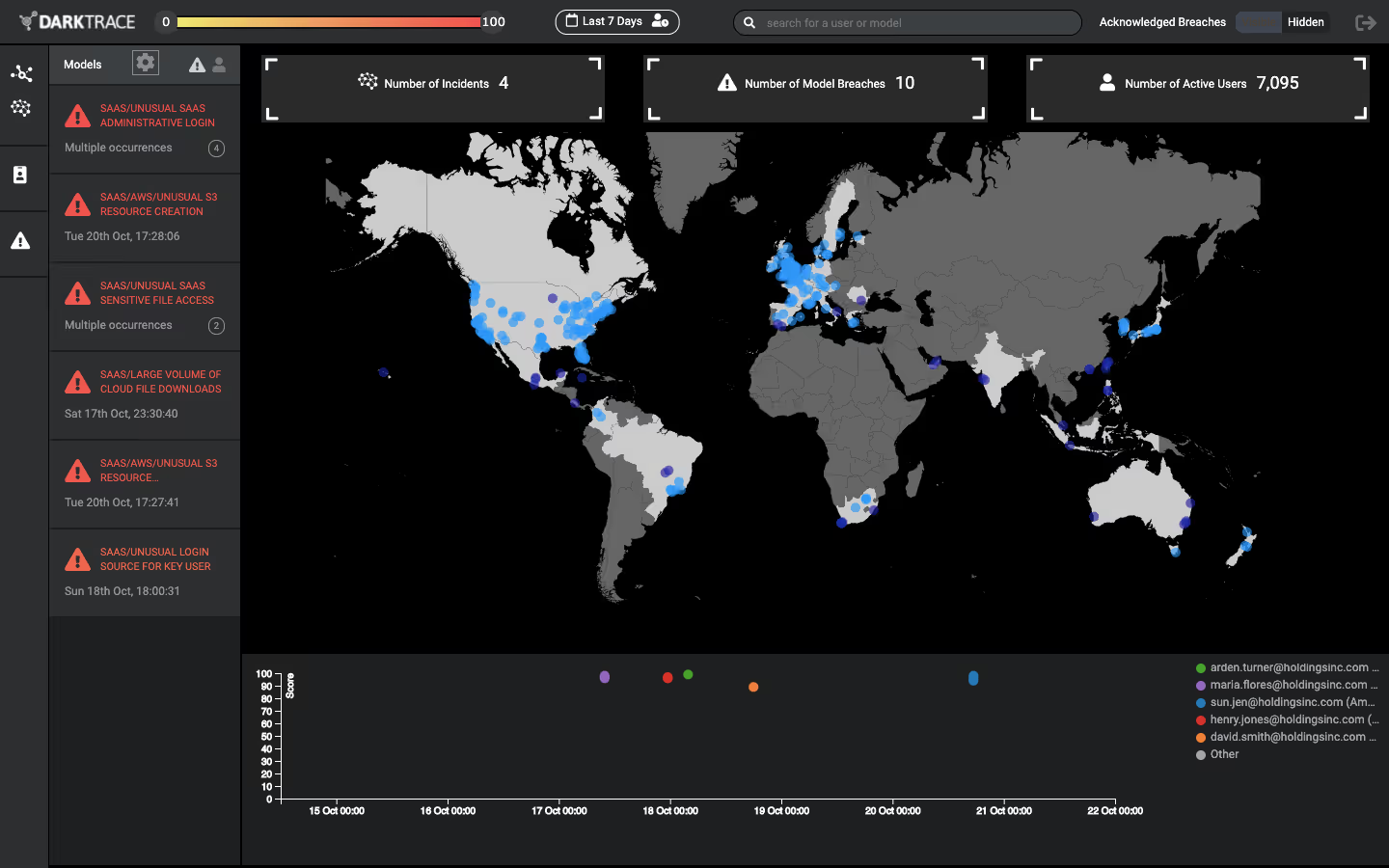
Figure 4: Darktrace’s SaaS console gives a clear overview of activity across all different applications.

ABCs of SaaS security

The approach of using various accounts to mount the offensive, while keeping one to maintain persistence, prolonged this intrusion. Such tactics will likely be seen again in the near future.

Tracking the number of factors involved in an attack with multiple credentials, multiple attack vectors, and multiple attacker-IPs, is a serious challenge. In these situations, it is essential to have a security solution which can detect activity across different applications, forming a unified and holistic understanding over the entire digital enterprise.

While not active in this case, Antigena SaaS would have taken autonomous action and prevented the threat from escalating by enforcing normal behavior, stopping the hacker from logging in from malicious infrastructure or performing any out-of-character SaaS actions, such as creating new inbox rules.

Following the intrusion, the company decided to adopt Antigena SaaS, which now mitigates their cloud security risks and guards against sensitive data loss and reputational damage.

Thanks to Darktrace analyst Daniel Gentle for his insights on the above threat find.

Darktrace model detections:

  • SaaS / Compromise / Unusual Login and New Email Rule
  • SaaS / Compliance / New Email Rule
  • SaaS / Unusual Activity / Unusual External Source for SaaS Credential Use
  • SaaS / Access / Suspicious Login Attempt
  • Antigena Email: Unusual Login Location + Sender Surge
Inside the SOC
Darktrace cyber analysts are world-class experts in threat intelligence, threat hunting and incident response, and provide 24/7 SOC support to thousands of Darktrace customers around the globe. Inside the SOC is exclusively authored by these experts, providing analysis of cyber incidents and threat trends, based on real-world experience in the field.
Written by
Max Heinemeyer
Global Field CISO

More in this series

No items found.

Blog

/

/

January 13, 2026

Runtime Is Where Cloud Security Really Counts: The Importance of Detection, Forensics and Real-Time Architecture Awareness

runtime, cloud security, cnaapDefault blog imageDefault blog image

Introduction: Shifting focus from prevention to runtime

Cloud security has spent the last decade focused on prevention; tightening configurations, scanning for vulnerabilities, and enforcing best practices through Cloud Native Application Protection Platforms (CNAPP). These capabilities remain essential, but they are not where cloud attacks happen.

Attacks happen at runtime: the dynamic, ephemeral, constantly changing execution layer where applications run, permissions are granted, identities act, and workloads communicate. This is also the layer where defenders traditionally have the least visibility and the least time to respond.

Today’s threat landscape demands a fundamental shift. Reducing cloud risk now requires moving beyond static posture and CNAPP only approaches and embracing realtime behavioral detection across workloads and identities, paired with the ability to automatically preserve forensic evidence. Defenders need a continuous, real-time understanding of what “normal” looks like in their cloud environments, and AI capable of processing massive data streams to surface deviations that signal emerging attacker behavior.

Runtime: The layer where attacks happen

Runtime is the cloud in motion — containers starting and stopping, serverless functions being called, IAM roles being assumed, workloads auto scaling, and data flowing across hundreds of services. It’s also where attackers:

  • Weaponize stolen credentials
  • Escalate privileges
  • Pivot programmatically
  • Deploy malicious compute
  • Manipulate or exfiltrate data

The challenge is complex: runtime evidence is ephemeral. Containers vanish; critical process data disappears in seconds. By the time a human analyst begins investigating, the detail required to understand and respond to the alert, often is already gone. This volatility makes runtime the hardest layer to monitor, and the most important one to secure.

What Darktrace / CLOUD Brings to Runtime Defence

Darktrace / CLOUD is purpose-built for the cloud execution layer. It unifies the capabilities required to detect, contain, and understand attacks as they unfold, not hours or days later. Four elements define its value:

1. Behavioral, real-time detection

The platform learns normal activity across cloud services, identities, workloads, and data flows, then surfaces anomalies that signify real attacker behavior, even when no signature exists.

2. Automated forensic level artifact collection

The moment Darktrace detects a threat, it can automatically capture volatile forensic evidence; disk state, memory, logs, and process context, including from ephemeral resources. This preserves the truth of what happened before workloads terminate and evidence disappears.

3. AI-led investigation

Cyber AI Analyst assembles cloud behaviors into a coherent incident story, correlating identity activity, network flows, and Cloud workload behavior. Analysts no longer need to pivot across dashboards or reconstruct timelines manually.

4. Live architectural awareness

Darktrace continuously maps your cloud environment as it operates; including services, identities, connectivity, and data pathways. This real-time visibility makes anomalies clearer and investigations dramatically faster.

Together, these capabilities form a runtime-first security model.

Why CNAPP alone isn’t enough

CNAPP platforms excel at pre deployment checks all the way down to developer workstations, identifying misconfigurations, concerning permission combinations, vulnerable images, and risky infrastructure choices. But CNAPP’s breadth is also its limitation. CNAPP is about posture. Runtime defense is about behavior.

CNAPP tells you what could go wrong; runtime detection highlights what is going wrong right now.

It cannot preserve ephemeral evidence, correlate active behaviors across domains, or contain unfolding attacks with the precision and speed required during a real incident. Prevention remains essential, but prevention alone cannot stop an attacker who is already operating inside your cloud environment.

Real-world AWS Scenario: Why Runtime Monitoring Wins

A recent incident detected by Darktrace / CLOUD highlights how cloud compromises unfold, and why runtime visibility is non-negotiable. Each step below reflects detections that occur only when monitoring behavior in real time.

1. External Credential Use

Detection: Unusual external source for credential use: An attacker logs into a cloud account from a never-before-seen location, the earliest sign of account takeover.

2. AWS CLI Pivot

Detection: Unusual CLI activity: The attacker switches to programmatic access, issuing commands from a suspicious host to gain automation and stealth.

3. Credential Manipulation

Detection: Rare password reset: They reset or assign new passwords to establish persistence and bypass existing security controls.

4. Cloud Reconnaissance

Detection: Burst of resource discovery: The attacker enumerates buckets, roles, and services to map high value assets and plan next steps.

5. Privilege Escalation

Detection: Anomalous IAM update: Unauthorized policy updates or role changes grant the attacker elevated access or a backdoor.

6. Malicious Compute Deployment

Detection: Unusual EC2/Lambda/ECS creation: The attacker deploys compute resources for mining, lateral movement, or staging further tools.

7. Data Access or Tampering

Detection: Unusual S3 modifications: They alter S3 permissions or objects, often a prelude to data exfiltration or corruption.

Only some of these actions would appear in a posture scan, crucially after the fact.
Every one of these runtime detections is visible only through real-time behavioral monitoring while the attack is in progress.

The future of cloud security Is runtime-first

Cloud defense can no longer revolve solely around prevention. Modern attacks unfold in runtime, across a fast-changing mesh of workloads, services, and — critically — identities. To reduce risk, organizations must be able to detect, understand, and contain malicious activity as it happens, before ephemeral evidence disappears and before attacker's pivot across identity layers.

Darktrace / CLOUD delivers this shift by turning runtime, the most volatile and consequential layer in the cloud, into a fully defensible control point through unified visibility across behavior, workloads, and identities. It does this by providing:

  • Real-time behavior detection across workloads and identity activity
  • Autonomous response actions for rapid containment
  • Automated forensic level artifact preservation the moment events occur
  • AI-driven investigation that separates weak signals from true attacker patterns
  • Live cloud environment insight to understand context and impact instantly

Cloud security must evolve from securing what might go wrong to continuously understanding what is happening; in runtime, across identities, and at the speed attackers operate. Unifying runtime and identity visibility is how defenders regain the advantage.

[related-resource]

Continue reading
About the author
Adam Stevens
Senior Director of Product, Cloud | Darktrace

Blog

/

Network

/

January 12, 2026

Maduro Arrest Used as a Lure to Deliver Backdoor

maduro arrest used as lure to deliver backdoorDefault blog imageDefault blog image

Introduction

Threat actors frequently exploit ongoing world events to trick users into opening and executing malicious files. Darktrace security researchers recently identified a threat group using reports around the arrest of Venezuelan President Nicolàs Maduro on January 3, 2025, as a lure to deliver backdoor malware.

Technical Analysis

While the exact initial access method is unknown, it is likely that a spear-phishing email was sent to victims, containing a zip archive titled “US now deciding what’s next for Venezuela.zip”. This file included an executable named “Maduro to be taken to New York.exe” and a dynamic-link library (DLL), “kugou.dll”.  

The binary “Maduro to be taken to New York.exe” is a legitimate binary (albeit with an expired signature) related to KuGou, a Chinese streaming platform. Its function is to load the DLL “kugou.dll” via DLL search order. In this instance, the expected DLL has been replaced with a malicious one with the same name to load it.  

DLL called with LoadLibraryW.
Figure 1: DLL called with LoadLibraryW.

Once the DLL is executed, a directory is created C:\ProgramData\Technology360NB with the DLL copied into the directory along with the executable, renamed as “DataTechnology.exe”. A registry key is created for persistence in “HKCU\Software\Microsoft\Windows\CurrentVersion\Run\Lite360” to run DataTechnology.exe --DATA on log on.

 Registry key added for persistence.
Figure 2. Registry key added for persistence.
Folder “Technology360NB” created.
Figure 3: Folder “Technology360NB” created.

During execution, a dialog box appears with the caption “Please restart your computer and try again, or contact the original author.”

Message box prompting user to restart.
Figure 4. Message box prompting user to restart.

Prompting the user to restart triggers the malware to run from the registry key with the command --DATA, and if the user doesn't, a forced restart is triggered. Once the system is reset, the malware begins periodic TLS connections to the command-and-control (C2) server 172.81.60[.]97 on port 443. While the encrypted traffic prevents direct inspection of commands or data, the regular beaconing and response traffic strongly imply that the malware has the ability to poll a remote server for instructions, configuration, or tasking.

Conclusion

Threat groups have long used geopolitical issues and other high-profile events to make malicious content appear more credible or urgent. Since the onset of the war in Ukraine, organizations have been repeatedly targeted with spear-phishing emails using subject lines related to the ongoing conflict, including references to prisoners of war [1]. Similarly, the Chinese threat group Mustang Panda frequently uses this tactic to deploy backdoors, using lures related to the Ukrainian war, conventions on Tibet [2], the South China Sea [3], and Taiwan [4].  

The activity described in this blog shares similarities with previous Mustang Panda campaigns, including the use of a current-events archive, a directory created in ProgramData with a legitimate executable used to load a malicious DLL and run registry keys used for persistence. While there is an overlap of tactics, techniques and procedures (TTPs), there is insufficient information available to confidently attribute this activity to a specific threat group. Users should remain vigilant, especially when opening email attachments.

Credit to Tara Gould (Malware Research Lead)
Edited by Ryan Traill (Analyst Content Lead)

Indicators of Compromise (IoCs)

172.81.60[.]97
8f81ce8ca6cdbc7d7eb10f4da5f470c6 - US now deciding what's next for Venezuela.zip
722bcd4b14aac3395f8a073050b9a578 - Maduro to be taken to New York.exe
aea6f6edbbbb0ab0f22568dcb503d731  - kugou.dll

References

[1] https://cert.gov.ua/article/6280422  

[2] https://www.ibm.com/think/x-force/hive0154-mustang-panda-shifts-focus-tibetan-community-deploy-pubload-backdoor

[3] https://www.ibm.com/think/x-force/hive0154-targeting-us-philippines-pakistan-taiwan

[4] https://www.ibm.com/think/x-force/hive0154-targeting-us-philippines-pakistan-taiwan

Continue reading
About the author
Tara Gould
Malware Research Lead
Your data. Our AI.
Elevate your network security with Darktrace AI