
Blog
/
Identity
/
August 21, 2025

From VPS to Phishing: How Darktrace Uncovered SaaS Hijacks through Virtual Infrastructure Abuse

Darktrace identified coordinated SaaS account compromises across multiple customer environments. The incidents involved suspicious logins from VPS-linked infrastructure followed by unauthorized inbox rule creation and deletion of phishing-related emails. These consistent behaviors across devices point to a targeted phishing campaign leveraging virtual infrastructure for access and concealment. Discover how Darktrace uncovered this activity and what it means for the future of SaaS security.
Inside the SOC
Darktrace cyber analysts are world-class experts in threat intelligence, threat hunting and incident response, and provide 24/7 SOC support to thousands of Darktrace customers around the globe. Inside the SOC is exclusively authored by these experts, providing analysis of cyber incidents and threat trends, based on real-world experience in the field.
Written by
Rajendra Rushanth
Cyber Analyst
VPS phishingDefault blog image
21
Aug 2025

What is a VPS and how are they abused?

A Virtual Private Server (VPS) is a virtualized server that provides dedicated resources and control to users on a shared physical device.  VPS providers, long used by developers and businesses, are increasingly misused by threat actors to launch stealthy, scalable attacks. While not a novel tactic, VPS abuse is has seen an increase in Software-as-a-Service (SaaS)-targeted campaigns as it enables attackers to bypass geolocation-based defenses by mimicking local traffic, evade IP reputation checks with clean, newly provisioned infrastructure, and blend into legitimate behavior [3].

VPS providers like Hyonix and Host Universal offer rapid setup and minimal open-source intelligence (OSINT) footprint, making detection difficult [1][2]. These services are not only fast to deploy but also affordable, making them attractive to attackers seeking anonymous, low-cost infrastructure for scalable campaigns. Such attacks tend to be targeted and persistent, often timed to coincide with legitimate user activity, a tactic that renders traditional security tools largely ineffective.

Darktrace’s investigation into Hyonix VPS abuse

In May 2025, Darktrace’s Threat Research team investigated a series of incidents across its customer base involving VPS-associated infrastructure. The investigation began with a fleet-wide review of alerts linked to Hyonix (ASN AS931), revealing a noticeable spike in anomalous behavior from this ASN in March 2025. The alerts included brute-force attempts, anomalous logins, and phishing campaign-related inbox rule creation.

Darktrace identified suspicious activity across multiple customer environments around this time, but two networks stood out. In one instance, two internal devices exhibited mirrored patterns of compromise, including logins from rare endpoints, manipulation of inbox rules, and the deletion of emails likely used in phishing attacks. Darktrace traced the activity back to IP addresses associated with Hyonix, suggesting a deliberate use of VPS infrastructure to facilitate the attack.

On the second customer network, the attack was marked by coordinated logins from rare IPs linked to multiple VPS providers, including Hyonix. This was followed by the creation of inbox rules with obfuscated names and attempts to modify account recovery settings, indicating a broader campaign that leveraged shared infrastructure and techniques.

Darktrace’s Autonomous Response capability was not enabled in either customer environment during these attacks. As a result, no automated containment actions were triggered, allowing the attack to escalate without interruption. Had Autonomous Response been active, Darktrace would have automatically blocked connections from the unusual VPS endpoints upon detection, effectively halting the compromise in its early stages.

Case 1
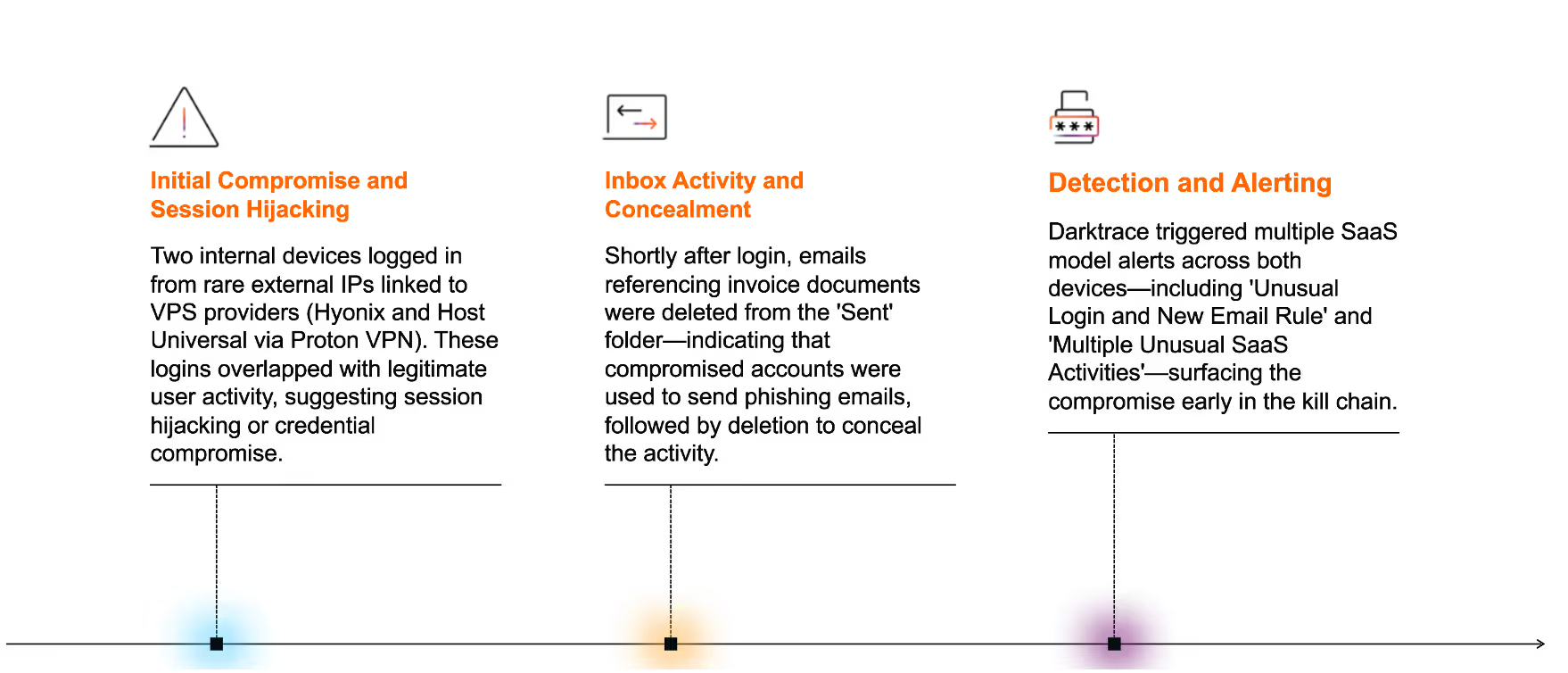
Timeline of activity for Case 1 - Unusual VPS logins and deletion of phishing emails.
Figure 1: Timeline of activity for Case 1 - Unusual VPS logins and deletion of phishing emails.

Initial Intrusion

On May 19, 2025, Darktrace observed two internal devices on one customer environment initiating logins from rare external IPs associated with VPS providers, namely Hyonix and Host Universal (via Proton VPN). Darktrace recognized that these logins had occurred within minutes of legitimate user activity from distant geolocations, indicating improbable travel and reinforcing the likelihood of session hijacking. This triggered Darktrace / IDENTITY model “Login From Rare Endpoint While User Is Active”, which highlights potential credential misuse when simultaneous logins occur from both familiar and rare sources.  

Shortly after these logins, Darktrace observed the threat actor deleting emails referring to invoice documents from the user’s “Sent Items” folder, suggesting an attempt to hide phishing emails that had been sent from the now-compromised account. Though not directly observed, initial access in this case was likely achieved through a similar phishing or account hijacking method.

 Darktrace / IDENTITY model "Login From Rare Endpoint While User Is Active", which detects simultaneous logins from both a common and a rare source to highlight potential credential misuse.
Figure 2: Darktrace / IDENTITY model "Login From Rare Endpoint While User Is Active", which detects simultaneous logins from both a common and a rare source to highlight potential credential misuse.

Case 2

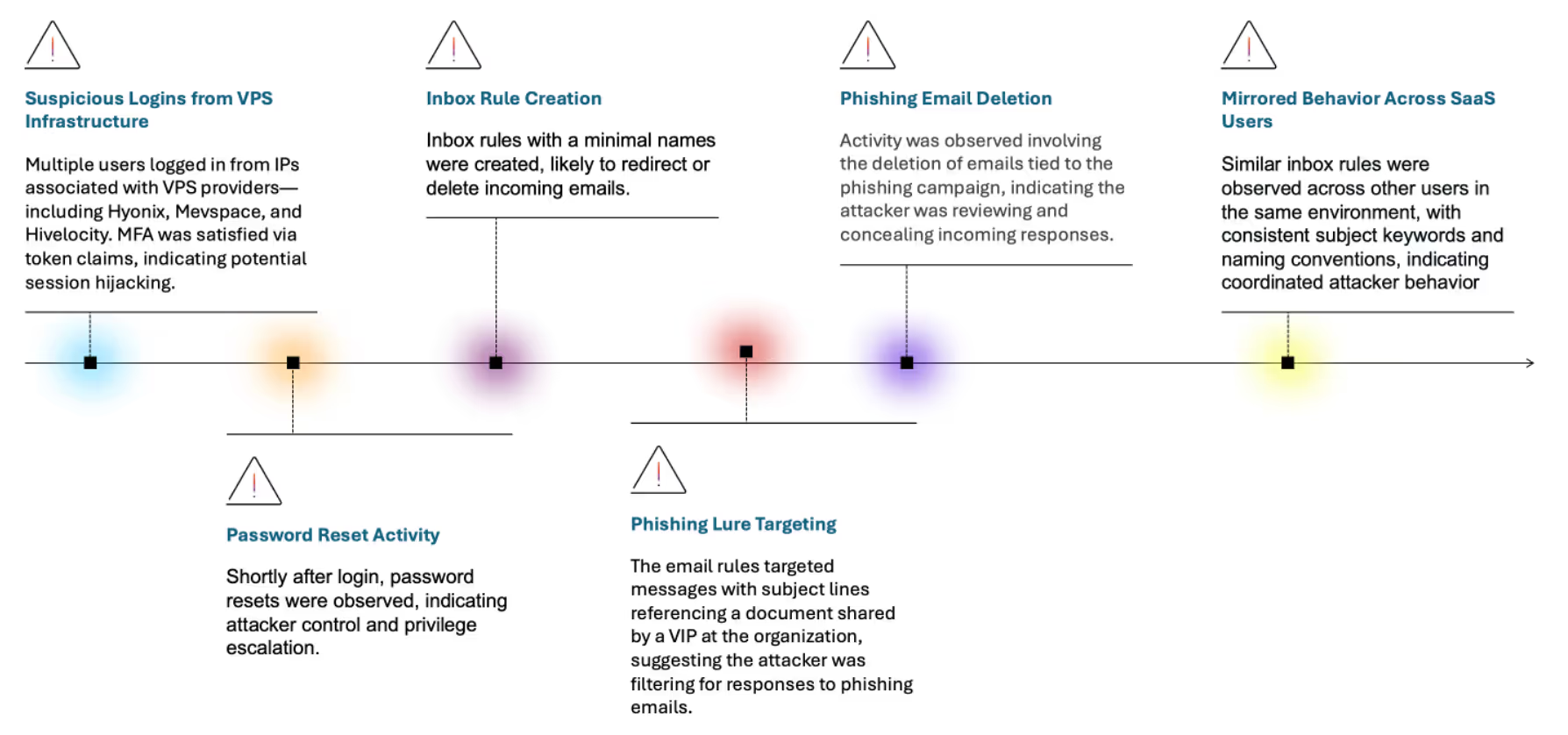
Timeline of activity for Case 2 – Coordinated inbox rule creation and outbound phishing campaign.
Figure 3: Timeline of activity for Case 2 – Coordinated inbox rule creation and outbound phishing campaign.

In the second customer environment, Darktrace observed similar login activity originating from Hyonix, as well as other VPS providers like Mevspace and Hivelocity. Multiple users logged in from rare endpoints, with Multi-Factor Authentication (MFA) satisfied via token claims, further indicating session hijacking.

Establishing control and maintaining persistence

Following the initial access, Darktrace observed a series of suspicious SaaS activities, including the creation of new email rules. These rules were given minimal or obfuscated names, a tactic often used by attackers to avoid drawing attention during casual mailbox reviews by the SaaS account owner or automated audits. By keeping rule names vague or generic, attackers reduce the likelihood of detection while quietly redirecting or deleting incoming emails to maintain access and conceal their activity.

One of the newly created inbox rules targeted emails with subject lines referencing a document shared by a VIP at the customer’s organization. These emails would be automatically deleted, suggesting an attempt to conceal malicious mailbox activity from legitimate users.

Mirrored activity across environments

While no direct lateral movement was observed, mirrored activity across multiple user devices suggested a coordinated campaign. Notably, three users had near identical similar inbox rules created, while another user had a different rule related to fake invoices, reinforcing the likelihood of a shared infrastructure and technique set.

Privilege escalation and broader impact

On one account, Darktrace observed “User registered security info” activity was shortly after anomalous logins, indicating attempts to modify account recovery settings. On another, the user reset passwords or updated security information from rare external IPs. In both cases, the attacker’s actions—including creating inbox rules, deleting emails, and maintaining login persistence—suggested an intent to remain undetected while potentially setting the stage for data exfiltration or spam distribution.

On a separate account, outbound spam was observed, featuring generic finance-related subject lines such as 'INV#. EMITTANCE-1'. At the network level, Darktrace / NETWORK detected DNS requests from a device to a suspicious domain, which began prior the observed email compromise. The domain showed signs of domain fluxing, a tactic involving frequent changes in IP resolution, commonly used by threat actors to maintain resilient infrastructure and evade static blocklists. Around the same time, Darktrace detected another device writing a file named 'SplashtopStreamer.exe', associated with the remote access tool Splashtop, to a domain controller. While typically used in IT support scenarios, its presence here may suggest that the attacker leveraged it to establish persistent remote access or facilitate lateral movement within the customer’s network.

Conclusion

This investigation highlights the growing abuse of VPS infrastructure in SaaS compromise campaigns. Threat actors are increasingly leveraging these affordable and anonymous hosting services to hijack accounts, launch phishing attacks, and manipulate mailbox configurations, often bypassing traditional security controls.

Despite the stealthy nature of this campaign, Darktrace detected the malicious activity early in the kill chain through its Self-Learning AI. By continuously learning what is normal for each user and device, Darktrace surfaced subtle anomalies, such as rare login sources, inbox rule manipulation, and concurrent session activity, that likely evade traditional static, rule-based systems.

As attackers continue to exploit trusted infrastructure and mimic legitimate user behavior, organizations should adopt behavioral-based detection and response strategies. Proactively monitoring for indicators such as improbable travel, unusual login sources, and mailbox rule changes, and responding swiftly with autonomous actions, is critical to staying ahead of evolving threats.

Credit to Rajendra Rushanth (Cyber Analyst), Jen Beckett (Cyber Analyst) and Ryan Traill (Analyst Content Lead)

References

·      1: https://cybersecuritynews.com/threat-actors-leveraging-vps-hosting-providers/

·      2: https://threatfox.abuse.ch/asn/931/

·      3: https://www.cyfirma.com/research/vps-exploitation-by-threat-actors/

Appendices

Darktrace Model Detections

•   SaaS / Compromise / Unusual Login, Sent Mail, Deleted Sent

•   SaaS / Compromise / Suspicious Login and Mass Email Deletes

•   SaaS / Resource / Mass Email Deletes from Rare Location

•   SaaS / Compromise / Unusual Login and New Email Rule

•   SaaS / Compliance / Anomalous New Email Rule

•   SaaS / Resource / Possible Email Spam Activity

•   SaaS / Unusual Activity / Multiple Unusual SaaS Activities

•   SaaS / Unusual Activity / Multiple Unusual External Sources For SaaS Credential

•   SaaS / Access / Unusual External Source for SaaS Credential Use

•   SaaS / Compromise / High Priority Login From Rare Endpoint

•   SaaS / Compromise / Login From Rare Endpoint While User Is Active

List of Indicators of Compromise (IoCs)

Format: IoC – Type – Description

•   38.240.42[.]160 – IP – Associated with Hyonix ASN (AS931)

•   103.75.11[.]134 – IP – Associated with Host Universal / Proton VPN

•   162.241.121[.]156 – IP – Rare IP associated with phishing

•   194.49.68[.]244 – IP – Associated with Hyonix ASN

•   193.32.248[.]242 – IP – Used in suspicious login activity / Mullvad VPN

•   50.229.155[.]2 – IP – Rare login IP / AS 7922 ( COMCAST-7922 )

•   104.168.194[.]248 – IP – Rare login IP / AS 54290 ( HOSTWINDS )

•   38.255.57[.]212 – IP – Hyonix IP used during MFA activity

•   103.131.131[.]44 – IP – Hyonix IP used in login and MFA activity

•   178.173.244[.]27 – IP – Hyonix IP

•   91.223.3[.]147 – IP – Mevspace Poland, used in multiple logins

•   2a02:748:4000:18:0:1:170b[:]2524 – IPv6 – Hivelocity VPS, used in multiple logins and MFA activity

•   51.36.233[.]224 – IP – Saudi ASN, used in suspicious login

•   103.211.53[.]84 – IP – Excitel Broadband India, used in security info update

MITRE ATT&CK Mapping

Tactic – Technique – Sub-Technique

•   Initial Access – T1566 – Phishing

                       T1566.001 – Spearphishing Attachment

•   Execution – T1078 – Valid Accounts

•   Persistence – T1098 – Account Manipulation

                       T1098.002 – Exchange Email Rules

•   Command and Control – T1071 – Application Layer Protocol

                       T1071.001 – Web Protocols

•   Defense Evasion – T1036 – Masquerading

•   Defense Evasion – T1562 – Impair Defenses

                       T1562.001 – Disable or Modify Tools

•   Credential Access – T1556 – Modify Authentication Process

                       T1556.004 – MFA Bypass

•   Discovery – T1087 – Account Discovery

•      Impact – T1531 – Account Access Removal

The content provided in this blog is published by Darktrace for general informational purposes only and reflects our understanding of cybersecurity topics, trends, incidents, and developments at the time of publication. While we strive to ensure accuracy and relevance, the information is provided “as is” without any representations or warranties, express or implied. Darktrace makes no guarantees regarding the completeness, accuracy, reliability, or timeliness of any information presented and expressly disclaims all warranties.

Nothing in this blog constitutes legal, technical, or professional advice, and readers should consult qualified professionals before acting on any information contained herein. Any references to third-party organizations, technologies, threat actors, or incidents are for informational purposes only and do not imply affiliation, endorsement, or recommendation.

Darktrace, its affiliates, employees, or agents shall not be held liable for any loss, damage, or harm arising from the use of or reliance on the information in this blog.

The cybersecurity landscape evolves rapidly, and blog content may become outdated or superseded. We reserve the right to update, modify, or remove any content without notice.

Inside the SOC
Darktrace cyber analysts are world-class experts in threat intelligence, threat hunting and incident response, and provide 24/7 SOC support to thousands of Darktrace customers around the globe. Inside the SOC is exclusively authored by these experts, providing analysis of cyber incidents and threat trends, based on real-world experience in the field.
Written by
Rajendra Rushanth
Cyber Analyst

More in this series

No items found.

Blog

/

Proactive Security

/

June 2, 2026

Stopping Stealth Attacks with Precision: How Núclea Prevented a Breach Without Disruption

Default blog imageDefault blog image

Núclea is a Brazilian data and technology company that supports the country’s financial system by delivering digital services exclusively to banks and financial institutions. Operating in an environment where trust, availability, and data integrity are critical, the company faces a threat landscape that has evolved rapidly—particularly with the rise of AI-driven cyberattacks.

Brazil has experienced a wave of successful cyber incidents targeting financial institutions, many of them enabled by insiders or compromised credentials. The result was a noticeable shift in attacker strategy: instead of focusing on end customers, threat actors began targeting the institutions and platforms that underpin the financial ecosystem itself.

“Attacks became far more directed and contextual,” explains Guilherme, who leads incident response within Núclea’s security platform engineering team. “They weren’t noisy or obviously malicious—they were precise, patient, and designed to blend into normal operations.”

That precision was on full display in January 2026, when Núclea faced one of the most convincing phishing attacks the team had seen.

A real attack, built on trust and context

The attack began with a seemingly routine email.

It was sent from a real Brazilian government institution, using legitimate infrastructure and valid credentials that were later confirmed to have been compromised. Núclea had an established, ongoing relationship with this organization, and the email’s language, tone, and subject matter aligned perfectly with the type of communication the recipient team handled every day.

Attached to the email was a PDF document containing content that looked entirely legitimate.

The problem? A single URL embedded inside that PDF.

“The message itself was correct. The sender was real. The context was familiar. Even the document content made sense,” Guilherme explains. “There was just one small element that didn’t belong.”

That small detail was enough to initiate a full attack chain.

What the attackers were trying to do

If clicked, the URL would have downloaded a malicious payload designed to:

  • Collect information about the user and device
  • Identify where the system was located within the financial ecosystem
  • Install remote access tools to maintain control
  • Deploy an infostealer to extract sensitive data
  • Execute anti-forensic scripts to erase traces of the intrusion

In other words, it was a carefully engineered operation designed for persistence and stealth, not immediate disruption.

The attack also employed urgency—a classic social engineering technique. When the link didn’t open as expected, employees requested assistance from the security team, insisting the document was important and needed to be accessed quickly.

This is precisely the kind of scenario where traditional security tools struggle: almost everything about the interaction is legitimate.

Where Darktrace made the difference

Instead of blocking the entire message or relying on known indicators of compromise, Darktrace focused on behavioral context.

Darktrace recognized:

  • That the sending organization was normally trusted
  • That the communication pattern matched historical behavior
  • That the PDF content itself was not suspicious

But it also identified that the URL embedded within the document deviated from established behavioral patterns.

Rather than disrupting business operations, Darktrace took precise action: it rewrote the URL, preventing the malicious download while leaving the rest of the email untouched.

“When we analyzed it afterward, it became clear how dangerous the attack would have been,” says Guilherme. “But it never progressed—because Darktrace acted at exactly the right point.”

Subsequent forensic analysis confirmed the payload’s malicious intent. The attack never succeeded.

Precision over disruption

For Núclea, this incident reinforced a critical lesson: modern attacks don’t always look malicious—they hide within normal activity.

“What stands out to me is the precision,” Guilherme says. “Darktrace doesn’t rely on big, obvious signals. It’s effective in situations that fall outside the standard patterns we all know.”

Building resilience in a high trust ecosystem

For Núclea, cybersecurity is not just a defensive measure—it’s a business enabler.

Availability failures or successful breaches in the financial ecosystem can have immediate, large-scale consequences, from financial loss to reputational damage. Preventing those outcomes protects not just Núclea, but its partners and customers as well.

“Cyber resilience means keeping the business running—even under attack,” Guilherme explains. “And that requires people, processes, and technology working together.”

As AI continues to accelerate both attacks and defenses, the role of security is evolving. Precision, behavioral understanding, and intelligent automation are no longer optional—they’re essential.

“The easy days were yesterday,” Guilherme says. “The challenges ahead are bigger. We need to be prepared—internally and with partners that help us build resilience.”

Continue reading
About the author

Blog

/

Proactive Security

/

June 1, 2026

Defend What You Trust: Stories from the Front Lines of Modern Cyber Defense

Default blog imageDefault blog image

Modern attacks don’t always announce themselves, follow obvious patterns, or rely on known malware. Often, they move quietly inside trusted systems, authenticated sessions, and everyday behavior.

They don’t break in. They blend in.

That’s why an AI-powered defense is essential. It turns invisible signals into actionable insights at a scale neither analysts nor traditional tools can achieve alone.

Confidence is creating risk

One of the most dangerous assumptions in cybersecurity today is that strong controls equal strong protection.

Multi-factor authentication (MFA), for example, is widely viewed as a foundational safeguard. But as the CISO for a professional sports organization explains, that confidence can be misplaced. “A lot of organizations assume that once you have MFA, those accounts are safe. That’s not true.”

In one instance, his team identified a sophisticated attack where a threat actor bypassed MFA entirely, not by breaking it, but by going around it. A user’s authenticated session was hijacked and re-used, allowing the attacker to impersonate them without triggering traditional controls.

“Darktrace picked up that a session had been re-injected by the hacker, and we were able to block it right away,” he explains.

Attackers anticipate what we miss

Even well-trained users can become entry points.

“An email bypassed our existing security tools,” shares the VP of IT at a U.S.-based risk management services provider.  “The user missed one signal and entered their credentials into a malicious site. That’s what the bad guys count on.”

The organization responded quickly, but not before damage was done. Crucially, this occurred while Darktrace was in “watch mode,” before autonomous response was fully enabled. “Darktrace would have seen that and shut it down immediately,” he notes.

Mistakes and oversights like misconfigurations, forgotten machines, and missed patches can create serious vulnerabilities.

The CIO of a utility services organization shares an instance when Darktrace detected a breach to a client’s network via their ZTNA VPN due to misconfigured MFA. “Darktrace alerted us and autonomously blocked the scanning, preventing what could have been a ransomware-type incident.”  

The most dangerous threats are already inside

The Head of Security at a global business services provider knows firsthand how blind spots can persist inside environments. His team uncovered evidence of dormant ransomware artifacts sitting unnoticed within a company’s environment ¬¬– long before modern detection was in place.

“During a routine file transfer, Darktrace flagged the suspicious activity, identified the ransomware, and immediately quarantined the server,” he recalls.  While the attack was never executed, the implication was significant: the risk existed long before it was finally detected.

Cyber threats are also successful because they take advantage of normal human behavior, exploiting moments of cognitive overload, urgency, and trust.

The Executive Director of IT and Business Applications at a pharmaceutical lab describes the time Darktrace flagged an employee logging into Microsoft 365 from Singapore, despite him being physically located in the U.S. Darktrace immediately cut off his access and within minutes revealed that the employee’s son was using a VPN to play a video game.

While the threat was benign, it demonstrated the strength of AI to use contextual information to detect threats other tools miss. The information also saved security analysts hours of investigation and minimized downtime for the employee. “That level of precision and speed isn’t just convenient, it’s game changing.”

“Unusual” behavior is the new red flag

Detecting modern threats requires an understanding of what “normal” looks like and recognizing when something subtly deviates.

One security leader  at an AI technology enterprise described a scenario in which an employee connected to a proxy service in China. The service itself was legitimate, and although traditional tools didn’t flag it, the behavior was unusual for that user specifically.

“That’s what Darktrace picked up on. The activity turned out to be benign, but without visibility into behavioral deviations, it could just as easily have been something more serious.”

AI shifts defense from reaction to anticipation

These stories point to a fundamental shift by cyber attackers, both tactically and strategically. Because traditional security tools were built to detect what’s already known, modern attacks are often:

  • Credential-based, not malware-based
  • Behavioral, not signature-based
  • Subtle, not overt

They may operate within the boundaries of what appears normal, exploiting what organizations trust, not what they block:

  • Trusted sessions
  • Legitimate services
  • Human error

This is where AI is changing the equation. Rather than relying on predefined rules or known threat signatures, AI can:

  • Establish a baseline of normal behavior
  • Detect subtle anomalies in real time
  • Act autonomously to contain potential threats

Resilience, not perfection, is the new security standard

As these frontline experiences show, the organizations that lead are those that move beyond reactive defense and embrace AI as a core part of their strategy.

It eliminates the blind spots and uncertainty, says the CISO of a professional sports organization. “If you lack visibility, you’re not managing risk, you’re assuming it. AI gives you the actionable insights needed to turn uncertainty into control.”

And it provides the speed and agility that are vital when seconds matter, says the Executive Director of IT and Business Applications. “When Darktrace alerted us at 3:00 am to a ransomware attack, it had already quarantined the affected systems, blocked the attacker’s access, and provided us with the critical details and time needed to investigate. That action likely saved us hundreds of thousands, if not millions, of dollars.”

The modern SOC has become a cornerstone of enterprise resilience, responsible for protecting data and operational continuity while enabling digital growth and innovation. For today’s security professional, that means success is no longer measured by what they keep out, but by what they protect: revenue, reputation, and trust.

Continue reading
About the author
Your data. Our AI.
Elevate your network security with Darktrace AI