Blog
/
/
February 22, 2022

Cybersprint Attack Management Joins Darktrace

Learn how the addition of Cybersprint improves our attack surface management solutions, providing better visibility and security.
Inside the SOC
Darktrace cyber analysts are world-class experts in threat intelligence, threat hunting and incident response, and provide 24/7 SOC support to thousands of Darktrace customers around the globe. Inside the SOC is exclusively authored by these experts, providing analysis of cyber incidents and threat trends, based on real-world experience in the field.
Written by
Max Heinemeyer
Global Field CISO
Default blog imageDefault blog imageDefault blog imageDefault blog imageDefault blog imageDefault blog image
22
Feb 2022

Today Darktrace announced the acquisition of best-in-class Attack Surface Management (ASM) company Cybersprint. This is hugely exciting for both our companies, our customers and the wider security industry.

After months of meeting with the Cybersprint teams, diving into their technology and shared opportunities, we are truly excited for the way ahead. Cybersprint is a fantastic fit for Darktrace because of their technology, their people and their data. I want to go into those three reasons in a little more detail.

The Technology

We have tested Cybersprint’s technology intensely ourselves and have seen first-hand great benefits in the short, medium and long-term for our customers.

There are three technical requirements to ensure it met Darktrace’s architectural needs:

  1. Unique to each customer; delivering a bespoke perspective of the attack surface of a given organisation by starting just with a brand or domain. No access to sensitive customer data is required. No installation or integration is required to get started.
  2. The analysis of data had to be real-time and continuous. This is critically important for Darktrace’s Continuous Cyber AI Loop. We always operate on real-time data that is continuously updated as things change; so does Cybersprint.
  3. Built-in automation and integration. Cybersprint automates everything possible in Attack Surface Management and integrates with every external data source.

We have already identified several high-impact integration opportunities where Cybersprint and its external data can be additive to Darktrace’s self-learning, internal data; applying this to each area of the Loop.

The People

Thinking about people, Cybersprint has a well-functioning technical team that we welcome with open arms here at Darktrace, to help accelerate our Prevent vision and create something better together.

When we first started meeting with the Cybersprint teams, we immediately noticed that this is a meeting of minds. We both share a vision for cyber security – using smart tech to move the needle in favour of defenders. We both believe that cyber security is not a human-scale problem – this won’t be solved by throwing more humans in the mix.

Their world-class teams of researchers, ethical hackers and developers are a great addition to our own R&D capabilities in Cambridge, who have a heavy focus on AI. We share many common values across both organizations – such as friends & family first. It is great to have another European research hub that is only a short train-ride or flight away from our Cambridge R&D HQ. It’s important to note that the vast majority of Cybersprint employees are deep technologists.

The Data

Lastly, touching on data, Cybersprint has unparalleled access to attack surface data – basically an up-to-date, continuous copy of the internet. Having access to this data and being able to intelligently analyse it is a huge benefit in itself.

At Darktrace, we already have complete visibility over the internal data of our customers – their email environment, SaaS data, operational technology, IoT, network, zero-trust and other coverage areas – but being able to combine those data sets and deriving insights from them will further drive breakthrough innovations.

Delivering on a shared vision

To understand why we are so excited about Cybersprint and see it as a great fit, one has to be aware of our technology vision of a closed loop system:
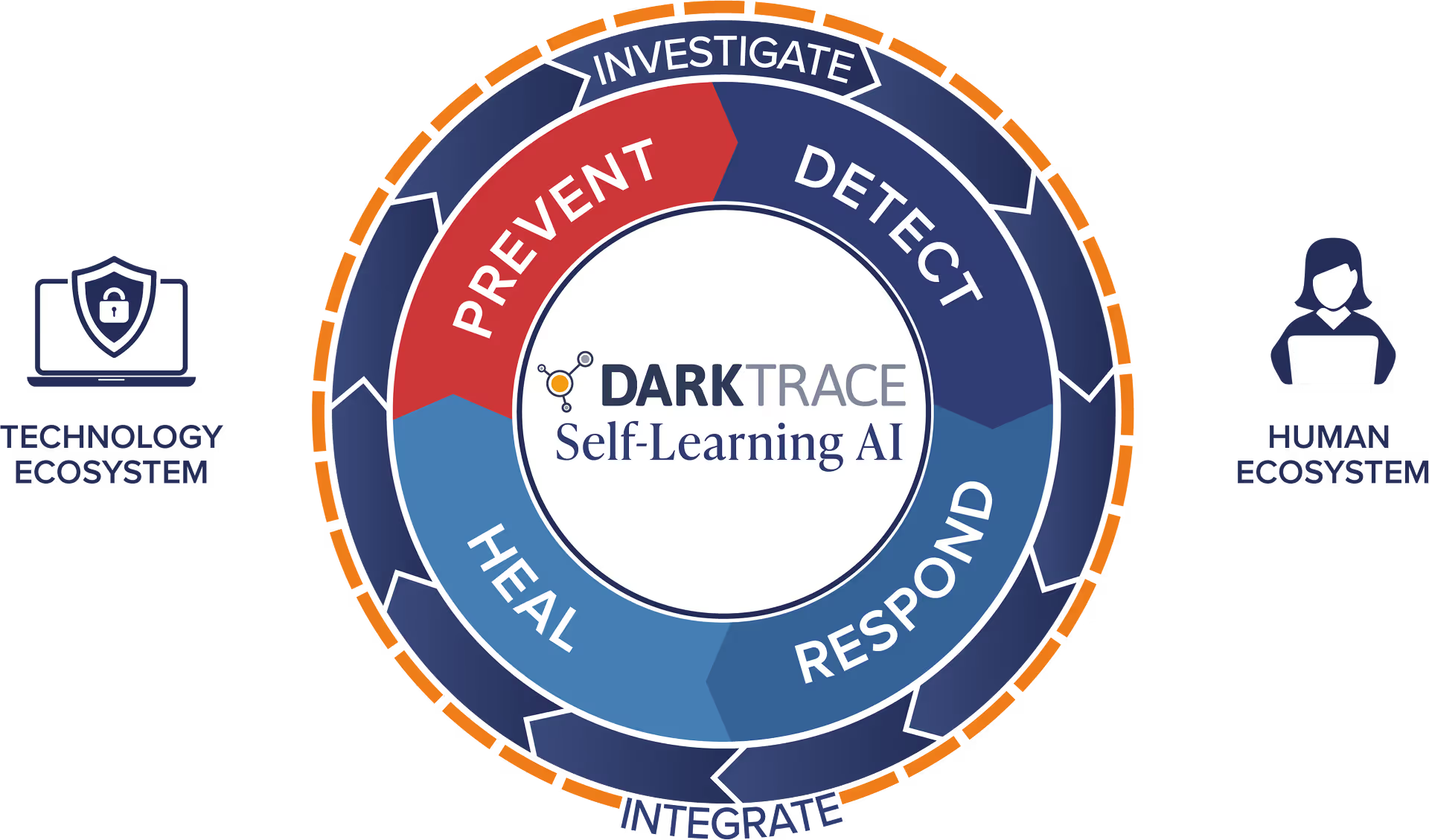
Darktrace is already well-known for its offering in the Detect (Enterprise Immune System), Investigate (Cyber AI Analyst) and Respond (Antigena) areas. As we work towards further augmenting security teams in other areas, we are starting to productize technology that makes it more costly and harder for attackers to succeed – we refer to this area broadly as ‘Prevent’.

Prevent is all about being proactive, hardening your environment and reducing risk. The core technology for Prevent is Attack Path Modeling – feeding Attack Path Modeling with various telemetry and working out the most critical attack paths and chokepoints to remediate.

Darktrace already has complete coverage of an organization’s digital estate from an internal perspective, thanks to our various coverage areas. Our Attack Path Modeling is currently producing powerful results based on an organization’s internal data only – but by adding Cybersprint’s attack surface data and external asset information, we will have complete visibility, internal and external, and bespoke to each individual organization.

While the ASM data in itself is valuable to harden the external attack surface, feeding it into our Attack Path Modeling engine will unlock further capabilities. It allows us to model bespoke, multi-domain, end-to-end attack paths in real time.

Stay tuned

This is the beginning of an exciting journey for both Cybersprint and Darktrace. We look forward to updating you again on the evolution of our upcoming Prevent offering.

In the meantime, feel free to send any questions relating to Cybersprint to cybersprint@darktrace.com

Inside the SOC
Darktrace cyber analysts are world-class experts in threat intelligence, threat hunting and incident response, and provide 24/7 SOC support to thousands of Darktrace customers around the globe. Inside the SOC is exclusively authored by these experts, providing analysis of cyber incidents and threat trends, based on real-world experience in the field.
Written by
Max Heinemeyer
Global Field CISO

More in this series

No items found.

Blog

/

/

January 6, 2026

How a leading bank is prioritizing risk management to power a resilient future

Default blog imageDefault blog image

As one of the region’s most established financial institutions, this bank sits at the heart of its community’s economic life – powering everything from daily transactions to business growth and long-term wealth planning. Its blend of physical branches and advanced digital services gives customers the convenience they expect and the personal trust they rely on. But as the financial world becomes more interconnected and adversaries more sophisticated, safeguarding that trust requires more than traditional cybersecurity. It demands a resilient, forward-leaning approach that keeps pace with rising threats and tightening regulatory standards.

A complex risk landscape demands a new approach

The bank faced a challenge familiar across the financial sector: too many tools, not enough clarity. Vulnerability scans, pen tests, and risk reports all produced data, yet none worked together to show how exposures connected across systems or what they meant for day-to-day operations. Without a central platform to link and contextualize this data, teams struggled to see how individual findings translated into real exposure across the business.

  • Fragmented risk assessments: Cyber and operational risks were evaluated in silos, often duplicated across teams, and lacked the context needed to prioritize what truly mattered.
  • Limited executive visibility: Leadership struggled to gain a complete, real-time view of trends or progress, making risk ownership difficult to enforce.
  • Emerging compliance pressure: This gap also posed compliance challenges under the EU’s Digital Operational Resilience Act (DORA), which requires financial institutions to demonstrate continuous oversight, effective reporting, and the ability to withstand and recover from cyber and IT disruptions.
“The issue wasn’t the lack of data,” recalls the bank’s Chief Technology Officer. “The challenge was transforming that data into a unified, contextualized picture we could act on quickly and decisively.”

As the bank advanced its digital capabilities and embraced cloud services, its risk environment became more intricate. New pathways for exploitation emerged, human factors grew harder to quantify, and manual processes hindered timely decision-making. To maintain resilience, the security team sought a proactive, AI-powered platform that could consolidate exposures, deliver continuous insight, and ensure high-value risks were addressed before they escalated.

Choosing Darktrace to unlock proactive cyber resilience

To reclaim control over its fragmented risk landscape, the bank selected Darktrace / Proactive Exposure Management™ for cyber risk insight. The solution’s ability to consolidate scanner outputs, pen test results, CVE data, and operational context into one AI-powered view made it the clear choice. Darktrace delivered comprehensive visibility the team had long been missing.

By shifting from a reactive model to proactive security, the bank aimed to:

  • Improve resilience and compliance with DORA
  • Prioritize remediation efforts with greater accuracy
  • Eliminate duplicated work across teams
  • Provide leadership with a complete view of risk, updated continuously
  • Reduce the overall likelihood of attack or disruption

The CTO explains: “We needed a solution that didn’t just list vulnerabilities but showed us what mattered most for our business – how risks connected, how they could be exploited, and what actions would create the biggest reduction in exposure. Darktrace gave us that clarity.”

Targeting the risks that matter most

Darktrace / Proactive Exposure Management offered the bank a new level of visibility and control by continuously analyzing misconfigurations, critical attack paths, human communication patterns, and high-value assets. Its AI-driven risk scoring allowed the team to understand which vulnerabilities had meaningful business impact, not just which were technically severe.

Unifying exposure across architectures

Darktrace aggregates and contextualizes data from across the bank’s security stack, eliminating the need to manually compile or correlate findings. What once required hours of cross-team coordination now appears in a single, continuously updated dashboard.

Revealing an adversarial view of risk

The solution maps multi-stage, complex attack paths across network, cloud, identity systems, email environments, and endpoints – highlighting risks that traditional CVE lists overlook.

Identifying misconfigurations and controlling gaps

Using Self-Learning AI, Darktrace / Proactive Exposure Management spots misconfigurations and prioritizes them based on MITRE adversary techniques, business context, and the bank’s unique digital environment.

Enhancing red-team and pen test effectiveness

By directing testers to the highest-value targets, Darktrace removes guesswork and validates whether defenses hold up against realistic adversarial behavior.

Supporting DORA compliance

From continuous monitoring to executive-ready reporting, the solution provides the transparency and accountability the bank needs to demonstrate operational resilience frameworks.

Proactive security delivers tangible outcomes

Since deploying Darktrace / Proactive Exposure Management, the bank has significantly strengthened its cybersecurity posture while improving operational efficiency.

Greater insight, smarter prioritization, stronger defensee

Security teams are now saving more than four hours per week previously spent aggregating and analyzing risk data. With a unified view of their exposure, they can focus directly on remediation instead of manually correlating multiple reports.

Because risks are now prioritized based on business impact and real-time operational context, they no longer waste time on low-value tasks. Instead, critical issues are identified and resolved sooner, reducing potential windows for exploitation and strengthening the bank’s ongoing resilience against both known and emerging threats.

“Our goal was to move from reactive to proactive security,” the CTO says. “Darktrace didn’t just help us achieve that, it accelerated our roadmap. We now understand our environment with a level of clarity we simply didn’t have before.”

Leadership clarity and stronger governance

Executives and board stakeholders now receive clear, organization-wide visibility into the bank’s risk posture, supported by consistent reporting that highlights trends, progress, and areas requiring attention. This transparency has strengthened confidence in the bank’s cyber resilience and enabled leadership to take true ownership of risk across the institution.

Beyond improved visibility, the bank has also deepened its overall governance maturity. Continuous monitoring and structured oversight allow leaders to make faster, more informed decisions that strategically align security efforts with business priorities. With a more predictable understanding of exposure and risk movement over time, the organization can maintain operational continuity, demonstrate accountability, and adapt more effectively as regulatory expectations evolve.

Trading stress for control

With Darktrace, leaders now have the clarity and confidence they need to report to executives and regulators with accuracy. The ability to see organization-wide risk in context provides assurance that the right issues are being addressed at the right time. That clarity is also empowering security analysts who no longer shoulder the anxiety of wondering which risks matter most or whether something critical has slipped through the cracks. Instead, they’re working with focus and intention, redirecting hours of manual effort into strategic initiatives that strengthen the bank’s overall resilience.

Prioritizing risk to power a resilient future

For this leading financial institution, Darktrace / Proactive Exposure Management has become the foundation for a more unified, data-driven, and resilient cybersecurity program. With clearer, business-relevant priorities, stronger oversight, and measurable efficiency gains, the bank has strengthened its resilience and met demanding regulatory expectations without adding operational strain.

Most importantly, it shifted the bank’s security posture from a reactive stance to a proactive, continuous program. Giving teams the confidence and intelligence to anticipate threats and safeguard the people and services that depend on them.

Continue reading
About the author
Kelland Goodin
Product Marketing Specialist

Blog

/

/

December 22, 2025

The Year Ahead: AI Cybersecurity Trends to Watch in 2026

2026 cyber threat trendsDefault blog imageDefault blog image

Introduction: 2026 cyber trends

Each year, we ask some of our experts to step back from the day-to-day pace of incidents, vulnerabilities, and headlines to reflect on the forces reshaping the threat landscape. The goal is simple:  to identify and share the trends we believe will matter most in the year ahead, based on the real-world challenges our customers are facing, the technology and issues our R&D teams are exploring, and our observations of how both attackers and defenders are adapting.  

In 2025, we saw generative AI and early agentic systems moving from limited pilots into more widespread adoption across enterprises. Generative AI tools became embedded in SaaS products and enterprise workflows we rely on every day, AI agents gained more access to data and systems, and we saw glimpses of how threat actors can manipulate commercial AI models for attacks. At the same time, expanding cloud and SaaS ecosystems and the increasing use of automation continued to stretch traditional security assumptions.

Looking ahead to 2026, we’re already seeing the security of AI models, agents, and the identities that power them becoming a key point of tension – and opportunity -- for both attackers and defenders. Long-standing challenges and risks such as identity, trust, data integrity, and human decision-making will not disappear, but AI and automation will increase the speed and scale of the cyber risk.  

Here's what a few of our experts believe are the trends that will shape this next phase of cybersecurity, and the realities organizations should prepare for.  

Agentic AI is the next big insider risk

In 2026, organizations may experience their first large-scale security incidents driven by agentic AI behaving in unintended ways—not necessarily due to malicious intent, but because of how easily agents can be influenced. AI agents are designed to be helpful, lack judgment, and operate without understanding context or consequence. This makes them highly efficient—and highly pliable. Unlike human insiders, agentic systems do not need to be socially engineered, coerced, or bribed. They only need to be prompted creatively, misinterpret legitimate prompts, or be vulnerable to indirect prompt injection. Without strong controls around access, scope, and behavior, agents may over-share data, misroute communications, or take actions that introduce real business risk. Securing AI adoption will increasingly depend on treating agents as first-class identities—monitored, constrained, and evaluated based on behavior, not intent.

-- Nicole Carignan, SVP of Security & AI Strategy

Prompt Injection moves from theory to front-page breach

We’ll see the first major story of an indirect prompt injection attack against companies adopting AI either through an accessible chatbot or an agentic system ingesting a hidden prompt. In practice, this may result in unauthorized data exposure or unintended malicious behavior by AI systems, such as over-sharing information, misrouting communications, or acting outside their intended scope. Recent attention on this risk—particularly in the context of AI-powered browsers and additional safety layers being introduced to guide agent behavior—highlights a growing industry awareness of the challenge.  

-- Collin Chapleau, Senior Director of Security & AI Strategy

Humans are even more outpaced, but not broken

When it comes to cyber, people aren’t failing; the system is moving faster than they can. Attackers exploit the gap between human judgment and machine-speed operations. The rise of deepfakes and emotion-driven scams that we’ve seen in the last few years reduce our ability to spot the familiar human cues we’ve been taught to look out for. Fraud now spans social platforms, encrypted chat, and instant payments in minutes. Expecting humans to be the last line of defense is unrealistic.

Defense must assume human fallibility and design accordingly. Automated provenance checks, cryptographic signatures, and dual-channel verification should precede human judgment. Training still matters, but it cannot close the gap alone. In the year ahead, we need to see more of a focus on partnership: systems that absorb risk so humans make decisions in context, not under pressure.

-- Margaret Cunningham, VP of Security & AI Strategy

AI removes the attacker bottleneck—smaller organizations feel the impact

One factor that is currently preventing more companies from breaches is a bottleneck on the attacker side: there’s not enough human hacker capital. The number of human hands on a keyboard is a rate-determining factor in the threat landscape. Further advancements of AI and automation will continue to open that bottleneck. We are already seeing that. The ostrich approach of hoping that one’s own company is too obscure to be noticed by attackers will no longer work as attacker capacity increases.  

-- Max Heinemeyer, Global Field CISO

SaaS platforms become the preferred supply chain target

Attackers have learned a simple lesson: compromising SaaS platforms can have big payouts. As a result, we’ll see more targeting of commercial off-the-shelf SaaS providers, which are often highly trusted and deeply integrated into business environments. Some of these attacks may involve software with unfamiliar brand names, but their downstream impact will be significant. In 2026, expect more breaches where attackers leverage valid credentials, APIs, or misconfigurations to bypass traditional defenses entirely.

-- Nathaniel Jones, VP of Security & AI Strategy

Increased commercialization of generative AI and AI assistants in cyber attacks

One trend we’re watching closely for 2026 is the commercialization of AI-assisted cybercrime. For example, cybercrime prompt playbooks sold on the dark web—essentially copy-and-paste frameworks that show attackers how to misuse or jailbreak AI models. It’s an evolution of what we saw in 2025, where AI lowered the barrier to entry. In 2026, those techniques become productized, scalable, and much easier to reuse.  

-- Toby Lewis, Global Head of Threat Analysis

Conclusion

Taken together, these trends underscore that the core challenges of cybersecurity are not changing dramatically -- identity, trust, data, and human decision-making still sit at the core of most incidents. What is changing quickly is the environment in which these challenges play out. AI and automation are accelerating everything: how quickly attackers can scale, how widely risk is distributed, and how easily unintended behavior can create real impact. And as technology like cloud services and SaaS platforms become even more deeply integrated into businesses, the potential attack surface continues to expand.  

Predictions are not guarantees. But the patterns emerging today suggest that 2026 will be a year where securing AI becomes inseparable from securing the business itself. The organizations that prepare now—by understanding how AI is used, how it behaves, and how it can be misused—will be best positioned to adopt these technologies with confidence in the year ahead.

Learn more about how to secure AI adoption in the enterprise without compromise by registering to join our live launch webinar on February 3, 2026.  

Continue reading
About the author
The Darktrace Community
Your data. Our AI.
Elevate your network security with Darktrace AI