Key Findings
- Darktrace’s Threat Research team is exploring a new method to identify malicious campaigns by correlating similar anomalous activity across its customer fleet.
- The method uses unsupervised clustering to identify shared behavioral patterns across multiple customer deployments without relying on prior indicators of compromise (IoCs).
- The approach identified shared infrastructure across dozens of customers, with activity linked to the likely POPA botnet.
- A second cluster identified anomalous activity associated with Monero cryptocurrency mining.
How does Darktrace conduct threat research?
The Darktrace Threat Research team aims to identify malicious campaign activity affecting multiple customers. By their nature, these campaigns will lead to shared behavioral patterns across multiple victims.
In this piece, we describe a method for identifying malicious campaign activity that uses this simple observation as a guiding principle. We begin by outlining a few key facts about the modern threat landscape and why behavioral detection is necessary to meet the challenges it presents. We then explore how fleet-wide behavioral detections can be leveraged using the principle above to systematically identify multi-deployment campaigns impacting the Darktrace customer fleet. Finally, we demonstrate that this research is not purely theoretical, using real examples of campaign activity detected through this novel approach.
Shifting to a behavioral-focused approach
The modern era of cyber-defense necessitates detection capabilities beyond traditional signature-based methods. Technologies such as antivirus signatures, hash-based malware identification, and IP blocklists have historically been successful in defending against known threats. However, they are easily circumvented by attackers and inherently limited in defending against the novel attack techniques that today's threat landscape is producing.
Recent breakthroughs in AI represent a transformational risk multiplier that cannot be ignored. AI systems do not merely execute existing attacks at machine speed; there are signs they can also synthesize novel tradecraft [1], increasing the likelihood that defenders will encounter attack patterns that have never previously been observed. Meanwhile vulnerability disclosures continue to accelerate. More than 48,000 CVEs were published in 2025, and published statistics to date indicate that 2026 is already on track to significantly exceed that figure [2]. While multiple factors may contribute to vulnerability discovery, AI is seen as a key factor in this rapid growth. Organizations should expect a growing proportion of malicious activity to fall outside the scope of detections that rely solely on prior knowledge of known threats.
By design, Darktrace’s behavioral and anomaly-focused detection capabilities are well-suited to this testing landscape. With a focus on detecting unknown and unexpected activity that deviates from the baseline of “normal” behavior, detection of CVE exploitation without prior knowledge of the vulnerability and before public disclosure, for example, is achievable [3][4].
Darktrace’s diverse customer base benefits from a further layer of protection: working with only deidentified alert metadata[EF1] [EF2] , our threat researchers hunt proactively across the fleet. Beyond the level of the individual customer, there is a second, larger vantage to be leveraged.
Darktrace data provides unique insight into the unexpected behavioral patterns that occur across its customer fleet. What can we see if we look at this fleet-wide telemetry and hunt for systematic behavioral campaigns that impact our customer base?
Correlating across the customer base
At the deployment level, Darktrace focuses on whether activity is unusual in the context of an organization's normal behavior, but as we zoom out and look at these alerts at the fleet level, the problem fundamentally changes . We are no longer seeking anomalies in largely normal data; we are seeking systematic patterns within data already known to be anomalous. An isolated behavior anomaly may be notable for a single customer; the same fingerprint across dozens is a signal of a structured campaign. Hunting for such campaigns and sharing our findings are key areas of focus for Darktrace’s Threat Research team. In this spirit, Darktrace is actively exploring a a new research approach that leverages deidentified alert metadata to increase campaign detection ability.
This approach is based on the premise that an expert human analyst presented with a set of alerts will identify likely related activity by assessing whether the metadata fields indicate a relationship. For example, two connections to a rare endpoint that exhibits naming structure that is likely from a single algorithm are a strong indicator, as is the use of an unusual port carrying a given protocol (e.g. port 6000 for SSL). Darktrace’s approach to campaign detection encodes this expert human judgement process through deterministic embedding functions that obtain reproducible vector representations of alert data. Unsupervised clustering is then applied to these vector representations to obtain groups of alerts that describe semantically similar alert data across multiple customers. These clusters therefore represent similar anomalous activity that has occurred across multiple customers. In other words, these clusters are candidates for malicious campaign activity.

Case study 1 – unusual connections to shared underlying infrastructure
In one recent case, the clustering produced several tight groups of alerts spanning dozens of customers. Each group centered on a single domain whose subdomains were algorithmically generated (e.g. s01699, s1736, s91). Examined side by side, these clusters shared an unmistakable behavioral shape: each involved a domain with a clear naming pattern (e.g. s016841786.net-echo[.]com, s1670.pixellog[.]io, s217.pixellog[.]io) , with connections over SSL on the unusual port 6000 to servers hosted by non-mainstream providers (e.g. OVH, Hetzner, GTHost, Leaseweb), rather than generally expected content-delivery networks.
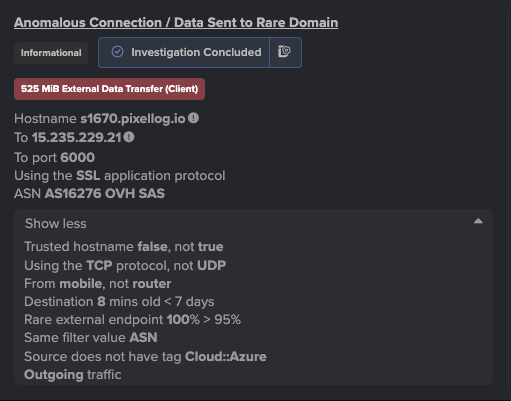
Closer inspection revealed that the same subdomain label appeared under different domains (e.g. s1786.net-echo[.]com and s1786.pixellog[.]io). Following this lead, Darktrace’s threat researchers pivoted across the customer base and found numerous distinct subdomain labels reused under more than one registered domain. In several cases, the same label resolved to the same IP across different domains (e.g. s1704 under both pixellog[.]io and net-echo[.]com → 148.113.222[.]244; s01684 → 15.235.67[.]95), suggesting the use of ephemeral subdomain infrastructure in an attempt to avoid signature-based defense techniques.
This example demonstrates how multi-deployment data can uncover shared infrastructure that may be difficult to identify at the individual deployment level alone. In particular, the presented method facilitated this discovery by producing coherent, tight clusters of geometrically similar vector embeddings of malicious activity from large-scale fleet data, which could then be presented to a researcher for further investigation. This activity highlighted across the Darktrace customer base was ultimately linked to likely POPA botnet activity through use of open-source intelligence (OSINT) [5].
Case Study 2 – anomalous user agent and txt URI
A second example shows the method surfacing a single, self-contained cluster. The clustering was not given any indicators to look for; instead, it grouped devices that shared an unusual combination of features. On inspection, that shared consisted of:
- unusual user agent (tes)
- specific request path (/md5_GIP.txt)
- uncommon destination port (83)
- hostname impersonating Google (matching regular expression ^www\.google\.com\.[a-zA-Z0-9]+\.fast-dns-host\.com$)
Treating these shared features as IoCs, Darktrace’s threat researchers then pivoted to an exploration across the customer base to investigate the full breadth of the campaign. This search identified further commonalities; additional domains which shared the same IP as the domain family highlighted in the cluster, as well as evidence of cryptocurrency mining on affected devices. Additional OSINT research also aligned with these findings, linking the discovered payloads and infrastructure to Monero cryptocurrency mining [6].
Conclusion
The method outlined in this blog is under active development, with ongoing technical refinement providing opportunities to further enhance its capabilities. While the capability continues to mature, this approach to threat hunting leverages the powerful vantage point of fleetwide telemetry across a diverse customer base to help protect Darktrace customers. This method allows campaigns that at the deployment level appear as isolated alerts to be seen at their true scale and spread. It enables proactive fleet-wide analysis without prior IoCs to identify campaigns impacting Darktrace customers.
This is possible because of what the method is built on: the atomic unit is the Darktrace alert, a signal that encodes years of cyber expertise, while the multi-deployment nature of the method allows organizations to indirectly benefit from findings from other networks through shared intelligence by Darktrace’s Threat Research team.
Credit to Daniel Levy (Threat Hunting Data Scientist), Paul Jennings (Principal Cyber Analyst), Emma Foulger (Global Head, Threat Operations)
Edited by Ryan Traill (Content Manager)
References
1. https://www.aisi.gov.uk/blog/incident-report-unsanctioned-agent-behaviour-during-cyber-testing
2. https://www.cvefind.com/en/cve-statistic-date.html
5. https://github.com/synthient/public-research/blob/main/2026/06/popa/Popa.md