


Key insights
· Darktrace observed activity in several customer environments involving infrastructure and behaviors associated with reported ARTEX-enabled campaigns, including activity linked to China-nexus espionage and financially motivated attacks.
· In the higher-confidence cases, known infrastructure appeared alongside beaconing, unusual TLS, reconnaissance, tunneling, script retrieval, SMB activity and external data transfer. One Azure case had no observed network command and control at all, only key listing and application identity activity.
· ARTEX is now used by actors with different objectives. Identifying the framework can help locate relevant activity, while the behavior around the affected system provides the stronger evidence for understanding compromise and attribution.
Introduction
Attackers have moved beyond using AI for phishing and are running agentic frameworks; open-source tools like ARTEX, CAIRN, PentAGI and Hexstrike that let AI agents scan, exploit and move through an environment with little human input [1]. ARTEX has moved quickly from an offensive security project into live intrusion activity. Since at least August 2026, the framework has been associated with espionage, financially motivated attacks and opportunistic campaigns across government, financial services, technology, defense, telecommunications and other sectors. The FBI has documented ARTEX activity spanning reconnaissance, exploitation, credential abuse, lateral movement, collection, command and control, and exfiltration [2].
Darktrace has observed activity in customer environments that overlaps with infrastructure, tooling and behaviors reported in several of these campaigns. The cases below highlight how those intrusions appeared on the network, including the activity visible before an analyst can determine which actor or framework may be responsible.
ARTEX as part of the attacker workflow
ARTEX is an open-source, multi-agent offensive security platform that converts high-level objectives into actions carried out by specialized agents [2]. Operators have used it to automate activity across the attack lifecycle, including scanning, exploitation, credential activity and post-compromise operations. Some reported intrusions moved from initial targeting to privileged access in under three hours [2].
The framework is now associated with actors pursuing different objectives and using different post-exploitation tooling. The original public repository was removed in October 2026, but archived copies and localized versions remain available. For defenders, ARTEX is more useful as context for an investigation than as an attribution shortcut.
Darktrace observations show the same point at network level. Infrastructure linked to reported ARTEX campaigns appeared alongside beaconing, tunneling, unusual TLS, reconnaissance, file retrieval and lateral activity.
Case 1: Espionage-linked activity
Darktrace observed activity associated with BLOODALCHEMY command-and-control (C2) infrastructure in two customer environments. In one environment, five devices communicated with nginxmysql[.]com and 45.153.126[.]223 between October 23 and November 2. Both indicators had previously been linked to China-nexus espionage activity involving ARTEX [4].
The connections were accompanied by suspicious beaconing, repeated successful connections and unusual self-signed TLS. One system began making suspicious TLS connections to nginxmysql[.]com on October 23. Beaconing followed on October 24, and SMB scanning appeared later in the sequence. Other affected systems subsequently communicated with previously unseen external endpoints.
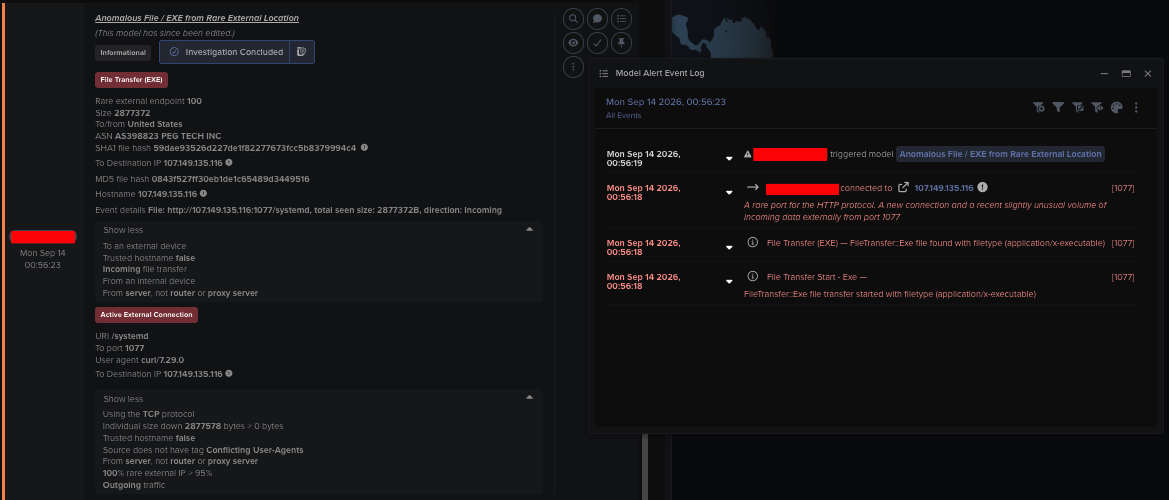
Prior to the observed C2, Darktrace detected curl requests retrieving executable and script content including /systemd, /wazuh, linux_amd64, u.sh and q.sh. Related telemetry included DRSGetNCChanges activity consistent with DCSync, LDAP enumeration, DNS zone transfers, network scanning, certificate downloads and SMB writes involving start.bat.

BLOODALCHEMY has been reported in more than one China-nexus cluster [5]. SoftEther infrastructure observed in one environment provided another point of correlation with reported VAPOR PANDA tradecraft. The moderate-confidence assessment tying this to a Chinese nexus threat actor is based on infrastructure, victim context, tradecraft behavior that followed the initial connection, and public reporting.
Case 2: Financial-sector activity
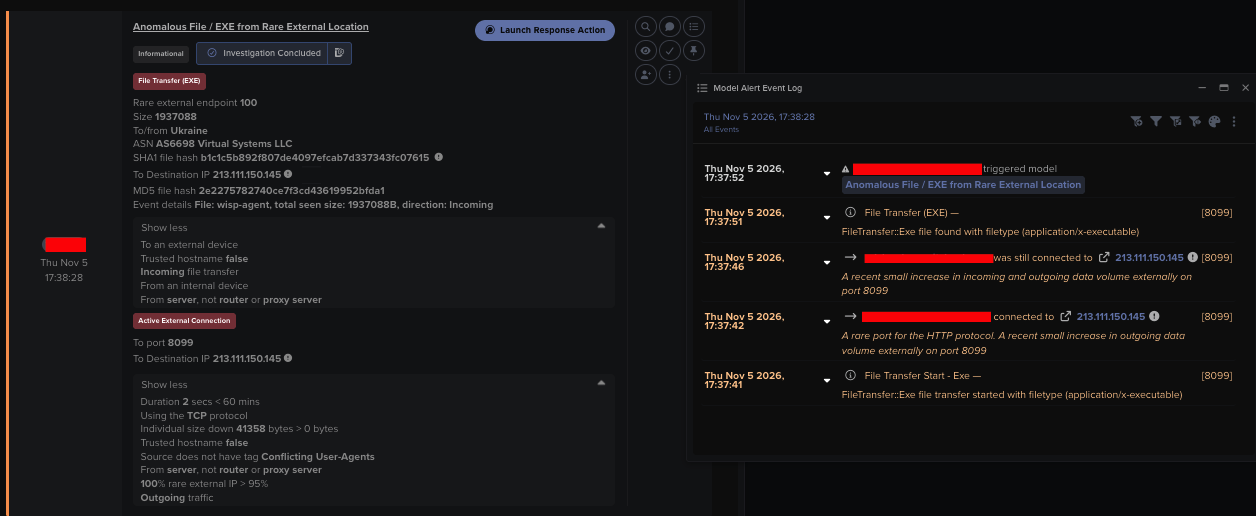
In early November, Darktrace observed activity in two financial-sector environments that overlap with reported ARTEX infrastructure. On November 5, a server connected to 213.111.150[.]145:8099 and downloaded wisp-agent, associated with WISP C2 activity.
In a second environment, a device attempted connections to 85.11.167[.]52 on November 1 and 2. The connections occurred alongside beaconing to new and rare destinations, anomalous TLS, possible tunneling and unusual package downloads.
The device also communicated with temp[.]sh, ssh.localhost[.]run, localhost[.]run, termbin[.]com, pastebin[.]com and GitHub-hosted release infrastructure. The sequence showed potential tooling retrieval, C2, tunneling and use of external services capable of staging or moving data.
Case 3: Credential collection in Azure
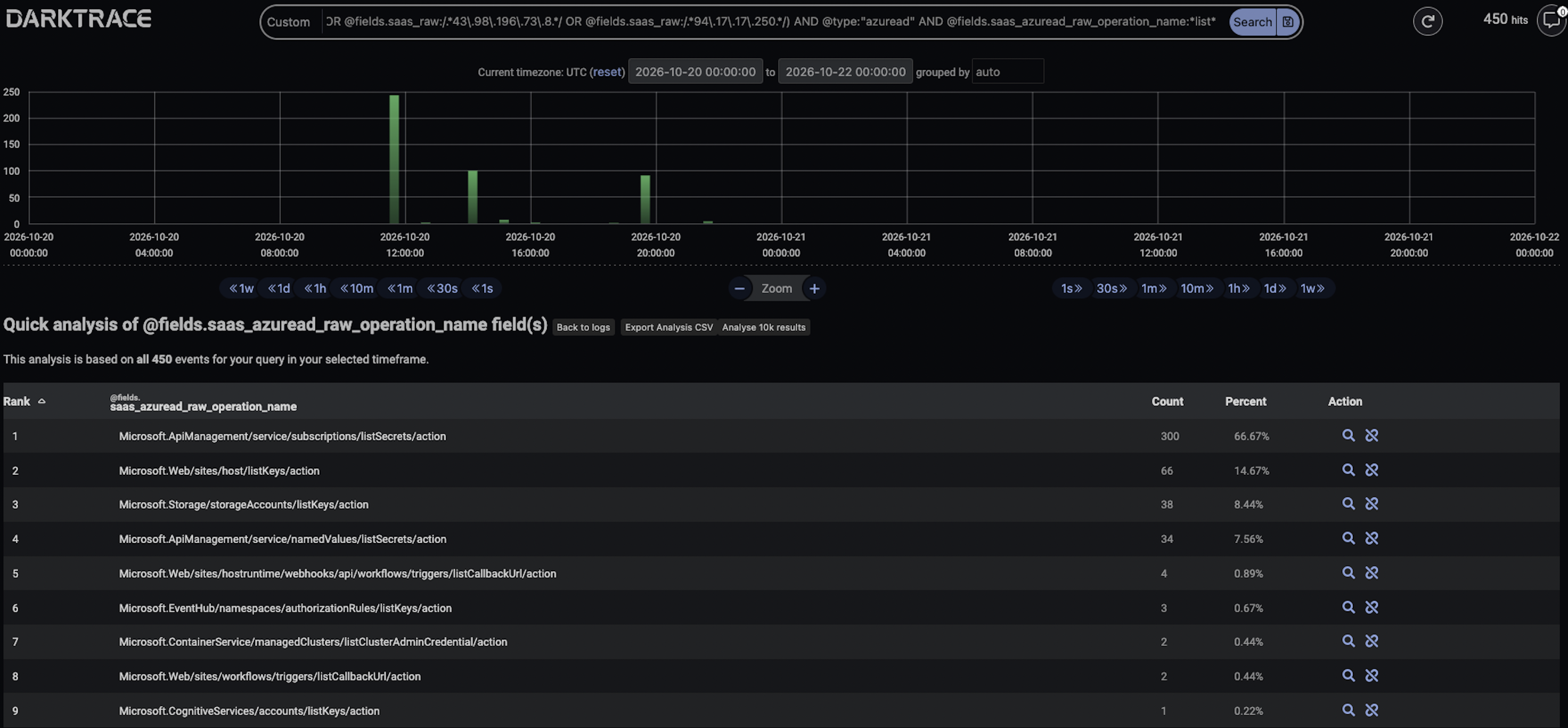
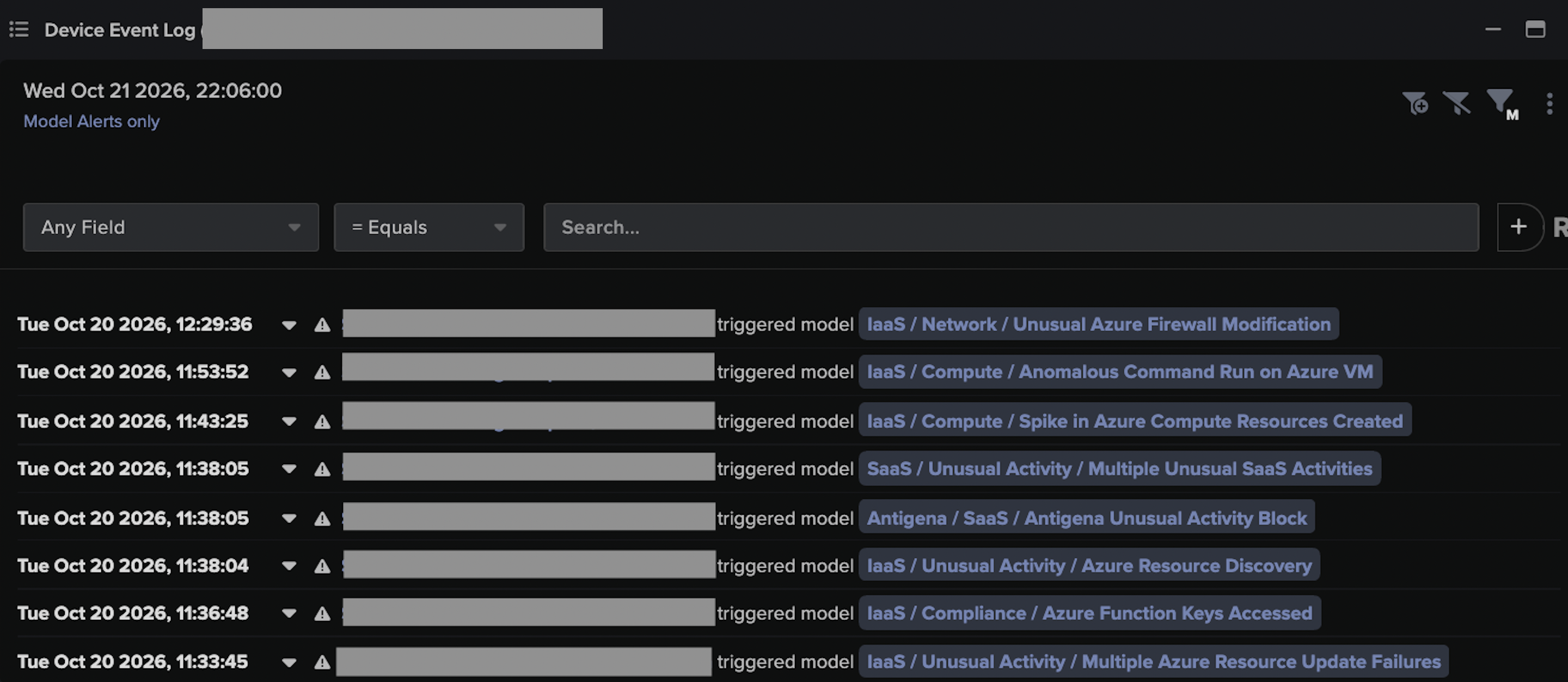
On October 20, Darktrace observed a sweep of credential collection in a customer’s Azure environment that is consistent with ARTEX use. The intrusion began with connections to the virtual network from 43.98.196[.]73 (Alibaba Cloud). Open-source scanning data associates the address with ARTEX.
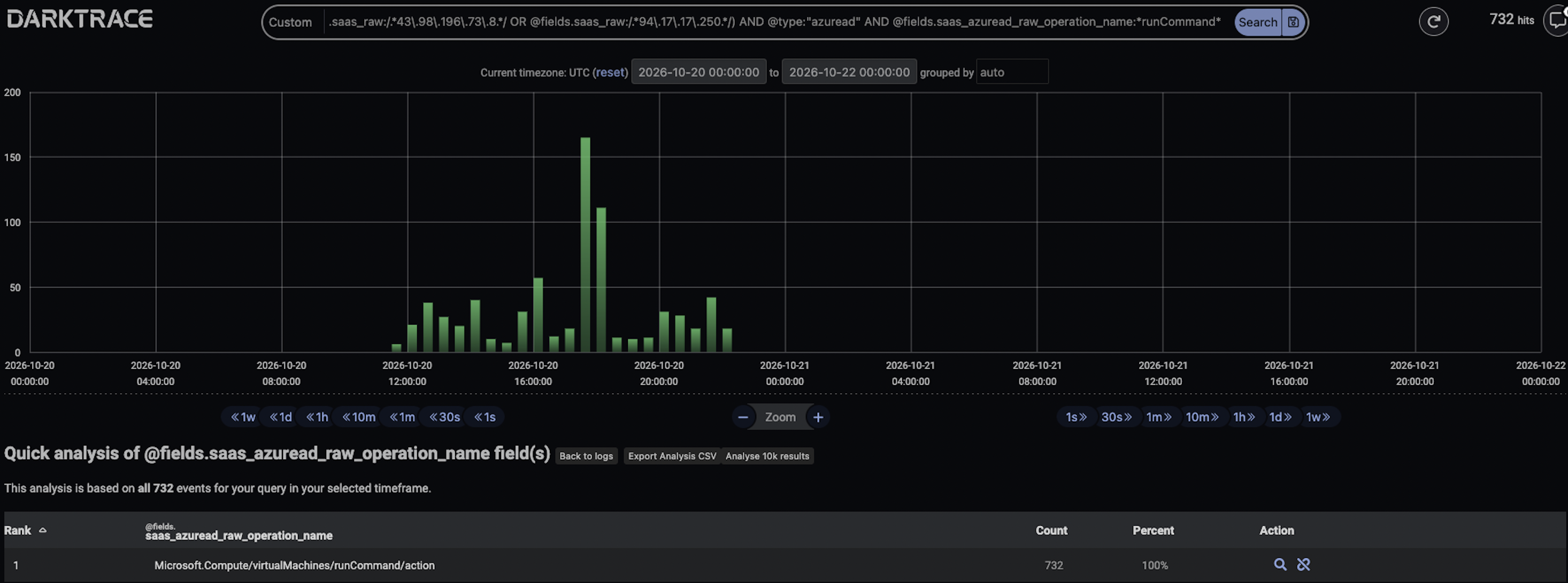
A compromised user identity made requests to the Azure Resource Manager API, though how it was compromised is unknown. The requests listed keys and secrets across API Management, web and function apps, Cognitive Services, Event Hubs, storage accounts and a managed Kubernetes cluster. With those credentials the attacker compromised multiple application identities. The attacker then used the application identities and the user identity to retrieve more credentials, change firewall and security rules and run scripts on virtual machines. Microsoft Defender alerts showed attempted execution of scripts related to Mimikatz and Impacket.
In a cloud environment, such privileged and enumerative operations are potentially indistinguishable from legitimate administrative actions. Consequently, the sequence and context of such operations signified more than any specific API call. There was no C2 traffic to match, and listing keys and using application identities are also what administrators and automation do. A compromised user, credential retrieval across several Azure services, new application identities, more credential collection and changes to security controls only made sense together, and by then access was spreading through the cloud environment.
Shared tooling weakens attribution signals
The three cases looked different on the network: BLOODALCHEMY infrastructure and espionage-consistent tradecraft, WISP infrastructure in financial-sector systems, and Azure identity and control-plane activity with no C2 at all.
Shared tooling has complicated attribution for years, and ARTEX adds to it because the framework carries out more of the attack, so reconnaissance, exploitation attempts and some post-compromise activity can look the same whoever set the objective. Attribution still needs infrastructure, malware, victimology, timing and the sequence of behavior inside the environment, and an ARTEX link is one input to that. Moreover, the behavior and the agent will still be shaped by the biases, preferences, and tradecraft of its operators.
At its core, ARTEX’s planner and worker agents identify and record facts, while exploring intents. However, the way the Large Language Model (LLM) chooses its next steps toward an objective is shaped fundamentally by the skills and tools available in its context. This includes its starting context, as well as various possible Model Context Protocol (MCP) plugins and user-injected context (e.g. user input mid-operation). Operators still have preferred tradecraft, and this preference shapes the pathways the harness will provide to the LLM in context prompts. Even on the same platform, customization based on operator preferences and goals will remain a key facet of campaign and actor identification.
Detection and response
Across the Darktrace cases, the stronger signals came from behavior after the connection: beaconing, abnormal TLS, reconnaissance, unusual authentication, tunneling, script retrieval, SMB activity and outbound transfer. Automated activity also produced compressed bursts of requests, sequential enumeration and repeated attempts with small changes.
With agentic tools reaching privileged access in under three hours, analysts may have only a short window to connect scanning or authentication activity to credential changes, new administrative access, tooling retrieval or lateral movement. Keeping network, identity and cloud telemetry together shows what happened before and after the first match, and whether a connection was noise or an intrusion moving toward privileged access.
ARTEX won’t be the last of these frameworks. The next ones will come with new capabilities and defaults, but an intrusion still must interact with the target environment, and that shows up in how systems, identities and applications behave even after the indicator has aged out. The harder intrusions to catch will have no infrastructure to match, just ordinary API calls and legitimate identities. Detecting those depends on knowing what normal looks like for each identity and device.
Credit to Nathaniel Jones (SVP, Global Threat Intelligence), Eugene Chua (Principal Analyst), Sam Lister (Senior Security Researcher), Adam Potter (Associate Principal Cyber Analyst)
Appendices
Darktrace model detections
· Anomalous Connection / Multiple HTTP POSTs to Rare Hostname
· Anomalous Connection / Rare External SSL Self-Signed
· Anomalous Connection / Suspicious Self-Signed SSL
· Compromise / Large Number of Suspicious Successful Connections
· Compromise / Suspicious Beaconing Behaviour
· Compromise / Agent Beacon to New Endpoint
· Compromise / Beacon to Young Endpoint
· Compromise / SSL Beaconing to Rare Destination
· Compromise / Suspicious TLS Beaconing To Rare External
· Compromise / Possible Tunnelling to Bin Services
· Device / Anomalous Github Download
· Device / Anomalous Package Download
· Device / Initial Attack Chain Activity
Indicators of compromise (IoCs)
nginxmysql[.]com
45.153.126[.]223
213.111.150[.]145
wisp-agent
85.11.167[.]52
43.98.196[.]73
192.121.47[.]20
www[.]ddduuuppp[.]com
89.46.234[.]50
sqlserver-sqlite[.]com
199.19.95[.]66
graphics-hook-filter64.dll
graphics-hook_config.bin
References
1. Google. GTIG AI Threat Tracker - https://cloud.google.com/blog/topics/threat-intelligence/agentic-threat-activity-crosses-a-significant-threshold
2. Federal Bureau of Investigation, Threat Overview of ARTEX Autonomous Penetration Testing Framework, FLASH-20261113-001, 13 November 2026: https://www.ic3.gov/CSA/2026/261113.pdf
3. Microsoft Security Blog, Storm-0940 Uses ARTEX Agentic AI in ConnectWise Supply Chain Compromise: https://www.microsoft.com/en-us/security/blog/2026/10/21/storm-0940-uses-artex-agentic-ai-connectwise-supply-chain-compromise/
4. CrowdStrike, VAPOR PANDA Uses ARTEX to Scale Global Campaign: https://www.crowdstrike.com/en-us/blog/vapor-panda-uses-artex-to-scale-global-campaign/
5. Bitdefender, SilkParasite: Tracking a China-Nexus APT Across Central Asia: https://www.bitdefender.com/en-us/blog/businessinsights/silkparasite-tracking-china-nexus-apt-across-central-asia