
ブログ
/
AI
/
November 18, 2026

Agentic attacks in the wild: Inside three ARTEX investigations

Darktrace analyzes three real-world ARTEX investigations, revealing how agentic AI attack frameworks appear on networks and in the cloud. From China-nexus espionage and financial-sector intrusions to Azure credential collection, learn which behaviors (beaconing, TLS anomalies, tunneling, identity abuse) expose compromise, and why shared AI tooling complicates threat attribution for security teams.
Inside the SOC
Darktrace cyber analysts are world-class experts in threat intelligence, threat hunting and incident response, and provide 24/7 SOC support to thousands of Darktrace customers around the globe. Inside the SOC is exclusively authored by these experts, providing analysis of cyber incidents and threat trends, based on real-world experience in the field.
Written by
Nathaniel Jones
SVP, Global Threat Intelligence
Written by
Eugene Chua
Cyber Security Analyst
Default blog image
18
Nov 2026

Key insights

·       Darktrace observed activity in several customer environments involving infrastructure and behaviors associated with reported ARTEX-enabled campaigns, including activity linked to China-nexus espionage and financially motivated attacks.

·       In the higher-confidence cases, known infrastructure appeared alongside beaconing, unusual TLS, reconnaissance, tunneling, script retrieval, SMB activity and external data transfer. One Azure case had no observed network command and control at all, only key listing and application identity activity.

·       ARTEX is now used by actors with different objectives. Identifying the framework can help locate relevant activity, while the behavior around the affected system provides the stronger evidence for understanding compromise and attribution.

‍

Introduction

Attackers have moved beyond using AI for phishing and are running agentic frameworks; open-source tools like ARTEX, CAIRN, PentAGI and Hexstrike that let AI agents scan, exploit and move through an environment with little human input [1]. ARTEX has moved quickly from an offensive security project into live intrusion activity. Since at least August 2026, the framework has been associated with espionage, financially motivated attacks and opportunistic campaigns across government, financial services, technology, defense, telecommunications and other sectors. The FBI has documented ARTEX activity spanning reconnaissance, exploitation, credential abuse, lateral movement, collection, command and control, and exfiltration [2].

Darktrace has observed activity in customer environments that overlaps with infrastructure, tooling and behaviors reported in several of these campaigns. The cases below highlight how those intrusions appeared on the network, including the activity visible before an analyst can determine which actor or framework may be responsible.

ARTEX as part of the attacker workflow

ARTEX is an open-source, multi-agent offensive security platform that converts high-level objectives into actions carried out by specialized agents [2]. Operators have used it to automate activity across the attack lifecycle, including scanning, exploitation, credential activity and post-compromise operations. Some reported intrusions moved from initial targeting to privileged access in under three hours [2].

The framework is now associated with actors pursuing different objectives and using different post-exploitation tooling. The original public repository was removed in October 2026, but archived copies and localized versions remain available. For defenders, ARTEX is more useful as context for an investigation than as an attribution shortcut.

Darktrace observations show the same point at network level. Infrastructure linked to reported ARTEX campaigns appeared alongside beaconing, tunneling, unusual TLS, reconnaissance, file retrieval and lateral activity.

Case 1: Espionage-linked activity

Darktrace observed activity associated with BLOODALCHEMY command-and-control (C2) infrastructure in two customer environments. In one environment, five devices communicated with nginxmysql[.]com and 45.153.126[.]223 between October 23 and November 2. Both indicators had previously been linked to China-nexus espionage activity involving ARTEX [4].

The connections were accompanied by suspicious beaconing, repeated successful connections and unusual self-signed TLS. One system began making suspicious TLS connections to nginxmysql[.]com on October 23. Beaconing followed on October 24, and SMB scanning appeared later in the sequence. Other affected systems subsequently communicated with previously unseen external endpoints.

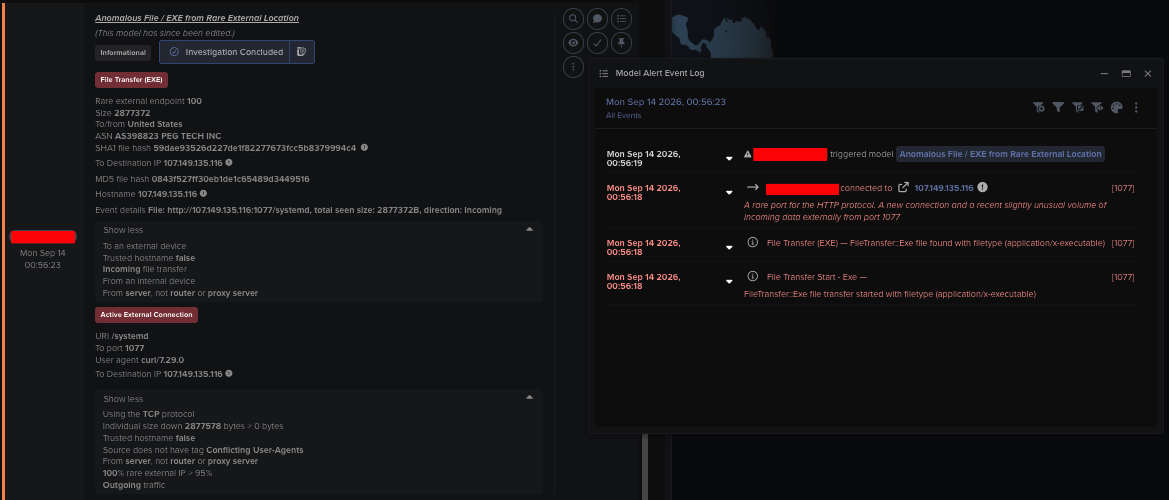
Prior to the observed C2, Darktrace detected curl requests retrieving executable and script content including /systemd, /wazuh, linux_amd64, u.sh and q.sh. Related telemetry included DRSGetNCChanges activity consistent with DCSync, LDAP enumeration, DNS zone transfers, network scanning, certificate downloads and SMB writes involving start.bat.
‍

Figure 1: Darktrace investigation showing suspicious network activity associated with infrastructure linked to reported ARTEX activity.

‍

Figure 2: Darktrace detection showing anomalous self-signed TLS activity during the espionage-linked investigation.

‍

BLOODALCHEMY has been reported in more than one China-nexus cluster [5]. SoftEther infrastructure observed in one environment provided another point of correlation with reported VAPOR PANDA tradecraft. The moderate-confidence assessment tying this to a Chinese nexus threat actor is based on infrastructure, victim context, tradecraft behavior that followed the initial connection, and public reporting.

Case 2: Financial-sector activity

In early November, Darktrace observed activity in two financial-sector environments that overlap with reported ARTEX infrastructure. On November 5, a server connected to 213.111.150[.]145:8099 and downloaded wisp-agent, associated with WISP C2 activity.

In a second environment, a device attempted connections to 85.11.167[.]52 on November 1 and 2. The connections occurred alongside beaconing to new and rare destinations, anomalous TLS, possible tunneling and unusual package downloads.

The device also communicated with temp[.]sh, ssh.localhost[.]run, localhost[.]run, termbin[.]com, pastebin[.]com and GitHub-hosted release infrastructure. The sequence showed potential tooling retrieval, C2, tunneling and use of external services capable of staging or moving data.
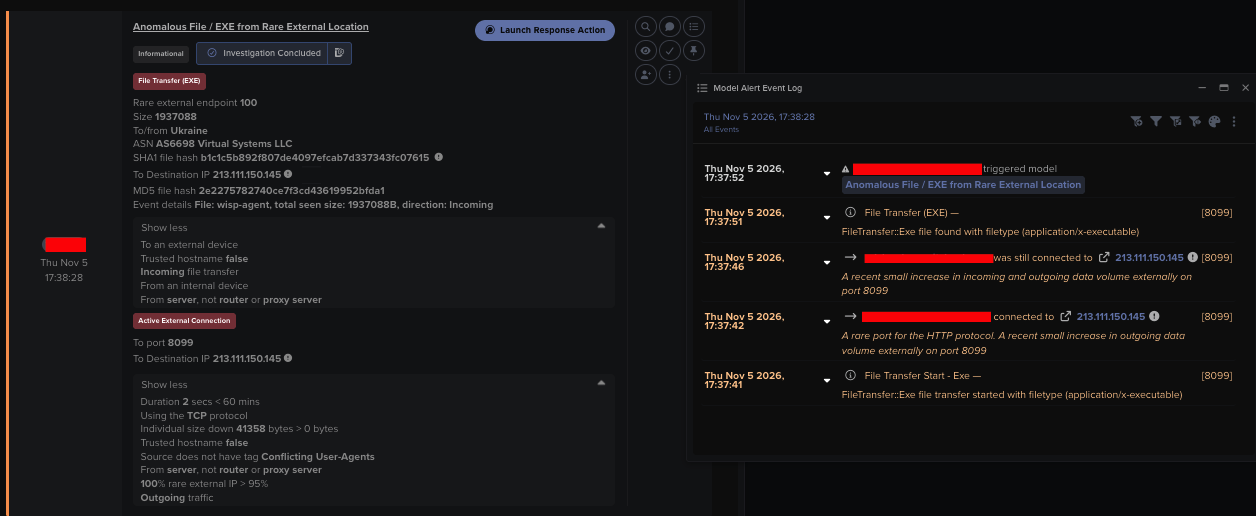
Figure 3: Darktrace investigation showing connections to new and rare external destinations during the financial-sector activity.

‍

Case 3: Credential collection in Azure

On October 20, Darktrace observed a sweep of credential collection in a customer’s Azure environment that is consistent with ARTEX use. The intrusion began with connections to the virtual network from 43.98.196[.]73 (Alibaba Cloud). Open-source scanning data associates the address with ARTEX.

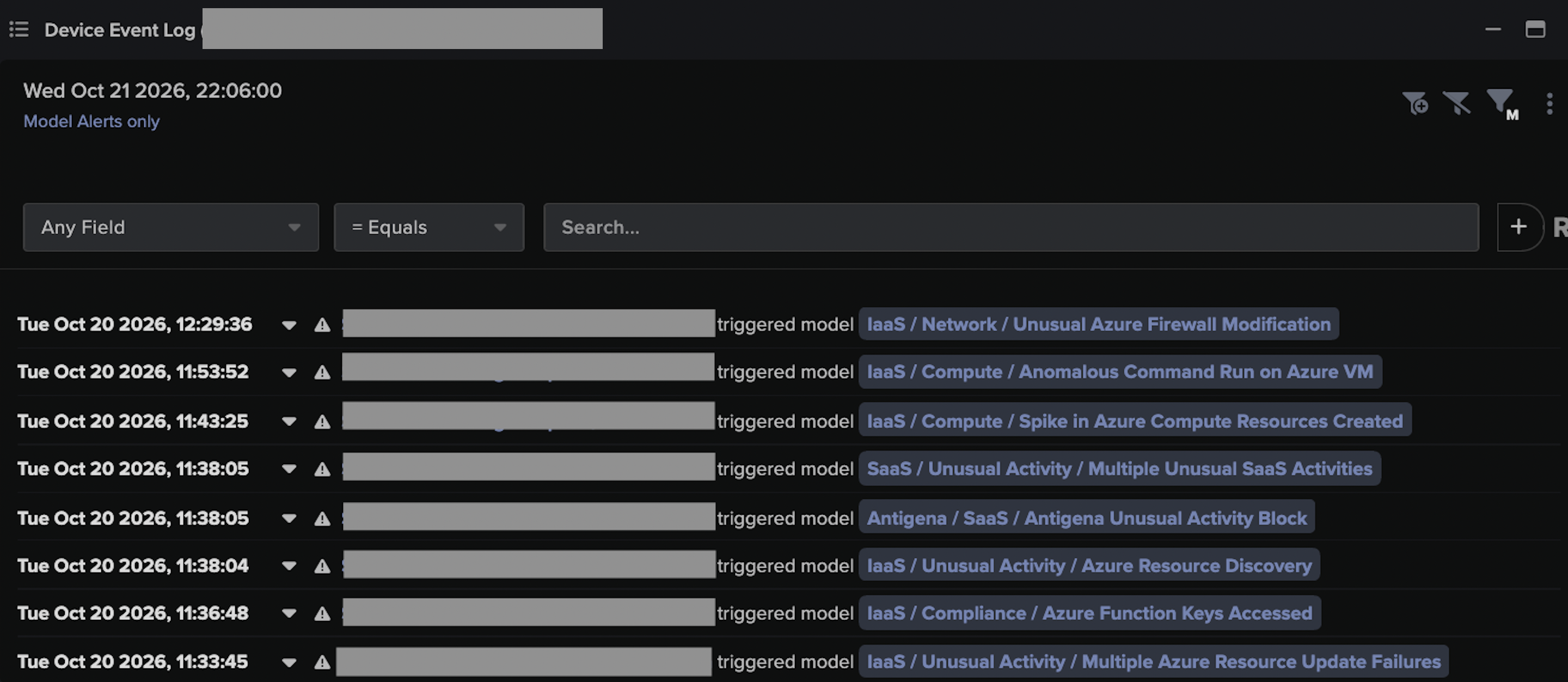
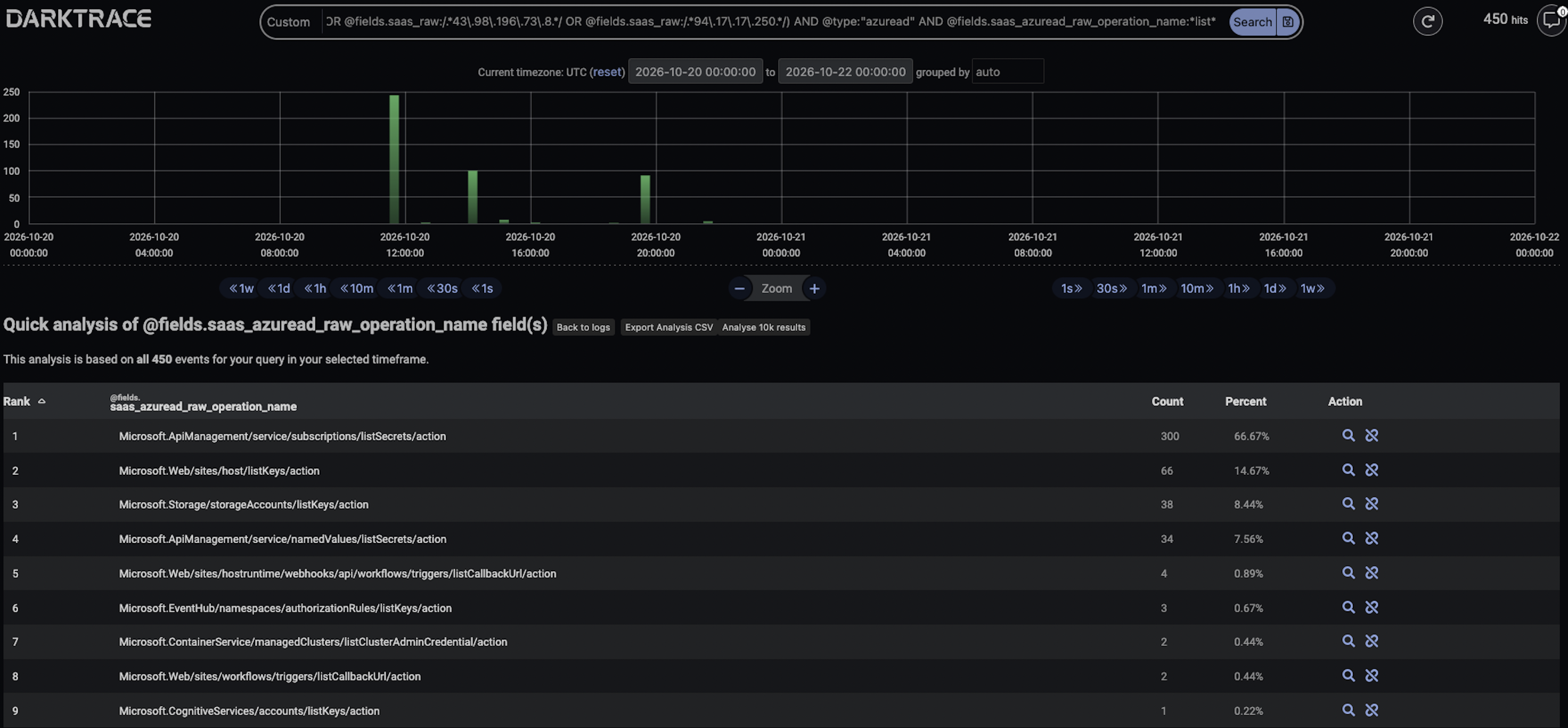
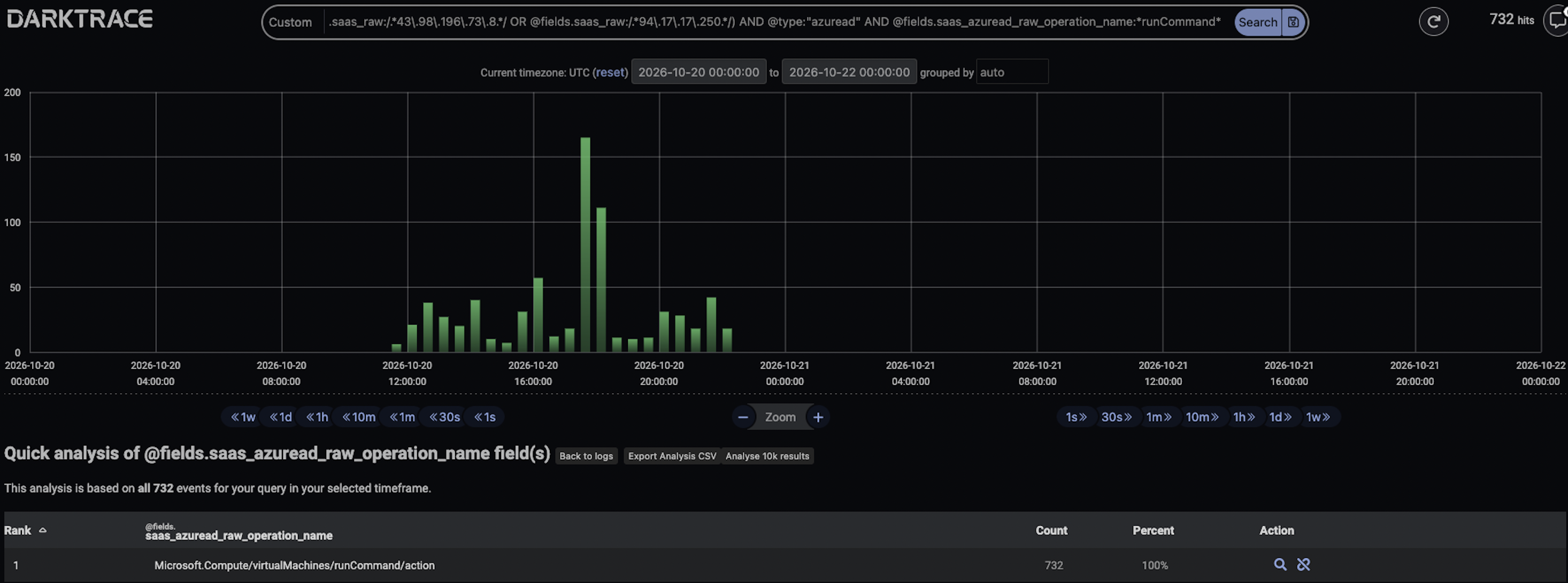
A compromised user identity made requests to the Azure Resource Manager API, though how it was compromised is unknown. The requests listed keys and secrets across API Management, web and function apps, Cognitive Services, Event Hubs, storage accounts and a managed Kubernetes cluster. With those credentials the attacker compromised multiple application identities. The attacker then used the application identities and the user identity to retrieve more credentials, change firewall and security rules and run scripts on virtual machines. Microsoft Defender alerts showed attempted execution of scripts related to Mimikatz and Impacket.

In a cloud environment, such privileged and enumerative operations are potentially indistinguishable from legitimate administrative actions. Consequently, the sequence and context of such operations signified more than any specific API call. There was no C2 traffic to match, and listing keys and using application identities are also what administrators and automation do. A compromised user, credential retrieval across several Azure services, new application identities, more credential collection and changes to security controls only made sense together, and by then access was spreading through the cloud environment.
‍

Figure 4: Darktrace Advanced Search showing Azure AD operation names associated with the activity.

‍

Figure 5: Darktrace Advanced Search showing the Azure Resource Manager action used to execute scripts.
Figure 6: Darktrace Device Event log window showing the triggered models related to the suspicious Azure activity.

‍

Shared tooling weakens attribution signals

The three cases looked different on the network: BLOODALCHEMY infrastructure and espionage-consistent tradecraft, WISP infrastructure in financial-sector systems, and Azure identity and control-plane activity with no C2 at all.

Shared tooling has complicated attribution for years, and ARTEX adds to it because the framework carries out more of the attack, so reconnaissance, exploitation attempts and some post-compromise activity can look the same whoever set the objective. Attribution still needs infrastructure, malware, victimology, timing and the sequence of behavior inside the environment, and an ARTEX link is one input to that. Moreover, the behavior and the agent will still be shaped by the biases, preferences, and tradecraft of its operators.

At its core, ARTEX’s planner and worker agents identify and record facts, while exploring intents. However, the way the Large Language Model (LLM) chooses its next steps toward an objective is shaped fundamentally by the skills and tools available in its context. This includes its starting context, as well as various possible Model Context Protocol (MCP) plugins and user-injected context (e.g. user input mid-operation). Operators still have preferred tradecraft, and this preference shapes the pathways the harness will provide to the LLM in context prompts. Even on the same platform, customization based on operator preferences and goals will remain a key facet of campaign and actor identification.

Detection and response

Across the Darktrace cases, the stronger signals came from behavior after the connection: beaconing, abnormal TLS, reconnaissance, unusual authentication, tunneling, script retrieval, SMB activity and outbound transfer. Automated activity also produced compressed bursts of requests, sequential enumeration and repeated attempts with small changes.

With agentic tools reaching privileged access in under three hours, analysts may have only a short window to connect scanning or authentication activity to credential changes, new administrative access, tooling retrieval or lateral movement. Keeping network, identity and cloud telemetry together shows what happened before and after the first match, and whether a connection was noise or an intrusion moving toward privileged access.

ARTEX won’t be the last of these frameworks. The next ones will come with new capabilities and defaults, but an intrusion still must interact with the target environment, and that shows up in how systems, identities and applications behave even after the indicator has aged out. The harder intrusions to catch will have no infrastructure to match, just ordinary API calls and legitimate identities. Detecting those depends on knowing what normal looks like for each identity and device.

‍

Credit to Nathaniel Jones (SVP, Global Threat Intelligence), Eugene Chua (Principal Analyst), Sam Lister (Senior Security Researcher), Adam Potter (Associate Principal Cyber Analyst)

Appendices

Darktrace model detections

·       Anomalous Connection / Multiple HTTP POSTs to Rare Hostname

·       Anomalous Connection / Rare External SSL Self-Signed

·       Anomalous Connection / Suspicious Self-Signed SSL

·       Compromise / Large Number of Suspicious Successful Connections

·       Compromise / Suspicious Beaconing Behaviour

·       Compromise / Agent Beacon to New Endpoint

·       Compromise / Beacon to Young Endpoint

·       Compromise / SSL Beaconing to Rare Destination

·       Compromise / Suspicious TLS Beaconing To Rare External

·       Compromise / Possible Tunnelling to Bin Services

·       Device / Anomalous Github Download

·       Device / Anomalous Package Download

·       Device / Initial Attack Chain Activity

Indicators of compromise (IoCs)

nginxmysql[.]com

45.153.126[.]223

213.111.150[.]145

wisp-agent

85.11.167[.]52

43.98.196[.]73

192.121.47[.]20

www[.]ddduuuppp[.]com

89.46.234[.]50

sqlserver-sqlite[.]com

199.19.95[.]66

graphics-hook-filter64.dll

graphics-hook_config.bin

References

1.      Google. GTIG AI Threat Tracker - https://cloud.google.com/blog/topics/threat-intelligence/agentic-threat-activity-crosses-a-significant-threshold

2.      Federal Bureau of Investigation, Threat Overview of ARTEX Autonomous Penetration Testing Framework, FLASH-20261113-001, 13 November 2026: https://www.ic3.gov/CSA/2026/261113.pdf

3.      Microsoft Security Blog, Storm-0940 Uses ARTEX Agentic AI in ConnectWise Supply Chain Compromise: https://www.microsoft.com/en-us/security/blog/2026/10/21/storm-0940-uses-artex-agentic-ai-connectwise-supply-chain-compromise/

4.      CrowdStrike, VAPOR PANDA Uses ARTEX to Scale Global Campaign: https://www.crowdstrike.com/en-us/blog/vapor-panda-uses-artex-to-scale-global-campaign/

5.      Bitdefender, SilkParasite: Tracking a China-Nexus APT Across Central Asia: https://www.bitdefender.com/en-us/blog/businessinsights/silkparasite-tracking-china-nexus-apt-across-central-asia

‍

‍

Inside the SOC
Darktrace cyber analysts are world-class experts in threat intelligence, threat hunting and incident response, and provide 24/7 SOC support to thousands of Darktrace customers around the globe. Inside the SOC is exclusively authored by these experts, providing analysis of cyber incidents and threat trends, based on real-world experience in the field.
Written by
Nathaniel Jones
SVP, Global Threat Intelligence
Written by
Eugene Chua
Cyber Security Analyst

More in this series

No items found.

Blog

/

AI

/

November 18, 2026

Darktrace qualifies for NATO’s Cybersecurity Dynamic Marketplace

Default blog imageDefault blog image

Darktrace has been selected to join NATO’s Cybersecurity Dynamic Marketplace (CSDM), an initiative designed to give NATO faster, more flexible access to cybersecurity technology and services in support of its missions.  

Established by the NATO Communications and Information Agency (NCIA), the marketplace brings together qualified suppliers whose technical capabilities have been reviewed, helping NATO match specialist expertise to project needs and respond more quickly to changing operational priorities.

Qualified across all eight cybersecurity categories

The program’s first phase, known as Lot 1, covers eight cybersecurity categories. Suppliers can qualify in individual categories; Darktrace has qualified to compete for future work across all eight:

  • Identity, Credential and Access Management
  • Endpoint Protection and Platforms
  • Network and Perimeter Security
  • Cloud Security
  • Threat Detection and Analytics Platforms
  • Vulnerability and Exposure Management
  • Digital Forensics and Evidence Platforms
  • Professional Services

Darktrace’s qualification across all eight categories reflects the breadth of our technology and services.

Supporting government and defense organizations

Nation-state attacks, compromised suppliers, the rapid exploitation of security weaknesses and attackers’ growing use of AI are increasing pressure on public-sector organizations. At the same time, agencies are adopting cloud services, connecting the technology that runs physical operations, and introducing automation and AI. Security teams must manage these changes while keeping essential operations running and sensitive information secure.

Protecting these environments requires an understanding of how people, AI and connected systems interact, and the ability to recognize when their activity creates risk. Threats can span several systems, making it essential for security teams to connect related activity and respond quickly.

The Darktrace Behavioral Defense Platform™ supports this approach through unified visibility, continuous behavioral monitoring and autonomous response across AI, people and infrastructure.

At its core, Darktrace’s Adaptive AI™ continuously learns how each organization behaves, building a unique understanding of its people, AI agents and connected systems. This enables the platform to help identify activity that does not belong, connect related behavior across the organization, and investigate and respond to threats autonomously in real time, helping prevent disruption to essential operations.

Our selection builds on work to meet government security requirements internationally. Darktrace recently completed an independent assessment under Australia’s InfoSec Registered Assessors Program (IRAP) for Darktrace / NETWORK™ and Darktrace / OT™ against the Australian Government’s Information Security Manual PROTECTED-level controls. In the United States, Darktrace Federal continues to deliver the Darktrace technology to Department of War, Department of State, and Federal civilian organizations via its on-premises and FedRAMP CLASS D (High) Authorization platforms.

Together, these achievements demonstrate Darktrace’s ability to meet rigorous public-sector security requirements and reinforce its position as a trusted provider of mission-critical cybersecurity technology for government environments.

Meet us at NATO Edge 2026

Darktrace representatives will attend NATO Edge 2026, NCIA’s flagship technology event, in İzmir, Türkiye, from 17 to 19 November. We look forward to meeting government, military, and industry partners to discuss their cybersecurity priorities and how we can support them.

To learn more about the Darktrace Behavioral Defense Platform, visit the platform hub.

Continue reading
About the author
The Darktrace Community

Blog

/

Network

/

November 17, 2026

GTA VI Cyber Threats: Fake downloads, ransomware and account hijacking

Default blog imageDefault blog image

Key findings

  • Darktrace detected GTA VI-themed suspicious activity across organizations in multiple sectors ahead of the game’s release, showing how malicious gaming content can reach corporate environments outside the gaming industry.
  • Twelve Darktrace customer environments connected to gta6demo[.]asia, a domain that public threat research has associated with a fake GTA VI demo used to distribute the Vidar infostealer. Seven of the twelve communicated with infrastructure associated with AS56322 ServerAstra Kft as part of this connectivity.
  • Darktrace investigated ransomware activity at two European games companies. One incident involved DireWolf ransomware alongside reported data exfiltration. A separate Qilin incident included Active Directory reconnaissance, new administrative credentials, possible lateral movement and substantial cloud-storage transfers before ransomware deployment.
  • Another incident on a gaming organization involved a SaaS account hijack in which a compromised account authenticated from unusual IP addresses, created a new privileged account and subsequently sent a high volume of suspected malicious email. An administrative account later authenticated from rare endpoints.‍
  • Darktrace's new report highlights how threat actors continue to weaponize launch hype to breach corporate networks and target gaming infrastructure following the guilty plea of hacker Arion Kurtaj. These findings demonstrate that global enterprises remain actively exposed to franchise-related social engineering and exploitation attempts.

‍

GTA VI gives criminals an audience

Grand Theft Auto VI arrives on November 19 with the kind of attention few entertainment releases command [1]. Before launch, that interest is already being exploited by sites offering supposed demos and downloads.

During September and October 2026, Darktrace detected devices across multiple customer environments connecting to GTA VI-themed sites associated with suspicious activity. The organizations involved were spread across EMEA and the Americas and included Manufacturing, Finance, and Public administration and defense sectors.

Darktrace has also investigated multiple incidents affecting gaming organizations including ransomware and a SaaS account hijack. Those investigations show a separate side of the threat: attackers operating inside corporate infrastructure and accounts, sometimes well before the eventual impact becomes apparent.

Following a fake GTA VI download

On October 7, 2026, Darktrace detected a device making suspicious DNS requests for gta6-play[.]ru, an unofficial Russian-language GTA VI site that had also been flagged as likely malicious in open-source intelligence (OSINT).

‍

Figure 1: A screenshot of the suspicious endpoint gta6-play[.]ru .

‍

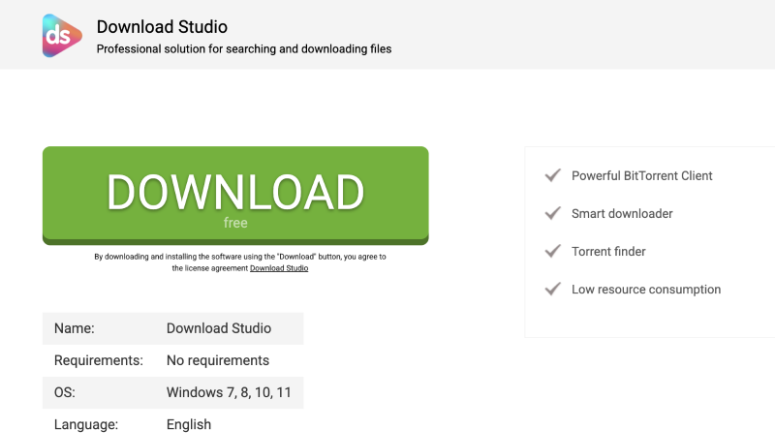
Figure 2: A screenshot of a “Download Studio” endpoint led to on gta6-play[.]ru.

‍

The site advertised a GTA VI download. The site led to a separate “Download Studio” page offering a Windows executable. Analysis found the file was packaged using InstallMate, a commercial installation framework, with an embedded .tsuarch section containing a compressed tiz3 archive.


Further examination identified functionality designed to inspect the environment in which the installer was running. This included checking registry entries for installed software and disk devices, enumerating network adapters, inspecting MAC addresses, and searching for running processes and window titles.


The installer also searched for processes associated with virtualization, debugging, and network analysis, including VMware and VirtualBox components, alongside debugging and monitoring utilities such as OllyDbg, WinDbg, Process Hacker, Process Monitor, Wireshark and Fiddler.

The presence of those checks did not prove that the executable was malicious. The installer contained functionality capable of extracting embedded files, but the investigation did not establish that it was being used to deploy a malicious payload. No definitive malicious payload or command-and-control infrastructure was identified. The software appeared to be InstallRex, which is classified by several security vendors as a potentially unwanted program.

That is still a useful finding; A user looking for GTA VI content could move from an unofficial gaming site to an executable that inspected the local environment, including checking for software commonly used by security researchers.

A second GTA VI lure appeared across twelve organizations

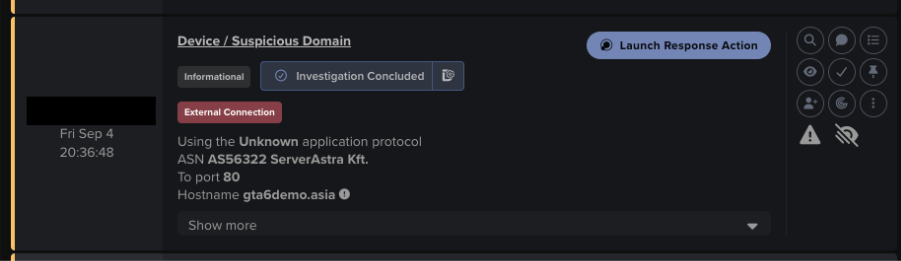
During September 2026, Darktrace alerted on HTTP connections to gta6demo[.]asia across twelve customer environments. Seven of the twelve communicated with infrastructure associated with AS56322 ServerAstra Kft as part of this connectivity.

‍

Figure 3: An example model alert generated due to a suspicious connection to gta6demo[.]asia.

‍

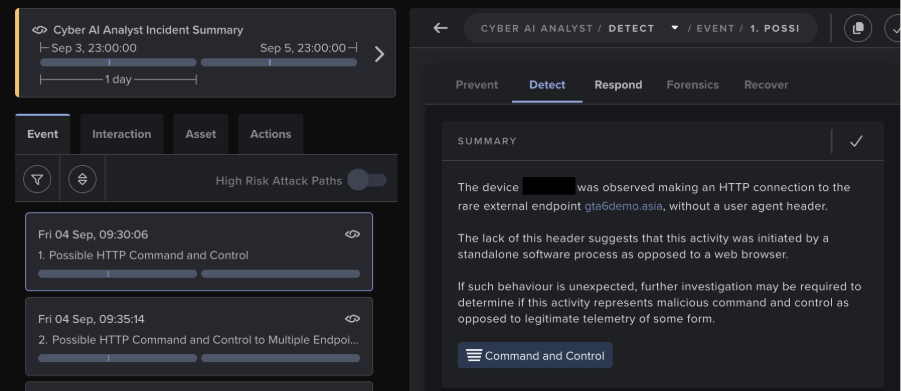
In a case affecting a UK-based customer, Darktrace’s Real-Time AI Analyst further investigated connections to gta6demo[.]asia and generated an incident due to the highly suspicious nature of the behavior.

‍

Figure 4: A Real-Time AI Analyst incident highlighting the suspicious activity for further investigation

‍

Public threat research has associated gta6demo[.]asia with a campaign advertising a fake GTA VI demo. Users clicking "Play Now" were reportedly directed towards an executable containing the Vidar infostealer [2].

There is a practical difference between this activity and an attack against a games company. The users encountering GTA VI-themed infrastructure can work anywhere. Darktrace saw the activity across several sectors outside Gaming, including Finance, Manufacturing, and Public administration and defense.

A major game release can therefore create security exposure well beyond its publisher. A search for a demo or unofficial download on a corporate device is enough to bring gaming-themed infrastructure into an enterprise environment.

Ransomware operators inside the gaming industry

The attacks Darktrace observed against Gaming companies themselves show different patterns.

In August 2026, Darktrace threat research identified possible malicious activity at a European game developer. Ransomware was ultimately deployed and data was exfiltrated, with the DireWolf ransomware group claiming responsibility.

Darktrace observed suspicious file downloads and beaconing from several devices to rare endpoints alongside Monero cryptocurrency mining, Active Directory and network reconnaissance, unusual administrative RDP connections, activity associated with data staging and HTTP-based exfiltration.

Much of the intrusion was therefore visible before ransomware appeared; the environment was already showing evidence of ingress tooling, external command-and-control communications (C2), reconnaissance, unusual administrative access and data movement.

A separate investigation in December 2025 provides a closer view of this pre-ransomware activity. A European games company was targeted by Qilin ransomware with Darktrace observing scanning and LDAP searches involving userAccountControl, which can expose information useful for identifying accounts and Service Principal Names within Active Directory.

New administrative credentials then appeared on a Domain Controller and the Domain Controller also generated scanning, anomalous RPC, SMB, and SSH activity, and NetShareEnum activity through srvsvc. Elsewhere in the environment, long Remote Desktop sessions and SMB enumeration appeared consistent with lateral movement.

Several devices also transferred data to cloud storage services including WebDrive and Amazon Web Services (AWS). In some cases, large downloads preceded subsequent uploads. Darktrace observed the transfer pattern, although the available telemetry does not establish that every transfer represented attacker-controlled exfiltration.

The activity preceding the Qilin deployment included Active Directory reconnaissance, privileged credential use, network and share enumeration, unusual remote access and significant data movement. Each appeared before ransomware became the defining feature of the incident.

SaaS hijacking shifts the attacker evidence

A separate investigation in May 2026 involved the hijacking of a SaaS account at a Gaming organization.

The compromised account authenticated from several IP addresses that were unusual for the organization. It then performed suspicious SaaS group administration, including creating a new privileged account. The account subsequently sent a high volume of emails assessed as likely malicious spam and potentially intended to compromise additional users.

The following day, an administrative SaaS account authenticated from rare endpoints, raising the possibility that further privileged access had been obtained.

The activity presented a different detection problem from the ransomware cases. Authentication from rare infrastructure, administrative changes, creation of a privileged account and subsequent email activity provided the strongest indications that a legitimate identity had been compromised.

For a Gaming company using hosted platforms for development, communication and business operations, a compromised account with the right permissions can provide considerable access without requiring the attacker to reproduce a conventional network intrusion.

Detecting the intrusion before impact

The ransomware investigations show why encryption should not be the first point at which an incident comes into focus. Darktrace observed LDAP and Active Directory-related reconnaissance, new privileged credentials, unusual Domain Controller activity, remote sessions, network enumeration and abnormal data movement before ransomware deployment.

The SaaS case produced different evidence: authentication from rare infrastructure, unexpected administrative changes and activity performed through a compromised account. GTA VI-themed activity required another approach again, following users through unofficial sites and redirects and examining the software offered for download.

GTA VI has put gaming back into the headlines ahead of its November release. The security activity around it is already visible beyond the games industry, while ransomware and account-compromise investigations show attackers operating inside gaming companies through very different routes.

For defenders, those routes leave evidence before the incident reaches its most damaging stage. The practical work is in recognizing those changes early enough to investigate them.

Credit to Gemma Stubberfield (Cyber Analyst), Ahmed Gardezi (Senior Cyber Analyst), Tara Gould (Malware Research Lead), Nathaniel Jones (SVP, Global Threat Intelligence)

References:

1.        https://www.rockstargames.com/VI

2.     https://www.malwarebytes.com/blog/threat-intel/2026/08/fake-gta-6-extended-look-and-demo-sites-deliver-an-infostealer

‍

‍

Continue reading
About the author
Gemma Stubberfield
Cyber Analyst
あなたのデータ × DarktraceのAI
唯一無二のDarktrace AIで、ネットワークセキュリティを次の次元へ