

ブログ
/
/
10月 29, 2026

1つのアラートから大規模なキャンペーンへ : 振る舞い分析を通じて新手の脅威を明らかに

ダークトレースの脅威調査チームは、教師なしクラスタリングとDarktrace運用環境全体の振る舞いベースの分析によって、事前のIoCなしに悪意あるキャンペーンを特定し、POPA BotnetとMonero暗号通貨マイニングに関連する異常なアクティビティをを明らかにしました。
Inside the SOC
Darktrace cyber analysts are world-class experts in threat intelligence, threat hunting and incident response, and provide 24/7 SOC support to thousands of Darktrace customers around the globe. Inside the SOC is exclusively authored by these experts, providing analysis of cyber incidents and threat trends, based on real-world experience in the field.
Written by
Daniel Levy
Threat Hunting Data Scientist
Written by
Paul Jennings
Principal Cyber Analyst
Default blog image
29
10月 2026

主な調査結果

  • ダークトレースの脅威調査チームは、顧客の運用環境全体で発生している類似の異常活動を関連付けることにより悪意あるキャンペーンを特定する新しい方法を模索しています。
  • この手法では、教師なしクラスタリングを用いて、複数の顧客運用環境で共通している振る舞いのパターンを識別し、事前のIoCに依存せずに脅威を特定します。
  • このアプローチにより、数十の顧客環境において共通しているインフラを発見し、このアクティビティがPOPA Botnetと関連していることを特定しました。
  • もう1つのクラスターでは、Monero暗号通貨マイニングに関連する異常なアクティビティが確認されました。

‍

ダークトレースの脅威調査手法

ダークトレース脅威調査チームは、複数の顧客に影響を与える悪意あるキャンペーンアクティビティの特定に取り組んでいます。これらのキャンペーンは、その性質上、複数の被害者の間で共通の振る舞いのパターンを示すことになります。

本稿では、この単純な観察を指針として、悪意あるキャンペーンを特定する方法について説明します。まず、現代の脅威ランドスケープに関するいくつかの重要な事実を概説し、それがもたらす課題に対処するために振る舞いベースの検知が必要な理由を説明します。次に、上記の原理を用いて顧客の運用環境全体に対する振る舞いベースの検知を活用し、複数標的型の攻撃キャンペーンを体系的に特定する方法を探ります。最後に、この研究が単なる理論的なものではないことを、この新しい手法によって検知された実際のキャンペーンアクティビティの事例を用いて実証します。

振る舞いに焦点を当てたアプローチへの移行

現代のサイバー防御においては、従来のシグネチャベースの手法を超えた検知能力が不可欠です。アンチウイルスのシグネチャ、ハッシュベースのマルウェア識別、IPブロックリストなどの技術は、これまで既知の脅威から防御するのに成功してきました。しかしながら、これらの対策は攻撃者によって容易に回避され、今日の脅威ランドスケープが生み出す新たな攻撃手法に対する防御には本質的に限界があります。

AIの最近のブレークスルーは、状況を一変させるようなリスクの倍増を意味しています。AIシステムは単に既存の攻撃をマシンスピードで実行するだけではなく、新しい手法を作り出せることを示す兆候もあり[1]、防御側がこれまで観測したことのない攻撃パターンに遭遇する可能性を高めています。一方、脆弱性の開示は増え続けています。2025年には48,000件以上のCVEが公開され、これまでに公開された統計情報によれば、2026年は既にその数字を大幅に上回る見込みです[2]。脆弱性の発見には複数の要因が関係しているかもしれませんが、AIはこの急速な増加の重要な要因と見なされています。そのため、組織は既知の脅威に関する事前知識のみに依存する検知の範囲外となるような悪意ある活動の比率が高まることを想定しておかなければならないでしょう。

振る舞いに基づき、異常に的を絞ったDarktraceの検知機能は、設計上、この厳しい環境に非常に適しています。「通常」の振る舞いのベースラインから逸脱する未知で予期しないアクティビティの検知に重点を置くことで、脆弱性の事前知識を必要とせず、公開前にCVEのエクスプロイトを検知することが可能です[3][4]。

幅広い分野にわたるダークトレースの顧客層には、さらなる保護のレイヤーも提供されています。匿名化されたアラートメタデータのみを用いて、ダークトレースの脅威調査チームが顧客ベース全体で積極的に脅威ハンティングを行っているのです。個々の顧客のレベルを超えて、もう一つの、より大きな視点を活用できるのです。

Darktraceのデータは、顧客ベース全体で発生している予期しない振る舞いのパターンについて独自の知見を提供します。この広範なテレメトリデータを分析し、顧客ベース全体に影響を与える組織的なキャンペーンを探し出すことで、どのようなことが分かるでしょうか?

顧客ベース全体で相関付け

個々の環境レベルでは、Darktraceは組織の通常の振る舞いのコンテキストに照らしてアクティビティが異常かどうかに焦点を当てていますが、顧客ベース全体レベルにこれらのアラートの視野を広げると、問題は根本的に変わります。そこではもはや、概ね正常なデータの中に存在する異常を探すのではなく、既に異常であることが分かっているデータの中に存在する体系的なパターンを探し求めているのです。1社で見つかった単発的な振る舞いの異常は、数十社で同じパターンが見られれば、組織的な攻撃キャンペーンの兆候を示すものとなります。こうしたキャンペーンの捜索と調査結果の共有は、ダークトレースの脅威調査チームの重要な業務です。このように、ダークトレースは非特定アラートメタデータを活用してキャンペーン検知能力を高める新たな研究アプローチを積極的に模索しています。

このアプローチは、一連のアラートを提示された人間のエキスパートアナリストは、メタデータフィールドが関連性を示しているかどうかを評価することによって、関連すると思われるアクティビティを特定するという前提に基づいています。例えば、未知のエンドポイントへの2つの接続が1つのアルゴリズムから作成された可能性が高い命名構造を持つ場合それは強いインジケータであり、また特定のプロトコルに通常とは異なるポートが使用されている(例:SSLにポート6000など)などもそうです。Darktraceのキャンペーン検知アプローチは、こうした人間のエキスパートの判断プロセスを決定論的な埋め込み関数を通じてコード化し、アラートデータの再現可能なベクトル表現を取得します。次に、これらのベクトル表現に教師なしクラスタリングを適用し、複数の顧客にわたる意味的に類似したアラートデータを表すアラートのグループを取得します。その結果これらのクラスターは、複数の顧客にわたって発生した類似の異常なアクティビティを表すものとなります。言い換えれば、これらのクラスターは悪意あるキャンペーンアクティビティの候補ということになります。

‍

__wf_reserved_inherit
図1: Darktrace製品を通じて提供されるAIベースの分析のレイヤーと顧客横断的相関付け。

‍

ケーススタディ1 – 共通のインフラに対する異常な接続

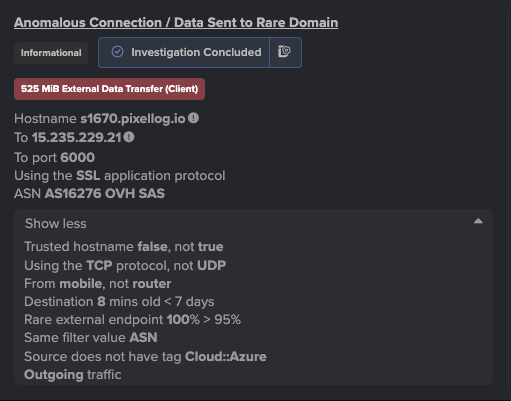
最近のある事例では、クラスタリングによって、数十社の顧客にわたる複数の緊密なアラートグループが生成されました。各グループは、サブドメインがアルゴリズムによって生成された単一のドメインを中心としていました(例:s01699、s1736、s91)。これらのクラスターを並べて調べると、間違いなく共通の振る舞いのパターンが存在し、それぞれ明確な命名パターンを持つドメインが関係していました(例:s016841786.net-echo[.]com、s1670.pixellog[.]io、s217.pixellog[.]io)。また通常とは異なるポート6000でSSLを使って一般的なコンテンツ配信ネットワークではなく非主流プロバイダー(例:OVH、Hetzner、GTHost、Leaseweb)でホスティングされるサーバーへの接続が見られました。
‍

__wf_reserved_inherit
図2:s1670.pixellog[.]ioへの異常なアウトバウンド接続とデータ転送でトリガーされたモデルアラートの例。

‍

詳しく調べたところ、同じサブドメインラベルが異なるドメインでも確認されました(例:s1786.net-echo[.]com および s1786.pixellog[.]io)。この手がかりを追ってダークトレースの脅威調査チームは顧客ベースを横断し、複数の登録ドメインで重複利用されている多数の異なるサブドメインラベルを発見しました。いくつかのケースでは、異なるドメイン間で同じラベルが同じIPに解決されました(例:pixellog[.]ioおよび net-echo[.]comの下のs1704→ 148.113.222[.]244;s01684 → 15.235.67[.]95)。これはシグネチャベースの防御技術を回避するために、一時的なサブドメインインフラが使用されていることを示唆しています。

この例は、複数の環境からのデータを利用することで、個々の顧客レベルだけでは特定が難しい共通のインフラを明らかにすることができることを示しています。特に、この手法では大規模な顧客環境データから悪意あるアクティビティの幾何学的に類似したベクトル埋め込みの、一貫性のある密なクラスターを生成することでこの発見を容易にし、それを研究者がさらに調査することが可能になりました。この Darktrace 顧客ベース全体で特定されたアクティビティは、オープンソースインテリジェンス(OSINT)を通じて最終的にPOPA Botnet と関連づけられました[5]。

ケーススタディ2 – 異常なユーザーエージェントとテキストURI

2つ目の例では、この手法によって単一の自己完結型クラスターが明らかになりました。クラスタリングには、探すべき指標は何も与えられませんでした。その代わりに、珍しい特徴の組み合わせを共有するデバイスがグループ化されました。調査の結果、共有されていた内容は以下の通りでした。

-      異常なユーザーエージェント (tes)

- 特定のリクエストパス (/md5_GIP.txt)

- 珍しい接続先ポート (83)

- ホスト名がGoogleを模倣(正規表現 ^www\.google\.com\.[a-zA-Z0-9]+\.fast-DNS-host\.com$)

これらの共通した特徴をIoCとして扱い、ダークトレースの脅威調査チームはキャンペーン全体像を明らかにするために顧客ベース全体を調査する方向に進みました。この調査により、さらなる共通点が明らかになりました。クラスター内で特定されたドメインファミリーと同じIPアドレス持つ他のドメインや、影響を受けたデバイス上での暗号通貨マイニングの証拠などです。その後のOSINT調査もこれらの結果と一致しており、発見されたペイロードとインフラはMonero暗号通貨マイニングに関連していました[6]。

結論

このブログで紹介されている手法は現在も活発に開発が進められており、継続的な技術改良によってその機能をさらに向上させています。この脅威ハンティングアプローチは能力を向上させ続け、多様な顧客ベースにわたる全体的テレメトリーという強力な視点を活用し、ダークトレースの顧客の保護に役立てられます。この方法により、個々の環境レベルでは単発的なアラートとして表示されるかもしれない再規模な攻撃キャンペーンの真の規模と拡散状況を把握することが可能になります。これにより、ダークトレースの顧客に影響を与えるキャンペーンを特定するための、事前のIoCを必要としない積極的な分析が実現されます。

これを可能にしたのはこの手法の基盤を構成する技術です。その基本単位はDarktrace アラートであり、長年のサイバー専門技術が組み込まれたシグナルです。これに加えて複数の環境を対象としたこの手法により、他のネットワークからの発見からダークトレースの脅威調査チームが共有するインテリジェンスを通じて間接的に利益を得ることができます。

担当:Daniel Levy (Threat Hunting Data Scientist), Paul Jennings (Principal Cyber Analyst), Emma Foulger (Global Head, Threat Operations)

編集:Ryan Traill (Content Manager)

参考文献

1. https://www.aisi.gov.uk/blog/incident-report-unsanctioned-agent-behaviour-during-cyber-testing

2. https://www.cvefind.com/en/cve-statistic-date.html

3. https://www.darktrace.com/blog/security-after-signatures-operating-in-a-world-of-pre-cve-disclosure-exploitation-collapsed-trust-boundaries-and-autonomous-systems

4. https://www.darktrace.com/blog/pre-cve-threat-detection-10-examples-identifying-malicious-activity-prior-to-public-disclosure-of-a-vulnerability

5. https://github.com/synthient/public-research/blob/main/2026/06/popa/Popa.md

6. https://www.deepwatch.com/blog/pirated-adobe-photoshop-2023-installers-lead-to-monero-cryptocurrency-mining/

Inside the SOC
Darktrace cyber analysts are world-class experts in threat intelligence, threat hunting and incident response, and provide 24/7 SOC support to thousands of Darktrace customers around the globe. Inside the SOC is exclusively authored by these experts, providing analysis of cyber incidents and threat trends, based on real-world experience in the field.
Written by
Daniel Levy
Threat Hunting Data Scientist
Written by
Paul Jennings
Principal Cyber Analyst

More in this series

No items found.

Blog

/

AI

/

11月 26, 2026

Black Friday phishing rises more than 1,200% ahead of holiday shopping weekend

Default blog imageDefault blog image

Black Friday creates conditions in which a fraudulent message can look routine. Shoppers expect promotional emails, unfamiliar sellers compete for attention, and limited-time offers encourage quick decisions. A fake discount or delivery notification can blend into those messages. The deception can continue after payment, through delivery, returns and customer support.

Darktrace’s latest analysis shows an increase in Black Friday phishing, with emails often concentrated into short periods. Between November 1 and 21, average daily volumes were more than 13 times those recorded in October. Among businesses receiving significant volumes, many received most of their Black Friday phishing emails on just a handful of days.

The risks also extend beyond the inbox. AI shopping assistants can help people compare prices and choose sellers, but their recommendations may draw on fabricated reviews or manipulated webpages. For shoppers and retailers, checking who and what to trust now includes the information behind an assistant’s recommendation.

Black Friday phishing volumes and delivery patterns  

The Black Friday phishing total for November 1–21 reached nine times the total recorded throughout October. In the six days to November 21, daily volumes were nearly 3 times those of the previous week. The daily average for Christmas-themed phishing also rose 117% over the period from October through Nov. 21.

Among businesses in the US and Canada, Black Friday phishing volumes in the week beginning November 16 reached nearly 27 times the October weekly average. Among businesses in EMEA, volumes reached nearly 12 times the October weekly average.

Black Friday themes also accounted for a growing share of phishing impersonating the global consumer brands tracked. Among phishing emails impersonating Amazon, Apple, eBay, Netflix, Alibaba and PayPal, nearly 13% were also flagged as likely Black Friday-related during November 16–21, roughly one in eight. That compares with 0.3% in October and 8% across November 1–21.

For businesses experiencing bursts, emails arrived on fewer days than expected, even after accounting for the seasonal rise in activity and weekday patterns. Across businesses receiving significant volume, half received at least 85% of their Black Friday phishing emails on just three days.

Retailers can be impersonated through websites and email infrastructure outside their control. An attacker can copy a brand’s name, imagery and promotional style without gaining access to the retailer’s systems. Being impersonated by attackers does not indicate that a brand’s own systems or services have been compromised.

Seasonal offers make suspicious requests harder to judge

Black Friday can make a risky decision feel reasonable. Someone trying to stretch a limited budget may spend longer searching for a gift, consider a retailer they have never used before or feel pressure to secure a discount before it disappears.  

Legitimate retailers use countdown timers, low stock warnings and delivery deadlines too. Urgency alone is therefore a poor way to distinguish a genuine offer from a scam. Excitement about finding the right gift can encourage a quick decision just as effectively as anxiety about a missing package.

Scams can also reach shoppers after a genuine purchase. Real delays and split orders make fake delivery problems believable. Returns and refunds create further openings, as do offers of help from someone impersonating customer support. A request to confirm an address or resolve a refund can feel like a routine part of the purchase.  

How AI shopping assistants can be manipulated

People are increasingly turning to AI to reduce the effort of finding gifts, comparing prices and choosing sellers. They may see a recommendation without seeing the sources behind it.

An assistant could recommend a seller after finding positive reviews and comparison pages that appear credible, even if those sources are fabricated. When several pages support the same seller, repetition can look like independent confirmation.  

Attackers can also place malicious instructions inside webpages to try to manipulate an AI system's recommendations or actions, a technique known as prompt injection. An attacker could therefore influence a purchase without persuading the shopper directly.  

Practical checks for holiday shoppers

  • Go directly to the source: Check offers, delivery problems and refund requests through the retailer’s official app or a website address you already know. Leave the message and check independently before sharing personal information or paying.
  • Pause before acting: Treat pressure to pay immediately or provide personal information as a reason to stop. Excitement about a bargain and anxiety about a missing gift can both encourage a quick response. Take a ten-minute break before deciding what to do, even if an offer appears to be expiring.
  • Check AI recommendations: Ask the assistant to identify the exact seller, website address, product, total price and return policy, then check those details independently. Treat its recommendation as a lead rather than proof that a seller is trustworthy. If the assistant can make purchases, require it to seek your approval before spending money.

Preparing retailers for peak periods

During Black Friday, retailers must protect payments, orders and customer service while managing higher transaction volumes and access for seasonal staff and suppliers. Teams need to understand how those systems connect so they can contain a compromised account or device without unnecessarily interrupting trading.

Retailers should update e-commerce platforms and plugins, require multi-factor authentication for administrative accounts and review access for temporary staff and suppliers. Staff need a clear way to report suspicious activity, supported by agreed escalation routes and incident response coverage during peak trading.

For businesses using chatbots or AI assistants, preparation should include reviewing what those tools can access and authorize. Customer identity should be verified before sensitive actions, with limits on automated decisions and human review for high-risk or unusual requests involving refunds, order changes or customer information.

Retailers should also monitor unusual purchasing and refund activity alongside fake domains, advertisements and social accounts impersonating their brand. Clear processes for reporting impersonation and requesting takedowns can help teams respond, while reliable support channels give customers a way to check unexpected requests.

Assessing email behavior during peak trading

Attackers can copy a retailer’s branding and write a plausible message, so neither is a reliable basis for deciding whether an email is safe. Email security needs to assess whether the sender’s behavior and request fit the recipient’s usual communications. Identifying and stopping malicious messages as they arrive reduces reliance on employees recognizing and reporting each attack.

Darktrace / EMAIL™ learns how each organization and its people communicate, helping it assess whether a message fits their expected relationships and behavior. By examining behavioral signals alongside message content and links, it helps identify phishing, impersonation and social engineering, including unfamiliar attacks using polished language.

With autonomous response enabled, Darktrace / EMAIL can take action on malicious messages, reducing reliance on someone recognizing and reporting an attack. Connecting email activity with wider account and identity behavior also helps security teams investigate signs of compromise during a busy trading period.

Learn more about Darktrace / EMAIL.

Methodology

Insights derive from anonymized, aggregated live data across customers protected by Darktrace / EMAIL. Darktrace used separate detection models to track phishing emails that:

  • Explicitly mentioned Black Friday.
  • Explicitly mentioned Christmas or Xmas.
  • Impersonated selected US retailers: Walmart, Target, Best Buy, Macy’s, Old Navy and 1-800-Flowers.
  • Impersonated selected global brands: Amazon, Apple, eBay, Netflix, Alibaba and PayPal.

Tracking covered September 1 to November 21, 2026. October provides the baseline for comparisons unless otherwise stated. Identified phishing simulations were excluded from the Black Friday and Christmas figures. Reported volumes are based on detection counts.

Brand impersonation emails did not necessarily mention Black Friday. Emails were counted as both brand impersonation and Black Friday-related when both detection models flagged the same email event.

Burst analysis focused on deployments receiving significant volumes of Black Friday phishing (i.e., at least 20 detections over the tracking period). A deployment was classified as experiencing bursts if its alerts occurred on significantly fewer days than expected and at least half fell on its three busiest days. Expected activity was modeled using daily phishing patterns across other deployments, accounting for the seasonal increase and weekday patterns.

Darktrace, Darktrace / EMAIL and the Darktrace logo are trademarks or registered trademarks of Darktrace Holdings Limited. All other trademarks and brand names referenced are the property of their respective owners and are used for identification purposes only; their use does not imply any affiliation with or endorsement by those owners.

Continue reading
About the author
Nathaniel Jones
SVP, Global Threat Intelligence

Blog

/

AI

/

11月 20, 2026

Microsoft Perception, Agentic Insiders and the Role of Behavioral Security

Default blog imageDefault blog image

This week at Ignite, Microsoft announced that Microsoft Perception is generally available. It is a significant milestone for the industry, and one we welcome as a Microsoft partner. Microsoft is putting an architectural bet at the center of its security strategy: AI has changed the speed of cyber, and defense must change with it.

At Darktrace, we’ve long held the same view, so it’s encouraging to see a partner of Microsoft’s scale articulate it so clearly and bring it to market.

Security gets a team of agents

Perception is Microsoft’s agentic security system. It orchestrates red, blue, and green team agents through playbooks in a closed loop: red agents simulate attacks, blue agents detect, triage and investigate, and green agents fix and remediate. Rather than adding another assistant to the SOC, it creates coordinated teams of agents that share context. Security teams set the guardrails and approve high-impact actions.

Microsoft frames this as a three-layer cyber stack: signals, sensors and actuators; a context layer; and agents, harness and models on top. Together with partner sources, the foundation produces more than 165 trillion signals per day.  

The announcement also makes a second point that matters just as much. Microsoft is treating AI agents themselves as a new insider-risk category. In its words, “Agents are the new insiders.” They work at machine speed, around the clock, with broad access to data, apps, tools and other agents, and like any insider they can make mistakes, be manipulated or be compromised. New capabilities such as Dynamic Agent Risk (now in preview) and dynamic Conditional Access controls are designed to assess and contain that risk as it changes.

Four truths about security in the agentic era

The announcement is built on four ideas, and together they describe the new reality security teams are defending:

  1. Static security can’t keep up. Microsoft validates what many security practitioners have observed; the window between a vulnerability’s discovery and its exploitation is collapsing from months to minutes. Manual triage can’t answer that pace. Autonomous detection and response is now a requirement, not simply a “nice to have”.
  2. Agents must be treated as insiders. The question for security teams is no longer only “who is this user?” but “what is this agent actually doing?” Identity tells you who an agent is. Policy tells you what it is allowed to do. Neither tells you whether its behavior is normal.
  3. Security is moving from signatures to behavior and context. Dynamic Agent Risk looks across identity, data, endpoint, cloud and network signals and asks whether an agent’s actions are drifting from the intent of its task. That is behavioral thinking, and it is philosophically close to the Adaptive AI approach Darktrace has pioneered.
  4. Machine-speed attacks demand machine-speed response. Humans set the objectives and guardrails. Autonomous systems do the work inside them, both detecting and acting. Microsoft’s design has agents investigate, recommend and, within approved boundaries, act, with security teams setting the limits. At this pace, the gap between knowing something is wrong and doing something about it has to close to seconds.

The opportunity: where control plane meets behavioral context

Perception is an extraordinary control plane for agentic security. The question for security leaders is how to make it even more effective in the environments they actually run.

Real enterprises are heterogeneous. They run AWS and Google Cloud alongside Azure, and OT, IoT and third-party identity alongside Entra. Increasingly they also run AI agents and MCP-connected systems that no single vendor’s telemetry fully covers. Microsoft’s architecture recognizes this, with more than 500 connectors into the wider ecosystem.

That is where Darktrace’s role is distinct. The challenge isn’t signal volume, where Microsoft’s scale is unmatched. It’s deeply understanding what is normal for a specific organization, across every system, identity and agent in it. Together, we deliver two complementary layers:

  • Microsoft brings global intelligence and orchestration. It tells you what is known, what it means and what to do about it.
  • Darktrace brings organization-specific behavioral context. It tells you what is unusual here, right now, across the organizations AI, people and infrastructure, even if it has never been seen before.

The difference shows up in the numbers. A large enterprise generates billions of signals. Darktrace turns them into thousands of incidents, narrows those to hundreds of AI-led investigations, and surfaces as few as 20 that merit a human’s attention. For an agentic SOC, that kind of evaluated, prioritized input makes agents faster, not busier.

As enterprises deploy more agents, the hard problem becomes behavior that is technically permitted but unusual, manipulated or inconsistent with the agent’s purpose. Consider an agent that normally reads Salesforce records during US business hours and suddenly starts enumerating SharePoint and opening unusual outbound connections. Each step may use valid access and approved tools, so identity and policy checks can all pass. Spotting it requires knowing the behavior is abnormal for this agent, in this environment, right now.

That is why one principle in Microsoft’s AI Transparency Initiative matters so much: organizations should be able to see what their AI accesses and does, and independently verify those actions.  

  • Identity and permissions answer “should this agent be allowed to do this?”
  • Behavioral defense answers “even though it is allowed, is what it’s doing normal?”

Deterministic controls around non-deterministic AI are the right foundation, and continuously learned baselines are how organizations can verify those controls are working. ‍

What to look for in an agentic SOC architecture

As organizations adopt platforms like Perception, we’d encourage them to look for three capabilities:

  1. Behavioral context in the control plane. Agents work best with high-confidence signals rather than thousands of raw alerts: here is the behavior that materially deviates from this organization’s learned normal.
  2. ‍Behavioral reasoning on demand. During an investigation, agents should be able to ask what changed around a given identity, device or agent in the last 24 hours, and get a clear answer. ‍
  3. Autonomous, coordinated response across the stack. Response should be as fast as the threat without being reckless: acting immediately when confidence is high, constraining or reversing actions when it isn’t, and keeping a human in the loop when it matters. Within policy and human-approval guardrails, it should target the abnormal behavior rather than the whole business process and span identity, endpoint and the wider environment.

These are the areas where we’re focused, and where we look forward to working with Microsoft and the broader ecosystem.

Response is where speed is won or lost

In the AI era, detection and investigation only matter if action follows quickly. Perception brings agentic orchestration to that problem, with security teams setting the guardrails and approving high-impact steps. Autonomous response from Darktrace takes a complementary approach: it responds on behavioral deviation, in a way that is proportionate and targeted. It can interrupt activity that is abnormal for that specific device, identity or agent while leaving normal business activity running.

The two approaches fit together naturally. Behavioral signals can tell an orchestration layer that something has changed and how confident the system is. Orchestrated playbooks can then coordinate wider containment across identity, endpoint and cloud, within the policies customers define.

The bigger picture

The industry’s architecture is converging on identity, policy, telemetry, behavior, autonomous reasoning and machine-speed response. Microsoft is building formidable pieces of that picture, especially identity, policy, telemetry and orchestration.

Behavior is the layer Darktrace is built to provide: an independent intelligence that continuously learns how humans, machines and AI agents normally act, detects the moment reality departs from intent, and can respond to that deviation in a targeted, proportionate way that keeps normal business running. When attacks move at machine speed, understanding what is abnormal and acting on it quickly have to go together.

Perception brings together what Microsoft knows and orchestrates the response across its stack. Darktrace helps organizations understand what is normal for them and act on what isn’t. Customers building their agentic security strategy will need both.

Congratulations to our partners at Microsoft on this milestone. We look forward to helping customers secure the agentic era together.

Learn more about Darktrace Behavioral Defense.

Continue reading
About the author
Kellie Regan
Director, Product Marketing - Cloud Security
あなたのデータ × DarktraceのAI
唯一無二のDarktrace AIで、ネットワークセキュリティを次の次元へ