

Blog
/
AI
/
October 22, 2026

PHP Vulnerabilities, ARTEX and the Growing Role of AI in Cyber Attacks

Recent PHP disclosures and published investigations into ARTEX indicate that AI is being used across vulnerability research and offensive operations. Darktrace telemetry identified failed authentication activity involving infrastructure that Microsoft later publicly associated with the ARTEX campaign.
Inside the SOC
Darktrace cyber analysts are world-class experts in threat intelligence, threat hunting and incident response, and provide 24/7 SOC support to thousands of Darktrace customers around the globe. Inside the SOC is exclusively authored by these experts, providing analysis of cyber incidents and threat trends, based on real-world experience in the field.
Written by
Nathaniel Jones
SVP, Global Threat Intelligence
Default blog image
22
Oct 2026

The disclosure of CVE-2026-109618 and CVE-2026-109619 placed immediate pressure on organizations running PHP. Both vulnerabilities can allow unauthenticated remote code execution, including in products and appliances where PHP is embedded, and updates depend on third-party vendors [1].

Early guidance focused on patching internet-facing systems and monitoring for behavior associated with successful exploitation, including unexpected command execution, Webroot changes and outbound connections from PHP servers.

Darktrace observed widespread scanning across monitored environments involving hundreds of distinct source IP addresses that public reporting has associated with activity targeting the PHP vulnerabilities. The volume of scanning was significantly greater than the evidence available for successful exploitation. For analysts, that distinction is important. Scanning demonstrates interest in exposed infrastructure; establishing compromise requires evidence of subsequent behavior on the targeted system, including command execution, file modification or unexpected outbound communication.

PHP is not an isolated example. Imperva subsequently demonstrated remote code execution against a vulnerable Node.js build through malicious Brotli data, reproducing execution through compressed HTTP responses and configured request parsers. The same inputs were rejected by the patched runtime. Imperva linked its Node2Shell and PHP2Shell research to the increasing speed of vulnerability discovery and exploit development. [2]

While Darktrace has not observed direct evidence of CVE-2026-109618 or CVE-2026-109619 exploitation, on October 21st we observed a six-month high in detections consistent with zero-day exploitation activity, representing a 64% increase compared to historic data. This increase has not been confirmed as related to the PHP vulnerabilities. Darktrace’s behavioral approach is designed to detect anomalous activity without relying solely on rules written for a specific exploit. Comparable increases were observed around the Log4j disclosure and other globally significant vulnerability disclosures.

AI-assisted vulnerability research

The PHP disclosure arrives as AI systems have become more capable at vulnerability research [3]. OpenAI launched Daybreak in June 2026, combining GPT-5.5-Cyber, Codex Security and partnerships with security researchers and software maintainers. OpenAI says its models have been applied to discovering and generating patches for vulnerabilities in browsers, network infrastructure, FreeBSD and the Linux kernel. Darktrace joined the OpenAI Daybreak Cyber Partner Program in June to explore how OpenAI's cyber capabilities could be integrated within Darktrace products and services [4][10].

OpenAI reported in August that Codex Security Cloud had analyzed more than 30 million commits across more than 30,000 codebases. According to OpenAI, Cloudflare uses models accessed through Daybreak to investigate customer-authorized code and combines findings with live traffic and security signals to assess whether affected routes are active or receiving suspicious traffic, with proposed mitigations and patches remaining subject to customer review [5][6].

Faster discovery still leaves defenders with the work of locating affected software, testing fixes and completing remediation. The PHP case shows that gap clearly, particularly when vulnerable runtimes are embedded inside other products.

Enterprise agents as an attack surface

Darktrace Signal Labs has also examined how a trusted enterprise agent could be abused after an attacker has already obtained access to an environment. In a controlled simulation, researchers demonstrated that, in that post-compromise scenario, the Claude platform’s memory stores feature could be abused to establish a live C2 channel between an external operator and internal Claude Code agents. The external operator was able to dynamically assign network discovery, credential access, and data exfiltration tasks to the agents via this C2 channel. Detection of the agents’ activities relied on the correlation of process creation and network traffic activity from agent harness processes, alongside behavioral analysis to identify deviations from expected behavior. Darktrace has not claimed it observed this memory-store command-and-control technique in operational attacks [7].

AI-assisted attacks in Japan

Evidence from Japan indicates AI being used for vulnerability scanning and attacks outside controlled research. On 21 October, JPCERT/CC published findings from an investigation into recent unauthorized access incidents affecting organizations in Japan. JPCERT/CC states that it confirmed attackers had used AI to scan for known vulnerabilities and conduct attacks through APIs. According to JPCERT/CC, its examination of attack infrastructure found evidence of Android application analysis, API discovery and testing for weaknesses including server-side request forgery, and the infrastructure also targeted services intended for users outside Japan [8].

JPCERT/CC does not identify ARTEX by name in that publication. The named ARTEX attribution comes from separate investigations, including Microsoft's analysis of Storm-0940.

AI in offensive operations

Microsoft describes ARTEX as an open-source, multi-agent penetration-testing system capable of automating activity with limited human interaction. Microsoft reported that Storm-0940, which it assesses to be a China state-aligned actor active since 2021, used ARTEX against hundreds of organizations, and Microsoft attributed the ConnectWise supply-chain compromise [9].

Microsoft observed ARTEX accelerating scanning, reconnaissance, password spraying and OAuth application abuse. Several ARTEX-driven operations reached privileged cloud access less than three hours after initial targeting. Following the ConnectWise compromise, Storm-0940 attempted to authenticate to more than 2,250 tenants at rates of up to 2,900 attempts per minute [9].

Darktrace Threat Research found activity in its own telemetry involving infrastructure later associated with the campaign. On 13 October, Darktrace recorded failed authentication activity involving 144.172.64[.]128, one of the addresses Microsoft later identified as performing sign-ins and Microsoft Graph activity in ConnectWise customer environments. Darktrace analysis identified 65 failed authentication attempts in around 20 minutes.

Figure 1: Darktrace Advanced Search showing failed authentication events involving 144.172.64[.]128 on 13 October 2026, (customer-identifying information redacted).

The telemetry establishes repeated failed authentication from infrastructure later associated with the campaign. It does not establish ARTEX execution or successful compromise. At the time of observation, Microsoft's later attribution was unavailable. Analysts therefore had the behavior itself: repeated failed authentication from the same source over a short period, together with any related identity, application or network activity inside the environment.

Microsoft documented a wider password-spray campaign against 327 accounts across eight organizations between 10 and 14 October. It recorded more than 151,000 failed logons, including more than 111,000 on 11 October, but no successful authentication, token issuance, Graph call or directory change from that campaign. Microsoft also reported that most Storm-0940 targeting was unsuccessful [9].

Where the actor progressed beyond authentication, Microsoft observed service-principal sign-ins followed by Graph and directory operations. Activity included reconnaissance, application credential changes and attempts to modify privileges. Microsoft recommends correlating service-principal sign-ins with Graph activity, directory changes and resource access [9].

Behavior before attribution

The PHP and ARTEX cases begin with different information. PHP defenders knew which software required urgent remediation but initially had limited information about exploitation. Process execution, file modification and outbound communication could still provide evidence of compromise.

The PHP and ARTEX observations also illustrate the difference between volume and impact. Darktrace observed broad scanning around the PHP disclosure, while the ARTEX-associated infrastructure produced concentrated authentication activity. Neither observation independently demonstrates compromise and in each case examining the behavior that follows the initial interaction is the investigative clue.

The Darktrace ARTEX-related observation began with authentication behavior. Microsoft publicly attributed the source infrastructure eight days later. That attribution added context, but it did not change what had originally been recorded in the environment.

AI is now present at several points in this cycle. Daybreak applies models to vulnerability discovery and remediation. Darktrace Signal Labs demonstrated how a trusted enterprise agent could be co-opted in a controlled environment. JPCERT/CC confirmed AI-assisted vulnerability scanning and API attacks in recent incidents. Microsoft documented ARTEX being used by Storm-0940 in active operations [4][7][8][9].

Microsoft's findings also show why scale and impact must be assessed separately. One ARTEX-associated campaign produced more than 151,000 failed logons without successful access, while other operations reached privileged cloud access in less than three hours. Security teams have to distinguish high-volume attempts from activity that progresses through authentication, privilege changes and resource access.

The evidence required to assess these cases remains familiar: authentication records, process execution, application and directory changes, file activity and network communication. AI can increase the rate at which those behaviors occur. Defenders still need to establish their sequence and impact.

Credit to Emma Foulger, Sam Lister, Dylan Evans, Moishe Tajtelbaum

References

[1] NCSC-NL, php2shell vulnerabilities (CVE-2026-109618, CVE-2026-109619), 21 October 2026. https://github.com/NCSC-NL/php2shell

[2] Imperva, https://www.imperva.com/blog/node2shell-from-brotli-data-to-remote-code-execution/

[3] Cyber Security Agency of Singapore, https://www.csa.gov.sg/alerts-and-advisories/alerts/al-2026-151/

[4] OpenAI, Daybreak: Tools for securing every organization in the world, 22 June 2026. https://openai.com/index/daybreak-securing-the-world/

[5] OpenAI Developers, Scaling cyber defenders with Daybreak, 21 August 2026. https://developers.openai.com/blog/scaling-cyber-defenders-with-daybreak

[6] OpenAI, Cloudflare links vulnerability discovery to defense with OpenAI, 21 October 2026. https://openai.com/index/cloudflare-cyber/

[7] Darktrace Signal Labs, Shared Memories as a Covert C2 Channel, draft research supplied for review.

[8] JPCERT/CC, Recent AI-Assisted Cyber Attacks in Japan: Investigating Attack Infrastructure and Techniques, 21 October 2026. https://blogs.jpcert.or.jp/en/2026/10/web_api_attacks.html

[9] Microsoft Security Research and Microsoft Threat Intelligence, AI-driven, large-scale nation-state campaign using ARTEX enables supply chain compromise, 21 October 2026. https://www.microsoft.com/en-us/security/blog/2026/10/21/storm-0940-uses-artex-agentic-ai-connectwise-supply-chain-compromise/

[10] Darktrace, Advancing the Use of Frontier AI in Cybersecurity: Darktrace Joins the OpenAI Daybreak Cyber Partner Program to Explore Defensive AI Integrations, 22 June 2026. https://www.darktrace.com/blog/advancing-the-use-of-frontier-ai-in-cybersecurity-darktrace-joins-the-openai-daybreak-cyber-partner-program-to-explore-defensive-ai-integrations

Inside the SOC
Darktrace cyber analysts are world-class experts in threat intelligence, threat hunting and incident response, and provide 24/7 SOC support to thousands of Darktrace customers around the globe. Inside the SOC is exclusively authored by these experts, providing analysis of cyber incidents and threat trends, based on real-world experience in the field.
Written by
Nathaniel Jones
SVP, Global Threat Intelligence

More in this series

No items found.

Blog

/

Network

/

November 17, 2026

GTA VI Cyber Threats: Fake downloads, ransomware and account hijacking

Default blog imageDefault blog image

Key findings

  • Darktrace detected GTA VI-themed suspicious activity across organizations in multiple sectors ahead of the game’s release, showing how malicious gaming content can reach corporate environments outside the gaming industry.
  • Twelve Darktrace customer environments connected to gta6demo[.]asia, a domain that public threat research has associated with a fake GTA VI demo used to distribute the Vidar infostealer. Seven of the twelve communicated with infrastructure associated with AS56322 ServerAstra Kft as part of this connectivity.
  • Darktrace investigated ransomware activity at two European games companies. One incident involved DireWolf ransomware alongside reported data exfiltration. A separate Qilin incident included Active Directory reconnaissance, new administrative credentials, possible lateral movement and substantial cloud-storage transfers before ransomware deployment.
  • Another incident on a gaming organization involved a SaaS account hijack in which a compromised account authenticated from unusual IP addresses, created a new privileged account and subsequently sent a high volume of suspected malicious email. An administrative account later authenticated from rare endpoints.‍
  • Darktrace's new report highlights how threat actors continue to weaponize launch hype to breach corporate networks and target gaming infrastructure following the guilty plea of hacker Arion Kurtaj. These findings demonstrate that global enterprises remain actively exposed to franchise-related social engineering and exploitation attempts.

‍

GTA VI gives criminals an audience

Grand Theft Auto VI arrives on November 19 with the kind of attention few entertainment releases command [1]. Before launch, that interest is already being exploited by sites offering supposed demos and downloads.

During September and October 2026, Darktrace detected devices across multiple customer environments connecting to GTA VI-themed sites associated with suspicious activity. The organizations involved were spread across EMEA and the Americas and included Manufacturing, Finance, and Public administration and defense sectors.

Darktrace has also investigated multiple incidents affecting gaming organizations including ransomware and a SaaS account hijack. Those investigations show a separate side of the threat: attackers operating inside corporate infrastructure and accounts, sometimes well before the eventual impact becomes apparent.

Following a fake GTA VI download

On October 7, 2026, Darktrace detected a device making suspicious DNS requests for gta6-play[.]ru, an unofficial Russian-language GTA VI site that had also been flagged as likely malicious in open-source intelligence (OSINT).

‍

Figure 1: A screenshot of the suspicious endpoint gta6-play[.]ru .

‍

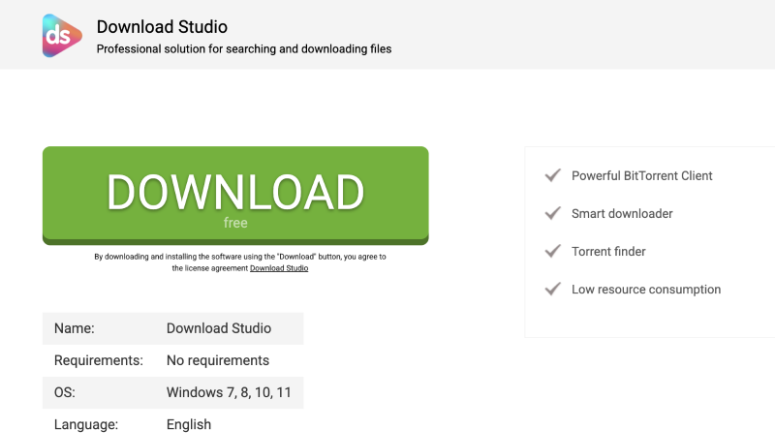
Figure 2: A screenshot of a “Download Studio” endpoint led to on gta6-play[.]ru.

‍

The site advertised a GTA VI download. The site led to a separate “Download Studio” page offering a Windows executable. Analysis found the file was packaged using InstallMate, a commercial installation framework, with an embedded .tsuarch section containing a compressed tiz3 archive.


Further examination identified functionality designed to inspect the environment in which the installer was running. This included checking registry entries for installed software and disk devices, enumerating network adapters, inspecting MAC addresses, and searching for running processes and window titles.


The installer also searched for processes associated with virtualization, debugging, and network analysis, including VMware and VirtualBox components, alongside debugging and monitoring utilities such as OllyDbg, WinDbg, Process Hacker, Process Monitor, Wireshark and Fiddler.

The presence of those checks did not prove that the executable was malicious. The installer contained functionality capable of extracting embedded files, but the investigation did not establish that it was being used to deploy a malicious payload. No definitive malicious payload or command-and-control infrastructure was identified. The software appeared to be InstallRex, which is classified by several security vendors as a potentially unwanted program.

That is still a useful finding; A user looking for GTA VI content could move from an unofficial gaming site to an executable that inspected the local environment, including checking for software commonly used by security researchers.

A second GTA VI lure appeared across twelve organizations

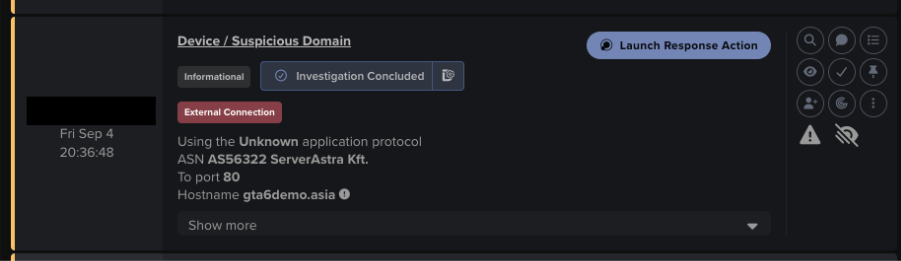
During September 2026, Darktrace alerted on HTTP connections to gta6demo[.]asia across twelve customer environments. Seven of the twelve communicated with infrastructure associated with AS56322 ServerAstra Kft as part of this connectivity.

‍

Figure 3: An example model alert generated due to a suspicious connection to gta6demo[.]asia.

‍

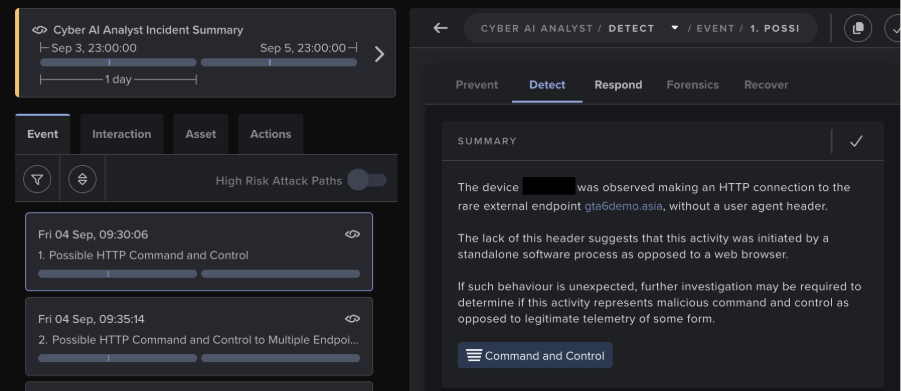
In a case affecting a UK-based customer, Darktrace’s Real-Time AI Analyst further investigated connections to gta6demo[.]asia and generated an incident due to the highly suspicious nature of the behavior.

‍

Figure 4: A Real-Time AI Analyst incident highlighting the suspicious activity for further investigation

‍

Public threat research has associated gta6demo[.]asia with a campaign advertising a fake GTA VI demo. Users clicking "Play Now" were reportedly directed towards an executable containing the Vidar infostealer [2].

There is a practical difference between this activity and an attack against a games company. The users encountering GTA VI-themed infrastructure can work anywhere. Darktrace saw the activity across several sectors outside Gaming, including Finance, Manufacturing, and Public administration and defense.

A major game release can therefore create security exposure well beyond its publisher. A search for a demo or unofficial download on a corporate device is enough to bring gaming-themed infrastructure into an enterprise environment.

Ransomware operators inside the gaming industry

The attacks Darktrace observed against Gaming companies themselves show different patterns.

In August 2026, Darktrace threat research identified possible malicious activity at a European game developer. Ransomware was ultimately deployed and data was exfiltrated, with the DireWolf ransomware group claiming responsibility.

Darktrace observed suspicious file downloads and beaconing from several devices to rare endpoints alongside Monero cryptocurrency mining, Active Directory and network reconnaissance, unusual administrative RDP connections, activity associated with data staging and HTTP-based exfiltration.

Much of the intrusion was therefore visible before ransomware appeared; the environment was already showing evidence of ingress tooling, external command-and-control communications (C2), reconnaissance, unusual administrative access and data movement.

A separate investigation in December 2025 provides a closer view of this pre-ransomware activity. A European games company was targeted by Qilin ransomware with Darktrace observing scanning and LDAP searches involving userAccountControl, which can expose information useful for identifying accounts and Service Principal Names within Active Directory.

New administrative credentials then appeared on a Domain Controller and the Domain Controller also generated scanning, anomalous RPC, SMB, and SSH activity, and NetShareEnum activity through srvsvc. Elsewhere in the environment, long Remote Desktop sessions and SMB enumeration appeared consistent with lateral movement.

Several devices also transferred data to cloud storage services including WebDrive and Amazon Web Services (AWS). In some cases, large downloads preceded subsequent uploads. Darktrace observed the transfer pattern, although the available telemetry does not establish that every transfer represented attacker-controlled exfiltration.

The activity preceding the Qilin deployment included Active Directory reconnaissance, privileged credential use, network and share enumeration, unusual remote access and significant data movement. Each appeared before ransomware became the defining feature of the incident.

SaaS hijacking shifts the attacker evidence

A separate investigation in May 2026 involved the hijacking of a SaaS account at a Gaming organization.

The compromised account authenticated from several IP addresses that were unusual for the organization. It then performed suspicious SaaS group administration, including creating a new privileged account. The account subsequently sent a high volume of emails assessed as likely malicious spam and potentially intended to compromise additional users.

The following day, an administrative SaaS account authenticated from rare endpoints, raising the possibility that further privileged access had been obtained.

The activity presented a different detection problem from the ransomware cases. Authentication from rare infrastructure, administrative changes, creation of a privileged account and subsequent email activity provided the strongest indications that a legitimate identity had been compromised.

For a Gaming company using hosted platforms for development, communication and business operations, a compromised account with the right permissions can provide considerable access without requiring the attacker to reproduce a conventional network intrusion.

Detecting the intrusion before impact

The ransomware investigations show why encryption should not be the first point at which an incident comes into focus. Darktrace observed LDAP and Active Directory-related reconnaissance, new privileged credentials, unusual Domain Controller activity, remote sessions, network enumeration and abnormal data movement before ransomware deployment.

The SaaS case produced different evidence: authentication from rare infrastructure, unexpected administrative changes and activity performed through a compromised account. GTA VI-themed activity required another approach again, following users through unofficial sites and redirects and examining the software offered for download.

GTA VI has put gaming back into the headlines ahead of its November release. The security activity around it is already visible beyond the games industry, while ransomware and account-compromise investigations show attackers operating inside gaming companies through very different routes.

For defenders, those routes leave evidence before the incident reaches its most damaging stage. The practical work is in recognizing those changes early enough to investigate them.

Credit to Gemma Stubberfield (Cyber Analyst), Ahmed Gardezi (Senior Cyber Analyst), Tara Gould (Malware Research Lead), Nathaniel Jones (SVP, Global Threat Intelligence)

References:

1.        https://www.rockstargames.com/VI

2.     https://www.malwarebytes.com/blog/threat-intel/2026/08/fake-gta-6-extended-look-and-demo-sites-deliver-an-infostealer

‍

‍

Continue reading
About the author
Gemma Stubberfield
Cyber Analyst

Blog

/

AI

/

November 17, 2026

How Microsoft and Darktrace Secure the AI-Powered Enterprise

Default blog imageDefault blog image

When legitimate activity creates business risk

AI is making information more accessible and enabling autonomous agents to act across enterprise systems. But legitimate access can still result in sensitive-data exposure, unintended actions, or activity that deviates from business expectations.

Microsoft's evolving security strategy recognizes this shift, emphasizing continuous risk assessment, stronger identity protection, and security that adapts as AI systems operate. For enterprises, the challenge is increasingly about recognizing when trusted activity introduces risk, even when existing controls are functioning as intended.

Where global intelligence meets deep business context

Microsoft brings global threat intelligence and comprehensive security capabilities, helping organizations protect identities, data, applications, and infrastructure. Its integrated approach connects security signals, governance, detection, and response across increasingly complex environments.

Darktrace complements these strengths with deep, organization-specific behavioral understanding. Powered by Adaptive AI, Darktrace continuously learns the patterns and relationships unique to each business, developing a Unique Behavioral Profile for each organization that helps distinguish meaningful threats from legitimate activity. By connecting identity, activity, context, and intent, it adds another dimension to security intelligence.

Together, Microsoft and Darktrace combine global intelligence with deeper knowledge of how each customer operates. Through supported integrations, this behavioral context enriches existing Microsoft security workflows, enabling more informed investigations and precise response.

This complementary approach extends across three interconnected areas of enterprise security- AI, People and Infrastructure. From understanding how AI and agents operate to protecting trusted communications and the infrastructure businesses depend on, Darktrace strengthens Microsoft's security capabilities with behavioral insight specific to each organization.

Understanding AI beyond permissions and policies

As AI moves into business-critical operations, security teams need to understand more than which applications and agents are approved. They need visibility into how AI is used, what information it accesses, and whether its actions remain aligned with business intent.

Microsoft provides extensive AI development, governance, and security capabilities. Darktrace / SECURE AI complements these with behavioral analysis across Shadow AI, prompts, agent identities and actions, and development risk. Policy Manager helps evaluate activity against organizational AI policies, while the announced integration with Microsoft Agent 365 is designed to enrich agent risk assessments with organization-specific behavioral signals. Together, these capabilities help organizations scale AI adoption with greater confidence.

Recognizing risk within trusted relationships

Sophisticated threats increasingly exploit established business relationships, familiar communications, and legitimate accounts. A message from a trusted supplier or an action taken through an authorized identity may appear routine until considered against the organization's normal behavior.

Darktrace / EMAIL complements Microsoft's native email, identity, and data protection capabilities by understanding how people and organizations communicate. This enables more precise detection of targeted phishing, business email compromise, account takeover, and data loss, supported by proportionate response. Integrations such as Unified Quarantine within Microsoft Defender for Office 365 bring this additional protection into existing security workflows.

Seeing the bigger picture behind an attack across domains

Threats rarely unfold within a single security domain. Suspicious identity activity, unexpected cloud connections, and unusual network behavior may appear unrelated until the relationships between them reveal a developing attack.

Darktrace / HYBRID NETWORK complements Microsoft's security capabilities with organization-specific behavioral detection across network, cloud, identity, and operational technology. Real-Time AI Analyst, including Cyber AI Analyst, connects related activity into investigated incidents that can be delivered into Microsoft Sentinel, helping security teams accelerate investigations and support targeted containment across the hybrid enterprise.

Turning security intelligence into business confidence

As AI becomes more deeply integrated into business operations, organizations need security that understands not only what technology can access, but how it behaves within their unique environment.

Microsoft and Darktrace bring complementary strengths to that challenge. By connecting global threat intelligence and integrated security capabilities with deep behavioral understanding, the partnership helps organizations recognize emerging risks, respond with greater precision, and strengthen their existing security investments.

The opportunity is to turn security intelligence into meaningful business context, enabling organizations to innovate and operate AI with confidence.

Darktrace named a 2026 Microsoft Partner of the Year Finalist for ISV Innovation

Darktrace has been named a finalist for the 2026 Microsoft Partner of the Year Award in the ISV Innovation category.  

This recognition reflects our collaboration with Microsoft to bring business context to enterprise security. By connecting Microsoft's global threat intelligence and integrated security capabilities with Darktrace's deep behavioral understanding, we help organizations recognize emerging risks and respond with greater precision across AI, People and Infrastructure.

Thank you to Microsoft, our customers, and our teams for their continued collaboration.

Meet Darktrace at Microsoft Ignite and the Microsoft Frontier Tour

Explore how Darktrace and Microsoft are bringing behavioral security to AI, people, and infrastructure.

Join Darktrace at Microsoft Ignite in San Francisco, November 17–19, or connect with our experts as we join the Microsoft Frontier Tour across 21 cities worldwide.

Meet Darktrace at Microsoft Ignite

Connect with Darktrace at the Microsoft Frontier Tour

[related-resource]

Continue reading
About the author
Your data. Our AI.
Elevate your network security with Darktrace AI