
Blog
/
OT
/
January 15, 2023

Qatar World Cup 2022 Protected by Darktrace AI Cybersecurity

Discover how Darktrace's AI technology safeguarded the Qatar World Cup 2022 from cyber threats. Learn more about cutting-edge cybersecurity measures today!
No items found.
Inside the SOC
Darktrace cyber analysts are world-class experts in threat intelligence, threat hunting and incident response, and provide 24/7 SOC support to thousands of Darktrace customers around the globe. Inside the SOC is exclusively authored by these experts, providing analysis of cyber incidents and threat trends, based on real-world experience in the field.
No items found.
Default blog imageDefault blog imageDefault blog imageDefault blog imageDefault blog imageDefault blog image
15
Jan 2023

Qatar World Cup 2022 was the fifth world cup (football and rugby) I have been closely involved in from the operation and cyber security standpoint. Over the last two decades, I have witnessed a dramatic shift in the cyber landscape.

A few years back, the main challenge was to mitigate technical issues due to failures or human error by increasing the resilience with high-availability and failover design. Today, with the increased complexity of the digital infrastructure underpinning global tournaments, and the sophistication and ferocity of the threat actors (ransomware gangs, hacktivists, APT groups) seeking to disrupt them, it is no surprise that cyber security has been pushed to the top of organizers’ agendas.   

This football World Cup represented a challenge like no other. The tournament introduced the world’s first ‘connected stadium’ concept whereby all eight stadiums were managed by a single unified technology from the state-of-the-art Aspire Command Centre in Doha. 
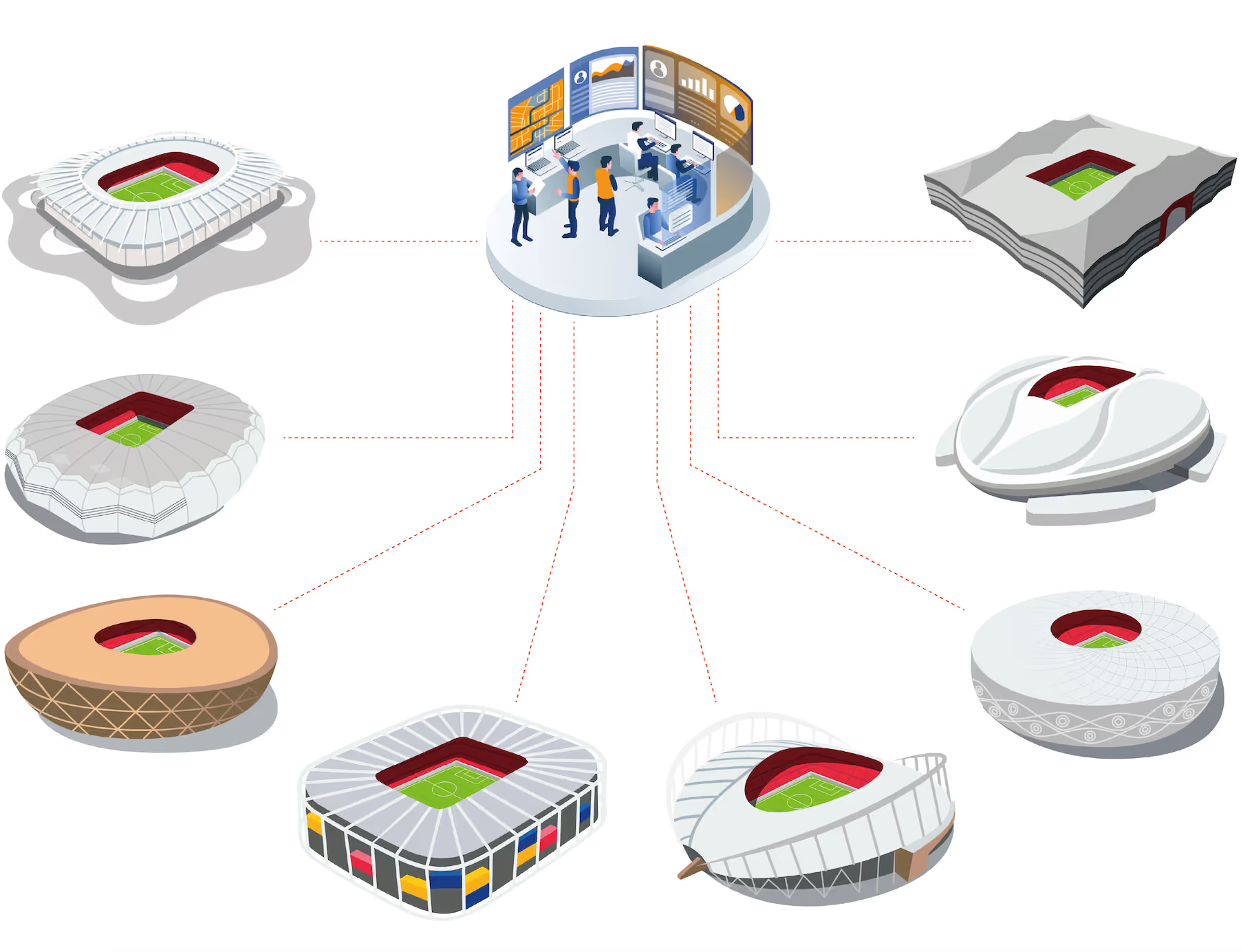
Figure 1: The connected stadium concept visualized

The centre – described as the most sophisticated setup ever seen at a sporting event – managed everything, from the lighting and access gates through to communications and IT. This unified integrated technology ecosystem offers the potential to drastically increase efficiency and gave the ability to seamlessly manage multiple matches at once. Each of the eight stadiums has a ‘digital twin’, allowing the cyber security experts to detect and mitigate issues as and when they arise. 

Figure 2: The Aspire Command Centre

The organizer realized the importance of protecting a digital infrastructure of this scale and complexity from attempted cyber-attacks. A football World Cup draws in a global audience – an estimated 3.75 billion were said to have tuned in for the previous final. It is difficult to overstate the financial and reputational impacts of disruption to any game – whether that be to the turnstiles within the stadium or the broadcast of the game – due to a cyber incident. Hacktivists and other cyber-criminals are acutely aware of the global stage a tournament like this provides and so these events become an obvious target for threats such as Distributed-Denial-of-Service (DDoS) and ransomware attacks.  

Furthermore, the interconnectivity between IT and OT systems means that the line between cyber security and physical safety is significantly blurred. For example, having your access control and CCTV malfunctioning may lead to overcrowding within parts of stadium and leave fans vulnerable to crushes and physical injuries. 

Initially, the World Cup organizer was looking to improve OT visibility. They quickly recognized that Darktrace’s technology could take them a step further than any other solutions on the market. Darktrace AI is uniquely able to monitor and protect their OT and their IT, detect unusual behaviors, and mitigate cyber-threats, and present its findings in a single pane of glass. 

The host country recognized that a best-in-class event needed best-in-class technology. The nature of international events means that timing is critical and puts enormous pressure on the organizers and operators. ‘D-Day’ cannot be replayed or postponed, and so if cyber disruption occurs during the event, every minute is crucial. Darktrace was selected not only because of its unified IT and OT coverage, but because of its ability to detect, investigate, and respond at machine speed.

In the end, Darktrace played a crucial role in protecting the tournament across all eight stadiums throughout the World Cup. Supplementing the value of the AI, our team was on the ground, working alongside the cyber security team to assist with investigations. The teamwork and collaboration were second-to-none and the energy in the Command Centre was palpable when Darktrace was able to spot events of interest that would have otherwise gone under the radar. 

On game day, every second counts, so pairing people with the right technology is critical. Explainable AI really came into its own during the World Cup, rapidly synthesizing information about disparate events, and generating alerts in seconds about emerging threats. That meant the team had the information they needed at their fingertips in an easily-understand format. 

Our AI technology, created in 2013 in our Cambridge AI Research Centre, has disrupted the cyber security industry, and is making a big impact in the real world: from financial services and education through to critical national infrastructure like utilities, energy suppliers, and healthcare. The Qatar World Cup 2022 provided a unique and high-profile challenge. Darktrace didn’t just successfully protect the World Cup against cyber-attackers; it protected the more than 1.4 million people entering the stadiums from physical risk arising from OT attacks.

In all likelihood, you probably watched this year’s World Cup engrossed in the games, without giving much of a thought to cyber security. That’s the funny thing about success in the cyber security world: if all goes well, the average person wouldn’t even know it. 

We are incredibly proud to have helped defend the Qatar World Cup 2022. I would like to congratulate the organizer and all security team members involved for delivering a World Cup free from cyber disruption, allowing fans both on site and the billions watching at home to simply enjoy the action on the pitch. 

Learn more about how Darktrace helped protect the World Cup: Watch the video.

No items found.
Inside the SOC
Darktrace cyber analysts are world-class experts in threat intelligence, threat hunting and incident response, and provide 24/7 SOC support to thousands of Darktrace customers around the globe. Inside the SOC is exclusively authored by these experts, providing analysis of cyber incidents and threat trends, based on real-world experience in the field.
No items found.

More in this series

No items found.

Blog

/

Network

/

March 26, 2026

Phantom Footprints: Tracking GhostSocks Malware

Default blog imageDefault blog image

Why are attackers using residential proxies?

In today's threat landscape, blending in to normal activity is the key to success for attackers and the growing reliance on residential proxies shows a significant shift in how threat actors are attempting to bypass IP detection tools.

The increasing dependency on residential proxies has exposed how prevalent proxy services are and how reliant a diverse range of threat actors are on them. From cybercriminal groups to state‑sponsored actors, the need to bypass IP detection tools is fundamental to the success of these groups. One malware that has quietly become notorious for its ability to avoid anomaly detection is GhostSocks, a malware that turns compromised devices into residential proxies.

What is GhostSocks?

Originally marketed on the Russian underground forum xss[.]is as a Malware‑as‑a‑Service (MaaS), GhostSocks enables threat actors to turn compromised devices into residential proxies, leveraging the victim's internet bandwidth to route malicious traffic through it.

How does Ghostsocks malware work? 

The malware offers the threat actor a “clean” IP address, making it look like it is coming from a household user. This enables the bypassing of geographic restrictions and IP detection tools, a perfect tool for avoiding anomaly detection. It wasn’t until 2024, when a partnership was announced with the infamous information stealer Lumma Stealer, that GhostSocks surged into widespread adoption and alluded to who may be the author of the proxy malware.

Written in GoLang, GhostSocks utilizes the SOCKS5 proxy protocol, creating a SOCKS5 connection on infected devices. It uses a relay‑based C2 implementation, where an intermediary server sits in between the real command-and-control (C2) server and the infected device.

How does Ghostsocks malware evade detection?

To further increase evasion, the Ghostsocks malware wraps its SOCKS5 tunnels in TLS encryption, allowing its malicious traffic to blend into normal network traffic.

Early variants of GhostSocks do not implement a persistence mechanism; however, later versions achieve persistence via registry run keys, ensuring sustained proxy operational time [1].

While proxying is its primary purpose, GhostSocks also incorporates backdoor functionality, enabling malicious actors to run arbitrary commands and download and deploy additional malicious payloads. This was evident with the well‑known ransomware group Black Basta, which reportedly used GhostSocks as a way of maintaining long‑term access to victims’ networks [1].

Darktrace’s detection of GhostSocks Malware

Darktrace observed a steady increase in GhostSocks activity across its customer base from late 2025, with its Threat Research team identifying multiple incidents involving the malware. In one notable case from December 2025, Darktrace detected GhostSocks operating alongside Lumma Stealer, reinforcing that the partnership between Lumma and GhostSocks remains active despite recent attempts to disrupt Lumma’s infrastructure.

Darktrace’s first detection of GhostSocks‑related activity came when a device on the network of a customer in the education sector began making connections to an endpoint with a suspicious self‑signed certificate that had never been seen on the network before.

The endpoint in question, 159.89.46[.]92 with the hostname retreaw[.]click, has been flagged by multiple open‑source intelligence (OSINT) sources as being associated with Lumma Stealer’s C2 infrastructure [2], indicating its likely role in the delivery of malicious payloads.

Darktrace’s detection of suspicious SSL connections to retreaw[.]click, indicating an attempted link to Lumma C2 infrastructure.
Figure 1: Darktrace’s detection of suspicious SSL connections to retreaw[.]click, indicating an attempted link to Lumma C2 infrastructure.

Less than two minutes later, Darktrace observed the same device downloading the executable (.exe) file “Renewable.exe” from the IP 86.54.24[.]29, which Darktrace recognized as 100% rare for this network.

Darktrace’s detection of a device downloading the unusual executable file “Renewable.exe”.
Figure 2: Darktrace’s detection of a device downloading the unusual executable file “Renewable.exe”.

Both the file MD5 hash and the executable itself have been identified by multiple OSINT vendors as being associated with the GhostSocks malware [3], with the executable likely the backdoor component of the GhostSocks malware, facilitating the distribution of additional malicious payloads [4].

Following this detection, Darktrace’s Autonomous Response capability recommended a blocking action for the device in an early attempt to stop the malicious file download. In this instance, Darktrace was configured in Human Confirmation Mode, meaning the customer’s security team was required to manually apply any mitigative response actions. Had Autonomous Response been fully enabled at the time of the attack, the connections to 86.54.24[.]29 would have been blocked, rendering the malware ineffective at reaching its C2 infrastructure and halting any further malicious communication.

 Darktrace’s Autonomous Response capability suggesting blocking the suspicious connections to the unusual endpoint from which the malicious executable was downloaded.
Figure 3: Darktrace’s Autonomous Response capability suggesting blocking the suspicious connections to the unusual endpoint from which the malicious executable was downloaded.

As the attack was able to progress, two days later the device was detected downloading additional payloads from the endpoint www.lbfs[.]site (23.106.58[.]48), including “Setup.exe”, “,.exe”, and “/vp6c63yoz.exe”.

Darktrace’s detection of a malicious payload being downloaded from the endpoint www.lbfs[.]site.
Figure 4: Darktrace’s detection of a malicious payload being downloaded from the endpoint www.lbfs[.]site.

Once again, Darktrace recognized the anomalous nature of these downloads and suggested that a “group pattern of life” be enforced on the offending device in an attempt to contain the activity. By enforcing a pattern of life on a device, Darktrace restricts its activity to connections and behaviors similar to those performed by peer devices within the same group, while still allowing it to carry out its expected activity, effectively preventing deviations indicative of compromise while minimizing disruption. As mentioned earlier, these mitigative actions required manual implementation, so the activity was able to continue. Darktrace proceeded to suggest further actions to contain subsequent malicious downloads, including an attempt to block all outbound traffic to stop the attack from progressing.

An overview of download activity and the Autonomous Response actions recommended by Darktrace to block the downloads.
Figure 5: An overview of download activity and the Autonomous Response actions recommended by Darktrace to block the downloads.

Around the same time, a third executable download was detected, this time from the hostname hxxp[://]d2ihv8ymzp14lr.cloudfront.net/2021-08-19/udppump[.]exe, along with the file “udppump.exe”.While GhostSocks may have been present only to facilitate the delivery of additional payloads, there is no indication that these CloudFront endpoints or files are functionally linked to GhostSocks. Rather, the evidence points to broader malicious file‑download activity.

Shortly after the multiple executable files had been downloaded, Darktrace observed the device initiating a series of repeated successful connections to several rare external endpoints, behavior consistent with early-stage C2 beaconing activity.

Cyber AI Analyst’s investigation

Darktrace’s detection of additional malicious file downloads from malicious CloudFront endpoints.
Figure 7: Darktrace’s detection of additional malicious file downloads from malicious CloudFront endpoints.

Throughout the course of this attack, Darktrace’s Cyber AI Analyst carried out its own autonomous investigation, piecing together seemingly separate events into one wider incident encompassing the first suspicious downloads beginning on December 4, the unusual connectivity to many suspicious IPs that followed, and the successful beaconing activity observed two days later. By analyzing these events in real-time and viewing them as part of the bigger picture, Cyber AI Analyst was able to construct an in‑depth breakdown of the attack to aid the customer’s investigation and remediation efforts.

Cyber AI Analyst investigation detailing the sequence of events on the compromised device, highlighting its extensive connectivity to rare endpoints, the related malicious file‑download activity, and finally the emergence of C2 beaconing behavior.
Figure 8: Cyber AI Analyst investigation detailing the sequence of events on the compromised device, highlighting its extensive connectivity to rare endpoints, the related malicious file‑download activity, and finally the emergence of C2 beaconing behavior.

Conclusion

The versatility offered by GhostSocks is far from new, but its ability to convert compromised devices into residential proxy nodes, while enabling long‑term, covert network access—illustrates how threat actors continue to maximise the value of their victims’ infrastructure. Its growing popularity, coupled with its ongoing partnership with Lumma, demonstrates that infrastructure takedowns alone are insufficient; as long as threat actors remain committed to maintaining anonymity and can rapidly rebuild their ecosystems, related malware activity is likely to persist in some form.

Credit to Isabel Evans (Cyber Analyst), Gernice Lee (Associate Principal Analyst & Regional Consultancy Lead – APJ)
Edited by Ryan Traill (Content Manager)

Appendices

References

1.    https://bloo.io/research/malware/ghostsocks

2.    https://www.virustotal.com/gui/domain/retreaw.click/community

3.    https://synthient.com/blog/ghostsocks-from-initial-access-to-residential-proxy

4.    https://www.joesandbox.com/analysis/1810568/0/html

5. https://www.virustotal.com/gui/url/fab6525bf6e77249b74736cb74501a9491109dc7950688b3ae898354eb920413

Darktrace Model Detections

Real-time Detection Models

Anomalous Connection / Suspicious Self-Signed SSL

Anomalous Connection / Rare External SSL Self-Signed

Anomalous File / EXE from Rare External Location

Anomalous File / Multiple EXE from Rare External Locations

Compromise / Possible Fast Flux C2 Activity

Compromise / Large Number of Suspicious Successful Connections

Compromise / Large Number of Suspicious Failed Connections

Compromise / Sustained SSL or HTTP Increase

Autonomous Response Models

Antigena / Network / Significant Anomaly / Antigena Significant Anomaly from Client Block

Antigena / Network / External Threat / Antigena Suspicious File Block

Antigena / Network / Significant Anomaly / Antigena Controlled and Model Alert

Antigena / Network / External Threat / Antigena File then New Outbound Block

Antigena / Network / Significant Anomaly / Antigena Alerts Over Time Block

Antigena / Network / External Threat / Antigena Suspicious Activity Block

MITRE ATT&CK Mapping

Tactic – Technique – Sub-Technique

Resource Development – T1588 - Malware

Initial Access - T1189 - Drive-by Compromise

Persistence – T1112 – Modify Registry

Command and Control – T1071 – Application Layer Protocol

Command and Control – T1095 – Non-application Layer Protocol

Command and Control – T1071 – Web Protocols

Command and Control – T1571 – Non-Standard Port

Command and Control – T1102 – One-Way Communication

List of Indicators of Compromise (IoCs)

86.54.24[.]29 - IP - Likely GhostSocks C2

http[://]86.54.24[.]29/Renewable[.]exe - Hostname - GhostSocks Distribution Endpoint

http[://]d2ihv8ymzp14lr.cloudfront[.]net/2021-08-19/udppump[.]exe - CDN - Payload Distribution Endpoint

www.lbfs[.]site - Hostname - Likely C2 Endpoint

retreaw[.]click - Hostname - Lumma C2 Endpoint

alltipi[.]com - Hostname - Possible C2 Endpoint

w2.bruggebogeyed[.]site - Hostname - Possible C2 Endpoint

9b90c62299d4bed2e0752e2e1fc777ac50308534 - SHA1 file hash – Likely GhostSocks payload

3d9d7a7905e46a3e39a45405cb010c1baa735f9e - SHA1 file hash - Likely follow-up payload

10f928e00a1ed0181992a1e4771673566a02f4e3 - SHA1 file hash - Likely follow-up payload

Continue reading
About the author
Gernice Lee
Associate Principal Analyst & Regional Consultancy Lead

Blog

/

Email

/

March 24, 2026

Darktrace Unites Human Behavior and Threat Detection Across Email, Slack, Teams, and Zoom

Photo of office workers collaborating at a laptopDefault blog imageDefault blog image

The communication attack surface is expanding

Modern attackers no longer focus solely on inboxes, they target people and the productivity systems where work actually happens. Meanwhile, the boundary between internal and external usage of tools is becoming blurrier everyday – turning the entire workplace into the attack surface. In 2025, identity compromise emerged as the single most consistent threat across the global threat landscape, as observed by Darktrace research across our entire customer base. Over 70% of incidents in the US involved SaaS/M365 account compromise and phishing or email-based social engineering, making credential abuse the single most effective initial access vector.

Despite this upward trend, investment in existing security awareness training (SAT) isn’t moving the needle on reducing risk. 84% of organizations still measure success through completion rates1, even though completion of standard training correlates with less than 2% real improvement in risky behavior.2 By prioritizing completion, organizations reward time spent rather than meaningful engagement, yet time in training doesn’t translate to retention or real-world decision-making. This compliance-first approach has left the workforce unprepared for the threats they actually face.

At the same time, attacks have evolved. Highly personalized, AI-generated campaigns now move fluidly across email, Slack, Teams, Zoom, and beyond, blending channels and even targeting systems directly through techniques like prompt injection. This new reality demands a different approach: one that treats people and the tools they use as a single ecosystem, where behavior and detection continuously inform and strengthen each other.

Only an adaptive communication security system can keep pace with the speed, creativity, and cross channel nature of today’s threats. 

Ushering in the adaptive era of workplace security

With this release, Darktrace brings together our new behavior-driven training solution with email detection, cross-channel visibility, and platform-level insights. Powered by Self-Learning AI, it delivers protection across both people and the communication tools they rely on every day, including email, Slack, Teams, and Zoom.

Each component learns from the others – training adapts to real user behavior, detection evolves across channels, and response is continuously refined – creating a powerful feedback loop that strengthens resilience and improves accuracy against today’s AI-driven threats.

Introducing: Unified training and email security for a self-improving email defense

Our brand new product, Darktrace / Adaptive Human Defense, closes the gap between human behavior and email security to continuously strengthen both people and defenses. Each user receives personalized training that adapts to their own inbox activity and skill level, with learning delivered directly within the flow of their day-to-day email interactions.

By learning from each user’s interactions with security training, it adapts security responses, creating a closed-loop system where training reinforces detection and detection informs training. Let’s look at some of the benefits.

  • Reduce successful phishing at the source with contextual Just in Time coaching: Contextual coaching appears directly in real email threads the moment risky behavior is detected, so habits change where mistakes actually happen. Configurable triggers and group policies target the right users, reducing repeated errors and administrative overhead.
  • Adaptive phishing simulations that progress automatically with each user: Embedded simulations vary in their degree of realism, from generic phishing to generative AI-enabled spear phishing. Users progress through the difficulty levels based on their performance to give an accurate picture of their phishing preparedness.  
  • Native email security integration turns human behavior into quantified risk: The native email security integration allows engagement, links clicked, and question success signals to flow back into / EMAIL recipes and models, so detection and response adapt automatically as users learn.  
  • Actionable risk and trend analytics beyond completion rates: Analytics that surface repeat offenders, high-value targets, and measurable exposure, moving beyond completion metrics to give leaders actionable insights tied to real behavior.

Learn more about / Adaptive Human Defense in the product solution brief.

Industry-first cross-channel full-message analysis for email, Slack, Teams, and Zoom

Darktrace now brings full-message analysis to Email, Slack, Teams, Zoom, and even generative AI prompts. The same leading behavioral analysis from EMAIL extends to every message, tracing intent, tone, relationships, and conversation flow across all communication activity for a complete understanding of every user interaction.

By correlating messaging and collaboration activity with email and account environments, cross-channel analysis reveals multi-domain attack paths and follows both users and threats as a single, continuous narrative – delivering better context to improve detection across the entire organization.

  • Eliminate cross-channel blind spots: Detect phishing, malware, account takeovers, and conversational manipulation across email and collaboration platforms, so attackers can’t exploit Slack, Teams, or Zoom as a new entry point. Unified behavioral analysis gives security teams a coherent, single view, for no more fragmented, channel-specific gaps.
  • Spot generative AI prompt injection attacks before they manipulate assistants: Dedicated models surface threats targeting corporate AI assistants – like ShadowLeak and Hashjack – before they can silently manipulate workflows, reducing risk before static filters catch up.

Learn more about Darktrace’s messaging security offering in the product solution brief.

Industry-first DMARC with bi-directional ASM and email security integration

Darktrace transforms domain protection by linking DMARC, attack surface intelligence, and email security into a single, continuously evolving workflow. Instead of treating domain authentication and exposure as separate tasks, this unified approach shows not just where domains are vulnerable, but how attackers are actively exploiting them.

  • Fix authentication weaknesses faster: SPF, DKIM, DMARC configurations, and external exposure data are analyzed together, giving teams clear guidance to correct weaknesses before they can be abused. Deep bidirectional integration with attack surface intelligence reduces impersonation risk at the source.
  • Accelerate email investigations: DMARC context is embedded directly into email workflows, enriching triage with authentication posture, internal/external sender lists, and seamless pivots between email and domain intelligence for faster, more accurate investigations.

Committed to innovation

These updates are part of a broader Darktrace release, which also includes:

Join our Live Launch Event on April 14, 2026.

Join us for an exclusive announcement event where Darktrace, the leader in AI-native cybersecurity, will be announcing our latest innovations, including  a demo of our new product / Adaptive Human Defense, an exclusive conversation with a Darktrace customer, and a deep dive into the Darktrace ActiveAI Security Portal.  

Register here.

References

[1] 84% of organizations still measure security awareness training success through completion rates, a vanity metric with no correlation to behavior change. (Source:  NIST Awareness Effectiveness Study, Forrester 2025)

[2] 'Limited benefit from embedded phishing training. Using randomized controlled trials and statistical modeling, embedded training provides a statistically-significant reduction in average failure rate, but of only 2%.' Ho, G., Mirian, A., Luo, E., Tong, K., Lee, E., Liu, L., Longhurst, C. A., Dameff, C., Savage, S., & Voelker, G. M. (2025). Understanding the Efficacy of Phishing Training in Practice. Proceedings of the 2025 IEEE Symposium on Security and Privacy.

Continue reading
About the author
Carlos Gray
Senior Product Marketing Manager, Email
Your data. Our AI.
Elevate your network security with Darktrace AI