
ブログ
/
OT
/
January 15, 2023

Qatar World Cup 2022 Protected by Darktrace AI Cybersecurity

Discover how Darktrace's AI technology safeguarded the Qatar World Cup 2022 from cyber threats. Learn more about cutting-edge cybersecurity measures today!
No items found.
Inside the SOC
Darktrace cyber analysts are world-class experts in threat intelligence, threat hunting and incident response, and provide 24/7 SOC support to thousands of Darktrace customers around the globe. Inside the SOC is exclusively authored by these experts, providing analysis of cyber incidents and threat trends, based on real-world experience in the field.
No items found.
Default blog imageDefault blog imageDefault blog imageDefault blog imageDefault blog imageDefault blog image
15
Jan 2023

Qatar World Cup 2022 was the fifth world cup (football and rugby) I have been closely involved in from the operation and cyber security standpoint. Over the last two decades, I have witnessed a dramatic shift in the cyber landscape.

A few years back, the main challenge was to mitigate technical issues due to failures or human error by increasing the resilience with high-availability and failover design. Today, with the increased complexity of the digital infrastructure underpinning global tournaments, and the sophistication and ferocity of the threat actors (ransomware gangs, hacktivists, APT groups) seeking to disrupt them, it is no surprise that cyber security has been pushed to the top of organizers’ agendas.   

This football World Cup represented a challenge like no other. The tournament introduced the world’s first ‘connected stadium’ concept whereby all eight stadiums were managed by a single unified technology from the state-of-the-art Aspire Command Centre in Doha. 
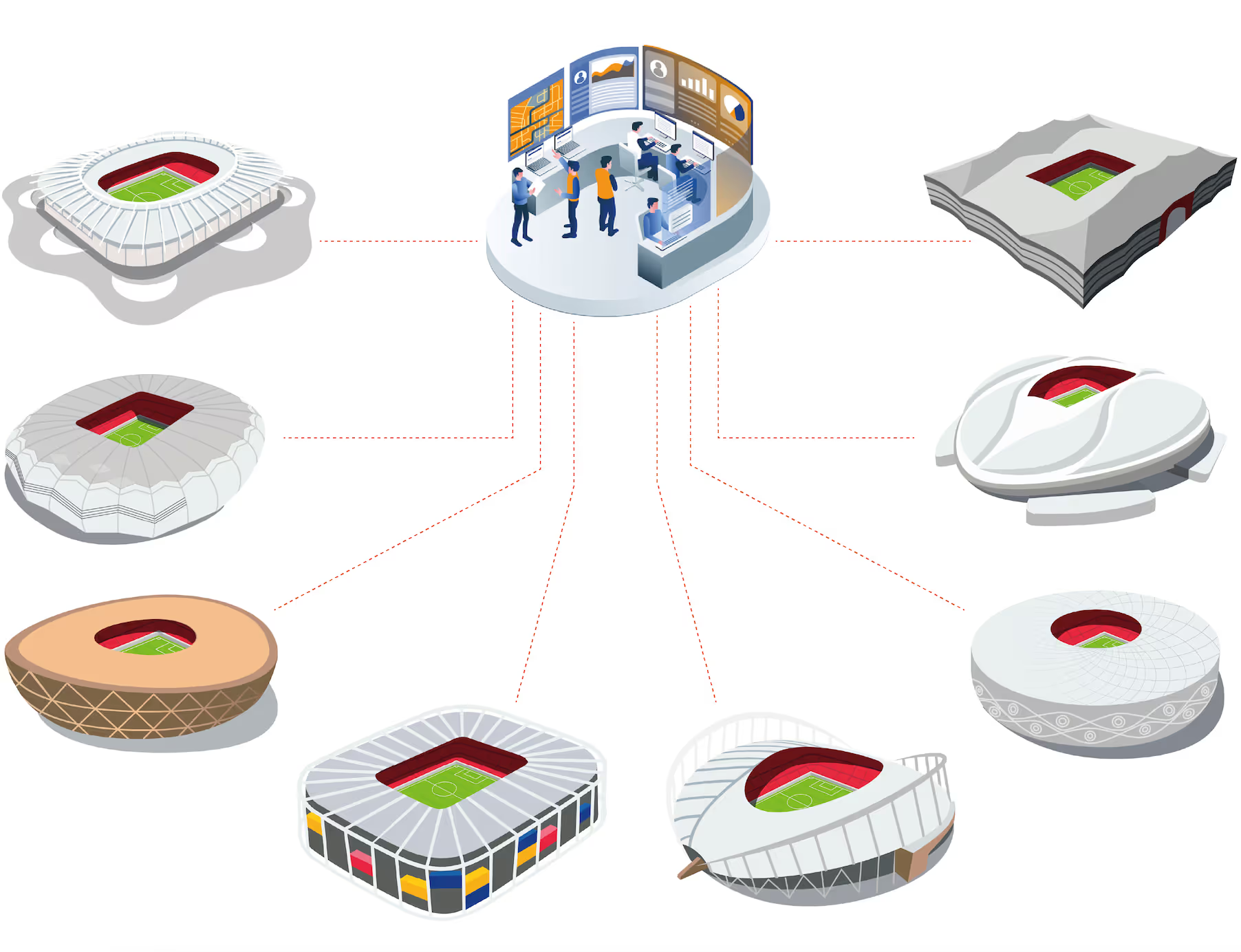
Figure 1: The connected stadium concept visualized

The centre – described as the most sophisticated setup ever seen at a sporting event – managed everything, from the lighting and access gates through to communications and IT. This unified integrated technology ecosystem offers the potential to drastically increase efficiency and gave the ability to seamlessly manage multiple matches at once. Each of the eight stadiums has a ‘digital twin’, allowing the cyber security experts to detect and mitigate issues as and when they arise. 

Figure 2: The Aspire Command Centre

The organizer realized the importance of protecting a digital infrastructure of this scale and complexity from attempted cyber-attacks. A football World Cup draws in a global audience – an estimated 3.75 billion were said to have tuned in for the previous final. It is difficult to overstate the financial and reputational impacts of disruption to any game – whether that be to the turnstiles within the stadium or the broadcast of the game – due to a cyber incident. Hacktivists and other cyber-criminals are acutely aware of the global stage a tournament like this provides and so these events become an obvious target for threats such as Distributed-Denial-of-Service (DDoS) and ransomware attacks.  

Furthermore, the interconnectivity between IT and OT systems means that the line between cyber security and physical safety is significantly blurred. For example, having your access control and CCTV malfunctioning may lead to overcrowding within parts of stadium and leave fans vulnerable to crushes and physical injuries. 

Initially, the World Cup organizer was looking to improve OT visibility. They quickly recognized that Darktrace’s technology could take them a step further than any other solutions on the market. Darktrace AI is uniquely able to monitor and protect their OT and their IT, detect unusual behaviors, and mitigate cyber-threats, and present its findings in a single pane of glass. 

The host country recognized that a best-in-class event needed best-in-class technology. The nature of international events means that timing is critical and puts enormous pressure on the organizers and operators. ‘D-Day’ cannot be replayed or postponed, and so if cyber disruption occurs during the event, every minute is crucial. Darktrace was selected not only because of its unified IT and OT coverage, but because of its ability to detect, investigate, and respond at machine speed.

In the end, Darktrace played a crucial role in protecting the tournament across all eight stadiums throughout the World Cup. Supplementing the value of the AI, our team was on the ground, working alongside the cyber security team to assist with investigations. The teamwork and collaboration were second-to-none and the energy in the Command Centre was palpable when Darktrace was able to spot events of interest that would have otherwise gone under the radar. 

On game day, every second counts, so pairing people with the right technology is critical. Explainable AI really came into its own during the World Cup, rapidly synthesizing information about disparate events, and generating alerts in seconds about emerging threats. That meant the team had the information they needed at their fingertips in an easily-understand format. 

Our AI technology, created in 2013 in our Cambridge AI Research Centre, has disrupted the cyber security industry, and is making a big impact in the real world: from financial services and education through to critical national infrastructure like utilities, energy suppliers, and healthcare. The Qatar World Cup 2022 provided a unique and high-profile challenge. Darktrace didn’t just successfully protect the World Cup against cyber-attackers; it protected the more than 1.4 million people entering the stadiums from physical risk arising from OT attacks.

In all likelihood, you probably watched this year’s World Cup engrossed in the games, without giving much of a thought to cyber security. That’s the funny thing about success in the cyber security world: if all goes well, the average person wouldn’t even know it. 

We are incredibly proud to have helped defend the Qatar World Cup 2022. I would like to congratulate the organizer and all security team members involved for delivering a World Cup free from cyber disruption, allowing fans both on site and the billions watching at home to simply enjoy the action on the pitch. 

Learn more about how Darktrace helped protect the World Cup: Watch the video.

No items found.
Inside the SOC
Darktrace cyber analysts are world-class experts in threat intelligence, threat hunting and incident response, and provide 24/7 SOC support to thousands of Darktrace customers around the globe. Inside the SOC is exclusively authored by these experts, providing analysis of cyber incidents and threat trends, based on real-world experience in the field.
No items found.

More in this series

No items found.

Blog

/

Cloud

/

March 5, 2026

Inside Cloud Compromise: Investigating Attacker Activity with Darktrace / Forensic Acquisition & Investigation

Default blog imageDefault blog image

Investigating Cloud Attacks with Forensic Acquisition & Investigation

Darktrace / Forensic Acquisition & Investigation™ is the industry’s first truly automated forensic solution purpose-built for the cloud. This blog will demonstrate how an investigation can be carried out against a compromised cloud server in minutes, rather than hours or days.

The compromised server investigated in this case originates from Darktrace’s Cloudypots system, a global honeypot network designed to observe adversary activity in real time across a wide range of cloud services. Whenever an attacker successfully compromises one of these honeypots, a forensic copy of the virtual server's disk is preserved for later analysis. Using Forensic Acquisition & Investigation, analysts can then investigate further and obtain detailed insights into the compromise including complete attacker timelines and root cause analysis.

Forensic Acquisition & Investigation supports importing artifacts from a variety of sources, including EC2 instances, ECS, S3 buckets, and more. The Cloudypots system produces a raw disk image whenever an attack is detected and stores it in an S3 bucket. This allows the image to be directly imported into Forensic Acquisition & Investigation using the S3 bucket import option.

As Forensic Acquisition & Investigation runs cloud-natively, no additional configuration is required to add a specific S3 bucket. Analysts can browse and acquire forensic assets from any bucket that the configured IAM role is permitted to access. Operators can also add additional IAM credentials, including those from other cloud providers, to extend access across multiple cloud accounts and environments.

Figure 1: Forensic Acquisition & Investigation import screen.

Forensic Acquisition & Investigation then retrieves a copy of the file and automatically begins running the analysis pipeline on the artifact. This pipeline performs a full forensic analysis of the disk and builds a timeline of the activity that took place on the compromised asset. By leveraging Forensic Acquisition & Investigation’s cloud-native analysis system, this process condenses hour of manual work into just minutes.

Successful import of a forensic artifact and initiation of the analysis pipeline.
Figure 2: Successful import of a forensic artifact and initiation of the analysis pipeline.

Once processing is complete, the preserved artifact is visible in the Evidence tab, along with a summary of key information obtained during analysis, such as the compromised asset’s hostname, operating system, cloud provider, and key event count.

The Evidence overview showing the acquired disk image.
Figure 3: The Evidence overview showing the acquired disk image.

Clicking on the “Key events” field in the listing opens the timeline view, automatically filtered to show system- generated alarms.

The timeline provides a chronological record of every event that occurred on the system, derived from multiple sources, including:

  • Parsed log files such as the systemd journal, audit logs, application specific logs, and others.
  • Parsed history files such as .bash_history, allowing executed commands to be shown on the timeline.
  • File-specific events, such as files being created, accessed, modified, or executables being run, etc.

This approach allows timestamped information and events from multiple sources to be aggregated and parsed into a single, concise view, greatly simplifying the data review process.

Alarms are created for specific timeline events that match either a built-in system rule, curated by Darktrace’s Threat Research team or an operator-defined created at the project level. These alarms help quickly filter out noise and highlight on events of interest, such as the creation of a file containing known malware, access to sensitive files like Amazon Web Service (AWS) credentials, suspicious arguments or commands, and more.

 The timeline view filtered to alarm_severity: “1” OR alarm_severity: “3”, showing only events that matched an alarm rule.
Figure 4: The timeline view filtered to alarm_severity: “1” OR alarm_severity: “3”, showing only events that matched an alarm rule.

In this case, several alarms were generated for suspicious Base64 arguments being passed to Selenium. Examining the event data, it appears the attacker spawned a Selenium Grid session with the following payload:

"request.payload": "[Capabilities {browserName: chrome, goog:chromeOptions: {args: [-cimport base64;exec(base64...], binary: /usr/bin/python3, extensions: []}, pageLoadStrategy: normal}]"

This is a common attack vector for Selenium Grid. The chromeOptions object is intended to specify arguments for how Google Chrome should be launched; however, in this case the attacker has abused the binary field to execute the Python3 binary instead of Chrome. Combined with the option to specify command-line arguments, the attacker can use Python3’s -c option to execute arbitrary Python code, in this instance, decoding and executing a Base64 payload.

Selenium’s logs truncate the Arguments field automatically, so an alternate method is required to retrieve the full payload. To do this, the search bar can be used to find all events that occurred around the same time as this flagged event.

Pivoting off the previous event by filtering the timeline to events within the same window using timestamp: [“2026-02-18T09:09:00Z” TO “2026-02-18T09:12:00Z”].
Figure 5: Pivoting off the previous event by filtering the timeline to events within the same window using timestamp: [“2026-02-18T09:09:00Z” TO “2026-02-18T09:12:00Z”].

Scrolling through the search results, an entry from Java’s systemd journal can be identified. This log contains the full, unaltered payload. GCHQ’s CyberChef can then be used to decode the Base64 data into the attacker’s script, which will ultimately be executed.[NJ9]

Continue reading
About the author
Nathaniel Bill
Malware Research Engineer

Blog

/

Network

/

February 19, 2026

CVE-2026-1731: How Darktrace Sees the BeyondTrust Exploitation Wave Unfolding

Default blog imageDefault blog image

Note: Darktrace's Threat Research team is publishing now to help defenders. We will continue updating this blog as our investigations unfold.

Background

On February 6, 2026, the Identity & Access Management solution BeyondTrust announced patches for a vulnerability, CVE-2026-1731, which enables unauthenticated remote code execution using specially crafted requests.  This vulnerability affects BeyondTrust Remote Support (RS) and particular older versions of Privileged Remote Access (PRA) [1].

A Proof of Concept (PoC) exploit for this vulnerability was released publicly on February 10, and open-source intelligence (OSINT) reported exploitation attempts within 24 hours [2].

Previous intrusions against Beyond Trust technology have been cited as being affiliated with nation-state attacks, including a 2024 breach targeting the U.S. Treasury Department. This incident led to subsequent emergency directives from  the Cybersecurity and Infrastructure Security Agency (CISA) and later showed attackers had chained previously unknown vulnerabilities to achieve their goals [3].

Additionally, there appears to be infrastructure overlap with React2Shell mass exploitation previously observed by Darktrace, with command-and-control (C2) domain  avg.domaininfo[.]top seen in potential post-exploitation activity for BeyondTrust, as well as in a React2Shell exploitation case involving possible EtherRAT deployment.

Darktrace Detections

Darktrace’s Threat Research team has identified highly anomalous activity across several customers that may relate to exploitation of BeyondTrust since February 10, 2026. Observed activities include:

Outbound connections and DNS requests for endpoints associated with Out-of-Band Application Security Testing; these services are commonly abused by threat actors for exploit validation.  Associated Darktrace models include:

  • Compromise / Possible Tunnelling to Bin Services

Suspicious executable file downloads. Associated Darktrace models include:

  • Anomalous File / EXE from Rare External Location

Outbound beaconing to rare domains. Associated Darktrace models include:

  • Compromise / Agent Beacon (Medium Period)
  • Compromise / Agent Beacon (Long Period)
  • Compromise / Sustained TCP Beaconing Activity To Rare Endpoint
  • Compromise / Beacon to Young Endpoint
  • Anomalous Server Activity / Rare External from Server
  • Compromise / SSL Beaconing to Rare Destination

Unusual cryptocurrency mining activity. Associated Darktrace models include:

  • Compromise / Monero Mining
  • Compromise / High Priority Crypto Currency Mining

And model alerts for:

  • Compromise / Rare Domain Pointing to Internal IP

IT Defenders: As part of best practices, we highly recommend employing an automated containment solution in your environment. For Darktrace customers, please ensure that Autonomous Response is configured correctly. More guidance regarding this activity and suggested actions can be found in the Darktrace Customer Portal.  

Appendices

Potential indicators of post-exploitation behavior:

·      217.76.57[.]78 – IP address - Likely C2 server

·      hXXp://217.76.57[.]78:8009/index.js - URL -  Likely payload

·      b6a15e1f2f3e1f651a5ad4a18ce39d411d385ac7  - SHA1 - Likely payload

·      195.154.119[.]194 – IP address – Likely C2 server

·      hXXp://195.154.119[.]194/index.js - URL – Likely payload

·      avg.domaininfo[.]top – Hostname – Likely C2 server

·      104.234.174[.]5 – IP address - Possible C2 server

·      35da45aeca4701764eb49185b11ef23432f7162a – SHA1 – Possible payload

·      hXXp://134.122.13[.]34:8979/c - URL – Possible payload

·      134.122.13[.]34 – IP address – Possible C2 server

·      28df16894a6732919c650cc5a3de94e434a81d80 - SHA1 - Possible payload

References:

1.        https://nvd.nist.gov/vuln/detail/CVE-2026-1731

2.        https://www.securityweek.com/beyondtrust-vulnerability-targeted-by-hackers-within-24-hours-of-poc-release/

3.        https://www.rapid7.com/blog/post/etr-cve-2026-1731-critical-unauthenticated-remote-code-execution-rce-beyondtrust-remote-support-rs-privileged-remote-access-pra/

Continue reading
About the author
Emma Foulger
Global Threat Research Operations Lead
あなたのデータ × DarktraceのAI
唯一無二のDarktrace AIで、ネットワークセキュリティを次の次元へ