Blog
/
/
March 4, 2019

The VR Goldilocks Problem and Value of Continued Recognition

Security and Operations Teams face challenges when it comes to visibility and recognition. Learn more about how we find a solution to the problems!
Inside the SOC
Darktrace cyber analysts are world-class experts in threat intelligence, threat hunting and incident response, and provide 24/7 SOC support to thousands of Darktrace customers around the globe. Inside the SOC is exclusively authored by these experts, providing analysis of cyber incidents and threat trends, based on real-world experience in the field.
Written by
Max Heinemeyer
Global Field CISO
Default blog imageDefault blog imageDefault blog imageDefault blog imageDefault blog imageDefault blog image
04
Mar 2019

First, some context about VR

Security Operations teams face two fundamental challenges when it comes to 'finding bad'.

The first is gaining and maintaining appropriate visibility into what is happening in our environments. Visibility is provided through data (e.g. telemetry, logs). The trinity of data sources for visibility concern accounts/credentials, devices, and network traffic.

The second challenge is getting good recognition within the scope of what is visible. Recognition is fundamentally about what alerting and workflows you can implement and automate in response to activity that is suspicious or malicious.

Visibility and Recognition each have their own different associated issues.

Visibility is a problem about what is and can be generated and either read as telemetry, or logged and stored locally, or shipped to a central platform. The timelines and completeness of what visibility you have can depend on factors such as how much data you can or can't store locally on devices that generate data - and for how long; what your data pipeline and data platform look like (e.g. if you are trying to centralise data for analysis); or the capability of host software agents you have to process certain information locally.

The constraints on visibility sets the bar for factors like coverage, timelines and completeness of what recognition you can achieve. Without visibility, we cannot recognize at all. With limited visibility, what we can recognize may not have much value. With the right visibility, we can still fail to recognise the right things. And with too much recognition, we can quickly overload our senses.

A good example of a technology that offers the opportunity to solve these challenges at the network layer is Darktrace. Their technology provides visibility, from a network traffic perspective, into data that concerns devices and the accounts/credentials associated with them. They then provide recognition on top of this by using Machine Learning (ML) models for anomaly detection. Their models alert on a wide range of activities that may be indicative of threat activity, (e.g. malware execution and command and control, a technical exploit, data exfiltration and so on).

The major advantage they provide, compared to traditional Intrusion Detection Systems (IDS) and other vendors who also use ML for network anomaly detection, is that you can a) adjust the sensitivity of their algorithms and b) build your own recognition for particular patterns of interest. For example, if you want to monitor what connections are made to one or two servers, you can set up alerts for any change to expected patterns. This means you can create and adjust custom recognition based on your enterprise context and tune it easily in response to how context changes over time.

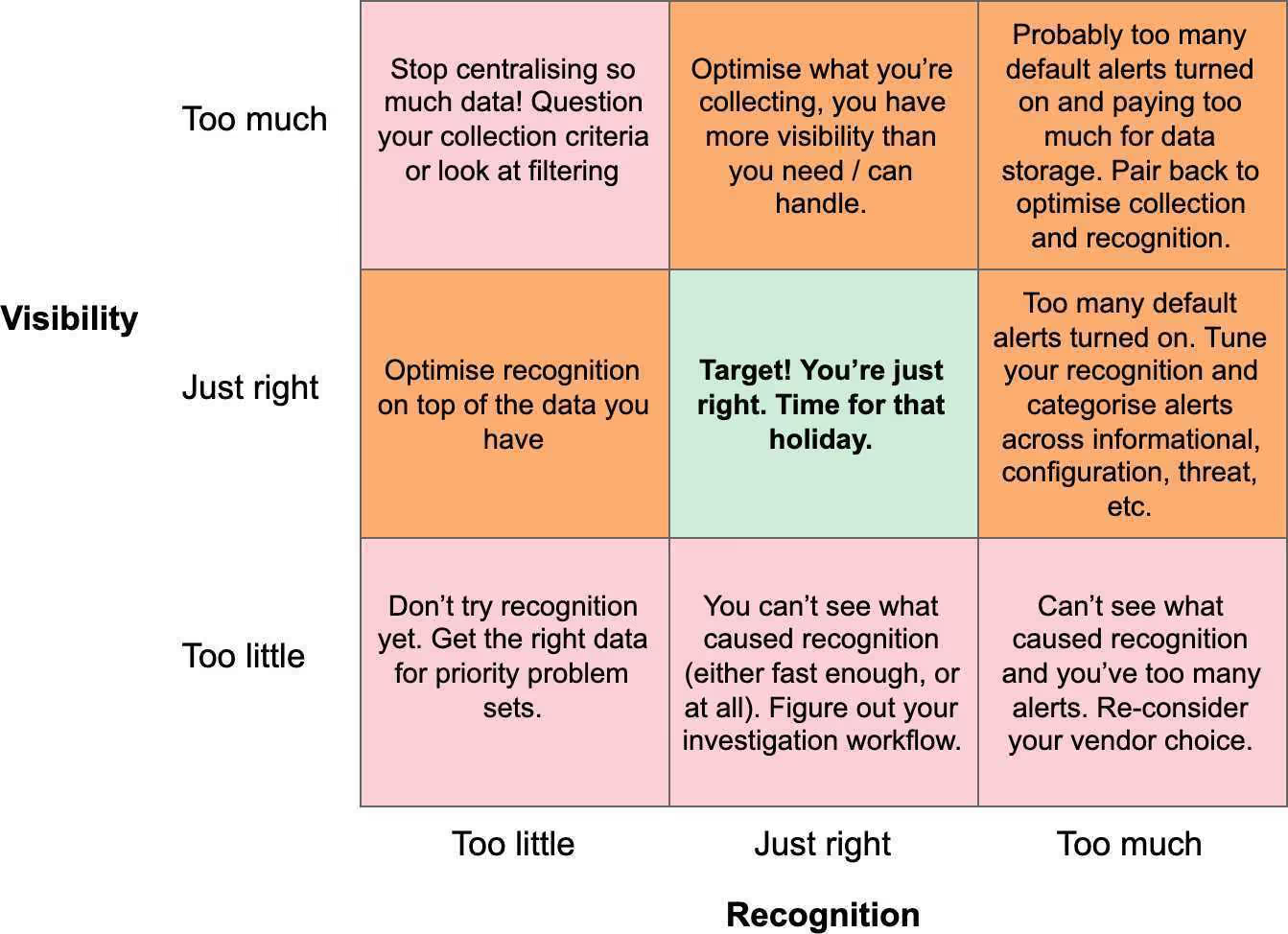
The Goldilocks VR Matrix

Below is what we call the VR Goldilocks Matrix at PBX Group Security. We use it to assess technology, measure our own capability and processes, and ask ourselves hard questions about where we need to focus to get the most value from our budget, (or make cuts / shift investment) if we need to.

In the squares are some examples of what you (maybe) should think about doing if you find yourself there.
Important questions to ask about VR

One of the things about Visibility and Recognition is that it’s not a given they are ‘always on’. Sometimes there are failure modes for visibility (causing a downstream issue with recognition). And sometimes there are failure modes or conditions under which you WANT to pause recognition.

The key questions you must have answers to about this include:

  • Under what conditions might I lose visibility?
  • How would I know if I have?
  • Is that loss a blind spot (i.e. data is lost for a given time period)…
  • …or is it 'a temporal delay’ (e.g. a connection fails and data is batched for moving from A to B but that doesn’t happen for a few hours)?
  • What are the recognitions that might be impacted by either of the above?
  • What is my expectation for the SLA on those recognitions from ‘cause of alert’ to ‘response workflow’?
  • Under what conditions would I be willing to pause recognition, change the workflow for what happens upon recognition, or stop it all together?
  • What is the stacked ranked list of ‘must, should, could’ for all recognition and why?

Alerts. Alerts everywhere.

More often than not, Security Operations teams suffer the costs of wasted time due to noisy alerts from certain data sources. As a consequence, it's more difficult for them to single out malicious behavior as suspicious or benign. The number of alerts that are generated due to out of the box SIEM platform configurations for sources like Web Proxies and Domain Controllers are often excessive, and the cost to tune those rules can also be unpalatable. Therefore, rather than trying to tune alerts, teams might make a call to switch them off until someone can get around to figuring out a better way. There’s no use having hypothetical recognition, but no workflow to act on what is generate (other than compliance).

This is where technologies that use ML can help. There are two basic approaches...

One is to avoid alerting until multiple conditions are met that indicate a high probability of threat activity. In this scenario, rather than alerting on the 1st, 2nd, 3rd and 4th ‘suspicious activities’, you wait until you have a critical mass of indicators, and then you generate one high fidelity alert that has a much greater weighting to be malicious. This requires both a high level of precision and accuracy in alerting, and naturally some trade off in the time that can pass before an alert for malicious activity is generated.

The other is to alert on ‘suspicious actives 1-4' and let an analyst or automated process decide if this merits further investigation. This approach sacrifices accuracy for precision, but provides rapid context on whether one, or multiple, conditions are met that push the machine(s) up the priority list in the triage queue. To solve for the lower level of accuracy, this approach can make decisions about how long to sustain alerting. For example, if a host triggers multiple anomaly detection models, rather than continue to send alerts (and risk the SOC deciding to turn them off), the technology can pause alerts after a certain threshold. If a machine has not been quarantined or taken off the network after 10 highly suspicious behaviors are flagged, there is a reasonable assumption that the analyst will have dug into these and found the activity is legitimate.

Punchline 1: the value of Continued Recognition even when 'not malicious'

The topic of paused detections was raised after a recent joint exercise between PBX Group Security and Darktrace in testing Darktrace’s recognition. After a machine being used by the PBX Red Team breached multiple high priority models on Darktrace, the technology stopped alerting on further activity. This was because the initial alerts would have been severe enough to trigger a SOC workflow. This approach is designed to solve the problem of alert overload on a machine that is behaving anomalously but is not in fact malicious. Rather than having the SOC turn off alerts for that machine (which could later be used maliciously), the alerts are paused.

One of the outcomes of the test was that the PBX Detect team advised they would still want those alerts to exist for context to see what else the machine does (i.e. to understand its pattern of life). Now, rather than pausing alerts, Darktrace is surfacing this to customers to show where a rule is being paused and create an option to continue seeing alerts for a machine that has breached multiple models.

Which leads us on to our next point…

Punchline 2: the need for Atomic Tests for detection

Both Darktrace and Photobox Security are big believers in Atomic Red Team testing, which involves ‘unit tests’ that repeatedly (or at a certain frequency) test a detection using code. Unit tests automate the work of Red Teams when they discovery control strengths (which you want to monitor continuously for uptime) or control gaps (which you want to monitor for when they are closed). You could design atomic tests to launch a series of particular attacks / threat actor actions from one machine in a chained event. Or you could launch different discreet actions from different machines, each of which has no prior context for doing bad stuff. This allows you to scale the sample size for testing what recognition you have (either through ML or more traditional SIEM alerting). Doing this also means you don't have to ask Red Teams to repeat the same tests again, allowing them to focus on different threat paths to achieve objectives.

Mitre Att&ck is an invaluable framework for this. Many vendors are now aligning to Att&ck to show what they can recognize relating to attack TTPs (Tools, Tactics and Procedures). This enables security teams to map what TTPs are relevant to them (e.g. by using threat intel about the campaigns of threat actor groups that are targeting them). Atomic Red Team tests can then be used to assure that expected detections are operational or find gaps that need closing.

If you miss detections, then you know you need to optimise the recognition you have. If you get too many recognitions outside of the atomic test conditions, you either have to accept a high false positive rate because of the nature of the network, or you can tune your detection sensitivity. The opportunities to do this with technology based on ML and anomaly detection are significant, because you can quickly see for new attack types what a unit test tells you about your current detections and that coverage you think you have is 'as expected'.

Punchline 3: collaboration for the win

Using well-structured Red Team exercises can help your organisation and your technology partners learn new things about how we can collectively find and halt evil. They can also help defenders learn more about good assumptions to build into ML models, as well as covering edge cases where alerts have 'business intelligence' value vs ‘finding bad’.

If you want to understand the categorisations of ways that your populations of machines act over time, there is no better way to do it than through anomaly detection and feeding alerts into a system that supports SOC operations as well as knowledge management (e.g. a graph database).

Working like this means that we also help get the most out of the visibility and recognition we have. Security solutions can be of huge help to Network and Operations teams for troubleshooting or answering questions about network architecture. Often, it’s just a shift in perspective that unlocks cross-functional value from investments in security tech and process. Understanding that recognition doesn’t stop with security is another great example of where technologies that let you build your own logic into recognition can make a huge difference above protecting the bottom line, to adding top line value.


Inside the SOC
Darktrace cyber analysts are world-class experts in threat intelligence, threat hunting and incident response, and provide 24/7 SOC support to thousands of Darktrace customers around the globe. Inside the SOC is exclusively authored by these experts, providing analysis of cyber incidents and threat trends, based on real-world experience in the field.
Written by
Max Heinemeyer
Global Field CISO

More in this series

No items found.

Blog

/

Network

/

May 22, 2026

Darktrace named a Leader in the 2026 Gartner® Magic Quadrant™ for Network Detection and Response (NDR) For the Second Consecutive Year

garnter ndr magic quadrantDefault blog imageDefault blog image

Continued recognition in NDR  

Darktrace has been recognized as a Leader in the 2026 Gartner® Magic Quadrant™ for Network Detection and Response (NDR), marking the second consecutive year in the Leaders quadrant.

We believe this consistency reflects sustained ability to execute, adapt, and deliver outcomes as the market evolves.

While we are immensely proud to be recognized by industry analysts as a Leader in NDR, that's just part of the story. Darktrace was also Named the Only 2025 Gartner® Peer Insights™ Customers’ Choice for Network Detection and Response based on direct customer feedback and real-world experience.

We believe the combination of these two signals is important. One reflects how the market is evaluated. The other reflects how technology performs in practice.

Why Darktrace continues to be recognized as a leader

We believe our position as a Leader for the second consecutive year reflects a combination of our sustained ability to execute in NDR, continued AI innovation, and proven delivery of security outcomes for customers and partners worldwide.

We also feel that our leadership in the NDR market is a testament to our unique and multi-layered AI approach, for which we were recognized as No.7 on Fast Company’s Most Innovative AI Companies of 2026 list, plus one of the hottest AI cybersecurity companies in CRN's AI 100.

Adapting to complex, real-world environments

Organizations are no longer protecting a single network perimeter. They are securing a mix of users, devices, applications, and data that move across hybrid environments.

Darktrace has focused on maintaining visibility and detection across these conditions, allowing security teams to understand activity as it scales.

Supporting organizations globally, not just technically

Security outcomes are shaped as much by deployment and support as they are by detection capability.

Darktrace continues to invest in regional presence across 29 countries around the world, helping organizations operationalize NDR in ways that align with local requirements, internal processes, and team structures.

Continuing to push AI beyond detection

AI in cybersecurity is often positioned as a way to improve detection accuracy. But the more important shift is how AI can influence decision-making and response.

Darktrace continues to develop models that learn from both live environments and historical incident data, combining real-time behavioral analysis with insights derived from prior attack patterns.

Using technologies such as the Incident Graph and DIGEST (Darktrace Incident Graph Evaluation for Security Threats), activity is not analyzed in isolation. Instead, relationships between users, devices, connections, and events are mapped over time, allowing the system to reconstruct how an incident is unfolding and how similar incidents have progressed in the past.

By evaluating these patterns, Darktrace can assess the likelihood that an incident will escalate, prioritizing the activity that poses the greatest risk and surfacing the most relevant context for investigation.

This shifts security operations from simply identifying anomalies to understanding their trajectory, helping teams anticipate potential impact and respond earlier with greater precision.

Why NDR is shifting from reactive detection to proactive, AI-driven security

Traditional approaches to NDR have been built around reactively identifying threats once they become clearly visible. That model is increasingly difficult to rely on.

Attackers are no longer operating in ways that stand out. They use valid credentials, trusted tools, and low-and-slow techniques that blend into everyday activity. By the time something looks obviously malicious, the impact is often already underway.

This is the core limitation of reactive detection. It depends on recognizing something that already looks like a threat.

As a result, many of the most consequential incidents today fall into a gap.

Insider activity, compromised credentials, and novel attacks rarely trigger traditional alerts because they do not follow known patterns. On the surface, they often appear legitimate, making them difficult to distinguish from normal behavior without deeper context.

This is why we believe this Gartner recognition reflects a broader shift in NDR toward autonomous, proactive and pre‑emptive security operations.

By understanding normal behavior within an environment, it is possible to identify subtle deviations rather than waiting for confirmation of threats as they are taking place.

Darktrace’s Self-Learning AI is designed for behavioral understanding. By continuously learning each organization’s normal patterns, it can detect deviations in real time, enabling a proactive and pre-emptive model of NDR where security teams can respond to early signs of risk as they emerge, reducing the window in which attacks can develop.

In multiple cases, this behavioral approach has led to early threat detection where Darktrace identified completely unknown threats, including pre-CVE zero-day activity. By detecting subtle behavioral changes before vulnerabilities were publicly disclosed or widely understood, organizations can mitigate threats before they do damage.

This shift is subtle but important. Modern NDR solutions must shift from a system that explains what happened to one that helps prevent threats from developing in the first place, and Darktrace is proud to be at the forefront of this shift - helping organizations build and maintain a state of proactive network resilience.

Continuing to innovate at the forefront of NDR

In our view, recognition as a Leader reflects where the market is today. Continuing to innovate defines what comes next.

As businesses evolve, new technologies like AI tools and agents introduce new security risks and challenges; security teams need more than simple detection. They need a complete understanding of risk as it develops, the ability to investigate it in context, and to contain threats at machine speed.  

Darktrace / NETWORK is built to deliver across that full spectrum. Its Self-Learning AI continuously adapts to each organization’s environment, identifying subtle behavioral changes that signal emerging threats. Integrated investigation and autonomous response reduce the time between detection and action, allowing teams to move with greater speed and confidence.

This combination enables organizations to detect and contain known, unknown, and insider threats as they develop, while also strengthening resilience over time.

As a two-time Leader in the Gartner® Magic Quadrant™ for NDR and the only 2025 Gartner® Peer Insights™ Customers’ Choice, we feel Darktrace continues to evolve its platform to meet the demands of modern environments, delivering a more complete and adaptive approach to network security.

[related-resource]

Disclaimer: The 2026 Gartner® Magic Quadrant™ for Network Detection and Response (NDR) ,The 2026 Gartner® Magic Quadrant™ for Network Detection and Response (NDR), Thomas Lintemuth, Charanpal Bhogal, Nahim Fazal, 18 May 2026.

Gartner does not endorse any vendor, product or service depicted in its research publications, and does not advise technology users to select only those vendors with the highest ratings or other designation. Gartner research publications consist of the opinions of Gartner’s research organization and should not be construed as statements of fact. Gartner disclaims all warranties, expressed or implied, with respect to this research, including any warranties of merchantability or fitness for a particular purpose.

GARTNER is a registered trademark and service mark of Gartner, Inc. and/or its affiliates in the U.S. and internationally and is used herein with permission. All rights reserved. Magic Quadrant is a registered trademark of Gartner, Inc. and/or its affiliates and is used herein with permission. All rights reserved.

Continue reading
About the author
Mikey Anderson
Product Marketing Manager, Network Detection & Response

Blog

/

/

May 21, 2026

Prompt Security in Enterprise AI: Strengths, Weaknesses, and Common Approaches

prompt securityDefault blog imageDefault blog image

How enterprise AI Agents are changing the risk landscape  

Generative AI Agents are changing the way work gets done inside enterprises, and subsequently how security risks may emerge. Organizations have quickly realized that providing these agents with wider access to tooling, internal information, and granting permissions for the agent to perform autonomous actions can greatly increase the efficiency of employee workflows.

Early deployments of Generative AI systems led many organizations to scope individual components as self-contained applications: a chat interface, a model, and a prompt, with guardrails placed at the boundary. Research from Gartner has shown that while the volume and scope of Agentic AI deployments in enterprise environments is rapidly accelerating, many of the mechanisms required to manage risk, trust, and cost are still maturing.

The issue now resides on whether an agent can be influenced, misdirected, or manipulated in ways that leads to unsafe behavior across a broader system.

Why prompt security matters in enterprise AI

Prompt security matters in enterprise AI because prompts are the primary way users and systems interact with Agentic AI models, making them one of the earliest and most visible indicators of how these systems are being used and where risk may emerge.

For security teams, prompt monitoring is a logical starting point for understanding enterprise AI usage, providing insight into what types of questions are being asked and tasks are being given to AI Agents, how these systems are being guided, and whether interactions align with expected behavior. Complete prompt security takes this one step further, filtering out or blocking sensitive or dangerous content to prevent risks like prompt injection and data leakage.

However, visibility only at the prompt layer can create a false sense of security. Prompts show what was asked, but not always why it was asked, or what downstream actions were triggered by the agent across connected systems, data sources, or applications.

What prompt security reveals  

The primary function of prompt security is to minimize risks associated with generative and agentic AI use, but monitoring and analysis of prompts can also grant insight into use cases for particular agents and model. With comprehensive prompt security, security teams should be able to answer the following questions for each prompt:

  • What task was the user attempting to complete?
  • What data was included in the request, and was any of the data high-risk or confidential?
  • Was the interaction high-risk, potentially malicious, or in violation of company policy?
  • Was the prompt anomalous (in comparison to previous prompts sent to the agent / model)?

Improving visibility at this layer is a necessary first step, allowing organizations to establish a baseline for how AI systems are being used and where potential risks may exist.  

Prompt security alone does not provide a complete view of risk. Further data is needed to understand how the prompt is interpreted, how context is applied, what autonomous actions the agent takes (if any), or what downstream systems are affected. Understanding the outcome of a query is just as important for complete prompt security as understanding the input prompt itself – for example, a perfectly normal, low-risk prompt may inadvertently result in an agent taking a high-risk action.

Comprehensive AI security systems like Darktrace / SECURE AI can monitor and analyze both the prompt submitted to a Generative AI system, as well as the responses and chain-of-thought of the system, providing greater insight into the behavior of the system. Darktrace / SECURE AI builds on the core Darktrace methodology, learning the expected behaviors of your organization and identifying deviations from the expected pattern of life.

How organizations address prompt security today

As prompt-level visibility has become a focus, a range of approaches have emerged to make this activity more observable and controllable. Various monitoring and logging tools aim to capture prompt inputs to be analyzed after the fact.  

Input validation and filtering systems attempt to intervene earlier, inspecting prompts before they reach the model. These controls look for known jailbreak patterns, language indicative of adversarial attacks, or ambiguous instructions which could push the system off course.

Importantly, for a prompt security solution to be accurate and effective, prompts must be continually observed and governed, rather than treated as a point-in-time snapshot.  

Where prompt security breaks down in real environments

In more complex environments, especially those involving multiple agents or extensive tool use, AI security becomes harder to define and control.

Agent-to-Agent communications can be harder to monitor and trace as these happen without direct user interaction. Communication between agents can create routes for potential context leakage between agents, unintentional privilege escalation, or even data leakage from a higher privileged agent to a lower privileged one.

Risk is shaped not just by what is asked, but by the conditions in which that prompt operates and the actions an agent takes. Controls at the orchestration layer are starting to reflect this reality. Techniques such as context isolation, scoped memory, and role-based boundaries aim to limit how far a prompt’s influence can extend.  

Furthermore, Shadow AI usage can be difficult to monitor. AI systems that are deployed outside of formal governance structures and Generative AI systems hosted on unknown endpoints can fly under the radar and can go unseen by monitoring tools, leaving a critical opening where adversarial prompts may go undetected. Darktrace / SECURE AI features comprehensive detection of Shadow AI usage, helping organizations identify potential risk areas.

How prompt security fits in a broader AI risk model

Prompt security is an important starting point, but it is not a complete security strategy. As AI systems become more integrated into enterprise environments, the risks extend to what resources the system can access, how it interprets context, and what actions it is allowed to take across connected tools and workflows.

This creates a gap between visibility and control. Prompt security alone allows security teams to observe prompt activity but falls short of creating a clear understanding of how that activity translates into real-world impact across the organization.

Closing that gap requires a broader approach, one that connects signals across human and AI agent identities, SaaS, cloud, and endpoint environments. It means understanding not just how an AI system is being used, but how that usage interacts with the rest of the digital estate.

Prompt security, in that sense, is less of a standalone solution and more of an entry point into a larger problem: securing AI across the enterprise as a whole.

Explore how Darktrace / SECURE AI brings prompt security to enterprises

Darktrace brings more than a decade of AI expertise, built on an enterprise‑wide platform designed to operate in and understand the behaviors of the complex, ambiguous environments where today’s AI now lives. With Darktrace / SECURE AI, enterprises can safely adopt, manage, monitor, and build AI within their business.  

Learn about Darktrace / SECURE AI here.

Sign up today to stay informed about innovations across securing AI.

[related-resource]

Continue reading
About the author
Jamie Bali
Technical Author (AI) Developer
Your data. Our AI.
Elevate your network security with Darktrace AI