

Blog
/
Network
/
May 5, 2026

When Trust Becomes the Attack Surface: Supply-Chain Attacks in an Era of Automation and Implicit Trust

Software supply-chain attacks dominate the threat landscape in 2026, as adversaries exploit trusted build systems, CI/CD pipelines, and management tools to gain access to target environments. This blog examines Axios, Trivy and Quest Kace compromises observed in the Darktrace customer base, highlighting the need for anomaly detection, assumed breach and continuous visibility.
Inside the SOC
Darktrace cyber analysts are world-class experts in threat intelligence, threat hunting and incident response, and provide 24/7 SOC support to thousands of Darktrace customers around the globe. Inside the SOC is exclusively authored by these experts, providing analysis of cyber incidents and threat trends, based on real-world experience in the field.
Written by
Nathaniel Jones
SVP, Global Threat Intelligence
Written by
Emma Foulger
Global Threat Research Operations Lead
Software supply chain attacksDefault blog image
05
May 2026

Software supply-chain attacks in 2026

Software supply-chain attacks now represent the primary threat shaping the 2026 security landscape. Rather than relying on exploits at the perimeter, attackers are targeting the connective tissue of modern engineering environments: package managers, CI/CD automation, developer systems, and even the security tools organizations inherently trust.

These incidents are not isolated cases of poisoned code. They reflect a structural shift toward abusing trusted automation and identity at ecosystem scale, where compromise propagates through systems designed for speed, not scrutiny. Ephemeral build runners, regardless of provider, represent high‑trust, low‑visibility execution zones.

The Axios compromise and the cascading Trivy campaign illustrate how quickly this abuse can move once attacker activity enters build and delivery workflows. This blog provides an overview of the latest supply chain and security tool incidents with Darktrace telemetry and defensive actions to improve organizations defensive cyber posture.

1. Why the Axios Compromise Scaled

On 31 March 2026, attackers hijacked the npm account of Axios’s lead maintainer, publishing malicious versions 1.14.1 and 0.30.4 that silently pulled in a malicious dependency, plain‑crypto‑[email protected]. Axios is a popular HTTP client for node.js and  processes 100 million weekly downloads and appears in around 80% of cloud and application environments, making this a high‑leverage breach [1].

The attack chain was simple yet effective:

  • A compromised maintainer account enabled legitimate‑looking malicious releases.
  • The poisoned dependency executed Remote Access Trojans (RATs) across Linux, macOS and Windows systems.
  • The malware beaconed to a remote command-and-control (C2) server every 60 seconds in a loop, awaiting further instructions.
  • The installer self‑cleaned by deleting malicious artifacts.

All of this matters because a single maintainer compromise was enough to project attacker access into thousands of trusted production environments without exploiting a single vulnerability.

A view from Darktrace

Multiple cases linked with the Axios compromise were identified across Darktrace’s customer base in March 2026, across both Darktrace / NETWORK and Darktrace / CLOUD deployments.

In one Darktrace / CLOUD deployment, an Azure Cloud Asset was observed establishing new external HTTP connectivity to the IP 142.11.206[.]73 on port 8000. Darktrace deemed this activity as highly anomalous for the device based on several factors, including the rarity of the endpoint across the network and the unusual combination of protocol and port for this asset. As a result, the triggering the "Anomalous Connection / Application Protocol on Uncommon Port" model was triggered in Darktrace / CLOUD. Detection was driven by environmental context rather than a known indicator at the time. Subsequent reporting later classified the destination as malicious in relation to the Axios supply‑chain compromise, reinforcing the gap that often exists between initial attacker activity and the availability of actionable intelligence. [5]

Additionally, shortly before this C2 connection, the device was observed communicating with various endpoints associated with the NPM package manager, further reinforcing the association with this attack.

Darktrace’s detection of the unusual external connection to 142.11[.]206[.]73 via port 8000.  
Figure 1: Darktrace’s detection of the unusual external connection to 142.11[.]206[.]73 via port 8000.  

Within Axios cases observed within Darktrace / NETWORK customer environments, activity generally focused on the use of newly observed cURL user agents in outbound connections to the C2 URL sfrclak[.]com/6202033, alongside the download of malicious files.

In other cases, Darktrace / NETWORK customers with Microsoft Defender for Endpoint integration received alerts flagging newly observed system executables and process launches associated with C2 communication.
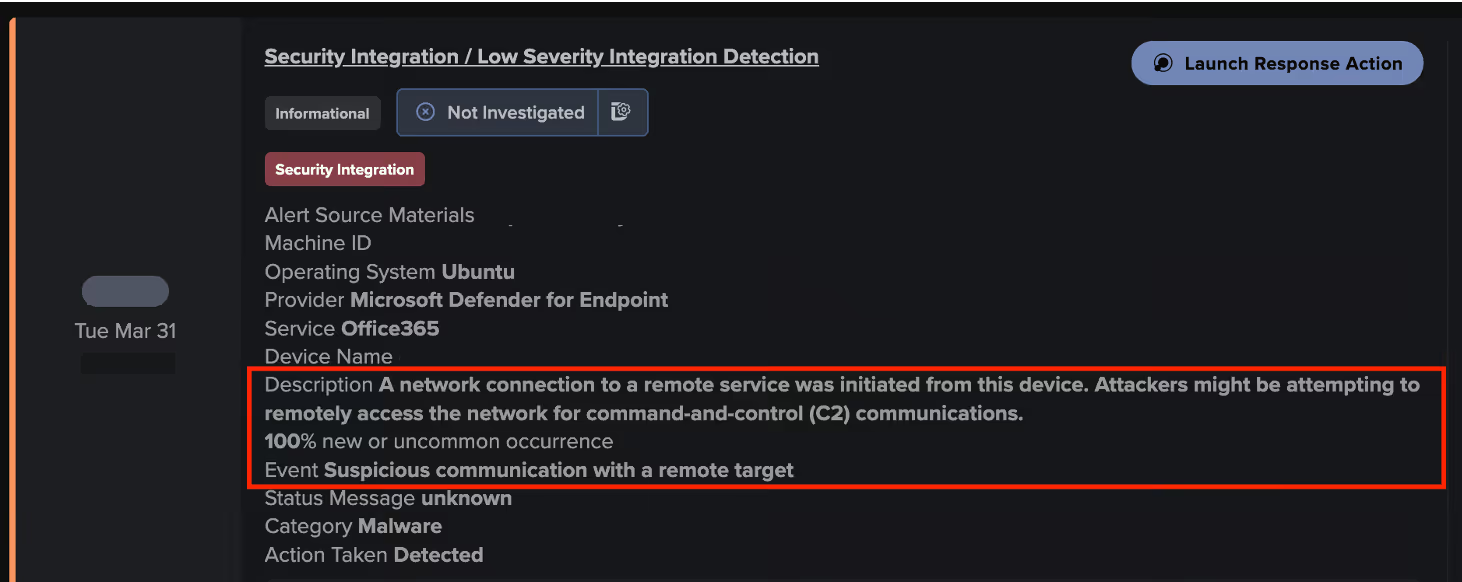
A Security Integration Alert from Microsoft Defender for Endpoint associated with the Axios supply chain attack.
Figure 2: A Security Integration Alert from Microsoft Defender for Endpoint associated with the Axios supply chain attack.

2. Why Trivy bypassed security tooling trust

Between late February and March 22, 2026, the threat group TeamPCP leveraged credentials from a previous incident to insert malicious artifacts across Trivy’s distribution ecosystem, including its CI automation, release binaries, Visual Studio Code extensions, and Docker container images [2].

While public reporting has emphasized GitHub Actions, Darktrace telemetry highlights attacker execution within CI/CD runner environments, including ephemeral build runners. These execution contexts are typically granted broad trust and limited visibility, allowing malicious activity within build automation to blend into expected operational workflows, regardless of provider.

This was a coordinated multi‑phase attack:

  • 75 of 76  of trivy-action tags and all setup‑trivy tags were force‑pushed to deliver a malicious payload.
  • A malicious binary (v0.69.4) was distributed across all major distribution channels.
  • Developer machines were compromised, receiving a persistent backdoor and a self-propagating worm.
  • Secrets were exfiltrated at scale, including SSH keys, Kuberenetes tokens, database passwords, and cloud credentials across Amazon Web Service (AWS), Azure, and Google Cloud Platform (GCP).

Within Darktrace’s customer base, an AWS EC2 instance monitored by Darktrace / CLOUD  appeared to have been impacted by the Trivy attack. On March 19, the device was seen connecting to the attacker-controlled C2 server scan[.]aquasecurtiy[.]org (45.148.10[.]212), triggering the model 'Anomalous Server Activity / Outgoing from Server’ in Darktrace / CLOUD.

Despite this limited historical context, Darktrace assessed this activity as suspicious due to the rarity of the destination endpoint across the wider deployment. This resulted in the triggering of a model alert and the generation of a Cyber AI Analyst incident to further analyze and correlate the attack activity.

TeamPCP’s continued abused of GitHub Actions against security and IT tooling has also been observed more recently in Darktrace’s customer base. On April 22, an AWS asset was seen connecting to the C2 endpoint audit.checkmarx[.]cx (94.154.172[.]43). The timing of this activity suggests a potential link to a malicious Bitwarden package distributed by the threat actor, which was only available for a short timeframe on April 22. [4][3]
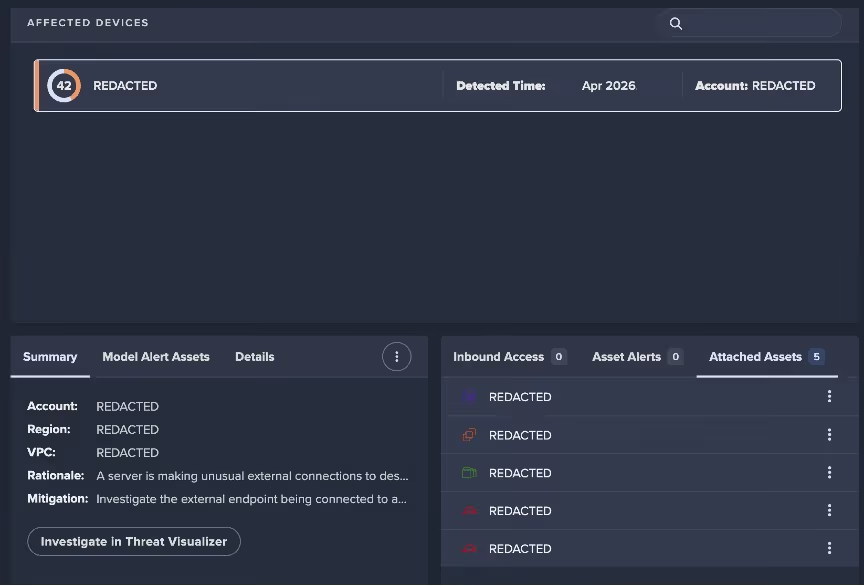
Figure 3: A model alert flagging unusual external connectivity from the AWS asset, as seen in Darktrace / CLOUD .

While the Trivy activity originated within build automation, the underlying failure mode mirrors later intrusions observed via management tooling. In both cases, attackers leveraged platforms designed for scale and trust to execute actions that blended into normal operational noise until downstream effects became visible.

Quest KACE: Legacy Risk, Real Impact

The Quest KACE System Management Appliance (SMA) incident reinforces that software risk is not confined to development pipelines alone. High‑trust infrastructure and management platforms are increasingly leveraged by adversaries when left unpatched or exposed to the internet.

Throughout March 2026, attackers exploited CVE 2025-32975 to authentication on outdated, internet-facing KACE appliances, gaining administrative control and pushing remote payloads into enterprise environments. Organizations still running pre-patch versions effectively handed adversaries a turnkey foothold, reaffirming a simple strategic truth: legacy management systems are now part of the supply-chain threat surface, and treating them as “low-risk utilities” is no longer defensible [3].

Within the Darktrace customer base, a potential case was identified in mid-March involving an internet-facing server that exhibited the use of a new user agent alongside unusual file downloads and unexpected external connectivity. Darktrace identified the device downloading file downloads from "216.126.225[.]156/x", "216.126.225[.]156/ct.py" and "216.126.225[.]156/n", using the user agents, "curl/8.5.0" & "Python-urllib/3.9".

The timeframe and IoCs observed point towards likely exploitation of CVE‑2025‑32975. As with earlier incidents, the activity became visible through deviations in expected system behavior rather than through advance knowledge of exploitation or attacker infrastructure. The delay between observed exploitation and its addition to the Known Exploited Vulnerabilities (KEV) catalogue underscores a recurring failure: retrospective validation cannot keep pace with adversaries operating at automation speed.

The strategic pattern: Ecosystem‑scale adversaries

The Axios and Trivy compromises are not anomalies; they are signals of a structural shift in the threat landscape. In this post-trust era, the compromise of a single maintainer, repository token, or CI/CD tag can produce large-scale blast radiuses with downstream victims numbering in the thousands. Attackers are no longer just exploiting vulnerabilities; they are exploiting infrastructure privileges, developer trust relationships, and automated build systems that the industry has generally under secured.

Supply‑chain compromise should now be treated as an assumed breach scenario, not a specialized threat class, particularly across build, integration, and management infrastructure. Organizations must operate under the assumption that compromise will occur within trusted software and automation layers, not solely at the network edge or user endpoint. Defenders should therefore expect compromise to emerge from trusted automation layers before it is labelled, validated, or widely understood.

The future of supply‑chain defense lies in continuous behavioral visibility, autonomous detection across developer and build environments, and real‑time anomaly identification.

As AI increasingly shapes software development and security operations, defenders must assume adversaries will also operate with AI in the loop. The defensive edge will come not from predicting specific compromises, but from continuously interrogating behavior across environments humans can no longer feasibly monitor at scale.

Credit to Nathaniel Jones (VP, Security & AI Strategy, FCISCO), Emma Foulger (Global Threat Research Operations Lead), Justin Torres (Senior Cyber Analyst), Tara Gould (Malware Research Lead)

Edited by Ryan Traill (Content Manager)

Appendices

References:

1)         https://www.infosecurity-magazine.com/news/hackers-hijack-axios-npm-package/

2)         https://thehackernews.com/2026/03/trivy-hack-spreads-infostealer-via.html

3)         https://thehackernews.com/2026/03/hackers-exploit-cve-2025-32975-cvss-100.html

4)         https://www.endorlabs.com/learn/shai-hulud-the-third-coming----inside-the-bitwarden-cli-2026-4-0-supply-chain-attack

5)         https://socket.dev/blog/axios-npm-package-compromised?trk=public_post_comment-text

IoCs

- 142.11.206[.]73 – IP Address – Axios supply chain C2

- sfrclak[.]com – Hostname – Axios supply chain C2

- hxxp://sfrclak[.]com:8000/6202033 - URI – Axios supply chain payload

- 45.148.10[.]212 – IP Address – Trivy supply chain C2

- scan.aquasecurtiy[.]org – Hostname - Trivy supply chain C2

- 94.154.172[.]43 – IP Address - Checkmarx/Bitwarden supply chain C2

- audit.checkmarx[.]cx – Hostname - Checkmarx/Bitwarder supply chain C2

- 216.126.225[.]156 – IP Address – Quest KACE exploitation C2

- 216.126.225[.]156/32 - URI – Possible Quest KACE exploitation payload

- 216.126.225[.]156/ct.py - URI - Possible Quest KACE exploitation payload

- 216.126.225[.]156/n - URI - Possible Quest KACE exploitation payload

- 216.126.225[.]156/x - URI - Possible Quest KACE exploitation payload

- e1ec76a0e1f48901566d53828c34b5dc – MD5 - Possible Quest KACE exploitation payload

- d3beab2e2252a13d5689e9911c2b2b2fc3a41086 – SHA1 - Possible Quest KACE exploitation payload

- ab6677fcbbb1ff4a22cc3e7355e1c36768ba30bbf5cce36f4ec7ae99f850e6c5 – SHA256 - Possible Quest KACE exploitation payload

- 83b7a106a5e810a1781e62b278909396 – MD5 - Possible Quest KACE exploitation payload

- deb4b5841eea43cb8c5777ee33ee09bf294a670d – SHA1 - Possible Quest KACE exploitation payload

- b1b2f1e36dcaa36bc587fda1ddc3cbb8e04c3df5f1e3f1341c9d2ec0b0b0ffaf – SHA256 - Possible Quest KACE exploitation payload

Darktrace Model Detections

Anomalous Connection / Application Protocol on Uncommon Port

Anomalous Server Activity / Outgoing from Server

Anomalous Connection / New User Agent to IP Without Hostname

Anomalous File / EXE from Rare External Location

Anomalous File / Script from Rare External Location

Anomalous Server Activity / New User Agent from Internet Facing System

Anomalous Server Activity / Rare External from Server

Antigena / Network / External Threat / Antigena Suspicious File Block

Antigena / Network / External Threat / Antigena Suspicious File Pattern of Life Block

Device / New User Agent

Device / Internet Facing Device with High Priority Alert

Anomalous File / New User Agent Followed By Numeric File Download

Inside the SOC
Darktrace cyber analysts are world-class experts in threat intelligence, threat hunting and incident response, and provide 24/7 SOC support to thousands of Darktrace customers around the globe. Inside the SOC is exclusively authored by these experts, providing analysis of cyber incidents and threat trends, based on real-world experience in the field.
Written by
Nathaniel Jones
SVP, Global Threat Intelligence
Written by
Emma Foulger
Global Threat Research Operations Lead

More in this series

No items found.

Blog

/

OT

/

September 2, 2026

Botnet Behind the Camera: Mirai Katana Activity on a Video Recording Device

Default blog imageDefault blog image

Key takeaways

  • Darktrace identified a camera device infected with the Mirai/Katana botnet in a sports-sector customer environment, showing how exposed IoT devices can become active participants in wider attack chains.
  • The compromise involved suspicious Wget behavior, file downloads from rare external IPs, unusual incoming HTTP connections to video recorder management interfaces, and large outbound data transfers to infrastructure associated with botnet activity.
  • The incident highlights the importance of extending visibility and response beyond traditional endpoints, as unmanaged or overlooked connected devices can be exploited for command-and-control, malware delivery, and data exfiltration.

Mirai and the Katana variant

Mirai is a botnet that first emerged in August 2016 and is well known for launching large-scale distributed-denial-of-service (DDoS) attacks, typically targeting exposed Internet of Things (IoT) devices. It identifies vulnerable IoT devices ,often by abusing default credentials or exposed services, and recruiting them into a remotely controlled botnet that can be used in DDoS campaigns [1].

Katana, one of the many variants that arose after Mirai’s source code was released publicly, was first observed in late 2020 and has been seen using more advanced capabilities, including custom command-and-control (C2), persistence mechanisms, and DDoS functionality [2].

In March 2026, research from the Nokia Deepfield Emergency Response Team (ERT) identified Katana as a Mirai-derived DDoS botnet targeting Android-based TV set-top boxes through exposed Android Debug Bridge (ADB) access.  Observed capabilities included custom C2, runtime domain rotation, multiple DDoS methods, and an on-device compiled kernel rootkit used for persistence and stealth [3].

Darktrace’s detection of Mirai Botnet activity on a camera device

In early 2026, Darktrace identified a Network/Digital Video Recorder (NVR/DVR) on the network of a sports-sector customer that had been infected with the Mirai Katana botnet and subsequently used to exfiltrate data from the customer’s environment. Seemingly related follow-up activity was observed on the same device several months later.

In both instances, the Darktrace Security Operations Centre (SOC) alerted the customer as part of the Managed Threat Detection (MTD) service. However, as Darktrace’s Autonomous Response capability was not fully enabled on the affected device, Darktrace was unable to proactively block the suspicious activity or prevent the compromise from continuing and recurring.

The initial compromise appears to have occurred when the affected device was seen using Wget to download Linux-based Executable and Linkable Format (ELF) files from a rare external IP, 195.177.94[.]105, which had not previously been observed in the customer’s network. Further analysis downloaded file hashes identified files related to the Mirai botnet.

Figure 1: Darktrace’s Real-Time AI Analyst investigation into the unusual outbound connection where the ELF files were downloaded.

Within a few hours, Darktrace detected the device uploading close to 3GB of data to another external IP, 50.7.49[.]4:3017 (ASN AS30058 FDCSERVERS), suggesting that the activity was likely routed via a virtual private server (VPS) hosted by FDC Servers [2]. Attackers often abuse VPS infrastructure from legitimate cloud providers to blend in with legitimate traffic and evade IP reputation and geolocation-based detections.

Figure 2:  Darktrace’s detection of the unusual data upload activity by the affected camera device.

Darktrace continued to observe similar data transfers to multiple rare endpoints  including 171.225.223[.]53, 95.161.128[.]62, 61.7.209[.]88, 95.161.128[.]62, which have been linked to Mirai by open-source intelligence (OSINT).

Figure 3: Darktrace’s detection of spikes in unusual external data transfer activity from the camera device.

Exploitation continued

Several months later, Darktrace identified the same exfiltration pattern on the device again, this time with stronger indications of associations with Mirai Katana botnet infection.

The device received incoming HTTP connections from 129.121.114[.]124, an external IP known to be associated with the Katana botnet IP [3]. The connections targeted the ‘/dvr/cmd’ path using the root username and user agent Mozilla/5.0 (Windows NT 10.0; Win64; x64) AppleWebKit/537.36 (KHTML, like Gecko) Chrome/42.0.2311.135 Safari/537.36 Edge/12.246.

The ‘/dvr/cmd’ path appears to be associated with the affected device’s web management functionality. This API endpoint has historically been targeted by Mirai and other IoT botnets through the exploitation of critical command injection vulnerabilities and automated botnet exploitation [4].

Figure 4: Darktrace’s  detection of HTTP connectivity from the external IP associated with Mirai Katana Botnet.

A few days later, Darktrace observed the Wget utility being used to download ELF files, including “/lil”,  from the IP 129.121.114[.]124. OSINT reporting has since associated this IP address with the Mirai Katana botnet. Notably, the IP observed earlier in the year, 195.177.94[.]105, had also hosted a file named “lil”, indicating a link between the observed activity.

Over the following days, the device received a sudden spike in connections from multiple rare external endpoints, suggesting a possible successful brute force attack. Darktrace also observed the device exfiltrating just under 4GB of data to another Mirai-associated IP address,  66.92.198[.]194, over ports 3344, 954922, and 80. Finally, the device was seen uploading data to the Mirai botnet IP 5.175.249[.]53 over port138 and exhibited an increase in UDP connections to 34.18.28[.]10 over port 9068.

Following both file download events, Darktrace identified spikes in external data transfers and connection attempts to rare destinations. While Darktrace’s Threat Research team could not confirm with high confidence that this to activity was directly associated with Mirai, it may indicate that Mirai Katana includes data exfiltration functionality.

Darktrace’s threat researchers also identified an internet-facing NTP server belonging to a separate customer receiving incoming connection attempts from the same initially observed IP, 195.177.94[.]105,over the port 123. This suggests that Mirai Katana may not exclusively target IoT devices.

Conclusion

This case demonstrates how threat actors can exploit overlooked IoT and OT devices to support broader malicious objectives. Here, a camera device infected with a botnet was used to exfiltrate data from the customer's environment, showing how peripheral assets can become active participants in an attack chain.

This case also reinforces a challenge many organizations face today: extending security visibility beyond traditional endpoints and servers. Cameras, sensors, and other connected devices often operate with limited monitoring and may fall outside established security processes, despite maintaining network connectivity and access to potentially sensitive environments. This is particularly relevant in the sports sector, where growing reliance on connected cameras, smart stadium technologies, and other IoT devices continues to expand the attack surface, as highlighted in Darktrace's Sports Sector Threat Report.

As botnets like Kata and Mirai continue to evolve, defenders need visibility across unmanaged IoT and edge devices, as well as security solutions that can recognize subtle deviations in device behavior that may indicate an emerging compromise.

Credit to Parvatha Ananthakannan (Cyber Analyst), Signe Zaharka (Principal Analyst)

Edited by Ryan Traill (Content Manager)

Appendices

Darktrace Model Detections

·      Anomalous File / EXE from Rare External Location

·      Anomalous File / Multiple EXE from Rare External Locations

·      Device / Initial Attack Chain Activity

·      Unusual Activity / Unusual External Data to New Endpoint

·      Anomalous Connection / Data Sent to Rare Domain

·      Unusual Activity / Enhanced Unusual External Data Transfer

·      Anomalous Connection / Uncommon 1 GiB Outbound

·      Device / Significant UDP Increase

·      Anomalous Connection / Low and Slow Exfiltration to IP

·      Compromise / Large Number of Suspicious Failed Connections

·      Compromise / Large Number of Suspicious Successful Connections

·      Unusual Activity / Unusual External Activity

·      Compliance / SSH to Rare External Destination

·      Unusual Activity / Unusual DNS

·      Device / External Network Scan

·      Device / Suspicious DNS Activity

·      Device / Large Number of Model Alerts

List of Indicators of Compromise (IoCs)

Indicator of Compromise Type Description
195.177.94[.]105 IP C2 endpoint
50.7.49[.]4:30171 IP Possible C2 endpoint
129.121.114[.]124 IP C2 endpoint
hxxp://195.177.94[.]105/n3 URL Likely C2 endpoint
hxxp://195.177.94[.]105/n2 URL Likely C2 endpoint
hxxp://129.121.114[.]124/lil URL Likely C2 endpoint
hxxp://129.121.114[.]124/HHn URL Possible C2 endpoint
hxxp://129.121.114[.]124/JFc URL Possible C2 endpoint
hxxp://129.121.114[.]124/jum URL Likely C2 endpoint
hxxp://129.121.114[.]124/OaSf URL Likely C2 endpoint
hxxp://129.121.114[.]124/OPWg URL Possible C2 endpoint
hxxp://129.121.114[.]124/vHwK URL Possible C2 endpoint
hxxp://129.121.114[.]124/VLv URL Possible C2 endpoint
hxxp://129.121.114[.]124/WbJ URL Possible C2 endpoint
hxxp://129.121.114[.]124/zkR URL Possible C2 endpoint
Ab17883ae4c3bc6afa18c439166eeeb4b03186e3093d984e3a95f573e0fcb7d8 SHA-256 Mirai payload
3d587e809dac49d34a3f717e072fd0aebe5e71db63333e45c81577d6b4266f87 SHA-256 Mirai payload
Bf6e81733a7e209d3dce80d15bf3c5d300752d961fae6b45d90c9bbe7f8c89a2 SHA-256 Possible payload
f25488303813ab1ec0eaa71562938601aac185e8aaf93adb84522557f7cf4dd6 SHA-256 Possible payload
0cb4ff6b71f4423184bfa35c34e9090297637208b0e30205d4b224e56abde2ef SHA-256 Possible payload
19c24cbeaf06b2e7697083f33a85521a9315105c784691bde7420fde4cc69410 SHA-256 Likely Mirai payload
1e74f734fff8df91f4f7172d0de10c421eca78aeb800e8a48e16bc5dbde5d20e SHA-256 Possible payload
6e71f7763d1f29d5712106ebb122e281c32787540aa2342b0fe5351d585d18d7 SHA-256 Possible payload
71f4ff7cdb6d6a7d2673c543c5d2535093afbd707b20a5b9ddf735466c1105c1 SHA-256 Possible payload
76db7ee73ebf15e48a3cb24a074d92248671ef2c6ed3bc3e708377341fb7674d SHA-256 Possible payload
da87a65f7beb438e61f0b61964fed8aa305a380f569042f84c55eca8fa7929b8 SHA-256 Possible payload
e15809eb6ba66477175270d62cfa53e4bf278595f69938708c81c4bc457930fe SHA-256 Mirai payload

MITRE ATT&CK Mapping

Tactic Technique ID Technique / Sub-technique
Initial Access T1659 Content Injection
T1189 Drive-by Compromise
Exfiltration T1041 Exfiltration Over C2 Channel
T1048.003 Exfiltration Over Unencrypted Non-C2 Protocol
Command and Control T1105 Ingress Tool Transfer
T1095 Non-Application Layer Protocol
T1571 Non-Standard Port
Reconnaissance T1595.001 Scanning IP Blocks
Continue reading
About the author
Parvatha Ananthakannan
Cyber Analyst

Blog

/

/

August 26, 2026

AI Agents: Securing the Path from Intent to Action

Photograph of AI data centerDefault blog imageDefault blog image

The UK’s National Cyber Security Centre (NCSC) recently published guidance on managing the cyber risk of agentic AI. While the document is framed as interim advice as more formal guidance is developed, the framing reflects the current state of the industry: organizations are already deploying agents into production environments while standards, controls, and operating models for autonomous systems remain unsettled. Governance is evolving alongside adoption rather than preceding it, a reality which underscores the importance of robust controls.  

The NCSC’s guidance recommends aligning controls to an agent's level of autonomy, assigning distinct identities, limiting permissions, constraining access to systems and data, monitoring activity, maintaining human oversight, and preserving the ability to intervene when necessary. Most of these recommendations will sound familiar to security teams. The challenge is not the novelty of the controls. It is the type of system those controls now need to govern.

The shift from model security to agent security

For several years, AI security discussions have focused heavily on models. Can a model be manipulated? Jailbroken? Trusted? Can it expose information it should not? Those questions remain important, but they capture only part of the problem. A model generating text is one thing. A system connected to identities, applications, tools, workflows, and business data is another.

The difference becomes clearer when comparing a chatbot that answers questions with an agent that can retrieve customer records, update tickets, invoke tools, trigger workflows, and interact with external systems. The underlying model may be identical. Its access is not. The security question begins to shift from what the model knows to what the system can do.

The same theme appears in the Five Eyes statement released earlier this year, describing AI as a force multiplier that is accelerating both offensive and defensive cyber operations. The NCSC guidance explores what that reality looks like when autonomous systems begin operating inside enterprise environments.

Securing AI agents in operation

The NCSC spends relatively little time debating model behavior and considerably more time discussing identity, permissions, monitoring, oversight, containment, and response. Agents are treated as participants within an environment rather than isolated pieces of technology.  

That's broadly consistent with how we think about the problem at Darktrace.

An agent should not be treated as an extension of a user account. It develops its own behavioral patterns. It accesses systems, interacts with data, invokes tools, and moves across workflows in ways that can be observed independently. Understanding what an agent is permitted to do matters. Understanding how it actually behaves once deployed, and whether that behavior aligns with business intent, matters just as much.

Identity provides an obvious example. The NCSC recommends assigning distinct identities to agents rather than allowing them to disappear into surrounding human or service accounts. Most importantly, assigning agents distinct identities enables independent behavioral monitoring.

Development assumptions vs. real-world behavior

The same principle extends to monitoring. NCSC guidance places agent activity within normal security operations rather than treating it as a separate AI governance function. Many of the controls described are put in place before an agent begins operating. Sandboxing, credential design, approval workflows and human oversight all reflect judgments about how the system is expected to behave and what risks it is likely to create.

Actual use may challenge those assumptions. Access patterns change. Workflows expand. Systems begin interacting with resources they have never touched before. Processes that appeared reasonable during design behave differently in production. Human oversight requirements may turn out to be either excessive or inadequate once the system is operating at scale and operating within the context of unique business processes.

The Five Eyes statement points to a similar issue: organizations need confidence that controls continue to work as intended once systems are exposed to real users, data, tools and operational pressures. Often, the question is not whether an agent is technically allowed to perform an action, but whether its behavior remains consistent with the role it was intended to play.

Monitoring and governance of AI agents go hand-in-hand

This problem is exactly why monitoring and governance should be treated as part of the same process. Governance sets the initial parameters for deployment, while monitoring provides evidence about whether those parameters remain appropriate. That evidence should, in turn, inform changes to permissions, controls and oversight.

This matters increasingly as autonomous systems are integrated into business processes. The relevant risk is shaped not only by the model or agent itself, but by what it can access, what actions it can take, and how its behavior changes in practice.

Developing continuous oversight of AI agent behavior

The implication is clear: governance cannot end at deployment. Organizations need a way to understand how agents behave after deployment, test whether controls remain appropriate, and adjust them as conditions change. That requires visibility not just into technical activity, but into whether that activity makes sense in the context of the business process the agent is intended to support.

This is where business-centric behavioral security can become critical. Risk does not emerge from the model itself: it emerges from the actions an autonomous system takes within the enterprise and the downstream consequences of those actions.  

An agent can operate exactly as intended and still create risk if it accesses sensitive information in an unexpected context, exercises permissions in ways that create unintended exposure, or influences business processes in ways that were not anticipated during design and review.

Traditional governance vs. behavioral security

Traditional governance frameworks provide assurance at a point in time. Behavioral security can provide ongoing visibility into how autonomous systems interact with the organization they are meant to serve. Rather than focusing exclusively on model performance or policy compliance, organizations need to understand whether an agent's behavior aligns with business intent, operational expectations, and acceptable risk tolerances as conditions change.

As enterprises move from isolated AI deployments to interconnected ecosystems of agents, visibility into behavior becomes as important as visibility into code. Governance determines what an autonomous system is permitted to do. Behavioral analytics helps determine what it is doing, what business outcomes it is producing, and whether those outcomes remain aligned with the organization's objectives.

[related-resource]

Continue reading
About the author
Margaret Cunningham, PhD
VP, Security & AI Strategy, Field CISO
Your data. Our AI.
Elevate your network security with Darktrace AI