

Blog
/
Network
/
May 5, 2026

When Trust Becomes the Attack Surface: Supply-Chain Attacks in an Era of Automation and Implicit Trust

Software supply-chain attacks dominate the threat landscape in 2026, as adversaries exploit trusted build systems, CI/CD pipelines, and management tools to gain access to target environments. This blog examines Axios, Trivy and Quest Kace compromises observed in the Darktrace customer base, highlighting the need for anomaly detection, assumed breach and continuous visibility.
Inside the SOC
Darktrace cyber analysts are world-class experts in threat intelligence, threat hunting and incident response, and provide 24/7 SOC support to thousands of Darktrace customers around the globe. Inside the SOC is exclusively authored by these experts, providing analysis of cyber incidents and threat trends, based on real-world experience in the field.
Written by
Nathaniel Jones
SVP, Global Threat Intelligence
Written by
Emma Foulger
Global Threat Research Operations Lead
Software supply chain attacksDefault blog image
05
May 2026

Software supply-chain attacks in 2026

Software supply-chain attacks now represent the primary threat shaping the 2026 security landscape. Rather than relying on exploits at the perimeter, attackers are targeting the connective tissue of modern engineering environments: package managers, CI/CD automation, developer systems, and even the security tools organizations inherently trust.

These incidents are not isolated cases of poisoned code. They reflect a structural shift toward abusing trusted automation and identity at ecosystem scale, where compromise propagates through systems designed for speed, not scrutiny. Ephemeral build runners, regardless of provider, represent high‑trust, low‑visibility execution zones.

The Axios compromise and the cascading Trivy campaign illustrate how quickly this abuse can move once attacker activity enters build and delivery workflows. This blog provides an overview of the latest supply chain and security tool incidents with Darktrace telemetry and defensive actions to improve organizations defensive cyber posture.

1. Why the Axios Compromise Scaled

On 31 March 2026, attackers hijacked the npm account of Axios’s lead maintainer, publishing malicious versions 1.14.1 and 0.30.4 that silently pulled in a malicious dependency, plain‑crypto‑[email protected]. Axios is a popular HTTP client for node.js and  processes 100 million weekly downloads and appears in around 80% of cloud and application environments, making this a high‑leverage breach [1].

The attack chain was simple yet effective:

  • A compromised maintainer account enabled legitimate‑looking malicious releases.
  • The poisoned dependency executed Remote Access Trojans (RATs) across Linux, macOS and Windows systems.
  • The malware beaconed to a remote command-and-control (C2) server every 60 seconds in a loop, awaiting further instructions.
  • The installer self‑cleaned by deleting malicious artifacts.

All of this matters because a single maintainer compromise was enough to project attacker access into thousands of trusted production environments without exploiting a single vulnerability.

A view from Darktrace

Multiple cases linked with the Axios compromise were identified across Darktrace’s customer base in March 2026, across both Darktrace / NETWORK and Darktrace / CLOUD deployments.

In one Darktrace / CLOUD deployment, an Azure Cloud Asset was observed establishing new external HTTP connectivity to the IP 142.11.206[.]73 on port 8000. Darktrace deemed this activity as highly anomalous for the device based on several factors, including the rarity of the endpoint across the network and the unusual combination of protocol and port for this asset. As a result, the triggering the "Anomalous Connection / Application Protocol on Uncommon Port" model was triggered in Darktrace / CLOUD. Detection was driven by environmental context rather than a known indicator at the time. Subsequent reporting later classified the destination as malicious in relation to the Axios supply‑chain compromise, reinforcing the gap that often exists between initial attacker activity and the availability of actionable intelligence. [5]

Additionally, shortly before this C2 connection, the device was observed communicating with various endpoints associated with the NPM package manager, further reinforcing the association with this attack.

Darktrace’s detection of the unusual external connection to 142.11[.]206[.]73 via port 8000.  
Figure 1: Darktrace’s detection of the unusual external connection to 142.11[.]206[.]73 via port 8000.  

Within Axios cases observed within Darktrace / NETWORK customer environments, activity generally focused on the use of newly observed cURL user agents in outbound connections to the C2 URL sfrclak[.]com/6202033, alongside the download of malicious files.

In other cases, Darktrace / NETWORK customers with Microsoft Defender for Endpoint integration received alerts flagging newly observed system executables and process launches associated with C2 communication.
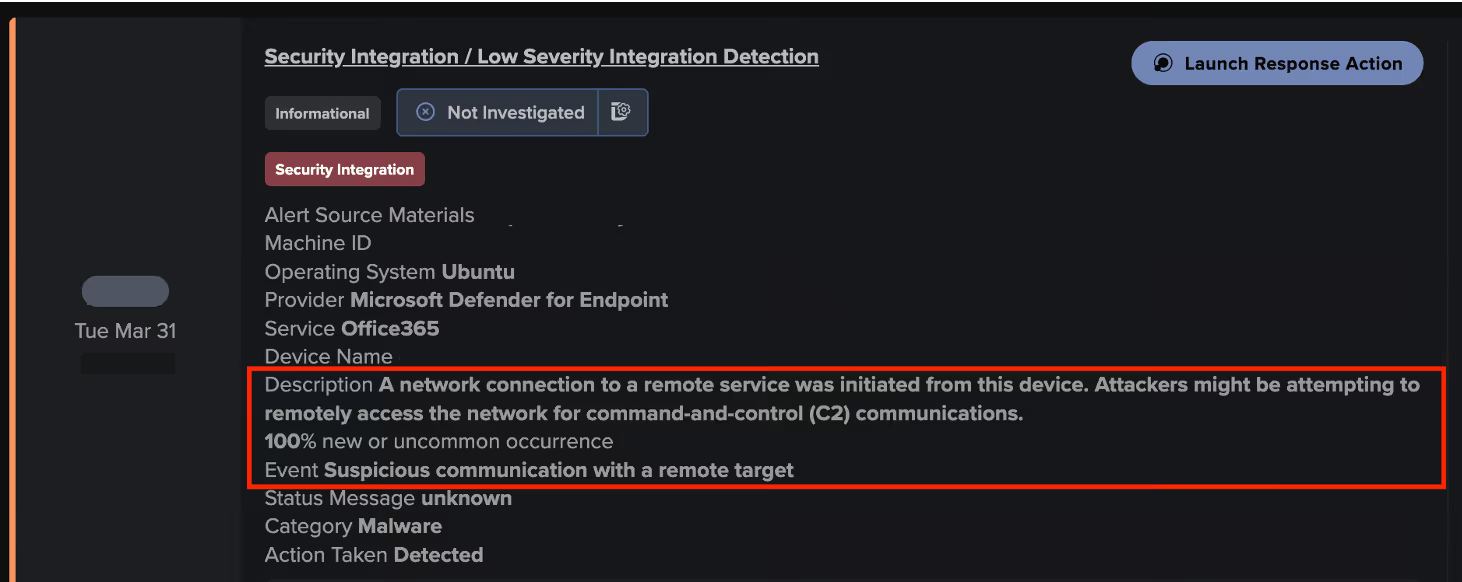
A Security Integration Alert from Microsoft Defender for Endpoint associated with the Axios supply chain attack.
Figure 2: A Security Integration Alert from Microsoft Defender for Endpoint associated with the Axios supply chain attack.

2. Why Trivy bypassed security tooling trust

Between late February and March 22, 2026, the threat group TeamPCP leveraged credentials from a previous incident to insert malicious artifacts across Trivy’s distribution ecosystem, including its CI automation, release binaries, Visual Studio Code extensions, and Docker container images [2].

While public reporting has emphasized GitHub Actions, Darktrace telemetry highlights attacker execution within CI/CD runner environments, including ephemeral build runners. These execution contexts are typically granted broad trust and limited visibility, allowing malicious activity within build automation to blend into expected operational workflows, regardless of provider.

This was a coordinated multi‑phase attack:

  • 75 of 76  of trivy-action tags and all setup‑trivy tags were force‑pushed to deliver a malicious payload.
  • A malicious binary (v0.69.4) was distributed across all major distribution channels.
  • Developer machines were compromised, receiving a persistent backdoor and a self-propagating worm.
  • Secrets were exfiltrated at scale, including SSH keys, Kuberenetes tokens, database passwords, and cloud credentials across Amazon Web Service (AWS), Azure, and Google Cloud Platform (GCP).

Within Darktrace’s customer base, an AWS EC2 instance monitored by Darktrace / CLOUD  appeared to have been impacted by the Trivy attack. On March 19, the device was seen connecting to the attacker-controlled C2 server scan[.]aquasecurtiy[.]org (45.148.10[.]212), triggering the model 'Anomalous Server Activity / Outgoing from Server’ in Darktrace / CLOUD.

Despite this limited historical context, Darktrace assessed this activity as suspicious due to the rarity of the destination endpoint across the wider deployment. This resulted in the triggering of a model alert and the generation of a Cyber AI Analyst incident to further analyze and correlate the attack activity.

TeamPCP’s continued abused of GitHub Actions against security and IT tooling has also been observed more recently in Darktrace’s customer base. On April 22, an AWS asset was seen connecting to the C2 endpoint audit.checkmarx[.]cx (94.154.172[.]43). The timing of this activity suggests a potential link to a malicious Bitwarden package distributed by the threat actor, which was only available for a short timeframe on April 22. [4][3]
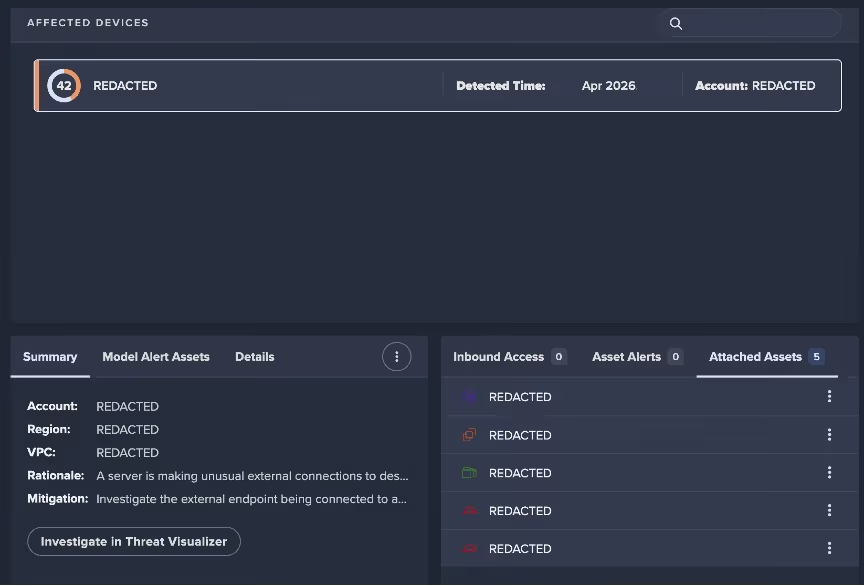
Figure 3: A model alert flagging unusual external connectivity from the AWS asset, as seen in Darktrace / CLOUD .

While the Trivy activity originated within build automation, the underlying failure mode mirrors later intrusions observed via management tooling. In both cases, attackers leveraged platforms designed for scale and trust to execute actions that blended into normal operational noise until downstream effects became visible.

Quest KACE: Legacy Risk, Real Impact

The Quest KACE System Management Appliance (SMA) incident reinforces that software risk is not confined to development pipelines alone. High‑trust infrastructure and management platforms are increasingly leveraged by adversaries when left unpatched or exposed to the internet.

Throughout March 2026, attackers exploited CVE 2025-32975 to authentication on outdated, internet-facing KACE appliances, gaining administrative control and pushing remote payloads into enterprise environments. Organizations still running pre-patch versions effectively handed adversaries a turnkey foothold, reaffirming a simple strategic truth: legacy management systems are now part of the supply-chain threat surface, and treating them as “low-risk utilities” is no longer defensible [3].

Within the Darktrace customer base, a potential case was identified in mid-March involving an internet-facing server that exhibited the use of a new user agent alongside unusual file downloads and unexpected external connectivity. Darktrace identified the device downloading file downloads from "216.126.225[.]156/x", "216.126.225[.]156/ct.py" and "216.126.225[.]156/n", using the user agents, "curl/8.5.0" & "Python-urllib/3.9".

The timeframe and IoCs observed point towards likely exploitation of CVE‑2025‑32975. As with earlier incidents, the activity became visible through deviations in expected system behavior rather than through advance knowledge of exploitation or attacker infrastructure. The delay between observed exploitation and its addition to the Known Exploited Vulnerabilities (KEV) catalogue underscores a recurring failure: retrospective validation cannot keep pace with adversaries operating at automation speed.

The strategic pattern: Ecosystem‑scale adversaries

The Axios and Trivy compromises are not anomalies; they are signals of a structural shift in the threat landscape. In this post-trust era, the compromise of a single maintainer, repository token, or CI/CD tag can produce large-scale blast radiuses with downstream victims numbering in the thousands. Attackers are no longer just exploiting vulnerabilities; they are exploiting infrastructure privileges, developer trust relationships, and automated build systems that the industry has generally under secured.

Supply‑chain compromise should now be treated as an assumed breach scenario, not a specialized threat class, particularly across build, integration, and management infrastructure. Organizations must operate under the assumption that compromise will occur within trusted software and automation layers, not solely at the network edge or user endpoint. Defenders should therefore expect compromise to emerge from trusted automation layers before it is labelled, validated, or widely understood.

The future of supply‑chain defense lies in continuous behavioral visibility, autonomous detection across developer and build environments, and real‑time anomaly identification.

As AI increasingly shapes software development and security operations, defenders must assume adversaries will also operate with AI in the loop. The defensive edge will come not from predicting specific compromises, but from continuously interrogating behavior across environments humans can no longer feasibly monitor at scale.

Credit to Nathaniel Jones (VP, Security & AI Strategy, FCISCO), Emma Foulger (Global Threat Research Operations Lead), Justin Torres (Senior Cyber Analyst), Tara Gould (Malware Research Lead)

Edited by Ryan Traill (Content Manager)

Appendices

References:

1)         https://www.infosecurity-magazine.com/news/hackers-hijack-axios-npm-package/

2)         https://thehackernews.com/2026/03/trivy-hack-spreads-infostealer-via.html

3)         https://thehackernews.com/2026/03/hackers-exploit-cve-2025-32975-cvss-100.html

4)         https://www.endorlabs.com/learn/shai-hulud-the-third-coming----inside-the-bitwarden-cli-2026-4-0-supply-chain-attack

5)         https://socket.dev/blog/axios-npm-package-compromised?trk=public_post_comment-text

IoCs

- 142.11.206[.]73 – IP Address – Axios supply chain C2

- sfrclak[.]com – Hostname – Axios supply chain C2

- hxxp://sfrclak[.]com:8000/6202033 - URI – Axios supply chain payload

- 45.148.10[.]212 – IP Address – Trivy supply chain C2

- scan.aquasecurtiy[.]org – Hostname - Trivy supply chain C2

- 94.154.172[.]43 – IP Address - Checkmarx/Bitwarden supply chain C2

- audit.checkmarx[.]cx – Hostname - Checkmarx/Bitwarder supply chain C2

- 216.126.225[.]156 – IP Address – Quest KACE exploitation C2

- 216.126.225[.]156/32 - URI – Possible Quest KACE exploitation payload

- 216.126.225[.]156/ct.py - URI - Possible Quest KACE exploitation payload

- 216.126.225[.]156/n - URI - Possible Quest KACE exploitation payload

- 216.126.225[.]156/x - URI - Possible Quest KACE exploitation payload

- e1ec76a0e1f48901566d53828c34b5dc – MD5 - Possible Quest KACE exploitation payload

- d3beab2e2252a13d5689e9911c2b2b2fc3a41086 – SHA1 - Possible Quest KACE exploitation payload

- ab6677fcbbb1ff4a22cc3e7355e1c36768ba30bbf5cce36f4ec7ae99f850e6c5 – SHA256 - Possible Quest KACE exploitation payload

- 83b7a106a5e810a1781e62b278909396 – MD5 - Possible Quest KACE exploitation payload

- deb4b5841eea43cb8c5777ee33ee09bf294a670d – SHA1 - Possible Quest KACE exploitation payload

- b1b2f1e36dcaa36bc587fda1ddc3cbb8e04c3df5f1e3f1341c9d2ec0b0b0ffaf – SHA256 - Possible Quest KACE exploitation payload

Darktrace Model Detections

Anomalous Connection / Application Protocol on Uncommon Port

Anomalous Server Activity / Outgoing from Server

Anomalous Connection / New User Agent to IP Without Hostname

Anomalous File / EXE from Rare External Location

Anomalous File / Script from Rare External Location

Anomalous Server Activity / New User Agent from Internet Facing System

Anomalous Server Activity / Rare External from Server

Antigena / Network / External Threat / Antigena Suspicious File Block

Antigena / Network / External Threat / Antigena Suspicious File Pattern of Life Block

Device / New User Agent

Device / Internet Facing Device with High Priority Alert

Anomalous File / New User Agent Followed By Numeric File Download

Inside the SOC
Darktrace cyber analysts are world-class experts in threat intelligence, threat hunting and incident response, and provide 24/7 SOC support to thousands of Darktrace customers around the globe. Inside the SOC is exclusively authored by these experts, providing analysis of cyber incidents and threat trends, based on real-world experience in the field.
Written by
Nathaniel Jones
SVP, Global Threat Intelligence
Written by
Emma Foulger
Global Threat Research Operations Lead

More in this series

No items found.

Blog

/

/

September 22, 2026

Darktrace / SECURE AI: Extending Behavioral Security for the Age of Agentic AI

Default blog imageDefault blog image

AI is moving faster than the controls built to secure it

Over 80% of Darktrace’s customers now use generative AI services, and the average organization interacted with five different AI provides in August 20261. That level of adoption reflects how quickly AI has become embedded in day-to-day business operations. But as adoption accelerates, so do the opportunities for new forms of exposure that often operate outside traditional security controls. Prompts can expose sensitive information, an over-permissioned agent can turn a routine task into a serious security concern, and an employee using an unsanctioned AI tool to get work done can quietly introduce risk long before the security team is aware of its existence.

Securing AI isn’t a nice-to-have. It's an urgent, board-level requirement for any business that wants AI adoption to be an advantage rather than a liability.

Why traditional security controls fall short

The challenge isn’t a lack of AI security tools, it’s that most security solutions weren’t built for the way AI behaves.  

AI systems are adaptive and, by nature, unpredictable. A prompt can be entirely benign in one context and a serious risk in another. An agent's permissions can look reasonable in isolation and dangerous the moment they're combined with what that agent is actually doing. Rule-based controls, built to catch known signatures and static policy violations, simply aren't designed to catch this kind of subtlety. They might be able to tell you what happened, but they can’t tell you if it mattered.  

Effective AI security requires something different: a deep understanding of what normal looks like across every human, system, and agent in an environment, so the earliest signs of drift, misuse, or compromise stand out as they emerge.

Behavioral understanding is our foundation

Darktrace isn’t reinventing itself to secure AI. We’re extending what we already do. For over a decade, Darktrace has been built on a single premise – that every organization has its own unique, evolving way of operating, shaped by how its systems, users, and devices behave. Understanding that is the only reliable way to catch what rules and signatures miss. Our Adaptive AI™ continuously learns the distinct behaviors, relationships, and operational patterns of every enterprise it protects, building a Unique Behavioral Profile that no other vendor can replicate. It's how we've spent years interpreting ambiguity, uncovering subtle intent, and spotting drift before it becomes dangerous across networks, cloud, identities, email, OT, and endpoints. AI is a new domain, but behavioral security isn't a new discipline for us.

Introducing Darktrace / SECURE AI

Darktrace / SECURE AI helps organizations embrace AI innovation without losing control of how it is used. Delivered through the Darktrace Behavioral Defense Platform™, it provides visibility into AI activity across employees, agents, and AI systems, helping security teams understand how AI is being used throughout their business.

Darktrace then applies behavioral understanding to that activity, adding the context needed to distinguish routine usage from genuine risk. By understanding the relationships between users, agents, systems, and data, / SECURE AI helps organizations move beyond simply observing AI usage to understanding risk, governing behavior against policy, and enabling AI adoption with confidence. The result is greater oversight, stronger governance, and the ability to confidently accelerate AI innovation without creating unmanaged risk.

Securing your AI ecosystem

AI risk doesn't originate from a single source, and effective AI security can't focus on just one layer of the problem. Organizations need visibility, understanding, and governance across the entire AI ecosystem, from the prompts users submit and the agents they create, to the development environments where AI is built and the unsanctioned tools operating outside approved channels. Here's how Darktrace / SECURE AI helps organizations secure each of these areas.

Shadow AI management

Darktrace / SECURE AI helps security teams discover unsanctioned AI services and track usage trends over time using Darktrace telemetry and supported SASE integrations such as Microsoft Entra Global Secure Access. It also extends visibility to Model Context Protocol (MCP) usage, helping teams understand where AI tools and agents are connecting to external services. Through Darktrace platform integrations, organizations can block unsanctioned AI usage or quarantine affected devices when needed, helping them reduce exposure and guide users toward approved options.

AI prompt analysis

Prompts reveal what users are asking AI to do, what information they are sharing, and the outcomes they are trying to produce. Darktrace / SECURE AI provides visibility into prompts, sessions, and responses across supported platforms, including Microsoft Copilot, Copilot Studio, ChatGPT Enterprise, Claude, Salesforce, and AWS Bedrock2. Behavioral analysis detects activity such as attempted jailbreaks, sensitive data exposure, and potential indirect prompt injection, while risk scoring helps analysts prioritize the sessions that need attention. Policy Manager maps organizational AI policies against prompt activity and surfaces potential violations, helping teams govern AI use with direct evidence instead of relying on fragmented logs or inferred intent.

AI agent identities and actions

AI agents have their own permissions, roles, relationships, and access to systems and data. Darktrace / SECURE AI brings agent identities together with the users interacting with them, giving security teams visibility into access, sessions, and connections across supported environments. A real-time audit trail helps teams continuously evaluate whether an agent’s activity remains aligned with its intended purpose, so they can identify excessive access or behavioral drift before it becomes a security issue.

AI agent development risk management

Many AI risks are introduced during development, when agents are created, permissions are assigned, and connections to data sources are established. Darktrace / SECURE AI provides visibility across both low-code and high-code environments. In platforms such as AWS Bedrock, teams can examine AI architecture and the agent identities involved in development and deployment. In low-code environments, such as Copilot Studio, they can observe agents as they are created, monitor whether behavior stays aligned with their intended purpose, and connect prompt activity during development with behavior in production. This helps organizations address misconfigurations and excessive permissions before they reach production.

The promise of AI, secured

The question isn't whether to adopt AI, it's whether security teams can enable secure adoption that allows every business to benefit from AI’s potential.

Darktrace / SECURE AI is built to solve this problem – extending a decade of behavioral understanding to the newest, fastest-moving part of the enterprise, using the same principles which already protect people and hybrid infrastructure.

Darktrace / SECURE AI is generally available now. Discover the product, or get a demo today.

[related-resource]

[1] Based on aggregated Darktrace product telemetry across a fleet of ~8,200 observed deployments, measuring generative AI service usage across accounts monitored in August 2026. The 80%+ figure reflects the share of monitored accounts with any generative AI service usage during the same period.

[2] Microsoft, Copilot, ChatGPT, Claude, Salesforce, and Amazon Bedrock are trademarks of their respective owners.

Continue reading
About the author
Brittany Woodsmall
Senior Product Marketing Manager, AI

Blog

/

/

September 17, 2026

The Problem of Re-defining Human Value in the Agentic Age

Default blog imageDefault blog image

Newsfeeds are constantly informing us about the rapid escalation of agentic AI systems. These systems move far beyond simple machine-based computations, and  the focused, defined and bounded assistance that most AI systems started out as.

The next evolution of AI will harness the agentic properties of orchestration, automation, and heightened value-chains in IT, taking on the burden of workflow management, not just workflow delivery.

In nearly all of these instances, promises are made such as ‘this will free up human time’ or ‘this will allow people to focus on higher-order strategy’. However that message is delivered, one thing is clear: in ceding the orchestration and management of work to increasingly sophisticated AI agents and agentic systems, human value will be elevated to a particular and specific layer: the ability to judge its outputs.  As AI takes on more tasks, humans should be able to focus on a higher level of governance; making sure the decisions that AI offers us are ethical, responsible and worthwhile.  

But there are two major problems with that approach.

This blog discusses the problem of how Agentic systems are re-shaping how we review information, where we fit in, and when we make decisions.  It also discusses the problem of how the increased flow of confident, generated information affects the way we make judgement.  This blog considers how human judgement needs to adapt, and how a behavioral defense approach – using techniques pioneered by Darktrace – can help us do that.

The challenge of knowing where human judgement belongs

As we confer more automated decision-making to agentic systems, it might look increasingly less like ‘granting permissions’, and more like ‘surrendering authority’.  

The judgement layer for AI-generated work is not a fixed boundary. We have become used to the idea of a ‘human in the loop’ (HITL) and, historically, relationships between humans and IT systems were reasonably clear and bounded.  Computer and software systems were programmed to carry out certain tasks or automated functions, and humans could control the gates and decision points where actions were undertaken. Even across highly complex computational workflows, human interaction was a controllable node within the process; we were able to configure and regulate. But in the agentic age, where that human interaction sits, and what it can influence shifts every time AI systems are granted autonomy.  

This leads us to the first problem: if humans are moving themselves (or are being moved) into the ‘judgement’ part of the value chain, exactly where and when do we exercise that judgement?  

Humans are no longer the sole shepherds of computer-based or software-controlled outputs.  We are at times at least one step further (and slower) behind the new agentic shepherds.  We might also be blind to what they are doing.  Not only might we be removed and blind to the actions of our AI shepherds, but with the challenge of unknown, unapproved AI systems operating beyond our control, humans might not even know that our work is being shepherded by an AI at all.  Simply put, with the advent of greater levels of autonomy and orchestration, humans are at risk of not even knowing where to apply our newly-extended powers of strategic judgement.

Shadow AI – the use of unapproved AI systems or processes – is a growing threat to the role of effective governance and oversight. Shadow AI isn't just the AI you can't see. Its the AI you already know about being used in an unapproved way. The ability to generate effective oversight of the AI systems you use (or that are used on your behalf) will be increasingly important to ensure that human judgement in the AI value chain is effective, and deliberately placed.

The problem of what makes good judgement

The second problem lies in how flawed human judgement can be.  Humans are historically, notoriously, and, sometimes dangerously, unreliable when it comes to exercising judgement.  Humans are prone to the worst kinds of bias, the seduction of malign influence, and the sometimes-overwhelming urge to succeed. AI has long had a known flaw of operating with sycophancy, providing outputs that tend to agree with or flatter the human user.  But as AI grows ever more effective, there is a risk of both hyper-enablement (where humans increasingly and knowingly enable AI despite potential harm), as well as the greater risk of suggestion. Both of these aspects could skew the newly-elevated input of human judgement.

Imagine a highly competent AI system that has just orchestrated and managed a dizzying array of processes and workflows.  The AI is designed to present the human decision-maker with recommendations; based on analysis, comparison and other programmed factors.  This is where the human judgement layer is enabled.  But what if that judgement is summarily diffused by an AI-based recommendation that emulates the decision, provides plausible but unattractive alternatives, then suggests (or, worse, directs) the human end-user to take a particular course of action.

The risk here is that you are given a recommendation, tailored to your preferences (which the AI has learned, or which you have divulged), and which appears to make perfect sense.  It appears to be a well-weighted recommendation, with sound arguments that tap into our inherent biases or inclinations so that a specific decision-path is followed. With the growth of agentic systems specifically designed to match user profiles (from Cowork agents to ‘digital twin’ models), the likelihood of agentic influence could badly skew human judgement or, at the least, devalue the proposition that humans are taking a higher-layer of strategic control over AI-based decisions.

If AI convincingly recommends something that may be problematic, it can be difficult to discern both accurate data, and the context required to make the right judgement.

Given the two problems described above, the job of exercising valuable human judgement in the agentic age can draw down to these two questions:

  • When should humans intervene in the agentic process?  
  • How can we make the best possible judgement calls?

What humans contribute that AI cannot

For all the flaws that make human judgement unreliable, people have the edge over even the most sophisticated and powerful AI systems when it comes to issues such as ethics and social context.  An AI system can, with startling granularity, rank the value of adopting a new business proposal: offering predictive metrics on costs, returns, market value, time-to-deliver operations, conformance with legal registers, etc.  But it can’t tell if the business proposal is ethically sound, or if the business venture will potentially affect groups outside of the analyzed proposal. It can’t tell you if the CEO has a ‘bad feeling’ about this effort.  It can’t tell you if this is the right thing to do.  

The ability to add social context, balance complex interpersonal dynamics, understand nuance, and to go beyond what seems economically reasonable is where human judgement can add value.  

Human judgement is difficult to encapsulate in metrics. And the way we train our development may need to adapt too. Rather than building up a gradual, experiential knowledge base, we should think about training the skill of judgement itself; especially for an agentic age.

How behavioral security strengthens AI governance

If this all feels like a vicious circle (‘I need AI help to make good judgements’ / ‘AI can twist what I need to judge’) it needn’t be. The key to this is having a defense-in-depth approach, with tools that can actually help.

This is precisely where behavioral security becomes important. The complex and nuanced way that humans exercise judgement is often rooted in our ability to recognize behavior that doesn't look right. We may not always be able to articulate it immediately, but we can often identify when an action, recommendation, or outcome feels inconsistent with the context around it. As AI systems take on more responsibility across the decision chain, preserving that ability to recognize meaningful deviations becomes increasingly important.

Darktrace’s / SECURE AI is designed to do exactly that. It applies behavioral security to AI ecosystems, helping organizations understand how people, AI tools, identities, and agents interact across the business. By learning the patterns of normal AI usage and surfacing activity that deviates from those patterns, it provides security teams with the context needed to investigate risk, understand unusual behavior, and make informed governance decisions. Rather than relying solely on predefined rules or assumptions, this behavioral understanding helps organizations distinguish between expected AI activity and behavior that warrants closer scrutiny.

This matters because we are already in an era of information overload. If humans are expected to elevate their value through strategic judgement, the ability to do this without being overwhelmed by data (good or bad) will be critical.  

We need the ability to discern when we're being misled by AI, and whether our judgement calls are being made on the basis of accurate, contextual information. Darktrace / SECURE AI provides that additional layer of defensive security for activity we cannot easily see. Whether it is suspected Shadow AI or skewed recommendations, the net result is a protected organization, where users can more effectively use AI to make positive judgements.

For those where that judgement is a critical skill (both individuals, as well as those working in security teams), improving our metacognition - the ability to understand information in a broader context - will supercharge the value of human judgement. When those judgements are grounded in context rather than assumptions we have better information to make sound decisions.

Conclusion

Human judgement is a skill that is honed over time and experience.  Darktrace’s / SECURE AI employs the same principles, but at machine-speed. Rather than influencing or directing, Darktrace / SECURE AI offers AI-enabled assurance; providing human-based judgement with the right context to make a balanced decision.  

What we judge can be valued by the legitimacy of its outputs. For AI, those outputs are valued on the speed and accuracy of the information provided.  Increasingly for humans, the value of our outputs will be based on the validity of our judgement, and how we justify our decisions in ways that engineer confidence.  

Humans often know more than we can express, while AI is prone to expressing more than it truly understands. Humans can bridge the context AI often fails to appreciate. When that judgement is supported by relevant, impartial AI systems, this is the future space where good AI governance will be exercised.

Discover Darktrace / SECURE AI.

[related-resource]

Continue reading
About the author
Jason Lusted
AI Governance Advisor
Your data. Our AI.
Elevate your network security with Darktrace AI