Introduction to ASPM
Cloud-native application environments introduce unprecedented security complexity. Distributed architectures built on containerized microservices, ephemeral infrastructure, and rapid deployment cycles create dynamic attack surfaces that traditional security tools cannot adequately protect.
Applications no longer exist as monolithic entities. They span multiple cloud providers, rely on third-party APIs, incorporate open-source dependencies, and scale autonomously based on demand. Security teams confront overwhelming alert volumes as disparate tools generate findings without context to distinguish genuine threats from false positives. Fragmented visibility across the Software Development Life Cycle (SDLC) leaves vulnerabilities undetected until production.
Application Security Posture Management (ASPM) addresses these challenges by providing unified visibility, contextual risk assessment, and actionable remediation guidance from code commit through runtime deployment.
What is ASPM?
ASPM is a security discipline that provides unified visibility and risk management across the entire application life cycle. Unlike traditional security testing approaches that operate in isolation, ASPM correlates findings from multiple sources to deliver a comprehensive view of application security posture.
Traditional application security relies on siloed tools such as Static Application Security Testing (SAST) and Dynamic Application Security Testing (DAST), which generate findings independently. These tools identify vulnerabilities but lack the context to determine which pose genuine threats in production environments. ASPM shifts the focus from fragmented testing to correlated risk management, connecting code-level vulnerabilities with runtime behavior and infrastructure configuration.
ASPM establishes a single source of truth for application assets, tracking security posture from initial code commit through production deployment. By aggregating data from security scanners, cloud platforms, and runtime environments, ASPM creates a holistic view that enables organizations to understand which vulnerabilities are exploitable given the actual deployment context.
Why is ASPM critical?
CISOs and DevSecOps teams face mounting pressure to secure applications without slowing development velocity. Several factors make ASPM essential for contemporary organizations.
Key challenges driving ASPM adoption include:
- Alert fatigue: Traditional security tools generate overwhelming volumes of findings, with many false positives that lack exploitability context. Security teams spend significant time triaging alerts that pose minimal actual risk, diverting attention from genuine threats.
- Velocity of development: Rapid CI/CD deployment cycles demand real-time visibility that manual testing and periodic security reviews cannot provide. Applications move from development to production in hours or days, leaving insufficient time for traditional security validation.
- Complex attack surfaces: Modern applications comprise microservices, APIs, and open-source dependencies, creating intricate attack surfaces that span multiple environments. Each component introduces potential vulnerabilities, and understanding how these interconnect requires correlation capabilities that isolated tools lack.
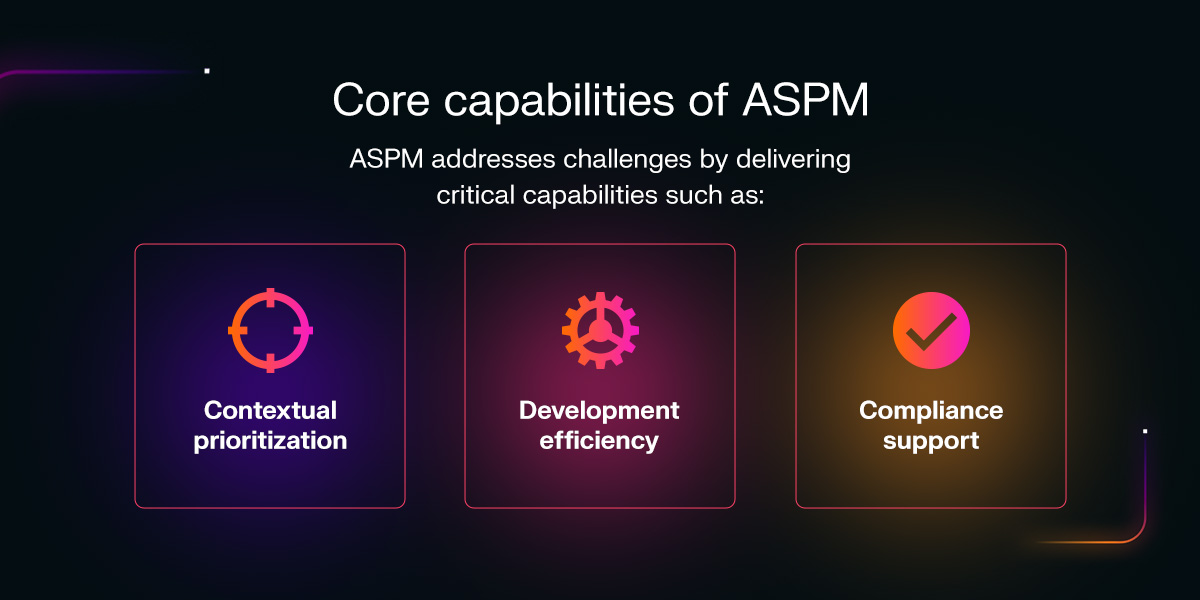
ASPM addresses these challenges by delivering critical capabilities such as:
- Contextual prioritization: ASPM filters vulnerabilities based on actual exploitability, identifying which issues matter given how code is deployed and accessed. For example, a vulnerable library that is never loaded or reachable receives lower priority than an exposed API endpoint with authentication weaknesses.
- Development efficiency: By surfacing only actionable security issues with clear remediation guidance, ASPM empowers developers to address risks without disrupting innovation. Teams focus on fixing vulnerabilities that genuinely threaten the organization rather than chasing theoretical concerns.
- Compliance support: Continuous posture monitoring helps organizations meet standards like SOC 2 and ISO 27001 by maintaining real-time inventories of software assets, tracking security controls, and demonstrating ongoing risk management.
How does ASPM work?
ASPM functions as an intelligence layer above existing security scanners rather than replacing them. Organizations continue to use their established scanning tools, while ASPM adds the correlation and prioritization capabilities needed to make sense of aggregated findings.
Runtime context distinguishes ASPM from traditional security tools. Understanding how applications behave in production environments enables ASPM to identify vulnerabilities that matter, filtering out theoretical risks that cannot be exploited given actual deployment configurations and access patterns.
ASPM operates through a continuous cycle that aggregates, analyzes, and acts on security data throughout the application life cycle. The ASPM workflow includes four core phases:
Ingestion
ASPM platforms gather findings from existing security tools, including SAST scanners that analyze source code, DAST tools that test running applications, Software Composition Analysis (SCA) that identifies open-source vulnerabilities, and Infrastructure as Code (IaC) scanners that detect misconfigurations before deployment.
Correlation
The platform maps code-level findings to cloud infrastructure, linking vulnerabilities discovered in source code with the actual runtime environment. This correlation reveals which vulnerabilities are present in deployed instances, whether they are exposed to external networks, and how they relate to other security controls.
Prioritization
ASPM applies risk scoring that considers both likelihood and business impact. Factors include vulnerability severity, exploitability in the current configuration, exposure to untrusted networks, access to sensitive data, and potential lateral movement paths.
Remediation
The platform generates automated tickets in development workflows and provides developers with specific guidance on fixing issues. Rather than generic vulnerability descriptions, ASPM delivers actionable remediation steps tied to the relevant code repositories and deployment pipelines.
ASPM vs. traditional AppSec tools
ASPM represents an evolution in application security, complementing and extending traditional tools through correlation and context.
ASPM vs. CSPM
Cloud Security Posture Management (CSPM) focuses on securing cloud infrastructure by identifying misconfigurations in cloud services, storage permissions, and network policies. ASPM secures the application layer, analyzing code logic, dependencies, and application-specific vulnerabilities. While CSPM ensures cloud resources are configured correctly, ASPM verifies that the applications running on those resources are secure. Modern security strategies increasingly overlap these disciplines, as application vulnerabilities often interact with infrastructure misconfigurations to create exploitable attack paths.
ASPM vs. vulnerability management
Traditional vulnerability management operates through periodic scans that generate lists of issues ranked by severity scores. This approach lacks continuous monitoring and provides limited context about exploitability. ASPM delivers continuous assessment that updates as code changes and new deployments occur. Rather than generic severity scores, ASPM provides contextual risk ratings based on how vulnerabilities manifest in actual production environments, whether they are exposed to attackers, and what data or systems they could compromise.
The role of CDR
ASPM takes a preventive approach, reducing attack surfaces by identifying and remediating vulnerabilities before they are exploited. However, posture management alone cannot stop live, novel attacks that exploit zero-day vulnerabilities or use sophisticated techniques to evade detection.
Cloud Detection and Response (CDR) serves as the active counterpart to ASPM's preventive focus. While ASPM highlights vulnerabilities in code and configuration, CDR detects active exploitation through behavioral analysis and anomaly detection. CDR identifies when adversaries attempt to exploit vulnerabilities, even previously unknown ones, by recognizing unusual patterns in application behavior, data access, or network communication.
Organizations achieve comprehensive security by combining ASPM's proactive hardening with CDR's real-time threat detection. ASPM reduces the number and severity of vulnerabilities that adversaries can target, while CDR defends against attacks that inevitably target remaining weaknesses.
How to implement ASPM
Successful ASPM implementation requires careful planning and integration with existing development and security workflows.
Organizations should approach implementation through these steps:
- Asset discovery: Establish a complete inventory of code repositories, container images, and runtime environments. Understanding what assets exist and how they interconnect provides the foundation for effective posture management.
- Tool integration: Connect existing development pipelines to the ASPM platform. Integration points typically include version control systems like GitHub, CI/CD platforms such as Jenkins, container registries, and cloud provider APIs.
- Policy definition: Set guardrails for acceptable risk levels across different environments and application types. Policies might specify that no critical vulnerabilities can exist in production or that high-severity issues must be remediated within specific time frames.
- Operationalization: Integrate ASPM findings into developer workflows using tools such as Jira, Slack, and development environment plug-ins. Reducing friction in the remediation process ensures that security issues are addressed promptly rather than creating backlogs.
Learn more about application security
ASPM is essential for reducing risk in complex, cloud-native environments by correlating vulnerabilities across the development life cycle. However, static posture management alone cannot address threats as they unfold in real time.
Darktrace's ActiveAI Security Platform complements ASPM strategies by providing runtime visibility and autonomous response capabilities that static posture tools lack.
Explore Cloud-Native Application Protection Platforms (CNAPP) to see how platform-based approaches integrate posture and runtime security. Download the 2024 Cloud Forensics Threat Report for insights into real-world cloud threats.
Cloud Security Posture Management (CSPM)
As organizations increasingly migrate to the cloud, CSPM tools become critical for ensuring the security of cloud environments. They provide:
- Continuous security assessment: Identifying misconfigurations, vulnerabilities, and compliance gaps in cloud environments.
- Automated remediation: Automating the process of fixing security issues and enforcing security policies.
- Compliance monitoring: Ensuring compliance with industry regulations and best practices.
Key players: Prisma Cloud by Palo Alto Networks, Check Point CloudGuard, Trend Micro Cloud One, Orca Security