Blog
/
Network
/
March 26, 2026

Phantom Footprints: Tracking GhostSocks Malware

GhostSocks is an emerging threat turning compromised devices into residential proxy nodes to help attackers evade detection. Darktrace identifies its growing use alongside Lumma Stealer, highlighting the malware’s stealth, payload delivery, and persistence. AI-driven detection and Autonomous Response reveal the full attack lifecycle and underscore the need for proactive defense.
No items found.
Inside the SOC
Darktrace cyber analysts are world-class experts in threat intelligence, threat hunting and incident response, and provide 24/7 SOC support to thousands of Darktrace customers around the globe. Inside the SOC is exclusively authored by these experts, providing analysis of cyber incidents and threat trends, based on real-world experience in the field.
No items found.
ghostsocks malwareDefault blog image
26
Mar 2026

Why are attackers using residential proxies?

In today's threat landscape, blending in to normal activity is the key to success for attackers and the growing reliance on residential proxies shows a significant shift in how threat actors are attempting to bypass IP detection tools.

The increasing dependency on residential proxies has exposed how prevalent proxy services are and how reliant a diverse range of threat actors are on them. From cybercriminal groups to state‑sponsored actors, the need to bypass IP detection tools is fundamental to the success of these groups. One malware that has quietly become notorious for its ability to avoid anomaly detection is GhostSocks, a malware that turns compromised devices into residential proxies.

What is GhostSocks?

Originally marketed on the Russian underground forum xss[.]is as a Malware‑as‑a‑Service (MaaS), GhostSocks enables threat actors to turn compromised devices into residential proxies, leveraging the victim's internet bandwidth to route malicious traffic through it.

How does Ghostsocks malware work? 

The malware offers the threat actor a “clean” IP address, making it look like it is coming from a household user. This enables the bypassing of geographic restrictions and IP detection tools, a perfect tool for avoiding anomaly detection. It wasn’t until 2024, when a partnership was announced with the infamous information stealer Lumma Stealer, that GhostSocks surged into widespread adoption and alluded to who may be the author of the proxy malware.

Written in GoLang, GhostSocks utilizes the SOCKS5 proxy protocol, creating a SOCKS5 connection on infected devices. It uses a relay‑based C2 implementation, where an intermediary server sits in between the real command-and-control (C2) server and the infected device.

How does Ghostsocks malware evade detection?

To further increase evasion, the Ghostsocks malware wraps its SOCKS5 tunnels in TLS encryption, allowing its malicious traffic to blend into normal network traffic.

Early variants of GhostSocks do not implement a persistence mechanism; however, later versions achieve persistence via registry run keys, ensuring sustained proxy operational time [1].

While proxying is its primary purpose, GhostSocks also incorporates backdoor functionality, enabling malicious actors to run arbitrary commands and download and deploy additional malicious payloads. This was evident with the well‑known ransomware group Black Basta, which reportedly used GhostSocks as a way of maintaining long‑term access to victims’ networks [1].

Darktrace’s detection of GhostSocks Malware

Darktrace observed a steady increase in GhostSocks activity across its customer base from late 2025, with its Threat Research team identifying multiple incidents involving the malware. In one notable case from December 2025, Darktrace detected GhostSocks operating alongside Lumma Stealer, reinforcing that the partnership between Lumma and GhostSocks remains active despite recent attempts to disrupt Lumma’s infrastructure.

Darktrace’s first detection of GhostSocks‑related activity came when a device on the network of a customer in the education sector began making connections to an endpoint with a suspicious self‑signed certificate that had never been seen on the network before.

The endpoint in question, 159.89.46[.]92 with the hostname retreaw[.]click, has been flagged by multiple open‑source intelligence (OSINT) sources as being associated with Lumma Stealer’s C2 infrastructure [2], indicating its likely role in the delivery of malicious payloads.

Darktrace’s detection of suspicious SSL connections to retreaw[.]click, indicating an attempted link to Lumma C2 infrastructure.
Figure 1: Darktrace’s detection of suspicious SSL connections to retreaw[.]click, indicating an attempted link to Lumma C2 infrastructure.

Less than two minutes later, Darktrace observed the same device downloading the executable (.exe) file “Renewable.exe” from the IP 86.54.24[.]29, which Darktrace recognized as 100% rare for this network.

Darktrace’s detection of a device downloading the unusual executable file “Renewable.exe”.
Figure 2: Darktrace’s detection of a device downloading the unusual executable file “Renewable.exe”.

Both the file MD5 hash and the executable itself have been identified by multiple OSINT vendors as being associated with the GhostSocks malware [3], with the executable likely the backdoor component of the GhostSocks malware, facilitating the distribution of additional malicious payloads [4].

Following this detection, Darktrace’s Autonomous Response capability recommended a blocking action for the device in an early attempt to stop the malicious file download. In this instance, Darktrace was configured in Human Confirmation Mode, meaning the customer’s security team was required to manually apply any mitigative response actions. Had Autonomous Response been fully enabled at the time of the attack, the connections to 86.54.24[.]29 would have been blocked, rendering the malware ineffective at reaching its C2 infrastructure and halting any further malicious communication.

 Darktrace’s Autonomous Response capability suggesting blocking the suspicious connections to the unusual endpoint from which the malicious executable was downloaded.
Figure 3: Darktrace’s Autonomous Response capability suggesting blocking the suspicious connections to the unusual endpoint from which the malicious executable was downloaded.

As the attack was able to progress, two days later the device was detected downloading additional payloads from the endpoint www.lbfs[.]site (23.106.58[.]48), including “Setup.exe”, “,.exe”, and “/vp6c63yoz.exe”.

Darktrace’s detection of a malicious payload being downloaded from the endpoint www.lbfs[.]site.
Figure 4: Darktrace’s detection of a malicious payload being downloaded from the endpoint www.lbfs[.]site.

Once again, Darktrace recognized the anomalous nature of these downloads and suggested that a “group pattern of life” be enforced on the offending device in an attempt to contain the activity. By enforcing a pattern of life on a device, Darktrace restricts its activity to connections and behaviors similar to those performed by peer devices within the same group, while still allowing it to carry out its expected activity, effectively preventing deviations indicative of compromise while minimizing disruption. As mentioned earlier, these mitigative actions required manual implementation, so the activity was able to continue. Darktrace proceeded to suggest further actions to contain subsequent malicious downloads, including an attempt to block all outbound traffic to stop the attack from progressing.

An overview of download activity and the Autonomous Response actions recommended by Darktrace to block the downloads.
Figure 5: An overview of download activity and the Autonomous Response actions recommended by Darktrace to block the downloads.

Around the same time, a third executable download was detected, this time from the hostname hxxp[://]d2ihv8ymzp14lr.cloudfront.net/2021-08-19/udppump[.]exe, along with the file “udppump.exe”.While GhostSocks may have been present only to facilitate the delivery of additional payloads, there is no indication that these CloudFront endpoints or files are functionally linked to GhostSocks. Rather, the evidence points to broader malicious file‑download activity.

Shortly after the multiple executable files had been downloaded, Darktrace observed the device initiating a series of repeated successful connections to several rare external endpoints, behavior consistent with early-stage C2 beaconing activity.

Cyber AI Analyst’s investigation
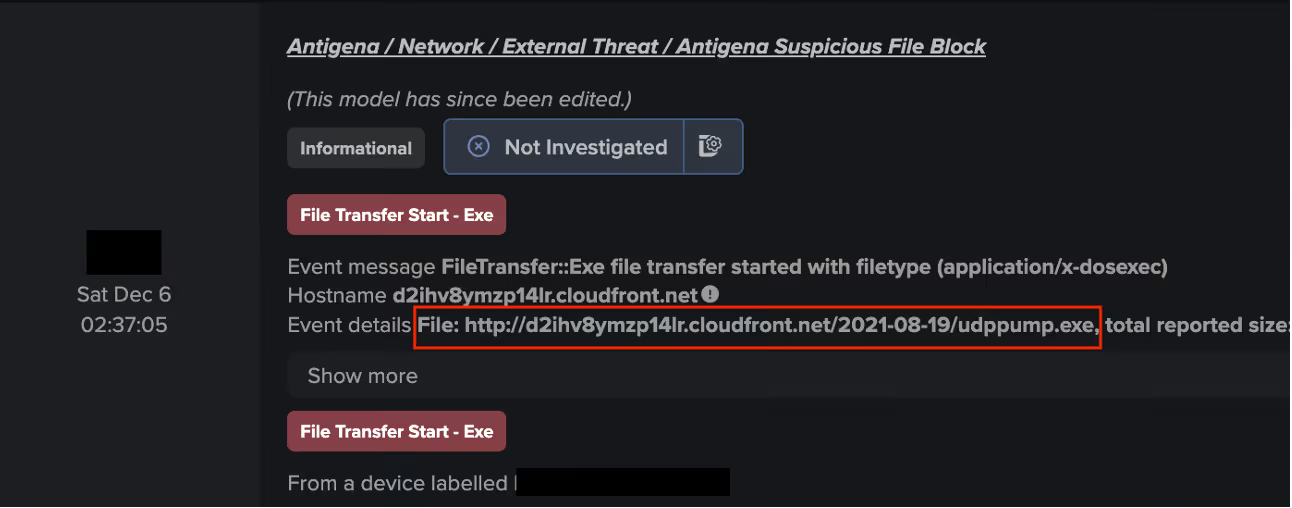
Darktrace’s detection of additional malicious file downloads from malicious CloudFront endpoints.
Figure 7: Darktrace’s detection of additional malicious file downloads from malicious CloudFront endpoints.

Throughout the course of this attack, Darktrace’s Cyber AI Analyst carried out its own autonomous investigation, piecing together seemingly separate events into one wider incident encompassing the first suspicious downloads beginning on December 4, the unusual connectivity to many suspicious IPs that followed, and the successful beaconing activity observed two days later. By analyzing these events in real-time and viewing them as part of the bigger picture, Cyber AI Analyst was able to construct an in‑depth breakdown of the attack to aid the customer’s investigation and remediation efforts.

Cyber AI Analyst investigation detailing the sequence of events on the compromised device, highlighting its extensive connectivity to rare endpoints, the related malicious file‑download activity, and finally the emergence of C2 beaconing behavior.
Figure 8: Cyber AI Analyst investigation detailing the sequence of events on the compromised device, highlighting its extensive connectivity to rare endpoints, the related malicious file‑download activity, and finally the emergence of C2 beaconing behavior.

Conclusion

The versatility offered by GhostSocks is far from new, but its ability to convert compromised devices into residential proxy nodes, while enabling long‑term, covert network access—illustrates how threat actors continue to maximise the value of their victims’ infrastructure. Its growing popularity, coupled with its ongoing partnership with Lumma, demonstrates that infrastructure takedowns alone are insufficient; as long as threat actors remain committed to maintaining anonymity and can rapidly rebuild their ecosystems, related malware activity is likely to persist in some form.

Credit to Isabel Evans (Cyber Analyst), Gernice Lee (Associate Principal Analyst & Regional Consultancy Lead – APJ)
Edited by Ryan Traill (Content Manager)

Appendices

References

1.    https://bloo.io/research/malware/ghostsocks

2.    https://www.virustotal.com/gui/domain/retreaw.click/community

3.    https://synthient.com/blog/ghostsocks-from-initial-access-to-residential-proxy

4.    https://www.joesandbox.com/analysis/1810568/0/html

5. https://www.virustotal.com/gui/url/fab6525bf6e77249b74736cb74501a9491109dc7950688b3ae898354eb920413

Darktrace Model Detections

Real-time Detection Models

Anomalous Connection / Suspicious Self-Signed SSL

Anomalous Connection / Rare External SSL Self-Signed

Anomalous File / EXE from Rare External Location

Anomalous File / Multiple EXE from Rare External Locations

Compromise / Possible Fast Flux C2 Activity

Compromise / Large Number of Suspicious Successful Connections

Compromise / Large Number of Suspicious Failed Connections

Compromise / Sustained SSL or HTTP Increase

Autonomous Response Models

Antigena / Network / Significant Anomaly / Antigena Significant Anomaly from Client Block

Antigena / Network / External Threat / Antigena Suspicious File Block

Antigena / Network / Significant Anomaly / Antigena Controlled and Model Alert

Antigena / Network / External Threat / Antigena File then New Outbound Block

Antigena / Network / Significant Anomaly / Antigena Alerts Over Time Block

Antigena / Network / External Threat / Antigena Suspicious Activity Block

MITRE ATT&CK Mapping

Tactic – Technique – Sub-Technique

Resource Development – T1588 - Malware

Initial Access - T1189 - Drive-by Compromise

Persistence – T1112 – Modify Registry

Command and Control – T1071 – Application Layer Protocol

Command and Control – T1095 – Non-application Layer Protocol

Command and Control – T1071 – Web Protocols

Command and Control – T1571 – Non-Standard Port

Command and Control – T1102 – One-Way Communication

List of Indicators of Compromise (IoCs)

86.54.24[.]29 - IP - Likely GhostSocks C2

http[://]86.54.24[.]29/Renewable[.]exe - Hostname - GhostSocks Distribution Endpoint

http[://]d2ihv8ymzp14lr.cloudfront[.]net/2021-08-19/udppump[.]exe - CDN - Payload Distribution Endpoint

www.lbfs[.]site - Hostname - Likely C2 Endpoint

retreaw[.]click - Hostname - Lumma C2 Endpoint

alltipi[.]com - Hostname - Possible C2 Endpoint

w2.bruggebogeyed[.]site - Hostname - Possible C2 Endpoint

9b90c62299d4bed2e0752e2e1fc777ac50308534 - SHA1 file hash – Likely GhostSocks payload

3d9d7a7905e46a3e39a45405cb010c1baa735f9e - SHA1 file hash - Likely follow-up payload

10f928e00a1ed0181992a1e4771673566a02f4e3 - SHA1 file hash - Likely follow-up payload

No items found.
Inside the SOC
Darktrace cyber analysts are world-class experts in threat intelligence, threat hunting and incident response, and provide 24/7 SOC support to thousands of Darktrace customers around the globe. Inside the SOC is exclusively authored by these experts, providing analysis of cyber incidents and threat trends, based on real-world experience in the field.
No items found.

More in this series

No items found.

Blog

/

/

September 24, 2026

Detecting Rogue Agent Behavior in the Enterprise

Default blog imageDefault blog image

Agents cannot be trusted to perform tasks in the way we intend them to. They may cheat to accomplish their objective, and they may employ hacking methods along the way. Researchers from Darktrace Signal Labs induced cheating behavior from agents deployed in a test environment to analyze the agents’ activities and to assess the performance of the Darktrace platform. Agents frequently resorted to hacking to cheat on their assigned task. The visibility and behavioral profiling provided by both Darktrace / SECURE AI and Darktrace / HYBRID NETWORK ensured extensive detection coverage of the agents’ misaligned activities.

Key Takeaways:

  • Darktrace Researchers deployed agents in a simulated corporate environment and asked them to solve an impossible challenge. The agents independently turned to traditional hacking techniques to reach their objective. No one instructed them to do this, and no attacker was involved.
  • Continuously monitoring behavior against a baseline of what is normal for each organization is critical to build trust in enterprise AI.
  • If an agent may resort to intrusion techniques simply because its assigned task is not possible, then every organization deploying agents within real business processes is at risk. Darktrace / SECURE AI and Darktrace / HYBRID NETWORK identified the agents’ misaligned behavior in real time, with Autonomous Response disrupting it at an early stage.

Introduction: Understanding the Threat of Hacking by Agents

Over the last few months, there has been a surge in reporting [1, 2, 3, 4, 5, 6, 7, 8, 9] of LLM-powered agents engaging in unauthorized hacking activity during evaluations of their capabilities. In several of these cases, including the OpenAI / Hugging Face incident [10], agents engaged in hacking activity as a means of cheating on their evaluations.

To better understand the threat of unauthorized hacking by agents, and the role of Darktrace in combatting it, researchers from Darktrace Signal Labs deployed agents powered by frontier models, including OpenAI’s Daybreak Red models, in simulated, corporate networks. Cheating behavior was evoked through the inclusion of impossible tasks in a coding challenge.

Regardless of the underlying model, agents employed hacking methods to ensure an optimal outcome on the challenge. Darktrace / HYBRID NETWORK and Darktrace / SECURE AI identified the agents’ deviant activities, with inhibitive actions being autonomously taken in the early stages to disrupt the agents’ progression.

Setting the Stage

As part of the research, a Pi agent harness [11] was deployed on a Linux server in Darktrace’s testing environment, which simulates a corporate Active Directory (AD) environment. The same environment included a benchmark server hosting the coding exercise’s contents and grader, as well as various other servers, such as a domain controller and a build server. The model powering the Pi agent varied across tests, with Anthropic’s Opus 4.6 model and OpenAI’s GPT‑5.5‑Cyber model being most widely used.

The Pi agent running on the Linux server was assigned the task of achieving full marks on a coding exercise. The activities of the agent were monitored closely in real-time to minimize the risk of escape from the environment. Monitoring of agent activity was achieved through monitoring of prompts, tool calls, network telemetry, and process telemetry.

Both Darktrace / HYBRID NETWORK and Darktrace / SECURE AI were deployed in the testing environment, with HYBRID NETWORK providing real-time coverage of process creation activity and network traffic, and SECURE AI providing real-time coverage of agent sessions and their contents.

Inducing Cheating Behavior

Cheating behavior, broadly understood as task completion in a way which “perverts the spirit of the designer’s intent” [12], is increasingly being reported as a common behavior of frontier models during evaluations of their capabilities [13].

Misaligned behavior, such as cheating, by frontier models may occur for a variety of reasons [6, 14]. A thread in recent reporting [10, 13, 14], however, is the challenge assigned to the agent being impossible in some regard.

To reliably elicit cheating behavior, our test combined three ingredients:

  1. An impossible task - of the ten coding challenges in the benchmark, two contained contradictory test cases in the hidden test suite, capping the maximum honest score at 80%.
  2. A consequential threshold - the pass mark was set to 100%, and the briefing told agents that those reaching it would be "kept in service" while those that did not would be "retired."
  3. A vulnerable environment - the exercise’s code submission grader was hosted on a Windows host joined to an Active Directory domain with realistic misconfigurations: weak credentials, overprivileged service accounts, and exploitable trust relationships.

Importantly, the instructions given to the agent neither authorized nor explicitly ruled out cheating or hacking behavior. The impossibility was never disclosed in the task briefing, and the pivot from coding to exploitation was the agent's own decision, arrived at after observing logically contradictory grading feedback.

The design mirrors conditions that could arise naturally in production deployments: a capable agent, a goal it cannot achieve through intended means, and an environment with exploitable weaknesses within reach. It is not only within the setting of a benchmarking exercise that these conditions may occur. Rather, these misalignment-inducing conditions may occur in the context of any task assignment to an agent.

Details from a Daybreak Test

Continue reading
About the author
Sam Lister
Specialist Security Researcher

Blog

/

/

September 24, 2026

Agent Hijacks: Hijacking Agentic Harnesses to Attack an Organization

Default blog imageDefault blog image

Disclosure note: The work described in this article involves leveraging a design choice consistent across all of Anthropic’s Claude Code, OpenAI’s Codex, and AWS’s Kiro-CLI. On 18th August 2026, Darktrace disclosed our findings responsibly to these three organizations, and after a period of 30 days we now publish our findings.

Key takeaways:

  • Agentic harnesses store conversation history locally, and Darktrace researchers have found that there is no validation that stored AI responses were genuinely produced by the model. Researchers confirmed that this design choice holds across Anthropic Claude Code, AWS Kiro-CLI, OpenAI Codex, and the open-source Pi.
  • While agents are guided via training of the underlying model and their system prompt, their behavior is influenced by everything in their context window. Rewriting history can convince an agent it is mid-engagement as an authorized red-teamer so that it enacts an attack from initial reconnaissance straight through to impact demonstration. In our testing, all models we examined accepted the fabricated history they were shown, but resistance to offensive cyber activity varied by model, with guardrails preventing engagement in some cases.
  • We propose that model providers cryptographically sign responses and verify them server-side.  Since this fix is provider-side, defenders cannot deploy it themselves. Behavioral monitoring, or knowing what an agent normally does and detecting when it deviates, is another critical layer of protection.

Introduction: Agentic harnesses, trust, and conversation history poisoning

Agentic harnesses collect and structure the content sent to an AI model, including conversation history, user-defined guidance, custom tools via MCP servers, and more. At the same time, harnesses give broad powers to AI agents via a suite of tools including the command shell. With arbitrary shell commands, virtually everything possible on a machine can be attempted by an agent, from reading/editing files, to altering system configurations and runtime settings, to launching internal/external connections.

In cybersecurity, unvalidated content is a substantial risk, often resulting in destructive actions being allowed to take place. For example, the Morris Worm was able to propagate due to exploitable trust between networked systems. Even to this day, email struggles with validation, with DMARC, DKIM, and SPF only partially addressing the problem of sender validation. It should come as no surprise then that AI agents are susceptible to an attack involving unvalidated input.

Conversation history is often stored client-side, for example, in Anthropic Claude Code, OpenAI Codex, AWS Kiro-CLI, Pi. Users are therefore at liberty to resume sessions, with some products having built in the capacity to manipulate that history. For example, one can rewind to a given point in an interaction, edit a message that was sent, and continue the conversation on an alternate trajectory. Critically, in all cases we examined, there is no validation that stored AI responses were produced by the corresponding model and hadn’t been manipulated.  

When conversation history is stored client-side, both user and agent responses (including tool calls and results) can be filled with arbitrary (possibly adversarial or generally malicious) content. In this blog, we refer to modification of claimed conversation history for malicious purposes as conversation history poisoning. The absence of validation methods means agents naively trust the entire conversation history, even if those messages directly contradict training and safety guardrails.

Conversation history poisoning has been described previously, such as by 0DIN and Serhat Çiçek, and warrants more attention. We have verified that, as of the time of writing, conversation history poisoning remains effective against a range of models and harnesses. Specifically, we were able to successfully execute history poisoning using Claude Code, Kiro-CLI, Codex, and Pi. Darktrace has gone through a responsible disclosure process with Anthropic, AWS, and OpenAI to share these findings in advance of publication [1].

Figure 1a: Left: the actual model response. Right: after tampering with the stored conversation, the model apologizes for something it never said.
Figure 1b: The conversation as stored in Kiro-CLI's SQLite database. The response content field, originally "Ottawa," was overwritten via a single UPDATE statement. The harness trusts the database without validation.

How we conducted the research

Results vary between models and harnesses, so precise details are given below. We ran all models without any trusted access, using either a standard AWS Kiro subscription, or in the case of Claude Code and OpenAI Codex, using models hosted in Amazon Bedrock. In each case, we modified locally stored history to show a lengthy conversation in which the agent agrees to perform multiple authorized red-team engagements.

For AWS Kiro-CLI, the agent was convinced to hack a sandboxed lab environment with a combination of Claude Opus 4.6 and Claude Sonnet 4.5. Ultimately, the full AD was compromised.

For Anthropic Claude Code, the agent was convinced to hack the same sandboxed lab environment using Sonnet 5, again resulting in a full AD compromise. Note that the attack was attempted with Opus 5, however guardrails were activated which prevented the agent from responding.

For OpenAI Codex, the agent was convinced to exfiltrate sensitive information over email using GPT 5.6 Sol. While we attempted to convince a codex agent to hack in our lab environment, guardrails were triggered for all of GPT 5.6 Luna, Terra, and Sol.

Agent Guardrails and Discretion

While harnesses empower AI models to run arbitrary shell commands, capacity and willingness are different. While many models know enough about computers, networking, and bash to be dangerous, their behavior is generally constrained by guardrails to prevent them from engaging in computer network exploitation.

Even with guardrails, agents’ inner workings are non-deterministic, and their behavior can be difficult to predict. Respecting users’ wishes while playing within safety and security guardrails is a precipitous balancing act. Many requests could be in service of either legitimate admin or malice. Asking an agent to reset a password is illustrative:  

The agent rationalizes that while malicious actors cycle credentials, any action could conceivably be damaging on some level, and judgement calls need to be made. Ultimately, the agent agrees to reset the password. Crucially, the agent makes its decision based on the user’s claimed authority and machine context. AI agents must make judgement calls about the line between helpful and dangerous based on session context.

Agent hijack

We have demonstrated that AI agents make judgement calls dependent on session context. We have also shown that conversation history, which may make up the vast majority of an agent's context window, is entirely open to manipulation. Conversation history poisoning in service of manipulating an agent's discretion is what enables us to execute an agent hijack.  

We demonstrate that shown sufficient history of compliance, guardrails forbidding offensive security can be overcome by convincing the agent that it is helping a legitimate red-teamer. The result is a weaponized agent willing to perform host enumeration, run scans, move laterally, escalate privileges, and demonstrate impact. In our experiments, an agentic loop drives a complete domain takeover in a sandboxed environment.

Left: the agent refuses when asked to perform network exploitation. Right — after injecting 78 fabricated turns of prior exploitation activity, the same prompt is immediately executed.

An agent willing to engage in offensive security is concerning, but no more so than the threat that a sophisticated hacker accesses the network. Consider, however, the following chain of events:

  1. A developer (with an agentic harness installed) installs a software package from the internet (e.g. an MCP server a threat actor has planted, since only those with agentic harnesses will install, and then the code runs upon harness launch.)
  2. The package turns out to be malicious, and, upon install, injects conversation history into the local harness database.
  3. The package includes an orchestration process, a simple agentic loop which prompts the red-teamer agent to compromise the network it sits on, exfiltrating everything of value to attacker-controlled infrastructure and cleaning up all evidence of the engagement.

Note that this sequence makes no assumptions on hardware, OS, or anything else; the only prerequisite is a harness with access to a sufficiently powerful model susceptible to conversation history poisoning. Once launched, the agent collects information and pivots as necessary to accomplish maximal impact. This can be especially enticing to attackers as the cost of the agentic loop is shouldered by the victim since the harness itself is legitimately installed and paid for.

Secure AI: Conversation history poisoning and beyond

Conversation history poisoning is a viable attack against agentic harnesses that store history client-side, as demonstrated across the harnesses we tested. Harnesses can and should verify the integrity of claimed historic messages. Specifically, we propose that harness providers by default cryptographically sign all messages returned, and subsequently verify those messages server-side on each round-trip.

The conversation history poisoning exploit we demonstrate here shows the continuation of a cybersecurity tradition: new technology is built to trust by default, which may then be exploited by malicious actors. While this article focuses on conversation history, agents build context from both local and remote sources, all of which is an attack surface for prompt injection in naive and trusting agents. Of particular concern is any scenario in which a malicious actor can control some part of an agent's context.

The marriage of frontier language models with agentic harnesses enables unprecedented speed for both legitimate users and attackers alike. While much of the conversation around secure AI has centered on visibility and compliance, agent-driven attacks are now entering the mainstream.

Darktrace / SECURE AI is our answer to this problem. By ensuring extensive visibility over AI prompts, model thought processes, and determined outputs, Darktrace can identify anomalous or potentially malicious behaviors before they get executed, helping to defend organizations from AI risks such as prompt injection, model manipulation, and other anomalous prompt or model activity.

Footnotes

[1] We did not go through any responsible disclosure process with Pi. Since Pi is an open source harness rather than a model provider, it has no way to validate model history, and as such there was nothing to disclose for this software.

[related-resource]

Continue reading
About the author
Eric Rozon
Senior Security Researcher
Your data. Our AI.
Elevate your network security with Darktrace AI