Blog
/
Network
/
November 5, 2025

Tracking a Dragon: Investigating a DragonForce-affiliated ransomware attack with Darktrace

Darktrace investigates a DragonForce-affiliated ransomware attack targeting the manufacturing sector. The blog details the attack lifecycle, from network scanning and credential brute-forcing to data exfiltration and file encryption.
Inside the SOC
Darktrace cyber analysts are world-class experts in threat intelligence, threat hunting and incident response, and provide 24/7 SOC support to thousands of Darktrace customers around the globe. Inside the SOC is exclusively authored by these experts, providing analysis of cyber incidents and threat trends, based on real-world experience in the field.
Written by
Justin Torres
Cyber Analyst
Tracking a Dragon: Investigating a DragonForce-affiliated ransomware attack with Darktrace Default blog image
05
Nov 2025

What is DragonForce?

DragonForce is a Ransomware-as-a-Service (RaaS) platform that emerged in late 2023, offering broad-scale capabilities and infrastructure to threat actors. Recently, DragonForce has been linked to attacks targeting the UK retail sector, resulting in several high-profile cases [1][2]. Moreover, the group launched an affiliate program offering a revenue share of roughly 20%, significantly lower than commissions reported across other RaaS platforms [3].

This Darktrace case study examines a DragonForce-linked RaaS infection within the manufacturing industry. The earliest signs of compromise were observed during working hours in August 2025, where an infected device started performing network scans and attempted to brute-force administrative credentials. After eight days of inactivity, threat actors returned and multiple devices began encrypting files via the SMB protocol using a DragonForce-associated file extension. Ransom notes referencing the group were also dropped, suggesting the threat actor is claiming affiliation with DragonForce, though this has not been confirmed.

Despite Darktrace’s detection of the attack in its early stages, the customer’s deployment did not have Darktrace’s Autonomous Response capability configured, allowing the threat to progress to data exfiltration and file encryption.

Darktrace's Observations

While the initial access vector was not clearly defined in this case study, it was likely achieved through common methods previously employed out by DragonForce affiliates. These include phishing emails leveraging social engineering tactics, exploitation of public-facing applications with known vulnerabilities, web shells, and/or the abuse of remote management tools.

Darktrace’s analysis identified internal devices performing internal network scanning, brute-forcing credentials, and executing unusual Windows Registry operations. Notably, Windows Registry events involving "Schedule\Taskcache\Tasks" contain subkeys for individual tasks, storing GUIDs that can be used to locate and analyze scheduled tasks. Additionally, Control\WMI\Security holds security descriptors for WMI providers and Event Tracing loggers that use non-default security settings respectively.

Furthermore, Darktrace identified data exfiltration activity over SSH, including connections to an ASN associated with a malicious hosting service geolocated in Russia.
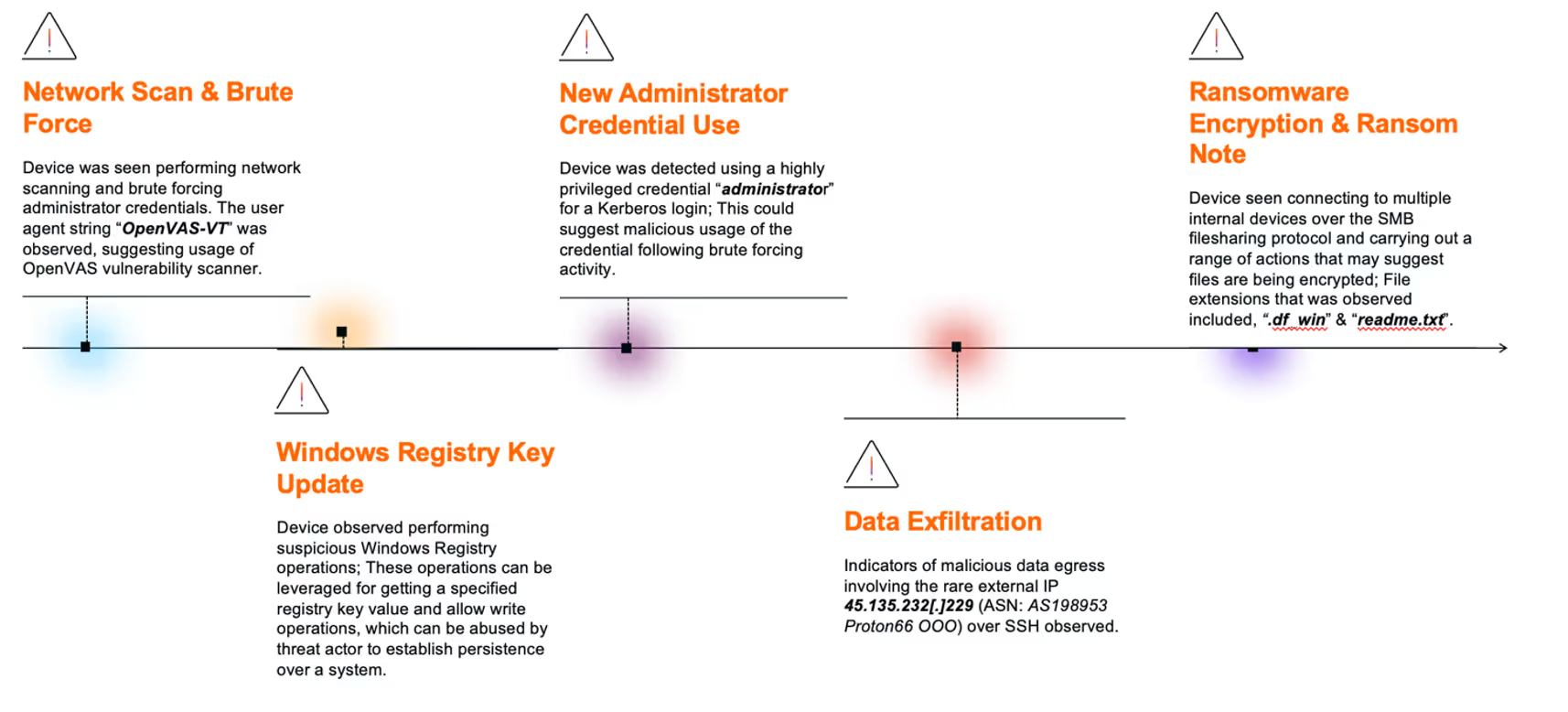
1. Network Scan & Brute Force

Darktrace identified anomalous behavior in late August to early September 2025, originating from a source device engaging in internal network scanning followed by brute-force attempts targeting administrator credential, including “administrator”, “Admin”, “rdpadmin”, “ftpadmin”.

Upon further analysis, one of the HTTP connections seen in this activity revealed the use of the user agent string “OpenVAS-VT”, suggesting that the device was using the OpenVAS vulnerability scanner. Subsequently, additional devices began exhibiting network scanning behavior. During this phase, a file named “delete.me” was deleted by multiple devices using SMB protocol. This file is commonly associated with network scanning and penetration testing tool NetScan.

2. Windows Registry Key Update

Following the scanning phase, Darktrace observed the initial device then performing suspicious Winreg operations. This included the use of the ”BaseRegOpenKey” function across multiple registry paths.

Additional operations such as “BaseRegOpenKey” and “BaseRegQueryValue” were also seen around this time. These operations are typically used to retrieve specific registry key values and allow write operations to registry keys.

The registry keys observed included “SYSTEM\CurrentControlSet\Control\WMI\Security” and “Software\Microsoft\Windows NT\CurrentVersion\Schedule\Taskcache\Tasks”. These keys can be leveraged by malicious actors to update WMI access controls and schedule malicious tasks, respectively, both of which are common techniques for establishing persistence within a compromised system.

3. New Administrator Credential Usage

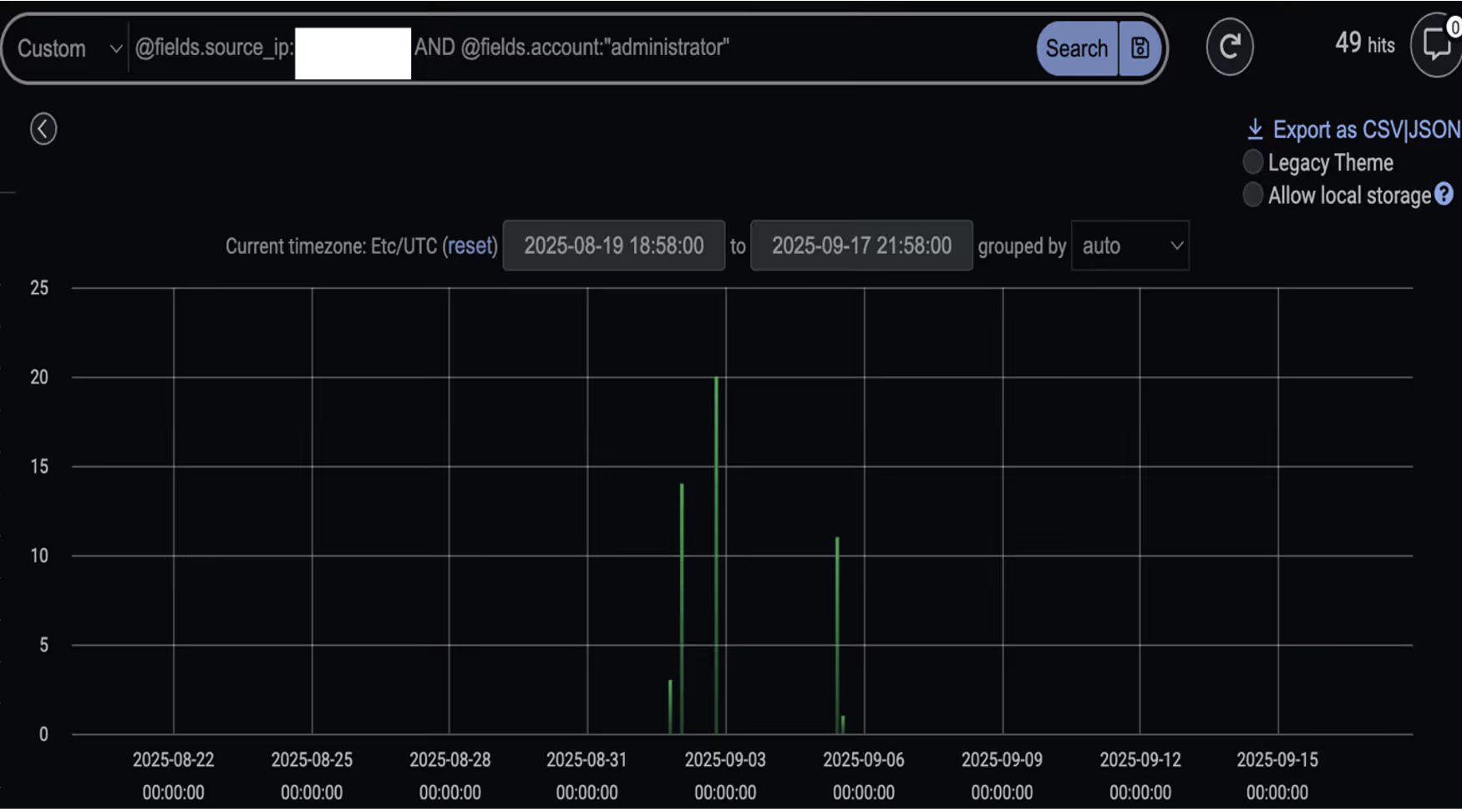
Darktrace subsequently detected the device using a highly privileged credential, “administrator”, via a successful Kerberos login for the first time. Shortly after, the same credential was used again for a successful SMB session.

These marked the first instances of authentication using the “administrator” credential across the customer’s environment, suggesting potential malicious use of the credential following the earlier brute-force activity.
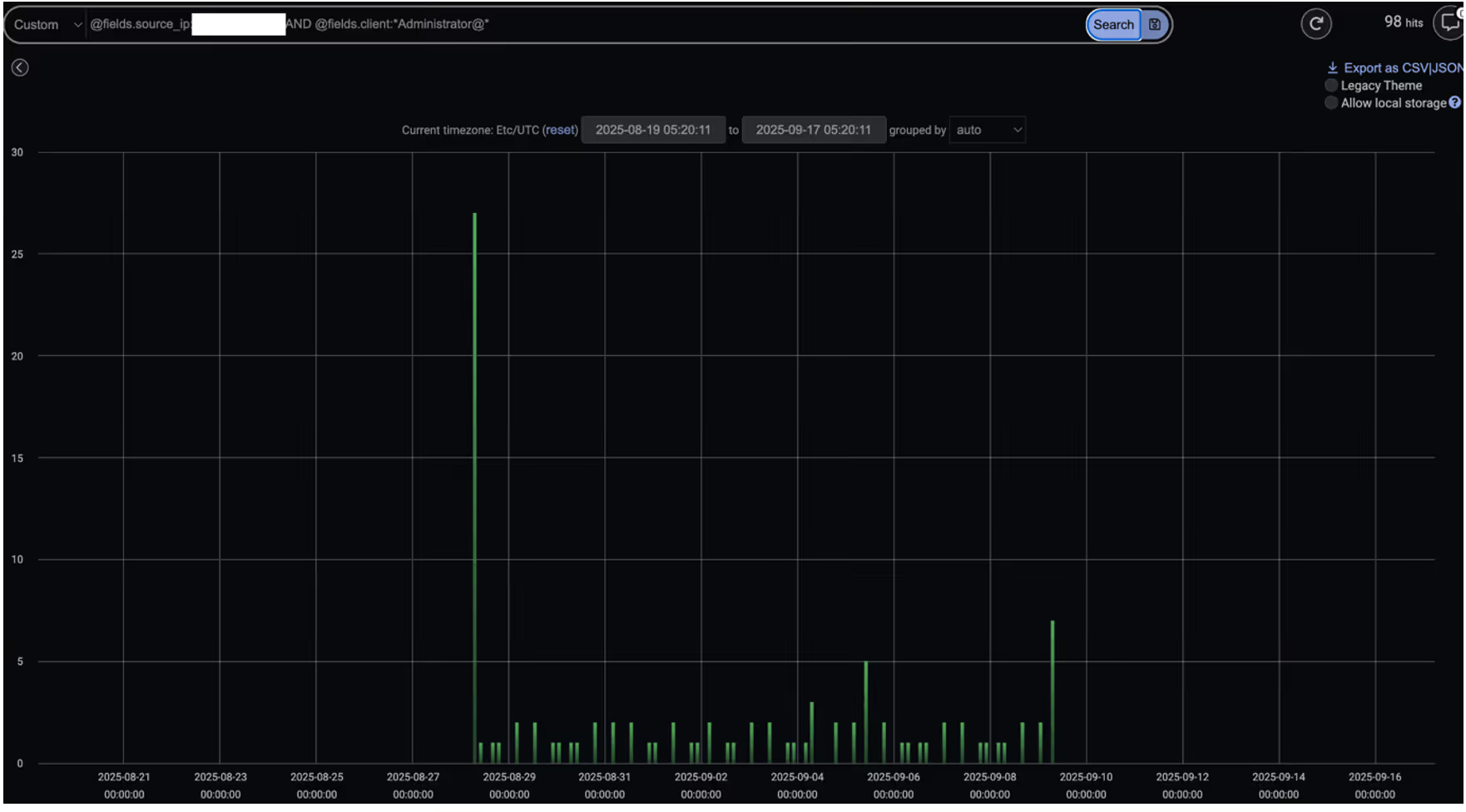
Darktrace’s detection of administrator credentials being used in Kerberos login events by an infected device.
Figure 1: Darktrace’s detection of administrator credentials being used in Kerberos login events by an infected device.
Darktrace’s detection of administrator credentials being used in SMB sessions by an infected device.
Figure 2: Darktrace’s detection of administrator credentials being used in SMB sessions by an infected device.

4. Data Exfiltration

Prior to ransomware deployment, several infected devices were observed exfiltrating data to the malicious IP 45.135.232[.]229 via SSH connections [7][8]. This was followed by the device downloading data from other internal devices and transferring an unusually large volume of data to the same external endpoint.

The IP address was first seen on the network on September 2, 2025 - the same date as the observed data exfiltration activity preceding ransomware deployment and encryption.

Further analysis revealed that the endpoint was geolocated in Russia and registered to the malicious hosting provider Proton66. Multiple external researchers have reported malicious activity involving the same Proton66 ASN (AS198953 Proton66 OOO) as far back as April 2025. These activities notably included vulnerability scanning, exploitation attempts, and phishing campaigns, which ultimately led to malware [4][5][6].

Data Exfiltration Endpoint details.

  • Endpoint: 45.135.232[.]229
  • ASN: AS198953 Proton66 OOO
  • Transport protocol: TCP
  • Application protocol: SSH
  • Destination port: 22
Darktrace’s summary of the external IP 45.135.232[.]229, first detected on September 2, 2025. The right-hand side showcases model alerts triggered related to this endpoint including multiple data exfiltration related model alerts.
Figure 3: Darktrace’s summary of the external IP 45.135.232[.]229, first detected on September 2, 2025. The right-hand side showcases model alerts triggered related to this endpoint including multiple data exfiltration related model alerts.

Further investigation into the endpoint using open-source intelligence (OSINT) revealed that it led to a Microsoft Internet Information Services (IIS) Manager console webpage. This interface is typically used to configure and manage web servers. However, threat actors have been known to exploit similar setups, using fake certificate warnings to trick users into downloading malware, or deploying malicious IIS modules to steal credentials.

Live screenshot of the destination (45.135.232[.]229), captured via OSINT sources, displaying a Microsoft IIS Manager console webpage.
Figure 4: Live screenshot of the destination (45.135.232[.]229), captured via OSINT sources, displaying a Microsoft IIS Manager console webpage.

5. Ransomware Encryption & Ransom Note

Multiple devices were later observed connecting to internal devices via SMB and performing a range of actions indicative of file encryption. This suspicious activity prompted Darktrace’s Cyber AI Analyst to launch an autonomous investigation, during which it pieced together associated activity and provided concrete timestamps of events for the customer’s visibility.

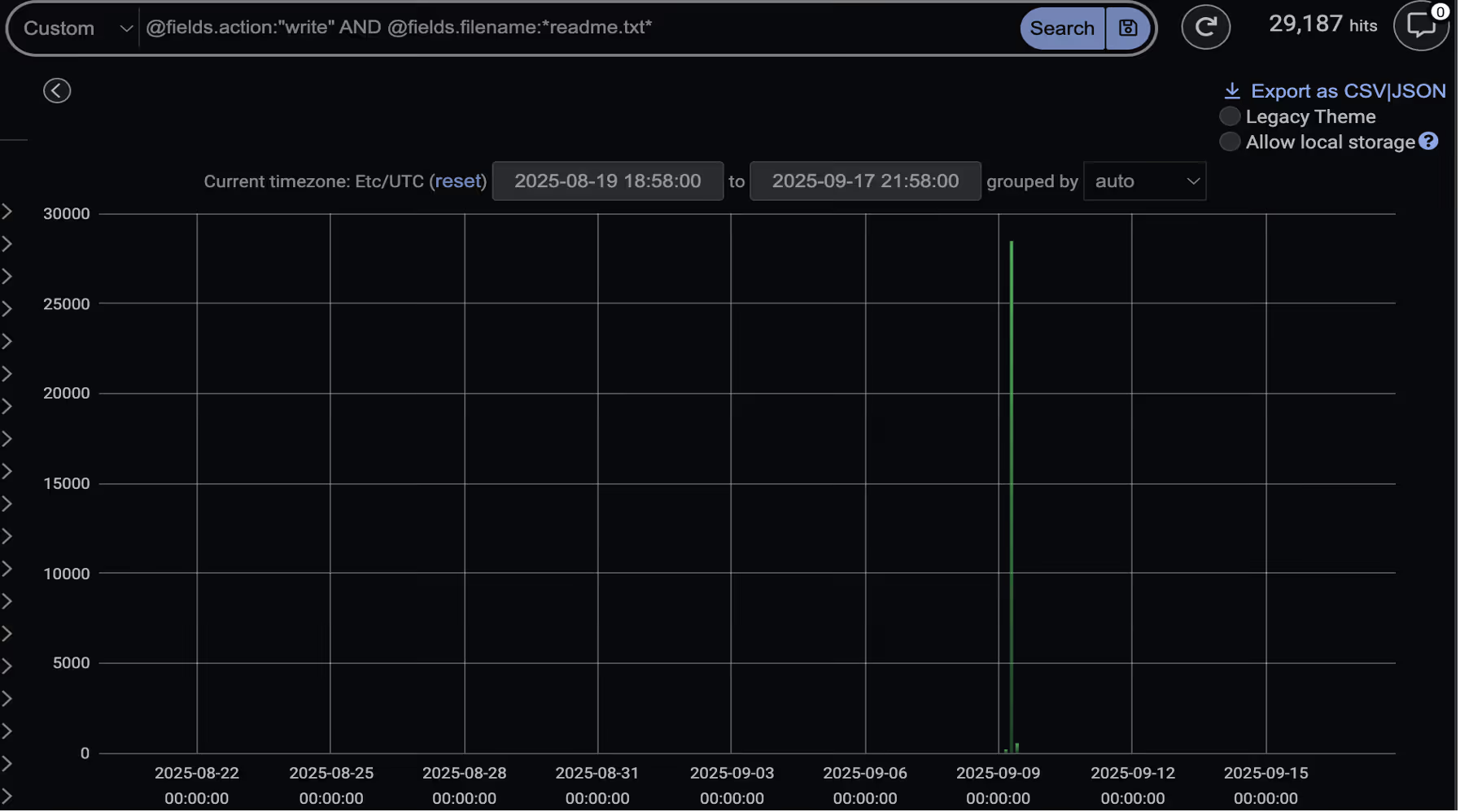
During this activity, several devices were seen writing a file named “readme.txt” to multiple locations, including network-accessible webroot paths such as inetpub\ and wwwroot\. This “readme.txt” file, later confirmed to be the ransom note, claimed the threat actors were affiliated with DragonForce.

At the same time, devices were seen performing SMB Move, Write and ReadWrite actions involving files with the “.df_win” extension across other internal devices, suggesting that file encryption was actively occurring.
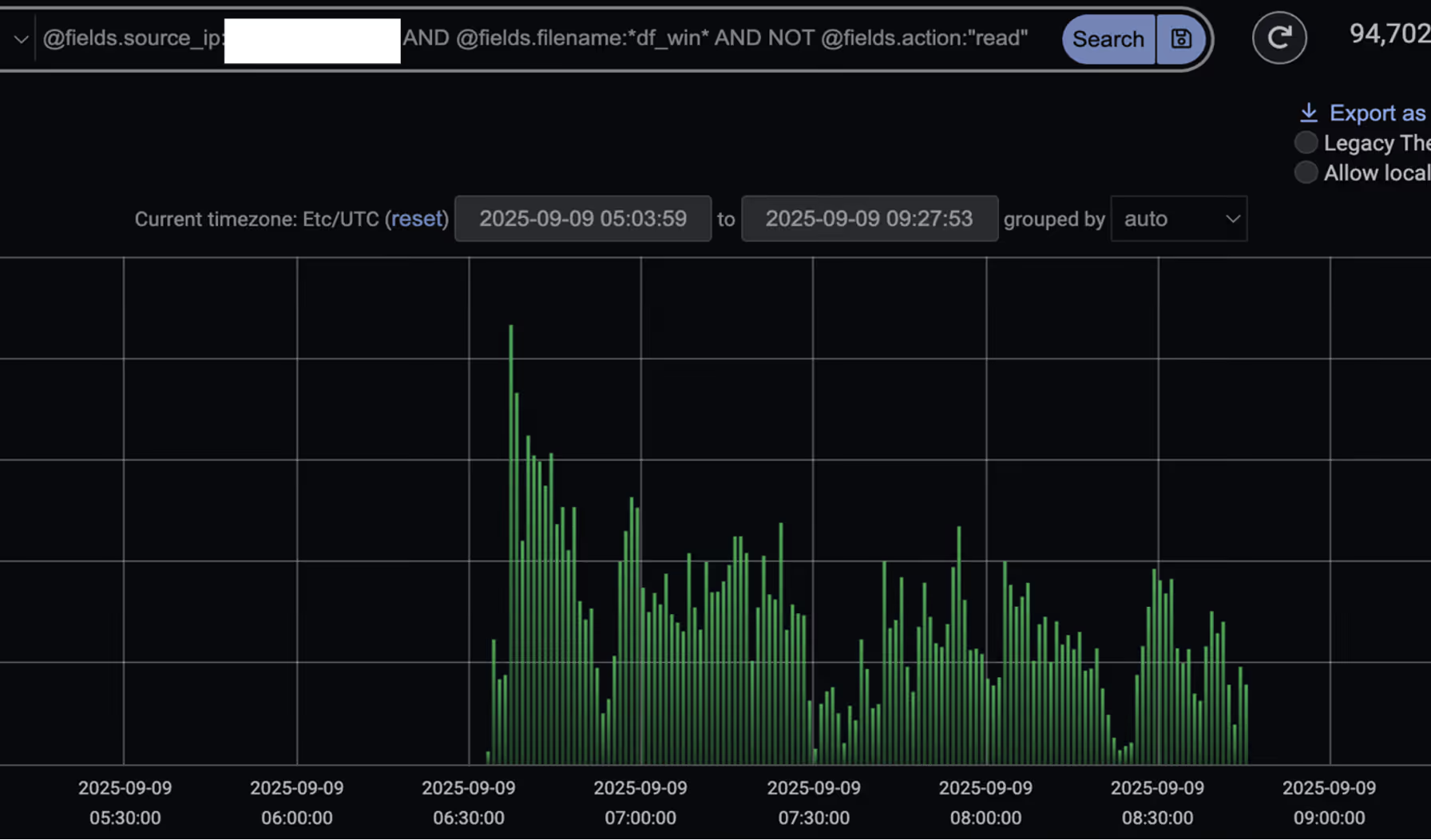
Darktrace’s detection of SMB events (excluding Read events) where the device was seen moving or writing files with the “.df_win” extension.
Figure 5: Darktrace’s detection of SMB events (excluding Read events) where the device was seen moving or writing files with the “.df_win” extension.
Darktrace’s detection of a spike in SMB Write events with the filename “readme.txt” on September 9, indicating the start of file encryption.
Figure 6: Darktrace’s detection of a spike in SMB Write events with the filename “readme.txt” on September 9, indicating the start of file encryption.

Conclusion

The rise of Ransomware-as-a-Service (RaaS) and increased attacker customization is fragmenting tactics, techniques, and procedures (TTPs), making it increasingly difficult for security teams to prepare for and defend against each unique intrusion. RaaS providers like DragonForce further complicate this challenge by enabling a wide range of affiliates, each with varying levels of sophistication [9].

In this instance, Darktrace was able to identify several stages of the attack kill chain, including network scanning, the first-time use of privileged credentials, data exfiltration, and ultimately ransomware encryption. Had the customer enabled Darktrace’s Autonomous Response capability, it would have taken timely action to interrupt the attack in its early stages, preventing the eventual data exfiltration and ransomware detonation.

Credit to Justin Torres, Senior Cyber Analyst, Nathaniel Jones, VP, Security & AI Strategy, FCISO, & Emma Foulger, Global Threat Research Operations Lead.

Edited by Ryan Traill (Analyst Content Lead)

[related-resource]

Appendices

References:

1. https://www.infosecurity-magazine.com/news/dragonforce-goup-ms-coop-harrods/

2. https://www.picussecurity.com/resource/blog/dragonforce-ransomware-attacks-retail-giants

3. https://blog.checkpoint.com/security/dragonforce-ransomware-redefining-hybrid-extortion-in-2025/

4. https://www.trustwave.com/en-us/resources/blogs/spiderlabs-blog/proton66-part-1-mass-scanning-and-exploit-campaigns/

5. https://www.trustwave.com/en-us/resources/blogs/spiderlabs-blog/proton66-part-2-compromised-wordpress-pages-and-malware-campaigns/

6. https://www.broadcom.com/support/security-center/protection-bulletin/proton66-infrastructure-tied-to-expanding-malware-campaigns-and-c2-operations

7. https://www.virustotal.com/gui/ip-address/45.135.232.229

8. https://spur.us/context/45.135.232.229

9. https://www.group-ib.com/blog/dragonforce-ransomware/

IoC - Type - Description + Confidence

·      45.135.232[.]229 - Endpoint Associated with Data Exfiltration

·      .readme.txt – Ransom Note File Extension

·      .df_win – File Encryption Extension Observed

MITRE ATT&CK Mapping

DragonForce TTPs vs Darktrace Models

Initial Access:

·      Anomalous Connection::Callback on Web Facing Device

Command and Control:

·      Compromise::SSL or HTTP Beacon

·      Compromise::Beacon to Young Endpoint

·      Compromise::Beaconing on Uncommon Port

·      Compromise::Suspicious SSL Activity

·      Anomalous Connection::Devices Beaconing to New Rare IP

·      Compromise::Suspicious HTTP and Anomalous Activity

·      DNS Tunnel with TXT Records

Tooling:

·      Anomalous File::EXE from Rare External Location

·      Anomalous File::Masqueraded File Transfer

·      Anomalous File::Numeric File Download

·      Anomalous File::Script from Rare External Location

·      Anomalous File::Uncommon Microsoft File then Exe

·      Anomalous File::Zip or Gzip from Rare External Location

·      Anomalous File::Uncommon Microsoft File then Exe

·      Anomalous File::Internet Facing System File Download

Reconnaissance:

·      Device::Suspicious SMB Query

·      Device::ICMP Address Scan

·      Anomalous Connection::SMB Enumeration

·      Device::Possible SMB/NTLM Reconnaissance

·      Anomalous Connection::Possible Share Enumeration Activity

·      Device::Possible Active Directory Enumeration

·      Anomalous Connection::Large Volume of LDAP Download

·      Device::Suspicious LDAP Search Operation

Lateral Movement:

·      User::Suspicious Admin SMB Session

·      Anomalous Connection::Unusual Internal Remote Desktop

·      Anomalous Connection::Unusual Long Remote Desktop Session

·      Anomalous Connection::Unusual Admin RDP Session

·      User::New Admin Credentials on Client

·      User::New Admin Credentials on Server

·      Multiple Device Correlations::Spreading New Admin Credentials

·      Anomalous Connection::Powershell to Rare External

·      Device::New PowerShell User Agent

·      Anomalous Active Directory Web Services

·      Compromise::Unusual SVCCTL Activity

Evasion:

·      Unusual Activity::Anomalous SMB Delete Volume

·      Persistence

·      Device::Anomalous ITaskScheduler Activity

·      Device::AT Service Scheduled Task

·      Actions on Objectives

·      Compromise::Ransomware::Suspicious SMB Activity (EM)

·      Anomalous Connection::Sustained MIME Type Conversion

·      Compromise::Ransomware::SMB Reads then Writes with Additional Extensions

·      Compromise::Ransomware::Possible Ransom Note Write

·      Data Sent to Rare Domain

·      Uncommon 1 GiB Outbound

·      Enhanced Unusual External Data Transfer

Darktrace Cyber AI Analyst Coverage/Investigation Events:

·      Web Application Vulnerability Scanning of Multiple Devices

·      Port Scanning

·      Large Volume of SMB Login Failures

·      Unusual RDP Connections

·      Widespread Web Application Vulnerability Scanning

·      Unusual SSH Connections

·      Unusual Repeated Connections

·      Possible Application Layer Reconnaissance Activity

·      Unusual Administrative Connections

·      Suspicious Remote WMI Activity

·      Extensive Unusual Administrative Connections

·      Suspicious Directory Replication Service Activity

·      Scanning of Multiple Devices

·      Unusual External Data Transfer

·      SMB Write of Suspicious File

·      Suspicious Remote Service Control Activity

·      Access of Probable Unencrypted Password Files

·      Internal Download and External Upload

·      Possible Encryption of Files over SMB

·      SMB Writes of Suspicious Files to Multiple Devices

The content provided in this blog is published by Darktrace for general informational purposes only and reflects our understanding of cybersecurity topics, trends, incidents, and developments at the time of publication. While we strive to ensure accuracy and relevance, the information is provided “as is” without any representations or warranties, express or implied. Darktrace makes no guarantees regarding the completeness, accuracy, reliability, or timeliness of any information presented and expressly disclaims all warranties.

Nothing in this blog constitutes legal, technical, or professional advice, and readers should consult qualified professionals before acting on any information contained herein. Any references to third-party organizations, technologies, threat actors, or incidents are for informational purposes only and do not imply affiliation, endorsement, or recommendation.

Darktrace, its affiliates, employees, or agents shall not be held liable for any loss, damage, or harm arising from the use of or reliance on the information in this blog.

The cybersecurity landscape evolves rapidly, and blog content may become outdated or superseded. We reserve the right to update, modify, or remove any content.

Get the latest insights on emerging cyber threats

This report explores the latest trends shaping the cybersecurity landscape and what defenders need to know in 2026.

Inside the SOC
Darktrace cyber analysts are world-class experts in threat intelligence, threat hunting and incident response, and provide 24/7 SOC support to thousands of Darktrace customers around the globe. Inside the SOC is exclusively authored by these experts, providing analysis of cyber incidents and threat trends, based on real-world experience in the field.
Written by
Justin Torres
Cyber Analyst

More in this series

No items found.

Blog

/

Compliance

/

May 26, 2026

The CIP-015 Countdown: What Utilities Should Be Doing Before October 2028

cip-015, utilities, cybersecurityDefault blog imageDefault blog image

CIP-015 what you need to know

The electric sector already knows CIP-015 is coming. The better question is whether utilities are using the time before October 1, 2028 to build an Internal Network Security Monitoring program that is defensible, auditable, and operationally useful.

I have spent most of my OT cybersecurity career around the power sector, from early NERC CIP program work as an asset owner, to consulting with utilities ranging from small municipalities and rural cooperatives to some of the largest power companies in the country, to now working with technology that helps organizations improve visibility and detection across IT and OT. One lesson has been consistent across all of those roles: compliance is not just about having a control in place. It is about being able to prove the control works.

That is where CIP-015 becomes important.

The standard is not simply asking utilities to deploy a tool inside the Electronic Security Perimeter and call the job done. CIP-015 is about improving the probability of detecting anomalous or unauthorized network activity so that organizations can improve response and recovery from an attack. That purpose is directly stated in the standard itself. (NERC)

The real work between now and October 2028 is not just buying technology. It is building an INSM capability that can collect the right data, detect meaningful activity, support evaluation, retain the right evidence, and protect that evidence from unauthorized deletion or modification.

Why CIP-015 exists

CIP-015 exists because perimeter security alone does not solve the internal visibility problem.

For years, many CIP controls have focused heavily on access management, segmentation, patching, logging, training, and other security practices that help reduce the likelihood of unauthorized access. Those controls still matter. But they do not fully answer what happens after an attacker, insider, compromised vendor account, misused credential, or malicious activity is already operating inside a trusted environment.

NERC’s technical rationale explains that Internal Network Security Monitoring focuses on the collection and analysis of network communications inside a “trust zone,” such as an ESP. In other words, CIP-015 is not only about defending the edge. It is about understanding what is happening inside the environment once traffic is already within the trusted zone. (NERC)

That is the internal visibility gap utilities need to close.

Why traditional security monitoring does not fully satisfy CIP-015

One mistake utilities should avoid is assuming that existing security event monitoring automatically solves CIP-015.

Many organizations already have logging programs tied to CIP-007, SIEM use cases, host-level security events, authentication logs, malware alerts, and incident response workflows. Those capabilities remain valuable, but they are not the same as Internal Network Security Monitoring.

Security event monitoring often tells you what happened on or to a system. INSM is intended to help show what is happening between systems, across network communications, devices, connections, and internal traffic patterns. That distinction is especially important in OT environments where adversaries may use legitimate pathways, valid credentials, native protocols, remote access, engineering workstations, or trusted systems to move inside the environment.

CIP-015 pushes utilities toward a different level of visibility: not just “did a system log something,” but “can we see and evaluate anomalous or unauthorized activity occurring inside the ESP?”

What CIP-015 requires

At a high level, CIP-015-1 requires three core capabilities.

Requirement R1: Monitoring internal network activity  

First, under Requirement R1, Responsible Entities must implement, using a risk-based rationale, network data feeds to monitor network activity, including connections, devices, and network communications. They must also implement one or more methods to detect anomalous network activity using those feeds, and one or more methods to evaluate detected anomalous activity to determine further actions.

Requirement R2: Retaining INSM data for investigations

Second, under Requirement R2, entities must retain INSM data associated with anomalous network activity at least until the related evaluation and action are complete. The standard also notes that entities are not required to retain INSM data that is not relevant to detected anomalous activity.

Requirement R3: Protecting monitoring data from tampering

Third, under Requirement R3, entities must protect INSM data collected for R1 and retained for R2 from unauthorized deletion or modification.

Those requirements may sound straightforward, but implementation is where the challenge begins.

What should utilities be asking themselves for CIP-015?

  • Where are we collecting network data inside the ESP, and why are those feeds defensible?
  • What methods are we using to detect anomalous network activity?
  • How do we distinguish meaningful anomalous behavior from normal operational change?
  • Who evaluates detections, and how are decisions documented?
  • What data is retained, and how is it protected from unauthorized deletion or modification?
  • Can we produce evidence that proves this process has worked over time?

Those answers matter because auditors will not be looking for marketing claims. They will be looking for evidence.

Why anomaly detection is central to CIP-015 compliance

One of the most important parts of CIP-015 is also one of the easiest to oversimplify: the word anomalous.

NERC’s technical rationale provides useful context. It explains that, as used in CIP-015, “anomalous” refers to unexpected, undesired, unusual, or undetermined network traffic. It also makes clear that the term does not refer to any single proprietary technology commonly marketed as “anomaly detection.”

Understanding static baselines vs true anomaly detection

A static baseline is not the same thing as meaningful anomaly detection. If a platform observes traffic for a limited period of time, assumes that observed behavior is “normal,” and then flags future deviations without deeper context, the result can be noisy, brittle, and operationally frustrating.

In real OT environments, “normal” is not fixed. Maintenance windows, vendor access, failovers, engineering changes, testing activity, backup jobs, and operational shifts can all change behavior. Detection has to keep learning and understand context. Otherwise, the organization may end up with alerts that are technically anomalous but not practically useful.

CIP-015 is not just about producing anomalies. It is about producing meaningful detections that can be evaluated, documented, and acted upon.

What should utilities consider when looking for anomaly detection tools

Some technologies were built around behavioral analysis and anomaly detection long before CIP-015 existed. What practitioners should look for is if the technology behind the phrase can identify meaningful deviations, provide context, reduce noise, and support the evaluation and evidence expectations of the standard.

Utilities should be cautious of vendor positioning that treats “anomaly” as a simple compliance keyword. This is especially important when evaluating tools historically built around signature-based, threat-based, or rule-based detection methods that are now being positioned as anomaly detection because CIP-015 uses the term.

A platform does not solve CIP-015 simply because it can baseline traffic or generate alerts when something changes.

The question is not: Can this tool create alerts?

The question is: Can this tool identify meaningful anomalous activity with enough context, prioritization, and evidence to support evaluation and response?

Why evidence and audit readiness matter for CIP-015

In NERC CIP, the control is only part of the story. Evidence is the part that proves the control existed, worked, and was followed.

That is why CIP-015 readiness should not be treated as a simple deployment project. It should be treated as a compliance operations and evidence program.

What auditors will expect utilities to prove

For R1, examples of evidence include documentation of network data feeds and the risk-based rationale for selecting them, anomalous network detection events, INSM configuration settings, communication baselines or other detection methods, methods used to evaluate anomalous activity, and actions taken in response to detected anomalies.

For R2, evidence may include documentation of the retention process, system configurations, or system-generated reports showing retention timelines sufficient to support evaluation. For R3, evidence may include documentation showing how INSM data is protected from unauthorized deletion or modification.

Common evidence gaps that can create compliance risk

If an entity implements a platform that generates noisy detections, lacks context, does not retain the right data, cannot demonstrate how data is protected, or cannot produce useful audit evidence, the issue may not become obvious until much later. By then, an organization may discover during an audit that it cannot prove what it thought it had implemented.

That is a bad place to be.

CIP evidence gaps can create exposure that goes back over time, not just to the day the audit finding is discovered. This is why utilities need to validate the process early. Do not wait until an audit cycle to find out whether your INSM approach can stand up to scrutiny.

How utilities should prepare for CIP-015 before 2028

October 2028 may sound far away, but in utility planning terms, it is not.

Utilities should already be moving through a structured readiness process.

Assessing internal network visibility across trusted environments

Start with scope. Identify the applicable High and Medium Impact BES Cyber Systems, the relevant ESPs, and the environments where INSM requirements will apply. Then map current visibility. Where do you already have useful network monitoring? Where are you relying mostly on logs, perimeter controls, or assumptions? Where do you have limited east-west visibility inside trusted environments?

Building a defensible network data feed strategy

Next, define the network data feed strategy. CIP-015 requires a risk-based rationale, so the organization should be able to explain why specific feeds were selected and how they support detection of anomalous activity across relevant connections, devices, and communications.

Validating anomaly detection workflows

Then validate the detection method. This is where utilities need to go deeper than vendor claims. Ask how the platform identifies anomalous activity. Ask how it reduces noise. Ask what context is provided for evaluation. Ask how it handles changes in normal operations. Ask what evidence is retained and how that evidence can be produced.

Testing evidence retention and protection processes

After that, build the evaluation workflow. Who reviews detections? How are anomalies classified as benign, abnormal but not suspicious, suspicious, or potentially malicious? When does an event move into CIP-008 incident response? What documentation is created during that process?

Finally, test evidence production. Utilities should be able to show detection records, configuration settings, evaluation notes, response actions, retention records, and data protection controls before an auditor asks for them.

Where Darktrace Fits into CIP-015

This is where technology matters, but only as part of the broader program.

Darktrace was built on self-learning anomaly detection long before CIP-015 created a new compliance driver around anomalous network activity. Its value is rooted in continuous behavioral understanding, multiple analytical techniques, and the ability to identify meaningful deviations across complex IT and OT environments. That matters because CIP-015 requires more than basic alerting. It requires detection that supports evaluation, evidence, and action.

This IT and OT visibility is especially important in power utility environments. High and Medium Impact environments are not made up only of industrial protocols and field devices. Control centers, operational workstations, engineering workstations, servers, remote access systems, domain services, printers, and other enterprise-class assets often sit inside or adjacent to critical operational environments. A useful INSM capability should understand a wide range of communications across both IT and OT, not only traditional industrial protocols like Modbus, DNP3, or IEC 61850.

That distinction matters because “protocol support” can mean very different things. Identifying that a protocol is present is not the same as performing deeper packet analysis that can provide behavioral context, richer protocol understanding, and meaningful detection across the communications actually used inside the environment. For CIP-015, utilities should be asking whether a platform can help evaluate activity across both enterprise and industrial communications, because real power utility environments are rarely “OT-only.”

This is also why utilities should look carefully at how vendors use the word “anomaly.” Some platforms were designed around behavioral understanding and anomaly detection long before CIP-015 created a new compliance driver. Others may now be adopting the language because the standard uses the term. The difference matters. Utilities should ask whether the platform’s detection approach is foundational to the technology, or simply a new label applied to existing signature-based, threat-based, or rule-based methods.

In OT environments, detection quality matters. Utilities do not need more noise. They need visibility into internal communications, confidence in what is normal, context when something changes, and prioritization that helps security and operations teams focus on what matters.

A strong INSM program should help utilities move from raw monitoring to operational confidence. It should support east-west visibility, better anomaly evaluation, defensible evidence retention, protection of monitoring data, and alignment between compliance and security outcomes.

That is the right way to think about CIP-015.

Not as “deploy a tool and move on.”But as “build a capability that can be trusted, operated, and proven.”

CIP-015 is about proving your INSM capability works

The CIP-015 countdown is real, but the countdown itself is not the whole story.

The real story is what utilities do with the time that remains.

Organizations that treat CIP-015 as a checkbox may be able to say they deployed something. But organizations that treat it as an opportunity to close the internal visibility gap will gain something much more valuable: better detection, better response, better evidence, and stronger operational resilience.

The question utilities should be asking now is not whether they can produce more alerts before October 2028.

The question is whether they can prove their INSM capability actually works.

Continue reading
About the author
Jeffrey Macre
Principal Industrial Security Solutions Architect

Blog

/

Email

/

May 26, 2026

Journey of a Threat: How Multi-Layered AI Works in Darktrace / EMAIL

Man at a computerDefault blog imageDefault blog image

Darktrace / EMAIL is an implementation of the Darktrace methodology – a multi-layered AI system built into a single product. As with other Darktrace products, Darktrace / EMAIL learns the expected behaviours of an organization and its employees to identify novel threats and anomalous activity.

The diagram below represents the architecture of Darktrace / EMAIL’s multi-layered AI: a structured visualization of how intelligence is built, step by step, from raw data to actionable insight. Each layer plays a distinct role, feeding into the next: collecting data, understanding behaviour, analysing intent, making decisions, and presenting clear outcomes.

It all starts with an email

In this blog, we’ll follow a malicious email as it passes through the Darktrace / EMAIL system, showing exactly what happens as it travels through each layer of the pyramid, from basic data extraction to AI-powered metric creation, and finally deciding on any autonomous actions.

Let’s take this example email. As an end-user, you can see that this is an obvious extortion attempt where an adversary is threatening legal action if money isn’t paid within 24 hours, but how does Darktrace figure that out?

Part 1: Data Gathering

Processing of an email begins on point-of-transit for all inbound, outbound, or lateral emails. The first step is to extract information directly. This includes taking information from the headers (such as sending and receiving addresses, sender IP address, routing, and authentication protocols), as well as extraction of raw HTML and CSS data from the email itself.

This directly extracted information only allows for immediate surface level analysis, such as identifying signature-based attacks (known malicious addresses / domains), but is insufficient for identifying novel threats, complex attacks, or potential email or vendor compromise. This is where Darktrace’s AI analysis shines.

In this example, the SPF, DKIM, and DMARC authentication all passed successfully, showing that even malicious emails can still bypass these signature-based checks. Even with this success, Darktrace will continue to analyse the email.

Diving deeper into the technical information, we can see further information extracted from the headers, including aggregations from the header information, historical calculations such as the frequency and volume of emails to and from a particular domain, and much more.

Part 2: Social Graphing

Social Graphing involves the analysis of sending and receiving behaviours of different mailboxes to create peer-groups. Mailboxes who often send and receive to and from the same mailboxes, or exhibit other correlated behaviours, will be clustered together using a collection of unsupervised AI clustering systems. These groups may represent uses in the same teams who perform similar activity, groups of external facing mailboxes which often receive unsolicited emails, or groups of VIP users (such as C-suite or executives).

Social graphing is an essential component of Darktrace’s pattern of life analysis. This clustering allows Darktrace to understand the responsibilities of individuals – for example, behaviours which are anomalous for one group of users may be completely expected of another group.

In our example, the email was sent to 3 different users within the organization. As part of the social graphing, an “Association Anomaly” is calculated which indicates the likelihood that these users would receive emails from this user or domain, based on historical patterns.

Part 3: Metric Calculation

Metrics are calculated for every email, representing more complex characteristics of an email which can’t be directly extracted. Darktrace / EMAIL features over 1000 unique metrics, calculated both algorithmically and using an ensemble of AI systems.

Algorithmically calculated (non-AI) metrics include further historical calculations, and counts of features such as code blocks, and hidden text, to name a few.

AI-driven metrics include Inducement Classification which uses Natural Language Processing to identify potential phishing, solicitation, or extortion attempts; Named Entity Recognition to identify PII and other sensitive data within an email to support Data Loss Prevention; and many more.

We can follow our example email through this process and view the outcome of these metric calculations. Looking at the language metrics for this email, we can see that our email has reported a high extortion inducement, along with identification of banking information and language indicating urgency.

Part 4: Evaluation and Combination Engine (models)

Once all metrics have been calculated for an email, it gets sent to an evaluation and combination engine where the metrics are compared against blocks of logic to determine if an email contains a threat. One key model which alerted for this example message was a model to tag and block extortion attempts.

Since our example email has a high inducement score for extortion, along the presence of a bitcoin wallet address in the message, this model alerts. When a model in the engine is activated, actions are taken – in this case adding a tag to the email to flag it as extortion in the console and hold the email to prevent it from reaching the end-user mailbox.

Part 5: Meta-Modelling and Actions

Once the models have been run, the actions are taken against the email. If the email hasn’t been blocked or held, this is the point where it will reach the end-user's mailbox.

In the Darktrace / EMAIL UI, all actions models which alerted for an email and actions taken as a result can be seen. At the top of this page, you can see the alert indicating an extortion attempt along with the action to hold the message.

Alongside this, a meta-classifier is used to calculate an overall anomaly score for each email, based on how much the email differs from the pattern of life for the user. The score of the email is boosted by any actions that have taken place.

Part 6: Campaign Clustering

All emails are passed through the Darktrace / EMAIL campaign clustering system. This system creates clusters based on related features within the emails to identify groups of emails with the same sender or intent.

In our case, the email was identified as part of a campaign, alongside other emails which were also identified as extortion attempts against a small group of recipients.

Email campaigns may have additional actions applied to them if the campaign is deemed malicious, and in this case, you can see that the autonomous response was to hold all emails in the campaign. This means that if an email manages to avoid being blocked in the evaluation and combination engine but gets identified as part of the campaign, the hold action will be applied to it retroactively.

Part 7: Cyber AI Analyst

Darktrace’s Cyber AI Analyst presents key information and anomaly indicators for each email, such as further information about authentication, specific metrics, or other identified anomalies and mismatches.

Cyber AI Analyst can also utilize data from Darktrace / EMAIL to enhance its investigation of incidents from other Darktrace products, correlating relevant information to build a fuller picture. More information about the Cyber AI Analyst is available in the Darktrace AI Arsenal.

Part 8: Data Presentation (UI)

Once all processing has taken place against the email, it is presented in the Darktrace / EMAIL UI. Here, members of the SOC team can investigate incidents and anomalies, interact with malicious emails to see why they were blocked, and much more.

Our email stands out here with its 100 anomaly score. Every email which passes through a Darktrace / EMAIL will undergo the same thorough and rigorous analysis to identify potential risks, apply autonomous actions where required, and will ultimately be assigned a score to be displayed here. By providing a single overall score in the UI, rather than presenting emails in full, Darktrace / EMAIL allows SOC teams to more easily identify which emails are most important to investigate, increasing efficiency and reducing alert fatigue.

Take the next step

Many email security tools on the market that claim to be AI-driven are in fact bolting AI onto attack-centric approaches, which rely on automating the identification of known threats. These approaches struggle, and will continue to struggle, with adapting to novel, AI-generated threats.

By analyzing every email within its deeply integrated, multi-layered AI system, Darktrace / EMAIL is able to identify the subtle threats that others miss. This depth not only improves detection accuracy, but enables confident, autonomous action, giving security teams clearer insight into AI outcomes and greater control while supporting users.

For a full deep dive into each stage of the AI system, check out the white paper: A Guide to the Multi-Layered AI in Darktrace / EMAIL

Learn more about securing AI in your enterprise.

[related-resource]

Continue reading
About the author
Jamie Bali
Technical Author (AI) Developer
Your data. Our AI.
Elevate your network security with Darktrace AI