
Blog
/
/
September 8, 2025

Unpacking the Salesloft Incident: Insights from Darktrace Observations

Darktrace identified anomalous activity within its customer base linked to a supply chain attack exploiting Salesloft integrations in August 2025. Learn about the campaign and how Darktrace detects and responds to such threats using AI-driven threat detection and Autonomous Response capabilities.
Inside the SOC
Darktrace cyber analysts are world-class experts in threat intelligence, threat hunting and incident response, and provide 24/7 SOC support to thousands of Darktrace customers around the globe. Inside the SOC is exclusively authored by these experts, providing analysis of cyber incidents and threat trends, based on real-world experience in the field.
Written by
Emma Foulger
Global Threat Research Operations Lead
solesloft incident Default blog imageDefault blog imageDefault blog imageDefault blog imageDefault blog imageDefault blog image
08
Sep 2025

Introduction

On August 26, 2025, Google Threat intelligence Group released a report detailing a widespread data theft campaign targeting the sales automation platform Salesloft, via compromised OAuth tokens used by the third-party Drift AI chat agent [1][2].  The attack has been attributed to the threat actor UNC6395 by Google Threat Intelligence and Mandiant [1].

The attack is believed to have begun in early August 2025 and continued through until mid-August 2025 [1], with the threat actor exporting significant volumes of data from multiple Salesforce instances [1]. Then sifting through this data for anything that could be used to compromise the victim’s environments such as access keys, tokens or passwords. This had led to Google Threat Intelligence Group assessing that the primary intent of the threat actor is credential harvesting, and later reporting that it was aware of in excess of 700 potentially impacted organizations [3].

Salesloft previously stated that, based on currently available data, customers that do not integrate with Salesforce are unaffected by this campaign [2]. However, on August 28, Google Threat Intelligence Group announced that “Based on new information identified by GTIG, the scope of this compromise is not exclusive to the Salesforce integration with Salesloft Drift and impacts other integrations” [2]. Google Threat Intelligence has since advised that any and all authentication tokens stored in or connected to the Drift platform be treated as potentially compromised [1].

This campaign demonstrates how attackers are increasingly exploiting trusted Software-as-a-Service (SaaS) integrations as a pathway into enterprise environment.

By abusing these integrations, threat actors were able to exfiltrate sensitive business data at scale, bypassing traditional security controls. Rather than relying on malware or obvious intrusion techniques, the adversaries leveraged legitimate credentials and API traffic that resembled legitimate Salesforce activity to achieve their goals. This type of activity is far harder to detect with conventional security tools, since it blends in with the daily noise of business operations.

The incident underscores the escalating significance of autonomous coverage within SaaS and third-party ecosystems. As businesses increasingly depend on interconnected platforms, visibility gaps become evident that cannot be managed by conventional perimeter and endpoint defenses.

By developing a behavioral comprehension of each organization's distinct use of cloud services, anomalies can be detected, such as logins from unexpected locations, unusually high volumes of API requests, or unusual document activity. These indications serve as an early alert system, even when intruders use legitimate tokens or accounts, enabling security teams to step in before extensive data exfiltration takes place

What happened?

The campaign is believed to have started on August 8, 2025, with malicious activity continuing until at least August 18. The threat actor, tracked as UNC6395, gained access via compromised OAuth tokens associated with Salesloft Drift integrations into Salesforce [1]. Once tokens were obtained, the attackers were able to issue large volumes of Salesforce API requests, exfiltrating sensitive customer and business data.

Initial Intrusion

The attackers first established access by abusing OAuth and refresh tokens from the Drift integration. These tokens gave them persistent access into Salesforce environments without requiring further authentication [1]. To expand their foothold, the threat actor also made use of TruffleHog [4], an open-source secrets scanner, to hunt for additional exposed credentials. Logs later revealed anomalous IAM updates, including unusual UpdateAccessKey activity, which suggested attempts to ensure long-term persistence and control within compromised accounts.

Internal Reconnaissance & Data Exfiltration

Once inside, the adversaries began exploring the Salesforce environments. They ran queries designed to pull sensitive data fields, focusing on objects such as Cases, Accounts, Users, and Opportunities [1]. At the same time, the attackers sifted through this information to identify secrets that could enable access to other systems, including AWS keys and Snowflake credentials [4]. This phase demonstrated the opportunistic nature of the campaign, with the actors looking for any data that could be repurposed for further compromise.

Lateral Movement

Salesloft and Mandiant investigations revealed that the threat actor also created at least one new user account in early September. Although follow-up activity linked to this account was limited, the creation itself suggested a persistence mechanism designed to survive remediation efforts. By maintaining a separate identity, the attackers ensured they could regain access even if their stolen OAuth tokens were revoked.

Accomplishing the mission

The data taken from Salesforce environments included valuable business records, which attackers used to harvest credentials and identify high-value targets. According to Mandiant, once the data was exfiltrated, the actors actively sifted through it to locate sensitive information that could be leveraged in future intrusions [1]. In response, Salesforce and Salesloft revoked OAuth tokens associated with Drift integrations on August 20 [1], a containment measure aimed at cutting off the attackers’ primary access channel and preventing further abuse.

How did the attack bypass the rest of the security stack?

The campaign effectively bypassed security measures by using legitimate credentials and OAuth tokens through the Salesloft Drift integration. This rendered traditional security defenses like endpoint protection and firewalls ineffective, as the activity appeared non-malicious [1]. The attackers blended into normal operations by using common user agents and making queries through the Salesforce API, which made their activity resemble legitimate integrations and scripts. This allowed them to operate undetected in the SaaS environment, exploiting the trust in third-party connections and highlighting the limitations of traditional detection controls.

Darktrace Coverage

Anomalous activities have been identified across multiple Darktrace deployments that appear associated with this campaign. This included two cases on customers based within the United States who had a Salesforce integration, where the pattern of activities was notably similar.

On August 17, Darktrace observed an account belonging to one of these customers logging in from the rare endpoint 208.68.36[.]90, while the user was seen active from another location. This IP is a known indicator of compromise (IoC) reported by open-source intelligence (OSINT) for the campaign [2].
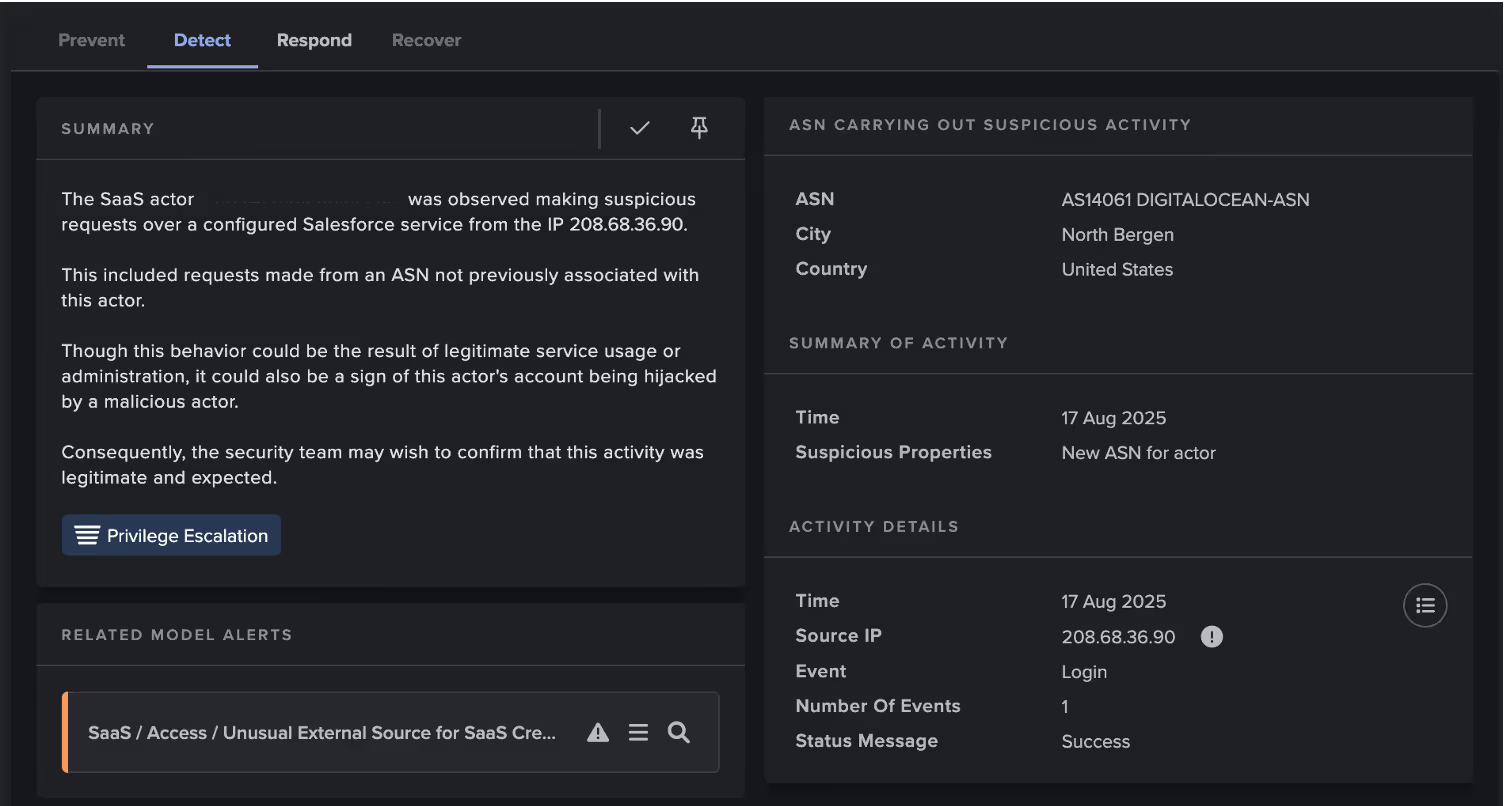
Cyber AI Analyst Incident summarizing the suspicious login seen for the account.
Figure 1: Cyber AI Analyst Incident summarizing the suspicious login seen for the account.

The login event was associated with the application Drift, further connecting the events to this campaign.

Advanced Search logs showing the Application used to login.
Figure 2: Advanced Search logs showing the Application used to login.

Following the login, the actor initiated a high volume of Salesforce API requests using methods such as GET, POST, and DELETE. The GET requests targeted endpoints like /services/data/v57.0/query and /services/data/v57.0/sobjects/Case/describe, where the former is used to retrieve records based on a specific criterion, while the latter provides metadata for the Case object, including field names and data types [5,6].

Subsequently, a POST request to /services/data/v57.0/jobs/query was observed, likely to initiate a Bulk API query job for extracting large volumes of data from the Ingest Job endpoint [7,8].

Finally, a DELETE request to remove an ingestion job batch, possibly an attempt to obscure traces of prior data access or manipulation.

A case on another US-based customer took place a day later, on August 18. This again began with an account logging in from the rare IP 208.68.36[.]90 involving the application Drift. This was followed by Salesforce GET requests targeting the same endpoints as seen in the previous case, and then a POST to the Ingest Job endpoint and finally a DELETE request, all occurring within one minute of the initial suspicious login.

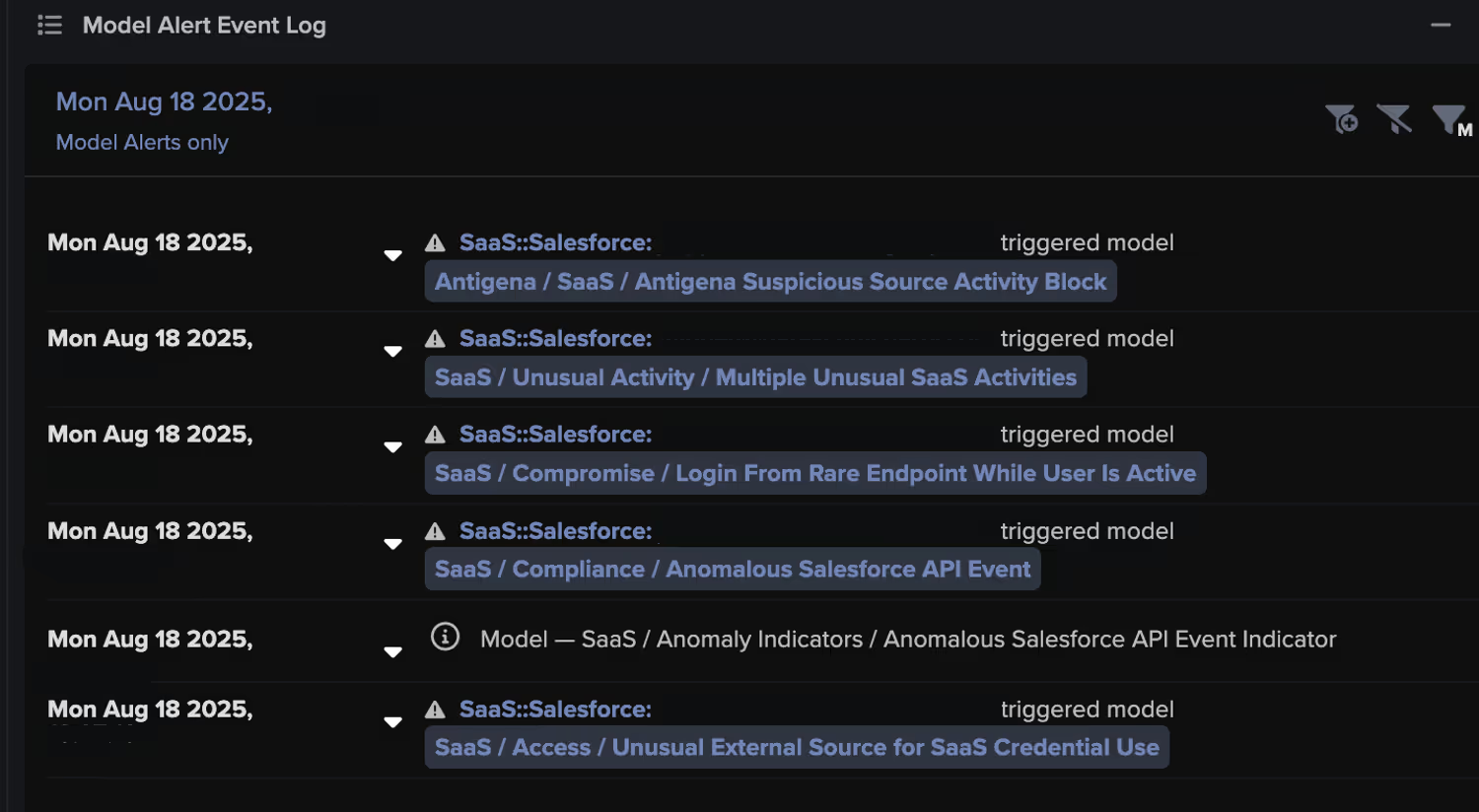
The chain of anomalous behaviors, including a suspicious login and delete request, resulted in Darktrace’s Autonomous Response capability suggesting a ‘Disable user’ action. However, the customer’s deployment configuration required manual confirmation for the action to take effect.
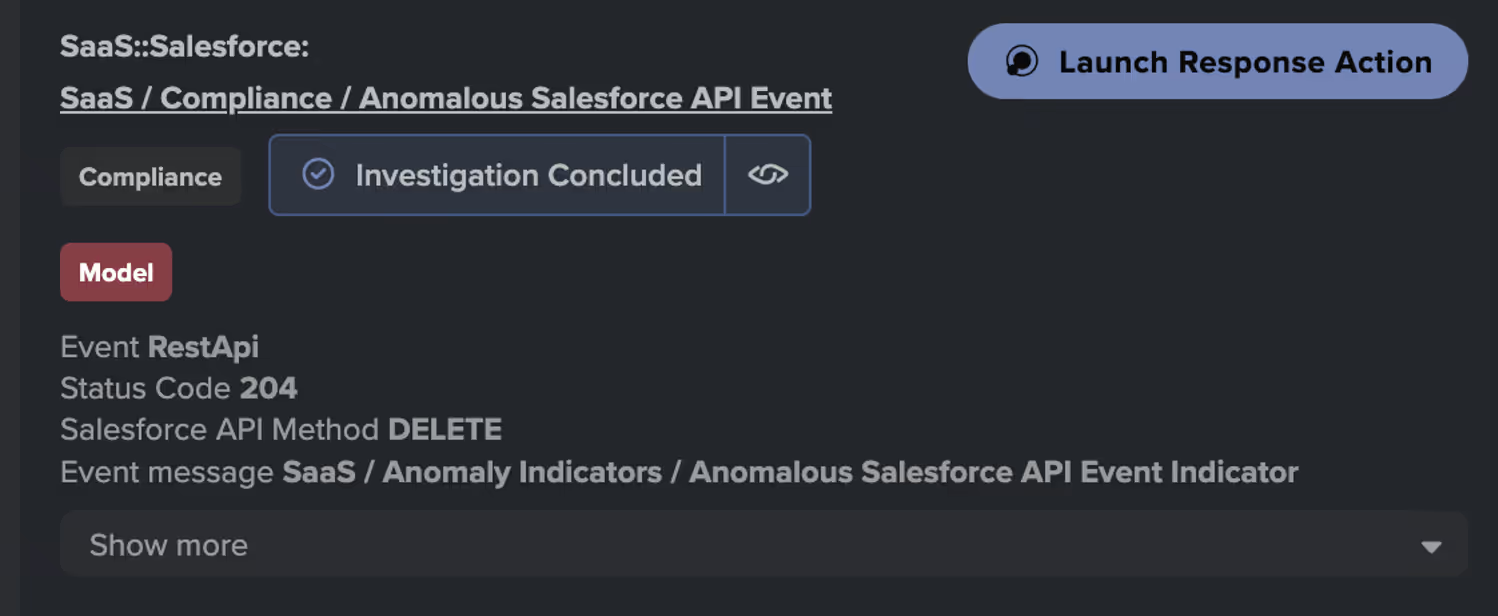
An example model alert for the user, triggered due to an anomalous API DELETE request.
Figure 3: An example model alert for the user, triggered due to an anomalous API DELETE request.
Figure 4: Model Alert Event Log showing various model alerts for the account that ultimately led to an Autonomous Response model being triggered.

Conclusion

In conclusion, this incident underscores the escalating risks of SaaS supply chain attacks, where third-party integrations can become avenues for attacks. It demonstrates how adversaries can exploit legitimate OAuth tokens and API traffic to circumvent traditional defenses. This emphasizes the necessity for constant monitoring of SaaS and cloud activity, beyond just endpoints and networks, while also reinforcing the significance of applying least privilege access and routinely reviewing OAuth permissions in cloud environments. Furthermore, it provides a wider perspective into the evolution of the threat landscape, shifting towards credential and token abuse as opposed to malware-driven compromise.

Credit to Emma Foulger (Global Threat Research Operations Lead), Calum Hall (Technical Content Researcher), Signe Zaharka (Principal Cyber Analyst), Min Kim (Senior Cyber Analyst), Nahisha Nobregas (Senior Cyber Analyst), Priya Thapa (Cyber Analyst)

Appendices

Darktrace Model Detections

·      SaaS / Access / Unusual External Source for SaaS Credential Use

·      SaaS / Compromise / Login From Rare Endpoint While User Is Active

·      SaaS / Compliance / Anomalous Salesforce API Event

·      SaaS / Unusual Activity / Multiple Unusual SaaS Activities

·      Antigena / SaaS / Antigena Unusual Activity Block

·      Antigena / SaaS / Antigena Suspicious Source Activity Block

Customers should consider integrating Salesforce with Darktrace where possible. These integrations allow better visibility and correlation to spot unusual behavior and possible threats.

IoC List

(IoC – Type)

·      208.68.36[.]90 – IP Address

References

1.     https://cloud.google.com/blog/topics/threat-intelligence/data-theft-salesforce-instances-via-salesloft-drift

2.     https://trust.salesloft.com/?uid=Drift+Security+Update%3ASalesforce+Integrations+%283%3A30PM+ET%29

3.     https://thehackernews.com/2025/08/salesloft-oauth-breach-via-drift-ai.html

4.     https://unit42.paloaltonetworks.com/threat-brief-compromised-salesforce-instances/

5.     https://developer.salesforce.com/docs/atlas.en-us.api_rest.meta/api_rest/resources_query.htm

6.     https://developer.salesforce.com/docs/atlas.en-us.api_rest.meta/api_rest/resources_sobject_describe.htm

7.     https://developer.salesforce.com/docs/atlas.en-us.api_asynch.meta/api_asynch/get_job_info.htm

8.     https://developer.salesforce.com/docs/atlas.en-us.api_asynch.meta/api_asynch/query_create_job.htm

Inside the SOC
Darktrace cyber analysts are world-class experts in threat intelligence, threat hunting and incident response, and provide 24/7 SOC support to thousands of Darktrace customers around the globe. Inside the SOC is exclusively authored by these experts, providing analysis of cyber incidents and threat trends, based on real-world experience in the field.
Written by
Emma Foulger
Global Threat Research Operations Lead

More in this series

No items found.

Blog

/

Network

/

January 12, 2026

Maduro Arrest Used as a Lure to Deliver Backdoor

maduro arrest used as lure to deliver backdoorDefault blog imageDefault blog image

Introduction

Threat actors frequently exploit ongoing world events to trick users into opening and executing malicious files. Darktrace security researchers recently identified a threat group using reports around the arrest of Venezuelan President Nicolàs Maduro on January 3, 2025, as a lure to deliver backdoor malware.

Technical Analysis

While the exact initial access method is unknown, it is likely that a spear-phishing email was sent to victims, containing a zip archive titled “US now deciding what’s next for Venezuela.zip”. This file included an executable named “Maduro to be taken to New York.exe” and a dynamic-link library (DLL), “kugou.dll”.  

The binary “Maduro to be taken to New York.exe” is a legitimate binary (albeit with an expired signature) related to KuGou, a Chinese streaming platform. Its function is to load the DLL “kugou.dll” via DLL search order. In this instance, the expected DLL has been replaced with a malicious one with the same name to load it.  

DLL called with LoadLibraryW.
Figure 1: DLL called with LoadLibraryW.

Once the DLL is executed, a directory is created C:\ProgramData\Technology360NB with the DLL copied into the directory along with the executable, renamed as “DataTechnology.exe”. A registry key is created for persistence in “HKCU\Software\Microsoft\Windows\CurrentVersion\Run\Lite360” to run DataTechnology.exe --DATA on log on.

 Registry key added for persistence.
Figure 2. Registry key added for persistence.
Folder “Technology360NB” created.
Figure 3: Folder “Technology360NB” created.

During execution, a dialog box appears with the caption “Please restart your computer and try again, or contact the original author.”

Message box prompting user to restart.
Figure 4. Message box prompting user to restart.

Prompting the user to restart triggers the malware to run from the registry key with the command --DATA, and if the user doesn't, a forced restart is triggered. Once the system is reset, the malware begins periodic TLS connections to the command-and-control (C2) server 172.81.60[.]97 on port 443. While the encrypted traffic prevents direct inspection of commands or data, the regular beaconing and response traffic strongly imply that the malware has the ability to poll a remote server for instructions, configuration, or tasking.

Conclusion

Threat groups have long used geopolitical issues and other high-profile events to make malicious content appear more credible or urgent. Since the onset of the war in Ukraine, organizations have been repeatedly targeted with spear-phishing emails using subject lines related to the ongoing conflict, including references to prisoners of war [1]. Similarly, the Chinese threat group Mustang Panda frequently uses this tactic to deploy backdoors, using lures related to the Ukrainian war, conventions on Tibet [2], the South China Sea [3], and Taiwan [4].  

The activity described in this blog shares similarities with previous Mustang Panda campaigns, including the use of a current-events archive, a directory created in ProgramData with a legitimate executable used to load a malicious DLL and run registry keys used for persistence. While there is an overlap of tactics, techniques and procedures (TTPs), there is insufficient information available to confidently attribute this activity to a specific threat group. Users should remain vigilant, especially when opening email attachments.

Credit to Tara Gould (Malware Research Lead)
Edited by Ryan Traill (Analyst Content Lead)

Indicators of Compromise (IoCs)

172.81.60[.]97
8f81ce8ca6cdbc7d7eb10f4da5f470c6 - US now deciding what's next for Venezuela.zip
722bcd4b14aac3395f8a073050b9a578 - Maduro to be taken to New York.exe
aea6f6edbbbb0ab0f22568dcb503d731  - kugou.dll

References

[1] https://cert.gov.ua/article/6280422  

[2] https://www.ibm.com/think/x-force/hive0154-mustang-panda-shifts-focus-tibetan-community-deploy-pubload-backdoor

[3] https://www.ibm.com/think/x-force/hive0154-targeting-us-philippines-pakistan-taiwan

[4] https://www.ibm.com/think/x-force/hive0154-targeting-us-philippines-pakistan-taiwan

Continue reading
About the author
Tara Gould
Malware Research Lead

Blog

/

Network

/

January 9, 2026

Under Medusa’s Gaze: How Darktrace Uncovers RMM Abuse in Ransomware Campaigns

madusa ransomwareDefault blog imageDefault blog image

What is Medusa Ransomware in 2025?

In 2025, the Medusa Ransomware-as-a-Service (RaaS) emerged as one of the top 10 most active ransomware threat actors [1]. Its growing impact prompted a joint advisory from the US Cybersecurity and Infrastructure Security Agency (CISA) and the Federal Bureau of Investigation (FBI) [3]. As of January 2026, more than 500 organizations have fallen victim to Medusa ransomware [2].

Darktrace previously investigated Medusa in a 2024 blog, but the group’s rapid expansion and new intelligence released in late 2025 has lead Darktrace’s Threat Research team to  investigate further. Recent findings include Microsoft’s research on Medusa actors exploiting a vulnerability in Fortra’s GoAnywhere MFT License Servlet (CVE-2025-10035)[4] and Zencec’s report on Medusa’s abuse of flaws in SimpleHelp’s remote support software (CVE-2024-57726, CVE-2024-57727, CVE-2024-57728) [5].

Reports vary on when Medusa first appeared in the wild. Some sources mention June 2021 as the earliest sightings, while others point to late 2022, when its developers transitioned to the RaaS model, as the true beginning of its operation [3][11].

Madusa Ransomware history and background

The group behind Medusa is known by several aliases, including Storm-1175 and Spearwing [4] [7]. Like its mythological namesake, Medusa has many “heads,” collaborating with initial access brokers (IABs) and, according to some evidence, affiliating with Big Game Hunting (BGH) groups such as Frozen Spider, as well as the cybercriminal group UNC7885 [3][6][13].

Use of Cyrillic in its scripts, activity on Russian-language cybercrime forums, slang unique to Russian criminal subcultures, and avoidance of targets in Commonwealth of Independent States (CIS) countries suggest that Medusa operates from Russia or an allied state [11][12].

Medusa ransomware should not be confused with other similarly named malware, such as the Medusa Android Banking Trojan, the Medusa Botnet/Medusa Stealer, or MedusaLocker ransomware. It is easily distinguishable from these variants because it appends the extension .MEDUSA to encrypted files and drops the ransom note !!!READ_ME_MEDUSA!!!.txt on compromised systems [8].

Who does Madusa Ransomware target?

The group appears to show little restraint, indiscriminately attacking organizations across all sectors, including healthcare, and is known to employ triple extortion tactics whereby sensitive data is encrypted, victims are threatened with data leaks, and additional pressure is applied through DDoS attacks or contacting the victim’s customers, rather than the more common double extortion model [13].

Madusa Ransomware TTPs

To attain initial access, Medusa actors typically purchase access to already compromised devices or accounts via IABs that employ phishing, credential stuffing, or brute-force attacks, and also target vulnerable or misconfigured Internet-facing systems.

In addition to the GoAnywhere MFT and SimpleHelp RMM flaws, other vulnerabilities exploited in Medusa attacks include ConnectWise ScreenConnect RMM (CVE-2024-1709), Microsoft Exchange Server (CVE-2021-34473, also known as ProxyShell), and Fortinet Enterprise Management Servers (CVE-2023-48788) [18][19][20][21][24][25].

Darktrace’s Coverage of Medusa Ransomware

Between December 2023 and November 2025, Darktrace observed multiple cases of file encryption related to Medusa ransomware across its customer base. When enabled, Darktrace’s Autonomous Response capability intervened early in the attack chain, blocking malicious activity before file encryption could begin.

Some of the affected were based in Europe, the Middle East and Africa (EMEA), others in the Americas (AMS), and the remainder in the Asia-Pacific and Japan region. The most impacted sectors were financial services and the automotive industry, followed by healthcare, and finally organizations in arts, entertainment and recreation, ICT, and manufacturing.

Remote Monitoring and Management (RMM) tool abuse

In most customer environments where Medusa file encryption attempts were observed, and in one case where the compromise was contained before encryption, unusual external HTTP connections associated with JWrapper were also detected. JWrapper is a legitimate tool designed to simplify the packaging, distribution, and management of Java applications, enabling the creation of executables that run across different operating systems. Many of the destination IP addresses involved in this activity were linked to SimpleHelp servers or associated with Atera.

Medusa actors appear to favor RMM tools such as SimpleHelp. Unpatched or misconfigured SimpleHelp RMM servers can serve as an initial access vector to the victims’ infrastructure.  After gaining access to SimpleHelp management servers, the threat actors edit server configuration files to redirect existing SimpleHelp RMM agents to communicate with unauthorized servers under their control.

The SimpleHelp tool is not only used for command-and-control (C2) and enabling persistence but is also observed during lateral movement within the network, downloading additional attack tools, data exfiltration, and even ransomware binary execution. Other legitimate remote access tools abused by Medusa in a similar manner to evade detection include Atera, AnyDesk, ScreenConnect, eHorus, N-able, PDQ Deploy/Inventory, Splashtop, TeamViewer, NinjaOne, Navicat, and MeshAgent [4][5][15][16][17].

Data exfiltration

Another correlation among Darktrace customers affected by Medusa was observed during the data exfiltration phase. In several environments, data was exfiltrated to the endpoints erp.ranasons[.]com or pruebas.pintacuario[.]mx (143.110.243[.]154, 144.217.181[.]205) over ports 443, 445, and 80. erp.ranasons[.]com was seemingly active between November 2024 and September 2025, while pruebas.pintacuario[.]mx was seen from November 2024 to March 2025. Evidence suggests that pruebas.pintacuario[.]mx previously hosted a SimpleHelp server [22][23].

Apart from RMM tools, Medusa is also known to use Rclone and Robocopy for data exfiltration [3][19]. During one Medusa compromise detected in mid-2024, the customer’s data was exfiltrated to external destinations associated with the Ngrok proxy service using an SSH-2.0-rclone client.

Medusa Compromise Leveraging SimpleHelp

In Q4 2025, Darktrace assisted a European company impacted by Medusa ransomware. The organization had partial Darktrace / NETWORK coverage and had configured Darktrace’s Autonomous Response capability to require manual confirmation for all actions. Despite these constraints, data received through the customer’s security integration with CrowdStrike Falcon enabled Darktrace analysts to reconstruct the attack chain, although the initial access vector remains unclear due to limited visibility.

In late September 2025, a device out of the scope of Darktrace's visibility began scanning the network and using RDP, NTLM/SMB, DCE_RPC, and PowerShell for lateral movement.

CrowdStrike “Defense Evasion: Disable or Modify Tools” alerts related to a suspicious driver (c:\windows\[0-9a-b]{4}.exe) and a PDQ Deploy executable (share=\\<device_hostname>\ADMIN$ file=AdminArsenal\PDQDeployRunner\service-1\exec\[0-9a-b]{4}.exe) suggest that the attackers used the Bring Your Own Vulnerable Driver (BYOVD) technique to terminate antivirus processes on network devices, leveraging tools such as KillAV or AbyssWorker along with the PDQ Software Deployment solution [19][26].

A few hours later, Darktrace observed the same device that had scanned the network writing Temp\[a-z]{2}.exe over SMB to another device on the same subnet. According to data from the CrowdStrike alert, this executable was linked to an RMM application located at C:\Users\<compromised_user>\Documents\[a-z]{2}.exe. The same compromised user account later triggered a CrowdStrike “Command and Control: Remote Access Tools” alert when accessing C:\ProgramData\JWrapper-Remote Access\JWrapper-Remote Access Bundle-[0-9]{11}\JWrapperTemp-[0-9]{10}-[0-9]{1}-app\bin\windowslauncher.exe [27].

An executable file associated with the SimpleHelp RMM tool being written to other devices using the SMB protocol, as detected by Darktrace.
Figure 1: An executable file associated with the SimpleHelp RMM tool being written to other devices using the SMB protocol, as detected by Darktrace.

Soon after, the destination device and multiple other network devices began establishing connections to 31.220.45[.]120 and 213.183.63[.]41, both of which hosted malicious SimpleHelp RMM servers. These C2 connections continued for more than 20 days after the initial compromise.

CrowdStrike integration alerts for the execution of robocopy . "c:\windows\\" /COPY:DT /E /XX /R:0 /W:0 /NP /XF RunFileCopy.cmd /IS /IT commands on several Windows servers, suggested that this utility was likely used to stage files in preparation for data exfiltration [19].

Around two hours later, Darktrace detected another device connecting to the attacker’s SimpleHelp RMM servers. This internal server had ‘doc’ in its hostname, indicating it was likely a file server. It was observed downloading documents from another internal server over SMB and uploading approximately 70 GiB of data to erp.ranasons[.]com (143.110.243[.]154:443).

Data uploaded to erp.ranasons[.]com and the number of model alerts from the exfiltrating device, represented by yellow and orange dots.
Figure 2: Data uploaded to erp.ranasons[.]com and the number of model alerts from the exfiltrating device, represented by yellow and orange dots.

Darktrace’s Cyber AI Analyst autonomously investigated the unusual connectivity, correlating the separate C2 and data exfiltration events into a single incident, providing greater visibility into the ongoing attack.

Cyber AI Analyst identified a file server making C2 connections to an attacker-controlled SimpleHelp server (213.183.63[.]41) and exfiltrating data to erp.ranasons[.]com.
Figure 3: Cyber AI Analyst identified a file server making C2 connections to an attacker-controlled SimpleHelp server (213.183.63[.]41) and exfiltrating data to erp.ranasons[.]com.
The same file server that connected to 213.183.63[.]41 and exfiltrated data to erp.ranasons[.]com was also observed attempting to connect to an IP address associated with Moscow, Russia (193.37.69[.]154:7070).
Figure 4: The same file server that connected to 213.183.63[.]41 and exfiltrated data to erp.ranasons[.]com was also observed attempting to connect to an IP address associated with Moscow, Russia (193.37.69[.]154:7070).

One of the devices connecting to the attacker's SimpleHelp RMM servers was also observed downloading 35 MiB from [0-9]{4}.filemail[.]com. Filemail, a legitimate file-sharing service, has reportedly been abused by Medusa actors to deliver additional malicious payloads [11].

A device controlled remotely via SimpleHelp downloading additional tooling from the Filemail file-sharing service.
Figure 5: A device controlled remotely via SimpleHelp downloading additional tooling from the Filemail file-sharing service.

Finally, integration alerts related to the ransomware binary, such as c:\windows\system32\gaze.exe and <device_hostname>\ADMIN$ file=AdminArsenal\PDQDeployRunner\service-1\exec\gaze.exe, along with “!!!READ_ME_MEDUSA!!!.txt” ransom notes were observed on network devices. This indicates that file encryption in this case was most likely carried out directly on the victim hosts rather than via the SMB protocol [3].

Conclusion

Threat actors, including nation-state actors and ransomware groups like Medusa, have long abused legitimate commercial RMM tools, typically used by system administrators for remote monitoring, software deployment, and device configuration, instead of relying on remote access trojans (RATs).

Attackers employ existing authorized RMM tools or install new remote administration software to enable persistence, lateral movement, data exfiltration, and ingress tool transfer. By mimicking legitimate administrative behavior, RMM abuse enables attackers to evade detection, as security software often implicitly trusts these tools, allowing attackers to bypass traditional security controls [28][29][30].

To mitigate such risks, organizations should promptly patch publicly exposed RMM servers and adopt anomaly-based detection solutions, like Darktrace / NETWORK, which can distinguish legitimate administrative activity from malicious behavior, applying rapid response measures through its Autonomous Response capability to stop attacks in their tracks.

Darktrace delivers comprehensive network visibility and Autonomous Response capabilities, enabling real-time detection of anomalous activity and rapid mitigation, even if an organization fall under Medusa’s gaze.

Credit to Signe Zaharka (Principal Cyber Analyst) and Emma Foulger (Global Threat Research Operations Lead

Edited by Ryan Traill (Analyst Content Lead)

Appendices

List of Indicators of Compromise (IoCs)

IoC - Type - Description + Confidence + Time Observed

185.108.129[.]62 IP address Malicious SimpleHelp server observed during Medusa attacks (High confidence) - March 7, 2023

185.126.238[.]119 IP address Malicious SimpleHelp server observed during Medusa attacks (High confidence) - November 26-27, 2024

213.183.63[.]41 IP address Malicious SimpleHelp server observed during Medusa attacks (High confidence) - November 28, 2024 - Sep 30, 2025

213.183.63[.]42 IP address Malicious SimpleHelp server observed during Medusa attacks (High confidence) - July 4 -9 , 2024

31.220.45[.]120 IP address Malicious SimpleHelp server observed during Medusa attacks (High confidence) - September 12 - Oct 20 , 2025

91.92.246[.]110 IP address Malicious SimpleHelp server observed during Medusa attacks (High confidence) - May 24, 2024

45.9.149[.]112:15330 IP address Malicious SimpleHelp server observed during Medusa attacks (High confidence) - June 21, 2024

89.36.161[.]12 IP address Malicious SimpleHelp server observed during Medusa attacks (High confidence) - June 26-28, 2024

193.37.69[.]154:7070 IP address Suspicious RU IP seen on a device being controlled via SimpleHelp and exfiltrating data to a Medusa related endpoint - September 30 - October 20, 2025

erp.ranasons[.]com·143.110.243[.]154 Hostname Data exfiltration destination - November 27, 2024 - September 30, 2025

pruebas.pintacuario[.]mx·144.217.181[.]205 - Hostname Data exfiltration destination - November 27, 2024  -  March 26, 2025

lirdel[.]com · 44.235.83[.]125/a.msi (1b9869a2e862f1e6a59f5d88398463d3962abe51e19a59) File & hash Atera related file downloaded with PowerShell - June 20, 2024

wizarr.manate[.]ch/108.215.180[.]161:8585/$/1dIL5 File Suspicious file observed on one of the devices exhibiting unusual activity during a Medusa compromise - February 28, 2024

!!!READ_ME_MEDUSA!!!.txt" File - Ransom note

*.MEDUSA - File extension        File extension added to encrypted files

gaze.exe – File - Ransomware binary

Darktrace Model Coverage

Darktrace / NETWORK model detections triggered during connections to attacker controlled SimpleHelp servers:

Anomalous Connection/Anomalous SSL without SNI to New External

Anomalous Connection/Multiple Connections to New External UDP Port

Anomalous Connection/New User Agent to IP Without Hostname

Anomalous Connection/Rare External SSL Self-Signed

Anomalous Connection/Suspicious Self-Signed SSL

Anomalous File/EXE from Rare External Location

Anomalous Server Activity/Anomalous External Activity from Critical Network Device

Anomalous Server Activity/New User Agent from Internet Facing System

Anomalous Server Activity/Outgoing from Server

Anomalous Server Activity/Rare External from Server

Compromise/High Volume of Connections with Beacon Score

Compromise/Large Number of Suspicious Failed Connections

Compromise/Ransomware/High Risk File and Unusual SMB

Device/New User Agent

Unusual Activity/Unusual External Data to New Endpoint

Unusual Activity/Unusual External Data Transfer

Darktrace / NETWORK Model Detections during the September/October 2025 Medusa attack:

Anomalous Connection / Data Sent to Rare Domain

Anomalous Connection / Download and Upload

Anomalous Connection / Low and Slow Exfiltration

Anomalous Connection / New User Agent to IP Without Hostname

Anomalous Connection / Uncommon 1 GiB Outbound

Anomalous Connection / Unusual Admin RDP Session

Anomalous Connection / Unusual Incoming Long Remote Desktop Session

Anomalous Connection / Unusual Long SSH Session

Anomalous File / EXE from Rare External Location

Anomalous File / Internal/Unusual Internal EXE File Transfer

Anomalous Server Activity / Anomalous External Activity from Critical Network Device

Anomalous Server Activity / Outgoing from Server

Anomalous Server Activity / Rare External from Server

Compliance / Default Credential Usage

Compliance / High Priority Compliance Model Alert

Compliance / Outgoing NTLM Request from DC

Compliance / Possible Unencrypted Password File On Server

Compliance / Remote Management Tool On Server

Compromise / Large Number of Suspicious Failed Connections

Compromise / Large Number of Suspicious Successful Connections

Compromise / Ransomware/High Risk File and Unusual SMB

Compromise / Suspicious Beaconing Behaviour

Compromise / Suspicious HTTP and Anomalous Activity

Compromise / Sustained SSL or HTTP Increase

Compromise / Sustained TCP Beaconing Activity To Rare Endpoint

Device / ICMP Address Scan

Device / Increase in New RPC Services

Device / Initial Attack Chain Activity

Device / Large Number of Model Alert

Device / Large Number of Model Alerts from Critical Network Device

Device / Lateral Movement and C2 Activity

Device / Multiple C2 Model Alert

Device / Network Scan

Device / Possible SMB/NTLM Reconnaissance

Device / Spike in LDAP Activity

Device / Suspicious Network Scan Activity

Device / Suspicious SMB Scanning Activity

Security Integration / High Severity Integration Incident

Security Integration / Low Severity Integration Incident

Unusual Activity / Enhanced Unusual External Data Transfer

Unusual Activity / Internal Data Transfer

Unusual Activity / Unusual External Activity

Unusual Activity / Unusual External Data to New Endpoint

Unusual Activity / Unusual External Data Transfer

User / New Admin Credentials on Server

Autonomous Response Actions

Antigena / Network/External Threat/Antigena File then New Outbound Block

Antigena / Network/External Threat/Antigena Ransomware Block

Antigena / Network/External Threat/Antigena Suspicious Activity Block

Antigena / Network/External Threat/Antigena Suspicious File Block

Antigena / Network/Insider Threat/Antigena Internal Anomalous File Activity

Antigena / Network/Insider Threat/Antigena Internal Data Transfer Block

Antigena / Network/Insider Threat/Antigena Large Data Volume Outbound Block

Antigena / Network/Insider Threat/Antigena Network Scan Block

Antigena / Network/Insider Threat/Antigena Unusual Privileged User Activities Block

Antigena / Network/Significant Anomaly/Antigena Alerts Over Time Block

Antigena / Network/Significant Anomaly/Antigena Controlled and Model Alert

Antigena / Network/Significant Anomaly/Antigena Enhanced Monitoring from Server Block

Antigena / Network/Significant Anomaly/Antigena Significant Server Anomaly Block

Antigena / Network/Significant Anomaly/Repeated Antigena Alerts

MITRE ATT&CK Mapping

Technique Name, Tactic, ID, Sub-Technique

Application Layer Protocol , COMMAND AND CONTROL , T1071

Automated Collection , COLLECTION , T1119

Automated Exfiltration , EXFILTRATION , T1020

Brute Force , CREDENTIAL ACCESS , T1110

Client Configurations , RECONNAISSANCE , T1592.004 , T1592

Cloud Accounts , DEFENSE EVASION ,  PERSISTENCE ,  PRIVILEGE ESCALATION ,  INITIAL ACCESS , T1078.004 , T1078

Command-Line Interface , EXECUTION ICS , T0807

Credential Stuffing , CREDENTIAL ACCESS , T1110.004 , T1110

Data Encrypted for Impact , IMPACT , T1486

Data from Network Shared Drive , COLLECTION , T1039

Data Obfuscation , COMMAND AND CONTROL , T1001

Data Staged , COLLECTION , T1074

Data Transfer Size Limits , EXFILTRATION , T1030

Default Accounts , DEFENSE EVASION ,  PERSISTENCE ,  PRIVILEGE ESCALATION ,  INITIAL ACCESS , T1078.001 , T1078

Default Credentials , LATERAL MOVEMENT ICS , T0812

Distributed Component Object Model , LATERAL MOVEMENT , T1021.003 , T1021

Drive-by Compromise , INITIAL ACCESS ICS , T0817

Drive-by Compromise , INITIAL ACCESS , T1189

Email Collection , COLLECTION , T1114

Exfiltration Over Alternative Protocol , EXFILTRATION , T1048

Exfiltration Over C2 Channel , EXFILTRATION , T1041

Exfiltration to Cloud Storage , EXFILTRATION , T1567.002 , T1567

Exploit Public-Facing Application , INITIAL ACCESS , T1190

Exploitation for Privilege Escalation , PRIVILEGE ESCALATION , T0890

Exploitation of Remote Services , LATERAL MOVEMENT , T1210

Exploits , RESOURCE DEVELOPMENT , T1588.005 , T1588

File and Directory Discovery , DISCOVERY , T1083

File Deletion , DEFENSE EVASION , T1070.004 , T1070

Graphical User Interface , EXECUTION ICS , T0823

Ingress Tool Transfer , COMMAND AND CONTROL , T1105

Lateral Tool Transfer , LATERAL MOVEMENT , T1570

LLMNR/NBT-NS Poisoning and SMB Relay , CREDENTIAL ACCESS ,  COLLECTION , T1557.001 , T1557

Malware , RESOURCE DEVELOPMENT , T1588.001 , T1588

Network Service Scanning , DISCOVERY , T1046

Network Share Discovery , DISCOVERY , T1135

Non-Application Layer Protocol , COMMAND AND CONTROL , T1095

Non-Standard Port , COMMAND AND CONTROL , T1571

One-Way Communication , COMMAND AND CONTROL , T1102.003 , T1102

Pass the Hash , DEFENSE EVASION ,  LATERAL MOVEMENT , T1550.002 , T1550

Password Cracking , CREDENTIAL ACCESS , T1110.002 , T1110

Password Guessing , CREDENTIAL ACCESS , T1110.001 , T1110

Password Spraying , CREDENTIAL ACCESS , T1110.003 , T1110

Program Download , LATERAL MOVEMENT ICS , T0843

Program Upload , COLLECTION ICS , T0845

Remote Access Software , COMMAND AND CONTROL , T1219

Remote Desktop Protocol , LATERAL MOVEMENT , T1021.001 , T1021

Remote System Discovery , DISCOVERY , T1018

Scanning IP Blocks , RECONNAISSANCE , T1595.001 , T1595

Scheduled Transfer , EXFILTRATION , T1029

Spearphishing Attachment , INITIAL ACCESS ICS , T0865

Standard Application Layer Protocol , COMMAND AND CONTROL ICS , T0869

Supply Chain Compromise , INITIAL ACCESS ICS , T0862

User Execution , EXECUTION ICS , T0863

Valid Accounts , DEFENSE EVASION ,  PERSISTENCE ,  PRIVILEGE ESCALATION ,  INITIAL ACCESS , T1078

Valid Accounts , PERSISTENCE ICS ,  LATERAL MOVEMENT ICS , T0859

Vulnerabilities , RESOURCE DEVELOPMENT , T1588.006 , T1588

Vulnerability Scanning , RECONNAISSANCE , T1595.002 , T1595

Web Protocols , COMMAND AND CONTROL , T1071.001 , T1071

References

1. https://www.intel471.com/blog/threat-hunting-case-study-medusa-ransomware

2. https://www.ransomware.live/group/medusa

3. https://www.cisa.gov/news-events/cybersecurity-advisories/aa25-071a

4. https://www.microsoft.com/en-us/security/blog/2025/10/06/investigating-active-exploitation-of-cve-2025-10035-goanywhere-managed-file-transfer-vulnerability/

5. https://zensec.co.uk/blog/how-rmm-abuse-fuelled-medusa-dragonforce-attacks/

6. https://www.checkpoint.com/cyber-hub/threat-prevention/ransomware/medusa-ransomware-group/

7. https://cyberpress.org/medusa-ransomware-attacks-spike-42/

8. https://blog.barracuda.com/2025/02/25/medusa-ransomware-and-its-cybercrime-ecosystem

10. https://www.cyberdaily.au/security/10021-more-monster-than-myth-unpacking-the-medusa-ransomware-operation

11. https://unit42.paloaltonetworks.com/medusa-ransomware-escalation-new-leak-site/

12. https://www.bitdefender.com/en-us/blog/businessinsights/medusa-ransomware-a-growing-threat-with-a-bold-online-presence

13. https://redpiranha.net/news/medusa-ransomware-everything-you-need-know

14.  https://www.theregister.com/2025/03/13/medusa_ransomware_infects_300_critical/

15. https://www.s-rminform.com/latest-thinking/cyber-threat-advisory-medusa-and-the-simplehelp-vulnerability

16. https://nagomisecurity.com/medusa-ransomware-us-cert-alert

17. https://arcticwolf.com/resources/blog/arctic-wolf-observes-campaign-exploiting-simplehelp-rmm-software-for-initial-access/

18. https://securityboulevard.com/2025/04/medusa-ransomware-inside-the-2025-resurgence-of-one-of-the-internets-most-aggressive-threats/

19. https://thehackernews.com/2025/03/medusa-ransomware-hits-40-victims-in.html

20.  https://www.quorumcyber.com/threat-intelligence/critical-alert-medusa-ransomware-threat-highlighted-by-fbi-cisa-and-ms-isac/

21. https://brandefense.io/blog/stone-gaze-in-depth-analysis-of-medusa-ransomware/

22. https://www.darktrace.com/ja/blog/2025-cyber-threat-landscape-darktraces-mid-year-review

23. https://www.joesandbox.com/analysis/1576447/0/html

24. https://blog.barracuda.com/2025/02/25/medusa-ransomware-and-its-cybercrime-ecosystem

25. https://shassit.mit.edu/news/medusa-ransomware-attacks-on-gmail/

26. https://thehackernews.com/2025/03/medusa-ransomware-uses-malicious-driver.html

27. https://www.cisa.gov/news-events/cybersecurity-advisories/aa25-163a

28. https://www.catonetworks.com/blog/cato-ctrl-investigation-of-rmm-tools/

29. https://redcanary.com/threat-detection-report/trends/rmm-tools/

30. https://www.proofpoint.com/us/blog/threat-insight/remote-monitoring-and-management-rmm-tooling-increasingly-attackers-first-choice

Continue reading
About the author
Signe Zaharka
Principal Cyber Analyst
Your data. Our AI.
Elevate your network security with Darktrace AI