
Blog
/
AI
/
August 21, 2026

Agentes de IA: proteger el camino de la intención a la acción

Las directrices recientes del NCSC establecen los controles necesarios para implantar la IA agéntica de forma segura. Pero la aprobación es solo el punto de partida; el siguiente paso consiste en comprender cómo se comportan realmente los agentes una vez que están operando en la empresa.
Inside the SOC
Darktrace cyber analysts are world-class experts in threat intelligence, threat hunting and incident response, and provide 24/7 SOC support to thousands of Darktrace customers around the globe. Inside the SOC is exclusively authored by these experts, providing analysis of cyber incidents and threat trends, based on real-world experience in the field.
Written by
Margaret Cunningham, PhD
VP, Security & AI Strategy, Head of Americas Field CISO Operations
Photograph of AI data centerDefault blog image
21
Aug 2026

El Centro Nacional de Ciberseguridad del Reino Unido (NCSC) ha publicado recientemente una guía sobre cómo gestionar los riesgos de ciberseguridad asociados a la IA agéntica. Aunque el documento ofrece recomendaciones provisionales mientras se elabora una guía más formal, refleja la situación actual del sector: las organizaciones ya están desplegando agentes en entornos de producción, mientras que los estándares, controles y modelos operativos para los sistemas autónomos aún no están consolidados. La gobernanza está evolucionando a la par que la adopción, en lugar de precederla, una realidad que subraya la importancia de contar con controles sólidos.  

Las directrices del NCSC recomiendan adaptar los controles al nivel de autonomía de cada agente, asignar identidades diferenciadas a los agentes, limitar sus permisos y el acceso a sistemas y datos, supervisar su actividad, mantener la supervisión humana y garantizar la posibilidad de intervenir cuando sea necesario. La mayoría de estas recomendaciones resultarán familiares a los equipos de seguridad. El reto no está en la novedad de los controles, sino en el tipo de sistema que ahora deben regir.

El paso de la seguridad de los modelos a la seguridad de los agentes

Durante varios años, los debates sobre la seguridad de la IA se han centrado en gran medida en los modelos. ¿Se puede manipular un modelo? ¿Se le ha hecho jailbreak? ¿Es de confianza? ¿Puede revelar información que no debería? Esas preguntas siguen siendo importantes, pero solo reflejan una parte del problema. Una cosa es que un modelo genere texto. Un sistema conectado a identidades, aplicaciones, herramientas, flujos de trabajo y datos empresariales es otra cosa.

La diferencia queda más clara al comparar un chatbot que responde preguntas con un agente capaz de consultar registros de clientes, actualizar tickets, invocar herramientas, activar flujos de trabajo e interactuar con sistemas externos. El modelo subyacente puede ser idéntico. Pero no ocurre lo mismo con su acceso. La cuestión de seguridad empieza a desplazarse de lo que sabe el modelo a lo que puede hacer el sistema.

La misma idea aparece en la declaración de Five Eyes, publicada a principios de este año, que describe la IA como un multiplicador de fuerza que está acelerando tanto las operaciones cibernéticas ofensivas como las defensivas. La guía del NCSC analiza cómo se manifiesta esa realidad cuando los sistemas autónomos empiezan a operar en entornos empresariales.

Protección de los agentes de IA en funcionamiento

El NCSC dedica relativamente poco tiempo a debatir sobre el comportamiento de los modelos y bastante más a tratar la identidad, los permisos, la monitorización, la supervisión, la contención y la respuesta. Los agentes se consideran participantes dentro de un entorno, en lugar de elementos tecnológicos aislados.  

Esto coincide, en términos generales, con nuestra forma de entender el problema en Darktrace.

Un agente no debe considerarse una extensión de una cuenta de usuario. Desarrolla sus propios patrones de comportamiento. Accede a sistemas, interactúa con datos, invoca herramientas y avanza por flujos de trabajo de formas que pueden observarse de manera independiente. Es importante entender qué tiene permitido hacer un agente. Entender cómo se comporta realmente una vez implementado y si ese comportamiento se ajusta a los objetivos empresariales es igual de importante.

La identidad es un ejemplo evidente. El NCSC recomienda asignar identidades diferenciadas a los agentes en lugar de permitir que se diluyan entre las cuentas humanas o de servicio que los rodean. Y lo que es más importante, asignar identidades diferenciadas a los agentes permite monitorizar su comportamiento de forma independiente.

Supuestos de desarrollo frente al comportamiento en el mundo real

El mismo principio se aplica también a la monitorización. La guía del NCSC sitúa la actividad de los agentes dentro de las operaciones de seguridad habituales, en lugar de tratarla como una función independiente de gobernanza de la IA. Muchos de los controles descritos se implementan antes de que un agente empiece a operar. El Sandboxing, el diseño de credenciales, los flujos de trabajo de aprobación y la supervisión humana reflejan decisiones sobre cómo se espera que se comporte el sistema y qué riesgos es probable que genere.

El uso real puede cuestionar esas suposiciones. Los patrones de acceso cambian. Los flujos de trabajo se amplían. Los sistemas empiezan a interactuar con recursos que nunca antes habían tocado. Procesos que parecían razonables durante el diseño se comportan de forma diferente en producción. Los requisitos de supervisión humana pueden resultar excesivos o insuficientes una vez que el sistema funciona a escala y opera en el contexto de procesos empresariales específicos.

La declaración de Five Eyes apunta a un problema similar: las organizaciones necesitan confiar en que los controles sigan funcionando según lo previsto cuando los sistemas se exponen a usuarios reales, datos, herramientas y presiones operativas. A menudo, la cuestión no es si un agente tiene técnicamente permiso para realizar una acción, sino si su comportamiento sigue siendo coherente con la función que debía desempeñar.

La supervisión y la gobernanza de los agentes de IA van de la mano

Este problema es precisamente la razón por la que la monitorización y la gobernanza deben tratarse como parte del mismo proceso. La gobernanza establece los parámetros iniciales para el despliegue, mientras que la monitorización aporta pruebas que permiten determinar si esos parámetros siguen siendo adecuados. Esa evidencia debería, a su vez, orientar los cambios en los permisos, los controles y la supervisión.

Esto cobra cada vez más importancia a medida que los sistemas autónomos se integran en los procesos empresariales. El riesgo pertinente no depende únicamente del modelo o del agente en sí, sino también de a qué puede acceder, qué acciones puede llevar a cabo y cómo cambia su comportamiento en la práctica.

Desarrollo de una supervisión continua del comportamiento de los agentes de IA

La implicación está clara: la gobernanza no puede terminar con la implementación. Las organizaciones necesitan una forma de comprender cómo se comportan los agentes tras la implementación, comprobar si los controles siguen siendo adecuados y ajustarlos a medida que cambian las condiciones. Eso requiere visibilidad no solo de la actividad técnica, sino también de si dicha actividad tiene sentido en el contexto del proceso empresarial al que el agente debe prestar apoyo.

Aquí es donde la seguridad conductual centrada en el negocio puede ser fundamental. El riesgo no surge del propio modelo, sino de las acciones que lleva a cabo un sistema autónomo dentro de la empresa y de las consecuencias derivadas de esas acciones.  

Un agente puede funcionar exactamente según lo previsto y aun así generar riesgos si accede a información confidencial en un contexto inesperado, utiliza permisos de formas que generan una exposición no deseada o influye en procesos empresariales de maneras que no se anticiparon durante el diseño y la revisión.

Gobernanza tradicional frente a seguridad basada en el comportamiento

Los marcos tradicionales de gobernanza ofrecen garantías en un momento determinado. La seguridad basada en el comportamiento permite mantener una visibilidad continua de cómo interactúan los sistemas autónomos con las organizaciones a las que prestan servicio. En lugar de centrarse exclusivamente en el rendimiento del modelo o en el cumplimiento de las políticas, las organizaciones deben comprobar si el comportamiento de un agente se ajusta a los objetivos empresariales, las expectativas operativas y los niveles de tolerancia al riesgo aceptables a medida que cambian las condiciones.

A medida que las empresas pasan de implementaciones aisladas de IA a ecosistemas interconectados de agentes, la visibilidad del comportamiento cobra tanta importancia como la visibilidad del código. La gobernanza determina qué tiene permitido hacer un sistema autónomo. El Análisis de comportamiento ayuda a determinar qué está haciendo, qué resultados empresariales está generando y si esos resultados siguen alineados con los objetivos de la organización.

‍

[related-resource]

Proteja su adopción de la IA

Guía práctica para proteger implantaciones de LLM, flujos de trabajo integrados con IA y sistemas basados en agentes, con controles de riesgo de IA.

Inside the SOC
Darktrace cyber analysts are world-class experts in threat intelligence, threat hunting and incident response, and provide 24/7 SOC support to thousands of Darktrace customers around the globe. Inside the SOC is exclusively authored by these experts, providing analysis of cyber incidents and threat trends, based on real-world experience in the field.
Written by
Margaret Cunningham, PhD
VP, Security & AI Strategy, Head of Americas Field CISO Operations

More in this series

No items found.

Blog

/

/

November 9, 2026

From One Alert to a Wider Campaign: Uncovering Novel Threats Through Behavioral Analysis

Default blog imageDefault blog image

Key Findings

  • Darktrace’s Threat Research team is exploring a new method to identify malicious campaigns by correlating similar anomalous activity across its customer fleet.
  • The method uses unsupervised clustering to identify shared behavioral patterns across multiple customer deployments without relying on prior indicators of compromise (IoCs).
  • The approach identified shared infrastructure across dozens of customers, with activity linked to the likely POPA botnet.
  • A second cluster identified anomalous activity associated with Monero cryptocurrency mining.

‍

How does Darktrace conduct threat research?

The Darktrace Threat Research team aims to identify malicious campaign activity affecting multiple customers. By their nature, these campaigns will lead to shared behavioral patterns across multiple victims.

In this piece, we describe a method for identifying malicious campaign activity that uses this simple observation as a guiding principle. We begin by outlining a few key facts about the modern threat landscape and why behavioral detection is necessary to meet the challenges it presents. We then explore how fleet-wide behavioral detections can be leveraged using the principle above to systematically identify multi-deployment campaigns impacting the Darktrace customer fleet. Finally, we demonstrate that this research is not purely theoretical, using real examples of campaign activity detected through this novel approach.

Shifting to a behavioral-focused approach

The modern era of cyber-defense necessitates detection capabilities beyond traditional signature-based methods. Technologies such as antivirus signatures, hash-based malware identification, and IP blocklists have historically been successful in defending against known threats. However, they are easily circumvented by attackers and inherently limited in defending against the novel attack techniques that today's threat landscape is producing.

Recent breakthroughs in AI represent a transformational risk multiplier that cannot be ignored. AI systems do not merely execute existing attacks at machine speed; there are signs they can also synthesize novel tradecraft [1], increasing the likelihood that defenders will encounter attack patterns that have never previously been observed. Meanwhile vulnerability disclosures continue to accelerate. More than 48,000 CVEs were published in 2025, and published statistics to date indicate that 2026 is already on track to significantly exceed that figure [2]. While multiple factors may contribute to vulnerability discovery, AI is seen as a key factor in this rapid growth. Organizations should expect a growing proportion of malicious activity to fall outside the scope of detections that rely solely on prior knowledge of known threats.

By design, Darktrace’s behavioral and anomaly-focused detection capabilities are well-suited to this testing landscape. With a focus on detecting unknown and unexpected activity that deviates from the baseline of “normal” behavior, detection of CVE exploitation without prior knowledge of the vulnerability and before public disclosure, for example, is achievable [3][4].

Darktrace’s diverse customer base benefits from a further layer of protection: working with only deidentified alert metadata, our threat researchers hunt proactively across the fleet. Beyond the level of the individual customer, there is a second, larger vantage to be leveraged.

Darktrace data provides unique insight into the unexpected behavioral patterns that occur across its customer fleet. What can we see if we look at this fleet-wide telemetry and hunt for systematic behavioral campaigns that impact our customer base?

Correlating across the customer base

At the deployment level, Darktrace focuses on whether activity is unusual in the context of an organization's normal behavior, but as we zoom out and look at these alerts at the fleet level, the problem fundamentally changes . We are no longer seeking anomalies in largely normal data; we are seeking systematic patterns within data already known to be anomalous. An isolated behavior anomaly may be notable for a single customer; the same fingerprint across dozens is a signal of a structured campaign. Hunting for such campaigns and sharing our findings are key areas of focus for Darktrace’s Threat Research team.  In this spirit, Darktrace is  actively exploring a a new research approach that leverages deidentified alert metadata to increase campaign detection ability.

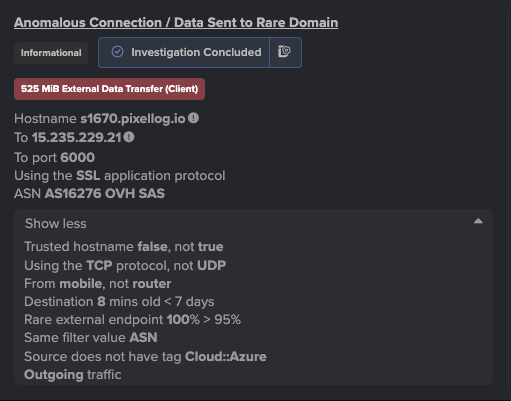
This approach is based on the premise that an expert human analyst presented with a set of alerts will identify likely related activity by assessing whether the metadata fields indicate a relationship. For example, two connections to a rare endpoint that exhibits naming structure that is likely from a single algorithm are a strong indicator, as is the use of an unusual port carrying a given protocol (e.g. port 6000 for SSL). Darktrace’s approach to campaign detection encodes this expert human judgement process through deterministic embedding functions that obtain reproducible vector representations of alert data. Unsupervised clustering is then applied to these vector representations to obtain groups of alerts that describe semantically similar alert data across multiple customers. These clusters therefore represent similar anomalous activity that has occurred across multiple customers. In other words, these clusters are candidates for malicious campaign activity.

‍

Figure 1: Layers of AI-based analysis provided through Darktrace products and cross-customer correlation.

‍

Case study 1 – unusual connections to shared underlying infrastructure

In one recent case, the clustering produced several tight groups of alerts spanning dozens of customers. Each group centered on a single domain whose subdomains were algorithmically generated (e.g. s01699, s1736, s91). Examined side by side, these clusters shared an unmistakable behavioral shape: each involved a domain with a clear naming pattern (e.g. s016841786.net-echo[.]com, s1670.pixellog[.]io, s217.pixellog[.]io) , with connections over SSL on the unusual port 6000 to servers hosted by non-mainstream providers (e.g. OVH, Hetzner, GTHost, Leaseweb), rather than generally expected content-delivery networks.

‍

Figure 2: An example model alert triggering on unusual outbound connections and data transfer to s1670.pixellog[.]io.

‍

Closer inspection revealed that the same subdomain label appeared under different domains (e.g. s1786.net-echo[.]com and s1786.pixellog[.]io). Following this lead, Darktrace’s threat researchers pivoted across the customer base and found numerous distinct subdomain labels reused under more than one registered domain. In several cases, the same label resolved to the same IP across different domains (e.g. s1704 under both pixellog[.]io and net-echo[.]com → 148.113.222[.]244; s01684 → 15.235.67[.]95), suggesting the use of ephemeral subdomain infrastructure in an attempt to avoid signature-based defense techniques.

This example demonstrates how multi-deployment data can uncover shared infrastructure that may be difficult to identify at the individual deployment level alone. In particular, the presented method facilitated this discovery by producing coherent, tight clusters of geometrically similar vector embeddings of malicious activity from large-scale fleet data, which could then be presented to a researcher for further investigation. This  activity highlighted across the Darktrace customer base was ultimately linked to likely POPA botnet activity through use of open-source intelligence (OSINT) [5].

Case Study 2 – anomalous user agent and txt URI

A second example shows the method surfacing a single, self-contained cluster. The clustering was not given any indicators to look for; instead, it grouped devices that shared an unusual combination of features. On inspection, that shared consisted of:

-      unusual user agent (tes)

-      specific request path (/md5_GIP.txt)

-      uncommon destination port (83)

-      hostname impersonating Google (matching regular expression ^www\.google\.com\.[a-zA-Z0-9]+\.fast-dns-host\.com$)

Treating these shared features as IoCs, Darktrace’s threat researchers then pivoted to an exploration across the customer base to investigate the full breadth of the campaign. This search identified further commonalities; additional domains which shared the same IP as the domain family highlighted in the cluster, as well as evidence of cryptocurrency mining on affected devices. Additional OSINT research also aligned with these findings, linking the discovered payloads and infrastructure to Monero cryptocurrency mining [6].

Conclusion

The method outlined in this blog is under active development, with ongoing technical refinement providing opportunities to further enhance its capabilities. While the capability continues to mature, this approach to threat hunting leverages the powerful vantage point of fleetwide telemetry across a diverse customer base to help protect Darktrace customers. This method allows campaigns that at the deployment level appear as isolated alerts to be seen at their true scale and spread. It enables proactive fleet-wide analysis without prior IoCs to identify campaigns impacting Darktrace customers.

This is possible because of what the method is built on: the atomic unit is the Darktrace alert, a signal that encodes years of cyber expertise, while the multi-deployment nature of the method allows organizations to indirectly benefit from findings from other networks through shared intelligence by Darktrace’s Threat Research team.

Credit to Daniel Levy (Threat Hunting Data Scientist), Paul Jennings (Principal Cyber Analyst), Emma Foulger (Global Head, Threat Operations)

Edited by Ryan Traill (Content Manager)

References

1. https://www.aisi.gov.uk/blog/incident-report-unsanctioned-agent-behaviour-during-cyber-testing

2. https://www.cvefind.com/en/cve-statistic-date.html

3. https://www.darktrace.com/blog/security-after-signatures-operating-in-a-world-of-pre-cve-disclosure-exploitation-collapsed-trust-boundaries-and-autonomous-systems

4. https://www.darktrace.com/blog/pre-cve-threat-detection-10-examples-identifying-malicious-activity-prior-to-public-disclosure-of-a-vulnerability

5. https://github.com/synthient/public-research/blob/main/2026/06/popa/Popa.md

6. https://www.deepwatch.com/blog/pirated-adobe-photoshop-2023-installers-lead-to-monero-cryptocurrency-mining/

Continue reading
About the author
Daniel Levy
Threat Hunting Data Scientist

Blog

/

AI

/

November 2, 2026

PHP Vulnerabilities, ARTEX and the Growing Role of AI in Cyber Attacks

Default blog imageDefault blog image

The disclosure of CVE-2026-109618 and CVE-2026-109619 placed immediate pressure on organizations running PHP. Both vulnerabilities can allow unauthenticated remote code execution, including in products and appliances where PHP is embedded, and updates depend on third-party vendors [1].

Early guidance focused on patching internet-facing systems and monitoring for behavior associated with successful exploitation, including unexpected command execution, Webroot changes and outbound connections from PHP servers.

Darktrace observed widespread scanning across monitored environments involving hundreds of distinct source IP addresses that public reporting has associated with activity targeting the PHP vulnerabilities. The volume of scanning was significantly greater than the evidence available for successful exploitation. For analysts, that distinction is important. Scanning demonstrates interest in exposed infrastructure; establishing compromise requires evidence of subsequent behavior on the targeted system, including command execution, file modification or unexpected outbound communication.

PHP is not an isolated example. Imperva subsequently demonstrated remote code execution against a vulnerable Node.js build through malicious Brotli data, reproducing execution through compressed HTTP responses and configured request parsers. The same inputs were rejected by the patched runtime. Imperva linked its Node2Shell and PHP2Shell research to the increasing speed of vulnerability discovery and exploit development. [2]

While Darktrace has not observed direct evidence of CVE-2026-109618 or CVE-2026-109619 exploitation, on October 21st we observed a six-month high in detections consistent with zero-day exploitation activity, representing a 64% increase compared to historic data. This increase has not been confirmed as related to the PHP vulnerabilities. Darktrace’s behavioral approach is designed to detect anomalous activity without relying solely on rules written for a specific exploit. Comparable increases were observed around the Log4j disclosure and other globally significant vulnerability disclosures.

AI-assisted vulnerability research

The PHP disclosure arrives as AI systems have become more capable at vulnerability research [3]. OpenAI launched Daybreak in June 2026, combining GPT-5.5-Cyber, Codex Security and partnerships with security researchers and software maintainers. OpenAI says its models have been applied to discovering and generating patches for vulnerabilities in browsers, network infrastructure, FreeBSD and the Linux kernel. Darktrace joined the OpenAI Daybreak Cyber Partner Program in June to explore how OpenAI's cyber capabilities could be integrated within Darktrace products and services [4][10].

OpenAI reported in August that Codex Security Cloud had analyzed more than 30 million commits across more than 30,000 codebases. According to OpenAI, Cloudflare uses models accessed through Daybreak to investigate customer-authorized code and combines findings with live traffic and security signals to assess whether affected routes are active or receiving suspicious traffic, with proposed mitigations and patches remaining subject to customer review [5][6].

Faster discovery still leaves defenders with the work of locating affected software, testing fixes and completing remediation. The PHP case shows that gap clearly, particularly when vulnerable runtimes are embedded inside other products.

Enterprise agents as an attack surface

Darktrace Signal Labs has also examined how a trusted enterprise agent could be abused after an attacker has already obtained access to an environment. In a controlled simulation, researchers demonstrated that, in that post-compromise scenario, the Claude platform’s memory stores feature could be abused to establish a live C2 channel between an external operator and internal Claude Code agents. The external operator was able to dynamically assign network discovery, credential access, and data exfiltration tasks to the agents via this C2 channel. Detection of the agents’ activities relied on the correlation of process creation and network traffic activity from agent harness processes, alongside behavioral analysis to identify deviations from expected behavior. Darktrace has not claimed it observed this memory-store command-and-control technique in operational attacks [7].

AI-assisted attacks in Japan

Evidence from Japan indicates AI being used for vulnerability scanning and attacks outside controlled research. On 21 October, JPCERT/CC published findings from an investigation into recent unauthorized access incidents affecting organizations in Japan. JPCERT/CC states that it confirmed attackers had used AI to scan for known vulnerabilities and conduct attacks through APIs. According to JPCERT/CC, its examination of attack infrastructure found evidence of Android application analysis, API discovery and testing for weaknesses including server-side request forgery, and the infrastructure also targeted services intended for users outside Japan [8].

JPCERT/CC does not identify ARTEX by name in that publication. The named ARTEX attribution comes from separate investigations, including Microsoft's analysis of Storm-0940.

AI in offensive operations

Microsoft describes ARTEX as an open-source, multi-agent penetration-testing system capable of automating activity with limited human interaction. Microsoft reported that Storm-0940, which it assesses to be a China state-aligned actor active since 2021, used ARTEX against hundreds of organizations, and Microsoft attributed the ConnectWise supply-chain compromise [9].

Microsoft observed ARTEX accelerating scanning, reconnaissance, password spraying and OAuth application abuse. Several ARTEX-driven operations reached privileged cloud access less than three hours after initial targeting. Following the ConnectWise compromise, Storm-0940 attempted to authenticate to more than 2,250 tenants at rates of up to 2,900 attempts per minute [9].

Darktrace Threat Research found activity in its own telemetry involving infrastructure later associated with the campaign. On 13 October, Darktrace recorded failed authentication activity involving 144.172.64[.]128, one of the addresses Microsoft later identified as performing sign-ins and Microsoft Graph activity in ConnectWise customer environments. Darktrace analysis identified 65 failed authentication attempts in around 20 minutes.

Figure 1: Darktrace Advanced Search showing failed authentication events involving 144.172.64[.]128 on 13 October 2026, (customer-identifying information redacted).

The telemetry establishes repeated failed authentication from infrastructure later associated with the campaign. It does not establish ARTEX execution or successful compromise. At the time of observation, Microsoft's later attribution was unavailable. Analysts therefore had the behavior itself: repeated failed authentication from the same source over a short period, together with any related identity, application or network activity inside the environment.

Microsoft documented a wider password-spray campaign against 327 accounts across eight organizations between 10 and 14 October. It recorded more than 151,000 failed logons, including more than 111,000 on 11 October, but no successful authentication, token issuance, Graph call or directory change from that campaign. Microsoft also reported that most Storm-0940 targeting was unsuccessful [9].

Where the actor progressed beyond authentication, Microsoft observed service-principal sign-ins followed by Graph and directory operations. Activity included reconnaissance, application credential changes and attempts to modify privileges. Microsoft recommends correlating service-principal sign-ins with Graph activity, directory changes and resource access [9].

Behavior before attribution

The PHP and ARTEX cases begin with different information. PHP defenders knew which software required urgent remediation but initially had limited information about exploitation. Process execution, file modification and outbound communication could still provide evidence of compromise.

The PHP and ARTEX observations also illustrate the difference between volume and impact. Darktrace observed broad scanning around the PHP disclosure, while the ARTEX-associated infrastructure produced concentrated authentication activity. Neither observation independently demonstrates compromise and in each case examining the behavior that follows the initial interaction is the investigative clue.

The Darktrace ARTEX-related observation began with authentication behavior. Microsoft publicly attributed the source infrastructure eight days later. That attribution added context, but it did not change what had originally been recorded in the environment.

AI is now present at several points in this cycle. Daybreak applies models to vulnerability discovery and remediation. Darktrace Signal Labs demonstrated how a trusted enterprise agent could be co-opted in a controlled environment. JPCERT/CC confirmed AI-assisted vulnerability scanning and API attacks in recent incidents. Microsoft documented ARTEX being used by Storm-0940 in active operations [4][7][8][9].

Microsoft's findings also show why scale and impact must be assessed separately. One ARTEX-associated campaign produced more than 151,000 failed logons without successful access, while other operations reached privileged cloud access in less than three hours. Security teams have to distinguish high-volume attempts from activity that progresses through authentication, privilege changes and resource access.

The evidence required to assess these cases remains familiar: authentication records, process execution, application and directory changes, file activity and network communication. AI can increase the rate at which those behaviors occur. Defenders still need to establish their sequence and impact.

Credit to Emma Foulger, Sam Lister, Dylan Evans, Moishe Tajtelbaum

References

[1] NCSC-NL, php2shell vulnerabilities (CVE-2026-109618, CVE-2026-109619), 21 October 2026. https://github.com/NCSC-NL/php2shell

[2] Imperva, https://www.imperva.com/blog/node2shell-from-brotli-data-to-remote-code-execution/

[3] Cyber Security Agency of Singapore, https://www.csa.gov.sg/alerts-and-advisories/alerts/al-2026-151/

[4] OpenAI, Daybreak: Tools for securing every organization in the world, 22 June 2026. https://openai.com/index/daybreak-securing-the-world/

[5] OpenAI Developers, Scaling cyber defenders with Daybreak, 21 August 2026. https://developers.openai.com/blog/scaling-cyber-defenders-with-daybreak

[6] OpenAI, Cloudflare links vulnerability discovery to defense with OpenAI, 21 October 2026. https://openai.com/index/cloudflare-cyber/

[7] Darktrace Signal Labs, Shared Memories as a Covert C2 Channel, draft research supplied for review.

[8] JPCERT/CC, Recent AI-Assisted Cyber Attacks in Japan: Investigating Attack Infrastructure and Techniques, 21 October 2026. https://blogs.jpcert.or.jp/en/2026/10/web_api_attacks.html

[9] Microsoft Security Research and Microsoft Threat Intelligence, AI-driven, large-scale nation-state campaign using ARTEX enables supply chain compromise, 21 October 2026. https://www.microsoft.com/en-us/security/blog/2026/10/21/storm-0940-uses-artex-agentic-ai-connectwise-supply-chain-compromise/

[10] Darktrace, Advancing the Use of Frontier AI in Cybersecurity: Darktrace Joins the OpenAI Daybreak Cyber Partner Program to Explore Defensive AI Integrations, 22 June 2026. https://www.darktrace.com/blog/advancing-the-use-of-frontier-ai-in-cybersecurity-darktrace-joins-the-openai-daybreak-cyber-partner-program-to-explore-defensive-ai-integrations

Continue reading
About the author
Nathaniel Jones
SVP, Global Threat Intelligence
Your data. Our AI.
Elevate your network security with Darktrace AI