Blog
/
/
December 2, 2019

Containing Cyber Threats with Autonomous Response

Autonomous response technology can stop cyber threats in their tracks. Discover how these solutions enable rapid threat containment.
Inside the SOC
Darktrace cyber analysts are world-class experts in threat intelligence, threat hunting and incident response, and provide 24/7 SOC support to thousands of Darktrace customers around the globe. Inside the SOC is exclusively authored by these experts, providing analysis of cyber incidents and threat trends, based on real-world experience in the field.
Written by
Max Heinemeyer
Global Field CISO
Default blog image
02
Dec 2019
“The next phase in our journey toward autonomous security is Autonomous Response decision-making.”

Lawrence Pingree, Research Vice President, Gartner

We’ve talked extensively on this blog about Autonomous Response: the AI-powered technology that, according to Gartner, represents a paradigm shift in cyber defense. As the first such Autonomous Response tool, Darktrace Antigena has already thwarted countless cyber-attacks, from a spear phishing campaign against a major city to an IoT smart locker attack targeting a popular amusement park. Antigena’s surgical intervention afforded their security teams the time they needed to investigate — stopping the clock in seconds by containing just the malicious behavior.

For all its benefits, however, Autonomous Response does have one drawback: it can make for slightly anticlimactic blog posts. In place of captivating, step-by-step descriptions of malware spreading throughout the enterprise and inflicting irrevocable damage, Antigena case studies end a mere moment after they start, with the “patient zero” employee completely unaware of the compromise that could have been.

In this particular case, however, Antigena was deployed in Human Confirmation Mode — a starter mode wherein the AI’s actions must first be approved by the security team. Absent such approval, the result was both an in-depth look at a sophisticated ransomware attack, as well as a remarkable illustration of how Antigena reacted in real time to every stage of that attack’s lifecycle:

Initial download

Patient zero here was a device that Darktrace detected downloading an executable file from a server with which no other devices on the network had ever communicated. Downloads like this one regularly bypass conventional endpoint tools, since they cannot be programmed in advance to catch the full range of unpredictable future threats. By contrast, because Darktrace AI learned the typical behavior of the company’s unique users and devices while ‘on the job’, it easily determined the download to be anomalous.
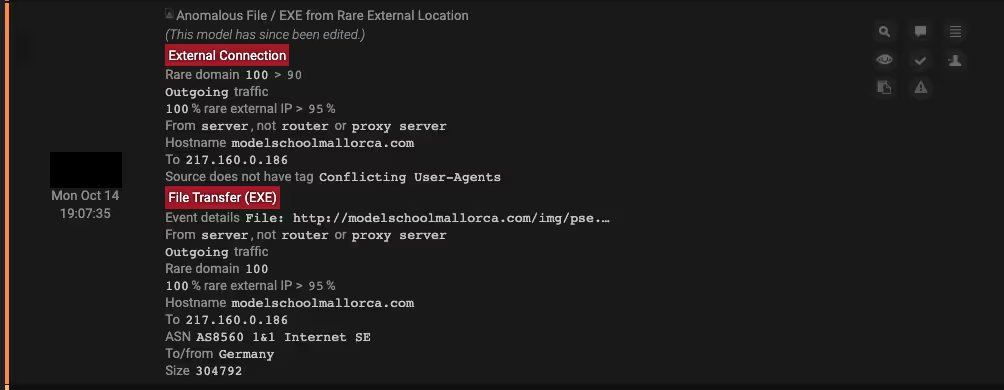
Figure 1: Darktrace alerts on the 100% rare connection and subsequent download — as it occurs.

Had Antigena been in Active Mode at the time, this would have marked the end of the blog post. By blocking all connections to the associated IP and port, Antigena would have instantly stopped the download — without otherwise impacting the device at all.
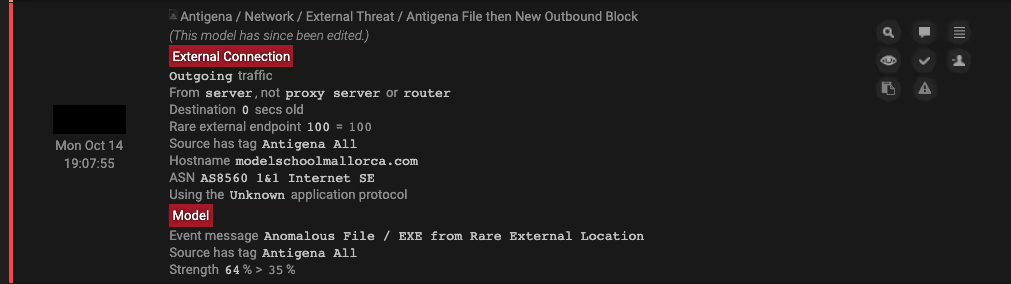
Figure 2: Antigena, in Human Confirmation Mode, recommends that it block the suspicious activity.

Command and control

Following the download, Darktrace observed the device making an HTTP GET request to the same rare endpoint. The continuation of this suspicious activity precipitated an escalation in Antigena’s recommended response, which would now have blocked all outgoing traffic from the breached device to prevent any infection from spreading.

Darktrace then detected the device making yet more unusual external connections to endpoints that, in many cases, had self-signed SSL certificates. Such self-signed certificates do not require verification by a trusted authority and are therefore frequently utilized by cyber-criminals. As a consequence, the outgoing connections from our infected device are likely the installed malware communicating with its command and control infrastructure, as Darktrace flagged below:

Figure 3: Darktrace alerts on the suspicious SSL certificates.

Figure 4: Antigena recommends taking action to block the connections in question.

Internal reconnaissance

Beyond the unusual external activity observed from the breached device, it also began to deviate significantly from its typical pattern of internal behavior. Indeed, Darktrace detected the device making over 160,000 failed internal connections on two key ports: Remote Desktop Protocol port 3389 and SMB port 445. This activity — known as network scanning — provides crucial reconnaissance, giving the attacker insight into the network structure, the services available on each device, and any potential vulnerabilities. Ports 3389 and 445 are especially common targets.

Figure 5: Darktrace tracks this ransomware attack at every step, though the security team does not mount a response in time.

The unusual external connections to self-signed SSL certificates, combined with the highly anomalous internal connectivity from the device, would have caused Antigena to escalate further. Alas, the attack proceeds.

Darktrace detected no further anomalous activity from patient zero for the next four days — perhaps a mechanism to remain under the radar. Yet this period of dormancy concluded when, once again, the device connected to a rare domain with a self-signed SSL certificate, likely reaching out to its command and control infrastructure for additional instructions.

Lateral movement

A day later — in a sign that suggests the prior scanning was somewhat fruitful — the infected device performed a large amount of unusual SMB activity consistent with the malware attempting to move laterally across the network. Darktrace picked up on the breached device sending unusual outgoing SMB writes to the remote administration tool PsExec to a total of 38 destination devices, 28 of which it compromised with a malicious file.

Darktrace recognized this activity as highly anomalous for the particular device, as it doesn’t usually communicate with these destination devices in this manner. Antigena would therefore would have surgically blocked the remote administration behavior by first containing the patient zero device to its normal ‘pattern of life’, and then by escalating to blocking all outgoing connections from the device if lateral movement had continued. Antigena’s escalation can be seen below: the first action is taken at 08:03, the second, more severe action at 08:43.
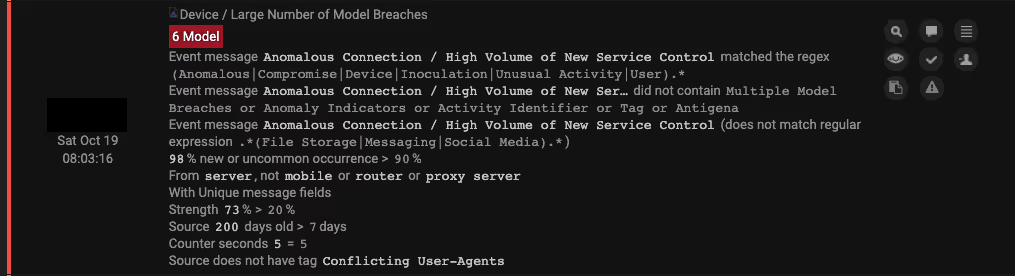

Figure 6: Darktrace repeatedly alerts on the unusual SMB traffic with high confidence — thanks to its evolving understanding of the device’s typical ‘pattern of life’.
Figure 7: Antigena again recommends immediate intervention, this time to impede lateral movement.

Encryption

Darktrace observed the first sign of the ransomware’s ultimate objective — encrypting files — on a different device, which also performed a large volume of unusual SMB activity. After accessing a multitude of SMB shares that it hadn’t accessed previously, it systematically appended those files with the .locked extension. When all was said and done, this encryption activity was seen from no less than 40 internal devices.

In Active Mode, Antigena Ransomware Block would have fully quarantined the devices — a culmination of increasingly severe Antigena actions from the initial infection of patient zero, to the command and control communication, to the internal reconnaissance, to the lateral movement, and finally to the file encryption.

Figure 8: Antigena Ransomware Block was fully armed and prepared to fight back against the infection.

The case for boring blog posts

No other approach to cyber security is able to track ransomware so comprehensively throughout its lifecycle, as programming legacy tools to flag all remote administration behavior, for instance, would inundate security teams with thousands of false positive alerts. Thus, only Darktrace’s understanding ‘self’ for each infected device can shed light on such activities — in the rare cases when they are anomalous.

Figure 9: An overview of Darktrace’s myriad warnings throughout the five-day attack with each colored dot representing a high-confidence alert.

However, intriguing though it may be to track this lifecycle to conclusion, the technology to write far less intriguing blog posts already exists and is already proven. Autonomous Response will render this kind of threat story a relic of the past, and for organizations with sensitive data and critical intellectual property to safeguard, the days of boring security blogs cannot come soon enough.


Inside the SOC
Darktrace cyber analysts are world-class experts in threat intelligence, threat hunting and incident response, and provide 24/7 SOC support to thousands of Darktrace customers around the globe. Inside the SOC is exclusively authored by these experts, providing analysis of cyber incidents and threat trends, based on real-world experience in the field.
Written by
Max Heinemeyer
Global Field CISO

More in this series

No items found.

Blog

/

Proactive Security

/

June 1, 2026

Defend What You Trust: Stories from the Front Lines of Modern Cyber Defense

Default blog imageDefault blog image

Modern attacks don’t always announce themselves, follow obvious patterns, or rely on known malware. Often, they move quietly inside trusted systems, authenticated sessions, and everyday behavior.

They don’t break in. They blend in.

That’s why an AI-powered defense is essential. It turns invisible signals into actionable insights at a scale neither analysts nor traditional tools can achieve alone.

Confidence is creating risk

One of the most dangerous assumptions in cybersecurity today is that strong controls equal strong protection.

Multi-factor authentication (MFA), for example, is widely viewed as a foundational safeguard. But as the CISO for a professional sports organization explains, that confidence can be misplaced. “A lot of organizations assume that once you have MFA, those accounts are safe. That’s not true.”

In one instance, his team identified a sophisticated attack where a threat actor bypassed MFA entirely, not by breaking it, but by going around it. A user’s authenticated session was hijacked and re-used, allowing the attacker to impersonate them without triggering traditional controls.

“Darktrace picked up that a session had been re-injected by the hacker, and we were able to block it right away,” he explains.

Attackers anticipate what we miss

Even well-trained users can become entry points.

“An email bypassed our existing security tools,” shares the VP of IT at a U.S.-based risk management services provider.  “The user missed one signal and entered their credentials into a malicious site. That’s what the bad guys count on.”

The organization responded quickly, but not before damage was done. Crucially, this occurred while Darktrace was in “watch mode,” before autonomous response was fully enabled. “Darktrace would have seen that and shut it down immediately,” he notes.

Mistakes and oversights like misconfigurations, forgotten machines, and missed patches can create serious vulnerabilities.

The CIO of a utility services organization shares an instance when Darktrace detected a breach to a client’s network via their ZTNA VPN due to misconfigured MFA. “Darktrace alerted us and autonomously blocked the scanning, preventing what could have been a ransomware-type incident.”  

The most dangerous threats are already inside

The Head of Security at a global business services provider knows firsthand how blind spots can persist inside environments. His team uncovered evidence of dormant ransomware artifacts sitting unnoticed within a company’s environment ¬¬– long before modern detection was in place.

“During a routine file transfer, Darktrace flagged the suspicious activity, identified the ransomware, and immediately quarantined the server,” he recalls.  While the attack was never executed, the implication was significant: the risk existed long before it was finally detected.

Cyber threats are also successful because they take advantage of normal human behavior, exploiting moments of cognitive overload, urgency, and trust.

The Executive Director of IT and Business Applications at a pharmaceutical lab describes the time Darktrace flagged an employee logging into Microsoft 365 from Singapore, despite him being physically located in the U.S. Darktrace immediately cut off his access and within minutes revealed that the employee’s son was using a VPN to play a video game.

While the threat was benign, it demonstrated the strength of AI to use contextual information to detect threats other tools miss. The information also saved security analysts hours of investigation and minimized downtime for the employee. “That level of precision and speed isn’t just convenient, it’s game changing.”

“Unusual” behavior is the new red flag

Detecting modern threats requires an understanding of what “normal” looks like and recognizing when something subtly deviates.

One security leader  at an AI technology enterprise described a scenario in which an employee connected to a proxy service in China. The service itself was legitimate, and although traditional tools didn’t flag it, the behavior was unusual for that user specifically.

“That’s what Darktrace picked up on. The activity turned out to be benign, but without visibility into behavioral deviations, it could just as easily have been something more serious.”

AI shifts defense from reaction to anticipation

These stories point to a fundamental shift by cyber attackers, both tactically and strategically. Because traditional security tools were built to detect what’s already known, modern attacks are often:

  • Credential-based, not malware-based
  • Behavioral, not signature-based
  • Subtle, not overt

They may operate within the boundaries of what appears normal, exploiting what organizations trust, not what they block:

  • Trusted sessions
  • Legitimate services
  • Human error

This is where AI is changing the equation. Rather than relying on predefined rules or known threat signatures, AI can:

  • Establish a baseline of normal behavior
  • Detect subtle anomalies in real time
  • Act autonomously to contain potential threats

Resilience, not perfection, is the new security standard

As these frontline experiences show, the organizations that lead are those that move beyond reactive defense and embrace AI as a core part of their strategy.

It eliminates the blind spots and uncertainty, says the CISO of a professional sports organization. “If you lack visibility, you’re not managing risk, you’re assuming it. AI gives you the actionable insights needed to turn uncertainty into control.”

And it provides the speed and agility that are vital when seconds matter, says the Executive Director of IT and Business Applications. “When Darktrace alerted us at 3:00 am to a ransomware attack, it had already quarantined the affected systems, blocked the attacker’s access, and provided us with the critical details and time needed to investigate. That action likely saved us hundreds of thousands, if not millions, of dollars.”

The modern SOC has become a cornerstone of enterprise resilience, responsible for protecting data and operational continuity while enabling digital growth and innovation. For today’s security professional, that means success is no longer measured by what they keep out, but by what they protect: revenue, reputation, and trust.

Continue reading
About the author

Blog

/

/

May 28, 2026

From Efficiency to Exposure: How AI Adoption Is Creating Unseen Vulnerabilities on the Factory Floor

AI in manufacturingDefault blog imageDefault blog image

How AI agents impact the manufacturing industry

Security teams and IT personnel across the manufacturing industry are under constant pressure to protect production, maintain uptime, and safeguard critical assets but the rise of AI is bringing huge new opportunities alongside new cyber risks. Across manufacturing, AI is embedded into workflows, decision-making, and increasingly, autonomous AI agents are acting on behalf of employees and systems.  

Agentic systems are powerful because they can act independently, but that same autonomy also creates cyber and operational risk. Agents have extensive permissions and are capable of carrying out complex tasks, making decisions, and interacting with tools or external systems with little to no human intervention.

Unlike traditional AI models that perform predefined tasks, AI agents use advanced techniques to mimic human decision-making processes, dynamically adapting to new challenges, making decision and taking action based on their own judgement. They look like employees operationally but lack judgment, ethics, or fear of consequences like humans do. This means they can be easily manipulated by cybercriminals, and an AI agent embedded across an OT network creates threats that extend well beyond data exposure. For example, at BMW, AI identifies faults in welding processes as they occur. At its Spartanburg plant, AI monitors the weld of 300-400 metal studs onto every SUV frame to detect misplaced or faulty studs and correct them instantly. Corruption of BMW’s AI system could lead to catastrophic quality control errors.

Adopting agentic AI systems across manufacturing raises some concerns across security teams. New data from our State of AI Cybersecurity survey shows that 78% of manufacturing security professionals are worried about employee use of AI agents – their top concern. That’s followed by employee use of generative AI tools like CoPilot and ChatGPT, a worry for 76% of security professionals at manufacturing organizations. As these tools gain more access to business data and processes, and more autonomy within organizations, security teams, who today have minimal visibility of agent activity in their environments, increasingly have sensitive data exposure (a worry for 60%) and accidental policy and regulatory violations (59%) on their minds.

External AI-powered threats are evolving just as quickly

The same capabilities transforming manufacturing are also reshaping cyberattacks.

AI is enabling attackers to automate reconnaissance, refine targeting, and adapt in real time. What once required time and manual effort can now be executed continuously and at scale. Manufacturers are already seeing the impact. According to manufacturing security professionals we surveyed, 76% are already being impacted by AI-powered threats and 90% see AI increasing the success of social engineering attacks.

And the techniques themselves are evolving. Concerns across the manufacturing sector show growing anxiety about the range of AI-powered attack routes, most pressingly of adaptive malware that evolves in real-time – a prospect half (49%) of manufacturing security professionals we surveyed are worried by, a full 9% more than the average across industries. AI adaptive malware is followed by:

  • Automated vulnerability scanning and exploit chaining (48%) which has become even more pressing as Anthropic’s new Mythos AI Model supercharges vulnerability discovery
  • Hyper-personalized phishing campaigns (46%), which remain a mainstay in hackers’ arsenals, and AI has amplified their effectiveness by making phishing emails more convincing and harder to detect.

This is not just an increase in volume, it is a shift toward threats that evolve as they unfold - often faster than static defenses can respond.

Despite rising awareness, many manufacturers are not yet equipped to manage this shift. More than half (51%) say they are not adequately prepared for AI-driven threats, and only 37% have formal policies governing AI deployment.  

Securing AI through visibility, context, and guardrails

Addressing this challenge does not require manufacturers to slow innovation. It requires a different approach to security, one that can operate at the same speed and scale as AI. Three specific priorities are emerging for manufacturers looking to take advantage of the power of AI.

Visibility is foundational.  

Organizations need to understand where AI is being used, what it can access, and how it behaves across both IT and OT environments. Without that, risk cannot be measured or managed. It is no surprise that Darktrace’s research found that 91% of manufacturing security professionals said that they need to understand how AI makes decisions before trusting it. This is even more critical in operational settings where disruption has safety, environmental, financial, and reputational impacts.

Context is what turns visibility into action.  

In environments shaped by AI, normal behavior is constantly shifting. Detecting threats requires a behavioral approach; understanding patterns of life across the organization and identifying subtle deviations in real time – a step change in organizations’ traditional approach to security and risk management.

Guardrails ensure that agency does not become exposure  

As AI systems take on greater responsibility, organizations need clear boundaries around what they can do and when they can act independently. These controls must be embedded into systems themselves, not applied after the fact.  

Securing AI Agents Across Manufacturing IT and OT

The rise of agentic AI is transforming manufacturing - powering next-generation operations while reshaping the security landscape. This is not just an increase in threats, but a shift to autonomous systems, continuously evolving behaviors, and risks moving at machine speed. For organizations trying to grapple with the challenge of enabling AI while managing the risk, visibility, context and guardrails should be foundational.

Darktrace helps manufacturers build secure AI approaches by making those foundations possible. It provides visibility and real-time detection and response to unusual activity across IT and OT environments and allows organizations to understand AI activity from the prompts employees use and the agents they build to how those agents are behaving across the environment. For manufacturers scaling AI, this delivers a foundation for innovation without sacrificing control.

Continue reading
About the author
Oakley Cox
Director of Product
Your data. Our AI.
Elevate your network security with Darktrace AI