
Blog
/
Email
/
April 15, 2025

Why Data Classification Isn’t Enough to Prevent Data Loss

In a world of growing data volume and diversity, protecting and keeping track of your organization’s sensitive information is increasingly complex – particularly when 63% of breaches stem from malicious insiders or human error. This blog explores how security teams can achieve visibility beyond the limits of data classification, without adding to the burden of data management.
Inside the SOC
Darktrace cyber analysts are world-class experts in threat intelligence, threat hunting and incident response, and provide 24/7 SOC support to thousands of Darktrace customers around the globe. Inside the SOC is exclusively authored by these experts, providing analysis of cyber incidents and threat trends, based on real-world experience in the field.
Written by
Carlos Gray
Senior Product Marketing Manager, Email
women looking at laptopDefault blog imageDefault blog imageDefault blog imageDefault blog imageDefault blog imageDefault blog image
15
Apr 2025

Why today’s data is fundamentally difficult to protect

Data isn’t what it used to be. It’s no longer confined to neat rows in a database, or tucked away in a secure on-prem server. Today, sensitive information moves freely between cloud platforms, SaaS applications, endpoints, and a globally distributed workforce – often in real time. The sheer volume and diversity of modern data make it inherently harder to monitor, classify, and secure. And the numbers reflect this challenge – 63% of breaches stem from malicious insiders or human error.

This complexity is compounded by an outdated reliance on manual data management. While data classification remains critical – particularly to ensure compliance with regulations like GDPR or HIPAA – the burden of managing this data often falls on overstretched security teams. Security teams are expected to identify, label, and track data across sprawling ecosystems, which can be time-consuming and error-prone. Even with automation, rigid policies that depend on pre-defined data classification miss the mark.

From a data protection perspective, if manual or basic automated classification is the sole methodology for preventing data loss, critical data will likely slip through the cracks. Security teams are left scrambling to fill the gaps, facing compliance risks and increasing operational overhead. Over time, the hidden costs of these inefficiencies pile up, draining resources and reducing the effectiveness of your entire security posture.

What traditional data classification can’t cover

Data classification plays an important role in data loss prevention, but it's only half the puzzle. It’s designed to spot known patterns and apply labels, yet the most common causes of data breaches don’t follow rules. They stem from something far harder to define: human behavior.

When Darktrace began developing its data loss detection capabilities, the question wasn’t what data to protect — it was how to understand the people using it. The numbers pointed clearly to where AI could make the biggest difference: 22% of email data breaches stem directly from user error, while malicious insider threats remain the most expensive, costing organizations an average of $4.99 million per incident.

Data classification is blind to nuance – it can’t grasp intent, context, or the subtle red flags that often precede a breach. And no amount of labeling, policy, or training can fully account for the reality that humans make mistakes. These problems require a system that sees beyond the data itself — one that understands how it’s being used, by whom, and in what context. That’s why Darktrace leans into its core strength: detecting the subtle symptoms of data loss by interpreting human behavior, not just file labels.

Achieving autonomous data protection with behavioral AI

Rather than relying on manual processes to understand what’s important, Darktrace uses its industry-leading AI to learn how your organization uses data — and spot when something looks wrong.

Its understanding of business operations allows it to detect subtle anomalies around data movement for your use cases, whether that’s a misdirected email, an insecure cloud storage link, or suspicious activity from an insider. Crucially, this detection is entirely autonomous, with no need for predefined rules or static labels.
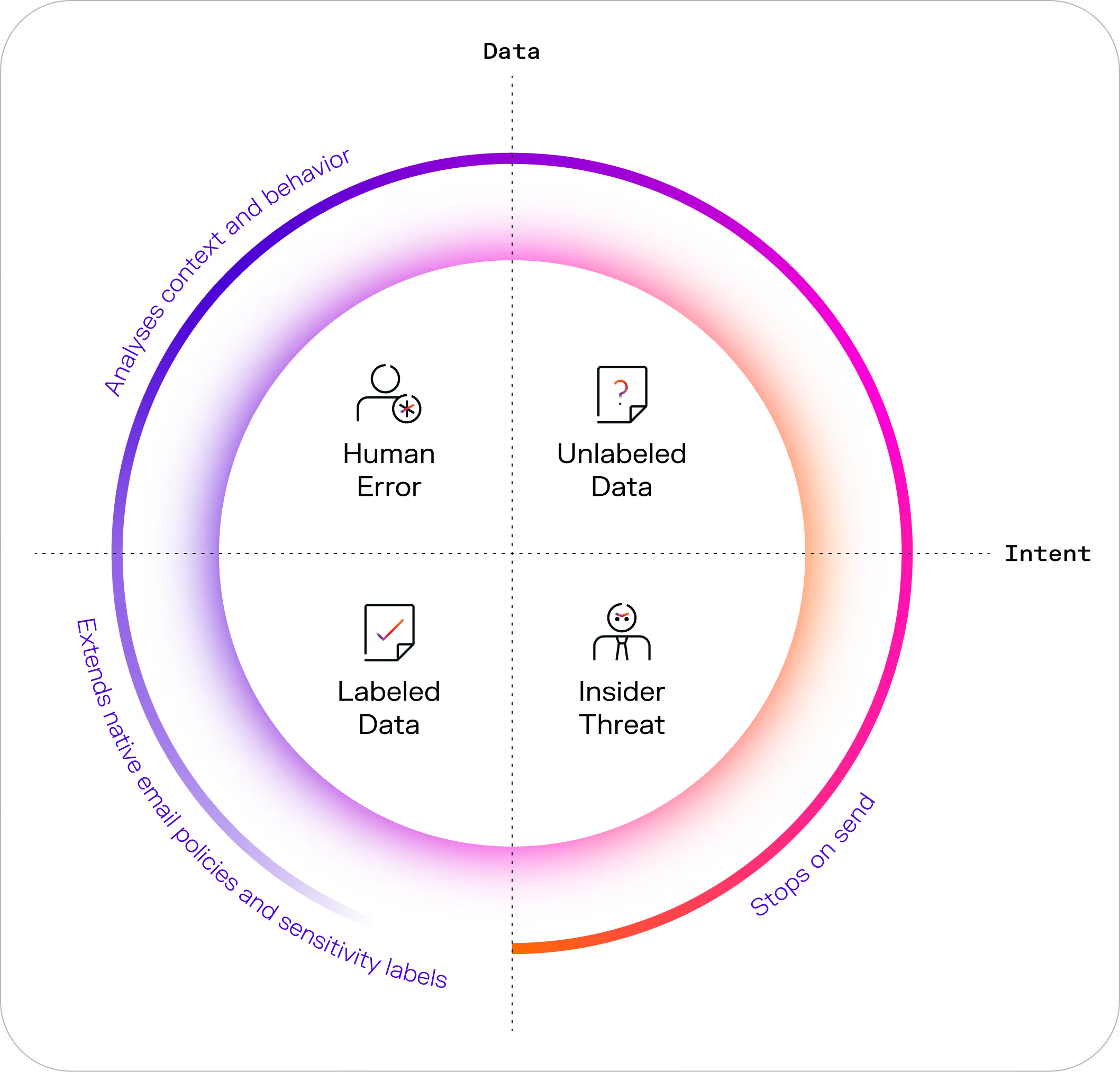
Darktrace uses its contextual understanding of each user to stop all types of sensitive or misdirected data from leaving the organization
Fig 1: Darktrace uses its contextual understanding of each user to stop all types of sensitive or misdirected data from leaving the organization

Darktrace / EMAIL’s DLP add-on continuously learns in real time, enabling:

  • Automatic detection: Identifies risky data behavior to catch threats that traditional approaches miss – from human error to sophisticated insider threats.
  • A dynamic range of actions: Darktrace always aims to avoid business disruption in its blocking actions, but this can be adjusted according to the unique risk appetite of each customer – taking the most appropriate response for that business from a whole scale of possibilities.
  • Enhanced context: While Darktrace doesn’t require sensitivity data labeling, it integrates with Microsoft Purview to ingest sensitivity labels and enrich its understanding of the data – for even more accurate decision-making.

Beyond preventing data loss, Darktrace uses DLP activity to enhance its contextual understanding of the user itself. In other words, outbound activity can be a useful symptom in identifying a potential account compromise, or can be used to give context to that user’s inbound activity. Because Darktrace sees the whole picture of a user across their inbound, outbound, and lateral mail, as well as messaging (and into collaboration tools with Darktrace / IDENTITY), every interaction informs its continuous learning of normal.

With Darktrace, you can achieve dynamic data loss prevention for the most challenging human-related use cases – from accidental misdirected recipients to malicious insiders – that evade detection from manual classification. So don’t stand still on data protection – make the switch to autonomous, adaptive DLP that understands your business, data, and people.

[related-resource]

Interested in finding out more?

Read the full solution brief to see how Darktrace's AI-driven approach to DLP stops data loss across email and Teams

Inside the SOC
Darktrace cyber analysts are world-class experts in threat intelligence, threat hunting and incident response, and provide 24/7 SOC support to thousands of Darktrace customers around the globe. Inside the SOC is exclusively authored by these experts, providing analysis of cyber incidents and threat trends, based on real-world experience in the field.
Written by
Carlos Gray
Senior Product Marketing Manager, Email

More in this series

No items found.

Blog

/

/

February 13, 2026

CVE-2026-1731: How Darktrace Sees the BeyondTrust Exploitation Wave Unfolding

Default blog imageDefault blog image

Note: Darktrace's Threat Research team is publishing now to help defenders. We will update continue updating this blog as our investigations unfold.

Background

On February 6, 2026, the Identity & Access Management solution BeyondTrust announced patches for a vulnerability, CVE-2026-1731, which enables unauthenticated remote code execution using specially crafted requests.  This vulnerability affects BeyondTrust Remote Support (RS) and particular older versions of Privileged Remote Access (PRA) [1].

A Proof of Concept (PoC) exploit for this vulnerability was released publicly on February 10, and open-source intelligence (OSINT) reported exploitation attempts within 24 hours [2].

Previous intrusions against Beyond Trust technology have been cited as being affiliated with nation-state attacks, including a 2024 breach targeting the U.S. Treasury Department. This incident led to subsequent emergency directives from  the Cybersecurity and Infrastructure Security Agency (CISA) and later showed attackers had chained previously unknown vulnerabilities to achieve their goals [3].

Additionally, there appears to be infrastructure overlap with React2Shell mass exploitation previously observed by Darktrace, with command-and-control (C2) domain  avg.domaininfo[.]top seen in potential post-exploitation activity for BeyondTrust, as well as in a React2Shell exploitation case involving possible EtherRAT deployment.

Darktrace Detections

Darktrace’s Threat Research team has identified highly anomalous activity across several customers that may relate to exploitation of BeyondTrust since February 10, 2026. Observed activities include:

-              Outbound connections and DNS requests for endpoints associated with Out-of-Band Application Security Testing; these services are commonly abused by threat actors for exploit validation.  Associated Darktrace models include:

o    Compromise / Possible Tunnelling to Bin Services

-              Suspicious executable file downloads. Associated Darktrace models include:

o    Anomalous File / EXE from Rare External Location

-              Outbound beaconing to rare domains. Associated Darktrace models include:

o   Compromise / Agent Beacon (Medium Period)

o   Compromise / Agent Beacon (Long Period)

o   Compromise / Sustained TCP Beaconing Activity To Rare Endpoint

o   Compromise / Beacon to Young Endpoint

o   Anomalous Server Activity / Rare External from Server

o   Compromise / SSL Beaconing to Rare Destination

-              Unusual cryptocurrency mining activity. Associated Darktrace models include:

o   Compromise / Monero Mining

o   Compromise / High Priority Crypto Currency Mining

And model alerts for:

o    Compromise / Rare Domain Pointing to Internal IP

IT Defenders: As part of best practices, we highly recommend employing an automated containment solution in your environment. For Darktrace customers, please ensure that Autonomous Response is configured correctly. More guidance regarding this activity and suggested actions can be found in the Darktrace Customer Portal.  

Appendices

Potential indicators of post-exploitation behavior:

·      217.76.57[.]78 – IP address - Likely C2 server

·      hXXp://217.76.57[.]78:8009/index.js - URL -  Likely payload

·      b6a15e1f2f3e1f651a5ad4a18ce39d411d385ac7  - SHA1 - Likely payload

·      195.154.119[.]194 – IP address – Likely C2 server

·      hXXp://195.154.119[.]194/index.js - URL – Likely payload

·      avg.domaininfo[.]top – Hostname – Likely C2 server

·      104.234.174[.]5 – IP address - Possible C2 server

·      35da45aeca4701764eb49185b11ef23432f7162a – SHA1 – Possible payload

·      hXXp://134.122.13[.]34:8979/c - URL – Possible payload

·      134.122.13[.]34 – IP address – Possible C2 server

·      28df16894a6732919c650cc5a3de94e434a81d80 - SHA1 - Possible payload

References:

1.        https://nvd.nist.gov/vuln/detail/CVE-2026-1731

2.        https://www.securityweek.com/beyondtrust-vulnerability-targeted-by-hackers-within-24-hours-of-poc-release/

3.        https://www.rapid7.com/blog/post/etr-cve-2026-1731-critical-unauthenticated-remote-code-execution-rce-beyondtrust-remote-support-rs-privileged-remote-access-pra/

Continue reading
About the author
Emma Foulger
Global Threat Research Operations Lead

Blog

/

/

February 13, 2026

How AI is redefining cybersecurity and the role of today’s CIO

Default blog imageDefault blog image

Why AI is essential to modern security

As attackers use automation and AI to outpace traditional tools and people, our approach to cybersecurity must fundamentally change. That’s why one of my first priorities as Withum's CIO was to elevate cybersecurity from a technical function to a business enabler.

What used to be “IT’s problem” is now a boardroom conversation – and for good reason. Protecting our data, our people, and our clients directly impacts revenue, reputation and competitive positioning.  

As CIOs / CISOs, our responsibilities aren’t just keeping systems running, but enabling trust, protecting our organization's reputation, and giving the business confidence to move forward even as the digital world becomes less predictable. To pull that off, we need to know the business inside-out, understand risk, and anticipate what's coming next. That's where AI becomes essential.

Staying ahead when you’re a natural target

With more than 3,100 team members and over 1,000 CPAs (Certified Public Accountant), Withum’s operates in an industry that naturally attracts attention from attackers. Firms like ours handle highly sensitive financial and personal information, which puts us squarely in the crosshairs for sophisticated phishing, ransomware, and cloud-based attacks.

We’ve built our security program around resilience, visibility, and scale. By using Darktrace’s AI-powered platform, we can defend against both known and unknown threats, across email and network, without slowing our teams down.

Our focus is always on what we’re protecting: our clients’ information, our intellectual property, and the reputation of the firm. With Darktrace, we’re not just keeping up with the massive volume of AI-powered attacks coming our way, we’re staying ahead. The platform defends our digital ecosystem around the clock, detecting potential threats across petabytes of data and autonomously investigating and responding to tens of thousands of incidents every year.

Catching what traditional tools miss

Beyond the sheer scale of attacks, Darktrace ActiveAI Security PlatformTM is critical for identifying threats that matter to our business. Today’s attackers don’t use generic techniques. They leverage automation and AI to craft highly targeted attacks – impersonating trusted colleagues, mimicking legitimate websites, and weaving in real-world details that make their messages look completely authentic.

The platform, covering our network, endpoints, inboxes, cloud and more is so effective because it continuously learns what’s normal for our business: how our users typically behave, the business- and industry-specific language we use, how systems communicate, and how cloud resources are accessed. It picks up on minute details that would sail right past traditional tools and even highly trained security professionals.

Freeing up our team to do what matters

On average, Darktrace autonomously investigates 88% of all our security events, using AI to connect the dots across email, network, and cloud activity to figure out what matters. That shift has changed how our team works. Instead of spending hours sorting through alerts, we can focus on proactive efforts that actually strengthen our security posture.

For example, we saved 1,850 hours on investigating security issues over a ten-day period. We’ve reinvested the time saved into strengthening policies, refining controls, and supporting broader business initiatives, rather than spending endless hours manually piecing together alerts.

Real confidence, real results

The impact of our AI-driven approach goes well beyond threat detection. Today, we operate from a position of confidence, knowing that threats are identified early, investigated automatically, and communicated clearly across our organization.

That confidence was tested when we withstood a major ransomware attack by a well-known threat group. Not only were we able to contain the incident, but we were able to trace attacker activity and provided evidence to law enforcement. That was an exhilarating experience! My team did an outstanding job, and moments like that reinforce exactly why we invest in the right technology and the right people.

Internally, this capability has strengthened trust at the executive level. We share security reporting regularly with leadership, translating technical activity into business-relevant insights. That transparency reinforces cybersecurity as a shared responsibility, one that directly supports growth, continuity, and reputation.

Culturally, we’ve embedded security awareness into daily operations through mandatory monthly training, executive communication, and real-world industry examples that keep cybersecurity top of mind for every employee.

The only headlines we want are positive ones: Withum expanding services, Withum growing year over year. Security plays a huge role in making sure that’s the story we get to tell.

What’s next

Looking ahead, we’re expanding our use of Darktrace, including new cloud capabilities that extend AI-driven visibility and investigation into our AWS and Azure environments.

As I continue shaping our security team, I look for people with passion, curiosity, and a genuine drive to solve problems. Those qualities matter just as much as formal credentials in my view. Combined with AI, these attributes help us build a resilient, engaged security function with low turnover and high impact.

For fellow technology leaders, my advice is simple: be forward-thinking and embrace change. We must understand the business, the threat landscape, and how technology enables both. By augmenting human expertise rather than replacing it, AI allows us to move upstream by anticipating risk, advising the business, and fostering stronger collaboration across teams.

Continue reading
About the author
Your data. Our AI.
Elevate your network security with Darktrace AI