Blog
/
Network
/
November 17, 2026

GTA VI Cyber Threats: Fake downloads, ransomware and account hijacking

Darktrace Threat Research examines GTA VI-themed fake download activity reaching enterprise environments alongside Qilin and DireWolf ransomware incidents and SaaS account hijacking affecting gaming companies.
Inside the SOC
Darktrace cyber analysts are world-class experts in threat intelligence, threat hunting and incident response, and provide 24/7 SOC support to thousands of Darktrace customers around the globe. Inside the SOC is exclusively authored by these experts, providing analysis of cyber incidents and threat trends, based on real-world experience in the field.
Written by
Gemma Stubberfield
Cyber Analyst
Default blog image
17
Nov 2026

Key findings

  • Darktrace detected GTA VI-themed suspicious activity across organizations in multiple sectors ahead of the game’s release, showing how malicious gaming content can reach corporate environments outside the gaming industry.
  • Twelve Darktrace customer environments connected to gta6demo[.]asia, a domain that public threat research has associated with a fake GTA VI demo used to distribute the Vidar infostealer. Seven of the twelve communicated with infrastructure associated with AS56322 ServerAstra Kft as part of this connectivity.

·       Darktrace investigated ransomware activity at two European games companies. One incident involved DireWolf ransomware alongside reported data exfiltration. A separate Qilin incident included Active Directory reconnaissance, new administrative credentials, possible lateral movement and substantial cloud-storage transfers before ransomware deployment.

  • Another incident on a gaming organization involved a SaaS account hijack in which a compromised account authenticated from unusual IP addresses, created a new privileged account and subsequently sent a high volume of suspected malicious email. An administrative account later authenticated from rare endpoints.

GTA VI gives criminals an audience

Grand Theft Auto VI arrives on November 19 with the kind of attention few entertainment releases command [1]. Before launch, that interest is already being exploited by sites offering supposed demos and downloads.

During September and October 2026, Darktrace detected devices across multiple customer environments connecting to GTA VI-themed sites associated with suspicious activity. The organizations involved were spread across EMEA and the Americas and included Manufacturing, Finance, and Public administration and defense sectors.

Darktrace has also investigated multiple incidents affecting gaming organizations including ransomware and a SaaS account hijack. Those investigations show a separate side of the threat: attackers operating inside corporate infrastructure and accounts, sometimes well before the eventual impact becomes apparent.

Following a fake GTA VI download

On October 7, 2026, Darktrace detected a device making suspicious DNS requests for gta6-play[.]ru, an unofficial Russian-language GTA VI site that had also been flagged as likely malicious in open-source intelligence (OSINT).

‍

Figure 1: A screenshot of the suspicious endpoint gta6-play[.]ru .

‍

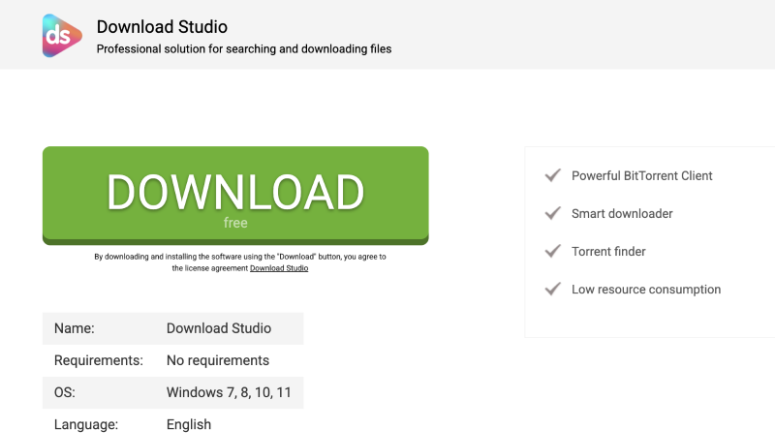
Figure 2: A screenshot of a “Download Studio” endpoint led to on gta6-play[.]ru.

‍

The site advertised a GTA VI download. The site led to a separate “Download Studio” page offering a Windows executable. Analysis found the file was packaged using InstallMate, a commercial installation framework, with an embedded .tsuarch section containing a compressed tiz3 archive.


Further examination identified functionality designed to inspect the environment in which the installer was running. This included checking registry entries for installed software and disk devices, enumerating network adapters, inspecting MAC addresses, and searching for running processes and window titles.


The installer also searched for processes associated with virtualization, debugging, and network analysis, including VMware and VirtualBox components, alongside debugging and monitoring utilities such as OllyDbg, WinDbg, Process Hacker, Process Monitor, Wireshark and Fiddler.

The presence of those checks did not prove that the executable was malicious. The installer contained functionality capable of extracting embedded files, but the investigation did not establish that it was being used to deploy a malicious payload. No definitive malicious payload or command-and-control infrastructure was identified. The software appeared to be InstallRex, which is classified by several security vendors as a potentially unwanted program.

That is still a useful finding; A user looking for GTA VI content could move from an unofficial gaming site to an executable that inspected the local environment, including checking for software commonly used by security researchers.

A second GTA VI lure appeared across twelve organizations

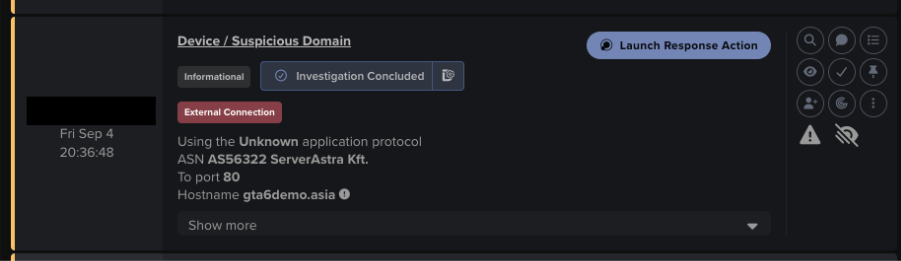
During September 2026, Darktrace alerted on HTTP connections to gta6demo[.]asia across twelve customer environments. Seven of the twelve communicated with infrastructure associated with AS56322 ServerAstra Kft as part of this connectivity.
‍

Figure 3: An example model alert generated due to a suspicious connection to gta6demo[.]asia.

‍

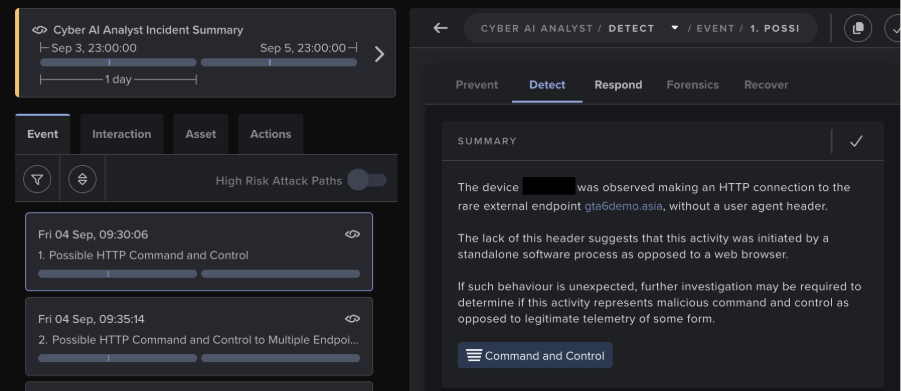
In a case affecting a UK-based customer, Darktrace’s Real-Time AI Analyst further investigated connections to gta6demo[.]asia and generated an incident due to the highly suspicious nature of the behavior.
‍

Figure 4: A Real-Time AI Analyst incident highlighting the suspicious activity for further investigation

‍

Public threat research has associated gta6demo[.]asia with a campaign advertising a fake GTA VI demo. Users clicking "Play Now" were reportedly directed towards an executable containing the Vidar infostealer [2].

There is a practical difference between this activity and an attack against a games company. The users encountering GTA VI-themed infrastructure can work anywhere. Darktrace saw the activity across several sectors outside Gaming, including Finance, Manufacturing, and Public administration and defense.

A major game release can therefore create security exposure well beyond its publisher. A search for a demo or unofficial download on a corporate device is enough to bring gaming-themed infrastructure into an enterprise environment.

Ransomware operators inside the gaming industry

The attacks Darktrace observed against Gaming companies themselves show different patterns.

In August 2026, Darktrace threat research identified possible malicious activity at a European game developer. Ransomware was ultimately deployed and data was exfiltrated, with the DireWolf ransomware group claiming responsibility.

Darktrace observed suspicious file downloads and beaconing from several devices to rare endpoints alongside Monero cryptocurrency mining, Active Directory and network reconnaissance, unusual administrative RDP connections, activity associated with data staging and HTTP-based exfiltration.

Much of the intrusion was therefore visible before ransomware appeared; the environment was already showing evidence of ingress tooling, external command-and-control communications (C2), reconnaissance, unusual administrative access and data movement.

A separate investigation in December 2025 provides a closer view of this pre-ransomware activity. A European games company was targeted by Qilin ransomware with Darktrace observing scanning and LDAP searches involving userAccountControl, which can expose information useful for identifying accounts and Service Principal Names within Active Directory.

New administrative credentials then appeared on a Domain Controller and the Domain Controller also generated scanning, anomalous RPC, SMB, and SSH activity, and NetShareEnum activity through srvsvc. Elsewhere in the environment, long Remote Desktop sessions and SMB enumeration appeared consistent with lateral movement.

Several devices also transferred data to cloud storage services including WebDrive and Amazon Web Services (AWS). In some cases, large downloads preceded subsequent uploads. Darktrace observed the transfer pattern, although the available telemetry does not establish that every transfer represented attacker-controlled exfiltration.

The activity preceding the Qilin deployment included Active Directory reconnaissance, privileged credential use, network and share enumeration, unusual remote access and significant data movement. Each appeared before ransomware became the defining feature of the incident.

SaaS hijacking shifts the attacker evidence

A separate investigation in May 2026 involved the hijacking of a SaaS account at a Gaming organization.

The compromised account authenticated from several IP addresses that were unusual for the organization. It then performed suspicious SaaS group administration, including creating a new privileged account. The account subsequently sent a high volume of emails assessed as likely malicious spam and potentially intended to compromise additional users.

The following day, an administrative SaaS account authenticated from rare endpoints, raising the possibility that further privileged access had been obtained.

The activity presented a different detection problem from the ransomware cases. Authentication from rare infrastructure, administrative changes, creation of a privileged account and subsequent email activity provided the strongest indications that a legitimate identity had been compromised.

For a Gaming company using hosted platforms for development, communication and business operations, a compromised account with the right permissions can provide considerable access without requiring the attacker to reproduce a conventional network intrusion.

Detecting the intrusion before impact

The ransomware investigations show why encryption should not be the first point at which an incident comes into focus. Darktrace observed LDAP and Active Directory-related reconnaissance, new privileged credentials, unusual Domain Controller activity, remote sessions, network enumeration and abnormal data movement before ransomware deployment.

The SaaS case produced different evidence: authentication from rare infrastructure, unexpected administrative changes and activity performed through a compromised account. GTA VI-themed activity required another approach again, following users through unofficial sites and redirects and examining the software offered for download.

GTA VI has put gaming back into the headlines ahead of its November release. The security activity around it is already visible beyond the games industry, while ransomware and account-compromise investigations show attackers operating inside gaming companies through very different routes.

For defenders, those routes leave evidence before the incident reaches its most damaging stage. The practical work is in recognizing those changes early enough to investigate them.

Credit to Gemma Stubberfield (Cyber Analyst), Ahmed Gardezi (Senior Cyber Analyst), Tara Gould (Malware Research Lead), Nathaniel Jones (SVP, Global Threat Intelligence)

References:

1.        https://www.rockstargames.com/VI

2.     https://www.malwarebytes.com/blog/threat-intel/2026/08/fake-gta-6-extended-look-and-demo-sites-deliver-an-infostealer

‍

Inside the SOC
Darktrace cyber analysts are world-class experts in threat intelligence, threat hunting and incident response, and provide 24/7 SOC support to thousands of Darktrace customers around the globe. Inside the SOC is exclusively authored by these experts, providing analysis of cyber incidents and threat trends, based on real-world experience in the field.
Written by
Gemma Stubberfield
Cyber Analyst

More in this series

No items found.

Blog

/

AI

/

November 17, 2026

How Microsoft and Darktrace Secure the AI-Powered Enterprise

Default blog imageDefault blog image

When legitimate activity creates business risk

AI is making information more accessible and enabling autonomous agents to act across enterprise systems. But legitimate access can still result in sensitive-data exposure, unintended actions, or activity that deviates from business expectations.

Microsoft's evolving security strategy recognizes this shift, emphasizing continuous risk assessment, stronger identity protection, and security that adapts as AI systems operate. For enterprises, the challenge is increasingly about recognizing when trusted activity introduces risk, even when existing controls are functioning as intended.

Where global intelligence meets deep business context

Microsoft brings global threat intelligence and comprehensive security capabilities, helping organizations protect identities, data, applications, and infrastructure. Its integrated approach connects security signals, governance, detection, and response across increasingly complex environments.

Darktrace complements these strengths with deep, organization-specific behavioral understanding. Powered by Adaptive AI, Darktrace continuously learns the patterns and relationships unique to each business, developing a Unique Behavioral Profile for each organization that helps distinguish meaningful threats from legitimate activity. By connecting identity, activity, context, and intent, it adds another dimension to security intelligence.

Together, Microsoft and Darktrace combine global intelligence with deeper knowledge of how each customer operates. Through supported integrations, this behavioral context enriches existing Microsoft security workflows, enabling more informed investigations and precise response.

This complementary approach extends across three interconnected areas of enterprise security- AI, People and Infrastructure. From understanding how AI and agents operate to protecting trusted communications and the infrastructure businesses depend on, Darktrace strengthens Microsoft's security capabilities with behavioral insight specific to each organization.

Understanding AI beyond permissions and policies

As AI moves into business-critical operations, security teams need to understand more than which applications and agents are approved. They need visibility into how AI is used, what information it accesses, and whether its actions remain aligned with business intent.

Microsoft provides extensive AI development, governance, and security capabilities. Darktrace / SECURE AI complements these with behavioral analysis across Shadow AI, prompts, agent identities and actions, and development risk. Policy Manager helps evaluate activity against organizational AI policies, while the announced integration with Microsoft Agent 365 is designed to enrich agent risk assessments with organization-specific behavioral signals. Together, these capabilities help organizations scale AI adoption with greater confidence.

Recognizing risk within trusted relationships

Sophisticated threats increasingly exploit established business relationships, familiar communications, and legitimate accounts. A message from a trusted supplier or an action taken through an authorized identity may appear routine until considered against the organization's normal behavior.

Darktrace / EMAIL complements Microsoft's native email, identity, and data protection capabilities by understanding how people and organizations communicate. This enables more precise detection of targeted phishing, business email compromise, account takeover, and data loss, supported by proportionate response. Integrations such as Unified Quarantine within Microsoft Defender for Office 365 bring this additional protection into existing security workflows.

Seeing the bigger picture behind an attack across domains

Threats rarely unfold within a single security domain. Suspicious identity activity, unexpected cloud connections, and unusual network behavior may appear unrelated until the relationships between them reveal a developing attack.

Darktrace / HYBRID NETWORK complements Microsoft's security capabilities with organization-specific behavioral detection across network, cloud, identity, and operational technology. Real-Time AI Analyst, including Cyber AI Analyst, connects related activity into investigated incidents that can be delivered into Microsoft Sentinel, helping security teams accelerate investigations and support targeted containment across the hybrid enterprise.

Turning security intelligence into business confidence

As AI becomes more deeply integrated into business operations, organizations need security that understands not only what technology can access, but how it behaves within their unique environment.

Microsoft and Darktrace bring complementary strengths to that challenge. By connecting global threat intelligence and integrated security capabilities with deep behavioral understanding, the partnership helps organizations recognize emerging risks, respond with greater precision, and strengthen their existing security investments.

The opportunity is to turn security intelligence into meaningful business context, enabling organizations to innovate and operate AI with confidence.

Darktrace named a 2026 Microsoft Partner of the Year Finalist for ISV Innovation

Darktrace has been named a finalist for the 2026 Microsoft Partner of the Year Award in the ISV Innovation category.  

This recognition reflects our collaboration with Microsoft to bring business context to enterprise security. By connecting Microsoft's global threat intelligence and integrated security capabilities with Darktrace's deep behavioral understanding, we help organizations recognize emerging risks and respond with greater precision across AI, People and Infrastructure.

Thank you to Microsoft, our customers, and our teams for their continued collaboration.

Meet Darktrace at Microsoft Ignite and the Microsoft Frontier Tour

Explore how Darktrace and Microsoft are bringing behavioral security to AI, people, and infrastructure.

Join Darktrace at Microsoft Ignite in San Francisco, November 17–19, or connect with our experts as we join the Microsoft Frontier Tour across 21 cities worldwide.

Meet Darktrace at Microsoft Ignite

Connect with Darktrace at the Microsoft Frontier Tour

[related-resource]

Continue reading
About the author

Blog

/

AI

/

November 13, 2026

Introducing Darktrace MCP: Connect your AI assistants to the Darktrace Behavioral Defense Platform

Default blog imageDefault blog image

The Darktrace MCP Server is now generally available to users of the Darktrace Platform Portal. It enables compatible AI assistants to query security data, retrieve Cyber AI Analyst findings, and execute supported actions across actively licensed Darktrace products. Customers can now use these capabilities in their own AI workflows to gather incident context, search telemetry, enrich investigations with information from other services, and carry out triage tasks.

What is MCP?
MCP is an open standard developed by Anthropic that lets AI systems connect to and use enterprise tools and data. Adoption of MCP servers creates an opportunity for SOC teams to move beyond isolated AI experiences toward truly operational AI workflows.

Available capabilities

The server exposes tools for three areas of security work:

  • Incident discovery and threat hunting. Retrieve model alerts and incident groups, search for relevant devices and investigate indicators of compromise. Assistants with access to other services can combine these results with external threat intelligence.
  • Investigation and analysis. Retrieve Cyber AI Analyst incident findings, examine related event data, and enrich the investigation with information from other platforms or external documentation.
  • Triage and workflow actions. Add comments, tags and statuses to alerts and assets, modify supported settings such as trusted domains and subnet details, or trigger a Cyber AI Analyst investigation.

Available capabilities depend on the licensed products connected to the server. The toolset also includes access to Secure AI prompt and shadow AI information, cloud misconfigurations and external exposure information, and Email threat trends and supported management functions.

The following examples show how the server’s discovery, investigation, and action capabilities can be combined within an AI assistant.

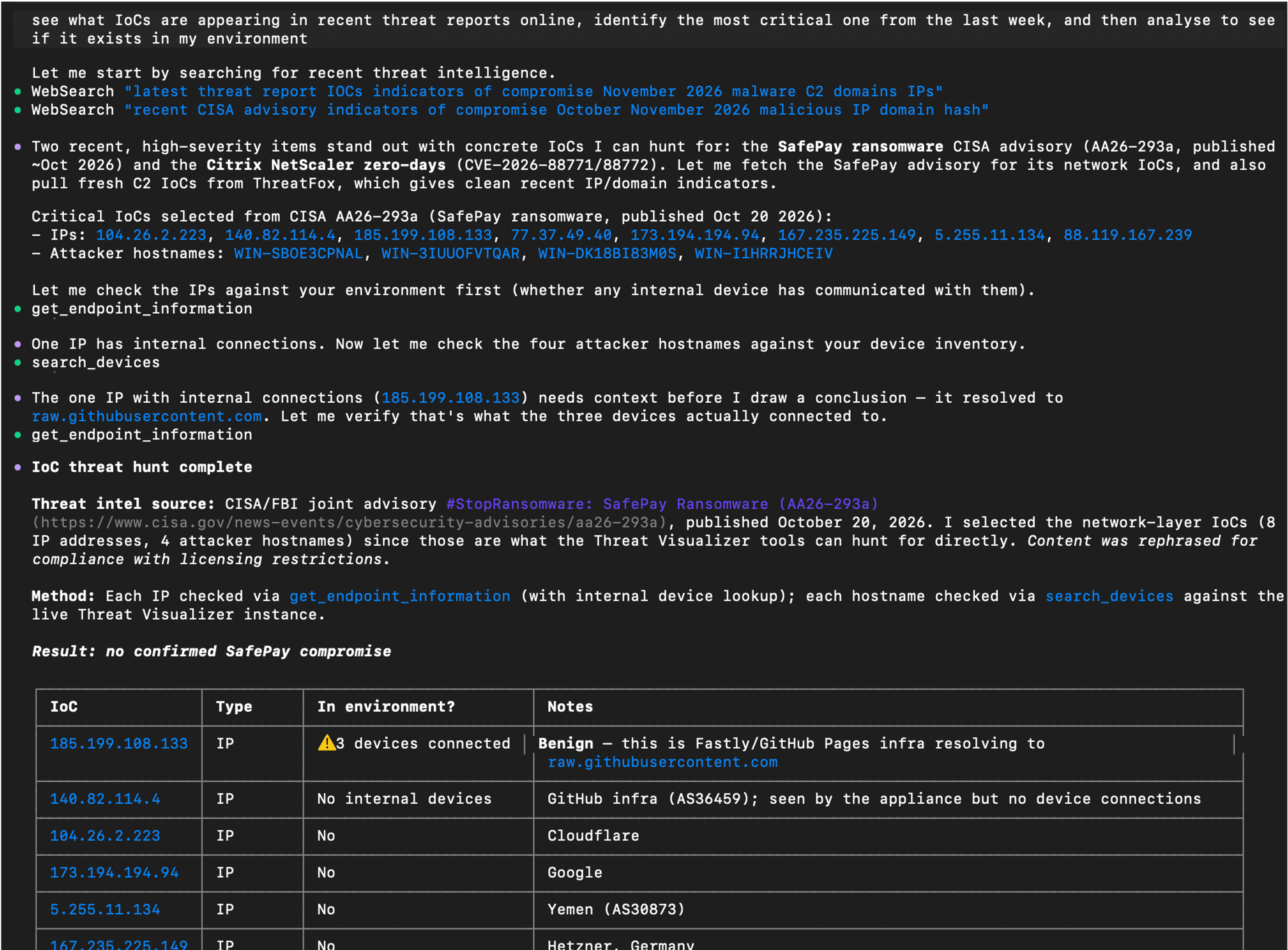
Check external threat indicators against your environment

An assistant can use Darktrace MCP alongside external threat intelligence to check whether reported indicators appear in an environment. Darktrace’s tools provide device information and endpoint context; the assistant’s other tools or connected services supply the external intelligence.

In this example, the assistant searched for recent threat reports, selected indicators of compromise (IoCs) to investigate, and checked for devices that had communicated with the reported IP addresses. It then examined endpoint information to put the matches into context.

Relevant Darktrace tools: search_devices, get_endpoint_information, get_model_alerts, get_incident_events

Example prompt: “See what IoCs are appearing in recent threat reports online, identify the most critical one from the last week, and then analyze to see if it exists in my environment.”

AI assistant output using external threat intelligence alongside data retrieved through the Darktrace MCP Server.

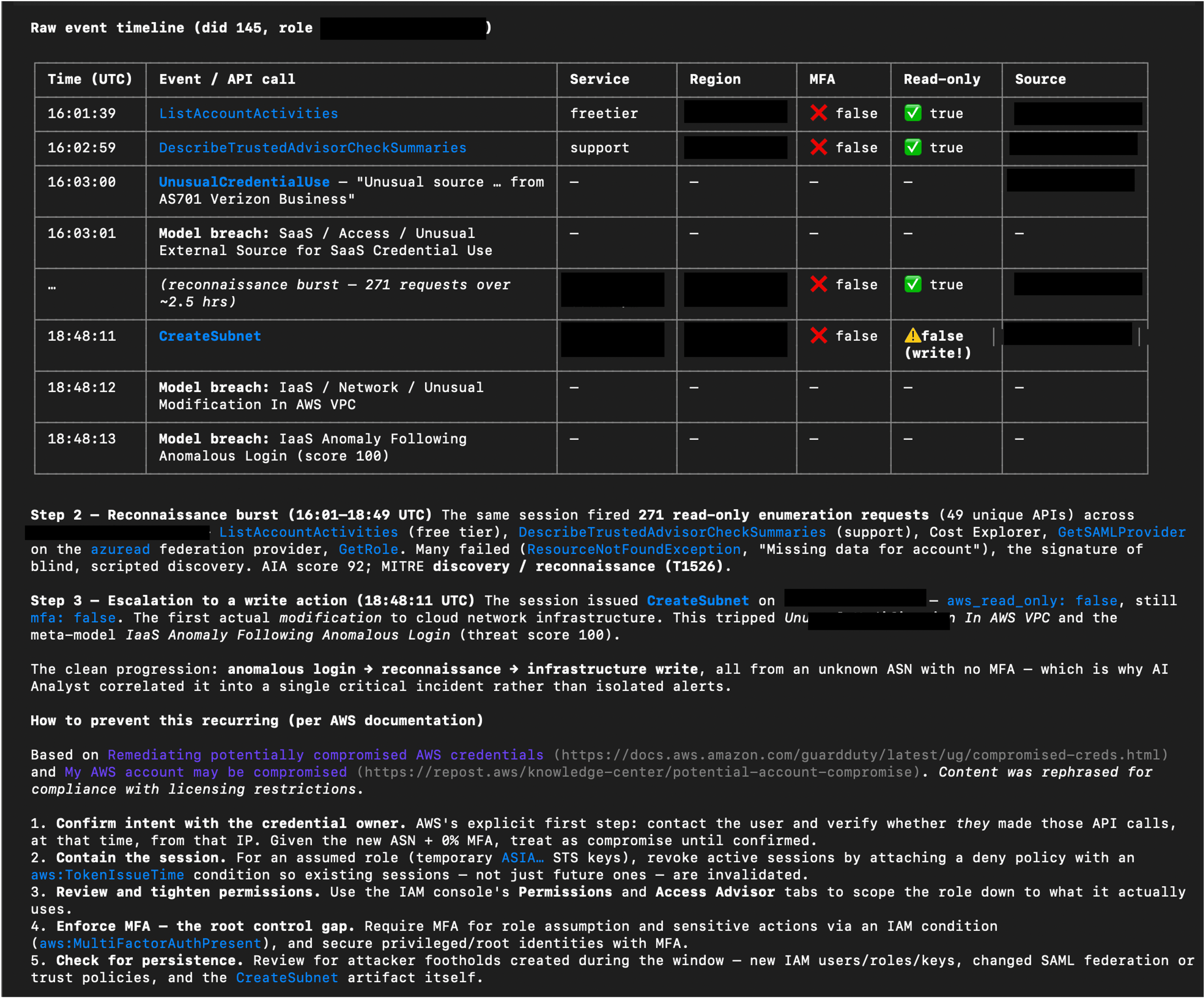
Enrich a Cyber AI Analyst investigation

Cyber AI Analyst provides Darktrace’s incident analysis. Through MCP, an assistant can retrieve those findings, explain specific parts of an incident, and bring in related data from other services.

In this example, the assistant examined a Potential AWS Account Hijack investigated by Cyber AI Analyst. It assembled a step-by-step account and raw event timeline, then consulted AWS documentation to add relevant prevention guidance. The assistant brings together the existing Darktrace analysis, supporting events, and external guidance in one response.

Relevant Darktrace tools: get_incident_groups, get_incident_events, get_detailed_events, get_ai_analyst_investigations, advanced_search

Example prompt: “Drill down on the identified potential AWS account hijack. Show me a detailed step-by-step of what happened using data from Cyber AI Analyst, including a raw event timeline, and provide info on how to prevent this from happening again using info from AWS documentation.”

AI assistant output combining Cyber AI Analyst findings and event data with guidance from AWS documentation. Some sensitive content has been redacted.

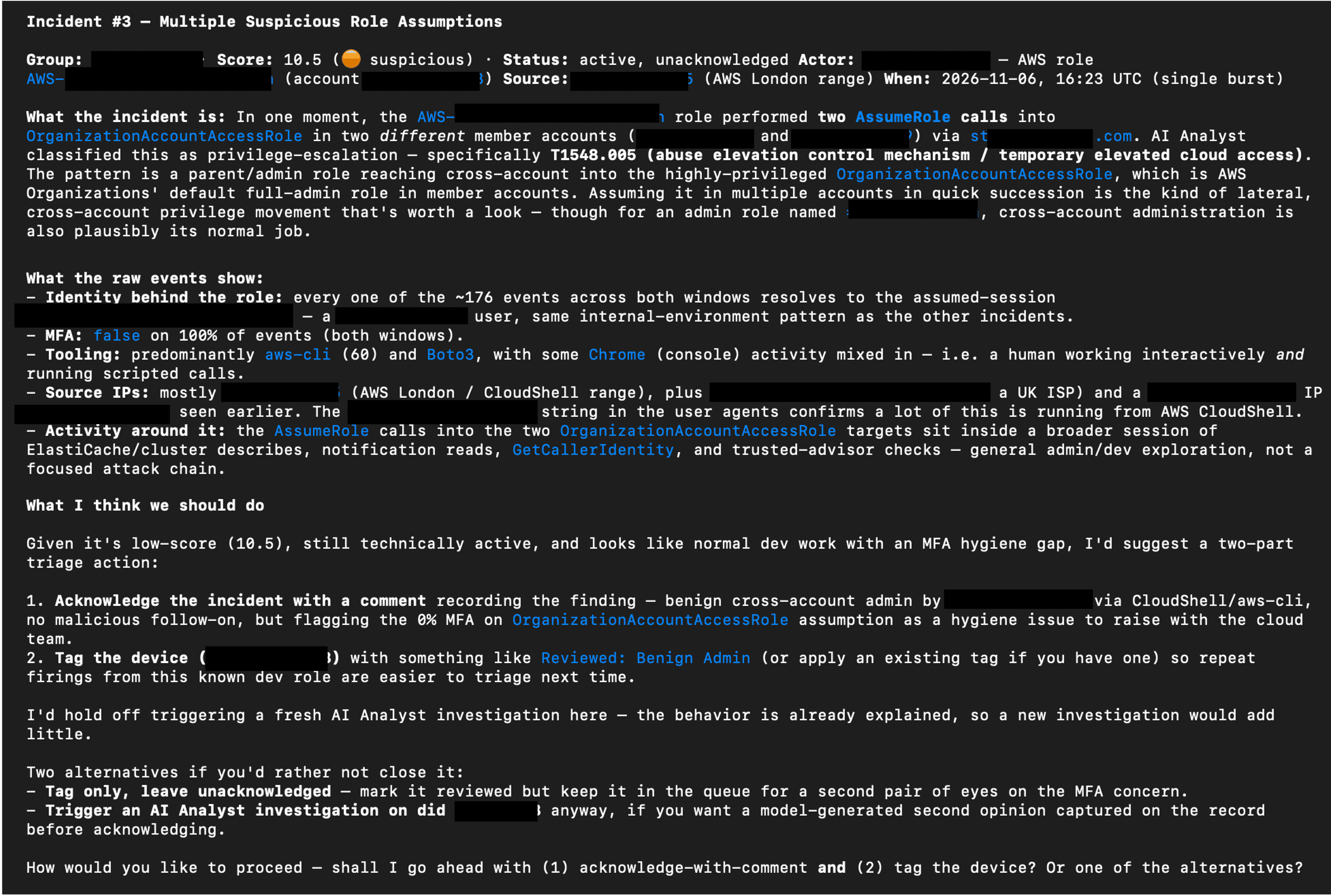
Work through triage with analyst confirmation

The server’s action tools allow an assistant to support repetitive triage tasks as well as retrieve information. For example, to improve efficiency of a daily triage workflow, an analyst could ask an AI assistant to present untriaged alerts one at a time, summarizing each issue and suggesting a next step for confirmation.

The example below shows the assistant proposing actions such as recording a finding, acknowledging an incident, tagging an asset, or triggering a Cyber AI Analyst investigation for more detail. The analyst chooses how to proceed.

Relevant Darktrace tools: get_model_alerts, update_model_alert, update_incident_group, manage_tags, create_ai_analyst_investigation

Example prompt: “Using the Darktrace MCP server, obtain all un-triaged alerts from the last 3 days and display them one at a time. Provide a summary of the issue, and a suggested triage and immediate response action. I will confirm what action should be performed.”

AI assistant output proposing triage actions using information retrieved through Darktrace MCP and asking the analyst how to proceed. Some sensitive content has been redacted.

Permissions and security considerations

The MCP server provides access to supported capabilities within the products a customer is licensed to use. Connections should follow the principle of least privilege, with access appropriate to the intended workflow.

A read-only connection mode is also available for workflows that do not require changes. This mode hides tools that mutate data; configuration details are provided in the Product Guide.

Some tools can change data or perform actions, including adding or removing asset tags, triggering Cyber AI Analyst investigations, and acting on assets. Consider which capabilities an assistant should be able to use before connecting it and retain human oversight of actions that could cause disruption or unwanted changes.

For further guidance, see:

Seven MCP risks CISOs should consider and how to prepare

Anthropic’s MCP Security Best Practices

Use the interface that suits the task

MCP gives customers another way to work with Darktrace alongside its product interfaces. Users may find that complex investigations requiring visual analysis, or strategic decisions involving impactful actions, are better suited to the graphical interfaces within Darktrace products. They can choose the approach that fits their workflow.

How to start using the Darktrace MCP Server

The Darktrace MCP Server is used to connect a compatible AI assistant to supported tools within your Darktrace deployment. The assistant can retrieve alerts and device information, draw on Cyber AI Analyst findings, and perform permitted actions across your licensed products.

To get started, you will need access to the Darktrace Platform Portal and a compatible AI assistant. Follow the Platform Portal MCP Server guide to find out how to create the required credentials and configure the connection today.

Contact a Darktrace representative to explore how the Darktrace MCP Server can support your security operations.

To learn more about Darktrace can help protect your MCP servers within your broader AI and agent use, discover Darktrace / SECURE AI.

‍

Appendix: Darktrace MCP available tools

The following tool catalogue reflects the list supplied for this announcement. Available tools depend on the connected products and access. The list may change as tools are added or removed.

ToolProductDescription
get_helpGeneral / MCP ServerReturns orientation info about the Darktrace MCP server: its purpose, tool categories, and documentation.
get_productsGeneral / MCP ServerLists available Darktrace product instances and their instance_id values needed by other tools.
submit_feedbackGeneral / MCP ServerLogs feedback about tool coverage, clarity, or usability for the Darktrace team.
count_devicesThreat VisualizerReturns the total count of devices/assets managed by Darktrace.
search_devicesThreat VisualizerSearches for devices by keyword and returns basic matching device details.
query_devicesThreat VisualizerQueries comprehensive device information using filters like IP, MAC, subnet, or SaaS module.
edit_deviceThreat VisualizerUpdates a device's label, type, priority, or notes.
get_device_activityThreat VisualizerReturns aggregated time-series data of a device's connection/data volume trends over 4 weeks.
get_detailed_eventsThreat VisualizerRetrieves individual low-level events (connections, notices, model breaches, processes) for a device or alert.
get_subnetsThreat VisualizerRetrieves monitored subnets with CIDR, device counts, DHCP status, and traffic stats.
update_subnetThreat VisualizerEdits subnet details such as label, network range, coordinates, and DHCP/exclusion flags.
get_model_alertsThreat VisualizerRetrieves model alerts (breaches) with model info, device details, and triggered components.
get_model_alert_credentialsThreat VisualizerReturns credentials seen on the device that triggered a given model alert.
update_model_alertThreat VisualizerComments on and/or acknowledges a model alert.
get_modelsThreat VisualizerRetrieves detection models with their logic, actions, and configuration.
get_incident_groupsThreat VisualizerRetrieves AI Analyst incident groups with scores, MITRE tactics, devices, and summaries.
get_incident_eventsThreat VisualizerRetrieves AI Analyst incident events with AI summaries, MITRE tactics, and breach details.
update_incident_groupThreat VisualizerComments on and/or acknowledges an AI Analyst incident group.
create_ai_analyst_investigationThreat VisualizerCreates a manual AI Analyst investigation for a device around a specified time.
get_ai_analyst_investigationsThreat VisualizerRetrieves the status and results of manual AI Analyst investigations.
advanced_searchThreat VisualizerExecutes a Lucene-syntax Advanced Search query against Darktrace log data.
get_advanced_search_syntaxThreat VisualizerReturns the full Advanced Search query syntax reference (must be called before querying).
get_response_actions_summaryThreat VisualizerReturns a summary of active and pending Autonomous Response actions and action counts over a time range.
get_endpoint_informationThreat VisualizerLooks up external endpoints (IPs/hostnames) for location, reputation, and connection history.
get_cvesThreat VisualizerRetrieves CVEs detected across assets with severity, scores, and affected devices.
get_system_healthThreat VisualizerReturns comprehensive system health metrics (CPU, memory, disk, licenses, bandwidth).
get_dam_alertsThreat VisualizerRetrieves health alerts from the Darktrace Alert Management system.
get_module_statusesThreat VisualizerRetrieves the status of Darktrace modules, optionally filtered to failing ones.
get_tagsThreat VisualizerRetrieves device tags and optionally the devices/credentials they are applied to.
manage_tagsThreat VisualizerCreates, deletes, applies, or removes tags on devices or credentials.
get_trusted_domainsThreat VisualizerRetrieves domains marked as trusted.
manage_trusted_domainsThreat VisualizerAdds or removes a trusted domain entry.
get_watched_domainsThreat VisualizerRetrieves watched domains monitored for suspicious activity.
manage_watched_domainsThreat VisualizerAdds or removes watched domain entries.
get_workflow_integration_ticketsThreat VisualizerRetrieves third-party platform tickets created by Workflow Integrations for Darktrace events.
get_cloud_accountsDarktrace / HYBRID NETWORKRetrieves cloud deployment accounts and their monitoring/compliance statuses.
get_cloud_architecturesDarktrace / HYBRID NETWORKRetrieves cloud architectures with risk breakdown, cost, and asset counts.
get_cloud_assetsDarktrace / HYBRID NETWORKRetrieves cloud assets with type, service, region, and attached/associated assets.
get_cloud_asset_filtersDarktrace / HYBRID NETWORKReturns available filter fields and operators for querying cloud assets.
get_cloud_misconfiguration_alertsDarktrace / HYBRID NETWORKRetrieves cloud security misconfiguration alerts grouped by rule.
get_cloud_misconfigured_assetsDarktrace / HYBRID NETWORKRetrieves the assets affected by a specific cloud misconfiguration rule.
get_cloud_rule_informationDarktrace / HYBRID NETWORKReturns detailed rationale, remediation, and compliance mappings for a cloud security rule.
get_emailDarktrace / EMAILRetrieves detailed information about a specific email by UUID.
search_emailsDarktrace / EMAILSearches for emails using filters and a time range.
get_email_search_filtersDarktrace / EMAILReturns available email search filter definitions and values.
action_emailDarktrace / EMAILPerforms an action (hold, release, approve/reject release) on an email for specific recipients.
analyse_email_linkDarktrace / EMAILAnalyzes a URL found in an email, returning classification tags and analysis metrics.
get_email_overviewDarktrace / EMAILReturns an aggregated email dashboard overview (threats, actions, campaigns, etc.).
get_email_listsDarktrace / EMAILRetrieves email lists and their entries.
manage_email_listsDarktrace / EMAILAdds or edits email lists, and adds or removes entries within an email list.
get_email_addin_recordsDarktrace / EMAILRetrieves Inbox Analysis or Misdirected Email add-in records.
get_email_audit_logsDarktrace / EMAILRetrieves EMAIL system audit log events for a time range.
get_email_audit_log_event_typesDarktrace / EMAILReturns available audit log event types for filtering.
get_secure_ai_overviewDarktrace / SECURE AIReturns a dashboard overview of Secure AI activity (anomaly scores, sessions, prompt categories).
get_secure_ai_sessionsDarktrace / SECURE AIRetrieves monitored generative-AI sessions with risk levels and anomaly scores.
get_secure_ai_promptsDarktrace / SECURE AIRetrieves individual prompts for a Secure AI session with anomaly/risk classifications.
get_secure_ai_usersDarktrace / SECURE AIRetrieves users interacting with generative-AI apps, with risk scores and session counts.
get_secure_ai_eventsDarktrace / SECURE AIRetrieves raw events ingested by the Secure AI post-handler.
get_secure_ai_detectionsDarktrace / SECURE AIRetrieves detections raised by Secure AI models with scores and OWASP/ATLAS mappings.
get_secure_ai_response_actionsDarktrace / SECURE AIRetrieves Autonomous Response actions taken by Secure AI.
manage_secure_ai_response_actionDarktrace / SECURE AIClears, confirms, extends, or reactivates a Secure AI response action.
get_shadow_ai_dashboardDarktrace / SECURE AIReturns the Shadow AI dashboard of unsanctioned AI/LLM services detected.
get_shadow_ai_detectionsDarktrace / SECURE AIRetrieves individual Shadow AI detections for unsanctioned AI/LLM service usage.
get_forensic_investigationsDarktrace / HYBRID NETWORKRetrieves forensic investigations with status, alarm counts, and AI summaries.
get_forensic_evidencesDarktrace / HYBRID NETWORKRetrieves evidence items with alarm counts, OS details, and processing status.
get_forensic_evidence_fileDarktrace / HYBRID NETWORKReturns detailed file metadata/content (hash, strings, VirusTotal, AI description) from an evidence item.
browse_forensic_evidence_filesDarktrace / HYBRID NETWORKBrowses the filesystem of a forensic evidence item, filtering by severity, path, or name.
get_forensic_alarmsDarktrace / HYBRID NETWORKRetrieves alarms from an investigation or evidence item with severity and MITRE techniques.
get_forensic_artifactsDarktrace / HYBRID NETWORKRetrieves detection artifacts (files, hashes, processes, users, IPs, domains) from an investigation.
get_forensic_detectionsDarktrace / HYBRID NETWORKRetrieves XDR/EDR detections with MITRE ATT&CK mappings.
get_forensic_indicatorsDarktrace / HYBRID NETWORKRetrieves indicators of compromise (IOCs) from an investigation.
get_forensic_vulnerabilitiesDarktrace / HYBRID NETWORKRetrieves vulnerabilities (CVEs) with CVSS scoring and package info.
get_forensic_pipelinesDarktrace / HYBRID NETWORKRetrieves processing/acquisition pipelines with real-time status.
get_forensic_timelineDarktrace / HYBRID NETWORKRetrieves or facets timeline events from a forensic investigation.
get_forensic_search_syntaxDarktrace / HYBRID NETWORKReturns the Forensic Search query syntax reference (call before forensic timeline queries).

[related-resource]

Continue reading
About the author
Jamie Bali
Technical Author (AI) Developer
Your data. Our AI.
Elevate your network security with Darktrace AI