Blog
/
Email
/
August 11, 2021

How One Email Compromised an Entire Logistics Company

A single phishing email led to a massive compromise at a logistics company in Europe. Discover the importance of email security with increasing SaaS usage.
No items found.
Inside the SOC
Darktrace cyber analysts are world-class experts in threat intelligence, threat hunting and incident response, and provide 24/7 SOC support to thousands of Darktrace customers around the globe. Inside the SOC is exclusively authored by these experts, providing analysis of cyber incidents and threat trends, based on real-world experience in the field.
No items found.
Default blog image
11
Aug 2021

Organizations are only as secure as their weakest link. In many cases, that weak link arises in the various cloud applications an organization relies on. Several high-profile groups including APT28 are known to exploit commonly-used passwords to bruteforce their way into businesses around the world. These ‘spray’ campaigns often target Microsoft Office 365 accounts and will only become more frequent as the use of SaaS increases.

This blog analyses how a single phishing email slipped under the radar of the gateway and other traditional tools in place, and eventually led to mass compromise at a logistics company in Europe.

Logistical nightmare

Logistics operators play a critical role across every industry sector. Managing the distribution of goods and services from the seller to the customer, they enable – or bottleneck – an efficient supply chain. Inevitably, logistics companies have become an attractive target for cyber-criminals, due to the high number of organizations they interact with, the pressure they’re under to deliver on time, and the sensitive data they often handle.

It is a simple equation for attackers: do they put in the hard work to infiltrate 20 well-defended organizations, or compromise just one, and from there gain access to all 20 or more? The majority of cyber-threats Darktrace has observed this year have gone for the latter – exploiting less protected third parties to gain a foothold across a range of businesses.

The vaccine supply in particular has fallen under attack, numerous times. Last autumn, threat actors infiltrated a German biomedical organization and launched a phishing campaign to harvest credentials and compromise several organizations involved in the COVID-19 cold chain.

Alongside ransomware, phishing attacks are one of the most pressing concerns facing the industry.

Breaking the chain

At a medium-sized logistics company, a user received one phishing email from a hijacked third party. The email came from a trusted source with a well established history of sending emails, so it easily passed the gateway.

Once the phishing email had reached the inbox, the user clicked on the malicious link and was led to a fake login page, where they were tricked into divulging their credentials.

Four days later, the attacker logged into the account from an unusual location, and proceeded to read files with sensitive information.

The next day, Darktrace detected a new email rule from another unusual location. Almost immediately, a large volume of outbound emails was sent from the account, all containing the suspicious link.

Figure 1: Timeline of the attack — the total dwell time was five days.

Supply and disrupt

Once you are inside an organization’s digital ecosystem, it is easy to move around and compromise more accounts. Most security tools and employees do not question an internal email sent by a trusted user, especially if the user is a senior figure with authority.

So, after this set of outbound emails, unusual activity from anomalous locations was duly seen on other company accounts. These users had been tricked into giving away their details from the emails supposedly sent by their colleague.

More sensitive customer files were read, followed by a second spike in outbound emails from these hijacked accounts.

This time, the emails were sent not internally, but to external contacts. The contacts likely were conducting business with the logistics company at the time, and so were used to receiving emails from the accounts.

In total, over 450 phishing emails were sent to a wide range of third parties. Many of these third parties in turn had their credentials compromised – repeating the cycle once again.

Figure 2: Cyber AI Analyst investigates the suspicious activity of a compromised user, providing a detailed summary with the unusual login location and actions carried out.

Hanging by a thread: The threat of third-party attacks

The source of the initial phishing email that kickstarted this attack was itself from a legitimate third party known to the customer, where presumably the same thing had occured.

This form of Vendor Email Compromise, which can be rinsed and repeated to form a vicious loop, is notoriously difficult for email security solutions to detect, and can lead to heavy reputational and financial damage. To complicate matters, acting against a suspicious email from a known sender can also cause severe business disruption if it turns out to be legitimate.

Because of this, security must move beyond the binary approach of ‘good’ and ‘bad’, towards a more holistic understanding of the contextual setting surrounding any email interaction.

Darktrace accurately detected the multiple anomalies when comparing it to other emails from senders of the same domain. It sent high-priority alerts to the security team, but could not prevent the email from reaching the inbox because it was only in detection mode.

Figure 3: Darktrace’s automatic summary of the initial phishing email gives an overview of the suspicious aspects of the email.

The phishing links during the attack used a third-party tool called Piktochart, designed to create various type of files such as infographics, charts, and forms. While Piktochart has several legitimate applications, it can also be exploited. Gateways thus have a hard time distinguishing between legitimate and malicious Piktochart links. In this case, the gateway rewrote the initial link for analysis, but did not identify it as malicious.

In comparison, Darktrace for Email easily identified the email to be suspicious because it noticed it was out of character for that particular sender, and because the link itself was suspicious. In active mode, the AI would have locked the link and moved the email to the Junk folder, effectively preventing the very first step of the attack and avoiding any further compromise.
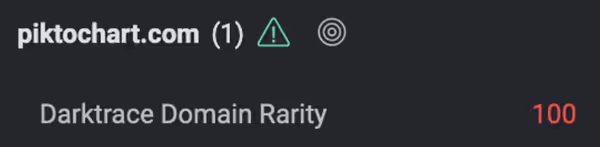
Figure 4: Piktochart was rarely seen on the deployment up until this point – the domain was 100% rare. Darktrace therefore easily detected the anomalous nature of this third-party tool usage.

The butterfly effect

Most cyber-attacks begin with just a single point of entry – that is all an attacker requires. One phishing email can be enough to bring a whole supply chain to its knees. With 94% of cyber-attacks beginning in the inbox, and suppliers and vendors in constant communication over multiple SaaS platforms – including Microsoft Teams and Google Cloud – email security tools must be capable of detecting when a trusted third party is acting abnormally.

Especially with the rise of remote working, SaaS usage has surged in businesses worldwide and many have been forced to turn to cloud and SaaS to enable a flexible workforce. While there are obvious benefits, these additions have expanded the attack surface and stretched the limits of traditional security and human security teams.

When it comes to logistics companies – who often act as the middle man in global operations – credential harvesting not only has serious consequences for the customer, but for anyone in the customer’s email contacts, and can lead to major breaches for numerous people and businesses.

Figure 5: Darktrace’s user interface reveals the two spikes in outbound emails that were sent out by compromised company accounts.

Thanks to Darktrace analyst Emma Foulger for her insights on the above threat find.

Learn more about the threats facing logistics providers

Darktrace model detections:

  • SaaS / Compliance / New Email Rule
  • SaaS / Unusual Login and New Email Rule
  • Antigena Email models included
  • Unusual / Unusual Login Location and New Unknown Link
  • Link / Account Hijack Link
  • Link / Outlook Hijack
  • Internal Compromise / Recipient Surge from Unusual Login Location (outbound emails)
  • Internal Compromise / Recipient Surge with Suspicious Content (outbound emails)

No items found.
Inside the SOC
Darktrace cyber analysts are world-class experts in threat intelligence, threat hunting and incident response, and provide 24/7 SOC support to thousands of Darktrace customers around the globe. Inside the SOC is exclusively authored by these experts, providing analysis of cyber incidents and threat trends, based on real-world experience in the field.
No items found.

More in this series

No items found.

Blog

/

Email

/

May 26, 2026

Journey of a Threat: How Multi-Layered AI Works in Darktrace / EMAIL

Man at a computerDefault blog imageDefault blog image

Darktrace / EMAIL is an implementation of the Darktrace methodology – a multi-layered AI system built into a single product. As with other Darktrace products, Darktrace / EMAIL learns the expected behaviours of an organization and its employees to identify novel threats and anomalous activity.

The diagram below represents the architecture of Darktrace / EMAIL’s multi-layered AI: a structured visualization of how intelligence is built, step by step, from raw data to actionable insight. Each layer plays a distinct role, feeding into the next: collecting data, understanding behaviour, analysing intent, making decisions, and presenting clear outcomes.

It all starts with an email

In this blog, we’ll follow a malicious email as it passes through the Darktrace / EMAIL system, showing exactly what happens as it travels through each layer of the pyramid, from basic data extraction to AI-powered metric creation, and finally deciding on any autonomous actions.

Let’s take this example email. As an end-user, you can see that this is an obvious extortion attempt where an adversary is threatening legal action if money isn’t paid within 24 hours, but how does Darktrace figure that out?

Part 1: Data Gathering

Processing of an email begins on point-of-transit for all inbound, outbound, or lateral emails. The first step is to extract information directly. This includes taking information from the headers (such as sending and receiving addresses, sender IP address, routing, and authentication protocols), as well as extraction of raw HTML and CSS data from the email itself.

This directly extracted information only allows for immediate surface level analysis, such as identifying signature-based attacks (known malicious addresses / domains), but is insufficient for identifying novel threats, complex attacks, or potential email or vendor compromise. This is where Darktrace’s AI analysis shines.

In this example, the SPF, DKIM, and DMARC authentication all passed successfully, showing that even malicious emails can still bypass these signature-based checks. Even with this success, Darktrace will continue to analyse the email.

Diving deeper into the technical information, we can see further information extracted from the headers, including aggregations from the header information, historical calculations such as the frequency and volume of emails to and from a particular domain, and much more.

Part 2: Social Graphing

Social Graphing involves the analysis of sending and receiving behaviours of different mailboxes to create peer-groups. Mailboxes who often send and receive to and from the same mailboxes, or exhibit other correlated behaviours, will be clustered together using a collection of unsupervised AI clustering systems. These groups may represent uses in the same teams who perform similar activity, groups of external facing mailboxes which often receive unsolicited emails, or groups of VIP users (such as C-suite or executives).

Social graphing is an essential component of Darktrace’s pattern of life analysis. This clustering allows Darktrace to understand the responsibilities of individuals – for example, behaviours which are anomalous for one group of users may be completely expected of another group.

In our example, the email was sent to 3 different users within the organization. As part of the social graphing, an “Association Anomaly” is calculated which indicates the likelihood that these users would receive emails from this user or domain, based on historical patterns.

Part 3: Metric Calculation

Metrics are calculated for every email, representing more complex characteristics of an email which can’t be directly extracted. Darktrace / EMAIL features over 1000 unique metrics, calculated both algorithmically and using an ensemble of AI systems.

Algorithmically calculated (non-AI) metrics include further historical calculations, and counts of features such as code blocks, and hidden text, to name a few.

AI-driven metrics include Inducement Classification which uses Natural Language Processing to identify potential phishing, solicitation, or extortion attempts; Named Entity Recognition to identify PII and other sensitive data within an email to support Data Loss Prevention; and many more.

We can follow our example email through this process and view the outcome of these metric calculations. Looking at the language metrics for this email, we can see that our email has reported a high extortion inducement, along with identification of banking information and language indicating urgency.

Part 4: Evaluation and Combination Engine (models)

Once all metrics have been calculated for an email, it gets sent to an evaluation and combination engine where the metrics are compared against blocks of logic to determine if an email contains a threat. One key model which alerted for this example message was a model to tag and block extortion attempts.

Since our example email has a high inducement score for extortion, along the presence of a bitcoin wallet address in the message, this model alerts. When a model in the engine is activated, actions are taken – in this case adding a tag to the email to flag it as extortion in the console and hold the email to prevent it from reaching the end-user mailbox.

Part 5: Meta-Modelling and Actions

Once the models have been run, the actions are taken against the email. If the email hasn’t been blocked or held, this is the point where it will reach the end-user's mailbox.

In the Darktrace / EMAIL UI, all actions models which alerted for an email and actions taken as a result can be seen. At the top of this page, you can see the alert indicating an extortion attempt along with the action to hold the message.

Alongside this, a meta-classifier is used to calculate an overall anomaly score for each email, based on how much the email differs from the pattern of life for the user. The score of the email is boosted by any actions that have taken place.

Part 6: Campaign Clustering

All emails are passed through the Darktrace / EMAIL campaign clustering system. This system creates clusters based on related features within the emails to identify groups of emails with the same sender or intent.

In our case, the email was identified as part of a campaign, alongside other emails which were also identified as extortion attempts against a small group of recipients.

Email campaigns may have additional actions applied to them if the campaign is deemed malicious, and in this case, you can see that the autonomous response was to hold all emails in the campaign. This means that if an email manages to avoid being blocked in the evaluation and combination engine but gets identified as part of the campaign, the hold action will be applied to it retroactively.

Part 7: Cyber AI Analyst

Darktrace’s Cyber AI Analyst presents key information and anomaly indicators for each email, such as further information about authentication, specific metrics, or other identified anomalies and mismatches.

Cyber AI Analyst can also utilize data from Darktrace / EMAIL to enhance its investigation of incidents from other Darktrace products, correlating relevant information to build a fuller picture. More information about the Cyber AI Analyst is available in the Darktrace AI Arsenal.

Part 8: Data Presentation (UI)

Once all processing has taken place against the email, it is presented in the Darktrace / EMAIL UI. Here, members of the SOC team can investigate incidents and anomalies, interact with malicious emails to see why they were blocked, and much more.

Our email stands out here with its 100 anomaly score. Every email which passes through a Darktrace / EMAIL will undergo the same thorough and rigorous analysis to identify potential risks, apply autonomous actions where required, and will ultimately be assigned a score to be displayed here. By providing a single overall score in the UI, rather than presenting emails in full, Darktrace / EMAIL allows SOC teams to more easily identify which emails are most important to investigate, increasing efficiency and reducing alert fatigue.

Take the next step

Many email security tools on the market that claim to be AI-driven are in fact bolting AI onto attack-centric approaches, which rely on automating the identification of known threats. These approaches struggle, and will continue to struggle, with adapting to novel, AI-generated threats.

By analyzing every email within its deeply integrated, multi-layered AI system, Darktrace / EMAIL is able to identify the subtle threats that others miss. This depth not only improves detection accuracy, but enables confident, autonomous action, giving security teams clearer insight into AI outcomes and greater control while supporting users.

For a full deep dive into each stage of the AI system, check out the white paper: A Guide to the Multi-Layered AI in Darktrace / EMAIL

Learn more about securing AI in your enterprise.

[related-resource]

Continue reading
About the author
Jamie Bali
Technical Author (AI) Developer

Blog

/

Network

/

May 26, 2026

Darktrace named a Leader in the 2026 Gartner® Magic Quadrant™ for Network Detection and Response (NDR) For the Second Consecutive Year

garnter ndr magic quadrantDefault blog imageDefault blog image

Continued recognition in NDR  

Darktrace has been recognized as a Leader in the 2026 Gartner® Magic Quadrant™ for Network Detection and Response (NDR), marking the second consecutive year in the Leaders quadrant.

We believe this consistency reflects sustained ability to execute, adapt, and deliver outcomes as the market evolves.

While we are immensely proud to be recognized by industry analysts as a Leader in NDR, that's just part of the story. Darktrace was also Named the Only 2025 Gartner® Peer Insights™ Customers’ Choice for Network Detection and Response based on direct customer feedback and real-world experience.

We believe the combination of these two signals is important. One reflects how the market is evaluated. The other reflects how technology performs in practice.

Why Darktrace continues to be recognized as a leader

We believe our position as a Leader for the second consecutive year reflects a combination of our sustained ability to execute in NDR, continued AI innovation, and proven delivery of security outcomes for customers and partners worldwide.

We also feel that our leadership in the NDR market is a testament to our unique and multi-layered AI approach, for which we were recognized as No.7 on Fast Company’s Most Innovative AI Companies of 2026 list, plus one of the hottest AI cybersecurity companies in CRN's AI 100.

Adapting to complex, real-world environments

Organizations are no longer protecting a single network perimeter. They are securing a mix of users, devices, applications, and data that move across hybrid environments.

Darktrace has focused on maintaining visibility and detection across these conditions, allowing security teams to understand activity as it scales.

Supporting organizations globally, not just technically

Security outcomes are shaped as much by deployment and support as they are by detection capability.

Darktrace continues to invest in regional presence across 29 countries around the world, helping organizations operationalize NDR in ways that align with local requirements, internal processes, and team structures.

Continuing to push AI beyond detection

AI in cybersecurity is often positioned as a way to improve detection accuracy. But the more important shift is how AI can influence decision-making and response.

Darktrace continues to develop models that learn from both live environments and historical incident data, combining real-time behavioral analysis with insights derived from prior attack patterns.

Using technologies such as the Incident Graph and DIGEST (Darktrace Incident Graph Evaluation for Security Threats), activity is not analyzed in isolation. Instead, relationships between users, devices, connections, and events are mapped over time, allowing the system to reconstruct how an incident is unfolding and how similar incidents have progressed in the past.

By evaluating these patterns, Darktrace can assess the likelihood that an incident will escalate, prioritizing the activity that poses the greatest risk and surfacing the most relevant context for investigation.

This shifts security operations from simply identifying anomalies to understanding their trajectory, helping teams anticipate potential impact and respond earlier with greater precision.

Why NDR is shifting from reactive detection to proactive, AI-driven security

Traditional approaches to NDR have been built around reactively identifying threats once they become clearly visible. That model is increasingly difficult to rely on.

Attackers are no longer operating in ways that stand out. They use valid credentials, trusted tools, and low-and-slow techniques that blend into everyday activity. By the time something looks obviously malicious, the impact is often already underway.

This is the core limitation of reactive detection. It depends on recognizing something that already looks like a threat.

As a result, many of the most consequential incidents today fall into a gap.

Insider activity, compromised credentials, and novel attacks rarely trigger traditional alerts because they do not follow known patterns. On the surface, they often appear legitimate, making them difficult to distinguish from normal behavior without deeper context.

This is why we believe this Gartner recognition reflects a broader shift in NDR toward autonomous, proactive and pre‑emptive security operations.

By understanding normal behavior within an environment, it is possible to identify subtle deviations rather than waiting for confirmation of threats as they are taking place.

Darktrace’s Self-Learning AI is designed for behavioral understanding. By continuously learning each organization’s normal patterns, it can detect deviations in real time, enabling a proactive and pre-emptive model of NDR where security teams can respond to early signs of risk as they emerge, reducing the window in which attacks can develop.

In multiple cases, this behavioral approach has led to early threat detection where Darktrace identified completely unknown threats, including pre-CVE zero-day activity. By detecting subtle behavioral changes before vulnerabilities were publicly disclosed or widely understood, organizations can mitigate threats before they do damage.

This shift is subtle but important. Modern NDR solutions must shift from a system that explains what happened to one that helps prevent threats from developing in the first place, and Darktrace is proud to be at the forefront of this shift - helping organizations build and maintain a state of proactive network resilience.

Continuing to innovate at the forefront of NDR

In our view, recognition as a Leader reflects where the market is today. Continuing to innovate defines what comes next.

As businesses evolve, new technologies like AI tools and agents introduce new security risks and challenges; security teams need more than simple detection. They need a complete understanding of risk as it develops, the ability to investigate it in context, and to contain threats at machine speed.  

Darktrace / NETWORK is built to deliver across that full spectrum. Its Self-Learning AI continuously adapts to each organization’s environment, identifying subtle behavioral changes that signal emerging threats. Integrated investigation and autonomous response reduce the time between detection and action, allowing teams to move with greater speed and confidence.

This combination enables organizations to detect and contain known, unknown, and insider threats as they develop, while also strengthening resilience over time.

As a two-time Leader in the Gartner® Magic Quadrant™ for NDR and the only 2025 Gartner® Peer Insights™ Customers’ Choice, we feel Darktrace continues to evolve its platform to meet the demands of modern environments, delivering a more complete and adaptive approach to network security.

[related-resource]

Disclaimer: The 2026 Gartner® Magic Quadrant™ for Network Detection and Response (NDR) ,The 2026 Gartner® Magic Quadrant™ for Network Detection and Response (NDR), Thomas Lintemuth, Charanpal Bhogal, Nahim Fazal, 18 May 2026.

Gartner does not endorse any vendor, product or service depicted in its research publications, and does not advise technology users to select only those vendors with the highest ratings or other designation. Gartner research publications consist of the opinions of Gartner’s research organization and should not be construed as statements of fact. Gartner disclaims all warranties, expressed or implied, with respect to this research, including any warranties of merchantability or fitness for a particular purpose.

GARTNER is a registered trademark and service mark of Gartner, Inc. and/or its affiliates in the U.S. and internationally and is used herein with permission. All rights reserved. Magic Quadrant is a registered trademark of Gartner, Inc. and/or its affiliates and is used herein with permission. All rights reserved.

Continue reading
About the author
Mikey Anderson
Product Marketing Manager, Network Detection & Response
Your data. Our AI.
Elevate your network security with Darktrace AI