Understanding generative AI security
As generative artificial intelligence (AI) models become more powerful and integrated into business operations, they bring a new wave of complex security challenges that traditional cybersecurity approaches struggle to address. Adversaries are exploiting vulnerabilities unique to AI systems by manipulating training data, injecting malicious prompts, and weaponizing AI to generate sophisticated attacks at scale.
Security professionals recognize this urgency, with 92% concerned about the use of AI agents across the workforce as these tools introduce novel attack surfaces and data exposure risks. For organizations to trust and leverage generative AI responsibly, they must be able to secure it. Generative AI security has emerged as a critical discipline to address these novel threats.
What is generative AI security?
Generative AI security encompasses the practices, tools, and frameworks designed to protect generative AI models, the data they are trained on, and the applications they power. Unlike traditional cybersecurity that focuses on securing networks, endpoints, and applications, generative AI security addresses unique attack vectors inherent to AI systems. These include model manipulation, data poisoning, and adversarial inputs that exploit how AI models learn and generate outputs.
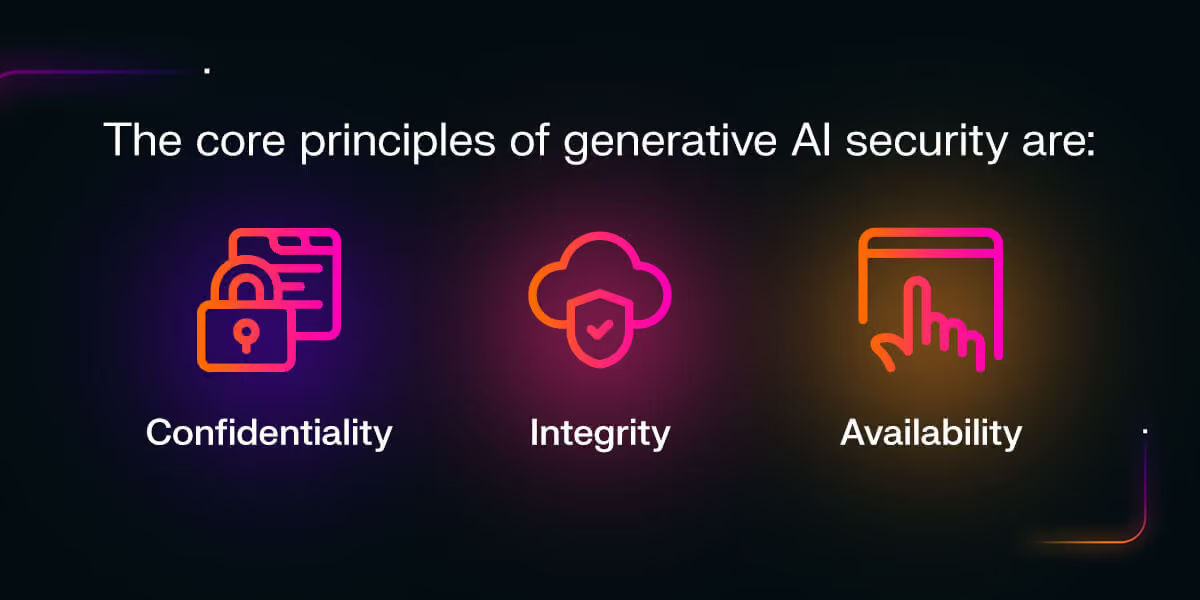
This discipline requires understanding how models process information, identifying anomalous behavior in AI interactions, and detecting threats at every stage from training to production deployment. The core principles of generative AI security are:
- Confidentiality: Protecting model weights, training datasets, and data throughout its life cycle from inference attacks that can extract information even when access controls are in place.
- Integrity: Preventing adversaries from corrupting training data or manipulating model behavior in ways that traditional file integrity monitoring cannot detect, as changes occur at the algorithmic level rather than the file system.
- Availability: Maintaining continuous access to AI systems while defending against resource exhaustion attacks that exploit the computational intensity of model inference, which differs from standard denial-of-service patterns.
Key generative AI security risks
Darktrace's State of AI Cybersecurity 2025 report indicates that 45% of security specialists do not feel prepared for the reality of AI-powered cyber-threats. Understanding these risks is essential for organizations deploying generative AI in production environments.
Data poisoning and training data attacks
Adversaries can manipulate an AI model's training data to introduce biases, create backdoors, or cause the model to generate incorrect outputs by injecting malicious data that alters how the model learns and responds. This manipulation can result in models that produce skewed recommendations, fail to detect legitimate threats, or execute unintended actions when triggered by specific inputs.
For instance, adversaries poisoning a fraud detection model's training data could teach it to ignore specific transaction patterns, enabling future attacks to bypass detection entirely. Organizations that fail to validate and secure their training pipelines face significant risks of deploying compromised models.
Prompt injection and malicious inputs
Attackers use malicious prompts to bypass security controls, extract sensitive information, or trick the model into performing unintended actions. Prompt injection exploits the way generative AI models interpret and respond to user inputs.
In production chatbots, this has enabled adversaries to access internal documentation and system prompts that reveal organizational vulnerabilities. This attack vector is particularly concerning for customer-facing AI applications where user input is difficult to constrain.
Sensitive data leakage and privacy breaches
Generative AI models can inadvertently reveal sensitive information from their training data when they memorize specific data points rather than learning generalized patterns. This risks exposure of proprietary business information, personally identifiable information, or other confidential content.
Recognizing this weakness, adversaries exploit this vulnerability through carefully crafted queries that extract memorized training examples from models, including source code, private communications, and customer records. This risk increases when models are trained on inadequately sanitized datasets.
Malicious code generation
Threat actors are weaponizing generative AI to develop malware, phishing campaigns, and sophisticated attack tools that adapt to defensive measures. Key applications include:
- Sophisticated phishing campaigns: AI produces highly convincing social engineering content tailored to specific targets, adapting language and formatting to bypass human detection.
- Polymorphic malware: Code generation models create malware variants that evade traditional signature-based detection by continuously changing their structure.
- Rapid exploit development: Functional exploit code can be created within hours of vulnerability disclosures, dramatically compressing attack preparation timelines and reducing the window for defensive patching.
The democratization of these capabilities lowers the barrier to entry for less sophisticated adversaries.
Model theft and sabotage
Attackers may attempt to steal or sabotage a trained AI model, representing a significant financial and intellectual property loss. Model theft occurs when adversaries extract model parameters, architecture details, or proprietary training methodologies through unauthorized access or inference attacks.
Sabotage involves deliberately degrading model performance or availability through resource exhaustion, adversarial inputs, or infrastructure compromise. Given the substantial investment in developing advanced AI models, these attacks undermine competitive advantages and disrupt operations.
How can generative AI be used in cybersecurity?
Despite the security challenges it presents, integrating generative AI in cybersecurity operations offers powerful capabilities for enhancing security operations. The technology is rapidly being adopted across security stacks, with 77% of security stacks now making use of generative AI. When implemented with appropriate safeguards and for the right use cases, gen AI can transform cybersecurity practices.
Enhancing threat detection and response
Generative AI acts as an interface and acceleration layer that helps interpret and contextualize detection outputs, turning complex signals into actionable insights. It can synthesize information from multiple security tools and telemetry sources to provide analysts with clear, natural-language summaries of security events.
This capability enables security teams to understand the scope and severity of incidents more quickly, correlate seemingly disparate alerts into coherent attack narratives, and prioritize response efforts based on business impact. The technology enhances human decision-making by surfacing relevant context without replacing the foundational detection mechanisms that identify anomalous behavior.
Automating security workflows
Generative AI accelerates security alert triage and reporting while still requiring grounding in real telemetry and human oversight. Security teams leverage AI to draft incident reports, generate remediation recommendations, and automate routine communication tasks that previously consumed significant analyst time.
Research shows that 88% of security experts agree that using AI within the security stack is critical to freeing up time for the security team to become more proactive. By handling repetitive analytical tasks, generative AI allows analysts to focus on strategic threat hunting, vulnerability research, and improving defensive posture rather than manual documentation and alert processing.
Improving security training and awareness
Generative AI can develop realistic security training simulations and generate personalized security awareness content tailored to specific roles and risk profiles. Organizations use generative AI to make phishing simulations with email content that mimics current threat campaigns, producing variations in language, formatting, and social engineering techniques at scale.
Generative AI can also develop role-specific training scenarios, such as detailed narratives where DevOps teams navigate supply chain compromises or finance personnel evaluate suspicious invoice requests, complete with realistic dialogue, decision branches, and immediate feedback tailored to each group's actual responsibilities. This approach improves engagement and retention compared to generic security awareness programs, helping organizations build a more resilient security culture across the workforce.
Discover how to secure gen AI
While generative AI introduces new and complex security challenges, a proactive approach can help organizations secure these systems. Monitoring them effectively demands an understanding of the normal behavior of AI systems and detecting deviations that signal risk.
Darktrace / SECURE AI provides the essential foundation for securing the AI-powered enterprise, detecting anomalous AI behavior, monitoring model interactions for signs of manipulation, and responding autonomously to threats targeting AI infrastructure.
Visit the product page to learn more about securing generative AI.