Blog
/
/
December 2, 2018

How Darktrace Finds 'Low and Slow' Cyber Threats

The latest escalation in the cyber arms race sees attackers choosing stealth over speed and cunning over chaos.
No items found.
Inside the SOC
Darktrace cyber analysts are world-class experts in threat intelligence, threat hunting and incident response, and provide 24/7 SOC support to thousands of Darktrace customers around the globe. Inside the SOC is exclusively authored by these experts, providing analysis of cyber incidents and threat trends, based on real-world experience in the field.
No items found.
Default blog imageDefault blog imageDefault blog imageDefault blog imageDefault blog imageDefault blog image
02
Dec 2018

Introduction

The speed of today’s most advanced threats can be devastating. In the few minutes it takes a security analyst to step away from her screen to grab a coffee, ransomware can take down thousands of computers before human teams or traditional tools have the chance to respond. And while big, fast threats are more likely to grab the headlines, cyber-attacks which do the opposite can be just as dangerous. The latest escalation in the cyber arms race sees attackers choosing stealth over speed and cunning over chaos.

As defenders work to rapidly deploy new security and detection technologies, malware authors have been similarly innovative, working to find a means of evading them. New ‘low and slow’ attacks are able to bypass traditional security tools because each individual action compiling the larger threat is too small to detect. These attacks are designed to operate over a longer period of time – and by minimizing disruption to any data transfer or connectivity levels, they blend into legitimate traffic.

For advanced and well-resourced actors like nation states in search of valuable intellectual property or sensitive political records, subtle and prolonged exposure to the systems they attack is a significant benefit. When it comes to the most sophisticated threats, slow and steady really can win the race.

Nevertheless, detection of low and slow attacks is possible with advanced machine learning techniques. To do so, contextual knowledge is critical; by modeling the subtle and unique ‘patterns of life’ of every user, device, and the network as a whole, AI-powered defenses are, for the first time, winning this battle.

This blog explores how attackers use low and slow techniques during multiple stages of the kill chain to achieve their eventual goal. We examine three real-world case studies, drawn from over 7,000 deployments of the Enterprise Immune System, to demonstrate how cyber AI detects low and slow reconnaissance, data exfiltration, and command-and-control activity.

Low and slow reconnaissance

By monitoring the behavioral pattern of devices and users, Darktrace AI is able to learn an evolving profile for expected activity. Armed with this understanding of ‘normal’ for the network, it can then identify significant anomalies indicative of a threat. It does all this without relying on training sets of historical data, enabling the technology to spot threats that other tools miss.

On the network of a European financial services firm, Darktrace discovered a server conducting port scans of various internal computers. This type of network scanning is regularly performed for legitimate testing purposes by administrative devices, but it is also a tactic for attackers to identify vulnerabilities and points of compromise – an early stage of an attack.

Over a duration of 7 days, the server made around 214,000 failed connections to 276 unique devices. However, only a small number of ports were targeted per day. The attack was sequential, but slow over time. Measured in one day, the level of disturbance was minimal enough to evade all rules-based defenses. Nevertheless, by learning ‘self’ across the entire digital business over time, cyber AI can detect even the subtlest deviation from ‘normal’ relative to the individual device, user, or network. Darktrace recognized the longer pattern of network scanning and alerted the customer immediately.

Advanced search view showing regular connections to closed ports over the scanning period.

Low and slow data exfiltration

At an industrial manufacturing company, a desktop was identified establishing over 2,000 connections to a rare host over a 7-day period. During this time, a total of 9.15GB of data was transferred externally. No single connection transmitted more than a few MB of data – an amount which, if viewed in isolation, would not be cause for concern. However, the destination for these connections was 100% rare for the network and maintained that level of rarity for the entire period of exfiltration. This not only flagged the activity as initially suspicious, but also prevented it from being absorbed into legitimate traffic. Combined with the accumulated volume of data leaving the network, Darktrace AI identified this as significant deviation in the device’s behavior, indicating a threat in progress.
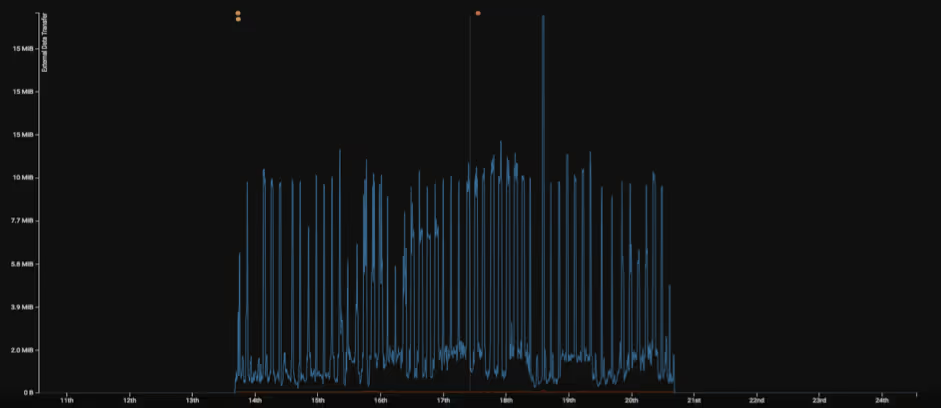
Steady exfiltration of data over a 7-day period.
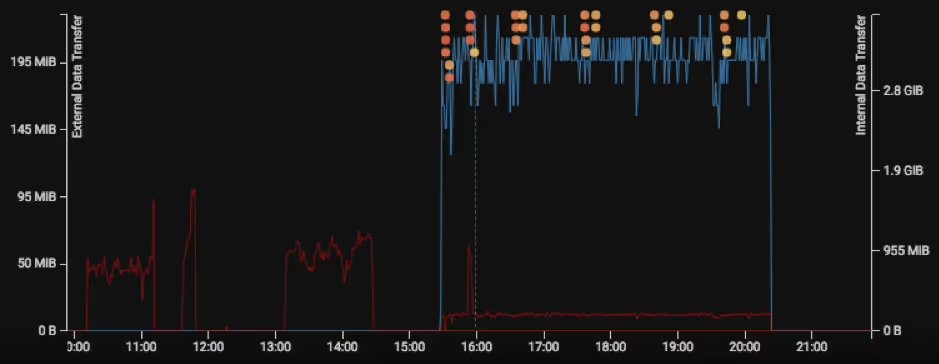
A series of model breaches (orange circles) occurring throughout the period of steady external data exfiltration (blue line).

Low and slow command and control

Darktrace is extremely successful in finding malware infections before they appear on open-source threat lists, a crucial ability when stopping the most serious, never-before-seen threats. This is achieved in large part by detecting beaconing patterns rather than relying on signatures. Beaconing occurs when a malicious program attempts to establish contact with its online infrastructure. Similar to network scanning, it creates a surge in outgoing connections.

Darktrace was deployed in a corporate network where a device was found making connections at steady intervals to a malicious browser extension. The average rate of connection was 11 connections every 4 hours – a low activity level which could easily have blended into legitimate internet traffic. Having identified the regularity of these connections, Darktrace’s AI assigned a high beaconing score, which indicated that they were likely initiated by an automated process. If we include the fact that the destination was rare, it became clear that this was caused by a malicious background program that was running unbeknownst to the user.

As cyber security advances, attackers will develop increasingly sophisticated methods to operate under the radar. Traditional cyber security tools which work in binary ways based on historical data – either the upload exceeded a predefined limit or not – cannot keep up. This new era will see AI proven crucial because of its ability to learn a constantly-evolving ‘pattern of life’ for a network over the duration of its deployment. This allows Darktrace AI to effectively locate the disturbances in connectivity levels – no matter how small – that have been caused by malicious or non-compliant activity. Fundamentally, this enables Darktrace to discover in-progress attacks and then autonomously respond, neutralizing them before they become a crisis.

High-profile, fast-moving attacks like NotPetya and WannaCry have encouraged some organizations to focus on preventing certain types of threat, at the expense of others – and hackers are catching on. By leveraging powerful AI, Darktrace empowers customers to prevent not just the fastest-moving attacks, but also the slowest and subtlest.


No items found.
Inside the SOC
Darktrace cyber analysts are world-class experts in threat intelligence, threat hunting and incident response, and provide 24/7 SOC support to thousands of Darktrace customers around the globe. Inside the SOC is exclusively authored by these experts, providing analysis of cyber incidents and threat trends, based on real-world experience in the field.
No items found.

More in this series

No items found.

Blog

/

/

April 30, 2026

Mythos vs Ethos: Defending in an Era of AI‑Accelerated Vulnerability Discovery

mythos vulnerability discoveryDefault blog imageDefault blog image

Anthropic’s Mythos and what it means for security teams

Recent attention on systems such as Anthropic Mythos highlights a notable problem for defenders. Namely that disclosure’s role in coordinating defensive action is eroding.

As AI systems gain stronger reasoning and coding capability, their usefulness in analyzing complex software environments and identifying weaknesses naturally increases. What has changed is not attacker motivation, but the conditions under which defenders learn about and organize around risk. Vulnerability discovery and exploitation increasingly unfold in ways that turn disclosure into a retrospective signal rather than a reliable starting point for defense.

Faster discovery was inevitable and is already visible

The acceleration of vulnerability discovery was already observable across the ecosystem. Publicly disclosed vulnerabilities (CVEs) have grown at double-digit rates for the past two years, including a 32% increase in 2024 according to NIST, driven in part by AI even prior to Anthropic’s Mythos model. Most notably XBOW topped the HackerOne US bug bounty leaderboard, marking the first time an autonomous penetration tester had done so.  

The technical frontier for AI capabilities has been described elsewhere as jagged, and the implication is that Mythos is exceptional but not unique in this capability. While Mythos appears to make significant progress in complex vulnerability analysis, many other models are already able to find and exploit weaknesses to varying degrees.  

What matters here is not which model performs best, but the fact that vulnerability discovery is no longer a scarce or tightly bounded capability.

The consequence of this shift is not simply earlier discovery. It is a change in the defender-attacker race condition. Disclosure once acted as a rough synchronization point. While attackers sometimes had earlier knowledge, disclosure generally marked the moment when risk became visible and defensive action could be broadly coordinated. Increasingly, that coordination will no longer exist. Exploitation may be underway well before a CVE is published, if it is published at all.

Why patch velocity alone is not the answer

The instinctive response to this shift is to focus on patching faster, but treating patch velocity as the primary solution misunderstands the problem. Most organizations are already constrained in how quickly they can remediate vulnerabilities. Asset sprawl, operational risk, testing requirements, uptime commitments, and unclear ownership all limit response speed, even when vulnerabilities are well understood.

If discovery and exploitation now routinely precede disclosure, then patching cannot be the first line of defense. It becomes one necessary control applied within a timeline that has already shifted. This does not imply that organizations should patch less. It means that patching cannot serve as the organizing principle for defense.

Defense needs a more stable anchor

If disclosure no longer defines when defense begins, then defense needs a reference point that does not depend on knowing the vulnerability in advance.  

Every digital environment has a behavioral character. Systems authenticate, communicate, execute processes, and access resources in relatively consistent ways over time. These patterns are not static rules or signatures. They are learned behaviors that reflect how an organization operates.

When exploitation occurs, even via previously unknown vulnerabilities, those behavioral patterns change.

Attackers may use novel techniques, but they still need to gain access, create processes, move laterally, and will ultimately interact with systems in ways that diverge from what is expected. That deviation is observable regardless of whether the underlying weakness has been formally named.

In an environment where disclosure can no longer be relied on for timing or coordination, behavioral understanding is no longer an optional enhancement; it becomes the only consistently available defensive signal.

Detecting risk before disclosure

Darktrace’s threat research has consistently shown that malicious activity often becomes visible before public disclosure.

In multiple cases, including exploitation of Ivanti, SAP NetWeaver, and Trimble Cityworks, Darktrace detected anomalous behavior days or weeks ahead of CVE publication. These detections did not rely on signatures, threat intelligence feeds, or awareness of the vulnerability itself. They emerged because systems began behaving in ways that did not align with their established patterns.

This reflects a defensive approach grounded in ‘Ethos’, in contrast to the unbounded exploration represented by ‘Mythos’. Here, Mythos describes continuous vulnerability discovery at speed and scale. Ethos reflects an understanding of what is normal and expected within a specific environment, grounded in observed behavior.

Revisiting assume breach

These conditions reinforce a principle long embedded in Zero Trust thinking: assume breach.

If exploitation can occur before disclosure, patching vulnerabilities can no longer act as the organizing principle for defense. Instead, effective defense must focus on monitoring for misuse and constraining attacker activity once access is achieved. Behavioral monitoring allows organizations to identify early‑stage compromise and respond while uncertainty remains, rather than waiting for formal verification.

AI plays a critical role here, not by predicting every exploit, but by continuously learning what normal looks like within a specific environment and identifying meaningful deviation at machine speed. Identifying that deviation enables defenders to respond by constraining activity back towards normal patterns of behavior.

Not an arms race, but an asymmetry

AI is often framed as fueling an arms race between attackers and defenders. In practice, the more important dynamic is asymmetry.

Attackers operate broadly, scanning many environments for opportunities. Defenders operate deeply within their own systems, and it’s this business context which is so significant. Behavioral understanding gives defenders a durable advantage. Attackers may automate discovery, but they cannot easily reproduce what belonging looks like inside a particular organization.

A changed defensive model

AI‑accelerated vulnerability discovery does not mean defenders have lost. It does mean that disclosure‑driven, patch‑centric models no longer provide a sufficient foundation for resilience.

As vulnerability volumes grow and exploitation timelines compress, effective defense increasingly depends on continuous behavioral understanding, detection that does not rely on prior disclosure, and rapid containment to limit impact. In this model, CVEs confirm risk rather than define when defense begins.

The industry has already seen this approach work in practice. As AI continues to reshape both offense and defense, behavioral detection will move from being complementary to being essential.

Continue reading
About the author

Blog

/

Network

/

April 27, 2026

How a Compromised eScan Update Enabled Multi‑Stage Malware and Blockchain C2

multi-stage malwareDefault blog imageDefault blog image

The rise of supply chain attacks

In recent years, the abuse of trusted software has become increasingly common, with supply chain compromises emerging as one of the fastest growing vectors for cyber intrusions. As highlighted in Darktrace’s Annual Threat Report 2026, attackers and state-actors continue to find significant value in gaining access to networks through compromised trusted links, third-party tools, or legitimate software. In January 2026, a supply chain compromise affecting MicroWorld Technologies’ eScan antivirus product was reported, with malicious updates distributed to customers through the legitimate update infrastructure. This, in turn, resulted in a multi‑stage loader malware being deployed on compromised devices [1][2].

An overview of eScan exploitation

According to eScan’s official threat advisory, unauthorized access to a regional update server resulted in an “incorrect file placed in the update distribution path” [3]. Customers associated with the affected update servers who downloaded the update during a two-hour window on January 20 were impacted, with affected Windows devices subsequently have experiencing various errors related to update functions and notifications [3].

While eScan did not specify which regional update servers were affected by the malicious update, all impacted Darktrace customer environments were located in the Europe, Middle East, and Africa (EMEA) region.

External research reported that a malicious 32-bit executable file , “Reload.exe”, was first installed on affected devices, which then dropped the 64-bit downloader, “CONSCTLX.exe”. This downloader establishes persistence by creating scheduled tasks such as “CorelDefrag”, which are responsible for executing PowerShell scripts. Subsequently, it evades detection by tampering with the Windows HOSTS file and eScan registry to prevent future remote updates intended for remediation. Additional payloads are then downloaded from its command-and-control (C2) server [1].

Darktrace’s coverage of eScan exploitation

Initial Access and Blockchain as multi-distributed C2 Infrastructure

On January 20, the same day as the aforementioned two‑hour exploit window, Darktrace observed multiple devices across affected networks downloading .dlz package files from eScan update servers, followed by connections to an anomalous endpoint, vhs.delrosal[.]net, which belongs to the attackers’ C2 infrastructure.

The endpoint contained a self‑signed SSL certificate with the string “O=Internet Widgits Pty Ltd, ST=SomeState, C=AU”, a default placeholder commonly used in SSL/TLS certificates for testing and development environments, as well as in malicious C2 infrastructure [4].

Utilizing a multi‑distributed C2 infrastructure, the attackers also leveraged domains linked with the Solana open‑source blockchain for C2 purposes, namely “.sol”. These domains were human‑readable names that act as aliases for cryptocurrency wallet addresses. As browsers do not natively resolve .sol domains, the Solana Naming System (formerly known as Bonfida, an independent contributor within the Solana ecosystem) provides a proxy service, through endpoints such as sol-domain[.]org, to enable browser access.

Darktrace observed devices connecting to blackice.sol-domain[.]org, indicating that attackers were likely using this proxy to reach a .sol domain for C2 activity. Given this behavior, it is likely that the attackers leveraged .sol domains as a dead drop resolver, a C2 technique in which threat actors host information on a public and legitimate service, such as a blockchain. Additional proxy resolver endpoints, such as sns-resolver.bonfida.workers[.]dev, were also observed.

Solana transactions are transparent, allowing all activity to be viewed publicly. When Darktrace analysts examined the transactions associated with blackice[.]sol, they observed that the earliest records dated November 7, 2025, which coincides with the creation date of the known C2 endpoint vhs[.]delrosal[.]net as shown in WHOIS Lookup information [4][5].

WHOIS Look records of the C2 endpoint vhs[.]delrosal[.]net.
Figure 1: WHOIS Look records of the C2 endpoint vhs[.]delrosal[.]net.
 Earliest observed transaction record for blackice[.]sol on public ledgers.
Figure 2: Earliest observed transaction record for blackice[.]sol on public ledgers.

Subsequent instructions found within the transactions contained strings such as “CNAME= vhs[.]delrosal[.]net”, indicating attempts to direct the device toward the malicious endpoint. A more recent transaction recorded on January 28 included strings such as “hxxps://96.9.125[.]243/i;code=302”, suggesting an effort to change C2 endpoints. Darktrace observed multiple alerts triggered for these endpoints across affected devices.

Similar blockchain‑related endpoints, such as “tumama.hns[.]to”, were also observed in C2 activities. The hns[.]to service allows web browsers to access websites registered on Handshake, a decentralized blockchain‑based framework designed to replace centralized authorities and domain registries for top‑level domains. This shift toward decentralized, blockchain‑based infrastructure likely reflects increased efforts by attackers to evade detection.

In outgoing connections to these malicious endpoints across affected networks, Darktrace / NETWORK recognized that the activity was 100% rare and anomalous for both the devices and the wider networks, likely indicative of malicious beaconing, regardless of the underlying trusted infrastructure. In addition to generating multiple model alerts to capture this malicious activity across affected networks, Darktrace’s Cyber AI Analyst was able to compile these separate events into broader incidents that summarized the entire attack chain, allowing customers’ security teams to investigate and remediate more efficiently. Moreover, in customer environments where Darktrace’s Autonomous Response capability was enabled, Darktrace took swift action to contain the attack by blocking beaconing connections to the malicious endpoints, even when those endpoints were associated with seemingly trustworthy services.

Conclusion

Attacks targeting trusted relationships continue to be a popular strategy among threat actors. Activities linked to trusted or widely deployed software are often unintentionally whitelisted by existing security solutions and gateways. Darktrace observed multiple devices becoming impacted within a very short period, likely because tools such as antivirus software are typically mass‑deployed across numerous endpoints. As a result, a single compromised delivery mechanism can greatly expand the attack surface.

Attackers are also becoming increasingly creative in developing resilient C2 infrastructure and exploiting legitimate services to evade detection. Defenders are therefore encouraged to closely monitor anomalous connections and file downloads. Darktrace’s ability to detect unusual activity amidst ever‑changing tactics and indicators of compromise (IoCs) helps organizations maintain a proactive and resilient defense posture against emerging threats.

Credit to Joanna Ng (Associate Principal Cybersecurity Analyst) and Min Kim (Associate Principal Cybersecurity Analyst) and Tara Gould (Malware Researcher Lead)

Edited by Ryan Traill (Content Manager)

Appendices

Darktrace Model Detections

  • Anomalous File::Zip or Gzip from Rare External Location
  • Anomalous Connection / Suspicious Self-Signed SSL
  • Anomalous Connection / Rare External SSL Self-Signed
  • Anomalous Connection / Suspicious Expired SSL
  • Anomalous Server Activity / Anomalous External Activity from Critical Network Device

List of Indicators of Compromise (IoCs)

  • vhs[.]delrosal[.]net – C2 server
  • tumama[.]hns[.]to – C2 server
  • blackice.sol-domain[.]org – C2 server
  • 96.9.125[.]243 – C2 Server

MITRE ATT&CK Mapping

  • T1071.001 - Command and Control: Web Protocols
  • T1588.001 - Resource Development
  • T1102.001 - Web Service: Dead Drop Resolver
  • T1195 – Supple Chain Compromise

References

[1] https://www.morphisec.com/blog/critical-escan-threat-bulletin/

[2] https://www.bleepingcomputer.com/news/security/escan-confirms-update-server-breached-to-push-malicious-update/

[3] hxxps://download1.mwti.net/documents/Advisory/eScan_Security_Advisory_2026[.]pdf

[4] https://www.virustotal.com/gui/domain/delrosal.net

[5] hxxps://explorer.solana[.]com/address/2wFAbYHNw4ewBHBJzmDgDhCXYoFjJnpbdmeWjZvevaVv

Continue reading
About the author
Joanna Ng
Associate Principal Analyst
Your data. Our AI.
Elevate your network security with Darktrace AI