Blog
/
/
November 6, 2022

Behind Yanluowang: Unveiling Cyber Threat Tactics

Discover the latest insights into the Yanluowang leak organization, uncovering its members and tactics.
Inside the SOC
Darktrace cyber analysts are world-class experts in threat intelligence, threat hunting and incident response, and provide 24/7 SOC support to thousands of Darktrace customers around the globe. Inside the SOC is exclusively authored by these experts, providing analysis of cyber incidents and threat trends, based on real-world experience in the field.
Written by
Taisiia Garkava
Security Analyst
Written by
Dillon Ashmore
Security and Research
Default blog image
06
Nov 2022

Background of Yanluowang

Yanluowang ransomware, also known as Dryxiphia, was first spotted in October 2021 by Symantec’s Threat Hunter Team. However, it has been operational since August 2021, when a threat actor used it to attack U.S. corporations. Said attack shared similar TTPs with ransomware Thieflock, designed by Fivehands ransomware gangs. This connection alluded to a possible link between the two through the presence or influence of an affiliate. The group has been known for successfully ransoming organisations globally, particularly those in the financial, manufacturing, IT services, consultancy, and engineering sectors.

Yanluowang attacks typically begin with initial reconnaissance, followed by credential harvesting and data exfiltration before finally encrypting the victim’s files. Once deployed on compromised networks, Yanluowang halts hypervisor virtual machines, all running processes and encrypts files using the “.yanluowang” extension. A file with name README.txt, containing a ransom note is also dropped. The note also warns victims against contacting law enforcement, recovery companies or attempting to decrypt the files themselves. Failure to follow this advice would result in distributed denial of service attacks against a victim, its employees and business partners. Followed by another attack, a few weeks later, in which all the victim’s files would be deleted.

The group’s name “Yanluowang” was inspired by the Chinese mythological figure Yanluowang, suggesting the group’s possible Chinese origin. However, the recent leak of chat logs belonging to the group, revealed those involved in the organisation spoke Russian. 

 Leak of Yanluowang’s chat logs

 On the 31st of October, a Twitter user named @yanluowangleaks shared the matrix chat and server leaks of the Yanluowang ransomware gang, alongside the builder and decryption source. In total, six files contained internal conversations between the group’s members. From the analysis of these chats, at least eighteen people have been involved in Yanluowang operations.

Twitter account where the leaks and decryption source were shared
Figure 1: Twitter account where the leaks and decryption source were shared

Potential members: ‘@killanas', '@saint', '@stealer', '@djonny', '@calls', '@felix', '@win32', '@nets', '@seeyousoon', '@shoker', '@ddos', '@gykko', '@loader1', '@guki', '@shiwa', '@zztop', '@al', '@coder1'

Most active members: ‘@saint’, ‘@killanas’, ‘@guki’, ‘@felix’, ‘@stealer’. 

To make the most sense out of the data that we analyzed, we combined the findings into two categories: tactics and organization.

Tactics 

From the leaked chat logs, several insights into the group’s operational security and TTPs were gained. Firstly, members were not aware of each other’s offline identities. Secondly, discussions surrounding security precautions for moving finances were discussed by members @killanas and @felix. The two exchanged recommendations on reliable currency exchange platforms as well as which ones to avoid that were known to leak data to law enforcement. The members also expressed paranoia over being caught with substantial amounts of money and therefore took precautions such as withdrawing smaller amounts of cash or using QR codes for withdrawals.

Additionally, the chat logs exposed the TTPs of Yanluowang. Exchanges between the group’s members @stealer, @calls and @saint, explored the possibilities of conducting attacks against critical infrastructure. One of these members, @call, was also quick to emphasise that Yanluowang would not target the critical infrastructure of former Soviet countries. Beyond targets, the chat logs also highlighted Yanluowang’s use of the ransomware, PayloadBIN but also that attacks that involved it may potentially have been misattributed to another ransomware actor, Evil Corp.

Further insight surrounding Yanluowang’s source code was also gained as it was revealed that it had been previously published on XSS.is as a downloadable file. The conversations surrounding this revealed that two members, @killanas and @saint, suspected @stealer was responsible for the leak. This suspicion was supported by @saint, defending another member whom he had known for eight years. It was later revealed that the code had been shared after a request to purchase it was made by a Chinese national. @saint also used their personal connections to have the download link removed from XSS.is. These connections indicate that some members of Yanluowang are well embedded in the ransomware and wider cybercrime community.

Another insight gained from the leaked chat logs was an expression by @saint in support of Ukraine, stating, “We stand with Ukraine” on the negotiation page of Yanluowang’s website. This action reflects a similar trend observed among threat actors where they have taken sides in the Russia-Ukraine conflict.

Regarding Yanluowang’s engagement with other groups, it was found that a former member of Conti had joined the group. This inference was made by @saint when a conversation regarding the Conti leak revolved around the possible identification of the now Yanluowang member @guki, in the Conti files. It was also commented that Conti was losing a considerable number of its members who were then looking for new work. Conversations about other ransomware groups were had with the mentioning of the REVIL group by @saint, specifically stating that five arrested members of the gang were former classmates. He backed his statement by attaching the article about it, to which @djonny replies that those are indeed REVIL members and that he knows it from his sources.

Organization 

When going through the chat logs, several observations were made that can offer some insights into the group's organizational structure. In one of the leaked files, user @saint was the one to publish the requirements for the group's ".onion" website and was also observed instructing other users on the tasks they had to complete. Based on this, @saint could be considered the leader of the group. Additionally, there was evidence indicating that a few users could be in their 30s or 40s, while most participants are in their 20s.

More details regarding Yanluowang's organizational structure were discussed deeper into the leak. The examples indicate various sub-groups within the Yanlouwang group and that a specific person coordinates each group. From the logs, there is a high probability that @killanas is the leader of the development team and has several people working under him. It is also possible that @stealer is on the same level as @killanas and is potentially the supervisor of another team within the group. This was corroborated when @stealer expressed concerns about the absence of certain group members on several occasions. There is also evidence showing that he was one of three people with access to the source code of the group. 

Role delineation within the group was also quite clear, with each user having specific tasks: DDoS (distributed denial of service) attacks, social engineering, victim negotiations, pentesting or development, to mention a few. When it came to recruiting new members, mostly pentesters, Yanluowang would recruit through XSS.is and Exploit.in forums.

Underground analysis and members’ identification 

From the leaked chat logs, several “.onion” URLs were extracted; however, upon further investigation, each site had been taken offline and removed from the TOR hashring. This suggests that Yanluowang may have halted all operations. One of the users on XSS.is posted a picture showing that the Yanluowang onion website was hacked, stating, “CHECKMATE!! YANLUOWANG CHATS HACKED @YANLUOWANGLEAKS TIME’S UP!!”.
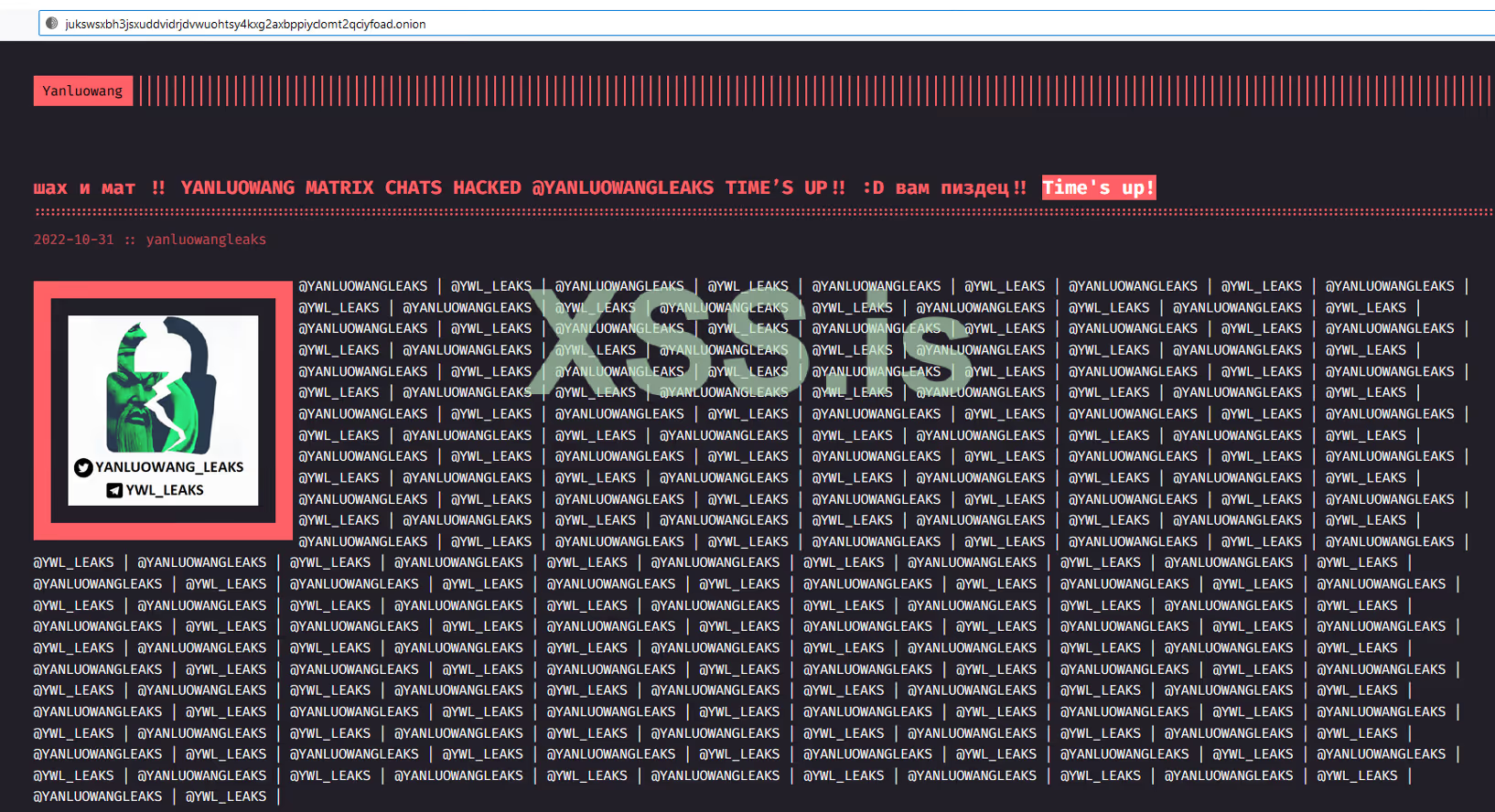
Figure 2: The screenshot of Yanluowang website on Tor (currently offline)

After learning that Yanluowang used Russian Web Forums, we did an additional search to see what we could find about the group and the mentioned nicknames. 

By searching through XSS.Is we managed to identify the user registered as @yanluowang. The date of the registration on the forum dates to 15 March 2022. Curiously, at the time of analysis, we noticed the user was online. There were in total 20 messages posted by @yanluowang, with a few publications indicating the group is looking for new pentesters.

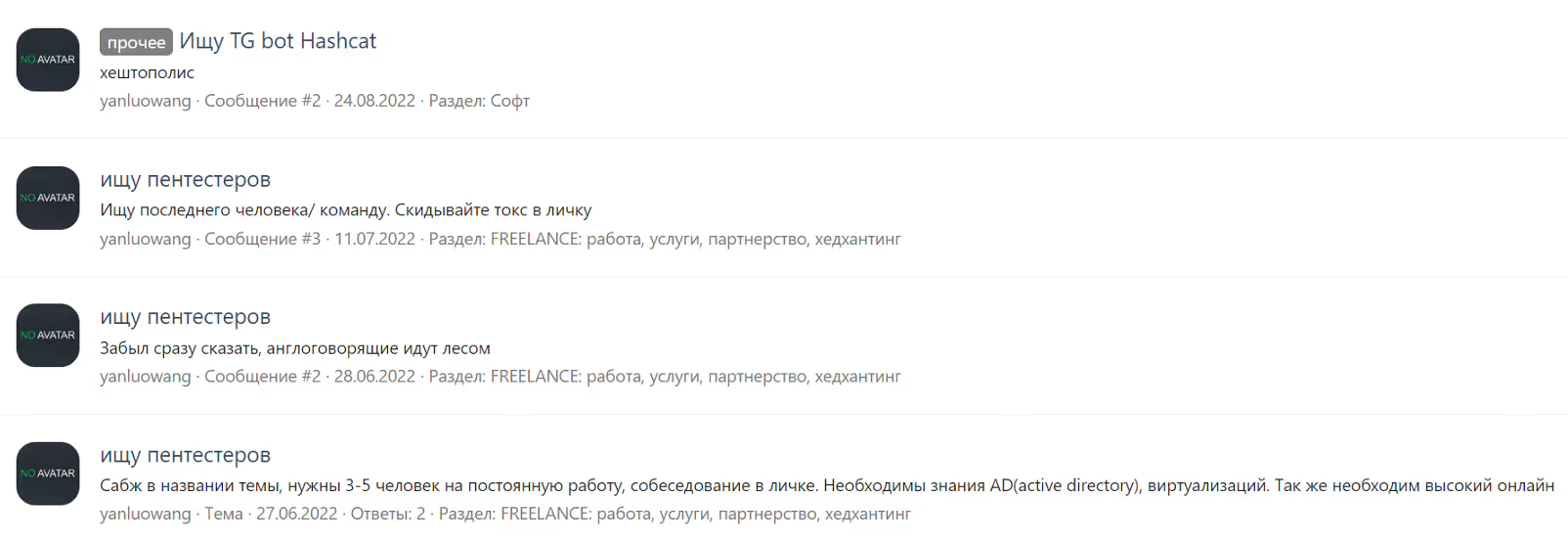
Figure 3: The screenshot of Yanluowang profile on XSS.is 

Figure 4: The screenshot of Yanluowang posts about pentester recruitment on XSS.is 

While going through the messages, it was noticed the reaction posted by another user identified as @Sa1ntJohn, which could be the gang member @saint.

Figure 5: The screenshot of Sa1ntJohn’s profile on XSS.is

Looking further, we identified that user @Ekranoplan published three links to the website doxbin.com containing information about three potential members of the YanLuoWang gang: @killanas/coder, @hardbass and @Joe/Uncle. The profile information was published by the user @Xander2727.

Figure 6: The screenshot of Yanlouwang member-profile leak on XSS.is
Figure 7: The screenshot of @hardbass Yanlouwang member profile leak
Figure 8: The screenshot of @killanas/coder Yanlouwang member profile leak.

If the provided information is correct, two group members are Russian and in their 30s, while another member is Ukrainian and in his 20s. One of the members, @killanas, who was also referenced in chat logs, is identified as the lead developer of the Yanluowang group; giving the interpretation of the chat leaks a high-level of confidence. Another two members, who were not referenced in the logs, took roles as Cracked Software/Malware provider and English translator/Victim Negotiator.

Implications for the wider ransomware landscape

To conclude with the potential implications of this leak, we have corroborated the evidence gathered throughout this investigation and employed contrarian analytical techniques. The ascertained implications that follow our mainline judgement, supporting evidence and our current analytical view on the matter can be categorized into three key components of this leak:

Impact on the ransomware landscape

The leak of Yanluowang’s chat logs has several implications for the broader ransomware landscape. This leak, much like the Conti leak in March, spells the end for Yanluowang operations for the time being, given how much of the group’s inner workings it has exposed. This could have an adverse effect. While Yanluowang did not control as large of a share of the ransomware market as Conti did, their downfall will undoubtedly create a vacuum space for established groups for their market share. The latter being a consequence of the release of their source code and build tools. 

Source code

The release of Yanluowang’s source code has several outcomes. If the recipients have no malintent, it could aid in reverse engineering the ransomware, like how a decryption tool for Yanluowng was released earlier this year. An alternative scenario is that the publication of the source code will increase the reach and deployment of this ransomware in the future, in adapted or modified versions by other threat actors. Reusing leaked material is notorious among ransomware actors, as seen in the past, when Babuk’s source code was leaked and led to the development of several variants based on this leak, including Rook and Pandora. This could also make it harder to attribute attacks to one specific group.

Members

The migration of unexposed Yanluowang members to other ransomware gangs could further add to the proliferation of ransomware groups. Such forms of spreading ransomware have been documented in the past when former Conti members repurposed their tactics to join efforts with an initial access broker, UAC-0098. Yet, the absence of evidence from members expressing and/or acting upon this claim requires further investigation and analysis. However, as there is no evidence of absence – this implication is based on the previously observed behavior from members of other ransomware gangs.

Inside the SOC
Darktrace cyber analysts are world-class experts in threat intelligence, threat hunting and incident response, and provide 24/7 SOC support to thousands of Darktrace customers around the globe. Inside the SOC is exclusively authored by these experts, providing analysis of cyber incidents and threat trends, based on real-world experience in the field.
Written by
Taisiia Garkava
Security Analyst
Written by
Dillon Ashmore
Security and Research

More in this series

No items found.

Blog

/

/

May 28, 2026

From Efficiency to Exposure: How AI Adoption Is Creating Unseen Vulnerabilities on the Factory Floor

AI in manufacturingDefault blog imageDefault blog image

How AI agents impact the manufacturing industry

Security teams and IT personnel across the manufacturing industry are under constant pressure to protect production, maintain uptime, and safeguard critical assets but the rise of AI is bringing huge new opportunities alongside new cyber risks. Across manufacturing, AI is embedded into workflows, decision-making, and increasingly, autonomous AI agents are acting on behalf of employees and systems.  

Agentic systems are powerful because they can act independently, but that same autonomy also creates cyber and operational risk. Agents have extensive permissions and are capable of carrying out complex tasks, making decisions, and interacting with tools or external systems with little to no human intervention.

Unlike traditional AI models that perform predefined tasks, AI agents use advanced techniques to mimic human decision-making processes, dynamically adapting to new challenges, making decision and taking action based on their own judgement. They look like employees operationally but lack judgment, ethics, or fear of consequences like humans do. This means they can be easily manipulated by cybercriminals, and an AI agent embedded across an OT network creates threats that extend well beyond data exposure. For example, at BMW, AI identifies faults in welding processes as they occur. At its Spartanburg plant, AI monitors the weld of 300-400 metal studs onto every SUV frame to detect misplaced or faulty studs and correct them instantly. Corruption of BMW’s AI system could lead to catastrophic quality control errors.

Adopting agentic AI systems across manufacturing raises some concerns across security teams. New data from our State of AI Cybersecurity survey shows that 78% of manufacturing security professionals are worried about employee use of AI agents – their top concern. That’s followed by employee use of generative AI tools like CoPilot and ChatGPT, a worry for 76% of security professionals at manufacturing organizations. As these tools gain more access to business data and processes, and more autonomy within organizations, security teams, who today have minimal visibility of agent activity in their environments, increasingly have sensitive data exposure (a worry for 60%) and accidental policy and regulatory violations (59%) on their minds.

External AI-powered threats are evolving just as quickly

The same capabilities transforming manufacturing are also reshaping cyberattacks.

AI is enabling attackers to automate reconnaissance, refine targeting, and adapt in real time. What once required time and manual effort can now be executed continuously and at scale. Manufacturers are already seeing the impact. According to manufacturing security professionals we surveyed, 76% are already being impacted by AI-powered threats and 90% see AI increasing the success of social engineering attacks.

And the techniques themselves are evolving. Concerns across the manufacturing sector show growing anxiety about the range of AI-powered attack routes, most pressingly of adaptive malware that evolves in real-time – a prospect half (49%) of manufacturing security professionals we surveyed are worried by, a full 9% more than the average across industries. AI adaptive malware is followed by:

  • Automated vulnerability scanning and exploit chaining (48%) which has become even more pressing as Anthropic’s new Mythos AI Model supercharges vulnerability discovery
  • Hyper-personalized phishing campaigns (46%), which remain a mainstay in hackers’ arsenals, and AI has amplified their effectiveness by making phishing emails more convincing and harder to detect.

This is not just an increase in volume, it is a shift toward threats that evolve as they unfold - often faster than static defenses can respond.

Despite rising awareness, many manufacturers are not yet equipped to manage this shift. More than half (51%) say they are not adequately prepared for AI-driven threats, and only 37% have formal policies governing AI deployment.  

Securing AI through visibility, context, and guardrails

Addressing this challenge does not require manufacturers to slow innovation. It requires a different approach to security, one that can operate at the same speed and scale as AI. Three specific priorities are emerging for manufacturers looking to take advantage of the power of AI.

Visibility is foundational.  

Organizations need to understand where AI is being used, what it can access, and how it behaves across both IT and OT environments. Without that, risk cannot be measured or managed. It is no surprise that Darktrace’s research found that 91% of manufacturing security professionals said that they need to understand how AI makes decisions before trusting it. This is even more critical in operational settings where disruption has safety, environmental, financial, and reputational impacts.

Context is what turns visibility into action.  

In environments shaped by AI, normal behavior is constantly shifting. Detecting threats requires a behavioral approach; understanding patterns of life across the organization and identifying subtle deviations in real time – a step change in organizations’ traditional approach to security and risk management.

Guardrails ensure that agency does not become exposure  

As AI systems take on greater responsibility, organizations need clear boundaries around what they can do and when they can act independently. These controls must be embedded into systems themselves, not applied after the fact.  

Securing AI Agents Across Manufacturing IT and OT

The rise of agentic AI is transforming manufacturing - powering next-generation operations while reshaping the security landscape. This is not just an increase in threats, but a shift to autonomous systems, continuously evolving behaviors, and risks moving at machine speed. For organizations trying to grapple with the challenge of enabling AI while managing the risk, visibility, context and guardrails should be foundational.

Darktrace helps manufacturers build secure AI approaches by making those foundations possible. It provides visibility and real-time detection and response to unusual activity across IT and OT environments and allows organizations to understand AI activity from the prompts employees use and the agents they build to how those agents are behaving across the environment. For manufacturers scaling AI, this delivers a foundation for innovation without sacrificing control.

Continue reading
About the author
Oakley Cox
Director of Product

Blog

/

/

May 28, 2026

How to Evaluate AI Vendors: 5 Key categories for AI Adoption

Default blog imageDefault blog image

Understanding the AI buyers’ market

AI adoption has become a central topic of discussion in boardrooms, drawing growing interest from business leaders. Ultimately, organizations hope that an investment in AI technology will have tremendous returns. However, the process of buying an AI solution is not as straight forward as it appears on the surface.  

While business leaders may be eager to improve productivity across their operations, practitioners responsible for evaluating and selecting AI solutions may not always have the visibility or technical understanding needed to make the right decisions for their business. What is typically marketed as a holistic solution to their most critical problems is usually followed by uncertainty when AI tools are finally operationalized in real environments.

This guide is intended to support security leaders who are under growing pressure to adopt AI tools while navigating complex terminology, vendor claims, and increasingly crowded buying cycles. Ultimately, the goal is to help organizations evaluate and adopt AI in a safe, effective, and well-governed way. To support this, we’ve structured the evaluation framework across five key categories:

  1. Governance, safety, and data controls
  1. Data gathering and training
  1. Model and technique choice
  1. Performance and accuracy validation    
  1. Interpretability, adjustability, and transparency    

What buying AI looks like in cybersecurity

While investing in AI can bring immense benefits to your security team, first-time buyers of AI cybersecurity solutions may not know where to start. They will have to determine the type of tool they want, know the options available, and evaluate vendors. Research and understanding are critical to ensure purchases are worth the investment.  

With acceleration in AI adoption, accompanied by the recent boom in agentic AI and autonomous agents, CISOs must look “beneath the hood" of these tools to understand how they work, how they are governed, and to ensure the system is secure and compliant with internal policies.

Challenges in the AI buyers’ marketplace  

The AI security software market is buzzing with hype and flashy promises, which, understandably, needs to be addressed with due diligence. Potential buyers, especially in the cybersecurity space, are hesitant when it comes to allowing AI autonomous capabilities across their workflows, and a lack of vendor transparency can exacerbate those feelings.  

Reinforcing this sentiment, research from this year's Darktrace’s State of AI Cybersecurity report shows where confidence and hesitancy emerge amongst potential buyers. On the one hand, security professionals agree that they have good visibility into the logic and reasoning processes their AI solutions use. However, they lack the explainability and trust to allow AI to take independent remedial action.

  • 89% say they have good visibility into the reasoning behind the outputs generated by AI solutions
  • 92% say they need to understand how a defensive AI tool makes decisions before they can trust it
  • Only 14% say they allow AI to act independently, performing autonomous actions without human approval
  • 74% say they are limiting the autonomy of AI taking action in their SOC until explainability improves

Given the desire for trust and explainability we are seeing from buyers, it's important for them to be equipped with the right questions to ask vendors during an assessment or POV of AI tools in order to demystify marketing hype from real operational outcomes.

Below is a list of categories in which buyers can assess AI vendors or AI Service Providers (AISPs) to help reach safe adoption and maximize their ROI.  

5 categories of AI vendor assessment

Darktrace groups these AI-related questions into 5 categories: governance, data and training, model and technique choice, performance validation, and interpretability and adjustability. By asking questions regarding each of these 5 categories, buyers can gain a deeper understanding of how an AISP’s systems work and whether they suit their business requirements.

Governance, safety, and data controls

Governance of AI systems is critical for all AISPs. Whether their platform is based around a single model, or is a more complex, composite AI solution, strong governance is essential to ensure the system is safe, robust, and reliable.

A simple question you could ask is:

What AI governance policies and frameworks do you follow, and/or certifications do you currently maintain?

For more questions you can ask vendors, download the full guide here.

Darktrace is certified to the ISO/IEC 42001 standard, the world’s first AI Management System (AIMS) standard. ISO/IEC 42001 addresses the unique ethical and technical challenges AI poses by setting out a structured way to manage risks such as transparency, accuracy, and misuse. This includes a commitment to ethical AI development, and effective management and monitoring of AI systems both prior to and continually after release.

Data gathering and training

Accurate, meaningful, and unbiased data gathering is the first important step in producing any AI system. An AI model trained using inaccurate, unbalanced, or poor-quality training data will fail to perform optimally.

To alleviate concerns regarding training data quality, a question you could ask is:

What steps do you take to prevent bias in your AI models and training data?

For more questions, download the full guide here.

AISPs should be able to provide information about the steps taken, workflows followed, and auditing performed to reduce AI bias where appropriate. While it’s sometimes impossible to fully remove bias from an AI model, appropriate actions should be taken to mitigate or reduce bias where relevant.

Model and technique choice

Different AI techniques are optimal for different tasks. For example, research from Gartner suggests that relying on a single “one-size-fits-all" model can lead to data gaps, especially in highly specialized domains.

To achieve more accurate and robust AI solutions, AI leaders should move beyond using just one model or technique, embrace composite AI practices, and adopt a holistic AI system perspective.

A straightforward question you could ask is simply:

What type(s) of AI model(s) do you utilize in your solution?

For more questions, download the full guide here.

While specific detailed information about custom systems used by AISPs is likely proprietary, buyers should expect vendors to be able to provide an overview of the broad techniques used. This will allow you as a buyer to determine if the type of model is appropriate for your use case.

Performance and accuracy validation  

Testing and evaluation of performance is essential for all AI systems. Performance analysis should be performed both before release and continually after release to identify potential data or model drift.  

A question you could ask to understand an AISPs testing workflow is:

How do you audit, test, evaluate, verify, and validate your AI model outputs?

For more questions, download the full guide here.

Testing workflows will likely vary depending on the type of model – measurements relevant to one system may not always be relevant to others. Assessment of systems should also extend beyond these standard accuracy and robustness tests, and should also feature physical performance, such as latency and resource consumption.  

Interpretability, adjustability, and transparency  

AI systems are typically a black box, simply providing an output without an explanation of how that output was attained. Interpretability and transparency are critical to ensure that both SOC teams and end-users trust the outputs of a system to be accurate and meaningful.

A question you could ask is:

How do you promote a trust relationship between human analysts and AI outputs?

For more questions, download the full guide here.

In the context of cybersecurity, trust and interpretability are even more essential. This is particularly relevant for generative AI-based systems (including most AI Agents), where the risk of hallucination can reduce trust in responses.

Cybersecurity systems often need to perform autonomous actions to block incoming threats – an email filtering system may hold potentially dangerous emails; a firewall may block malicious inbound connections. If SOC teams can’t trust these systems to perform accurately, these systems may be limited or disabled, critically reducing their defensive power.

Darktrace as an AI-native cybersecurity vendor

Darktrace has been building and applying AI in cybersecurity for over a decade, developing its capabilities alongside an increasingly complex and fast‑moving threat landscape. This experience has resulted in a mature, multi-layered approach to AI, which continuously learns the normal patterns of each organization to understand behavior, interpret context, and identify meaningful deviations — without relying on predefined rules or known attack signatures. Over time, this has enabled a proven behavioral understanding that helps uncover subtle signals of risk that may otherwise be missed.

With the backing of our ISO/IEC 42001 certification, stakeholders, customers, and partners can be confident that Darktrace is responsibly, ethically, and safely developing its AI systems, and managing the use of AI in day-to-day operations in a compliant and secure manner.  

Explore the principles behind Darktrace’s responsible AI approach, informed by collaboration with global experts in academia and governments, detailing how accountability, explainability, and continuous validation are built into its cybersecurity technology.

How Darktrace secures AI systems

Darktrace now brings these capabilities to monitor and respond to risk generated from AI systems across organizations with Darktrace / SECURE AI. This solution analyzes how prompts, agents, and systems are used within the context of each organization, bringing every AI interaction into a single view. This unique approach helps teams understand intent, assess risk, protect sensitive data, and enforce policy across both human and AI agent activity.

Stay up to date

Sign up for the Secure AI Readiness Program here: This gives you exclusive access to the latest news on the latest AI threats, updates on emerging approaches shaping AI security, and insights into the latest innovations, including Darktrace’s ongoing work in this area.

Ready to talk with a Darktrace expert on securing AI? Register here to receive practical guidance on the AI risks that matter most to your business, paired with clarity on where to focus first across governance, visibility, risk reduction, and long-term readiness.  

Further Reading on AI in cybersecurity

When deciding to invest in an AI solution, it’s important to understand what this means for you and your organization. The questions presented here are only a starting point in understanding an AI solution and whether it is appropriate for your use case.  

Gain deeper knowledge on applications of AI in cybersecurity and Darktrace’s multi-layered AI in the AI Arsenal White Paper.

[related-resource]

Continue reading
About the author
Jamie Bali
Technical Author (AI) Developer
Your data. Our AI.
Elevate your network security with Darktrace AI