ブログ
/
AI
/
November 6, 2022

Behind Yanluowang: Unveiling Cyber Threat Tactics

Discover the latest insights into the Yanluowang leak organization, uncovering its members and tactics.
Inside the SOC
Darktrace cyber analysts are world-class experts in threat intelligence, threat hunting and incident response, and provide 24/7 SOC support to thousands of Darktrace customers around the globe. Inside the SOC is exclusively authored by these experts, providing analysis of cyber incidents and threat trends, based on real-world experience in the field.
Written by
Taisiia Garkava
Security Analyst
Written by
Dillon Ashmore
Security and Research
Default blog imageDefault blog imageDefault blog imageDefault blog imageDefault blog imageDefault blog image
06
Nov 2022

Background of Yanluowang

Yanluowang ransomware, also known as Dryxiphia, was first spotted in October 2021 by Symantec’s Threat Hunter Team. However, it has been operational since August 2021, when a threat actor used it to attack U.S. corporations. Said attack shared similar TTPs with ransomware Thieflock, designed by Fivehands ransomware gangs. This connection alluded to a possible link between the two through the presence or influence of an affiliate. The group has been known for successfully ransoming organisations globally, particularly those in the financial, manufacturing, IT services, consultancy, and engineering sectors.

Yanluowang attacks typically begin with initial reconnaissance, followed by credential harvesting and data exfiltration before finally encrypting the victim’s files. Once deployed on compromised networks, Yanluowang halts hypervisor virtual machines, all running processes and encrypts files using the “.yanluowang” extension. A file with name README.txt, containing a ransom note is also dropped. The note also warns victims against contacting law enforcement, recovery companies or attempting to decrypt the files themselves. Failure to follow this advice would result in distributed denial of service attacks against a victim, its employees and business partners. Followed by another attack, a few weeks later, in which all the victim’s files would be deleted.

The group’s name “Yanluowang” was inspired by the Chinese mythological figure Yanluowang, suggesting the group’s possible Chinese origin. However, the recent leak of chat logs belonging to the group, revealed those involved in the organisation spoke Russian. 

 Leak of Yanluowang’s chat logs

 On the 31st of October, a Twitter user named @yanluowangleaks shared the matrix chat and server leaks of the Yanluowang ransomware gang, alongside the builder and decryption source. In total, six files contained internal conversations between the group’s members. From the analysis of these chats, at least eighteen people have been involved in Yanluowang operations.

Twitter account where the leaks and decryption source were shared
Figure 1: Twitter account where the leaks and decryption source were shared

Potential members: ‘@killanas', '@saint', '@stealer', '@djonny', '@calls', '@felix', '@win32', '@nets', '@seeyousoon', '@shoker', '@ddos', '@gykko', '@loader1', '@guki', '@shiwa', '@zztop', '@al', '@coder1'

Most active members: ‘@saint’, ‘@killanas’, ‘@guki’, ‘@felix’, ‘@stealer’. 

To make the most sense out of the data that we analyzed, we combined the findings into two categories: tactics and organization.

Tactics 

From the leaked chat logs, several insights into the group’s operational security and TTPs were gained. Firstly, members were not aware of each other’s offline identities. Secondly, discussions surrounding security precautions for moving finances were discussed by members @killanas and @felix. The two exchanged recommendations on reliable currency exchange platforms as well as which ones to avoid that were known to leak data to law enforcement. The members also expressed paranoia over being caught with substantial amounts of money and therefore took precautions such as withdrawing smaller amounts of cash or using QR codes for withdrawals.

Additionally, the chat logs exposed the TTPs of Yanluowang. Exchanges between the group’s members @stealer, @calls and @saint, explored the possibilities of conducting attacks against critical infrastructure. One of these members, @call, was also quick to emphasise that Yanluowang would not target the critical infrastructure of former Soviet countries. Beyond targets, the chat logs also highlighted Yanluowang’s use of the ransomware, PayloadBIN but also that attacks that involved it may potentially have been misattributed to another ransomware actor, Evil Corp.

Further insight surrounding Yanluowang’s source code was also gained as it was revealed that it had been previously published on XSS.is as a downloadable file. The conversations surrounding this revealed that two members, @killanas and @saint, suspected @stealer was responsible for the leak. This suspicion was supported by @saint, defending another member whom he had known for eight years. It was later revealed that the code had been shared after a request to purchase it was made by a Chinese national. @saint also used their personal connections to have the download link removed from XSS.is. These connections indicate that some members of Yanluowang are well embedded in the ransomware and wider cybercrime community.

Another insight gained from the leaked chat logs was an expression by @saint in support of Ukraine, stating, “We stand with Ukraine” on the negotiation page of Yanluowang’s website. This action reflects a similar trend observed among threat actors where they have taken sides in the Russia-Ukraine conflict.

Regarding Yanluowang’s engagement with other groups, it was found that a former member of Conti had joined the group. This inference was made by @saint when a conversation regarding the Conti leak revolved around the possible identification of the now Yanluowang member @guki, in the Conti files. It was also commented that Conti was losing a considerable number of its members who were then looking for new work. Conversations about other ransomware groups were had with the mentioning of the REVIL group by @saint, specifically stating that five arrested members of the gang were former classmates. He backed his statement by attaching the article about it, to which @djonny replies that those are indeed REVIL members and that he knows it from his sources.

Organization 

When going through the chat logs, several observations were made that can offer some insights into the group's organizational structure. In one of the leaked files, user @saint was the one to publish the requirements for the group's ".onion" website and was also observed instructing other users on the tasks they had to complete. Based on this, @saint could be considered the leader of the group. Additionally, there was evidence indicating that a few users could be in their 30s or 40s, while most participants are in their 20s.

More details regarding Yanluowang's organizational structure were discussed deeper into the leak. The examples indicate various sub-groups within the Yanlouwang group and that a specific person coordinates each group. From the logs, there is a high probability that @killanas is the leader of the development team and has several people working under him. It is also possible that @stealer is on the same level as @killanas and is potentially the supervisor of another team within the group. This was corroborated when @stealer expressed concerns about the absence of certain group members on several occasions. There is also evidence showing that he was one of three people with access to the source code of the group. 

Role delineation within the group was also quite clear, with each user having specific tasks: DDoS (distributed denial of service) attacks, social engineering, victim negotiations, pentesting or development, to mention a few. When it came to recruiting new members, mostly pentesters, Yanluowang would recruit through XSS.is and Exploit.in forums.

Underground analysis and members’ identification 

From the leaked chat logs, several “.onion” URLs were extracted; however, upon further investigation, each site had been taken offline and removed from the TOR hashring. This suggests that Yanluowang may have halted all operations. One of the users on XSS.is posted a picture showing that the Yanluowang onion website was hacked, stating, “CHECKMATE!! YANLUOWANG CHATS HACKED @YANLUOWANGLEAKS TIME’S UP!!”.
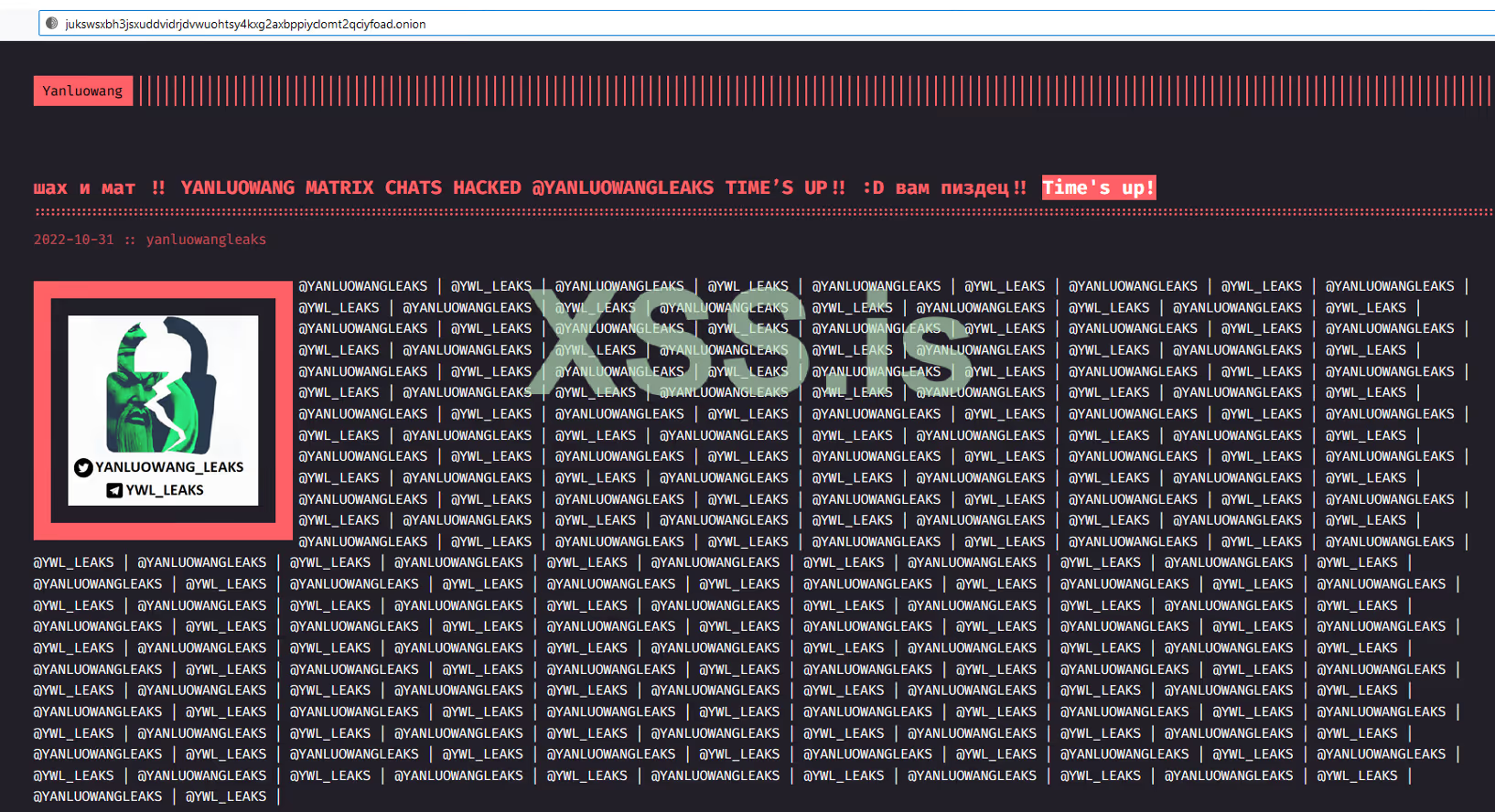
Figure 2: The screenshot of Yanluowang website on Tor (currently offline)

After learning that Yanluowang used Russian Web Forums, we did an additional search to see what we could find about the group and the mentioned nicknames. 

By searching through XSS.Is we managed to identify the user registered as @yanluowang. The date of the registration on the forum dates to 15 March 2022. Curiously, at the time of analysis, we noticed the user was online. There were in total 20 messages posted by @yanluowang, with a few publications indicating the group is looking for new pentesters.
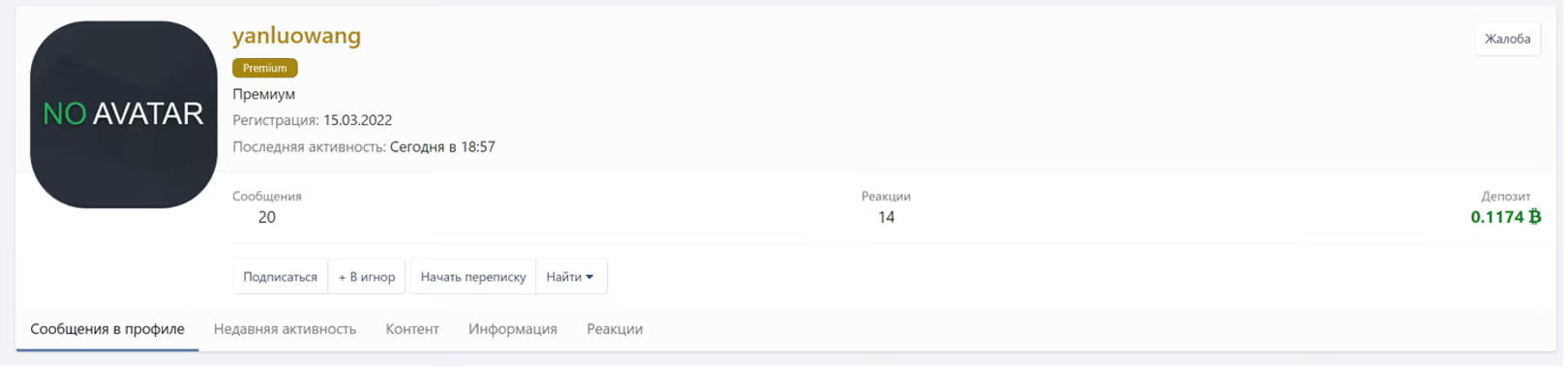
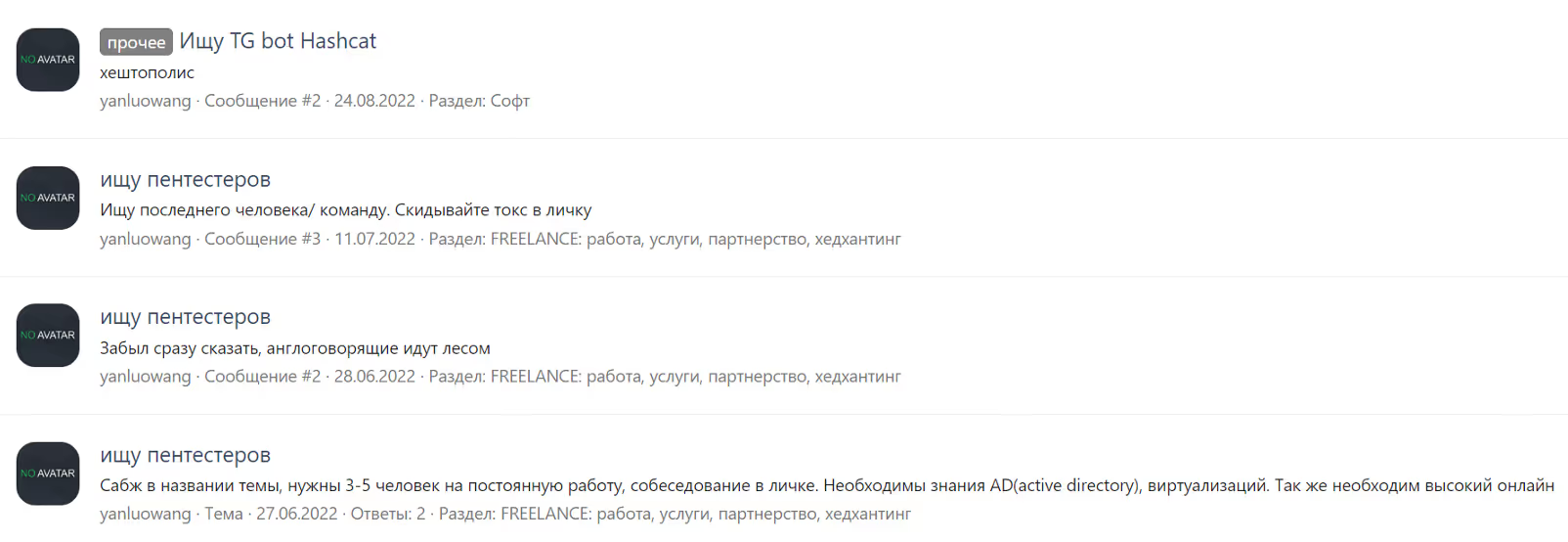
Figure 3: The screenshot of Yanluowang profile on XSS.is 

Figure 4: The screenshot of Yanluowang posts about pentester recruitment on XSS.is 

While going through the messages, it was noticed the reaction posted by another user identified as @Sa1ntJohn, which could be the gang member @saint.

Figure 5: The screenshot of Sa1ntJohn’s profile on XSS.is

Looking further, we identified that user @Ekranoplan published three links to the website doxbin.com containing information about three potential members of the YanLuoWang gang: @killanas/coder, @hardbass and @Joe/Uncle. The profile information was published by the user @Xander2727.

Figure 6: The screenshot of Yanlouwang member-profile leak on XSS.is
Figure 7: The screenshot of @hardbass Yanlouwang member profile leak
Figure 8: The screenshot of @killanas/coder Yanlouwang member profile leak.

If the provided information is correct, two group members are Russian and in their 30s, while another member is Ukrainian and in his 20s. One of the members, @killanas, who was also referenced in chat logs, is identified as the lead developer of the Yanluowang group; giving the interpretation of the chat leaks a high-level of confidence. Another two members, who were not referenced in the logs, took roles as Cracked Software/Malware provider and English translator/Victim Negotiator.

Implications for the wider ransomware landscape

To conclude with the potential implications of this leak, we have corroborated the evidence gathered throughout this investigation and employed contrarian analytical techniques. The ascertained implications that follow our mainline judgement, supporting evidence and our current analytical view on the matter can be categorized into three key components of this leak:

Impact on the ransomware landscape

The leak of Yanluowang’s chat logs has several implications for the broader ransomware landscape. This leak, much like the Conti leak in March, spells the end for Yanluowang operations for the time being, given how much of the group’s inner workings it has exposed. This could have an adverse effect. While Yanluowang did not control as large of a share of the ransomware market as Conti did, their downfall will undoubtedly create a vacuum space for established groups for their market share. The latter being a consequence of the release of their source code and build tools. 

Source code

The release of Yanluowang’s source code has several outcomes. If the recipients have no malintent, it could aid in reverse engineering the ransomware, like how a decryption tool for Yanluowng was released earlier this year. An alternative scenario is that the publication of the source code will increase the reach and deployment of this ransomware in the future, in adapted or modified versions by other threat actors. Reusing leaked material is notorious among ransomware actors, as seen in the past, when Babuk’s source code was leaked and led to the development of several variants based on this leak, including Rook and Pandora. This could also make it harder to attribute attacks to one specific group.

Members

The migration of unexposed Yanluowang members to other ransomware gangs could further add to the proliferation of ransomware groups. Such forms of spreading ransomware have been documented in the past when former Conti members repurposed their tactics to join efforts with an initial access broker, UAC-0098. Yet, the absence of evidence from members expressing and/or acting upon this claim requires further investigation and analysis. However, as there is no evidence of absence – this implication is based on the previously observed behavior from members of other ransomware gangs.

Inside the SOC
Darktrace cyber analysts are world-class experts in threat intelligence, threat hunting and incident response, and provide 24/7 SOC support to thousands of Darktrace customers around the globe. Inside the SOC is exclusively authored by these experts, providing analysis of cyber incidents and threat trends, based on real-world experience in the field.
Written by
Taisiia Garkava
Security Analyst
Written by
Dillon Ashmore
Security and Research

More in this series

No items found.

Blog

/

AI

/

December 2, 2025

Protecting the Experience: How a global hospitality brand stays resilient with Darktrace

Default blog imageDefault blog image

For the Global Chief Technology Officer (CTO) of a leading experiential leisure provider, security is mission critical to protecting a business built on reputation, digital innovation, and guest experience. The company operates large-scale immersive venues across the UK and US, blending activity-driven hospitality with premium dining and vibrant spaces designed for hundreds of guests. With a lean, centrally managed IT team responsible for securing locations worldwide, the challenge is balancing robust cybersecurity with operational efficiency and customer experience.

Brand buzz attracts attention – and attacks

Mid-sized, fast-growing hospitality organizations face a unique risk profile. When systems go down in a venue, the impact is immediate: hundreds of disrupted guest experiences, lost revenue during peak hours, and potential long-term reputation damage. Each time the organization opened a new venue, the surge of marketing buzz attracted attention in local markets and waves of sophisticated cyberattacks, including:

Phishing campaigns leveraging brand momentum to lure employees into clicking on malicious links.

AI-enhanced impersonation using advanced techniques to create AI-generated video calls and deep-researched, contextualized emails  

Fake domains targeting leadership with AI-generated messages that contained insider context gleaned from public information.

“Our endpoint security and antivirus tools were powerless against these sophisticated AI-powered campaigns. We didn’t want to manage incidents anymore. We wanted to prevent them from ever happening.”  - Global CTO

Proactive, preventative security with Darktrace AI

The company’s cybersecurity vision was clear: “Proactive, preventative – that was our mandate,” said the CTO. With a lean and busy IT group, the business evaluated several security solutions using deep-dive workshops. Darktrace proved the best fit for supporting the organization’s proactive mindset, offering:

  • Autonomy without added headcount: Darktrace provided powerful AI-driven detection and autonomous response functions with minimal manual oversight required.
  • Modular adoption: The company could start with core email and network protection and expand into cloud and endpoint coverage, aligning spend with growth.
  • Partnership and responsiveness: “We wanted people we trust, respect, and know will show up when we need them. Darktrace did just that,” said the CTO.
  • Affordability at scale: Darktrace offered reasonable upfront costs plus predictable, sustainable economics as the company and IT infrastructure expanded.  

“The combination of AI capabilities, a scalable model, and a strong engagement team tipped the balance in Darktrace’s favor, and we have not been disappointed,” said the CTO.

Phased deployment builds trust

To minimize disruption to critical hospitality systems like global Point of Sales (POS) terminals and Audio-Visual (AV) infrastructure, deployment was phased:

  1. Observation and human-led response: Initially, Darktrace was deployed in detection-only mode. Alerts were manually reviewed.
  2. Incremental autonomous response: Darktrace Autonomous Response was enabled on select models, taking action on low-risk scenarios. Higher-risk subnets and devices remained under human control.
  3. Full autonomous coverage: With tuning and reinforcement, autonomous response was expanded across domains, trusted to take decisive action in real time. Analysts retained the ability to review and contextualize incidents.

“Darktrace managed the rollout through detailed, professional, and responsive project management – ensuring a smooth, successful adoption and creating a standardized cybersecurity playbook for future venue launches,” said the CTO.  

AI delivers the outcomes that matter  

Measurable efficiency replaces endless alerts

Darktrace autonomous response significantly decreased false alerts and noise. “If it’s quiet, we’re confident there isn’t a problem,” said the CTO. Within six months, Darktrace conducted 3,599 total investigations, detected and contained 320 incidents indicative of an attack, resolved 91% of those events autonomously, and escalated only 9% to human analysts. The efficiency gains were enormous, saving analysts 740 hours on investigations within a single month.  

Precision AI turns inbox chaos into calm

Darktrace Self-Learning AI modeled sender/recipient norms, content/linguistic baselines, and communication patterns unique to the organization’s launch cadence, resulting in:

  • Automated holds and neutralizations of anomalous executive-style messages
  • Rapid detection of novel templates and tone shifts that deviated from the organization’s lived email graph, even when indicators were not yet on any feed
  • Downstream reduction in help-desk escalations tied to suspicious email

Full visibility fuels real-time response

Darktrace gives IT direct visibility without extra licensing, and it surfaces ground truth across every venue, including:

  • Device geolocation and placement drift: Darktrace exposed devices and users operating outside approved zones, prompting new segmentation and access-control policies.
  • Guest Wi-Fi realities: Darktrace AI uncovered high-risk activity on guest networks, like crypto-mining and dark-web traffic, driving stricter VLAN separation and access hygiene.
  • Lateral-movement containment: Autonomous response fenced suspicious activity in real time, buying time for human investigation while keeping POS and AV systems unaffected.

Smarter endpoints for a smarter network

Endpoints once relied on static agents effective only against known signatures. Darktrace’s behavioral models now detect subtle anomalies at the endpoint process level that EDRs often miss, such as misuse of legitimate applications (commonly used in living-off-the-land attacks), unapproved application usage and policy violations. This increases the accuracy and fidelity of network-based investigations by adding endpoint process context alongside existing EDR alerts.

Autonomous response for continuous compliance

Across PCI, GDPR, and cross-border privacy obligations, Darktrace’s native evidencing is helping the team demonstrate control rather than merely assert it:

  • Asset and flow awareness: Knowing “what is where” and “who talks to what” underpins PCI scoping and data-flow diagrams.
  • Layered safeguards: Showing autonomous prevention, network segmentation, and rapid containment supports risk registers and control attestations.
  • Audit-ready artifacts: Investigations and autonomous actions produce artifacts that “tick the box” without additional tooling.  

Defining the next era of resilience with AI

With rapid global expansion underway, the company is using its cybersecurity playbook to streamline and secure future venue launches. In the near term, IT is focused on strengthening prevention, using Darktrace insights to guide new policy updates and infrastructure changes like imposing stricter guest-network posture and refining venue device baselines.

For tech leaders charting their path to proactive cyber defense, the CTO stresses success won’t come from sidestepping AI, but from turning it into a core capability.

“AI isn’t optional – it’s operational. The real risk to your business is trying to out-scale automated adversaries with human speed alone. When applied to the right use case, AI becomes a catalyst for efficiency, resilience, and business growth.” - Global CTO
Continue reading
About the author
The Darktrace Community

Blog

/

Email

/

December 2, 2025

From Amazon to Louis Vuitton: How Darktrace Detects Black Friday Phishing Attacks

Default blog imageDefault blog image

Why Black Friday Drives a Surge in Phishing Attacks

In recent years, Black Friday has shifted from a single day of online retail sales and discounts to an extended ‘Black Friday Week’, often preceded by weeks of online hype. During this period, consumers are inundated with promotional emails and marketing campaigns as legitimate retailers compete for attention.

Unsurprisingly, this surge in legitimate communications creates an ideal environment for threat actors to launch targeted phishing campaigns designed to mimic legitimate retail emails. These campaigns often employ social engineering techniques that exploit urgency, exclusivity, and consumer trust in well-known brands, tactics designed to entice recipients into opening emails and clicking on malicious links.

Additionally, given the seasonal nature of Black Friday and the ever-changing habits of consumers, attackers adopt new tactics and register fresh domains each year, rather than reusing domains previously flagged as spam or phishing endpoints. While this may pose a challenge for traditional email security tools, it presents no such difficulty for Darktrace / EMAIL and its anomaly-based approach.

In the days and weeks leading up to ‘Black Friday’, Darktrace observed a spike in sophisticated phishing campaigns targeting consumers, demonstrating how attackers combine phycological manipulation with technical evasion to bypass basic security checks during this high-traffic period. This blog showcases several notable examples of highly convincing phishing emails detected and contained by Darktrace / EMAIL in mid to late November 2025.

Darktrace’s Black Friday Detections

Brand Impersonation: Deal Watchdogs’ Amazon Deals

The impersonation major online retailers has become a common tactic in retail-focused attacks, none more so than Amazon, which ranked as the fourth most impersonated brand in 2024, only behind Microsoft, Apple, Google, and Facebook [1]. Darktrace’s own research found Amazon to be the most mimicked brand, making up 80% of phishing attacks in its analysis of global consumer brands.

When faced with an email that appears to come from a trusted sender like Amazon, recipients are far more likely to engage, increasing the success rate of these phishing campaigns.

In one case observed on November 16, Darktrace detected an email with the subject line “NOW LIVE: Amazon’s Best Early Black Friday Deals on Gadgets Under $60”. The email was sent to a customer by the sender ‘Deal Watchdogs’, in what appeared to be an attempt to masquerade as a legitimate discount-finding platform. No evidence indicated that the company was legitimate. In fact, the threat actor made no attempt to create a convincing name, and the domain appeared to be generated by a domain generation algorithm (DGA), as shown in Figure 2.

Although the email was sent by ‘Deal Watchdogs’, it attempted to impersonate Amazon by featuring realistic branding, including the Amazon logo and a shade of orange similar to that used by them for the ‘CLICK HERE’ button and headline text.

Figure 1: The contents of the email observed by Darktrace, featuring authentic-looking Amazon branding.

Darktrace identified that the email, marked as urgent by the sender, contained a suspicious link to a Google storage endpoint (storage.googleapis[.]com), which had been hidden by the text “CLICK HERE”. If clicked, the link could have led to a credential harvester or served as a delivery vector for a malicious payload hosted on the Google storage platform.

Fortunately, Darktrace immediately identified the suspicious nature of this email and held it before delivery, preventing recipients from ever receiving or interacting with the malicious content.

Figure 2: Darktrace / EMAIL’s detection of the malicious phishing email sent to a customer.

Around the same time, Darktrace detected a similar email attempting to spoof Amazon on another customer’s network with the subject line “Our 10 Favorite Deals on Amazon That Started Today”, also sent by ‘Deal Watchdogs,’ suggesting a broader campaign.

Analysis revealed that this email originated from the domain petplatz[.]com, a fake marketing domain previously linked to spam activity according to open-source intelligence (OSINT) [2].

Brand Impersonation: Louis Vuitton

A few days later, on November 20, Darktrace / EMAIL detected a phishing email attempting to impersonate the luxury fashion brand Louis Vuitton. At first glance, the email, sent under the name ‘Louis Vuitton’ and titled “[Black Friday 2025] Discover Your New Favorite Louis Vuitton Bag – Elegance Starts Here”, appeared to be a legitimate Black Friday promotion. However, Darktrace’s analysis uncovered several red flags indicating a elaborate brand impersonation attempt.

The email was not sent by Louis Vuitton but by rskkqxyu@bookaaatop[.]ru, a Russia-based domain never before observed on the customer’s network. Darktrace flagged this as suspicious, noting that .ru domains were highly unusual for this recipient’s environment, further reinforcing the likelihood of malicious intent. Subsequent analysis revealed that the domain had only recently registered and was flagged as malicious by multiple OSINT sources [3].

Figure 3: Darktrace / EMAIL’s detection of the malicious email attempting to spoofLouis Vuitton, originating from a suspicious Russia-based domain.

Darktrace further noted that the email contained a highly suspicious link hidden behind the text “View Collection” and “Unsubscribe,” ensuring that any interaction, whether visiting the supposed ‘handbag store’ or attempting to opt out of marketing emails, would direct recipients to the same endpoint. The link resolved to xn--80aaae9btead2a[.]xn--p1ai (топааабоок[.]рф), a domain confirmed as malicious by multiple OSINT sources [4]. At the time of analysis, the domain was inaccessible, likely due to takedown efforts or the short-lived nature of the campaign.

Darktrace / EMAIL blocked this email before it reached customer inboxes, preventing recipients from interacting with the malicious content and averting any disruption.

Figure 4: The suspicious domain linked in the Louis Vuitton phishing email, now defunct.

Too good to be true?

Aside from spoofing well-known brands, threat actors frequently lure consumers with “too good to be true” luxury offers, a trend Darktrace observed in multiple cases throughout November.

In one instance, Darktrace identified an email with the subject line “[Black Friday 2025] Luxury Watches Starting at $250.” Emails contained a malicious phishing link, hidden behind text like “Rolex Starting from $250”, “Shop Now”, and “Unsubscribe”.

Figure 5: Example of a phishing email detected by Darktrace, containing malicious links concealed behind seemingly innocuous text.

Similarly to the Louis Vuitton email campaign described above, this malicious link led to a .ru domain (hxxps://x.wwwtopsalebooks[.]ru/.../d65fg4er[.]html), which had been flagged as malicious by multiple sources [5].

Figure 6: Darktrace / EMAIL’s detection of a malicious email promoting a fake luxury watch store, which was successfully held from recipient inboxes.

If accessed, this domain would redirect users to luxy-rox[.]com, a recently created domain (15 days old at the time of writing) that has also been flagged as malicious by OSINT sources [6]. When visited, the redirect domain displayed a convincing storefront advertising high-end watches at heavily discounted prices.

Figure 7: The fake storefront presented upon visiting the redirectdomain, luxy-rox[.]com.

Although the true intent of this domain could not be confirmed, it was likely a scam site or a credential-harvesting operation, as users were required to create an account to complete a purchase. As of the time or writing, the domain in no longer accessible .

This email illustrates a layered evasion tactic: attackers employed multiple domains, rapid domain registration, and concealed redirects to bypass detection. By leveraging luxury branding and urgency-driven discounts, the campaign sought to exploit seasonal shopping behaviors and entice victims into clicking.

Staying Protected During Seasonal Retail Scams

The investigation into these Black Friday-themed phishing emails highlights a clear trend: attackers are exploiting seasonal shopping events with highly convincing campaigns. Common tactics observed include brand impersonation (Amazon, Louis Vuitton, luxury watch brands), urgency-driven subject lines, and hidden malicious links often hosted on newly registered domains or cloud services.

These campaigns frequently use redirect chains, short-lived infrastructure, and psychological hooks like exclusivity and luxury appeal to bypass user scepticism and security filters. Organizations should remain vigilant during retail-heavy periods, reinforcing user awareness training, link inspection practices, and anomaly-based detection to mitigate these evolving threats.

Credit to Ryan Traill (Analyst Content Lead) and Owen Finn (Cyber Analyst)

Appendices

References

1.        https://keepnetlabs.com/blog/top-5-most-spoofed-brands-in-2024

2.        https://www.virustotal.com/gui/domain/petplatz.com

3.        https://www.virustotal.com/gui/domain/bookaaatop.ru

4.        https://www.virustotal.com/gui/domain/xn--80aaae9btead2a.xn--p1ai

5.        https://www.virustotal.com/gui/url/e2b868a74531cd779d8f4a0e1e610ec7f4efae7c29d8b8ab32c7a6740d770897?nocache=1

6.        https://www.virustotal.com/gui/domain/luxy-rox.com

Indicators of Compromise (IoCs)

IoC – Type – Description + Confidence

petplatz[.]com – Hostname – Spam domain

bookaaatop[.]ru – Hostname – Malicious Domain

xn--80aaae9btead2a[.]xn--p1ai (топааабоок[.]рф) – Hostname - Malicious Domain

hxxps://x.wwwtopsalebooks[.]ru/.../d65fg4er[.]html) – URL – Malicious Domain

luxy-rox[.]com – Hostname -  Malicious Domain

MITRE ATT&CK Mapping  

Tactic – Technique – Sub-Technique  

Initial Access - Phishing – (T1566)  

Continue reading
About the author
Ryan Traill
Analyst Content Lead
あなたのデータ × DarktraceのAI
唯一無二のDarktrace AIで、ネットワークセキュリティを次の次元へ