
Blog
/
/
April 12, 2023

P2Pinfect - New Variant Targets MIPS Devices

A new P2Pinfect variant compiled for the Microprocessor without Interlocked Pipelined Stages (MIPS) architecture has been discovered. This demonstrates increased targeting of routers, Internet of Things (IoT) and other embedded devices by those behind P2Pinfect.
Inside the SOC
Darktrace cyber analysts are world-class experts in threat intelligence, threat hunting and incident response, and provide 24/7 SOC support to thousands of Darktrace customers around the globe. Inside the SOC is exclusively authored by these experts, providing analysis of cyber incidents and threat trends, based on real-world experience in the field.
Written by
The Darktrace Community
P2PinfectDefault blog image
12
Apr 2023

Introduction: P2PInfect

Since July 2023, researchers at Cado Security Labs (now part of Darktrace) have been monitoring and reporting on the rapid growth of a cross-platform botnet, named “P2Pinfect”. As the name suggests, the malware - written in Rust - acts as a botnet agent, connecting infected hosts in a peer-to-peer topology. In early samples, the malware exploited Redis for initial access - a relatively common technique in cloud environments. 

There are a number of methods for exploiting Redis servers, several of which appear to be utilized by P2Pinfect. These include exploitation of CVE-2022-0543[1] - a sandbox escape vulnerability in the LUA scripting language (reported by Unit42 [2]), and, as reported previously by Cado Security Labs, an unauthorized replication attack resulting in the loading of a malicious Redis module.  

Researchers have since encountered a new variant of the malware, specifically targeting embedded devices based on 32-bit MIPS processors, and attempting to brute force SSH access to these devices. It’s highly likely that by targeting MIPS, the P2Pinfect developers intend to infect routers and IoT devices with the malware. Use of MIPS processors is common for embedded devices and the architecture has been previously targeted by botnet malware, including high-profile families like Mirai [3], and its variants/derivatives.

Not only is this an interesting development in that it demonstrates a widening of scope for the developers behind P2Pinfect (more supported processor architectures equals more nodes in the botnet itself), but the MIPS32 sample includes some notable defense evasion techniques. 

This, combined with the malware’s utilization of Rust (aiding cross-platform development) and rapid growth of the botnet itself, reinforces previous suggestions that this campaign is being conducted by a sophisticated threat actor.

Initial access

Cado researchers encountered the MIPS variant of P2Pinfect after triaging files uploaded via SFTP and SCP to a SSH honeypot. Although earlier variants had been observed scanning for SSH servers, and attempting to propagate the malware via SSH as part of its worming procedure, researchers had yet to observe successful implantation of a P2Pinfect sample using this method - until now.

In keeping with similar botnet families, P2Pinfect includes a number of common username/password pairs embedded within the MIPS binary itself. The malware will then iterate through these pairs, initiating a SSH connection with servers identified during the scanning phase to conduct a brute force attack. 

It was assumed that SSH would be the primary method of propagation for the MIPS variant, due to routers and other embedded devices being more likely to utilize SSH. However, additional research shows that it is in fact possible to run the Redis server on MIPS. This is achievable via an OpenWRT package named redis-server. [4]

It is unclear what use-case running Redis on an embedded MIPS device solves, or whether it is commonly encountered in the wild. If such a device is compromised by P2Pinfect and has the Redis-server package installed, it is perfectly feasible for that node to then be used to compromise new peers via one of the reported P2Pinfect attack patterns, involving exploitation of Redis or SSH brute-forcing.

Static analysis

The MIPS variant of P2Pinfect is a 32-bit, statically-linked, ELF binary with stripped debug information. Basic static analysis revealed the presence of an additional ELF executable, along with a 32-bit Windows DLL in the PE32 format - more on this later. 

This piqued the interest of Cado analysts, as it is unusual to encounter a compiled ELF with an embedded DLL. Consequently, it was a defining feature of the original P2Pinfect samples.
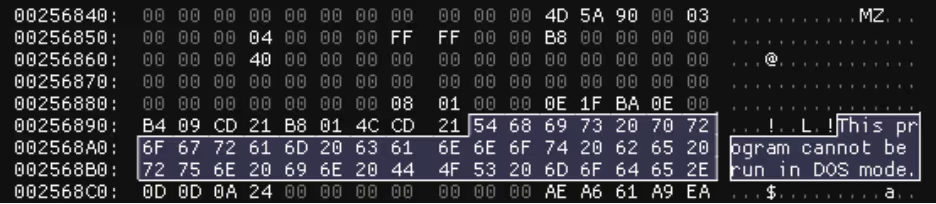
Embedded Windows PE32 executable
Figure 1: Embedded Windows PE32 executable

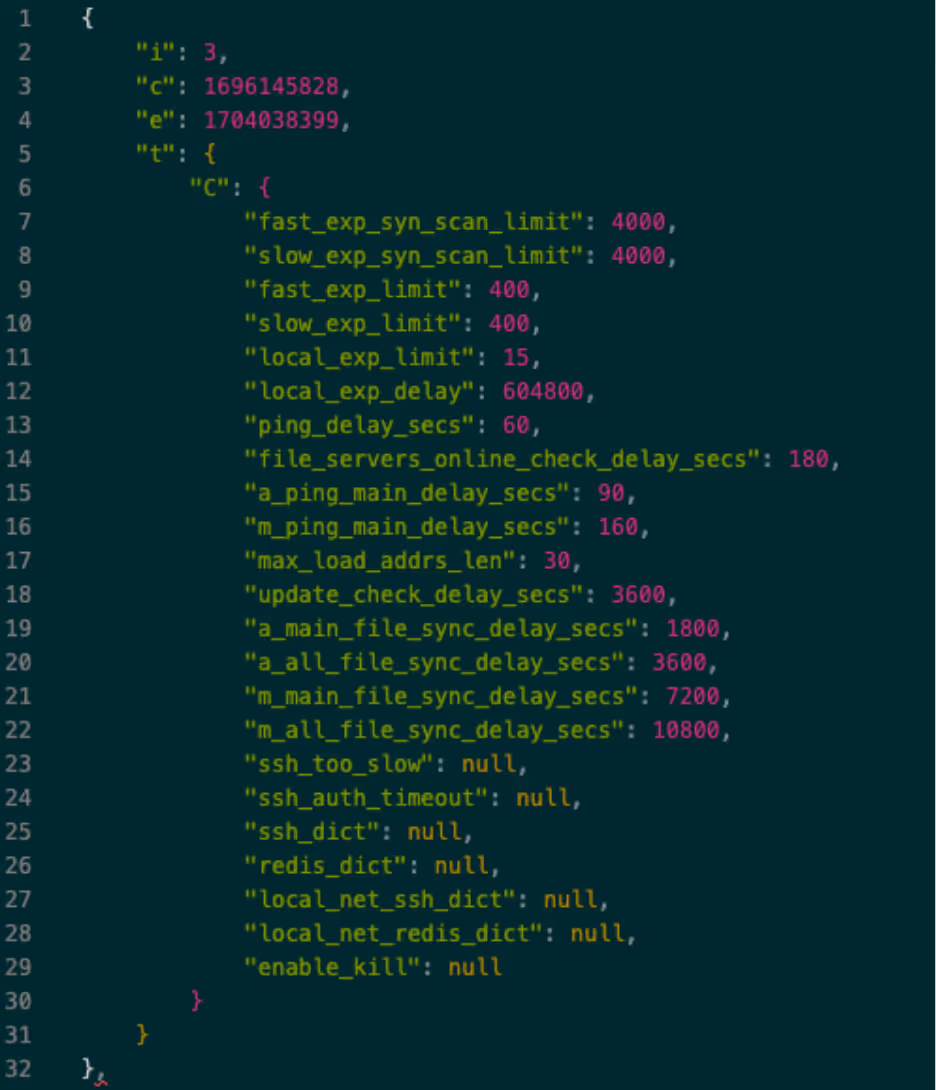
Further analysis of the host executable revealed a structure named “BotnetConf” with members consistent in naming with the original P2Pinfect samples. 
Example of a partially populated version of the BotnetConf struct 
Figure 2: Example of a partially populated version of the BotnetConf struct 

As the name suggests, this structure defines the configuration of the malware itself, whilst also storing the IP addresses of nodes identified during the SSH and Redis scans. This, in combination with the embedded ELF and DLL, along with the use of the Rust programming language allowed for positive attribution of this sample to the P2Pinfect family.

Updated evasion - consulting tracerpid

One of the more interesting aspects of the MIPS sample was the inclusion of a new evasion technique. Shortly after execution, the sample calls fork() to spawn a child process. 

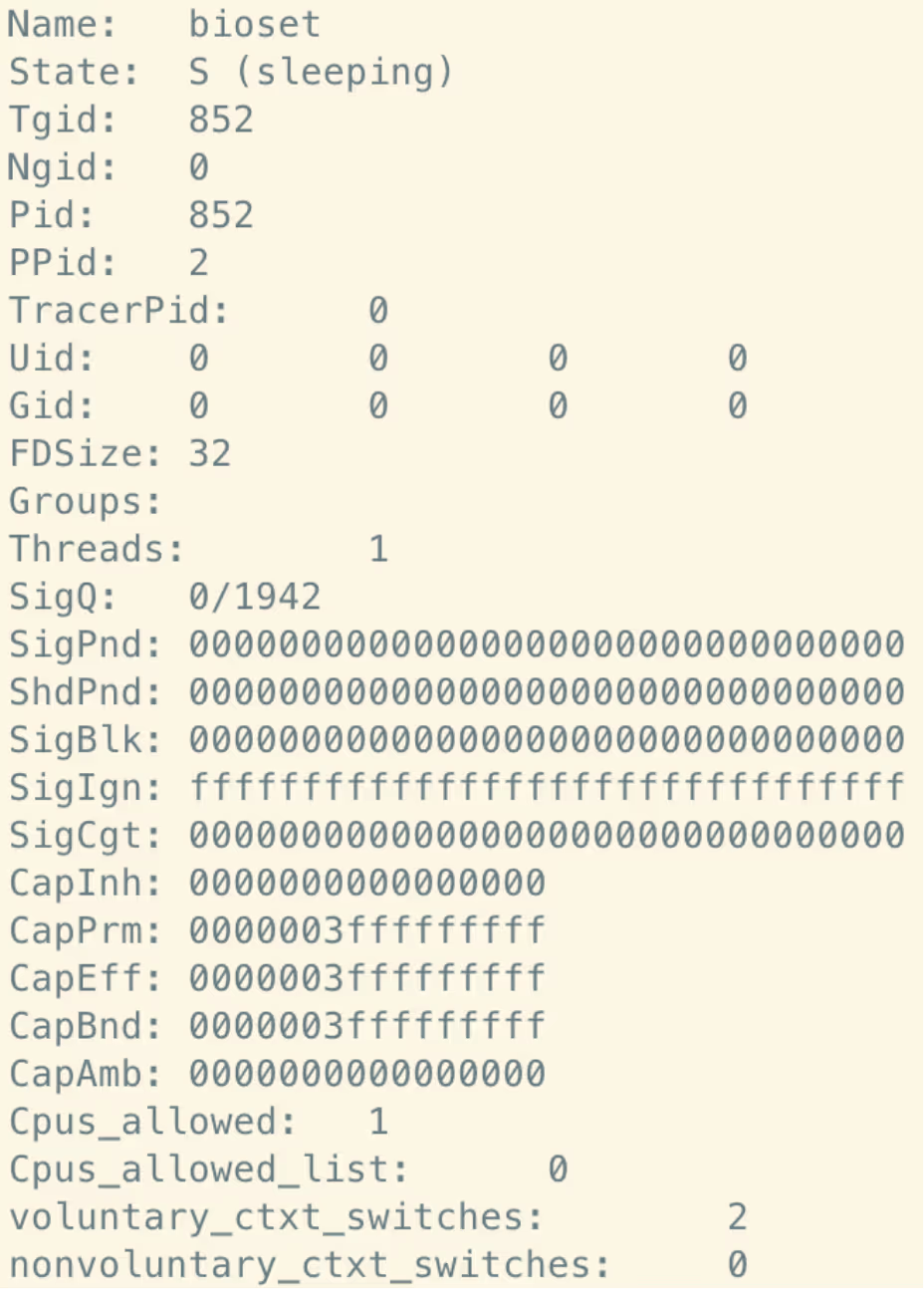
The child process then proceeds to access /proc using openat(), determines its own Process Identifier (PID) using the Linux getpid() syscall, and then uses this PID to consult the relevant /proc subdirectory and read the status file within that. Note that this is likely achieved in the source code by resolving the symbolic link at /proc/self/status.
Example contents of /proc/pid/status when process not being traced
Figure 3: Example contents of /proc/pid/status when process not being traced

/proc/<pid>/status contains human-readable metadata and other information about the process itself, including memory usage and the name of the command currently being run. Importantly, the status file also contains a field TracerPID:. This field is assigned a value of 0 if the current process is not being traced by dynamic analysis tools, such as strace and ltrace.
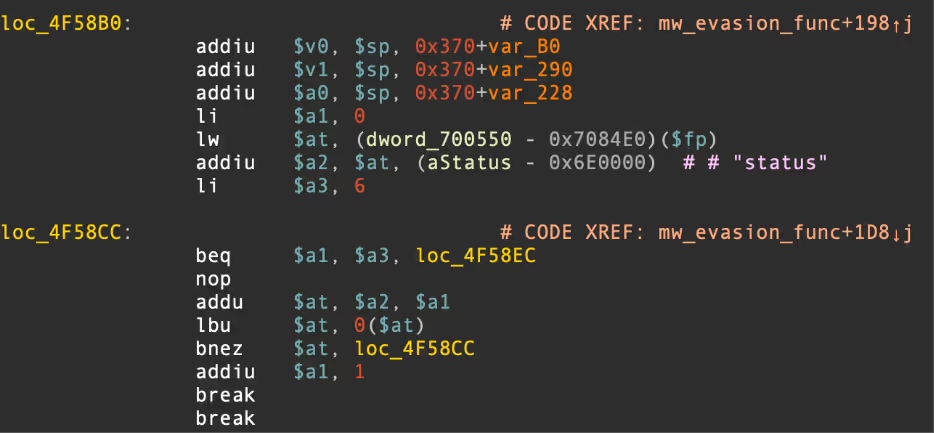
Example MIPS disassembly showing reading of /proc/pid/status file
Figure 4: Example MIPS disassembly showing reading of /proc/pid/status file

If this value is non-zero, the MIPS variant of P2Pinfect determines that it is being analyzed and will immediately terminate both the child process and its parent. 

read(5, "Name:\tmips_embedded_p\nUmask:\t002", 32) = 32 
read(5, "2\nState:\tR (running)\nTgid:\t975\nN", 32) = 32 
read(5, "gid:\t0\nPid:\t975\nPPid:\t1\nTracerPid:\t971\nUid:\t0\t0\t0\t0\nGid:\t0\t0\t0\t0", 64) = 64 
read(5, "\nFDSize:\t32\nGroups:\t0 \nNStgid:\t975\nNSpid:\t975\nNSpgid:\t975\nNSsid:\t975\nVmPeak:\t    3200 kB\nVmSize:\t    3192 kB\nVmLck:\t       0 kB\n", 128) = 128 
read(5, "VmPin:\t       0 kB\nVmHWM:\t    1564 kB\nVmRSS:\t    1560 kB\nRssAnon:\t      60 kB\nRssFile:\t    1500 kB\nRssShmem:\t       0 kB\nVmData:\t     108 kB\nVmStk:\t     132 kB\nVmExe:\t    2932 kB\nVmLib:\t       8 kB\nVmPTE:\t      16 kB\nVmSwap:\t       0 kB\nCoreDumping:\t0\nThre", 256) = 256 
mmap2(NULL, 4096, PROT_READ|PROT_WRITE, MAP_PRIVATE|MAP_ANONYMOUS, -1, 0) = 0x77ff1000 
read(5, "ads:\t1\nSigQ:\t0/1749\nSigPnd:\t00000000000000000000000000000000\nShdPnd:\t00000000000000000000000000000000\nSigBlk:\t00000000000000000000000000000000\nSigIgn:\t00000000000000000000000000001000\nSigCgt:\t00000000000000000000000000000600\nCapInh:\t0000000000000000\nCapPrm:\t0000003fffffffff\nCapEff:\t0000003fffffffff\nCapBnd:\t0000003fffffffff\nCapAmb:\t0000000000000000\nNoNewPrivs:\t0\nSeccomp:\t0\nSpeculation_Store_Bypass:\tunknown\nCpus_allowed:\t1\nCpus_allowed_list:\t0\nMems_allowed:\t1\nMems_allowed_list:\t0\nvoluntary_ctxt_switches:\t92\nn", 512) = 512 
mmap2(NULL, 8192, PROT_READ|PROT_WRITE, MAP_PRIVATE|MAP_ANONYMOUS, -1, 0) = 0x77fef000 
munmap(0x77ff1000, 4096)                = 0 
read(5, "onvoluntary_ctxt_switches:\t0\n", 1024) = 29 
read(5, "", 995)                        = 0 
close(5)                                = 0 
munmap(0x77fef000, 8192)                = 0 
sigaltstack({ss_sp=NULL, ss_flags=SS_DISABLE, ss_size=8192}, NULL) = 0 
munmap(0x77ff4000, 12288)               = 0 
exit_group(-101)                        = ? 
+++ exited with 155 +++ 

Strace output demonstrating TracerPid evasion technique

Updated evasion - disabling core dumps

Interestingly, the sample will also attempt to disable Linux core dumps. This is likely used as an anti-forensics procedure as the memory regions written to disk as part of the core dump can often contain internal information about the malware itself. In the case of P2Pinfect, this would likely include information such as IP addresses of connected peers and the populated BotnetConf structure mentioned previously. 

It is also possible that the sample prevents core dumps from being created to protect the availability of the MIPS device itself. Low-powered embedded devices are unlikely to have much local storage available and core dumps could quickly fill what little storage they do have, affecting performance of the device itself.
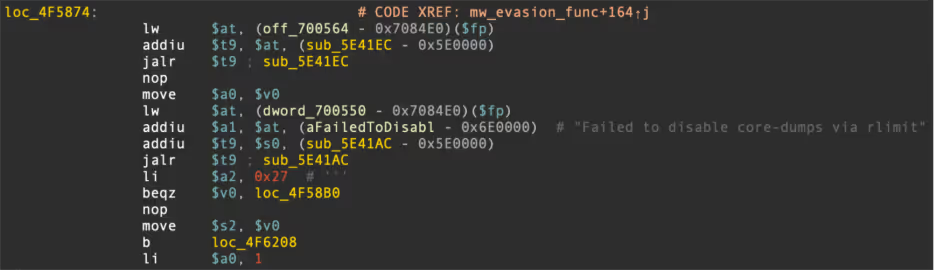
A screen shot of a computer codeAI-generated content may be incorrect.
Image 5

This procedure can be observed during dynamic analysis, with the binary utilising the prctl() syscall and passing the parameters PR_SET_DUMPABLE, SUID_DUMP_DISABLE.

munmap(0x77ff1000, 4096)                = 0 
prctl(PR_SET_DUMPABLE, SUID_DUMP_DISABLE) = 0 
prlimit64(0, RLIMIT_CORE, {rlim_cur=0, rlim_max=0}, NULL) = 0 

Example strace output demonstrating disabling of core dumps

Embedded DLL

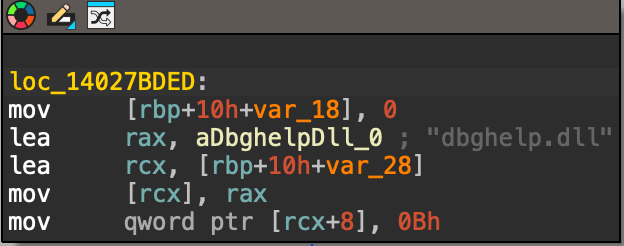
As mentioned in the Static Analysis section, the MIPS variant of P2Pinfect includes an embedded 64-bit Windows DLL. This DLL acts as a malicious loadable module for Redis, implementing the system.exec functionality to allow the running of shell commands on a compromised host.
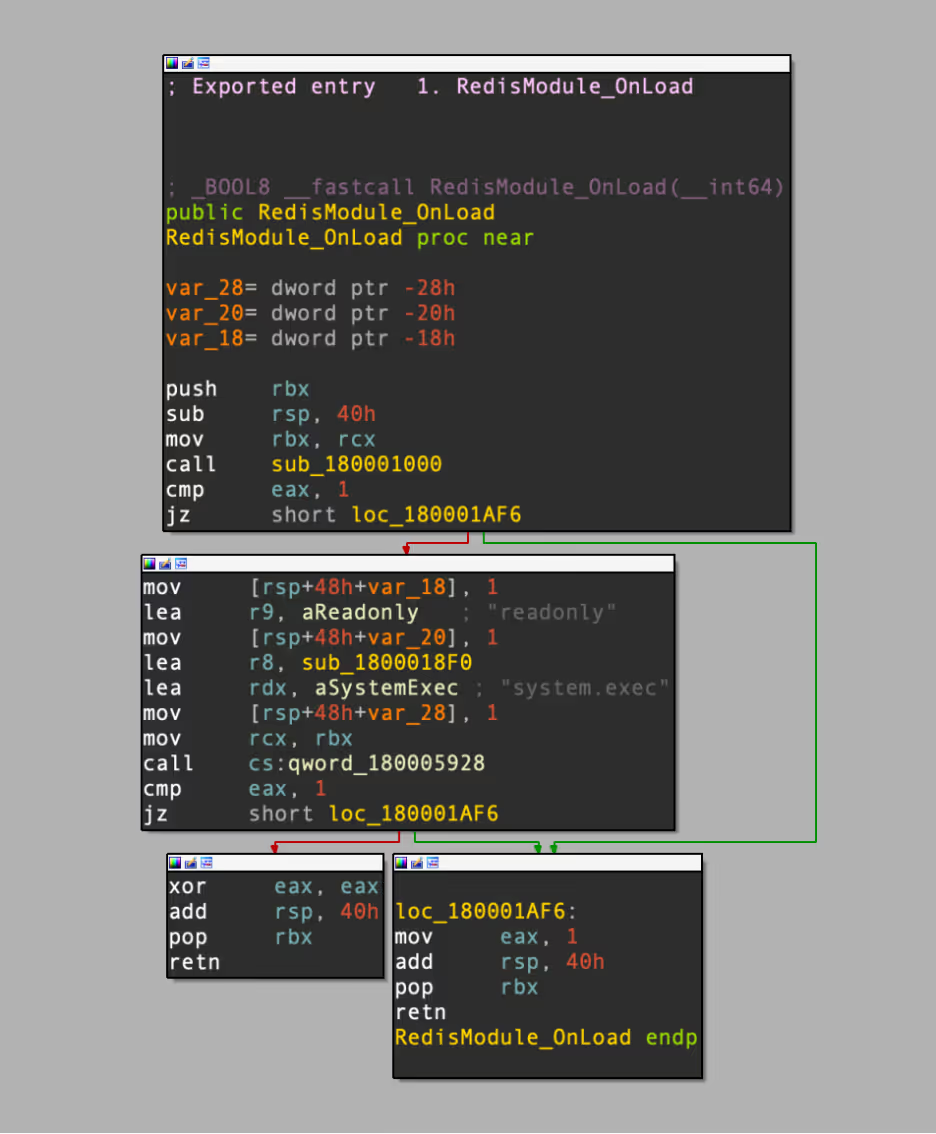
Disassembly of the Redis module entrypoint
Figure 6: Disassembly of the Redis module entrypoint, mapping the system.exec command to a handler

This is consistent with the previous examples of P2Pinfect, and demonstrates that the intention is to utilize MIPS devices for the Redis-specific initial access attack patterns mentioned throughout this blog. 

Interestingly, this embedded DLL also includes a Virtual Machine (VM) evasion function, demonstrating the lengths that the P2Pinfect developers have taken to hinder the analysis process. In the DLLs main function, a call can be observed to a function helpfully labelled anti_vm by IDAs Lumina feature.
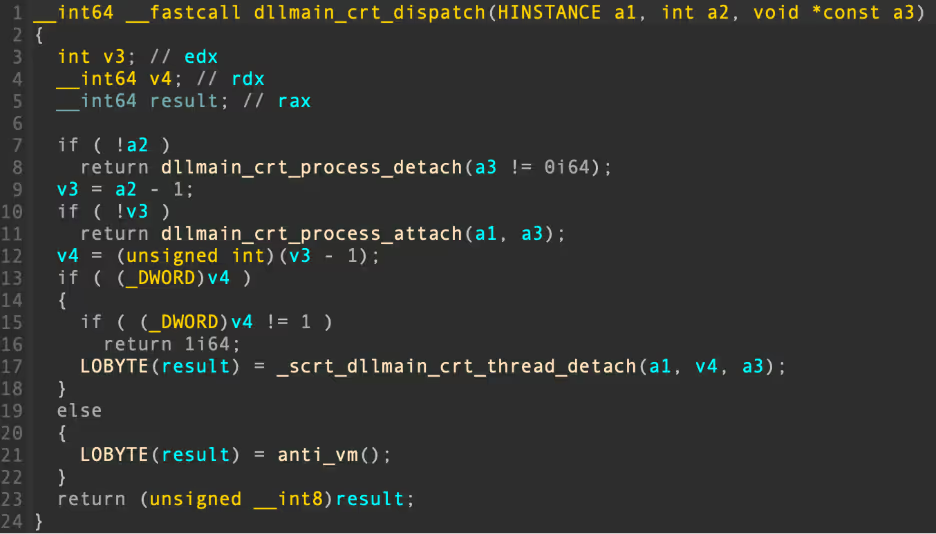
Decompiler output showing call to anti_vm function
Figure 7: Decompiler output showing call to anti_vm function

Viewing the function itself, it can be seen that researchers Christopher Gardner and Moritz Raabe have identified it as a known VM evasion method in other malware samples.
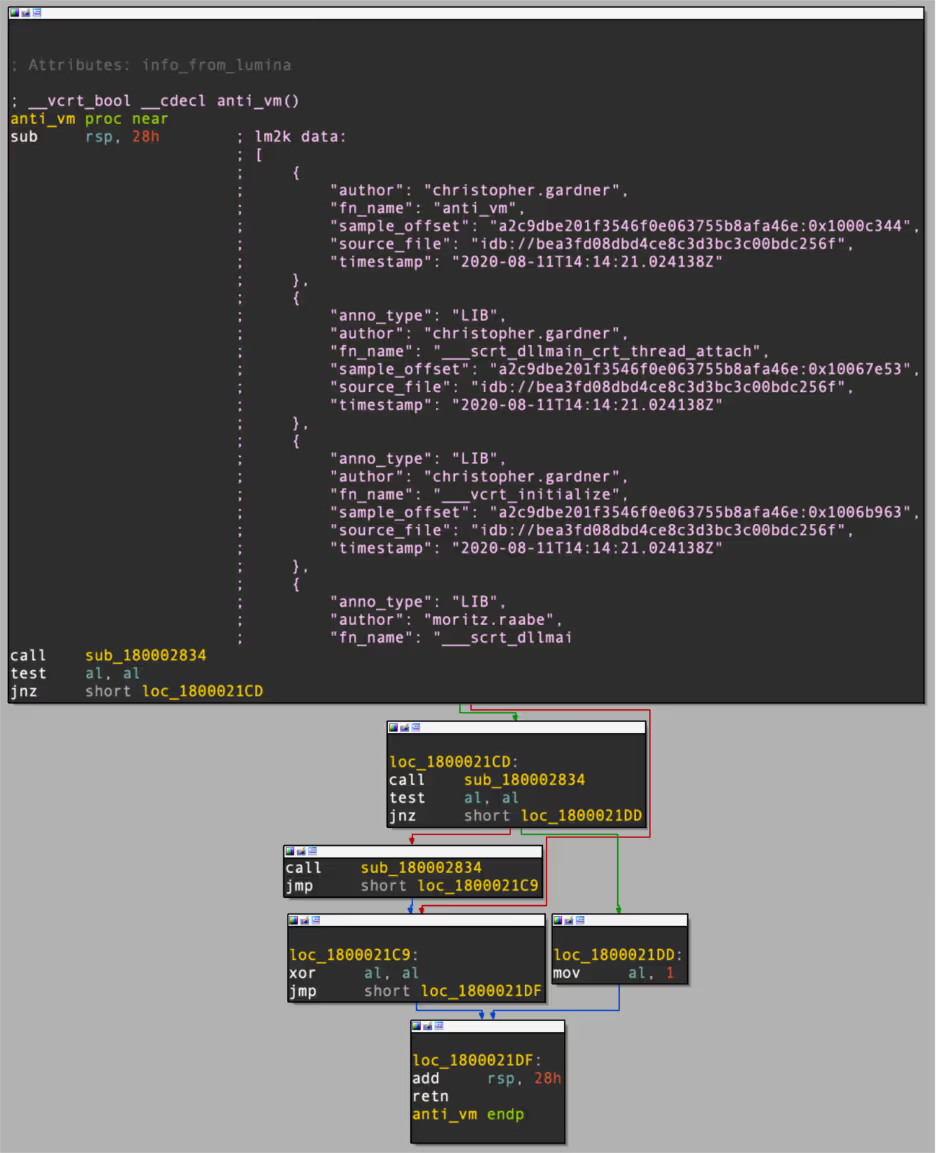
IDA’s graph view for the anti_vm function showing Lumina annotations
Figure 8: IDA’s graph view for the anti_vm function showing Lumina annotations

Conclusion

P2Pinfect’s continued evolution and broadened targeting appear to be the utilization of a variety of evasion techniques demonstrate an above-average level of sophistication when it comes to malware development. This is a botnet that will continue to grow until it’s properly utilized by its operators. 

While much of the functionality of the MIPS variant is consistent with the previous variants of this malware, the developer’s efforts in making both the host and embedded executables as evasive as possible show a continued commitment to complicating the analysis procedure. The use of anti-forensics measures such as the disabling of core dumps on Linux systems also supports this.

Indicators of compromise (IoCs)

Files SHA256

MIPS ELF 8b704d6334e59475a578d627ae4bcb9c1d6987635089790350c92eafc28f5a6c

Embedded DLL Redis Module  d75d2c560126080f138b9c78ac1038ff2e7147d156d1728541501bc801b6662f

References:

[1] https://nvd.nist.gov/vuln/detail/CVE-2022-0543

[2] https://unit42.paloaltonetworks.com/peer-to-peer-worm-p2pinfect/

[3] https://unit42.paloaltonetworks.com/mirai-variant-iz1h9/

[4] https://openwrt.org/packages/pkgdata/redis-server

Inside the SOC
Darktrace cyber analysts are world-class experts in threat intelligence, threat hunting and incident response, and provide 24/7 SOC support to thousands of Darktrace customers around the globe. Inside the SOC is exclusively authored by these experts, providing analysis of cyber incidents and threat trends, based on real-world experience in the field.
Written by
The Darktrace Community

More in this series

No items found.

Blog

/

/

May 27, 2026

How to Evaluate AI Vendors: 5 Key categories for AI Adoption

Default blog imageDefault blog image

Understanding the AI buyers’ market

AI adoption has become a central topic of discussion in boardrooms, drawing growing interest from business leaders. Ultimately, organizations hope that an investment in AI technology will have tremendous returns. However, the process of buying an AI solution is not as straight forward as it appears on the surface.  

While business leaders may be eager to improve productivity across their operations, practitioners responsible for evaluating and selecting AI solutions may not always have the visibility or technical understanding needed to make the right decisions for their business. What is typically marketed as a holistic solution to their most critical problems is usually followed by uncertainty when AI tools are finally operationalized in real environments.

This guide is intended to support security leaders who are under growing pressure to adopt AI tools while navigating complex terminology, vendor claims, and increasingly crowded buying cycles. Ultimately, the goal is to help organizations evaluate and adopt AI in a safe, effective, and well-governed way. To support this, we’ve structured the evaluation framework across five key categories:

  1. Governance, safety, and data controls
  1. Data gathering and training
  1. Model and technique choice
  1. Performance and accuracy validation    
  1. Interpretability, adjustability, and transparency    

What buying AI looks like in cybersecurity

While investing in AI can bring immense benefits to your security team, first-time buyers of AI cybersecurity solutions may not know where to start. They will have to determine the type of tool they want, know the options available, and evaluate vendors. Research and understanding are critical to ensure purchases are worth the investment.  

With acceleration in AI adoption, accompanied by the recent boom in agentic AI and autonomous agents, CISOs must look “beneath the hood" of these tools to understand how they work, how they are governed, and to ensure the system is secure and compliant with internal policies.

Challenges in the AI buyers’ marketplace  

The AI security software market is buzzing with hype and flashy promises, which, understandably, needs to be addressed with due diligence. Potential buyers, especially in the cybersecurity space, are hesitant when it comes to allowing AI autonomous capabilities across their workflows, and a lack of vendor transparency can exacerbate those feelings.  

Reinforcing this sentiment, research from this year's Darktrace’s State of AI Cybersecurity report shows where confidence and hesitancy emerge amongst potential buyers. On the one hand, security professionals agree that they have good visibility into the logic and reasoning processes their AI solutions use. However, they lack the explainability and trust to allow AI to take independent remedial action.

  • 89% say they have good visibility into the reasoning behind the outputs generated by AI solutions
  • 92% say they need to understand how a defensive AI tool makes decisions before they can trust it
  • Only 14% say they allow AI to act independently, performing autonomous actions without human approval
  • 74% say they are limiting the autonomy of AI taking action in their SOC until explainability improves

Given the desire for trust and explainability we are seeing from buyers, it's important for them to be equipped with the right questions to ask vendors during an assessment or POV of AI tools in order to demystify marketing hype from real operational outcomes.

Below is a list of categories in which buyers can assess AI vendors or AI Service Providers (AISPs) to help reach safe adoption and maximize their ROI.  

5 categories of AI vendor assessment

Darktrace groups these AI-related questions into 5 categories: governance, data and training, model and technique choice, performance validation, and interpretability and adjustability. By asking questions regarding each of these 5 categories, buyers can gain a deeper understanding of how an AISP’s systems work and whether they suit their business requirements.

Governance, safety, and data controls

Governance of AI systems is critical for all AISPs. Whether their platform is based around a single model, or is a more complex, composite AI solution, strong governance is essential to ensure the system is safe, robust, and reliable.

A simple question you could ask is:

What AI governance policies and frameworks do you follow, and/or certifications do you currently maintain?

For more questions you can ask vendors, download the full guide here.

Darktrace is certified to the ISO/IEC 42001 standard, the world’s first AI Management System (AIMS) standard. ISO/IEC 42001 addresses the unique ethical and technical challenges AI poses by setting out a structured way to manage risks such as transparency, accuracy, and misuse. This includes a commitment to ethical AI development, and effective management and monitoring of AI systems both prior to and continually after release.

Data gathering and training

Accurate, meaningful, and unbiased data gathering is the first important step in producing any AI system. An AI model trained using inaccurate, unbalanced, or poor-quality training data will fail to perform optimally.

To alleviate concerns regarding training data quality, a question you could ask is:

What steps do you take to prevent bias in your AI models and training data?

For more questions, download the full guide here.

AISPs should be able to provide information about the steps taken, workflows followed, and auditing performed to reduce AI bias where appropriate. While it’s sometimes impossible to fully remove bias from an AI model, appropriate actions should be taken to mitigate or reduce bias where relevant.

Model and technique choice

Different AI techniques are optimal for different tasks. For example, research from Gartner suggests that relying on a single “one-size-fits-all" model can lead to data gaps, especially in highly specialized domains.

To achieve more accurate and robust AI solutions, AI leaders should move beyond using just one model or technique, embrace composite AI practices, and adopt a holistic AI system perspective.

A straightforward question you could ask is simply:

What type(s) of AI model(s) do you utilize in your solution?

For more questions, download the full guide here.

While specific detailed information about custom systems used by AISPs is likely proprietary, buyers should expect vendors to be able to provide an overview of the broad techniques used. This will allow you as a buyer to determine if the type of model is appropriate for your use case.

Performance and accuracy validation  

Testing and evaluation of performance is essential for all AI systems. Performance analysis should be performed both before release and continually after release to identify potential data or model drift.  

A question you could ask to understand an AISPs testing workflow is:

How do you audit, test, evaluate, verify, and validate your AI model outputs?

For more questions, download the full guide here.

Testing workflows will likely vary depending on the type of model – measurements relevant to one system may not always be relevant to others. Assessment of systems should also extend beyond these standard accuracy and robustness tests, and should also feature physical performance, such as latency and resource consumption.  

Interpretability, adjustability, and transparency  

AI systems are typically a black box, simply providing an output without an explanation of how that output was attained. Interpretability and transparency are critical to ensure that both SOC teams and end-users trust the outputs of a system to be accurate and meaningful.

A question you could ask is:

How do you promote a trust relationship between human analysts and AI outputs?

For more questions, download the full guide here.

In the context of cybersecurity, trust and interpretability are even more essential. This is particularly relevant for generative AI-based systems (including most AI Agents), where the risk of hallucination can reduce trust in responses.

Cybersecurity systems often need to perform autonomous actions to block incoming threats – an email filtering system may hold potentially dangerous emails; a firewall may block malicious inbound connections. If SOC teams can’t trust these systems to perform accurately, these systems may be limited or disabled, critically reducing their defensive power.

Darktrace as an AI-native cybersecurity vendor

Darktrace has been building and applying AI in cybersecurity for over a decade, developing its capabilities alongside an increasingly complex and fast‑moving threat landscape. This experience has resulted in a mature, multi-layered approach to AI, which continuously learns the normal patterns of each organization to understand behavior, interpret context, and identify meaningful deviations — without relying on predefined rules or known attack signatures. Over time, this has enabled a proven behavioral understanding that helps uncover subtle signals of risk that may otherwise be missed.

With the backing of our ISO/IEC 42001 certification, stakeholders, customers, and partners can be confident that Darktrace is responsibly, ethically, and safely developing its AI systems, and managing the use of AI in day-to-day operations in a compliant and secure manner.  

Explore the principles behind Darktrace’s responsible AI approach, informed by collaboration with global experts in academia and governments, detailing how accountability, explainability, and continuous validation are built into its cybersecurity technology.

How Darktrace secures AI systems

Darktrace now brings these capabilities to monitor and respond to risk generated from AI systems across organizations with Darktrace / SECURE AI. This solution analyzes how prompts, agents, and systems are used within the context of each organization, bringing every AI interaction into a single view. This unique approach helps teams understand intent, assess risk, protect sensitive data, and enforce policy across both human and AI agent activity.

Stay up to date

Sign up for the Secure AI Readiness Program here: This gives you exclusive access to the latest news on the latest AI threats, updates on emerging approaches shaping AI security, and insights into the latest innovations, including Darktrace’s ongoing work in this area.

Ready to talk with a Darktrace expert on securing AI? Register here to receive practical guidance on the AI risks that matter most to your business, paired with clarity on where to focus first across governance, visibility, risk reduction, and long-term readiness.  

Further Reading on AI in cybersecurity

When deciding to invest in an AI solution, it’s important to understand what this means for you and your organization. The questions presented here are only a starting point in understanding an AI solution and whether it is appropriate for your use case.  

Gain deeper knowledge on applications of AI in cybersecurity and Darktrace’s multi-layered AI in the AI Arsenal White Paper.

[related-resource]

Continue reading
About the author
Jamie Bali
Technical Author (AI) Developer

Blog

/

Email

/

May 26, 2026

Journey of a Threat: How Multi-Layered AI Works in Darktrace / EMAIL

Man at a computerDefault blog imageDefault blog image

Darktrace / EMAIL is an implementation of the Darktrace methodology – a multi-layered AI system built into a single product. As with other Darktrace products, Darktrace / EMAIL learns the expected behaviours of an organization and its employees to identify novel threats and anomalous activity.

The diagram below represents the architecture of Darktrace / EMAIL’s multi-layered AI: a structured visualization of how intelligence is built, step by step, from raw data to actionable insight. Each layer plays a distinct role, feeding into the next: collecting data, understanding behaviour, analysing intent, making decisions, and presenting clear outcomes.

It all starts with an email

In this blog, we’ll follow a malicious email as it passes through the Darktrace / EMAIL system, showing exactly what happens as it travels through each layer of the pyramid, from basic data extraction to AI-powered metric creation, and finally deciding on any autonomous actions.

Let’s take this example email. As an end-user, you can see that this is an obvious extortion attempt where an adversary is threatening legal action if money isn’t paid within 24 hours, but how does Darktrace figure that out?

Part 1: Data Gathering

Processing of an email begins on point-of-transit for all inbound, outbound, or lateral emails. The first step is to extract information directly. This includes taking information from the headers (such as sending and receiving addresses, sender IP address, routing, and authentication protocols), as well as extraction of raw HTML and CSS data from the email itself.

This directly extracted information only allows for immediate surface level analysis, such as identifying signature-based attacks (known malicious addresses / domains), but is insufficient for identifying novel threats, complex attacks, or potential email or vendor compromise. This is where Darktrace’s AI analysis shines.

In this example, the SPF, DKIM, and DMARC authentication all passed successfully, showing that even malicious emails can still bypass these signature-based checks. Even with this success, Darktrace will continue to analyse the email.

Diving deeper into the technical information, we can see further information extracted from the headers, including aggregations from the header information, historical calculations such as the frequency and volume of emails to and from a particular domain, and much more.

Part 2: Social Graphing

Social Graphing involves the analysis of sending and receiving behaviours of different mailboxes to create peer-groups. Mailboxes who often send and receive to and from the same mailboxes, or exhibit other correlated behaviours, will be clustered together using a collection of unsupervised AI clustering systems. These groups may represent uses in the same teams who perform similar activity, groups of external facing mailboxes which often receive unsolicited emails, or groups of VIP users (such as C-suite or executives).

Social graphing is an essential component of Darktrace’s pattern of life analysis. This clustering allows Darktrace to understand the responsibilities of individuals – for example, behaviours which are anomalous for one group of users may be completely expected of another group.

In our example, the email was sent to 3 different users within the organization. As part of the social graphing, an “Association Anomaly” is calculated which indicates the likelihood that these users would receive emails from this user or domain, based on historical patterns.

Part 3: Metric Calculation

Metrics are calculated for every email, representing more complex characteristics of an email which can’t be directly extracted. Darktrace / EMAIL features over 1000 unique metrics, calculated both algorithmically and using an ensemble of AI systems.

Algorithmically calculated (non-AI) metrics include further historical calculations, and counts of features such as code blocks, and hidden text, to name a few.

AI-driven metrics include Inducement Classification which uses Natural Language Processing to identify potential phishing, solicitation, or extortion attempts; Named Entity Recognition to identify PII and other sensitive data within an email to support Data Loss Prevention; and many more.

We can follow our example email through this process and view the outcome of these metric calculations. Looking at the language metrics for this email, we can see that our email has reported a high extortion inducement, along with identification of banking information and language indicating urgency.

Part 4: Evaluation and Combination Engine (models)

Once all metrics have been calculated for an email, it gets sent to an evaluation and combination engine where the metrics are compared against blocks of logic to determine if an email contains a threat. One key model which alerted for this example message was a model to tag and block extortion attempts.

Since our example email has a high inducement score for extortion, along the presence of a bitcoin wallet address in the message, this model alerts. When a model in the engine is activated, actions are taken – in this case adding a tag to the email to flag it as extortion in the console and hold the email to prevent it from reaching the end-user mailbox.

Part 5: Meta-Modelling and Actions

Once the models have been run, the actions are taken against the email. If the email hasn’t been blocked or held, this is the point where it will reach the end-user's mailbox.

In the Darktrace / EMAIL UI, all actions models which alerted for an email and actions taken as a result can be seen. At the top of this page, you can see the alert indicating an extortion attempt along with the action to hold the message.

Alongside this, a meta-classifier is used to calculate an overall anomaly score for each email, based on how much the email differs from the pattern of life for the user. The score of the email is boosted by any actions that have taken place.

Part 6: Campaign Clustering

All emails are passed through the Darktrace / EMAIL campaign clustering system. This system creates clusters based on related features within the emails to identify groups of emails with the same sender or intent.

In our case, the email was identified as part of a campaign, alongside other emails which were also identified as extortion attempts against a small group of recipients.

Email campaigns may have additional actions applied to them if the campaign is deemed malicious, and in this case, you can see that the autonomous response was to hold all emails in the campaign. This means that if an email manages to avoid being blocked in the evaluation and combination engine but gets identified as part of the campaign, the hold action will be applied to it retroactively.

Part 7: Cyber AI Analyst

Darktrace’s Cyber AI Analyst presents key information and anomaly indicators for each email, such as further information about authentication, specific metrics, or other identified anomalies and mismatches.

Cyber AI Analyst can also utilize data from Darktrace / EMAIL to enhance its investigation of incidents from other Darktrace products, correlating relevant information to build a fuller picture. More information about the Cyber AI Analyst is available in the Darktrace AI Arsenal.

Part 8: Data Presentation (UI)

Once all processing has taken place against the email, it is presented in the Darktrace / EMAIL UI. Here, members of the SOC team can investigate incidents and anomalies, interact with malicious emails to see why they were blocked, and much more.

Our email stands out here with its 100 anomaly score. Every email which passes through a Darktrace / EMAIL will undergo the same thorough and rigorous analysis to identify potential risks, apply autonomous actions where required, and will ultimately be assigned a score to be displayed here. By providing a single overall score in the UI, rather than presenting emails in full, Darktrace / EMAIL allows SOC teams to more easily identify which emails are most important to investigate, increasing efficiency and reducing alert fatigue.

Take the next step

Many email security tools on the market that claim to be AI-driven are in fact bolting AI onto attack-centric approaches, which rely on automating the identification of known threats. These approaches struggle, and will continue to struggle, with adapting to novel, AI-generated threats.

By analyzing every email within its deeply integrated, multi-layered AI system, Darktrace / EMAIL is able to identify the subtle threats that others miss. This depth not only improves detection accuracy, but enables confident, autonomous action, giving security teams clearer insight into AI outcomes and greater control while supporting users.

For a full deep dive into each stage of the AI system, check out the white paper: A Guide to the Multi-Layered AI in Darktrace / EMAIL

Learn more about securing AI in your enterprise.

[related-resource]

Continue reading
About the author
Jamie Bali
Technical Author (AI) Developer
Your data. Our AI.
Elevate your network security with Darktrace AI