

Blog
/
/
July 13, 2026

Security After Signatures: Operating in a World of Pre‑CVE Disclosure Exploitation, Collapsed Trust Boundaries, and Autonomous Systems

As AI reshapes the threat landscape, attackers exploit vulnerabilities faster, abuse trusted identities, and leverage AI-driven tools and integrations to operate at scale. Drawing on real-world Darktrace observations, this article explores why behavioral detection, continuous trust validation, and early anomaly identification are becoming essential to defending modern enterprises.
Inside the SOC
Darktrace cyber analysts are world-class experts in threat intelligence, threat hunting and incident response, and provide 24/7 SOC support to thousands of Darktrace customers around the globe. Inside the SOC is exclusively authored by these experts, providing analysis of cyber incidents and threat trends, based on real-world experience in the field.
Written by
Nathaniel Jones
VP, Security & AI Strategy, Field CISO
Default blog image
13
Jul 2026

Three shifts have reshaped what it means to defend an enterprise securely.  

First, exploitation often begins before defenders have a Common Vulnerabilities and Exposures (CVE) identifier, a security advisory, or an entry in the Cybersecurity and Infrastructure Security Agency's (CISA) Known Exploited Vulnerabilities (KEV) catalog.

Secondly, the trust boundary has moved beyond the network edge into identities, tokens, APIs, and Software-as-a-Service (SaaS) workflows.  

Third, an increasing share of business activity is executed through automation, integrations, and AI agent-like systems that can act faster than teams can verify intent.  

If your security model still relies on detecting known bad artefacts, triaging isolated alerts, and waiting for confirmation before acting, you are already behind the threat.  

This is not a failure of security teams; it’s a failure of the operating model to keep pace with how the environment has changed.

A SOC built around alerts and signatures assumes that malicious activity will eventually surface as an event. In real incidents, however, the decisive evidence is rarely a single event. Instead, it is a chain of individually explainable actions that only appears malicious once you connect the dots across identity, non-human identity, cloud, email, SaaS, operational technology (OT), and network telemetry.

The defenders succeeding today observe behaviors, link them into sequences, understand what those sequences mean, and contain impact before the full story unfolds. That is the operating model the current threat environment demands.  

Exploitation before disclosure

The first shift is the straightforward: the time to exploit has dropped to nearly zero.  

In one example, Darktrace observed a sequence of subtle but strategically significant anomalies within a customer environment that later aligned with exploitation of CVE‑2025‑0994 in Trimble Cityworks by likely Chinese-nexus threat actors. Behavioral indicators were visible at least 18 days before public disclosure, with related anomalies emerging 40 to 50 days earlier during the intrusion window.  

This case illustrates a familiar pattern: clusters of weak‑signal anomalies combing to form an actionable picture of intrusion long before a CVE is published. Such activity reflects long‑horizon, option‑preserving operator models often associated with mature state‑linked activity.  
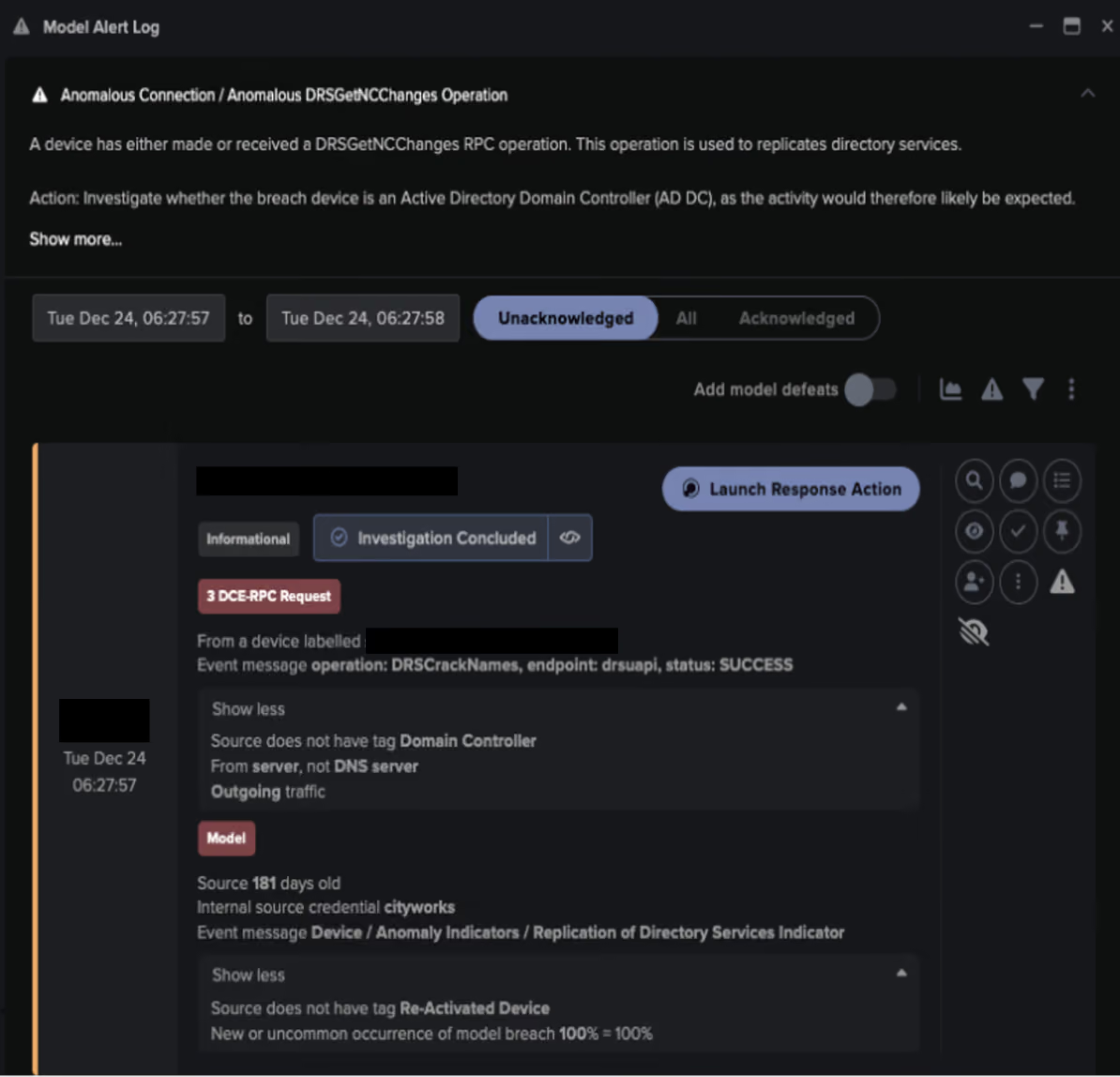
Figure 1: Darktrace’s detection of malicious exploitation of CVE 2025-0994, later tied to Chinese-nexus threat actors targeting critical national infrastructure (CNI) in the US, weeks before public disclosure.

Throughout 2025 and 2026, Darktrace has continued to observe the value of anomaly-based detections across a range of incidents.

CVE CVE Public Disclosure Date Darktrace Detection Date Days Between Detection of Exploitation and CVE Public Disclosure
CVE 2025 0994
(Trimble City Works)
2025-02-06 2025-01-19 18 Days
CVE 2025-24183
(Apache)
2025-03-10 2025-02-18 20 days
CVE 2025-10035
(Fortra GoAnywhere)
2025-09-18 2025-09-11 7 days

Identity is the real control plane

The second shift is that identity has replaced perimeter as the primary control plane. As Darktrace’s Annual Threat Report 2026 illustrated, identity remains the main challenge in defending against modern intrusions. A clear example is the Adversary-in-the-Middle (AiTM) case published by Darktrace in December 2025. A phishing email led to the compromise of an Office 365 account. Session hijacking bypassed multi-factor authentication (MFA), and the compromised account was used for follow-on phishing and persistence activities including the creation of malicious email rules.  

Every step in that sequence mattered. A successful login alone does not prove legitimacy. An inbox rule, on its own, may not appear catastrophic. Mail activity, viewed in isolation, may seem operationally normal. But the behavioral chain tells a different story: credential theft, token abuse, persistence, and onward compromise through a trusted identity.  

This is why the question is no longer “Did the user authenticate successfully”. The more important question is, “Does this identity action make sense right now, in this context, given what came before it?” The AiTM case shows how identity can be compromised. In practice, however, attacks rarely remained confined to identity alone.  

In another Darktrace case, a compromised SaaS account triggered activity across the email, SaaS, and network layers, including inbox rule changes, phishing propagation, and connections to suspicious infrastructure. Viewed in isolation, none of these events were decisive. Together, however,  they formed a behavioral sequence that revealed the intrusion, with the full attack story automatically correlated and surfaced to defenders by Darktrace’s Cyber AI Analyst.  
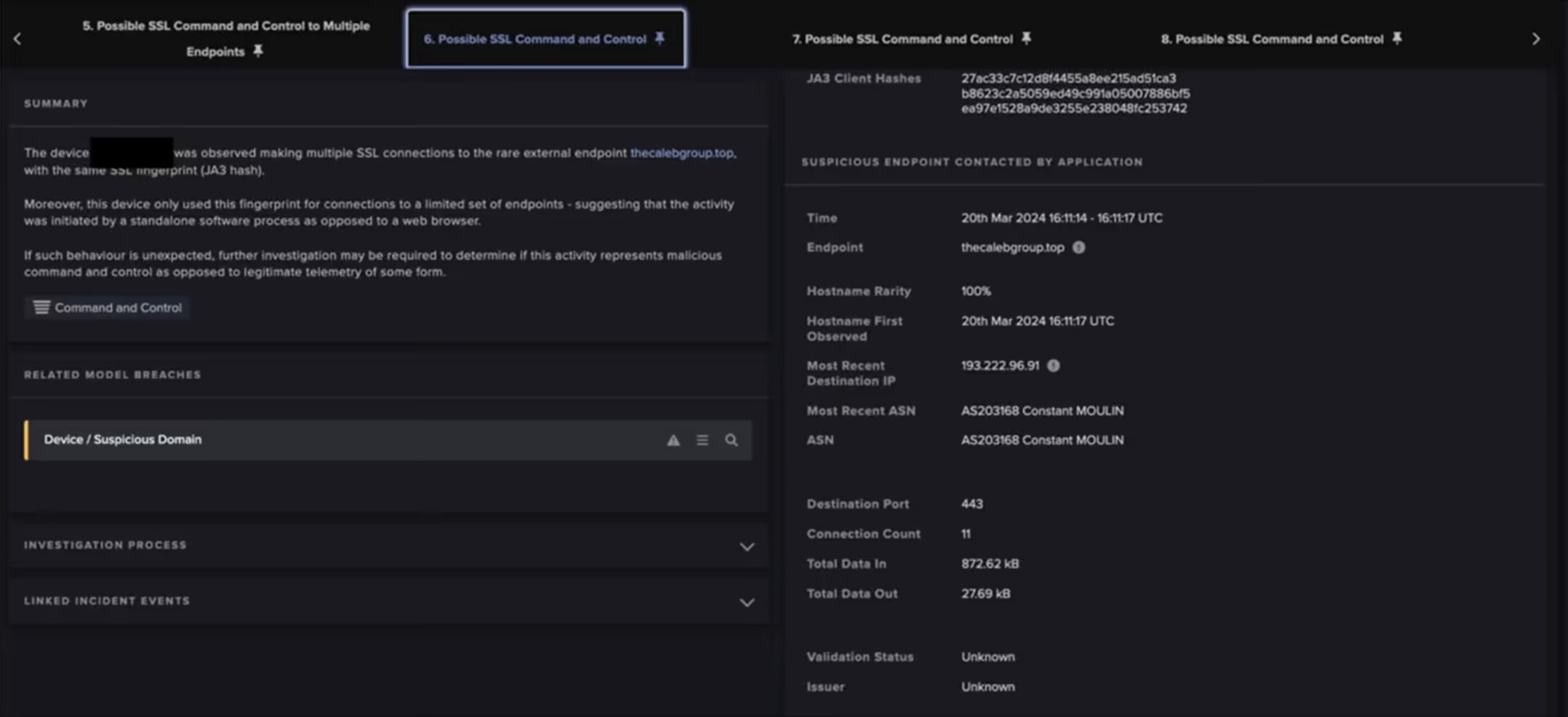
Figure 2: Cyber AI Analyst correlated and appended additional events to the incident, including other users who connected to the suspicious redirect link after outbound phishing emails were sent.

AI accelerates the threat  

The third shift is the one many teams still underestimate: trusted tooling, integrations, and AI agent-like systems can create actions that appear legitimate but are strategically dangerous.  

The shift becomes clearer when examining how governments are now framing AI risk. In 2026, guidance published by CISA, UK’s National Cyber Security Centre (NCSC) and Five Eyes partners warned that agentic systems expand attack surfaces, accumulate privilege, and can behave in ways that are difficult to predict or explain [1]. The advice is simple: assume unexpected behavior and design controls around it.  

The real risk is not AI usage. It is unknown autonomy: systems with credentials, data access, and action paths that can execute workflow steps without sufficient behavioral validation, traceability, or human oversight. Darktrace’s Model Context Protocol (MCP) risk analysis provides a useful framework for understanding this challenge. Over-privileged agents, content injection, and tool abuse become high-consequence risks when connected systems can dynamically retrieve data, execute actions, and communicate externally.  

Whether security teams like it or not, AI is already in the enterprise. It will help drive innovation, but it will also be abused, whether accidentally or maliciously. In each of the cases below, AI either scaled the attacker, built the tooling, or existed within the environment as something to exploit or misuse.

1. AI as an Attack Multiplier

In one campaign targeting Mexican government entities, a single operator used commercial AI platforms to generate exploits, automate reconnaissance, and process large volumes of data, compressing work that would traditionally have required an entire team into a single workflow [2].  

Darktrace is also observing this trend further down the stack. In one case, Darktrace identified AI-generated malware exploiting React2Shell, where an attacker used a Large Language Model (LLM) to produce working exploit code and deploy it at scale.  

[darktrace.com], [darktrace.com]

2. AI as an Attack Surface

Attempted AI exploitation is now appearing within customer environments. In one case involving an automation technology manufacturer, a compromised LLM proxy was seemingly used as a stepping stone to access additional AI services. When that attempt failed, the attacker pivoted to cryptomining.

What is clear is that the AI layer has already become an asset worth probing, exploiting, and pivoting through. It is also clear that defenders benefit from rapidly understanding how these activities connect. In this case, Cyber AI Analyst automatically pieced together the intrusion, while Darktrace’s Managed Threat Detection service alerted to the customer, enabling the activity to be contained before it could progress further.
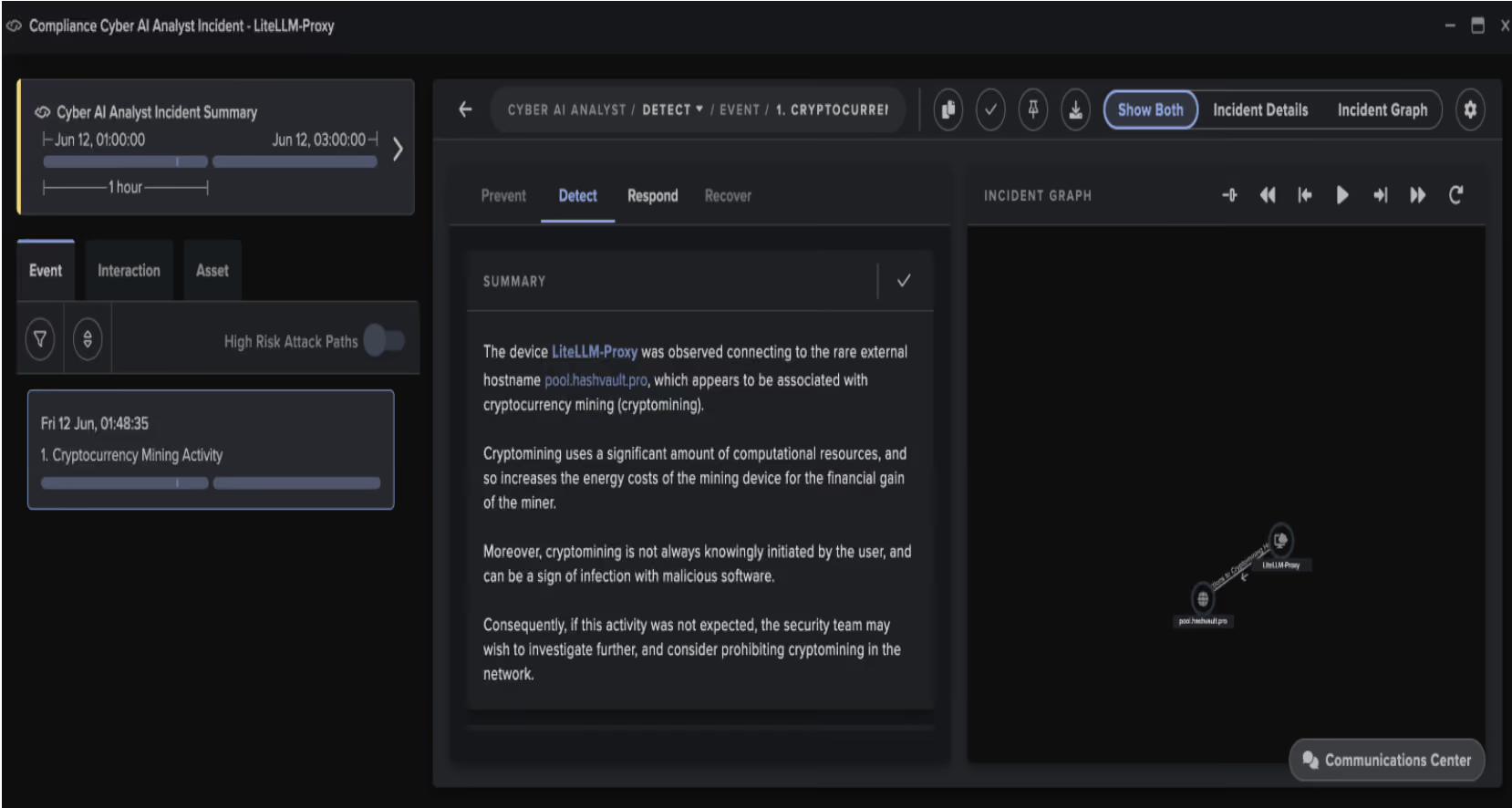
Figure 3: Cyber AI Analyst's investigation into a compromised LLM proxy that was abused for cryptomining activity.

AI as a trusted but dangerous actor

This does not require a cinematic vision of “rogue AI.” The Salesloft incident provides a more grounded example, where AI and automation operate with legitimate access but served malicious intent. In that case, attackers abused compromised OAuth tokens associated with the Drift AI chat agent to export significant volumes of data from Salesforce environments.  

The activity resembled legitimate API usage and relied on trusted SaaS integrations rather than malware or other obvious signs of intrusion. That is precisely the challenge. Traditional security controls are good at detecting forced entry, but far less effective when a trusted application integration behaves in a way that is technically permitted yet operationally harmful.  

In these scenarios, the security challenge shifts from validating access to validating behavior.

This is what that looks like in practice: AI-linked identities executing legitimate actions that require behavioral validation rather than access validation.
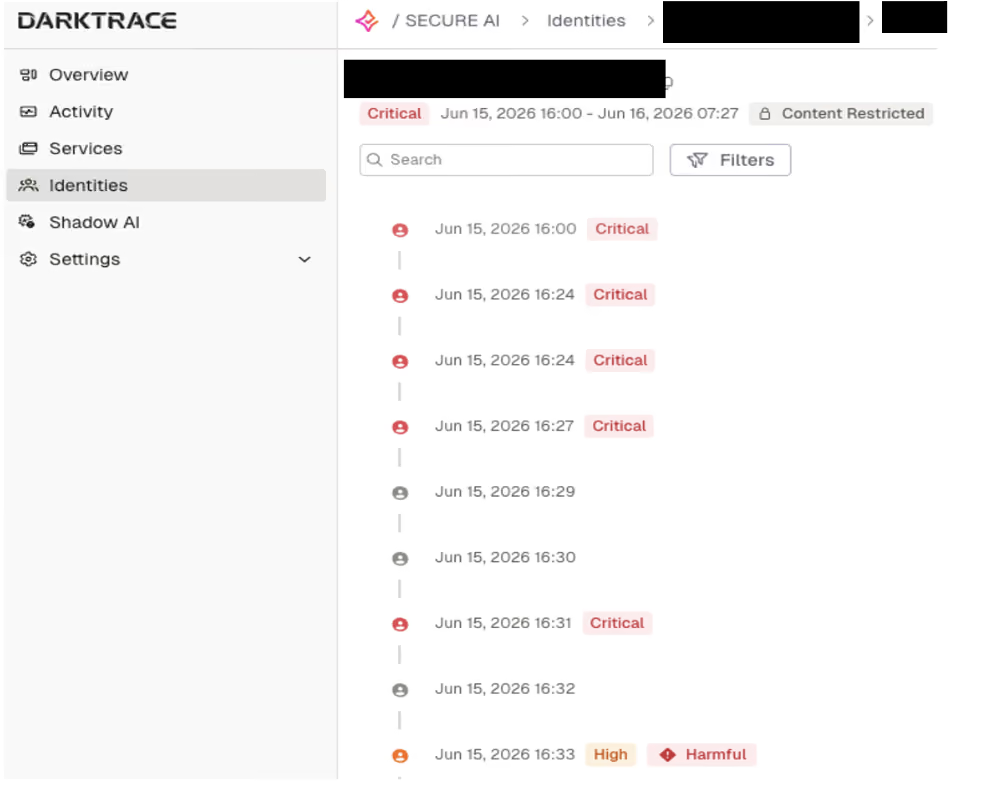
Figure 4: Darktrace / SECURE AI highlights anomalous activity across AI identities, surfacing critical behavior that requires validation and containment.

Early observations from Darktrace / SECURE AI deployments reinforce this reality. Across Darktrace's observed fleet, AI service connections per deployment increased 13% during the first half of 2026, reaching over 16 million connections overall. The typical organisation now interacts with seven different AI providers, evidence that AI is no longer operating at the edges of the enterprise. It is increasingly woven into day-to-day business activity.

The most common risks are not compromised models or advanced AI attacks. Instead, they stem from employees and business functions exposing sensitive information through entirely legitimate-looking interactions. Darktrace has observed repeated submission of personally identifiable information (PII), tax information, identification documents, and medical data into LLM prompts, alongside widespread use of unsanctioned (shadow) AI services and growing AI activity from mobile devices.  

For defenders, the challenge is increasingly one of context: understanding when legitimate business use crosses into material risk, while preserving privacy and user trust.

Conclusion

Across all three shifts, the pattern is the same: behavior precedes understanding. Security teams are not losing because adversaries have become invisible. An increasingly outdated security model assumes that malicious activity will reveal itself cleanly and early. It no longer does.  

In 2026 and beyond, defenders win by understanding behavioral sequences, continuously validating trust, and acting before certainty becomes hindsight. That is security after signatures. That is security in the AI era.

Credit to: Daniel Levy, Threat Hunting Data Scientist

Edited by: Ryan Traill, Content Manager

References

[1] https://www.cyber.gov.au/business-government/secure-design/artificial-intelligence/careful-adoption-of-agentic-ai-services  

[2]https://www.latimes.com/business/story/2026-02-26/hacker-used-anthropics-claude-ai-to-steal-mexican-government-data

Inside the SOC
Darktrace cyber analysts are world-class experts in threat intelligence, threat hunting and incident response, and provide 24/7 SOC support to thousands of Darktrace customers around the globe. Inside the SOC is exclusively authored by these experts, providing analysis of cyber incidents and threat trends, based on real-world experience in the field.
Written by
Nathaniel Jones
VP, Security & AI Strategy, Field CISO

More in this series

No items found.

Blog

/

/

July 31, 2026

Building Operational Resilience Across Mission-Critical Marine Services

Default blog imageDefault blog image

Mission-Critical Marine Services

This marine organization supports offshore energy production, export infrastructure, and regional logistics, delivering critical services through its diverse fleet and a regional shorebase footprint. To power rapid mobilization and 24/7 operational readiness, the organization has embraced cloud adoption and digital transformation, reshaping how crews, contractors, and shore-based teams access services.

While technology modernization has enhanced operations, it has also introduced new security complexities.

  • From perimeter to identity: As access becomes more distributed, identity has become the primary security control, elevating the risk of credential compromise and privilege misuse.
  • From confidentiality to availability and resilience: As cloud platforms increasingly underpin fleet and operational systems, cyber incidents can disrupt services and safety.
  • From isolated tools to unified visibility:  Because Information Technology (IT) and Operational Technology (OT) often intersect, and legacy systems coexist with modern cloud platforms, fragmented monitoring makes it harder to understand risk and respond decisively across domains.
“Our cybersecurity priorities expanded along with our business goals, placing availability and resilience at the forefront. The impact of a potential threat became an operational risk, which elevated cybersecurity from an IT issue to an operational safety and resilience enabler.” - Information and Communications Technology (ICT) Manager.

A Unified, AI-Driven Platform for IT and OT

To strengthen visibility, detection, and response across its highly distributed environment, the customer adopted the Darktrace ActiveAI Security Platform™ in 2022.

Darktrace’s contextual detection capability was a key driver. Unlike traditional tools that rely on known threat signatures, Darktrace’s Self-Learning AI learns “normal” behavior to identify emerging threats and correlate visibility across the customer's siloed on-premises and cloud domains.

Today, the customer relies on:

  • Darktrace / EMAIL™ to reduce phishing risk and minimize disruption from legacy mail controls and false positives
  • Darktrace / IDENTITY™ to support identity-centric security as cloud access expands across vessels and shore-based operations
  • Darktrace / NETWORK™ to strengthen oversight across the broader environment, including operational contexts where IT and OT intersect
  • Darktrace / CLOUD™ (Azure), added in 2024, to extend detection and response into Azure and support cloud transformation without treating cloud as a separate security silo
  • Darktrace / Incident Readiness & Recovery to strengthen incident readiness and recovery planning
  • Darktrace Managed Detection and Response Services to provide 24/7/365 monitoring and support

This combination supports a single operating model for the customer: security that can adapt as the environment changes while remaining practical for a lean team responsible for safeguarding both business operations and safety-critical services.

Extending cloud protection without complexity

As the customer accelerated cloud adoption, it expanded coverage in 2024 with Darktrace / CLOUD for Azure to bring cloud workloads under the same AI-driven visibility and response model – without adding operational burden. “This matters in hybrid environments because attacks rarely stay in one place,” explains the ICT Manager. “A compromised identity can trigger activity in the cloud, which can open pathways back into on-premises systems.”

In parallel, Darktrace / CLOUD’s posture management capabilities support governance and audit readiness by surfacing misconfigurations and exposure risks earlier, before they become incidents.

A Stronger, Faster, More Resilient Business

Since adopting Darktrace, the customer has strengthened cyber resilience while reducing operational burden on its small ICT team.

Darktrace continuously analyzes millions of individual events that can contribute to a wider incident. Within a single month, the solution autonomously investigated 88% of all potential threats, taking appropriate action within just 39.4 seconds on average.

Autonomous capabilities ensure threats are stopped and contained until the ICT team can investigate. In one standout instance, Darktrace autonomously blocked malicious links during a mass phishing/spam event before other controls flagged the threat. the ICT Manager later confirmed Microsoft reported the link as malicious, but Darktrace had already acted to prevent delivery and reduce exposure.

“Whether something happens during off hours, while we’re on vacation, or when our attention is focused elsewhere, we’re confident Darktrace will take control and stop a threat before it spreads,” says the ICT Manager.

Darktrace’s Self-Learning AI combines multiple AI methods and advanced techniques to improve threat detection, investigation, and response dramatically reducing alert overload and manual triage. Within a single month, the solution saved the customer's IT group 411 equivalent human investigation hours.

“For a lean team supporting a 24/7 operational footprint, this autonomous action eliminates the constant firefighting and stress, giving us the space to focus on higher-value priorities.”- Information and Communications Technology (ICT) Manager.

Protecting communications without disruption

the customer experienced friction from legacy email and network controls prior to Darktrace, which generated high false positive rates, disrupted legitimate communications, created operational drag, and added workload for ICT. With Darktrace / EMAIL learning normal email behavior and applying context-aware actions, the team reduced unnecessary interruptions while maintaining protection.

“That shift matters in marine services, where business communications directly support coordination across vessels, shore bases, clients, ports, and regulators,” says the ICT Manager. “Darktrace doesn’t just block more threats, it autonomously makes decisions that preserve operational continuity and enable my team to focus on credible threats instead of chasing volume.”

Delivering clarity and confidence

Darktrace has reduced manual triage by correlating activity across email, identity, network, and cloud, providing the context needed to prioritize what matters without requiring the ICT team to stitch together evidence across multiple tools.

“With unified visibility we can identify patterns across domains, make informed decisions about where risk actually exists, and align security actions with operational impact rather than theoretical threats,” explains the ICT Manager. “I can now prioritize effort and investment across our ICT landscape with far greater confidence.”

Regular Executive Threat Reports reinforce operational confidence by giving leadership clear visibility into threats Darktrace has handled autonomously, supporting decisive action when needed and confidence to avoid unnecessary disruption when it isn’t.

Scaling Securely in a Hybrid World

As the customer advances its cloud transformation, the ICT Manager sees the Darktrace partnership evolving into a foundational layer of resilience and assurance, supporting scale, governance, and operational confidence in an increasingly cloud-centric environment.

Key priorities include:

  • Shifting from hybrid visibility to cloud-first resilience, using continuous monitoring and posture insights to reduce exposure earlier
  • Strengthening governance and audit readiness, especially as critical workloads and sensitive data expand in Azure and expectations rise under regulatory and client assurance requirements
  • Increasing reliance on autonomous response and AI investigation as the number of identities, workloads, and access paths grows faster than headcount
  • Deepening cross-domain correlation so cloud signals further enrich decision-making, supporting faster containment and more confident prioritization

“As we accelerate our cloud strategy, Darktrace will play an even more strategic role,” says the ICT Manager, “providing the guidance, technology, and expertise that allow us to grow with confidence and innovate securely.”

Continue reading
About the author

Blog

/

Network

/

July 28, 2026

Hiding in Plain Sight: Uncovering a Multi-Stage Ransomware Attack Through Behavioral Detection

ransomware attackDefault blog imageDefault blog image

Why ransomware has changed

Ransomware attacks have continued to increase globally, with 698 incidents reported in May 2026, representing a 48% rise compared to 472 incidents in May 2025 [1]. At the same time, the ransomware landscape is evolving. Several major ransomware groups, including LockBit [2], have been disrupted by successful joint law enforcement operations, resulting in a shift away from a small number of dominant actors towards a more fragmented and distributed ecosystem. This is increasingly composed of smaller groups who play a specialized role in the attack, such as initial access brokers, affiliates or developers.

As a result, ransomware tactics, techniques, and procedures (TTPs) are becoming more diverse and less predictable. On top of this, adversaries are leveraging native tools and legitimate penetration testing frameworks to evade detection. Anomaly-based detection is therefore critical to identify pre-ransomware activity, rather than relying on signatures associated with a handful of well-known ransomware groups.

As these attacks often unfold over several days, there is a critical window for defenders to act. In this context, behavioral-based detection plays a vital role in identifying suspicious pre-ransomware activity, and enabling early intervention before encryption or exfiltration occurs.

Inside a modern ransomware intrusion

In early 2026, Darktrace detected activity within a customer’s environment related to a multi-stage ransomware intrusion from the initial compromise. This activity does not appear to be attributable to a specific ransomware group, and no known ransomware payload was observed until the final stage.

The attack aligns with a broader industry trend in which compromised virtual private network (VPN) credentials are used as an entry point, followed by rapid internal reconnaissance and lateral movement using legitimate administrative tools. This growing preference for native tools and legitimate frameworks in cyber-attacks illustrates that it is increasingly unreliable to depend solely on traditional indicators of compromise such as known malware signatures or exploit detection.

The intrusion also involved the use of Sliver, an open-source adversary emulation framework, which is increasingly observed in real-world attacks. Originally designed for penetration testing and red teaming, Sliver has gained traction among threat actors as a stealthier alternative to more heavily signatured frameworks such as Cobalt Strike. As a legitimate framework, its use further complicates detection for security tools that rely on known malicious signatures.

Darktrace’s detection of a ransomware event in a customer’s environment

The initial compromise appears to have occurred via compromised credentials used over the VPN shortly before, or at the onset of the first indicators of suspicious activity. While it remains unclear as to how or when the threat actors gained access to these credentials, the use of initial access brokers (IABs) is a common feature of modern ransomware operations. This suggests that access to the environment may have been established several days or weeks beforehand.

The intrusion unfolded over three days, presenting multiple opportunities for early detection and intervention before ransomware deployment. The attack progressed through a compressed but structured sequence: initial access and reconnaissance were completed within hours, followed by privilege escalation and lateral movement the next day, and culminating in data exfiltration and encryption shortly thereafter. Throughout each stage, distinct behavioral anomalies emerged across the network providing clear indicators of malicious activity well before the ransomware was deployed.

While Darktrace’s Autonomous Response capability was enabled within the customer’s environment, it was not fully configured across the impacted devices, allowing the attack to progress to ransomware deployment. Had Autonomous Response been fully deployed across the affected systems, it could have taken targeted action against the earliest stages of malicious activity, potentially disrupting the intrusion before it escalated.

Figure 1: Timeline of the attack progression.

Day 1: Reconnaissance and privilege escalation

The threat actor gained access via compromised VPN credentials and initiated internal reconnaissance. Darktrace detected anomalous scanning behavior, including unusual port scanning activity and widespread network enumeration.

Specifically, Darktrace detected a high volume of east-west scanning activity across a broad range of ports, with TCP connections targeting ports 21, 80, 445, 4899 and 8080. Associated URIs suggested the use of Nmap, a widely used penetration testing tool. This highlights how attackers often leverage legitimate penetration testing tools for malicious reconnaissance, enabling them to blend into normal network activity and evade traditional signature-based detection methods.

Figure 2: Darktrace's detection of a sharp increase in anomalous internal connections, triggering multiple high-severity model alerts associated with reconnaissance activity.

Several devices were observed using administrative credentials to carry out privileged actions in a manner that was highly anomalous for the environment. This activity was accompanied by behavior consistent with SMB authentication scanning, suggesting efforts to identify and access additional systems. As the activity intensified, an increasing number of devices became involved, signalling lateral movement and further spread across the network.

Darktrace also identified privilege escalation through active directory (AD) replication abuse, specifically via the drsuapi::DRSGetNCChanges function. This technique allows an attacker with sufficient privileges to request directory replication data from a domain controller (DC), enabling them to extract credentials, including password hashes, without directly interacting with user accounts. Commonly associated with ‘DCSync’ attacks, this technique is frequently used to obtain highly privileged credentials and enable further escalation within an environment.

Figure 3: Darktrace’s detection of anomalous AD replication activity indicative of privilege escalation.

This activity was seen alongside the use of the now obsolete SMBv1, repeated NTLM authentication attempts using multiple variations of ‘Administrator’ credentials, reverse DNS scanning, and large-scale network scanning. Darktrace observed widespread use of SMBv1 across the customer’s environment, exposing a significant security weakness. As a legacy protocol with well-documented weaknesses, SMBv1 can be exploited to facilitate lateral movement, allowing the attackers to expand their access following initial compromise.

Day 3: Lateral Movement, Command & Control, and Exfiltration

Two days later, the attacker escalated privileges and expanded their foothold using living-off-the-land (LOTL) techniques such as PSExec, WMI, and RDP. Concurrently, Darktrace identified command-and-control (C2)-style communications consistent with the Sliver framework, alongside rare outbound connections to cloud infrastructure indicating potential data exfiltration. The volume and severity of observed activity increased as attack behavior intensified.

The device was observed conducting extensive lateral movement, leveraging LOTL techniques to evade detection. Activity included WMI execution (e.g. ExecQuery), DCE-RPC activity, SMB sessions and file writes, most of which were successful, as well as the deployment of PSEXESVC.exe via ADMIN$ shares and prolonged RDP sessions. Darktrace identified this behavior as highly anomalous for the environment. Such activity is commonly associated with the transfer of attacker tooling, remote command execution, and the establishment of persistent access across compromised systems.  

Figure 4: Darktrace’s detection of a spike in RPC binding events indicative of potential lateral movement.

On the same day, Darktrace detected C2-style SSL communications originating from multiple internal devices to rare external endpoints. These connections exhibited anomalous characteristics, including invalid SSL certificates and repeated connection patterns resembling beaconing. Analysis of the observed JA3 fingerprint further linked the activity to Sliver, the adversary simulation framework referenced earlier, as the hash has previously been associated with Sliver-related infrastructure [3]. The use of this framework reflects a broader trend of attackers repurposing legitimate offensive security tools for stealthy C2 communications. Connections to 137[.]220[.]59[.]55 (ASN AS20473 AS-VULTR) indicated that the communications were likely routed via a virtual private server (VPS) hosted by Vultr. Attackers often utilize VPS infrastructure from legitimate cloud providers like Vultr to obscure their true origin, blend into benign traffic, and evade IP-based detection mechanisms [4].

Figure 5: Darktrace’s Cyber AI Analyst detection of two linked unusual connections to Vultr infrastructure.

Darktrace also observed a device initiating SSL connections to safedata.s3[.]wasabisys[.]com, an endpoint associated with Wasabi cloud storage. Darktrace recognized that neither the destination nor the associated IP address had previously been observed within the environment.  More than 200 MB of data was subsequently uploaded externally to endpoints sharing the same JA3 client hash, indicating a sustained transfer session and potential data exfiltration to third-party storage. The apparent exfiltration prior to encryption is consistent with a double-extortion ransomware strategy.

Figure 6: Darktrace’s Cyber AI Analyst detection of more than 30 rare outbound connections to a Wasabi cloud storage endpoint, indicative of potential data exfiltration

Day 4: Encryption

The attack culminated in ransomware deployment, marking the transition from suspicious network activity to a business-impacting incident. Using SMB-based propagation, the threat actor encrypted thousands of files across the network, affecting multiple systems and disrupting normal operations. Throughout the encryption event, the legacy SMBv1 protocol was used extensively across multiple internal systems, resulting in a significant increase in newly encrypted files.

Figure 7: Darktrace’s detection of abnormal spikes in SMB activity and associated model alerts, indicative of ransomware encryption and propagation.

Darktrace’s Cyber AI Analyst automatically investigated and correlated the encryption activity and related events into a single incident narrative, providing the customer with real-time visibility into the attack while significantly reducing investigation time.

Figure 8: Darktrace’s Cyber AI Analyst’s investigation into the encryption activity. AI Analyst incident detailing example encryption activity in real time. Related events are automatically correlated and summarized into a clear narrative, reducing investigation time.

Defender action recommendations

What Could Have Stopped the Attack Earlier?

Although the attack ultimately resulted in ransomware deployment, there were multiple opportunities to detect, contain, and disrupt the intrusion before encryption occurred. The following actions could have significantly reduced the overall impact:

Detect and investigate indicators of reconnaissance and lateral movement

  • Unusual scanning
  • Active Directory replication anomalies consistent with DCSync activity
  • Anomalous use of native tools and processes indicative of LOTL attacks
  • Unusual use of common reconnaissance tools such as Nmap and NetScan

Contain compromised credentials and affected devices

  • Disable and reset compromised VPN credentials
  • Isolate devices performing anomalous scanning and lateral movement activity

Block suspicious external communications and data exfiltration

  • Use anomaly-based detection to detect and block repeated outbound connections to rare external infrastructure
  • Prevent data exfiltration to unauthorized cloud storage services such as Wasabi

Conclusion

The incident highlights the importance of anomaly-based detection, particularly against attacks that primarily use native or legitimate tools to evade traditional security measures. Darktrace identified suspicious activity from the first day of the compromise, providing multiple opportunities to disrupt the intrusion before it progressed to lateral movement and data exfiltration.

In this instance, detection was not the limiting factor; response time was. Prompt investigation and containment of devices exhibiting anomalous behavior could have prevented lateral movement, data exfiltration, and ultimately ransomware deployment.

As adversaries increasingly prioritize stealth over custom malware, relying instead on legitimate tools, valid credentials, and trusted infrastructure, traditional signature-based detection becomes less effective. Identifying subtle behavioral deviations early remains critical to disrupting attacks before they escalate into full-scale ransomware incidents.

Credit to Alexandra Evzona (Cyber Analyst), Priya Thapa (Senior Cyber Analyst)
Edited by Ryan Traill (Content Manager)

Appendices

References

[1] https://industrialcyber.co/ransomware/check-point-reports-ransomware-attacks-jump-48-year-over-year-despite-decline-in-overall-cyberattack-activity/

[2] https://www.europol.europa.eu/media-press/newsroom/news/law-enforcement-disrupt-worlds-biggest-ransomware-operation

[3] https://fieldeffect.com/blog/field-effect-mitigates-not-so-simplehelp-exploits-enabling-deployment-of-backdoors

[4] https://www.darktrace.com/blog/from-vps-to-phishing-how-darktrace-uncovered-saas-hijacks-through-virtual-infrastructure-abuse

Indicators of Compromise (IoCs)

IP Addresses

  • 137[.]220[.]59[.]55 – Potential C2 infrastructure (Vultr AS20473)
  • 38[.]27[.]106[.]123 – Wasabi cloud storage endpoint associated with potential data exfiltration
  • 38[.]27[.]106[.]128 – Wasabi cloud storage endpoint associated with potential data exfiltration
  • 38[.]27[.]106[.]117 – Wasabi cloud storage endpoint associated with potential data exfiltration

Domains

  • safedata[.]s3[.]wasabisys[.]com – Potential data exfiltration endpoint
  • *.wasabisys[.]com – Associated Wasabi cloud storage infrastructure

JA3 Fingerprint

  • d6828e30ab66774a91a96ae93be4ae4c – Associated with the Sliver adversary emulation framework

Files

  • Delete[.]me – File observed during reconnaissance activity, commonly associated with NetScan

Darktrace Model Coverage

·       Anomalous Connection / Active Remote Desktop Tunnel

·       Anomalous Connection / Anomalous Remote Registry Service Control

·       Anomalous Connection / Multiple Failed Windows UDP

·       Anomalous Connection / New or Uncommon Service Control

·       Anomalous Connection / New or Uncommon Service Enumeration

·       Anomalous Connection / New User Agent to IP Without Hostname

·       Anomalous Connection / SMB Enumeration

·       Anomalous Connection / Suspicious Activity On High Risk Device

·       Anomalous Connection / Suspicious Read Write Ratio

·       Anomalous Connection / Sustained MIME Type Conversion

·       Anomalous Connection / Uncommon 1 GiB Outbound

·       Anomalous Connection / Unusual Admin RDP Session

·       Anomalous Connection / Unusual Admin SMB Session

·       Anomalous Connection / Unusual SMB Version 1 Connectivity

·       Anomalous File / EXE from Rare External Location

·       Anomalous File / Internal / Additional Extension Appended to SMB File

·       Anomalous Server Activity / Outgoing from Server

·       Compromise / Beaconing Activity To External Rare

·       Compromise / Ransomware / Possible Ransom Note Read

·       Compromise / Ransomware / Ransom or Offensive Words Written to SMB

·       Compromise / Ransomware / Suspicious SMB Activity

·       Device / Anonymous NTLM Logins

·       Device / Attack and Recon Tools

·       Device / Initial Attack Chain Activity

·       Device / Large Number of Model Alerts

·       Device / Long Agent Connection to New Endpoint

·       Device / Multiple Lateral Movement Model Alerts

·       Device / Network Scan

·       Device / New or Uncommon SMB Named Pipe

·       Device / New or Unusual Remote Command Execution

·       Device / New User Agent

·       Device / Possible RPC Lateral Movement

·       Device / Possible SMB/NTLM Brute Force

·       Device / RDP Scan

·       Device / SMB Lateral Movement

·       Device / SMB Session Brute Force (Non-Admin)

·       Device / SMB Version 1 Access Failures

·       Device / Suspicious File Delete Activity

·       Device / Suspicious Network Scan Activity

·       Device / Unusual SMB Error Detected

·       Device / Unusual SMB To Critical Resource

·       Device / Unusual Winreg Operation

·       Unusual Activity / Multiple Failed Internal Connections

·       Unusual Activity / Possible RPC Recon Activity

·       Unusual Activity / Sustained Anomalous SMB Activity

·       Unusual Activity / Unusual External Data to New Endpoint

·       Unusual Activity / Unusual External Data Transfer

·       Unusual Activity / Unusual File Storage Data Transfer

·       Unusual Activity / Unusual Large Internal Transfer

·       User / New Admin Credentials on Client

·       User / NTLM Login from Unauthenticated Device

Autonomous Response Model Alerts

·       Antigena / Network / External Threat / Antigena Ransomware Block

·       Antigena / Network / External Threat / Antigena Suspicious File Block

·       Antigena / Network / Insider Threat / Antigena Active Threat SMB Write Block

·       Antigena / Network / Insider Threat / Antigena Internal Anomalous File Activity

·       Antigena / Network / Insider Threat / Antigena Large Data Volume Outbound Block

·       Antigena / Network / Insider Threat / Antigena Network Scan Block

·       Antigena / Network / Insider Threat / Antigena Unusual Privileged User Activities Block

·       Antigena / Network / Manual / Quarantine Device

·       Antigena / Network / Significant Anomaly / Antigena Alerts Over Time Block

·       Antigena / Network / Significant Anomaly / Antigena Controlled and Model Alert

·       Antigena / Network / Significant Anomaly / Antigena Enhanced Monitoring from Client Block

·       Antigena / Network / Significant Anomaly / Antigena Enhanced Monitoring from Server Block 100

·       Antigena / Network / Significant Anomaly / Antigena Significant Anomaly from Client Block

MITRE ATT&CK MAPPING

Command and control - Protocol Tunneling - T1572

Command and control – Web Protocols – T1071.001

Credential Access- Exploitation for Credential Access- T1212

Credential Access- Password Guessing- T1110

Discovery- File and Directory Discovery- T1083

Discovery- Network Service Discovery- T1046

Discovery- Network Share Discovery- T1135

Discovery- Remote System Discovery- T1018

Exfiltration- Exfiltration Over C2 Channel- T1041

Exfiltration- Exfiltration to Cloud Storage- T1567

Impact- Data Encrypted for Impact- T1486

Impact- Data Encrypted for Impact- T1486

Impact- Service Stop - T1489

Initial Access- Public-Facing Application- T1190

Lateral Movement- Exploitation of Remote Services- T1210

Lateral Movement- Remote Desktop Protocol- T1021

Lateral Movement- SMB/Windows Admin Shares- T1021

Lateral Movement- Taint Shared Content- T1080

Persistence- Modify Registry- T1112

Privilege Escalation- Exploitation for Privilege Escalation- T0890

Privilege Escalation- Valid Accounts- T1078

Reconnaissance- Scanning IP Blocks- T1595

Reconnaissance- Vulnerability Scanning- T1595

Resource Development- Malware- T1588

Stealth- File Deletion- T1070

Continue reading
About the author
Alexandra Evzona
Cyber Analyst
Your data. Our AI.
Elevate your network security with Darktrace AI