



Three shifts have reshaped what it means to defend an enterprise securely.
First, exploitation often begins before defenders have a Common Vulnerabilities and Exposures (CVE) identifier, a security advisory, or an entry in the Cybersecurity and Infrastructure Security Agency's (CISA) Known Exploited Vulnerabilities (KEV) catalog.
Secondly, the trust boundary has moved beyond the network edge into identities, tokens, APIs, and Software-as-a-Service (SaaS) workflows.
Third, an increasing share of business activity is executed through automation, integrations, and AI agent-like systems that can act faster than teams can verify intent.
If your security model still relies on detecting known bad artefacts, triaging isolated alerts, and waiting for confirmation before acting, you are already behind the threat.
This is not a failure of security teams; it’s a failure of the operating model to keep pace with how the environment has changed.
A SOC built around alerts and signatures assumes that malicious activity will eventually surface as an event. In real incidents, however, the decisive evidence is rarely a single event. Instead, it is a chain of individually explainable actions that only appears malicious once you connect the dots across identity, non-human identity, cloud, email, SaaS, operational technology (OT), and network telemetry.
The defenders succeeding today observe behaviors, link them into sequences, understand what those sequences mean, and contain impact before the full story unfolds. That is the operating model the current threat environment demands.
Exploitation before disclosure
The first shift is the straightforward: the time to exploit has dropped to nearly zero.
In one example, Darktrace observed a sequence of subtle but strategically significant anomalies within a customer environment that later aligned with exploitation of CVE‑2025‑0994 in Trimble Cityworks by likely Chinese-nexus threat actors. Behavioral indicators were visible at least 18 days before public disclosure, with related anomalies emerging 40 to 50 days earlier during the intrusion window.
This case illustrates a familiar pattern: clusters of weak‑signal anomalies combing to form an actionable picture of intrusion long before a CVE is published. Such activity reflects long‑horizon, option‑preserving operator models often associated with mature state‑linked activity.
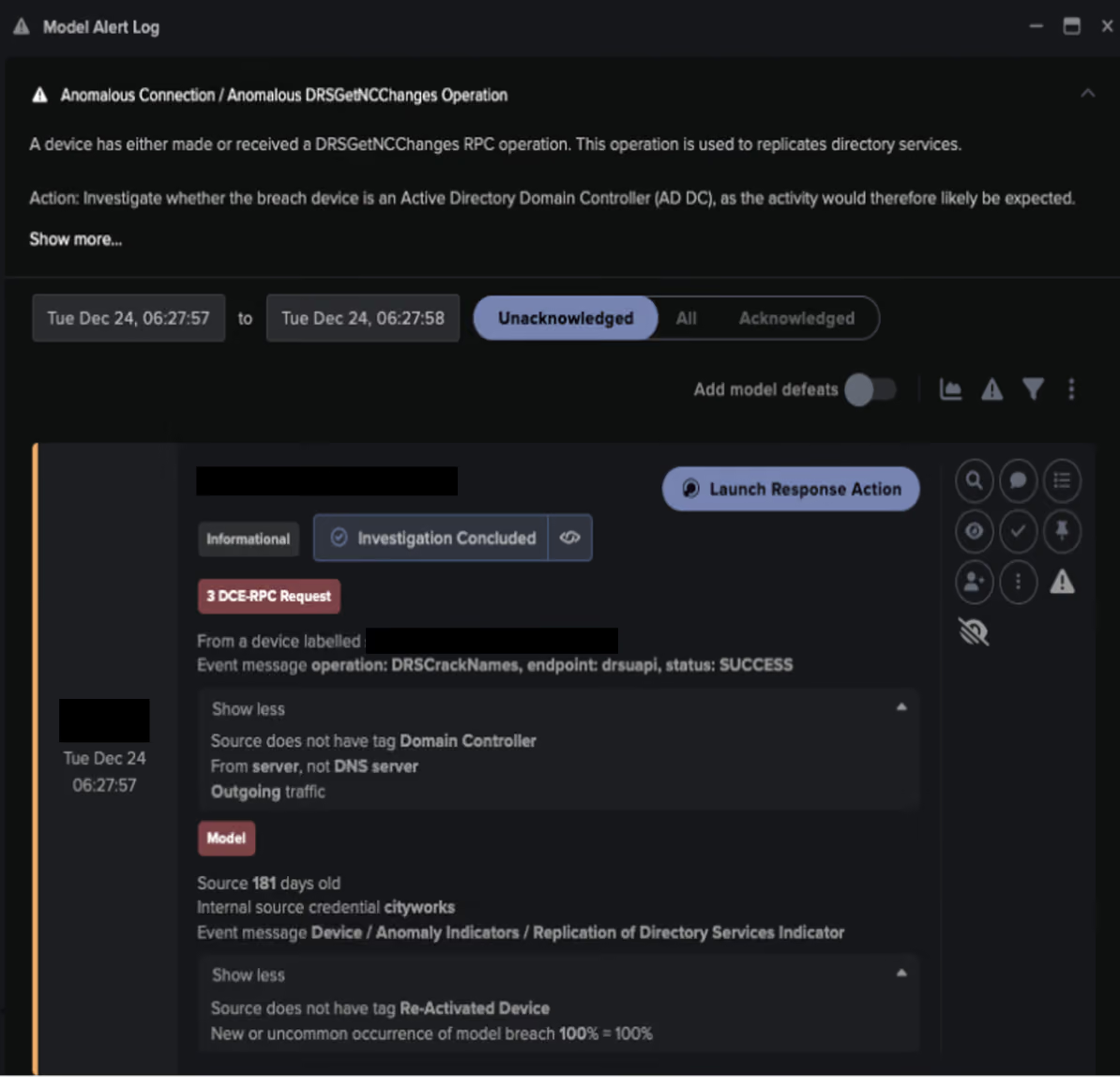
Throughout 2025 and 2026, Darktrace has continued to observe the value of anomaly-based detections across a range of incidents.
Identity is the real control plane
The second shift is that identity has replaced perimeter as the primary control plane. As Darktrace’s Annual Threat Report 2026 illustrated, identity remains the main challenge in defending against modern intrusions. A clear example is the Adversary-in-the-Middle (AiTM) case published by Darktrace in December 2025. A phishing email led to the compromise of an Office 365 account. Session hijacking bypassed multi-factor authentication (MFA), and the compromised account was used for follow-on phishing and persistence activities including the creation of malicious email rules.
Every step in that sequence mattered. A successful login alone does not prove legitimacy. An inbox rule, on its own, may not appear catastrophic. Mail activity, viewed in isolation, may seem operationally normal. But the behavioral chain tells a different story: credential theft, token abuse, persistence, and onward compromise through a trusted identity.
This is why the question is no longer “Did the user authenticate successfully”. The more important question is, “Does this identity action make sense right now, in this context, given what came before it?” The AiTM case shows how identity can be compromised. In practice, however, attacks rarely remained confined to identity alone.
In another Darktrace case, a compromised SaaS account triggered activity across the email, SaaS, and network layers, including inbox rule changes, phishing propagation, and connections to suspicious infrastructure. Viewed in isolation, none of these events were decisive. Together, however, they formed a behavioral sequence that revealed the intrusion, with the full attack story automatically correlated and surfaced to defenders by Darktrace’s Cyber AI Analyst.
AI accelerates the threat
The third shift is the one many teams still underestimate: trusted tooling, integrations, and AI agent-like systems can create actions that appear legitimate but are strategically dangerous.
The shift becomes clearer when examining how governments are now framing AI risk. In 2026, guidance published by CISA, UK’s National Cyber Security Centre (NCSC) and Five Eyes partners warned that agentic systems expand attack surfaces, accumulate privilege, and can behave in ways that are difficult to predict or explain [1]. The advice is simple: assume unexpected behavior and design controls around it.
The real risk is not AI usage. It is unknown autonomy: systems with credentials, data access, and action paths that can execute workflow steps without sufficient behavioral validation, traceability, or human oversight. Darktrace’s Model Context Protocol (MCP) risk analysis provides a useful framework for understanding this challenge. Over-privileged agents, content injection, and tool abuse become high-consequence risks when connected systems can dynamically retrieve data, execute actions, and communicate externally.
Whether security teams like it or not, AI is already in the enterprise. It will help drive innovation, but it will also be abused, whether accidentally or maliciously. In each of the cases below, AI either scaled the attacker, built the tooling, or existed within the environment as something to exploit or misuse.
1. AI as an Attack Multiplier
In one campaign targeting Mexican government entities, a single operator used commercial AI platforms to generate exploits, automate reconnaissance, and process large volumes of data, compressing work that would traditionally have required an entire team into a single workflow [2].
Darktrace is also observing this trend further down the stack. In one case, Darktrace identified AI-generated malware exploiting React2Shell, where an attacker used a Large Language Model (LLM) to produce working exploit code and deploy it at scale.
[darktrace.com], [darktrace.com]
2. AI as an Attack Surface
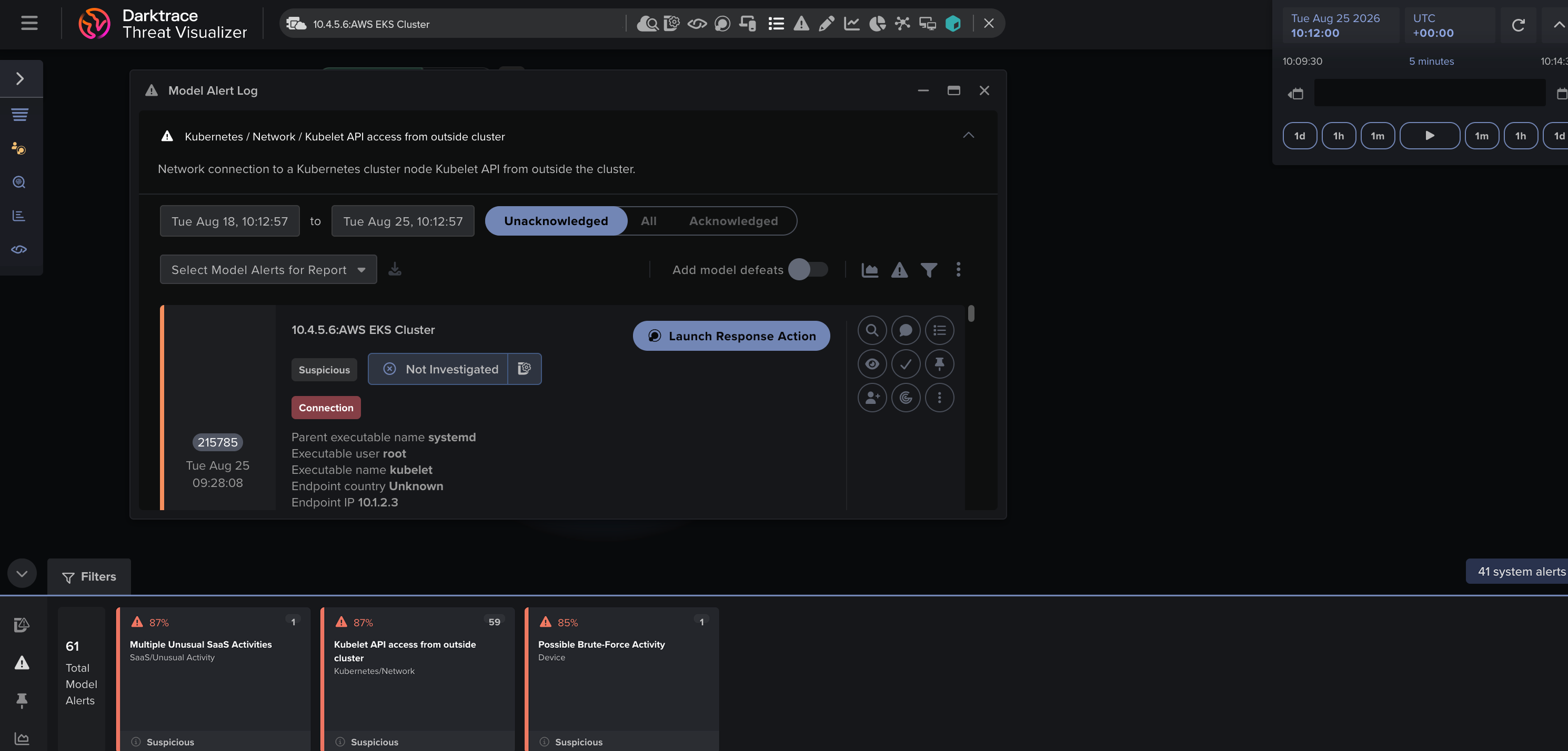
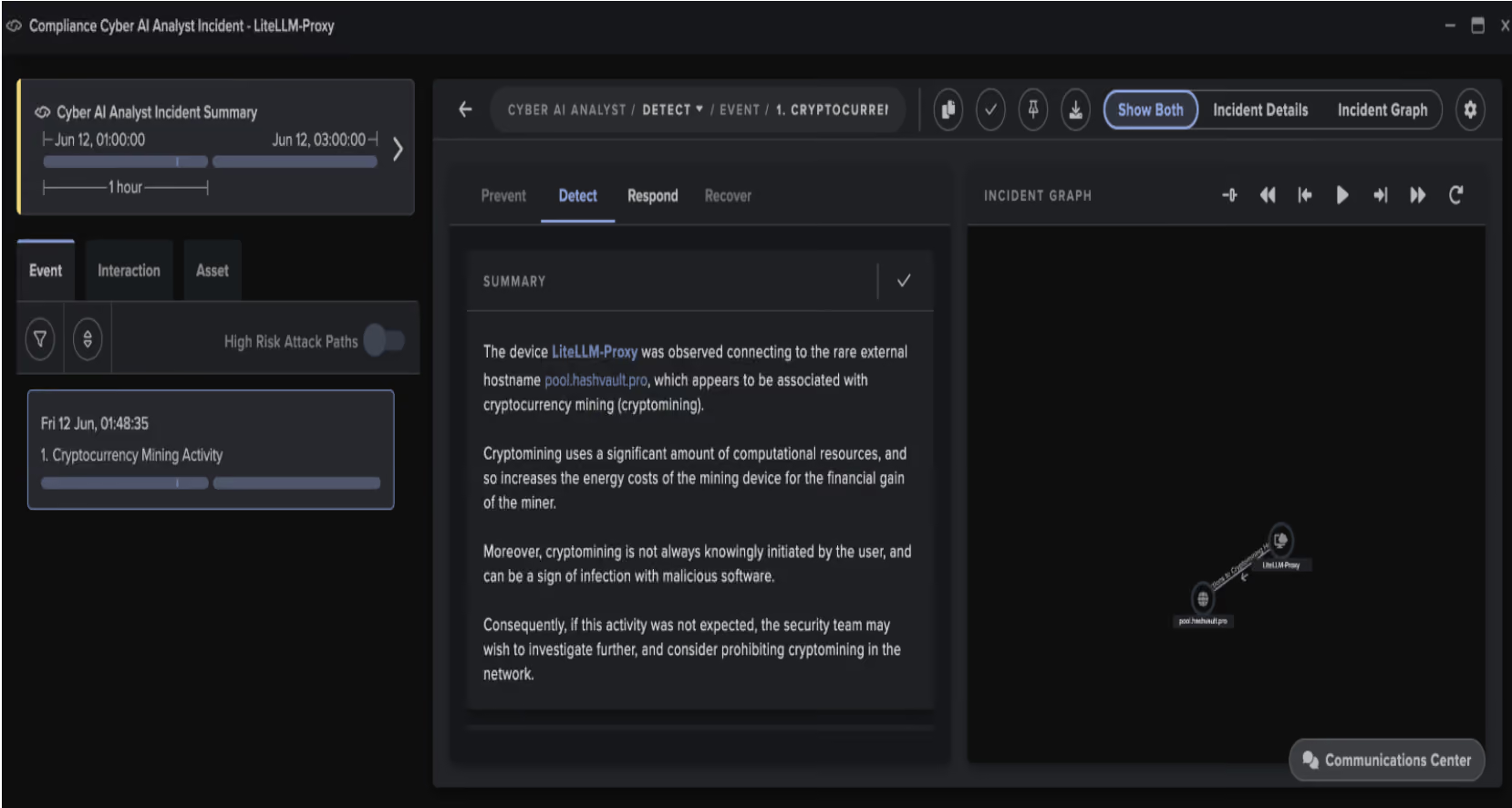
Attempted AI exploitation is now appearing within customer environments. In one case involving an automation technology manufacturer, a compromised LLM proxy was seemingly used as a stepping stone to access additional AI services. When that attempt failed, the attacker pivoted to cryptomining.
What is clear is that the AI layer has already become an asset worth probing, exploiting, and pivoting through. It is also clear that defenders benefit from rapidly understanding how these activities connect. In this case, Cyber AI Analyst automatically pieced together the intrusion, while Darktrace’s Managed Threat Detection service alerted to the customer, enabling the activity to be contained before it could progress further.
AI as a trusted but dangerous actor
This does not require a cinematic vision of “rogue AI.” The Salesloft incident provides a more grounded example, where AI and automation operate with legitimate access but served malicious intent. In that case, attackers abused compromised OAuth tokens associated with the Drift AI chat agent to export significant volumes of data from Salesforce environments.
The activity resembled legitimate API usage and relied on trusted SaaS integrations rather than malware or other obvious signs of intrusion. That is precisely the challenge. Traditional security controls are good at detecting forced entry, but far less effective when a trusted application integration behaves in a way that is technically permitted yet operationally harmful.
In these scenarios, the security challenge shifts from validating access to validating behavior.
This is what that looks like in practice: AI-linked identities executing legitimate actions that require behavioral validation rather than access validation.
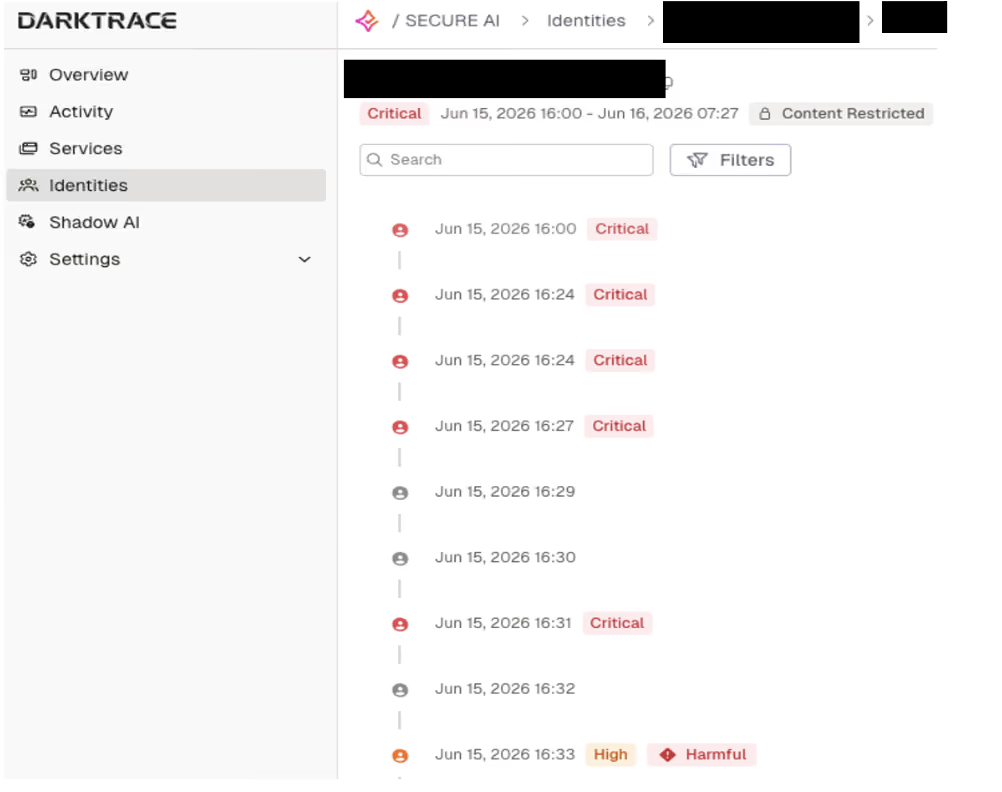
Early observations from Darktrace / SECURE AI deployments reinforce this reality. Across Darktrace's observed fleet, AI service detections per deployment increased 13% during the first half of 2026, reaching over 16 million detections overall. The typical organisation now interacts with seven different AI providers, evidence that AI is no longer operating at the edges of the enterprise. It is increasingly woven into day-to-day business activity.
The most common risks are not compromised models or advanced AI attacks. Instead, they stem from employees and business functions exposing sensitive information through entirely legitimate-looking interactions. Darktrace has observed repeated submission of personally identifiable information (PII), tax information, identification documents, and medical data into LLM prompts, alongside widespread use of unsanctioned (shadow) AI services and growing AI activity from mobile devices.
For defenders, the challenge is increasingly one of context: understanding when legitimate business use crosses into material risk, while preserving privacy and user trust.
Conclusion
Across all three shifts, the pattern is the same: behavior precedes understanding. Security teams are not losing because adversaries have become invisible. An increasingly outdated security model assumes that malicious activity will reveal itself cleanly and early. It no longer does.
In 2026 and beyond, defenders win by understanding behavioral sequences, continuously validating trust, and acting before certainty becomes hindsight. That is security after signatures. That is security in the AI era.
Credit to: Daniel Levy, Threat Hunting Data Scientist
Edited by: Ryan Traill, Content Manager
References
[2]https://www.latimes.com/business/story/2026-02-26/hacker-used-anthropics-claude-ai-to-steal-mexican-government-data



.jpeg)