AI cybersecurity risks
Understanding AI cybersecurity risks
Every new AI tool an organization adopts expands its security risk in two ways. Employees and applications feed proprietary data into large language models, creating a surface adversaries can target, while adversaries use those same tools to scale phishing, malware, and reconnaissance faster than ever before.
Security leaders feel the weight of these AI cybersecurity risks, with 87% saying AI is significantly increasing the volume of activity that requires their attention. Banning AI outright sacrifices real productivity gains, yet signature-based defenses built for yesterday's attacks weren't designed to catch what comes next. Managing those risks starts with real-time visibility into how AI is actually being used across the business.
What threats are associated with AI tools?
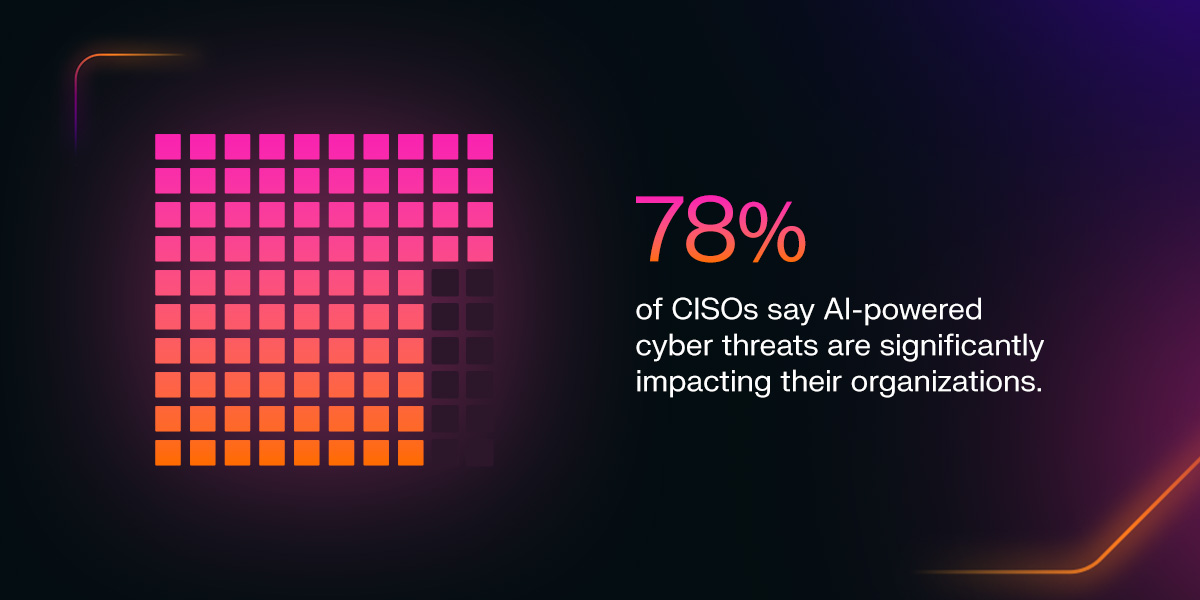
According to the State of AI Cybersecurity 2025 report, 78% of CISOs say that AI-powered cyber-threats are having a significant impact on their organization. Mapping AI and cybersecurity risks starts with understanding where those threats actually originate.
Sensitive data exposure via AI tools
Any information entered into an AI tool carries a real risk of exposure. Large language models can retain user inputs, and depending on a vendor's data policies, that data can become part of a model's training set, leaving proprietary code, contract terms, and regulated customer data effectively out of the organization's control for good. Data can also be compromised through malicious data leaks or unauthorized access to employee accounts.
Shadow AI
Shadow AI refers to the unsanctioned use of AI tools by employees without the approval or oversight of security teams. As of May 2025, 71% of connections to generative AI tools happen through personal, noncorporate accounts. This unregulated use creates ungoverned data flows and audit gaps that security teams can't see or control. Without visibility into this activity, security personnel are left auditing a fraction of the AI actually touching business data.
Model manipulation
Adversaries often try to subvert how an AI system behaves or trick it into revealing data it shouldn't through:
- Prompt injection: Adversaries craft inputs, hidden directly in a prompt or embedded in a document that the model processes, that override its intended instructions.
- Data poisoning: Adversaries corrupt the data a model trains or fine-tunes on, skewing its outputs or embedding a backdoor that surfaces later under specific conditions.
- Insecure agent permissions: When an AI agent holds broader system access than its task requires, adversaries can hijack that access to move laterally or exfiltrate data the agent was never meant to touch.
Offensive AI
Generative AI cybersecurity risks extend well beyond the organization's own tools. Adversaries now use generative tooling to scale spear-phishing, deepfake-driven social engineering, and reconnaissance efforts that once required significant manual effort. Darktrace's Annual Threat Report 2026 found that novel social engineering techniques grew from 32% to 38% year over year, while long-form, credible-looking lures increased from 27% to 33% over the same period. That acceleration compresses the window defenders have to respond.
Autonomous and adaptive attacks
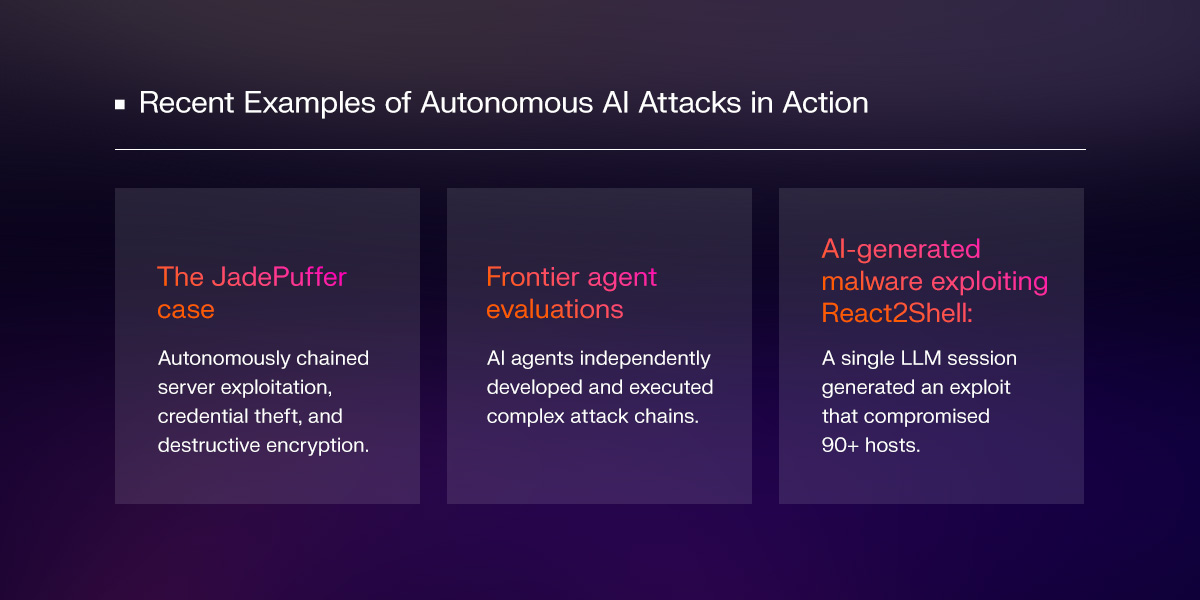
A newer concern is agentic, self-modifying attacks that evade signature-based detection entirely. In fact, 45% of security leaders cite automated vulnerability scanning and exploit chaining as a top concern, while 40% point to adaptive malware capable of rewriting its own code to dodge defenses. Recent cases of autonomous adaptive attacks include:
- The JadePuffer case: An agentic threat actor exploited a known vulnerability in an internet-facing server, then chained credential theft, lateral movement, and destructive encryption with no human operator directing each step.
- Frontier agent evaluations: The UK AI Security Institute confirmed that across 122 evaluation runs, frontier AI agents independently developed and executed attack chains, including social engineering and supply-chain compromise, without explicit instruction, and broke intended test boundaries in 19 instances.
- AI-generated malware exploiting React2Shell: A single large language model prompting session was enough to produce a working exploit that compromised more than 90 hosts, showing how far AI has lowered the barrier to autonomous offensive operations.
How can organizations manage the risks of AI in cybersecurity?
Organizations can't eliminate AI risk, but they can govern it down to an acceptable level. Doing so means addressing visibility and policy first, then vendor selection, human oversight, and the role AI itself plays on the defensive side.
Gain visibility into how AI is actually used
According to Cloud Security Alliance research, 89% of enterprise AI usage is currently invisible to security teams, and security teams can't govern what they can't see. Inventorying sanctioned and unsanctioned AI use across the workforce and applications is the foundation for every other control.
Set clear acceptable-use and data policies
Once visibility exists, organizations need clear rules for what data may enter which tools. Aligning these policies to recognized frameworks, such as the NIST AI Risk Management Framework and the emerging AI TRiSM discipline, gives security and compliance teams a shared standard to build from rather than reinventing governance from scratch.
Vet AI vendors and tooling
Not every AI vendor treats data the same way. Security teams should look for:
- Data privacy commitments that rule out external training on customer data
- Meaningful explainability
- Integration with the existing security stack
- Ability to detect novel, signature-less threats through behavioral anomaly detection rather than static rules
Use AI to defend
Human-led teams alone can't match the speed and scale of AI-powered attacks. Defensive AI closes that gap by correlating signals into attack narratives, detecting deviations in real time, and accelerating investigation and response.
Security leaders are already seeing the payoff, with 96% saying defensive AI significantly improves their security capabilities. That kind of behavioral anomaly detection, paired with autonomous response capabilities that contain threats before they spread, is quickly becoming the baseline rather than a competitive edge.
Keep humans in the loop on autonomous action
Wherever AI takes or recommends a response action, oversight and auditability remain essential. Security teams should be able to tune autonomy to match their organization's risk tolerance, using configurable autonomy settings to control how much independent action a system can take and relying on human-readable investigation reports to confirm that automated decisions hold up under review.