Collaboration tool security
What is collaboration tool security?
Collaboration tools like Microsoft Teams, Slack, and Zoom have become the operational backbone of today's enterprises. As hybrid work models cement these platforms as essential infrastructure, they've also emerged as a concentrated attack surface. Adversaries recognize that these tools house intellectual property, customer data, and sensitive business communications, making them high-value targets.
The challenge extends beyond external threats. Internal users operating in fast-paced environments can inadvertently expose data through misconfigurations or careless sharing practices. For organizations navigating this landscape, collaboration tool security isn't merely an IT concern. It's a business imperative that requires understanding both technological vulnerabilities and human behavior patterns within these platforms.
Collaboration tool security encompasses the strategies, processes, and technologies used to protect data, conversations, and user accounts within collaboration platforms. Unlike network security or traditional email protection, securing collaboration tools requires addressing the unique characteristics of these environments. These platforms handle real-time, often unstructured data flows where users share files, engage in rapid-fire conversations, and integrate third-party applications with minimal friction.
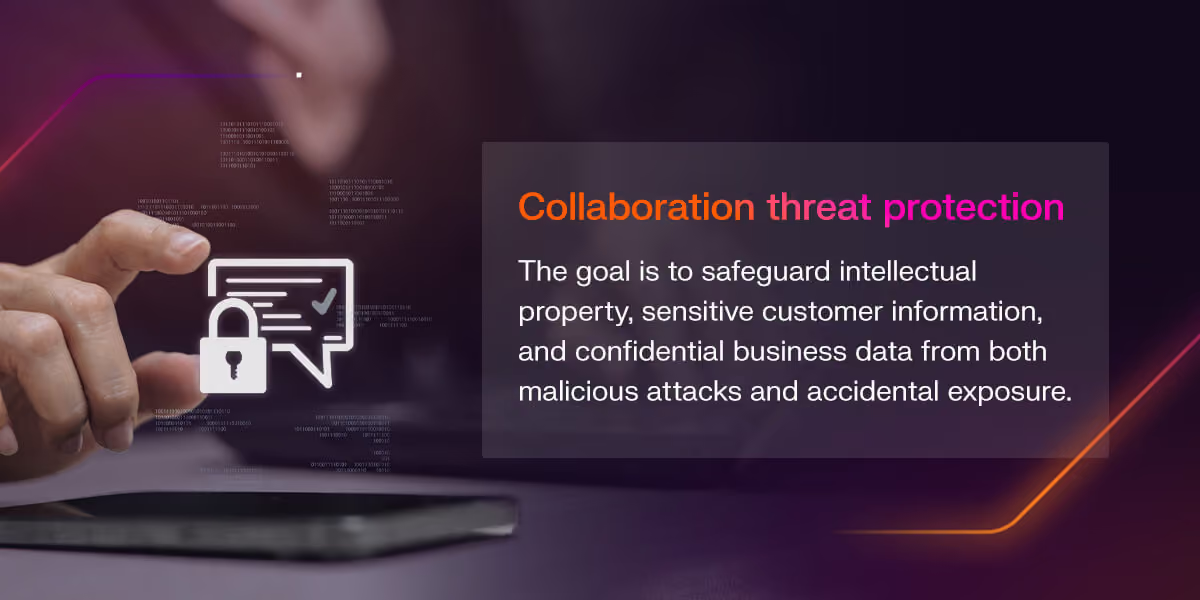
The goal of collaboration threat protection is to safeguard intellectual property, sensitive customer information, and confidential business data from both malicious attacks and accidental exposure. Effective security in this context demands a focus on user behavior. Collaboration tools integrate deeply into daily workflows, creating an environment where human error becomes as significant a risk factor as deliberate threat actor activity.
Understanding how to secure online collaboration tools means recognizing that perimeter-based defenses prove inadequate when the collaboration platform itself becomes the perimeter.
Common risks and vulnerabilities in collaboration tools
Organizations face a growing array of risks as collaboration platforms become more central to business operations. These risks span technical vulnerabilities, human factors, and the inherent complexity of collaborative environments.
Data leakage and accidental exposure
Fast-paced collaboration environments create conditions where employees can unintentionally share sensitive information. The frequent use of hybrid work models has amplified this risk, with employees now accessing sensitive data from multiple locations and devices while maintaining the same communication patterns.
Common accidental exposure scenarios include:
- Uploading confidential documents to public channels.
- Granting external access to internal-only files.
- Including contractors in conversations containing restricted information.
The speed at which teams communicate often outpaces security awareness, particularly when employees juggle multiple conversations across different platforms simultaneously.
Insider threats
Insider threats present a dual challenge. Malicious insiders can deliberately exfiltrate data through collaboration tools, using legitimate access to systematically extract valuable information. These adversaries understand which data holds value and how to move it without triggering obvious alarms.
Conversely, negligent employees pose an equally significant risk through carelessness rather than intent. A team member might reuse weak passwords, fall victim to social engineering, or ignore security protocols when rushing to meet deadlines. Both scenarios exploit the trust inherently built into collaboration platforms.
Malware and ransomware propagation
Adversaries leverage collaboration tools to distribute malware with higher success rates than conventional phishing campaigns. A compromised account can send malicious files or links that appear to originate from a trusted colleague. The rise of AI-powered phishing tools has made these attacks more convincing and harder to distinguish from legitimate communications.
Recipients accustomed to rapidly clicking through shared resources during normal workflow may not scrutinize a link from a known contact. This attack vector is particularly effective because collaboration platforms encourage the immediate sharing and opening of files, creating an environment where malicious payloads spread quickly through an organization.
Account takeover and impersonation
Once adversaries gain access to a legitimate user account through credential theft or phishing, they gain full privileges to:
- Impersonate the account holder to launch further attacks.
- Manipulate conversations to gather intelligence.
- Use the compromised account as a launching point for lateral movement across systems.
The extended time an attacker can operate undetected within a collaboration platform amplifies the potential damage, particularly when the compromised account belongs to someone with elevated access rights.
Third-party app and integration risks
The proliferation of shadow IT, where employees adopt unapproved third-party applications and integrations, introduces significant vulnerabilities, as these tools may:
- Request excessive permissions beyond operational needs.
- Lack robust security controls.
- Inadvertently expose organizational data to external servers.
An employee might integrate a productivity tool that syncs sensitive conversations to an external server, or grant a third-party bot access to channels containing confidential information. The challenge intensifies as organizations struggle to maintain visibility into which applications connect to their collaboration platforms and what data those connections reveal.
How AI helps secure collaboration tools
Traditional rule-based security approaches struggle to address collaboration tool risks because these platforms operate on unstructured data flows where legitimate sharing happens constantly. AI-driven security provides a different approach by learning what normal looks like for each user and detecting subtle deviations that indicate compromise or risk. With proper implementation, the system adapts to organizational patterns while maintaining security team oversight, allowing AI to enhance rather than replace human judgment.
Real-time anomaly detection
AI can identify deviations from established behavior patterns as they occur to detect anomalies in real time, including when:
- An employee suddenly accesses and shares an unusual volume of files.
- A user account exhibits activity from an unexpected geographic location.
- Conversation patterns shift in ways that suggest account compromise.
This capability extends beyond simple threshold monitoring to understand the context of user behavior. The system recognizes that a sales representative accessing customer data before a major presentation differs fundamentally from the same user exfiltrating similar data at 3 a.m. on a weekend.
Autonomous response and threat containment
Organizations can benefit when AI takes immediate action to contain emerging attacks without human intervention. Autonomous response capabilities allow the system to take targeted actions such as:
- Temporarily restricting a user's file-sharing abilities when unusual sharing patterns emerge.
- Quarantining suspicious links before users can click them.
- Locking a compromised account to prevent further damage.
These interventions occur proportionally to the threat level, ensuring that normal business operations continue while genuine risks receive immediate attention. With appropriate oversight, enterprises can secure collaboration tools more effectively when security systems respond at machine speed to contain threats while security teams focus on strategic decisions.
Proactive threat prevention
By understanding the nuances of human communication patterns and normal business processes, AI moves from reactive defense to proactive threat identification. The system detects and flags potential attacks before they materialize into actual breaches. How organizations secure collaboration tools increasingly depends on this predictive capability rather than responding after an attack succeeds.
When properly configured, this approach to collaboration threat protection means learning the unique behaviors of each user and understanding what constitutes normal activity for different roles within the organization. When AI recognizes patterns that historically precede security incidents, it can alert security teams or take preventive action before adversaries complete their objectives.
Secure your collaboration tools with Darktrace
The platforms driving enterprise collaboration also introduce significant risk. Conventional security measures struggle to address the dynamic, behavior-driven threats targeting these tools. Protecting your organization requires proactive, AI-powered security that understands normal user patterns and can detect subtle deviations in real time.
Darktrace's multi-layered AI provides comprehensive threat protection for collaboration platforms, enabling teams to work freely without compromising security. Darktrace / EMAIL extends beyond the inbox to secure messaging and collaboration apps, using behavioral analysis to identify threats before they escalate. The platform's autonomous response capabilities contain risks as they emerge, minimizing disruption while maintaining protection.
Contact us for more information on securing your collaboration tools with Darktrace / EMAIL.